NASA Image of the Day for Jan. 1

 Festival of Lights

Festival of Lights

WISE, NASA’s Wide-field Infrared Survey Explorer, has a new view of Barnard 3, or IRAS Ring G159.6-18.5, that is awash in bright green and red dust clouds. Interstellar clouds like these are stellar nurseries, where baby stars are being born.

The green ring is made of tiny particles of warm dust whose composition is very similar to smog found here on Earth. The red cloud in the center is most likely made of dust that is more metallic and cooler than the surrounding regions. HD 278942, the bright star in the middle of the red cloud, is so luminous that it is the likely cause of the surrounding ring’s glow. The bright greenish-yellow region left of center is similar to the ring, though more dense. The bluish-white stars scattered throughout are stars located both in front of, and behind, the nebula.

Regions similar to this nebula are found near the band of the Milky Way galaxy in the night sky. This nebulas is slightly off this band, near the boundary between the constellations of Perseus and Taurus, but at a relatively close distance of only about 1,000 light-years, the cloud is a still part of our Milky Way.

The colors used in this image represent specific wavelengths of infrared light. Blue and cyan (blue-green) represent light emitted at wavelengths of 3.4 and 4.6 microns, which is predominantly from stars. Green and red represent light from 12 and 22 microns, respectively, which is mostly emitted by dust.

Image Credit: NASA/JPL-Caltech/UCLA

Astronomy Picture of the Day for Dec. 30th

Astronomy Picture of the Day

Discover the cosmos!Each day a different image or photograph of our fascinating universe is featured, along with a brief explanation written by a professional astronomer.

2011 December 30
See Explanation.  Clicking on the picture will download the highest resolution version available.

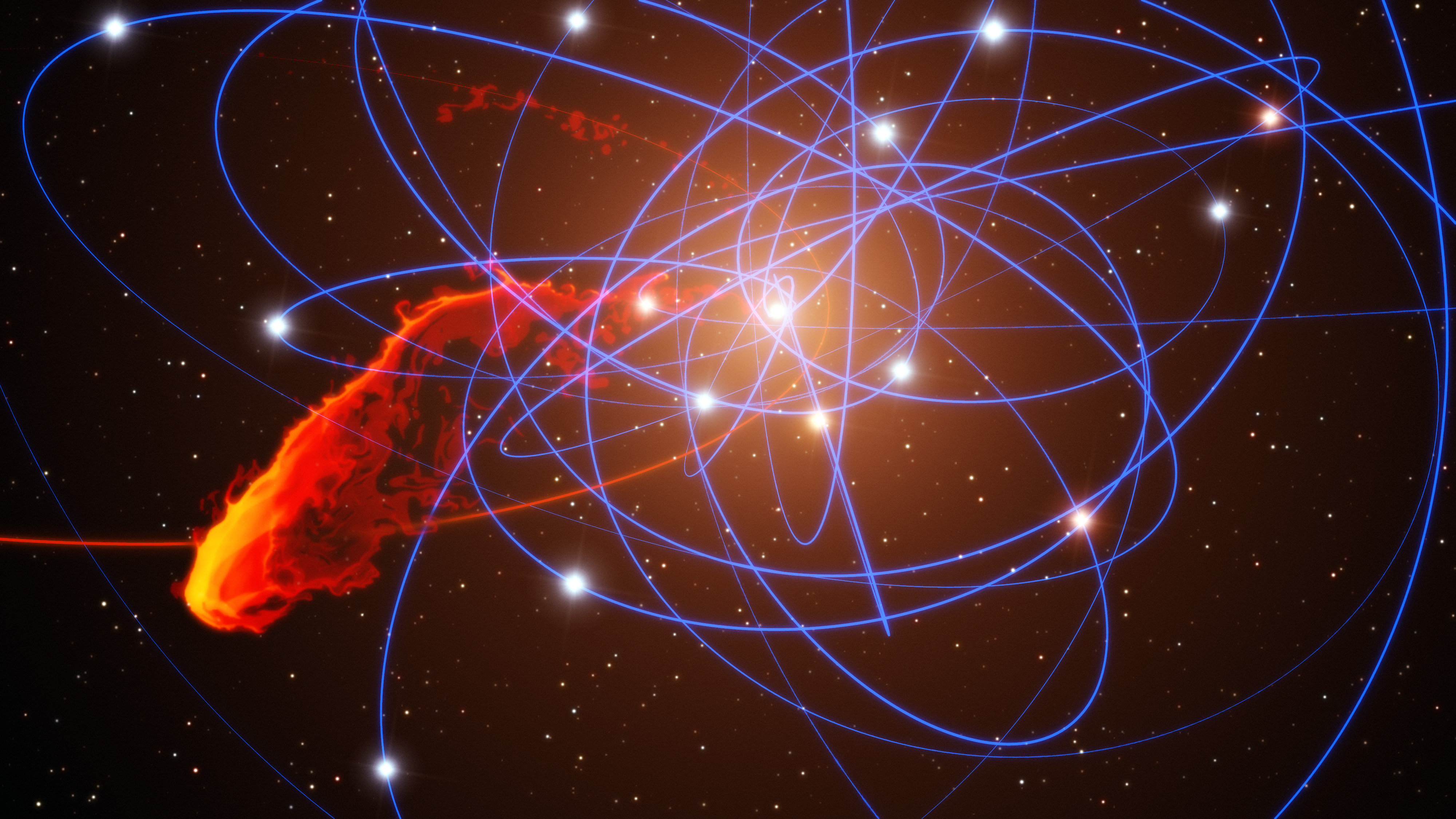
The Diner at the Center of the Galaxy
Illustration Credit: ESO/MPE/Marc Schartmann  


Explanation: The monster at the center of our Galaxy is about to get fed. Recent observations by the Very Large Telescopes indicate that a cloud of gas will venture too close to the supermassive black hole at the Galactic center. The gas cloud is being disrupted, stretched out, heated up, and some of it is expected to fall into the black hole over the next two years. In this artist’s illustration, what remains of the blob after a close pass to the black hole is shown in red and yellow, arching out from the gravitational death trap to its right. The cloud’s orbit is shown in red, while the orbits of central stars are shown in blue. The infalling nebula is estimated to contain several times the mass of our Earth, while the central black hole, thought to correspond to the radio source Sagittarius A*, contains about four million times the mass of our Sun. Once it falls in, nothing is expected to be heard from the doomed gas ever again.

Hubble Image Gallery for December 27th

Spiral Galaxy M100

An image of the grand design spiral galaxy M100 obtained with the second generation Wide Field and Planetary Camera (WFPC-2), newly installed in the Hubble Space Telescope. Though the galaxy lies several tens of millions of light-years away, modified optics incorporated within the WFPC-2 allow Hubble to view M100 with a level of clarity and sensitivity previously possible only for the very few nearby galaxies that compose our “Local Group.” Just as one does not learn about the diversity of mankind by conversing only with your next door neighbor, astronomers must study many galaxies in a host of different environments if they are to come to understand how our own galaxy, out star, and our earth came to be. By expanding the region of the universe that can be studied in such detail a thousand fold, the WFPC-2 will help the Hubble Space Telescope to fulfill this mission.

Astronomy Picture of the Day for December 23rd

Astronomy Picture of the Day

Discover the cosmos!Each day a different image or photograph of our fascinating universe is featured, along with a brief explanation written by a professional astronomer.

2011 December 23
See Explanation.  Clicking on the picture will download the highest resolution version available.

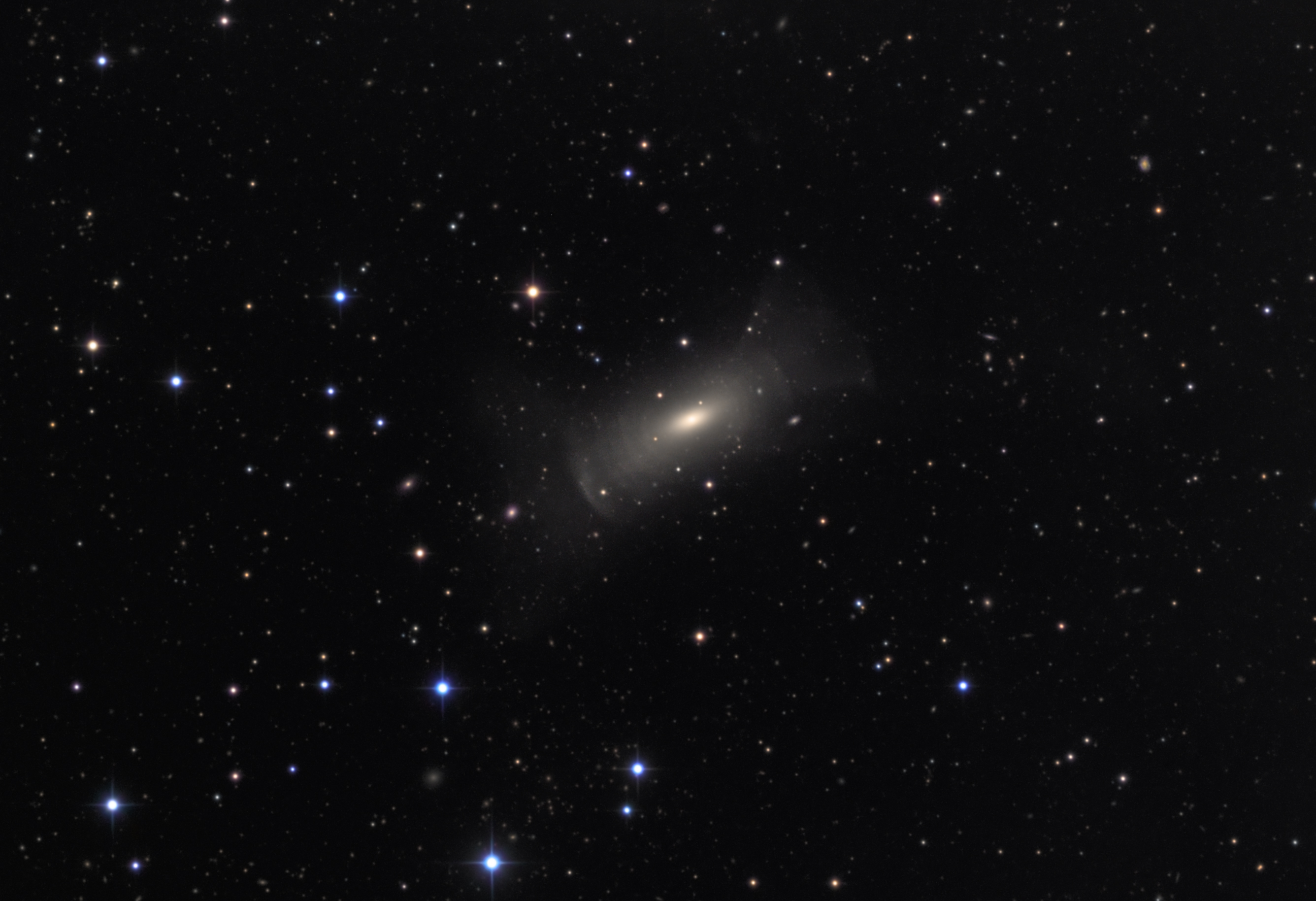
Shell Galaxy NGC 7600
Image Credit & Copyright: Ken Crawford (Rancho Del Sol Observatory)
Collaboration: Andrew Cooper (MPA), Carlos Frenk, John Helly, Shaun Cole (Institute for Computational Cosmology),David Martinez-Delgado (MPIA), Star Stream Pilot Survey Group 

Explanation: Similar in size to the Milky Way, elliptical galaxy NGC 7600 is about 160 million light-years distant. In this deep image, spanning about 1/2 degree on the sky toward the constellation Aquarius, NGC 7600 sports a remarkable outer halo of nested shells and broad circumgalactic structures. The tantalizing features can be explained by the accretion of dark matter and stars on a cosmic timescale. In fact, a movie generated by simulating galaxy formation using a cosmological model with cold dark matter for the halos of merging galaxies reproduces the appearance of NGC 7600 in amazing detail. The remarkable simulation movie is available here on Vimeo and here in other formats. It presents compelling evidence that detailed features of galaxy mergers observed with small, wide field telescopes on planet Earth, are natural consequences of galaxy formation and fundamental properties of dark matter.

Free Will And Reincarnation: Who Ever Said Anything About Earth?

Free Will And Reincarnation: Who Ever Said Anything About Earth?

Author: Zula

When the idea of reincarnation versus free will is addressed, nonbelievers often ask, “Why would anyone want to come back to this miserable dirtball of a planet, with all the wars and famine and violence here?” or variations of the question along those lines. I counter this question with yet another question: who says we must return to Earth?

Consider for a moment, if you will, the immensity of the universe. In our galaxy alone there are over two hundred billion stars, and Sol, our beloved sun, is only one little star in this relatively dense clump of cosmic matter. Scientists also estimate that there are one hundred billion galaxies in the entire universe. If one assumes that the Milky Way is an average-sized galaxy, as most astronomers do, that means that there are about 2 x 10²² stars in the entire universe. That is a two with twenty-two zeroes after it. I don’t even know what to call a number that big! How can anyone honestly believe that, of all those stars and all the planets orbiting those stars, Earth is the only one with life on it? The chances of such a thing are just too slim. In my opinion, it is the epitome of arrogance, ignorance, or both to claim that we have the sole privilege of life in this vast universe.

I think it is a general consensus that the spiritual realm is not bound by physical ideas like “distance,” so it is just as easy for a spirit to be on one side of the universe as the other. If that is the case, then when a soul is ready to return for another foray into the physical world, it is just as likely to end up on Earth as it is on Xar*** VII or some equally alien planet – assuming, of course, that a soul does not have a particularly strong attachment to one planet or another and chooses to return to that same planet again and again.

And even then, no one ever said we must be reincarnated in the same dimension. There is a relatively new way of thinking called the quantum theory. One aspect of this theory is called the multiverse theory, which states that every time there is a variable, the universe splits so that each possibility is realized in a different dimension. Now considering that there are variables all the way down to the atomic level, such as where an electron will be at any given point in an electron cloud; that means there are essentially an infinite number of parallel universes coexisting side by side.

Since this division of realities has gone on since the beginning of time, this means that there are universes completely different from our own. There is a universe where Hitler won World War II. There is a universe where the Aztecs are the dominant culture on the planet. There is a universe where dinosaurs never went extinct. There is a universe where Earth was never formed – this can go on and on ad infinitum. In the same way that psychic beings are not bound by distance, I believe that they are not constrained by the concept of reality as we know it. After all, if they have no bodies, why should they be stuck to move in four dimensions – back and forth, left and right, up and down, and forward (and possibly backward) in time – like the rest of us?

Of course, this is assuming that the multiverse theory is true. This, unfortunately, has not quite been determined yet. However, the fact still remains that the number of possibly inhabited planets is huge, and the number of life forms in the universe is even bigger.

Now, I will freely admit that I am a neophyte – I have known about quantum physics longer than I have known about Paganism. I would not be surprised if I made some glaring mistakes on the whole concept of reincarnation, free will, the gods and the spirit world, et cetera. If I have, I apologize for any offence right now. However, from what I know and what I have experienced, it makes sense when one thinks about it.

If one were to be reincarnated as all the types creatures on Earth, one would still get a rather limited experience. After all, all living things that we know of are carbon-based, oxygen-breathing (or carbon dioxide-breathing, in the case of plants), with only five or so senses of varying degrees of sharpness. Our mental capacities are also somewhat limited, regardless of what form we assume. Imagine how different a perspective one would get as, say, a creature made of pure energy that glided serenely through space, a species that had mastered time travel, or even a super-intelligent shade of blue! The lives of these creatures must be completely different than anything that we can possibly experience on Earth; I doubt anyone could even imagine it with any sort of accuracy.

The purpose of reincarnation, if I understand correctly, is to allow a soul to gain wisdom from its physical experiences. The only way to gain true wisdom, in my opinion, is to come in contact with as many different ideas, sensations, etc. as possible. Only then can one develop a truly informed philosophy. Considering the vastness of the universe, and considering that Earth and what we experience here is just a tiny speck of all the possibilities, then the only possible way for the soul to gain true wisdom is to traverse the expanse of the universe and experience all different possible forms of life there are to be had.

With that in mind, free will takes on another level of significance. When one dies, one has the entire universe at one’s metaphysical fingertips. One can literally become anything in one’s wildest dreams. Ever wondered what it’s like to be a velociraptor? To travel through space at the speed of light? To have twelve arms? All the curiosities, all the musings that one has ever had can be answered – if one chooses to find out.

Astronomy Picture of the Day

Astronomy Picture of the Day

Discover the cosmos!Each day a different image or photograph of our fascinating universe is featured, along with a brief explanation written by a professional astronomer.

2011 November 23
See Explanation.  Clicking on the picture will download the highest resolution version available.

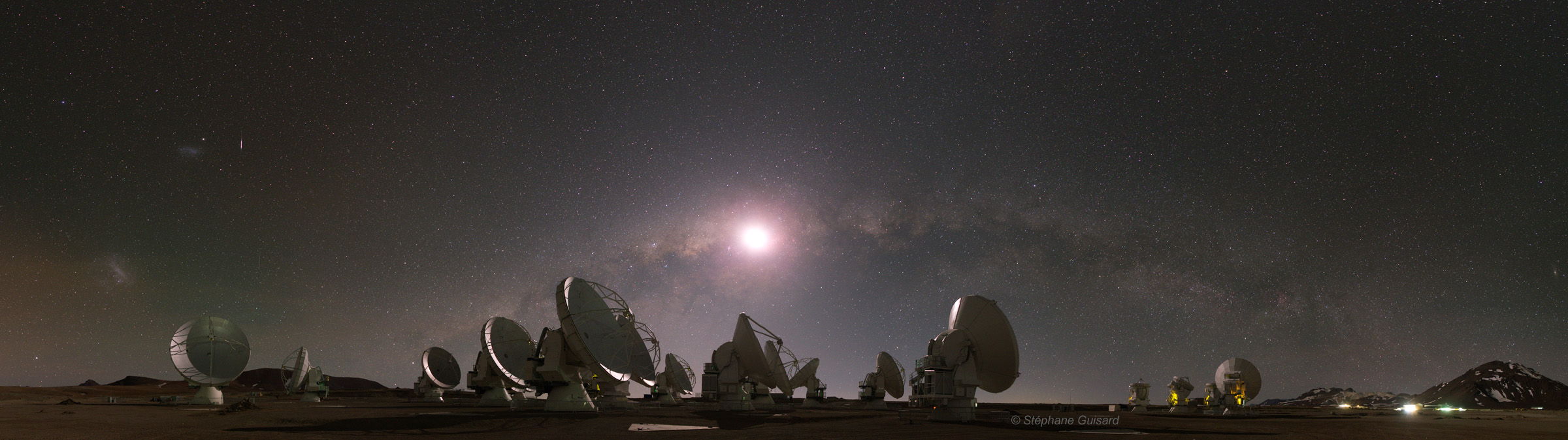
The View from Chajnantor
Image Credit & Copyright: Stéphane Guisard (Los Cielos de America), TWAN 


Explanation: From an altitude of over 5,000 meters, the night sky view from Chajnantor Plateau in the Chilean Andes is breathtaking in more ways than one. The dark site’s rarefied atmosphere, at about 50 percent sea level pressure, is also extremely dry. That makes it ideal for the Atacama Large Millimeter/submillimeter Array (ALMA) designed to explore the universe at wavelengths over 1,000 times longer than visible light. Near the center of the the panoramic scene, ALMA’s 7 and 12 meter wide dish antennas are illuminated by a young Moon nestled in the arc of the Milky Way. ALMA’s antenna configurations are intended to achieve a resolution comparable to space telescopes by operating as an interferometer. At left, a meteor’s streak and the Milky Way’s satellite galaxies, the Large (bottom) and Small Magellanic Clouds grace the night.

Astronomy Picture of the Day for November 20th

Astronomy Picture of the Day

Discover the cosmos!Each day a different image or photograph of our fascinating universe is featured, along with a brief explanation written by a professional astronomer.

2011 November 20
See Explanation.  Clicking on the picture will download the highest resolution version available.

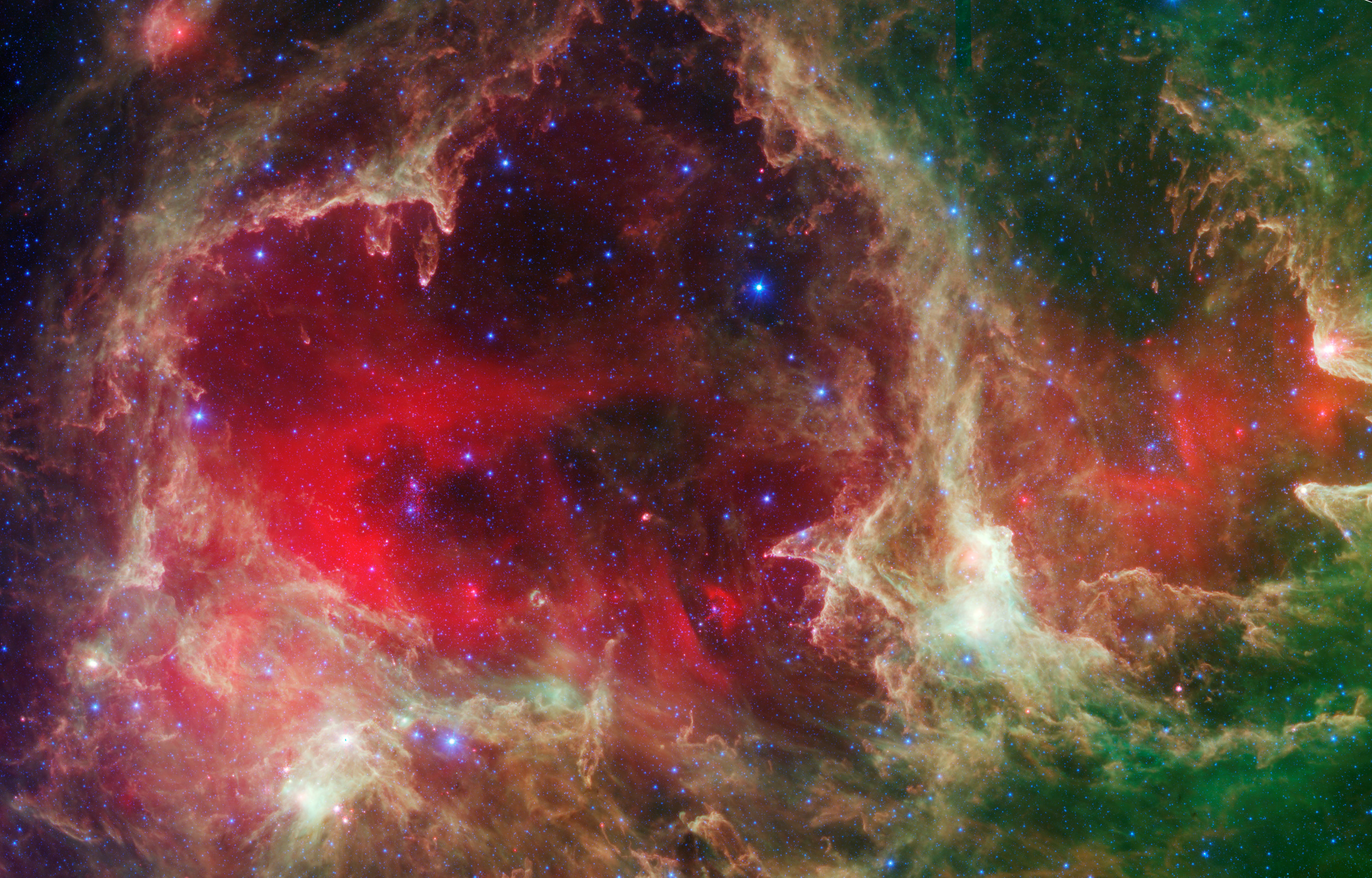
W5: Pillars of Star Formation
Image Credit & Copyright: Lori Allen, Xavier Koenig (Harvard-Smithsonian CfA) et al., JPL-Caltech, NASA  


Explanation: How do stars form? A study of star forming region W5 by the sun-orbiting Spitzer Space Telescope provides clear clues by recording that massive stars near the center of empty cavities are older than stars near the edges. A likely reason for this is that the older stars in the center are actually triggering the formation of the younger edge stars. The triggered star formation occurs when hot outflowing gas compresses cooler gas into knots dense enough to gravitationally contract into stars. Spectacular pillars, left slowly evaporating from the hot outflowing gas, provide further visual clues. In the above scientifically-colored infrared image, red indicates heated dust, while white and green indicate particularly dense gas clouds. W5 is also known as IC 1848, and together with IC 1805 form a complex region of star formation popularly dubbed the Heart and Soul Nebulas. The above image highlights a part of W5 spanning about 2,000 light years that is rich in star forming pillars. W5 lies about 6,500 light years away toward the constellation of Cassiopeia.

Astronomy Picture of the Day for November 10th

Astronomy Picture of the Day

Discover the cosmos!Each day a different image or photograph of our fascinating universe is featured, along with a brief explanation written by a professional astronomer.

2011 November 10
See Explanation.  Clicking on the picture will download the highest resolution version available.

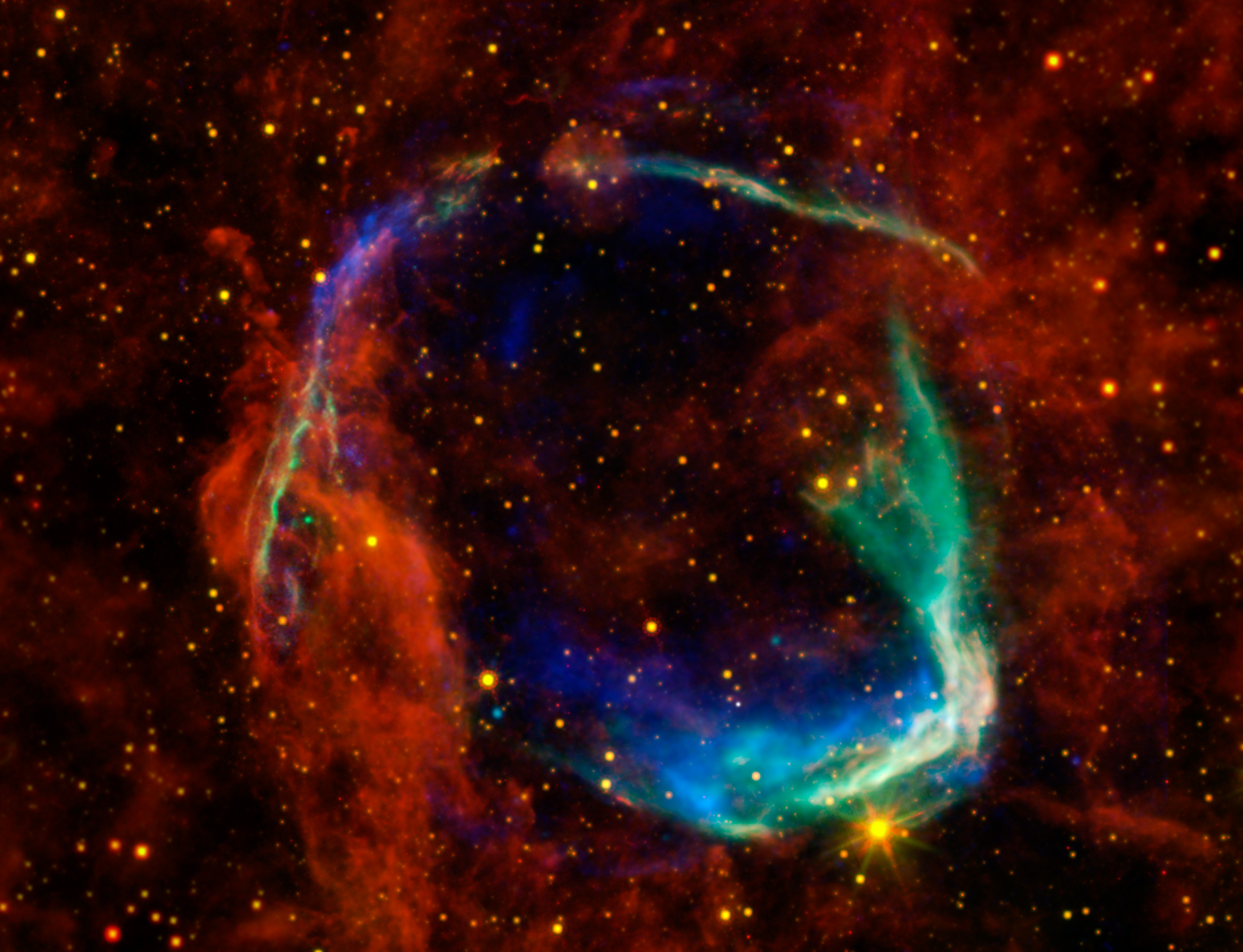
RCW 86: Historical Supernova Remnant
Credit: X-ray: XMM-Newton, Chandra / IR: WISE, Spitzer 


 Explanation: In 185 AD, Chinese astronomers recorded the appearance of a new star in the Nanmen asterism – a part of the sky identified with Alpha and Beta Centauri on modern star charts. The new star was visible for months and is thought to be the earliest recorded supernova. This multiwavelength composite image from orbiting telescopes of the 21st century, XMM-Newton and Chandra in X-rays, and Spitzer and WISE in infrared, show supernova remnant RCW 86, understood to be the remnant of that stellar explosion. The false-color view shows interstellar gas heated by the expanding supernova shock wave at X-ray energies (blue and green) and interstellar dust radiating at cooler temperatures in infrared light (yellow and red). An abundance of the element iron and lack of a neutron star or pulsar in the remnant suggest that the original supernova was Type Ia. Type Ia supernovae are thermonuclear explosions that destroy a white dwarf star as it accretes material from a companion in a binary star system. Shock velocities measured in the X-ray emitting shell and infrared dust temperatures indicate that the remnant is expanding extremely rapidly into a remarkable low density bubble created before the explosion by the white dwarf system. Near the plane of our Milky Way Galaxy, RCW 86 is about 8,200 light-years away and has an estimated radius of 50 light-years.

Astronomy Picture of the Day for October 27th

Astronomy Picture of the Day

Discover the cosmos!Each day a different image or photograph of our fascinating universe is featured, along with a brief explanation written by a professional astronomer.

2011 October 27
See Explanation.  Clicking on the picture will download the highest resolution version available.

Young Suns of NGC 7129
Image Credit & Copyright: Johannes Schedler (Panther Observatory)Explanation: Young suns still lie within dusty NGC 7129, some 3,000 light-years away toward the royal constellation Cepheus. While these stars are at a relatively tender age, only a few million years old, it is likely that our own Sun formed in a similar stellar nursery some five billion years ago. Most noticeable in the sharp image are the lovely bluish dust clouds that reflect the youthful starlight. But the compact, deep red crescent shapes are also markers of energetic, young stellar objects. Known as Herbig-Haro objects, their shape and color is characteristic of glowing hydrogen gas shocked by jets streaming away from newborn stars. Paler, extended filaments of redish emission mingling with the bluish clouds are caused by dust grains effectively converting the invisible ultraviolet starlight to visible red light through photoluminesence. Ultimately the natal gas and dust in the region will be dispersed, the stars drifting apart as the loose cluster orbits the center of the Galaxy. At the estimated distance of NGC 7129, this telescopic view spans about 40 light-years.

NASA Image of the Day for October 14th

Carina Nebula: 14,000+ Stars

The Carina Nebula is a star-forming region in the Sagittarius-Carina arm of the Milky Way that is 7,500 light years from Earth and the Chandra X-Ray Observatory has detected more than 14,000 stars in the region.

Chandra’s X-ray vision provides strong evidence that massive stars have self-destructed in this nearby star-forming region. Firstly, there is an observed deficit of bright X-ray sources in the area known as Trumpler 15, suggesting that some of the massive stars in this cluster were already destroyed in supernova explosions. Trumpler 15 is located in the northern part of the image and is one of ten star clusters in the Carina complex.

The detection of six possible neutron stars, the dense cores often left behind after stars explode in supernovas, provides additional evidence that supernova activity is increasing up in Carina. Previous observations had only detected one neutron star in Carina.

Image Credit: NASA/CXC/Penn State/L. Townsley et al.

Astronomy Picture of the Day for October 11th

Astronomy Picture of the Day

Discover the cosmos!Each day a different image or photograph of our fascinating universe is featured, along with a brief explanation written by a professional astronomer.

2011 October 11

NGC 7635: The Bubble Nebula
Image Credit & Copyright: Larry Van Vleet 


Explanation: It’s the bubble versus the cloud. NGC 7635, the Bubble Nebula, is being pushed out by the stellar wind of massive central star BD+602522. Next door, though, lives a giant molecular cloud, visible to the right. At this place in space, an irresistible force meets an immovable object in an interesting way. The cloud is able to contain the expansion of the bubble gas, but gets blasted by the hot radiation from the bubble’s central star. The radiation heats up dense regions of the molecular cloud causing it to glow. The Bubble Nebula, pictured above in scientifically mapped colors to bring up contrast, is about 10 light-years across and part of a much larger complex of stars and shells. The Bubble Nebula can be seen with a small telescope towards the constellation of the Queen of Aethiopia (Cassiopeia).

Astronomy Picture of the Day For October 10th

Astronomy Picture of the Day

Discover the cosmos! Each day a different image or photograph of our fascinating universe is featured, along with a brief explanation written by a professional astronomer.

The Milky Way in Infrared
Credit: E. L. Wright (UCLA), The COBE Project, DIRBE, NASA 

Explanation: At night, from a dark location, part of the clear sky looks milky. This unusual swath of dim light is generally visible during any month and from any location. Until the invention of the telescope, nobody really knew what the “Milky Way” was. About 300 years ago telescopes caused a startling revelation: the Milky Way was made of stars. Only 70 years ago, more powerful telescopes brought the further revelation that the Milky Way is only one galaxy among many. Now telescopes in space allow yet deeper understanding. The above picture was taken by the COBE satellite and shows the plane of our Galaxy in infrared light. The thin disk of our home spiral galaxy is clearly apparent, with stars appearing white and interstellar dust appearing red.

Astronomy Picture of the Day for October 9th

Astronomy Picture of the Day

Discover the cosmos! Each day a different image or photograph of our fascinating universe is featured, along with a brief explanation written by a professional astronomer.

SDSS J102915+172927: A Star That Should Not Exist
Image Credit: ESO, DSS2 


Explanation: Why does this star have so few heavy elements? Stars born in the generation of our Sun have an expected abundance of elements heavier than hydrogen and helium mixed into their atmospheres. Stars born in the generation before our Sun, Population II stars, the stars that created most of the heavy elements around us today, are seen to have some, although fewer, elements heavier than H and He. Furthermore, even the elusive never-seen first stars in the universe, so-called Population III stars, are predicted to have a large mass and a small but set amount of heavy elements. Yet low-mass Milky Way star SDSS J102915+172927, among others, appears to have fewer metals than ever predicted for any stars, including at least 50 times less lithium than came out of the Big Bang. The unusual nature of this star, initially cataloged by the Sloan Digital Sky Survey (SDSS) and pictured above, was discovered by detailed spectroscopic observations by a large VLT telescope in Chile. Many models of star formation indicate that such a star should not even form. Research is ongoing, however, with one leading hypothesis holding that fragile primordial lithium was destroyed in the star’s hot core.

Astronomy Picture of the Day for Sept. 9th

Astronomy Picture of the Day

Discover the cosmos!Each day a different image or photograph of our fascinating universe is featured, along with a brief explanation written by a professional astronomer.

2011 September 9

Comet Garradd and the Coat Hanger
Image Credit & Copyright: Rogelio Bernal Andreo

Explanation: Sweeping through planet Earth’s night sky, last weekend Comet Garradd (C/2009 P1) visited this lovely star field along the Milky Way in the constellation Vulpecula. Suggestively oriented, the colorful skyscape features stars in the asterism known as the Coat Hanger with the comet’s tail pointing toward the southeast. Also known as Al Sufi’s Cluster, the Coat Hanger itself is likely just a chance alignment and not a cluster of related stars. But compact open star cluster NGC 6802 does grace the field of view just right of the Coat Hanger, near the edge of the frame. Below naked eye visibility but approaching 7th magnitude in brightness, Comet Garradd has been a good target for binoculars and small telescopes. Still, bright moonlit skies this week will make the comet harder to spot.

Astronomy Picture of the Day for August 25

Astronomy Picture of the Day

Discover the cosmos!Each day a different image or photograph of our fascinating universe is featured, along with a brief explanation written by a professional astronomer.

2011 August 25

Portrait of NGC 281
Image Credit & Copyright: J-P Metsävainio (Astro Anarchy)

Explanation: Look through the cosmic cloud cataloged as NGC 281 and it’s almost easy to miss stars of open cluster IC 1590. But, formed within the nebula, that cluster’s young, massive stars ultimately power the pervasive nebular glow. The eye-catching shapes looming in this portrait of NGC 281 are sculpted columns and dense dust globules seen in silhouette, eroded by intense, energetic winds and radiation from the hot cluster stars. If they survive long enough, the dusty structures could also be sites of future star formation. Playfully called the Pacman Nebula because of its overall shape, NGC 281 is about 10,000 light-years away in the constellation Cassiopeia. This composite image was made through narrow-band filters, but combines emission from the nebula’s hydrogen, sulfur, and oxygen atoms in a visible spectrum palette. It spans over 80 light-years at the estimated distance of NGC 281.

Astronomy Picture of the Day for August 10th

Astronomy Picture of the Day

Discover the cosmos! Each day a different image or photograph of our fascinating universe is featured, along with a brief explanation written by a professional astronomer.

The Summer Triangle Over Catalonia

Image Credit: Copyright: Juan Carlos Casado (TWAN)Explanation: Can you find the Summer Triangle? It’s not hard to find this famous triangle of stars this time of year from northern locations. Just look straight up after sunset and find three of the brightest stars in the sky that nearly form a triangle. Then compare these stars to sky images like the one shown above, or hold up a smart phone running a good sky labelling application. The three stars that form the vertexes of the Summer Triangle are Vega, Deneb, and Altair. Pictured above is a 360 degree full sky projection framing not only the Summer Triangle but the great arch of our Milky Way Galaxy. The image was taken last week in front of a small river that encircles the historic town of Sant Llorenç de la Muga in Catalonia, northeastern Spain.

The Witch’s Altar

The Witch’s Altar
 
Some scholars think that the first altars were actually tombs of the dead where offerings were made to a deified ancestor. Others believe that the idea of the altar came from the Pagan belief that the newly deceased were gathered on the borders of the sky, under the constellation call Ara, meaning “the altar.” Ara lies in the Milky Way, south of Scorpius, and is well to the south of the celestial equator. The ancient Greeks visualized it as the altar on which their Gods swore an oath of allegiance before challenging the Titans for control of the universe. The word “altar” comes from a Latin word that translates to “on high.” We could put a variety of meanings to this terminology–from a physically high place, to a seat in the stars, to the more esoteric meaning of consecrating a sacred area that sits between the worlds of human and deity, enabling the human to work with deity on the deity’s level from where the Witch physically stands. Ancient altars were often made of stone or, if constructed of wood, held some type of stone surface in the center. Many were carved or painted with symbols of animals and deities. It was during the various Inquisitions that the Witch altar took on a more lurid, negative role–an inappropriate and unaccurate representation of the Craft altar–that was reflected in many horror movies from the 1940s through the 70s, feeding the inaccurate, sensationalist information to the general public. During a few modern Craft ceremonies, a person’s body may become the altar for a few moments to meld them with the elemental and divine energies so that in the future they may work easily through space and time; however, sacrifices and rampant sexual excursions, as shown in the movies, are not part of Wiccan dogma.