Astronomy Picture of the Day for Jan. 23

Astronomy Picture of the Day

Discover the cosmos!Each day a different image or photograph of our fascinating universe is featured, along with a brief explanation written by a professional astronomer.

2012 January 23
See Explanation.Moving the cursor over the image will bring up an annotated version.Clicking on the image will bring up the highest resolution versionavailable.

Deep Orion Over the Canary Islands
Image Credit & Copyright: Juan Carlos Casado (TWAN) 

Explanation: Which attracts your eye more — the sky or the ground? On the ground are rocky peaks in Teide National Park on Tenerife Island of the Spanish Canary Islands off the northwestern coast of Africa. The volcanic landscape features old island summits and is sometimes used as a testbed for instruments on future Martian rovers. The lights of a nearby hotel shine on the far left. Storm clouds are visible on the horizon, artificially strutted from multiple exposures. Dividing the sky, across the middle of the above deep image, is the vertical band of the Milky Way Galaxy. The red circle on the right is Barnard’s Loop, near the center of which are the famous belt stars of the constellation Orion. Soon after the above image was taken, during an evening earlier this year, storm clouds rolled across, and indoor locations began to attract eyes the most.
Astronomy Picture of the Day for Jan. 15th

Astronomy Picture of the Day

Discover the cosmos!Each day a different image or photograph of our fascinating universe is featured, along with a brief explanation written by a professional astronomer.

2012 January 15
See Explanation.  Clicking on the picture will download the highest resolution version available.

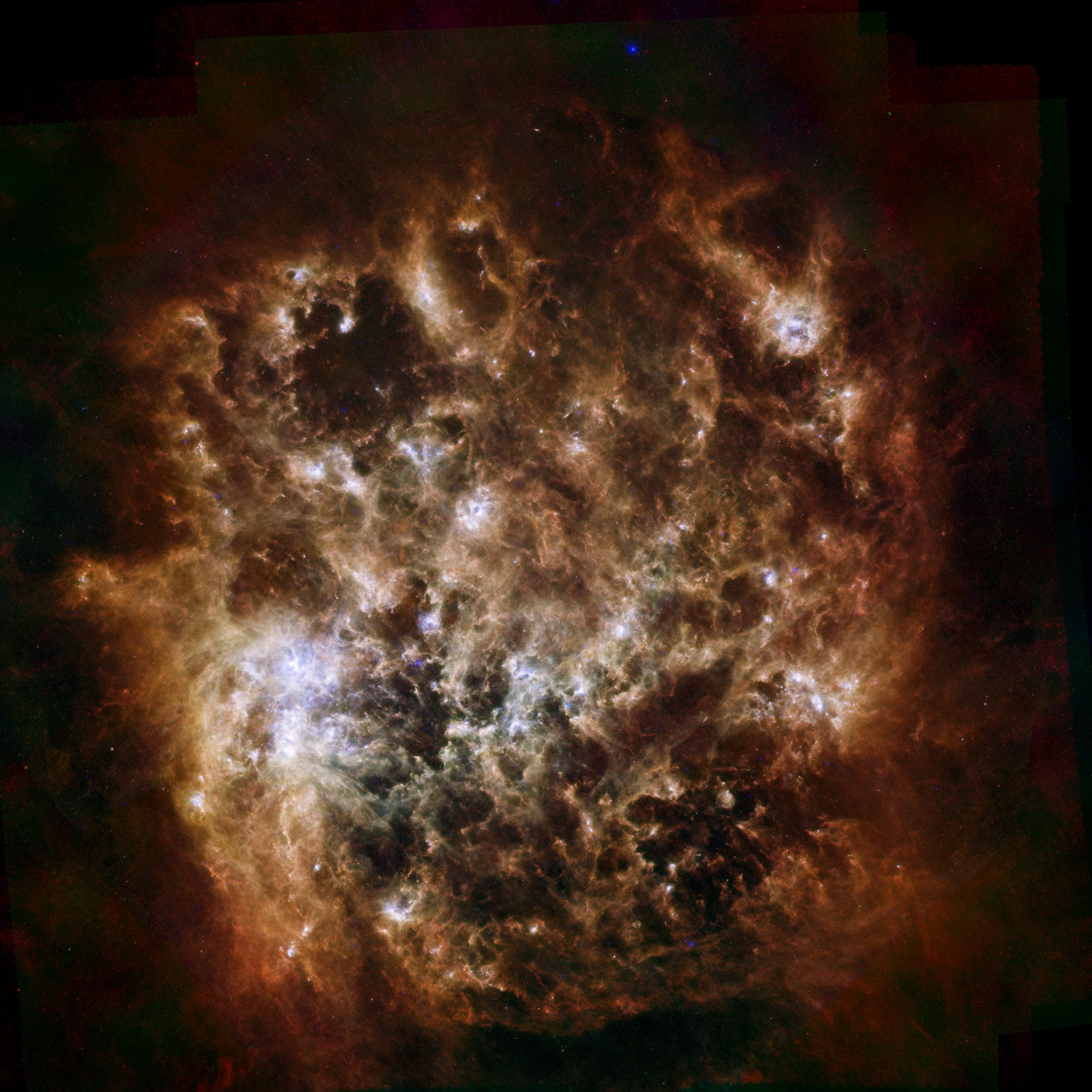
Infrared Portrait of the Large Magellanic Cloud
Credit: ESA / NASA / JPL-Caltech / STScI 

Explanation: Cosmic dust clouds ripple across this infrared portrait of our Milky Way’s satellite galaxy, the Large Magellanic Cloud. In fact, the remarkable composite image from the Herschel Space Observatory and the Spitzer Space Telescope show that dust clouds fill this neighboring dwarf galaxy, much like dust along the plane of the Milky Way itself. The dust temperatures tend to trace star forming activity. Spitzer data in blue hues indicate warm dust heated by young stars. Herschel’s instruments contributed the image data shown in red and green, revealing dust emission from cooler and intermediate regions where star formation is just beginning or has stopped. Dominated by dust emission, the Large Magellanic Cloud’s infrared appearance is different from views in optical images. But this galaxy’s well-known Tarantula Nebula still stands out, easily seen here as the brightest region to the left of center. A mere 160,000 light-years distant, the Large Cloud of Magellan is about 30,000 light-years across.

Astronomy Picture of the Day for Jan. 9th

Astronomy Picture of the Day

Discover the cosmos!Each day a different image or photograph of our fascinating universe is featured, along with a brief explanation written by a professional astronomer.

2012 January 9
See Explanation.  Clicking on the picture will download the highest resolution version available.

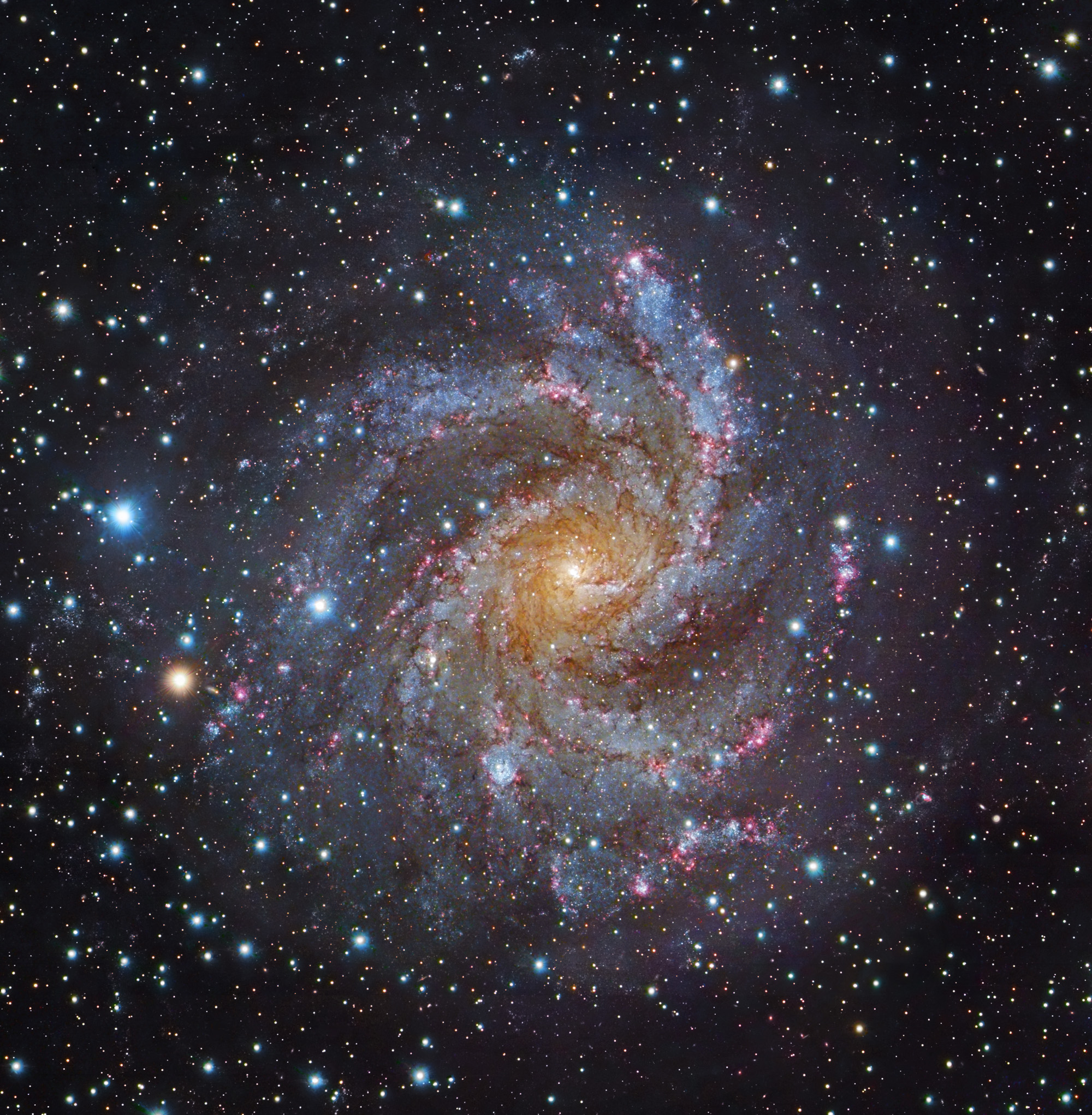
Facing NGC 6946
Composite Image Data – Subaru Telescope (NAOJ) and Robert Gendler; Processing – Robert Gendler   


Explanation: From our vantage point in the Milky Way Galaxy, we see NGC 6946 face-on. The big, beautiful spiral galaxy is located just 10 million light-years away, behind a veil of foreground dust and stars in the high and far-off constellation of Cepheus. From the core outward, the galaxy’s colors change from the yellowish light of old stars in the center to young blue star clusters and reddish star forming regions along the loose, fragmented spiral arms. NGC 6946 is also bright in infrared light and rich in gas and dust, exhibiting a high star birth and death rate. In fact, since the early 20th century at least nine supernovae, the death explosions of massive stars, were discovered in NGC 6946. Nearly 40,000 light-years across, NGC 6946 is also known as the Fireworks Galaxy. This remarkable portrait of NGC 6946 is a composite that includes image data from the 8.2 meter Subaru Telescope on Mauna Kea.

Astronomy Picture of the Day for Jan. 8th{Beautiful}

Astronomy Picture of the Day

Discover the cosmos!Each day a different image or photograph of our fascinating universe is featured, along with a brief explanation written by a professional astronomer.

A Sirius Leonid Meteor
Credit & Copyright: Wally Pacholka  

Explanation: In the sky or on the web, have you seen this year’s Leonid meteor shower? If you have, a bright meteor flashing through the night sky should be a familiar sight. Recorded last year during the 1998 apparation of the Leonids, this time-exposure of the sky around the constellation Canis Major (big dog) shows the trail of a spectacular fireball meteor. The meteor, by chance, seems to leap from the constellation’s brightest star Sirius, near the top right. In the foreground is the beautiful desert scenery of Joshua Tree National Park. Reports of bright meteors from this year’s Leonids are already wide-spread, with the 1999 shower predicted to peak around 0200 UTC on November 18 at rates of several hundred to thousands of meteors per hour. Awe inspiring as they are, the Leonids pose no danger to earthbound skywatchers.

Astronomy Picture of the Day for January 6th

Astronomy Picture of the Day

Discover the cosmos!Each day a different image or photograph of our fascinating universe is featured, along with a brief explanation written by a professional astronomer.

2012 January 6
See Explanation.  Clicking on the picture will download the highest resolution version available.

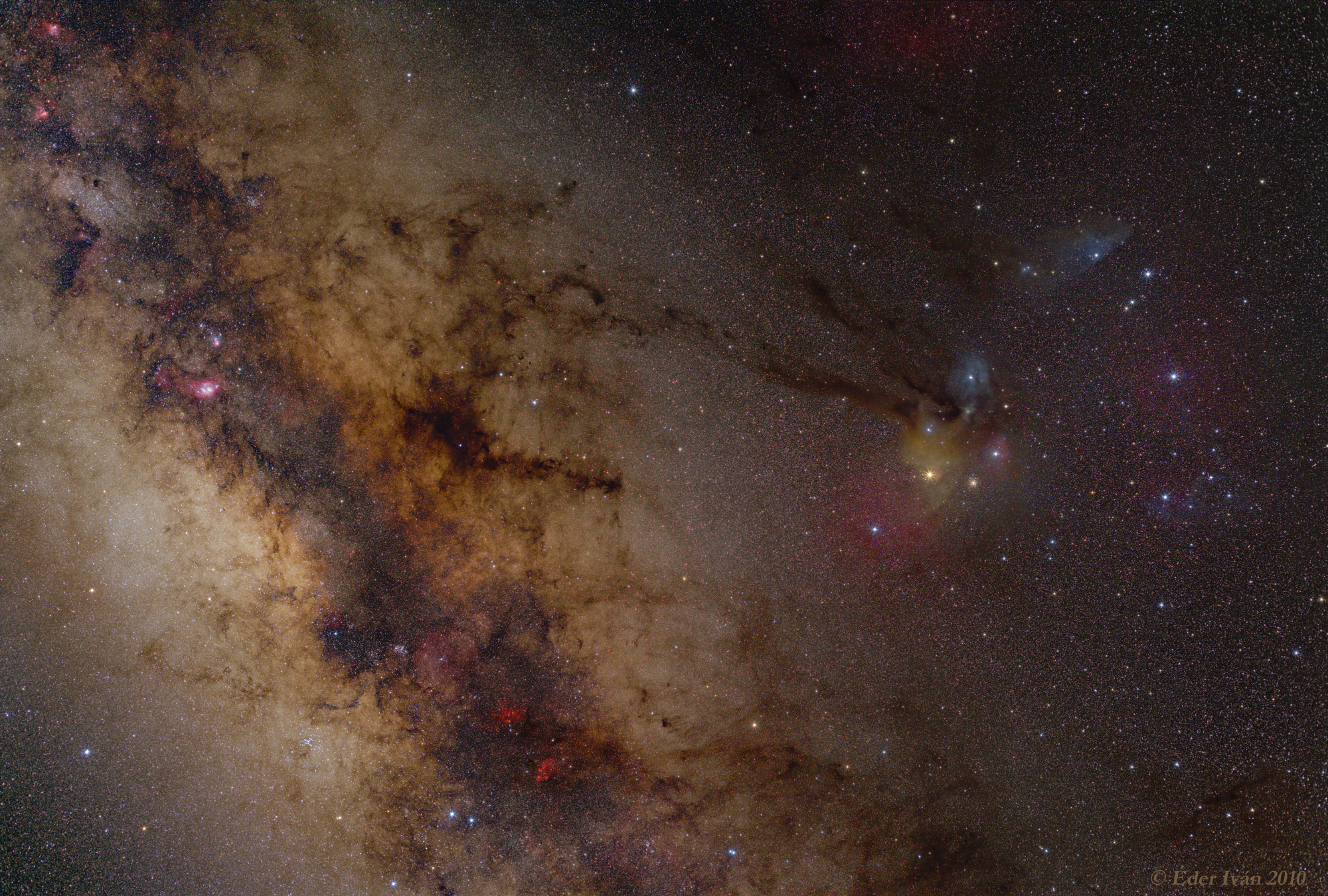
A Wide Field Image of the Galactic Center
Image Credit & Copyright: Ivan Eder 


Explanation: From Sagittarius to Scorpius, the central Milky Way is a truly beautiful part of planet Earth’s night sky. The gorgeous region is captured in this wide field image spanning about 30 degrees. The impressive cosmic vista, taken in 2010, shows off intricate dust lanes, bright nebulae, and star clusters scattered through our galaxy’s rich central starfields. Starting on the left, look for the Lagoon and Trifid nebulae, the Cat’s Paw, while on the right lies the Pipe dark nebula, and the colorful clouds of Rho Ophiuchi and Antares (right). The actual center of our Galaxy lies about 26,000 light years.

Astronomy Picture of the Day for Jan. 5

Astronomy Picture of the Day

Discover the cosmos!Each day a different image or photograph of our fascinating universe is featured, along with a brief explanation written by a professional astronomer.

2012 January 5
See Explanation.  Clicking on the picture will download the highest resolution version available.

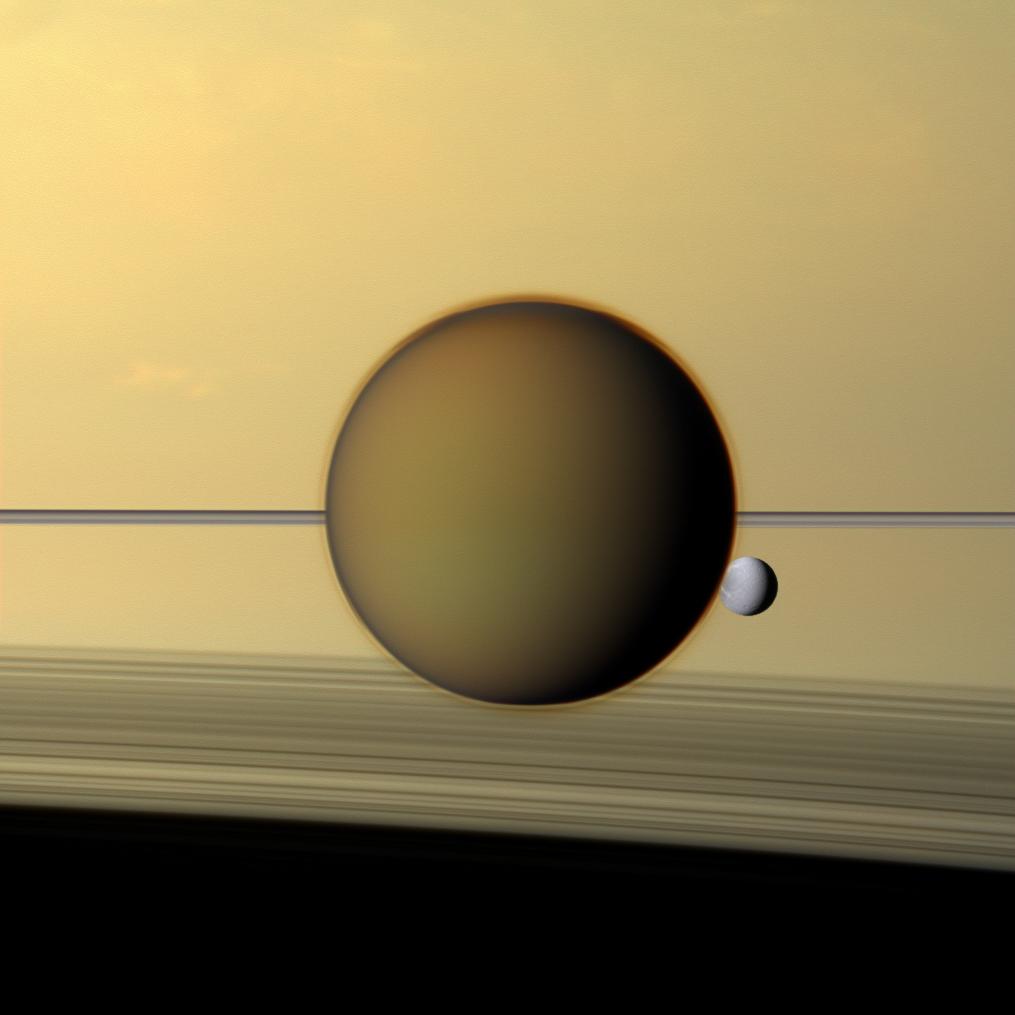
Ringside with Titan and Dione
Credit : Cassini Imaging Team, SSI, JPL, ESA, NASA  


Explanation: Orbiting in the plane of Saturn’s rings, Saturnian moons have a perpetual ringside view of the gorgeous gas giant planet. Of course, while passing near the ring plane the Cassini spacecraft also shares their stunning perspective. The rings themselves can be seen slicing across the middle of this Cassini snapshot from May of last year. The scene features Titan, largest, and Dione, third largest moon of Saturn. Remarkably thin, the bright rings still cast arcing shadows across the planet’s cloud tops at the bottom of the frame. Pale Dione is about 1,100 kilometers across and orbits over 300,000 kilometers from the visible outer edge of the A ring. Dione is seen through Titan’s atmospheric haze. At 5,150 kilometers across, Titan is about 2.3 million kilometers from Cassini, while Dione is 3.2 million kilometers away.

Astronomy Picture of the Day for January 3rd

Astronomy Picture of the Day

Discover the cosmos!Each day a different image or photograph of our fascinating universe is featured, along with a brief explanation written by a professional astronomer.

2012 January 3
See Explanation.  Clicking on the picture will download the highest resolution version available.

A Full Sky Aurora Over Norway
Image Credit & Copyright: Sebastian Voltmer 

Explanation: Higher than the highest building, higher than the highest mountain, higher than the highest airplane, lies the realm of the aurora. Auroras rarely reach below 60 kilometers, and can range up to 1000 kilometers. Aurora light results from energetic electrons and protons striking molecules in the Earth’s atmosphere. Frequently, when viewed from space, a complete aurora will appear as a circle around one of the Earth’s magnetic poles. The above wide angle image, horizontally compressed, captured an unexpected auroral display that stretched across the sky one month ago over eastern Norway.

Astronomy Picture of the Day for Jan. 1

Astronomy Picture of the Day

Discover the cosmos!Each day a different image or photograph of our fascinating universe is featured, along with a brief explanation written by a professional astronomer.

2012 January 1
See Explanation.  Clicking on the picture will download the highest resolution version available.

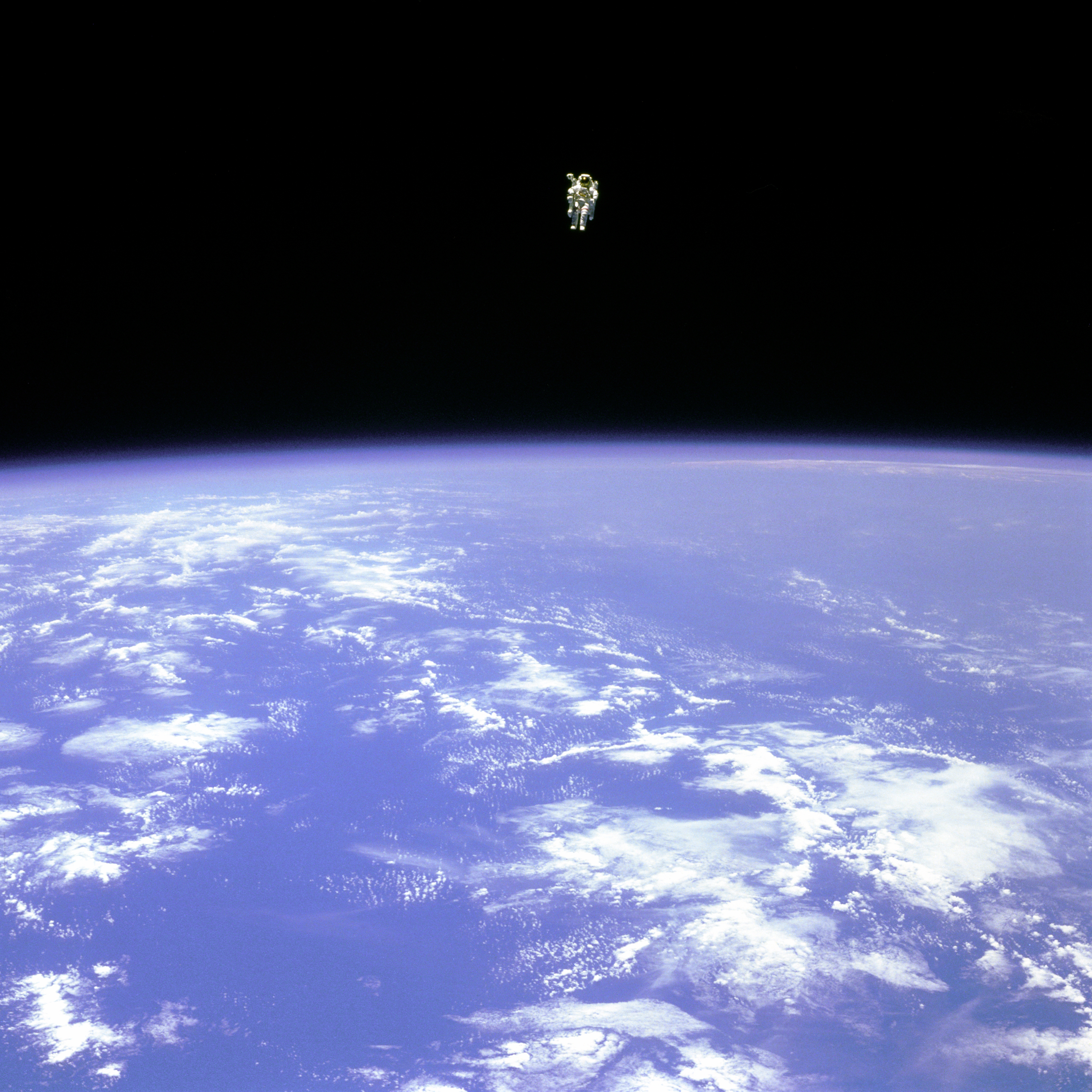
To Fly Free in Space
STS-41B, NASA 


Explanation: At about 100 meters from the cargo bay of the space shuttle Challenger, Bruce McCandless II was farther out than anyone had ever been before. Guided by a Manned Maneuvering Unit (MMU), astronaut McCandless, pictured above, was floating free in space. McCandless and fellow NASA astronaut Robert Stewart were the first to experience such an “untethered space walk” during Space Shuttle mission 41-B in 1984. The MMU works by shooting jets of nitrogen and has since been used to help deploy and retrieve satellites. With a mass over 140 kilograms, an MMU is heavy on Earth, but, like everything, is weightless when drifting in orbit. The MMU was replaced with the SAFER backpack propulsion unit.

Astronomy Picture of the Day for Dec. 30th

Astronomy Picture of the Day

Discover the cosmos!Each day a different image or photograph of our fascinating universe is featured, along with a brief explanation written by a professional astronomer.

2011 December 30
See Explanation.  Clicking on the picture will download the highest resolution version available.

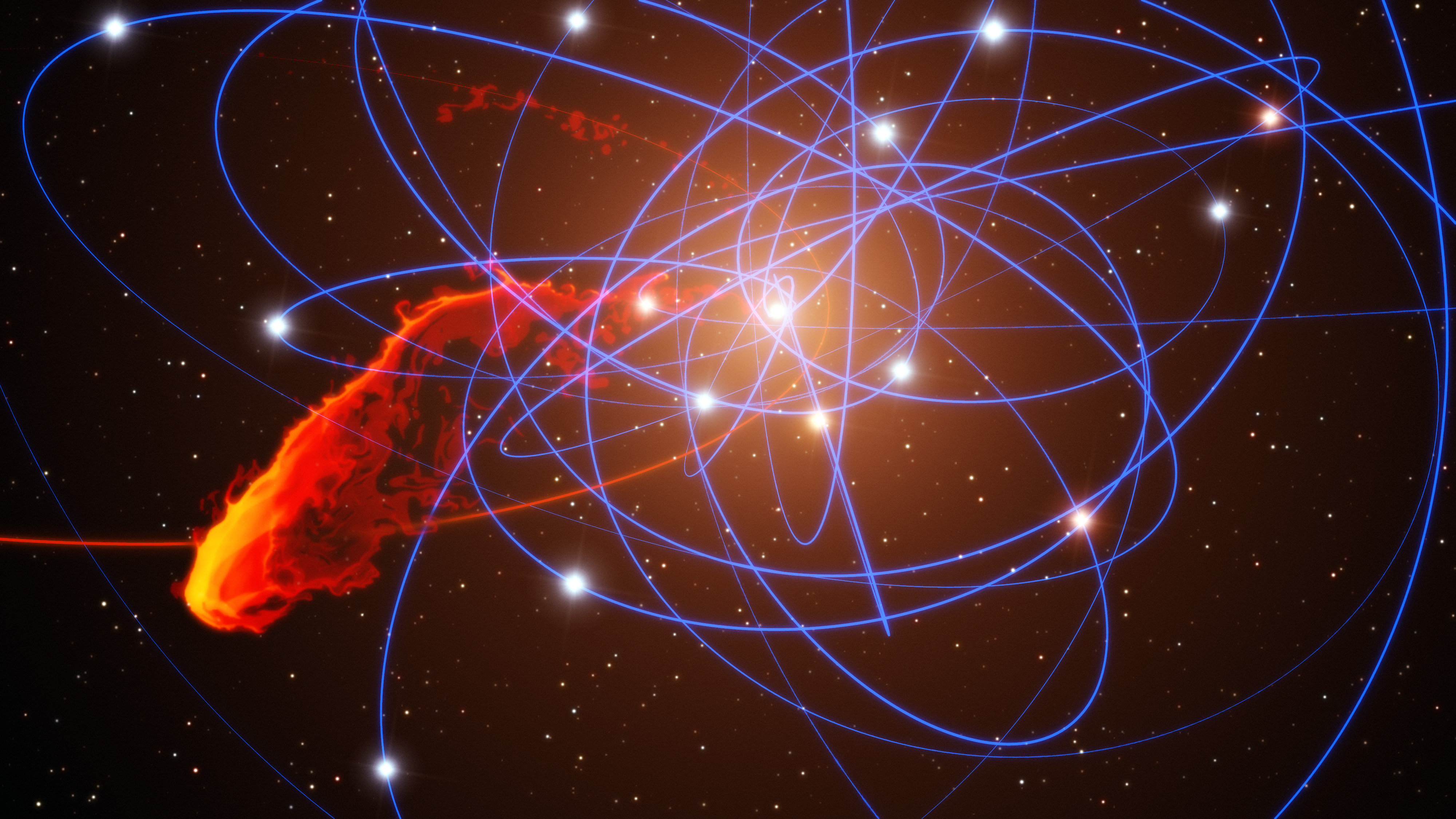
The Diner at the Center of the Galaxy
Illustration Credit: ESO/MPE/Marc Schartmann  


Explanation: The monster at the center of our Galaxy is about to get fed. Recent observations by the Very Large Telescopes indicate that a cloud of gas will venture too close to the supermassive black hole at the Galactic center. The gas cloud is being disrupted, stretched out, heated up, and some of it is expected to fall into the black hole over the next two years. In this artist’s illustration, what remains of the blob after a close pass to the black hole is shown in red and yellow, arching out from the gravitational death trap to its right. The cloud’s orbit is shown in red, while the orbits of central stars are shown in blue. The infalling nebula is estimated to contain several times the mass of our Earth, while the central black hole, thought to correspond to the radio source Sagittarius A*, contains about four million times the mass of our Sun. Once it falls in, nothing is expected to be heard from the doomed gas ever again.

Astronomy Picture of the Day for December 29th

Astronomy Picture of the Day

Discover the cosmos!Each day a different image or photograph of our fascinating universe is featured, along with a brief explanation written by a professional astronomer.

2011 December 29
See Explanation.  Clicking on the picture will download the highest resolution version available.

Conjunction at Sunset
Image Credit & Copyright: Stefano De Rosa 

Explanation: While Comet Lovejoy entertained early morning risers in in the southern hemisphere, a lovely conjunction of a young crescent Moon and Venus graced western skies at sunset. Captured on December 26th the conjunction, with beautiful sunset colors above and below, is seen here over Viverone Lake near Turin, Italy. But if you’ve been outdoors at all lately enjoying sunsets on planet Earth, then you’ve probably noticed Venus low in the west as the season’s brilliant evening star. Sometimes mistaken for a terrestrial light near the horizon, Venus is the third brightest celestial beacon, after the Sun and Moon. That distinction is particularly easy to appreciate in this peaceful scene.

Astronomy Picture of the Day for December 27th

Astronomy Picture of the Day

Discover the cosmos!Each day a different image or photograph of our fascinating universe is featured, along with a brief explanation written by a professional astronomer.

2011 December 27
See Explanation.  Clicking on the picture will download the highest resolution version available.

M27: The Dumbbell Nebula
Image Credit & Copyright: Bill Snyder (Bill Snyder Photography) 

Explanation: The first hint of what will become of our Sun was discovered inadvertently in 1764. At that time, Charles Messier was compiling a list of diffuse objects not to be confused with comets. The 27th object on Messier’s list, now known as M27 or the Dumbbell Nebula, is a planetary nebula, the type of nebula our Sun will produce when nuclear fusion stops in its core. M27 is one of the brightest planetary nebulae on the sky, and can be seen toward the constellation of the Fox (Vulpecula) with binoculars. It takes light about 1000 years to reach us from M27, shown above in colors emitted by hydrogen and oxygen. Understanding the physics and significance of M27 was well beyond 18th century science. Even today, many things remain mysterious about bipolar planetary nebula like M27, including the physical mechanism that expels a low-mass star’s gaseous outer-envelope, leaving an X-ray hot white dwarf.

Astronomy Picture of the Day for December 26th

Astronomy Picture of the Day

Discover the cosmos!Each day a different image or photograph of our fascinating universe is featured, along with a brief explanation written by a professional astronomer.

2011 December 26
See Explanation.  Clicking on the picture will download the highest resolution version available.

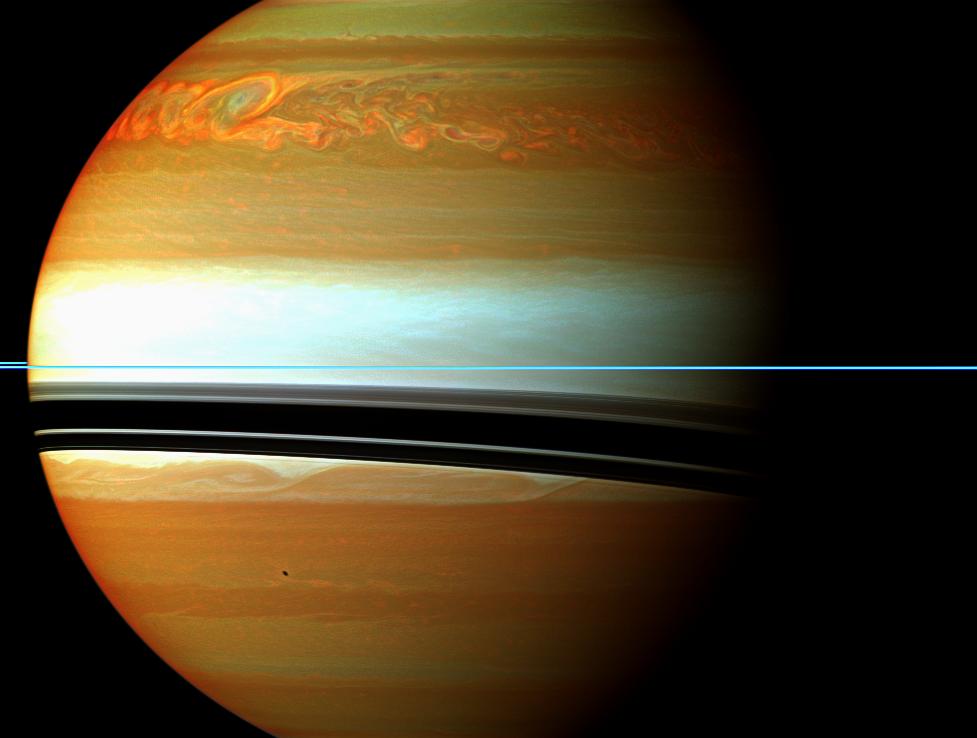
A Raging Storm System on Saturn
Image Credit: Cassini Imaging Team, SSI, JPL, ESA, NASA  


Explanation: It is one of the largest and longest lived storms ever recorded in our Solar System. First seen late last year, the above cloud formation in the northern hemisphere of Saturn started larger than the Earth and soon spread completely around the planet. The storm has been tracked not only from Earth but from up close by the robotic Cassini spacecraft currently orbiting Saturn. Pictured above in false colored infrared in February, orange colors indicate clouds deep in the atmosphere, while light colors highlight clouds higher up. The rings of Saturn are seen nearly edge-on as the thin blue horizontal line. The warped dark bands are the shadows of the rings cast onto the cloud tops by the Sun to the upper left. A source of radio noise from lightning, the intense storm may relate to seasonal changes as spring slowly emerges in the north of Saturn.

Astronomy Picture of the Day for December 23rd

Astronomy Picture of the Day

Discover the cosmos!Each day a different image or photograph of our fascinating universe is featured, along with a brief explanation written by a professional astronomer.

2011 December 23
See Explanation.  Clicking on the picture will download the highest resolution version available.

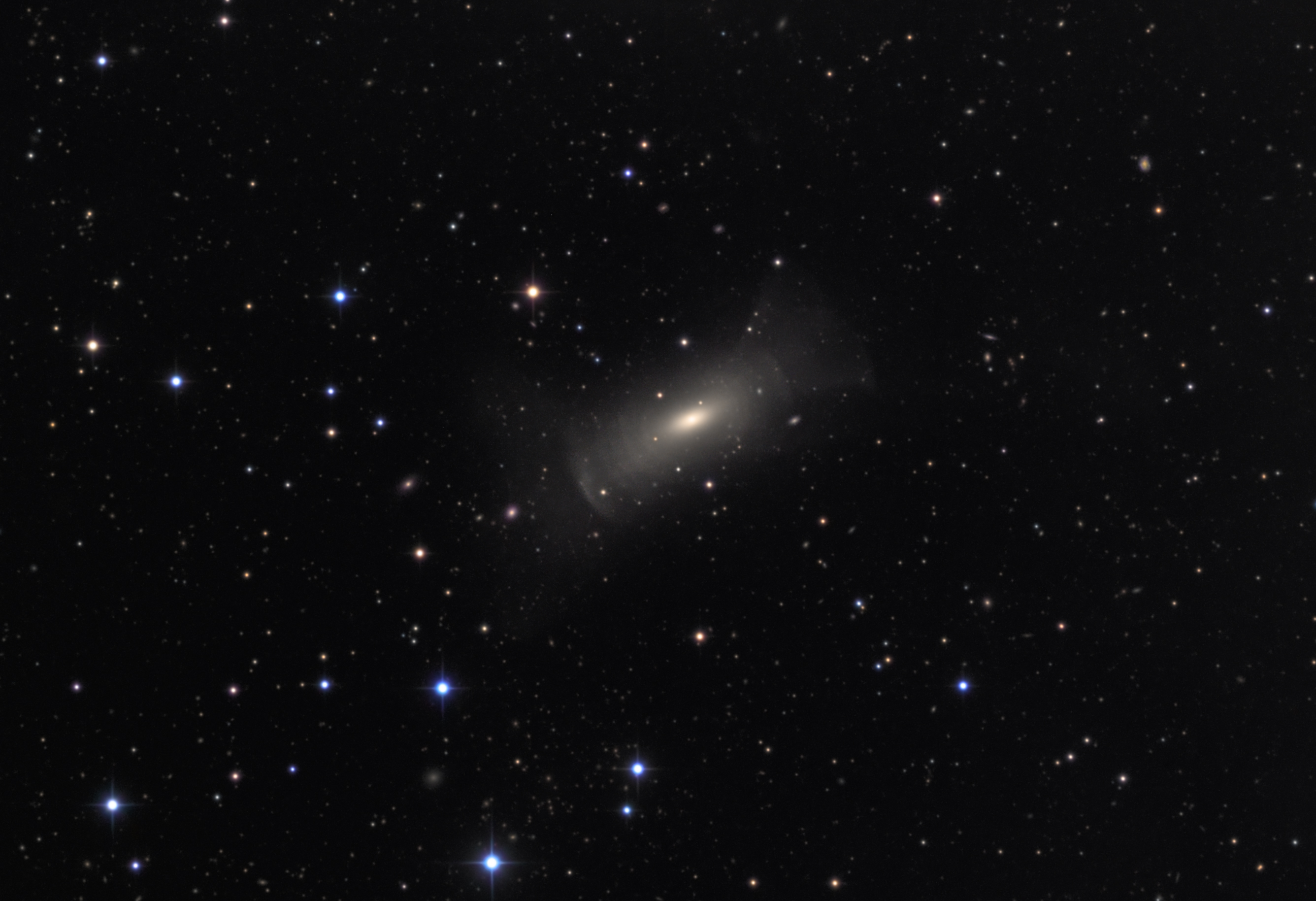
Shell Galaxy NGC 7600
Image Credit & Copyright: Ken Crawford (Rancho Del Sol Observatory)
Collaboration: Andrew Cooper (MPA), Carlos Frenk, John Helly, Shaun Cole (Institute for Computational Cosmology),David Martinez-Delgado (MPIA), Star Stream Pilot Survey Group 

Explanation: Similar in size to the Milky Way, elliptical galaxy NGC 7600 is about 160 million light-years distant. In this deep image, spanning about 1/2 degree on the sky toward the constellation Aquarius, NGC 7600 sports a remarkable outer halo of nested shells and broad circumgalactic structures. The tantalizing features can be explained by the accretion of dark matter and stars on a cosmic timescale. In fact, a movie generated by simulating galaxy formation using a cosmological model with cold dark matter for the halos of merging galaxies reproduces the appearance of NGC 7600 in amazing detail. The remarkable simulation movie is available here on Vimeo and here in other formats. It presents compelling evidence that detailed features of galaxy mergers observed with small, wide field telescopes on planet Earth, are natural consequences of galaxy formation and fundamental properties of dark matter.

Astronomy Picture of the Day for December 15th

Astronomy Picture of the Day

Discover the cosmos!Each day a different image or photograph of our fascinating universe is featured, along with a brief explanation written by a professional astronomer.

2011 December 15
See Explanation.  Clicking on the picture will download the highest resolution version available.

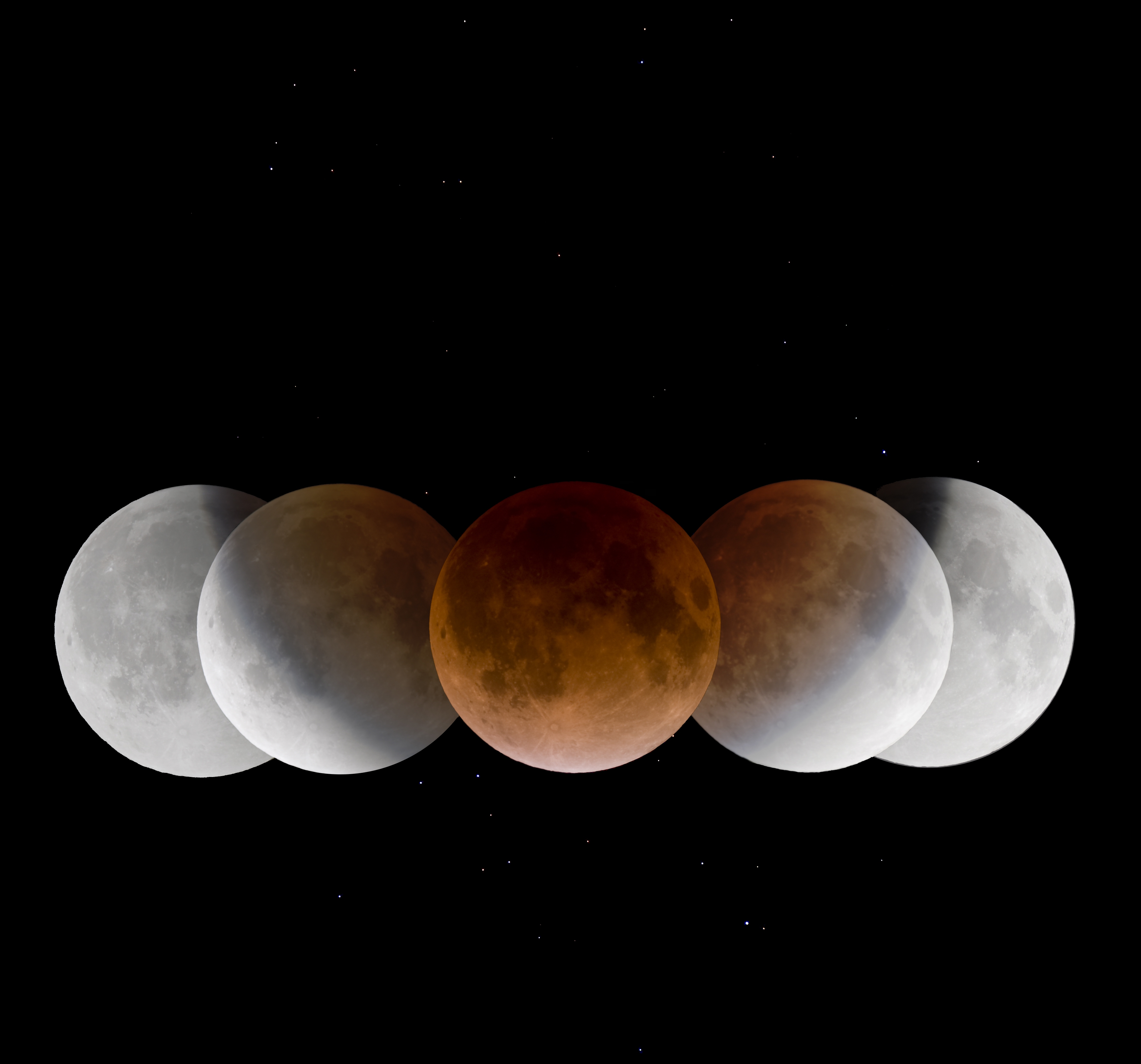
The Umbra of Earth
Image Credit & Copyright: Wang, Letian  

Explanation: The dark, inner shadow of planet Earth is called the umbra. Shaped like a cone extending into space, it has a circular cross section most easily seen during a lunar eclipse. For example, last Saturday the Full Moon slid across the southern half of Earth’s umbral shadow, entertaining moonwatchers around much of the planet. In the total phase of the eclipse, the Moon was completely within the umbra for 51 minutes. Recorded from Beijing, China, this composite eclipse image uses successive pictures from totality (center) and partial phases to trace out a large part of the umbra’s curved edge. Background stars are visible in the darker eclipse phases. The result shows the relative size of the shadow’s cross section at the distance of the Moon, as well as the Moon’s path through Earth’s umbra.

Astronomy Picture of the Day

Astronomy Picture of the Day

Discover the cosmos!Each day a different image or photograph of our fascinating universe is featured, along with a brief explanation written by a professional astronomer.

2011 December 8
See Explanation.  Clicking on the picture will download the highest resolution version available.

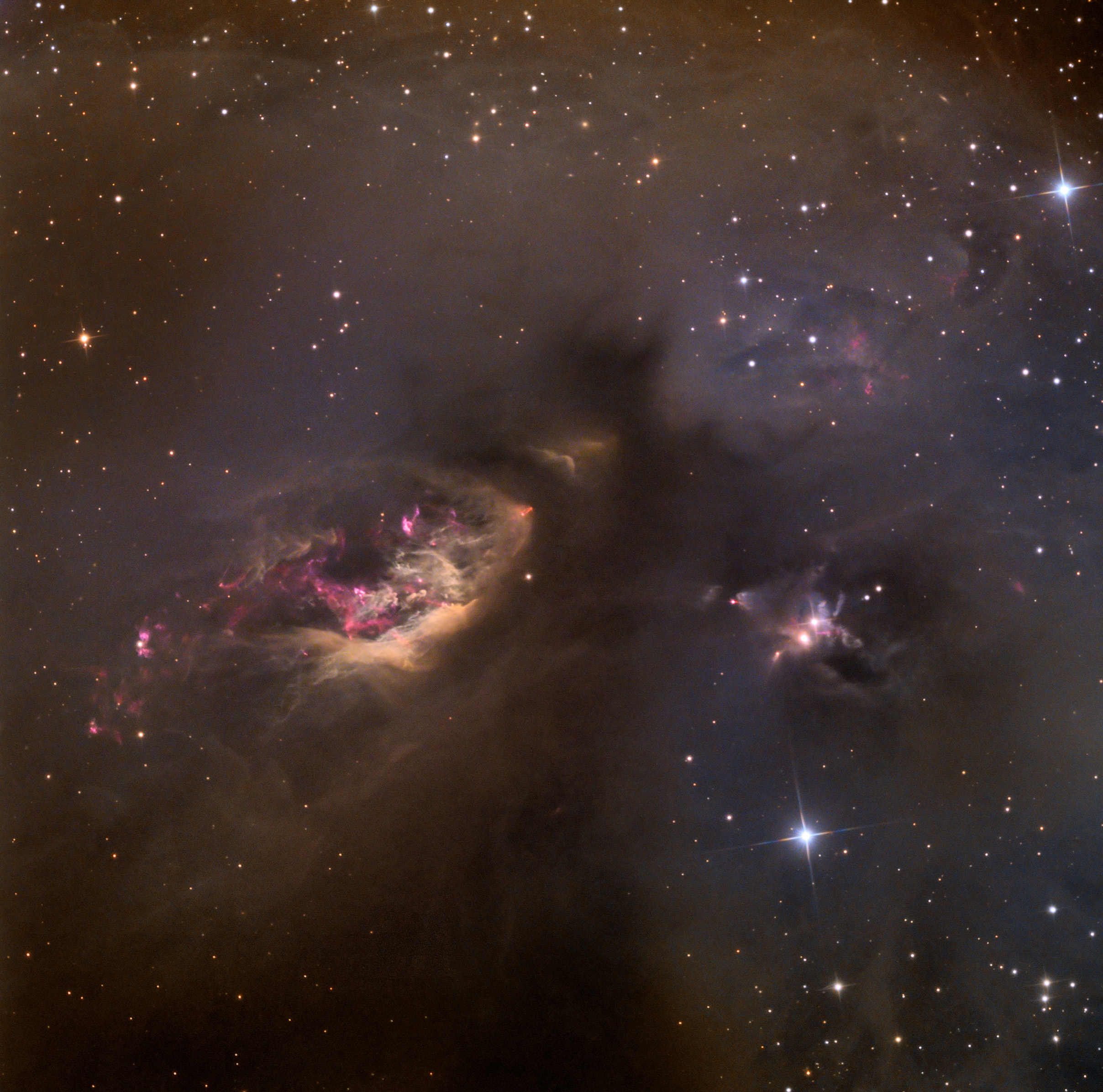
Sh2-239: Celestial Impasto
Image Credit & Copyright: Adam Block, Mt. Lemmon SkyCenter, University of Arizona 


 Explanation: The cosmic brush of star formation composed this alluring mix of dust and dark nebulae. Cataloged as Sh2-239 and LDN 1551, the region lies near the southern end of the Taurus molecular cloud complex some 450 light-years distant. Stretching for nearly 3 light-years, the canvas abounds with signs of embedded young stellar objects driving dynamic outflows into the surrounding medium. Included near the center of the frame, a compact, tell-tale red jet of shocked hydrogen gas is near the position of infrared source IRS5, known to be a system of protostars surrounded by dust disks. Just below it are the broader, brighter wings of HH 102, one of the region’s many Herbig-Haro objects, nebulosities associated with newly born stars. Estimates indicate that the star forming LDN 1551 region contains a total amount of material equivalent to about 50 times the mass of the Sun.

Astronomy Picture of the Day for November 25th

Astronomy Picture of the Day

Discover the cosmos!Each day a different image or photograph of our fascinating universe is featured, along with a brief explanation written by a professional astronomer.

2011 November 25
See Explanation.  Clicking on the picture will download the highest resolution version available.

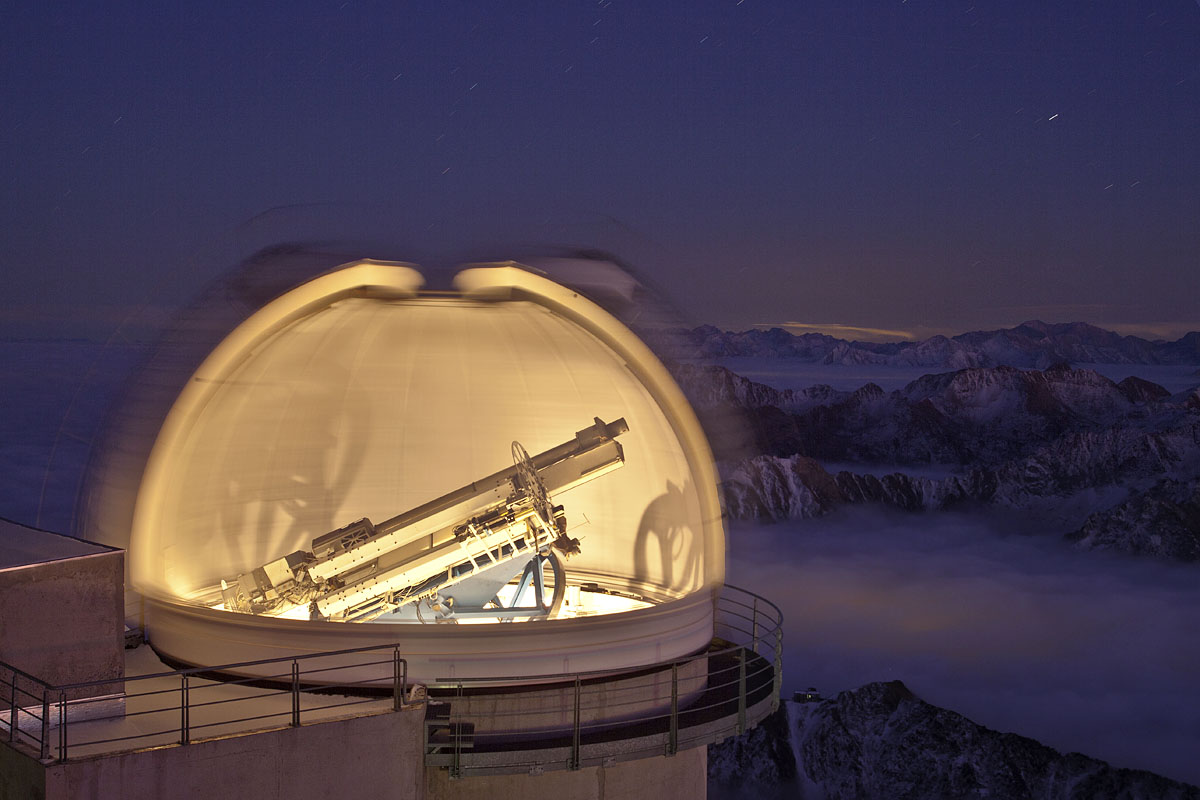
A Glimpse of CLIMSO
Image Credit & Copyright: Alain Sallez (picdumidi.org)  


Explanation: A tantalizing glimpse inside this dome was captured after sunset at the mountain top Pic Du Midi Observatory in the French Pyrenees. But while most are just beginning their work at sunset, this observatory’s day was done. The instrument looming within is CLIMSO (for Christian Latouche IMageur Solaire), dedicated to exploring dynamic phenomena across the surface and atmosphere of the Sun. To image the solar atmosphere or corona, CLIMSO uses coronagraphs. Developed by French astronomer Bernard Lyot in the 1930s, coronagraphs block light from the center of the telescope beam to create an artificial solar eclipse and allow a continuous view of the solar corona. In this surreal twilight scene above a sea of clouds, the dome’s interior was revealed by the single, long exposure as the open slit rotated across the field of view.

Astronomy Picture of the Day

Astronomy Picture of the Day

Discover the cosmos!Each day a different image or photograph of our fascinating universe is featured, along with a brief explanation written by a professional astronomer.

2011 November 23
See Explanation.  Clicking on the picture will download the highest resolution version available.

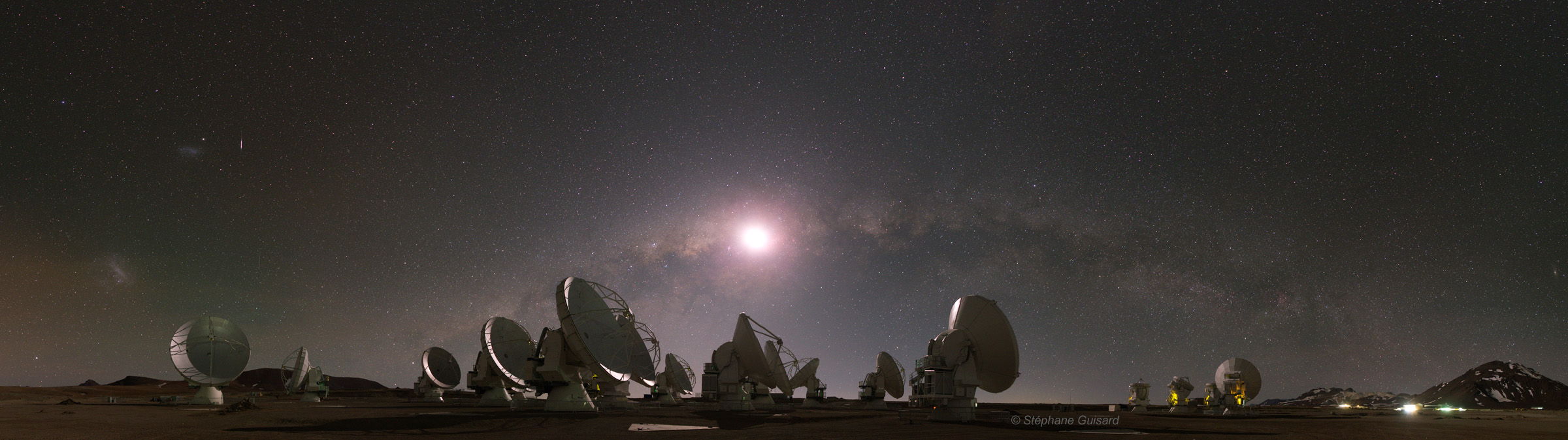
The View from Chajnantor
Image Credit & Copyright: Stéphane Guisard (Los Cielos de America), TWAN 


Explanation: From an altitude of over 5,000 meters, the night sky view from Chajnantor Plateau in the Chilean Andes is breathtaking in more ways than one. The dark site’s rarefied atmosphere, at about 50 percent sea level pressure, is also extremely dry. That makes it ideal for the Atacama Large Millimeter/submillimeter Array (ALMA) designed to explore the universe at wavelengths over 1,000 times longer than visible light. Near the center of the the panoramic scene, ALMA’s 7 and 12 meter wide dish antennas are illuminated by a young Moon nestled in the arc of the Milky Way. ALMA’s antenna configurations are intended to achieve a resolution comparable to space telescopes by operating as an interferometer. At left, a meteor’s streak and the Milky Way’s satellite galaxies, the Large (bottom) and Small Magellanic Clouds grace the night.

Astronomy Picture of the Day for November 20th

Astronomy Picture of the Day

Discover the cosmos!Each day a different image or photograph of our fascinating universe is featured, along with a brief explanation written by a professional astronomer.

2011 November 20
See Explanation.  Clicking on the picture will download the highest resolution version available.

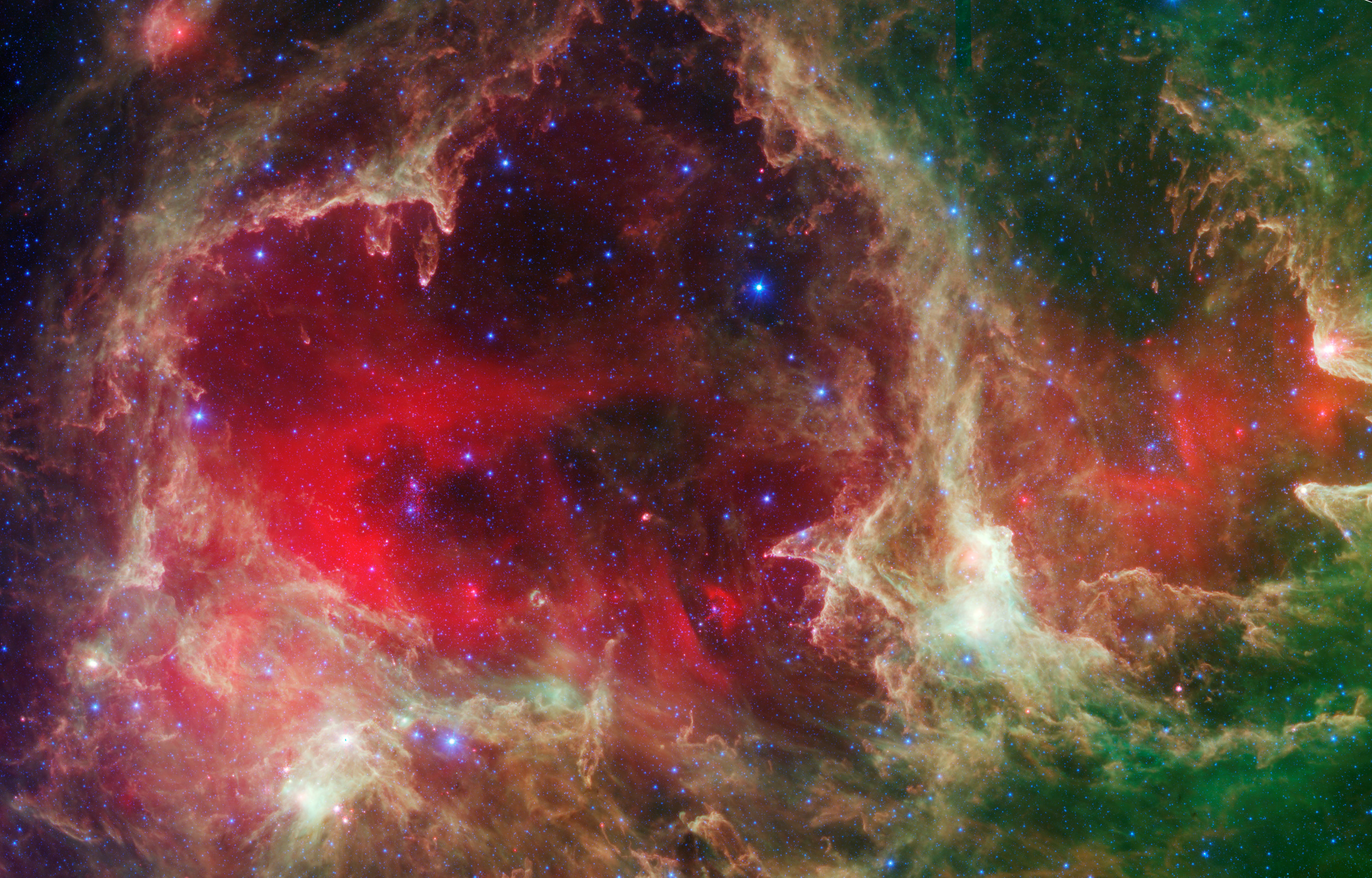
W5: Pillars of Star Formation
Image Credit & Copyright: Lori Allen, Xavier Koenig (Harvard-Smithsonian CfA) et al., JPL-Caltech, NASA  


Explanation: How do stars form? A study of star forming region W5 by the sun-orbiting Spitzer Space Telescope provides clear clues by recording that massive stars near the center of empty cavities are older than stars near the edges. A likely reason for this is that the older stars in the center are actually triggering the formation of the younger edge stars. The triggered star formation occurs when hot outflowing gas compresses cooler gas into knots dense enough to gravitationally contract into stars. Spectacular pillars, left slowly evaporating from the hot outflowing gas, provide further visual clues. In the above scientifically-colored infrared image, red indicates heated dust, while white and green indicate particularly dense gas clouds. W5 is also known as IC 1848, and together with IC 1805 form a complex region of star formation popularly dubbed the Heart and Soul Nebulas. The above image highlights a part of W5 spanning about 2,000 light years that is rich in star forming pillars. W5 lies about 6,500 light years away toward the constellation of Cassiopeia.

Astronomy Picture of the Day for November 18th – A Colorful Side of the Moon

Astronomy Picture of the Day

Discover the cosmos!Each day a different image or photograph of our fascinating universe is featured, along with a brief explanation written by a professional astronomer.

2011 November 18
See Explanation.  Clicking on the picture will download the highest resolution version available.

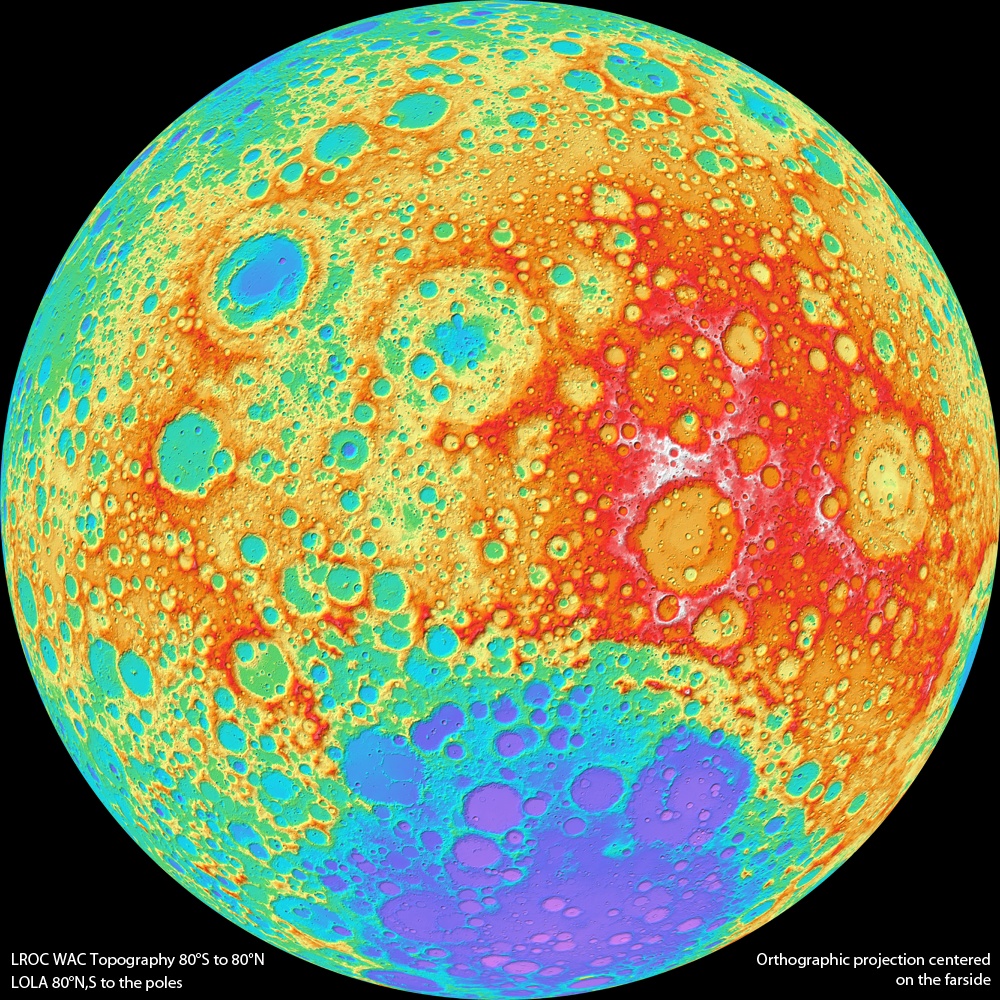
A Colorful Side of the Moon
NASA / GSFC / DLR / Arizona State Univ. / Lunar Reconnaissance Orbiter 

Explanation: This colorful topographical map of the Moon is centered on the lunar farside, the side not seen from planet Earth. That view is available to the Lunar Reconnaissance Orbiter though, as the spacecraft’s wide angle camera images almost the entire lunar surface every month. Stereo overlap of the imaging has allowed the computation of topographical maps with coverage between 80 degrees north and south latitude. The results have about a 300 meter resolution on the lunar surface and 10 to 20 meter elevation accuracy. Data closer to the north and south poles is filled in using the orbiter’s laser altimeter. In this map, white, red, green, and purple represent progressively lower elevations. In fact, the large circular splotch tending to purple hues at the bottom is the farside’s South Pole-Aitken Basin. About 2500 kilometers in diameter and over 12 kilometers deep, it is one of the largest impact basins in the Solar System.

Astronomy Picture of the Day for November 17th

Astronomy Picture of the Day

Discover the cosmos!Each day a different image or photograph of our fascinating universe is featured, along with a brief explanation written by a professional astronomer.

2011 November 17
See Explanation.  Clicking on the picture will download the highest resolution version available.

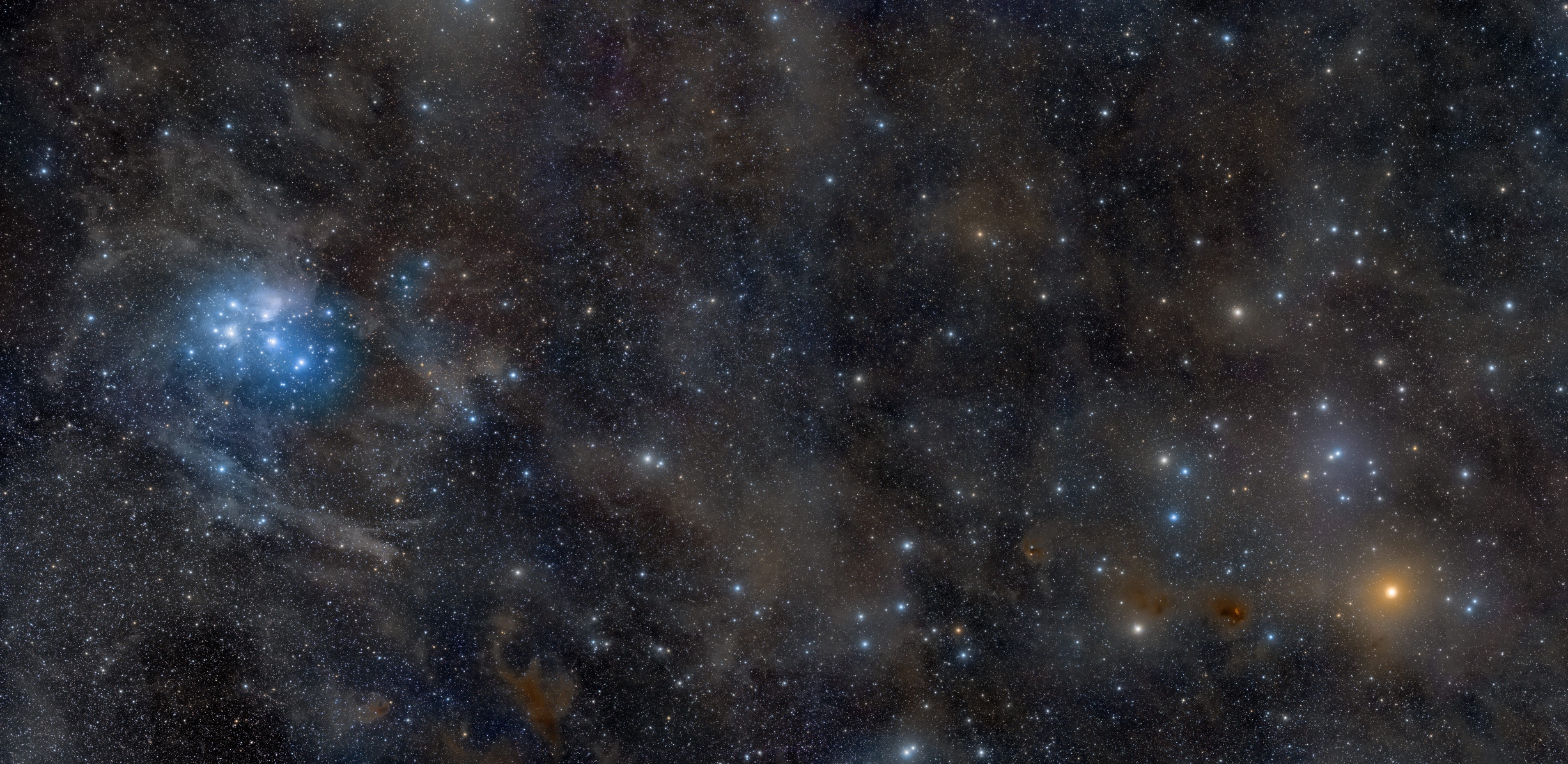
Pleiades to Hyades
Image Credit & Copyright: Rogelio Bernal Andreo


Explanation: This cosmic vista stretches almost 20 degrees across the gentle constellation Taurus. It begins at the Pleiades and ends at the Hyades, two of the best known star clusters in planet Earth’s sky. At left, the lovely Pleiades star cluster is about 400 light-years away. In a familiar celestial scene, the cluster stars shine through dusty clouds that scatter blue starlight. At right, the V-shaped Hyades cluster looks more spread out compared to the compact Pleiades and lies much closer, 150 light-years distant. Of course, the Hyades cluster stars seem anchored by bright Aldebaran, a red giant star with a yellowish appearance. But Aldebaran actually lies only 65 light-years away, by chance along the line of sight to the Hyades cluster. Faint dust clouds found near the edge of the Taurus Molecular Cloud are also evident throughout the remarkable 12 panel mosaic. The wide field of view includes the youthful star T Tauri and Hind’s variable nebula about four degrees left of Aldebaran on the sky.