Astronomy Pic of the Day for June 11 – A Message From Earth

Astronomy Picture of the Day

Discover the cosmos!Each day a different image or photograph of our fascinating universe is featured, along with a brief explanation written by a professional astronomer.

A Message From Earth 

 Image Credit: Frank Drake (UCSC) et al.,

Arecibo  Observatory (CornellNAIC

Explanation: What are these Earthlings trying to tell us?  The above message was broadcast from  Earth towards the  globular star cluster  M13 in 1974.   During the dedication of the  Arecibo Observatory – still  the largest single radio telescope in the world – a string of 1’s and 0’s  representing the above diagram was sent.    This attempt at extraterrestrial communication was mostly ceremonial –  humanity regularly broadcasts radio and television signals out into space accidentally.   Even were this message received, M13 is so far away we would  have to wait almost 50,000 years to hear an answer.    The above  message gives a few simple facts about humanity and its  knowledge:  from left to right are numbers from one to ten, atoms including  hydrogen and  carbon,  some interesting molecules,  DNA, a human with description, basics of our  Solar System, and  basics of the sending telescope.   Several  searches  for extraterrestrial intelligence are currently underway, including  one where you can use your own home computer.

Astronomy Picture of the Day

Astronomy Picture of the Day

Discover the cosmos! Each day a different image or photograph of our fascinating universe is  featured, along with a brief explanation written by a professional astronomer.

2012 June 9

Venus at the Edge

Image Credit: JAXANASA, Lockheed Martin  

Explanation: As its June 6 2012 transit begins Earth’s sister planet crosses the edge of the Sun in this stunning view from the Hinode spacecraft. The timing of limb crossings during the rare transits was used historically to triangulate the distance to Venus and determine a value for the Earth-Sun distance called the astronomical unit. Still, modern space-based views like this one show the event against an evocative backdrop of the turbulent solar surface with prominences lofted above the Sun’s edge by twisting magnetic fields. Remarkably, the thin ring of light seen surrounding the planet’s dark silhouette is sunlight refracted by Venus’ thick atmosphere.

Astronomy Picture of the Day for April 15 – A Possibly Titanic Mirage

Astronomy Picture of the Day

Discover the cosmos!Each day a different image or photograph of our fascinating universe is featured, along with a brief explanation written by a professional astronomer.

2012 April 15
See Explanation.  Clicking on the picture will download the highest resolution version available.

Fata Morgana: A Possibly Titanic Mirage
Image Credit & Copyright: Mila Zinkova


 Explanation: Did this mirage help sink the Titanic? The optical phenomenon called Fata Morgana can make strange shapes or a false wall of water appear above a watery horizon. When conditions are right, light reflecting off of cold water will be bent by an unusual layer of warm air above to arrive at the observer from several different angles. A conceptually comparable mirage can make a setting Sun appear strangely distorted or a distant pavement appear wet. One hundred years ago today, such a Fata Morgana mirage might have obscured real icebergs from the clear view of crew onboard the Titanic. Additional evidence for this distortion hypothesis arises from the nearby vessel SS Californian which reported sightings consistent with Fata Morgana mirages. The above Fata Morgana mirage was taken off the US Pacific coast in 2008.

Astronomy Picture of the Day for April 12 – A Beautiful Trifid

Astronomy Picture of the Day

Discover the cosmos!Each day a different image or photograph of our fascinating universe is featured, along with a brief explanation written by a professional astronomer.

See Explanation.  Clicking on the picture will downloadthe highest resolution version available.

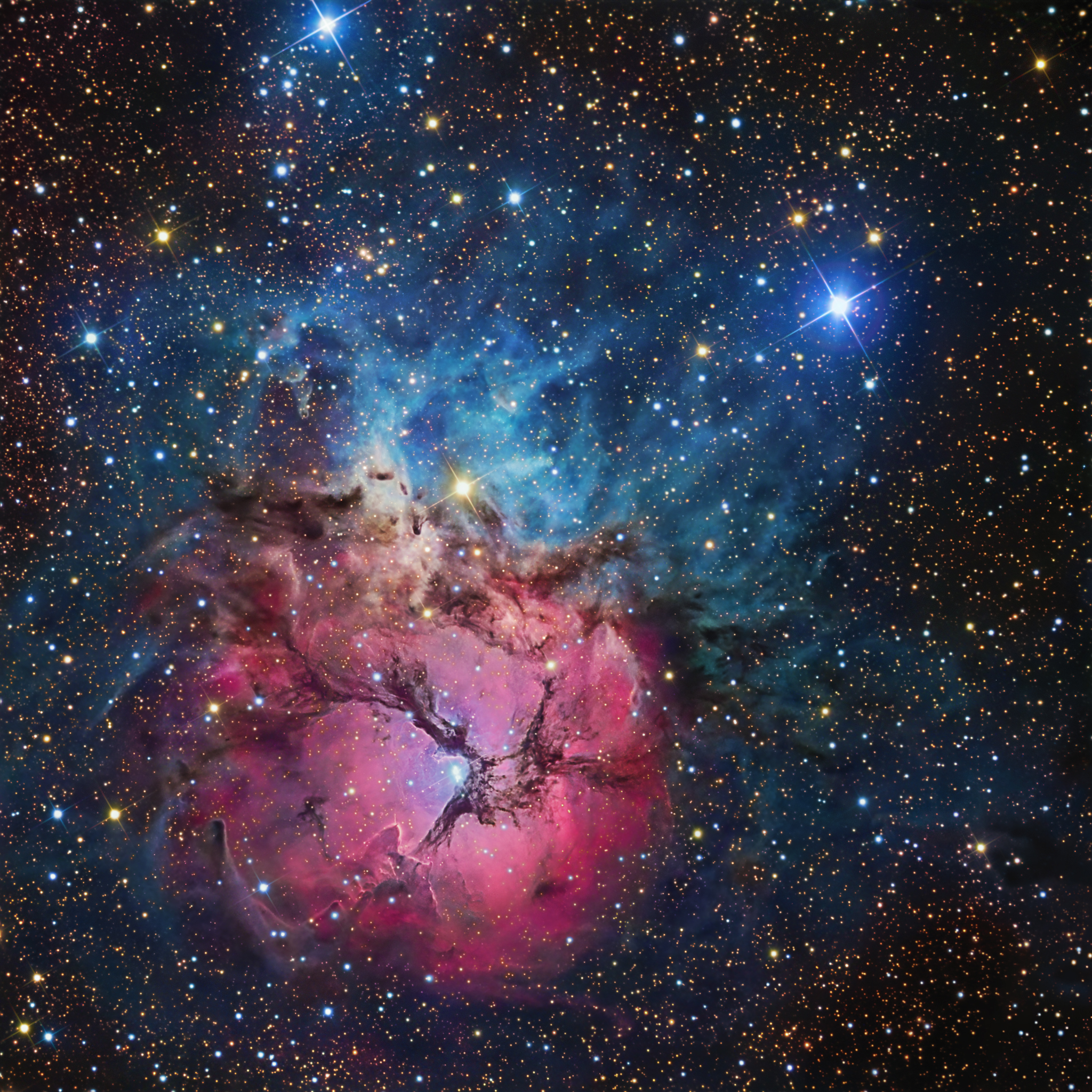
A Beautiful Trifid
Image Credit & Copyright: R Jay Gabany Explanation: The beautiful Trifid Nebula is a cosmic study in colorful contrasts. Also known as M20, it lies about 5,000 light-years away toward the nebula rich constellation Sagittarius. A star forming region in the plane of our galaxy, the Trifid illustrates three different types of astronomical nebulae; red emission nebulae dominated by light emitted by hydrogen atoms, blue reflection nebulae produced by dust reflecting starlight, and dark nebulae where dense dust clouds appear in silhouette. The bright red emission region, roughly separated into three parts by obscuring, dark dust lanes, lends the Trifid its popular name. In this well met scene, the red emission is also juxtaposed with the telltale blue haze of reflection nebulae. Pillars and jets sculpted by newborn stars, below and left of the emission nebula’s center, appear in Hubble Space Telescope close-up images of the region. The Trifid Nebula is about 40 light-years across.

Astronomy Picture of the Day for April 9th

Astronomy Picture of the Day

Discover the cosmos!Each day a different image or photograph of our fascinating universe is featured, along with a brief explanation written by a professional astronomer.

2012 April 9
See Explanation.  Clicking on the picture will download the highest resolution version available.

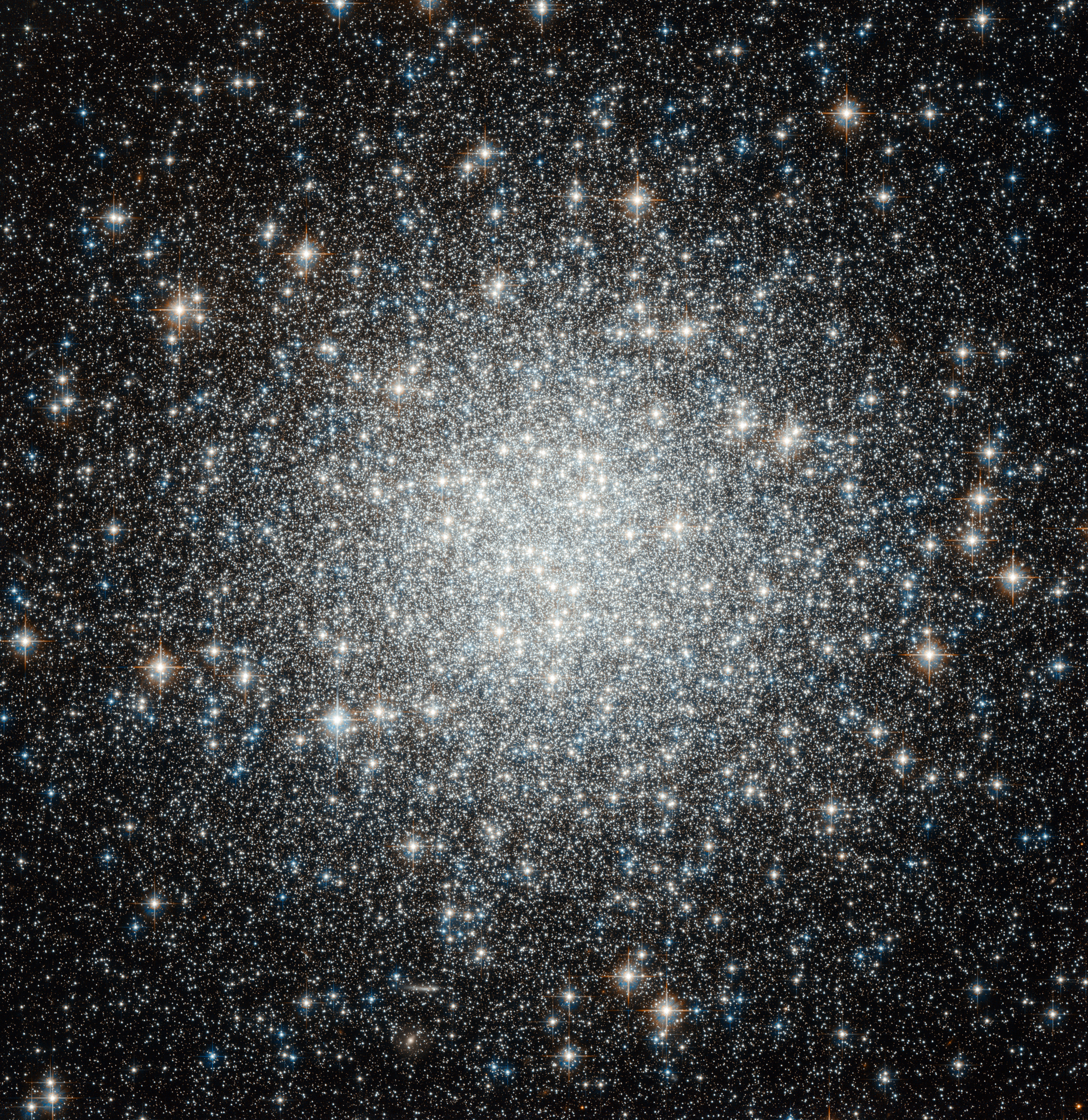
Blue Straggler Stars in Globular Cluster M53
Image Credit: ESA/Hubble, NASA 

Explanation: If our Sun were part of M53, the night sky would glow like a jewel box of bright stars. M53, also known as NGC 5024, is one of about 250 globular clusters that survive in our Galaxy. Most of the stars in M53 are older and redder than our Sun, but some enigmatic stars appear to be bluer and younger. These young stars might contradict the hypothesis that all the stars in M53 formed at nearly the same time. These unusual stars are known as blue stragglers and are unusually common in M53. After much debate, blue stragglers are now thought to be stars rejuvenated by fresh matter falling in from a binary star companion. By analyzing pictures of globular clusters like the above image taken by the Hubble Space Telescope, astronomers use the abundance of stars like blue stragglers to help determine the age of the globular cluster and hence a limit on the age of the universe. M53, visible with a binoculars towards the constellation of Bernice’s Hair (Coma Berenices), contains over 250,000 stars and is one of the furthest globulars from the center of our Galaxy.

Astronomy Picture of the Day for March 28th

Astronomy Picture of the Day

Discover the cosmos!Each day a different image or photograph of our fascinating universe is featured, along with a brief explanation written by a professional astronomer.

2012 March 28
See Explanation.  Clicking on the picture will download the highest resolution version available.

Earthshine and Venus Over Sierra de Guadarrama
Image Credit: Daniel Fernández (DANIKXT)  


Explanation: What just above that ridge? The Moon. Specifically, the Earth’s Moon was caught just above the horizon in a young crescent phase. The familiar Moon might look a bit odd as the exposure shows significant Earthshine — the illumination of the part of the Moon hidden from direct sunlight by the sun-reflecting Earth. Also captured in the image is the bright planet Venus on the right. Venus and Jupiter passed only three degrees from each other last week during a photogenic planetary conjunction. The above image was taken two days ago near Madrid, Spain. The foreground horizon silhouette includes some of the Seven Peaks of the Sierra de Guadarrama mountain range. Just a few minutes after this picture was taken, the Moon set.

Astronomy Picture of the Day for March 21

Astronomy Picture of the Day

Discover the cosmos!Each day a different image or photograph of our fascinating universe is featured, along with a brief explanation written by a professional astronomer.

2012 March 21
See Explanation.  Clicking on the picture will download the highest resolution version available.

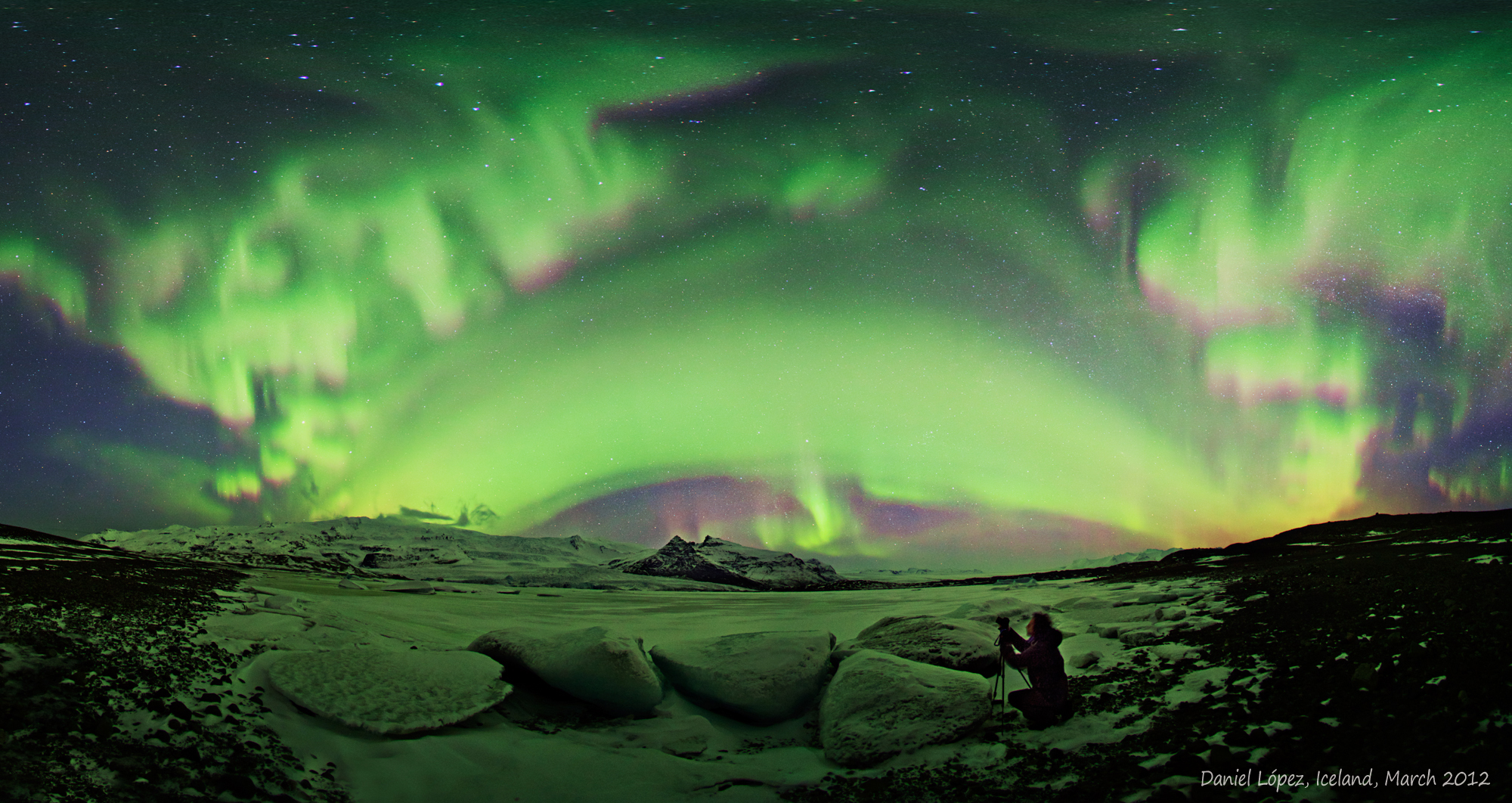
Aurora Over Iceland
Image Credit & Copyright: Daniel Lopez (El Cielo de Canarias)  


Explanation: If you see a sky like this — photograph it. Three nights ago in Iceland, an adventurous photographer (pictured) chanced across a sky full of aurora and did just that. Afterwards, by stitching together five smaller photographs, the entire aurora-lit sky was recreated in this 180-degree panorama taken from Vatnajökull glacier. Auroras are sparked by energetic particles from the Sun impacting the magnetic environment around the Earth. Resultant energetic particles such as electrons and protons rain down near the Earth’s poles and impact the air. The impacted air molecules obtain excited electrons, and when electrons in oxygen molecules fall back to their ground state, they emit green light. Auroras are known to have many shapes and colors.

Astronomy Picture of the Day for Mar. 7 – The Witch Head Nebula

Astronomy Picture of the Day

Discover the cosmos!Each day a different image or photograph of our fascinating universe is featured, along with a brief explanation written by a professional astronomer.

See Explanation.  Clicking on the picture will download the highest resolution version available.

IC 2118: The Witch Head Nebula
Image Credit & Copyright: Gimmi Ratto & Davide Bardini (Collecting Photons) 

Explanation: Double, double toil and trouble; Fire burn, and cauldron bubble — maybe Macbeth should have consulted the Witch Head Nebula. This suggestively shaped reflection nebula is associated with the bright star Rigel in the constellation Orion. More formally known as IC 2118, the Witch Head Nebula glows primarily by light reflected from bright star Rigel, located just below the lower edge of the above image. Fine dust in the nebula reflects the light. The blue color is caused not only by Rigel’s blue color but because the dust grains reflect blue light more efficiently than red. The same physical process causes Earth’s daytime sky to appear blue, although the scatterers in Earth’s atmosphere are molecules of nitrogen and oxygen. The nebula lies about 1000 light-years away.

Astronomy Picture of the Day for Feb. 23 – A Zodiacal Skyscape

Astronomy Picture of the Day

Discover the cosmos!Each day a different image or photograph of our fascinating universe is featured, along with a brief explanation written by a professional astronomer.

2012 February 23
See Explanation.  Clicking on the picture will download the highest resolution version available.

A Zodiacal Skyscape
Image Credit & Copyright: Jack Fusco 

Explanation: Venus and Jupiter are this month’s two brightest planets. Shortly after sunset on February 20, they dominate the sky above the western horizon and this snowy landscape. In clear and transparent skies over Cherry Springs State Park, Pennsylvania, USA, they are also seen immersed in Zodiacal light. The extended, diffuse, triangular glow is sunlight scattered by dust along the plane of the ecliptic. Brighter near the horizon, the Zodiacal glow angles upward, first to Venus and then to Jupiter hugging the ecliptic as they orbit the Sun. Fading even further, the glow stretches toward the lovely Pleides star cluster near the top of the frame. Following their appearance in this Zodiacal skyscape, the coming days will see Venus and Jupiter sharing the early evening sky with a young crescent Moon. The two bright planets are even headed for a close pairing or conjunction, separated by about 3 degrees on March 13.

Astronomy Picture of the Day for February 18th

Astronomy Picture of the Day

Discover the cosmos!Each day a different image or photograph of our fascinating universe is featured, along with a brief explanation written by a professional astronomer.

2012 February 18
See Explanation.Moving the cursor over the image will bring up an annotated version.Clicking on the image will bring up the highest resolution versionavailable.

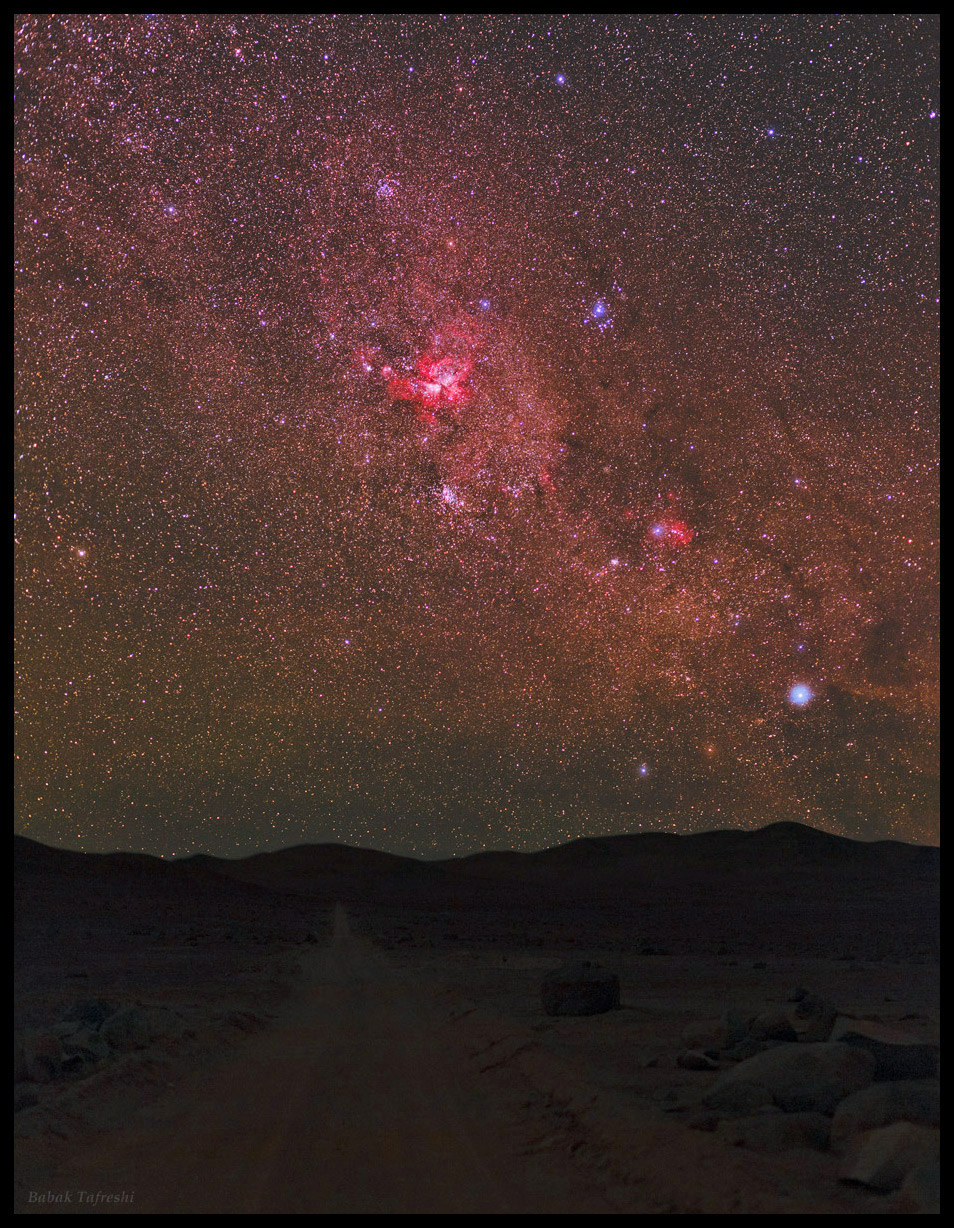
On the Road to Carina
Image Credit & Copyright: Babak Tafreshi (TWAN)


Explanation: This rugged road through the dark Atacama Desert seems to lead skyward toward the bright stars and glowing nebulae of the southern Milky Way. If you follow the road you will get to Cerro Armazones peak in Chile, future construction site for the 40-meter class European Extremely Large Telescope. For now though, sliding your cursor across the image will identify wonders of the southern skies in view. The scene is dominated by the reddish glow of the Great Carina Nebula, one of our galaxy’s largest star forming regions. In fact, the remarkable skyscape is not a composite of varying exposures or a photomontage. Far from sources of light pollution, the landscape illuminated by starlight and the Milky Way above were recorded by a modified digital camera and fast lens. The sensitive system captured both planet Earth and deep sky in a relatively short exposure.

Astronomy Picture of the Day for February 11

Astronomy Picture of the Day

Discover the cosmos!Each day a different image or photograph of our fascinating universe is featured, along with a brief explanation written by a professional astronomer.

2012 January 17
See Explanation.  Clicking on the picture will download the highest resolution version available.

IC 2118: The Witch Head Nebula
Image Credit & Copyright: Gimmi Ratto & Davide Bardini (Collecting Photons) 


Explanation: Double, double toil and trouble; Fire burn, and cauldron bubble — maybe Macbeth should have consulted the Witch Head Nebula. This suggestively shaped reflection nebula is associated with the bright star Rigel in the constellation Orion. More formally known as IC 2118, the Witch Head Nebula glows primarily by light reflected from bright star Rigel, located just below the lower edge of the above image. Fine dust in the nebula reflects the light. The blue color is caused not only by Rigel’s blue color but because the dust grains reflect blue light more efficiently than red. The same physical process causes Earth’s daytime sky to appear blue, although the scatterers in Earth’s atmosphere are molecules of nitrogen and oxygen. The nebula lies about 1000 light-years away.

Astronomy Picture of the Day for Thursday, Feb. 9th

Astronomy Picture of the Day

Discover the cosmos!Each day a different image or photograph of our fascinating universe is featured, along with a brief explanation written by a professional astronomer.

See Explanation.  Clicking on the picture will download the highest resolution version available.

Nobels for a Strange Universe
Image Credit: High-Z Supernova Search Team, HST, NASA


Explanation: Thirteen years ago results were first presented indicating that most of the energy in our universe is not in stars or galaxies but is tied to space itself. In the language of cosmologists, a large cosmological constant is directly implied by new distant supernova observations. Suggestions of a cosmological constant (lambda) were not new — they have existed since the advent of modern relativistic cosmology. Such claims were not usually popular with astronomers, though, because lambda is so unlike known universe components, because lambda’s value appeared limited by other observations, and because less-strange cosmologies without lambda had previously done well in explaining the data. What is noteworthy here is the seemingly direct and reliable method of the observations and the good reputations of the scientists conducting the investigations. Over the past thirteen years, independent teams of astronomers have continued to accumulate data that appears to confirm the existence of dark energy and the unsettling result of a presently accelerating universe. This year, the team leaders were awarded the Nobel Prize in Physics for their work. The above picture of a supernova that occurred in 1994 on the outskirts of a spiral galaxy was taken by one of these collaborations.

Astronomy Picture of the Day for February 8

Astronomy Picture of the Day

Discover the cosmos!Each day a different image or photograph of our fascinating universe is featured, along with a brief explanation written by a professional astronomer.

2012 February 8
See Explanation.  Clicking on the picture will download the highest resolution version available.

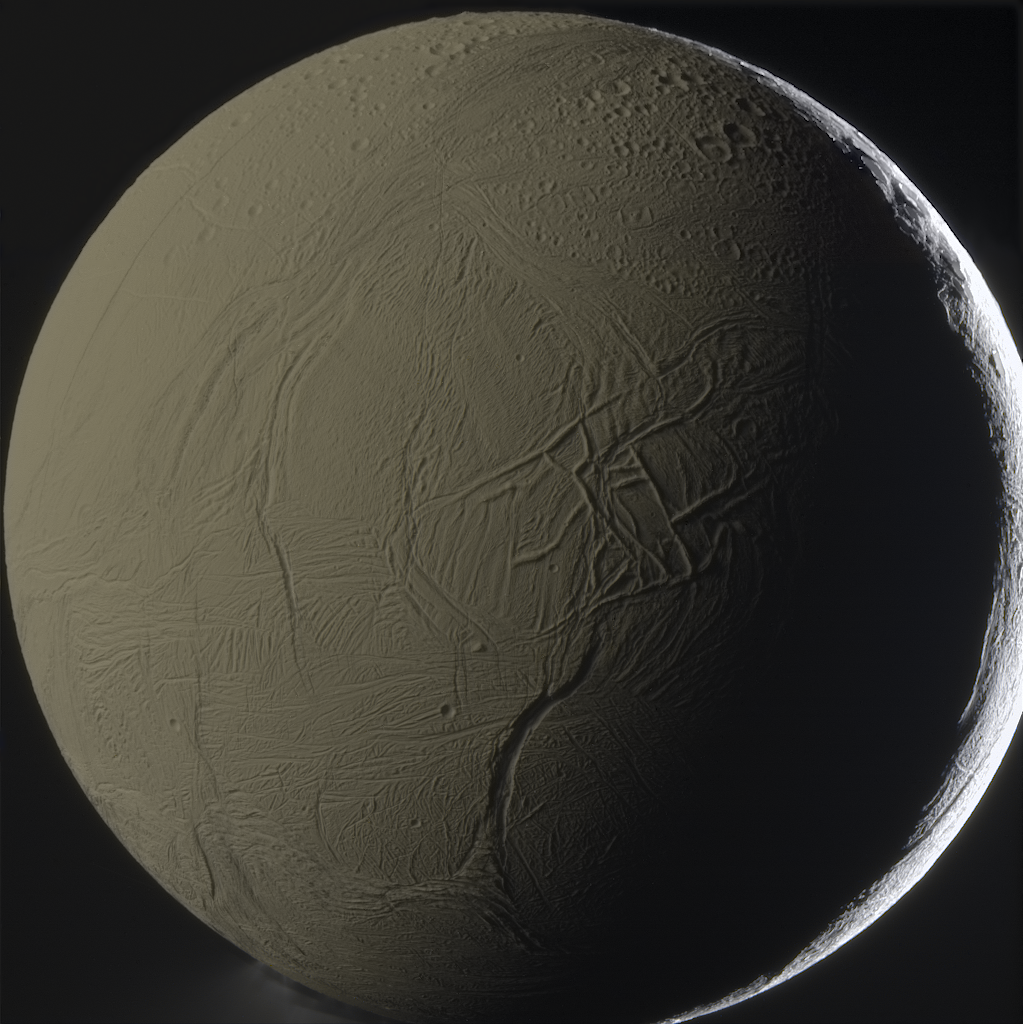
Enceladus Backlit by Saturn
Image Credit: Cassini Imaging Team, SSI, JPL, ESA, NASA; Color Composite: Gordan Ugarkovic 

Explanation: This moon is shining by the light of its planet. Specifically, a large portion of Enceladus pictured above is illuminated primarily by sunlight first reflected from the planet Saturn. The result is that the normally snow-white moon appears in the gold color of Saturn’s cloud tops. As most of the illumination comes from the image left, a labyrinth of ridges throws notable shadows just to the right of the image center, while the kilometer-deep canyon Labtayt Sulci is visible just below. The bright thin crescent on the far right is the only part of Enceladus directly lit by the Sun. The above image was taken last year by the robotic Cassini spacecraft during a close pass by by the enigmatic moon. Inspection of the lower part of this digitally sharpened image reveals plumes of ice crystals thought to originate in a below-surface sea.

Astronomy Picture of the Day for Feb. 6th

Astronomy Picture of the Day

Discover the cosmos!Each day a different image or photograph of our fascinating universe is featured, along with a brief explanation written by a professional astronomer.

2012 February 6
See Explanation.  Clicking on the picture will download the highest resolution version available.

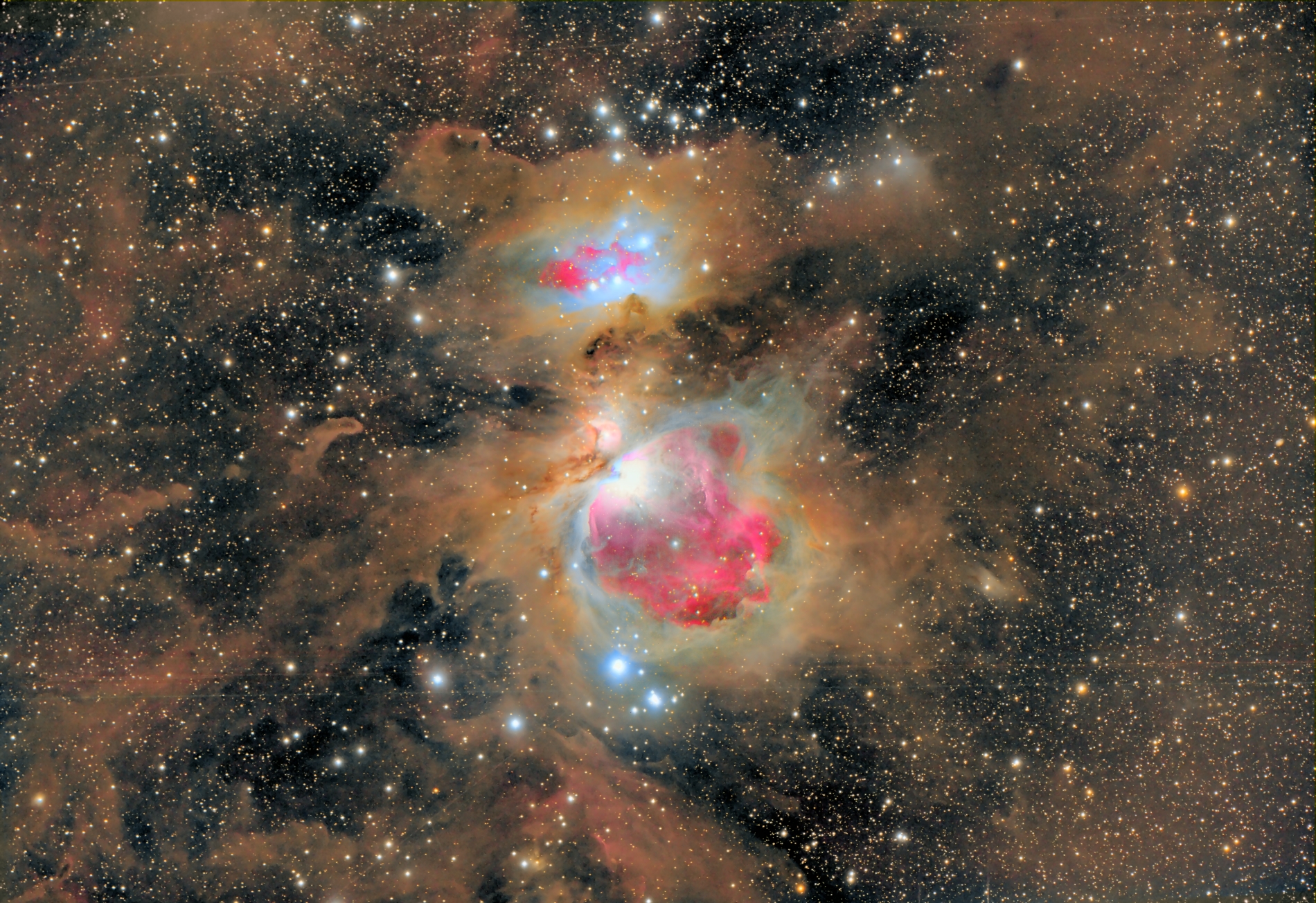
Dust of the Orion Nebula
Image Credit & Copyright: Nicolás Villegas 

Explanation: What surrounds a hotbed of star formation? In the case of the Orion Nebula — dust. The entire Orion field, located about 1600 light years away, is inundated with intricate and picturesque filaments of dust. Opaque to visible light, dust is created in the outer atmosphere of massive cool stars and expelled by a strong outer wind of particles. The Trapezium and other forming star clusters are embedded in the nebula. The intricate filaments of dust surrounding M42 and M43 appear brown in the above image, while central glowing gas is highlighted in red. Over the next few million years much of Orion’s dust will be slowly destroyed by the very stars now being formed, or dispersed into the Galaxy.

Astronomy Picture of the Day for Feb. 4th

Astronomy Picture of the Day

Discover the cosmos!Each day a different image or photograph of our fascinating universe is featured, along with a brief explanation written by a professional astronomer.

2012 February 4
See Explanation.  Clicking on the picture will download the highest resolution version available.

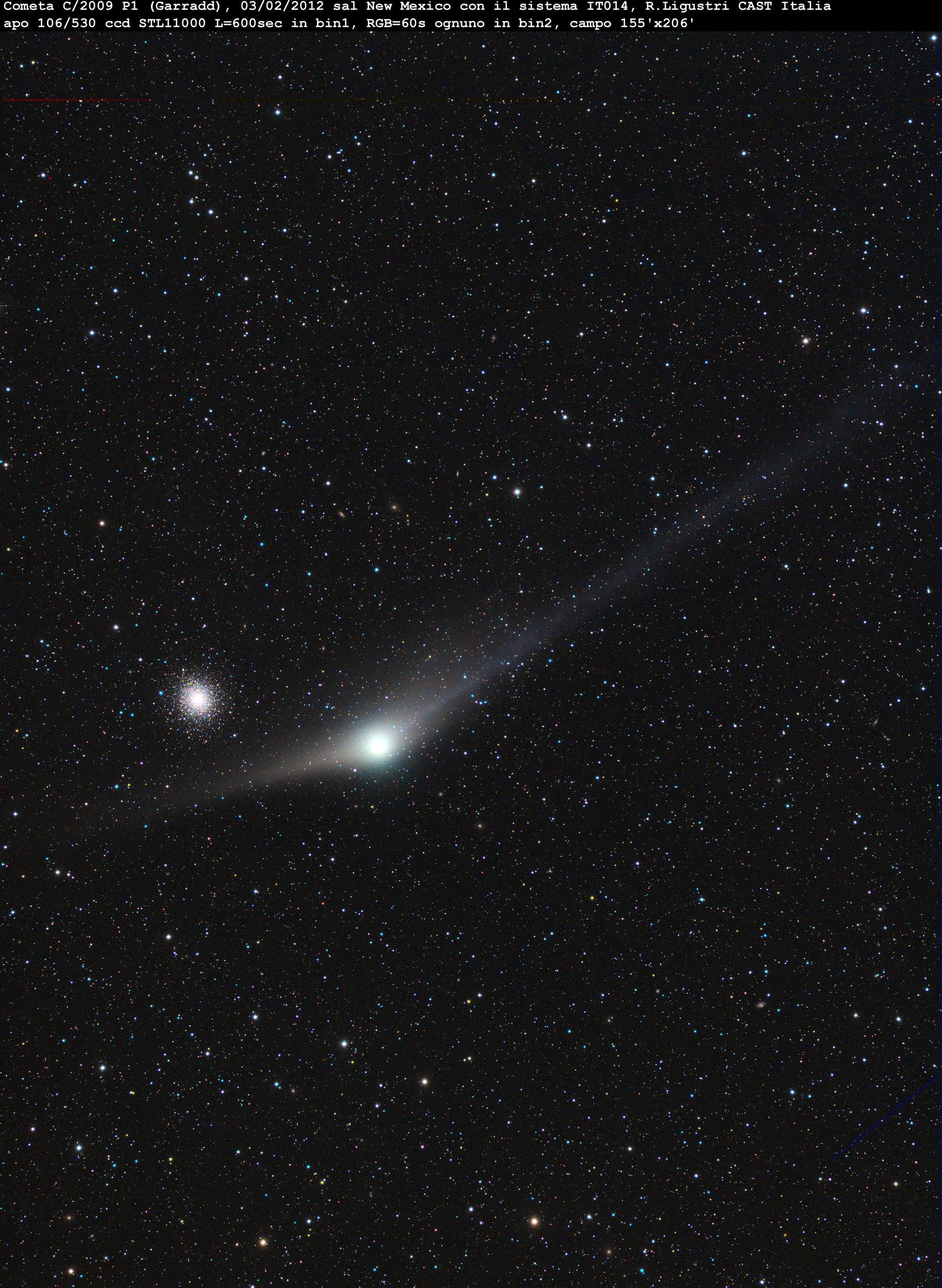
Comet Garradd and M92
Image Credit & Copyright: Rolando Ligustri (CARA Project, CAST) 

Explanation: Sweeping slowly through the constellation Hercules, Comet Garradd (C2009/P1) passed with about 0.5 degrees of globular star cluster M92 on February 3. Captured here in its latest Messier moment, the steady performer remains just below naked-eye visibility with a central coma comparable in brightness to the dense, well-known star cluster. The rich telescopic view from New Mexico’s, early morning skies, also features Garradd’s broad fan shaped dust tail and a much narrower ion tail that extends up and beyond the right edge of the frame. Pushed out by the pressure of sunlight, the dust tail tends to trail the comet along its orbit while the ion tail, blown by the solar wind, streams away from the comet in the direction opposite the Sun. Of course, M92 is over 25,000 light-years away. Comet Garradd is 12.5 light-minutes from planet Earth, arcing above the ecliptic plane.

Astronomy Picture of the Day for February 3rd

Astronomy Picture of the Day

Discover the cosmos!Each day a different image or photograph of our fascinating universe is featured, along with a brief explanation written by a professional astronomer.

2012 February 3
See Explanation.  Clicking on the picture will download the highest resolution version available.

Inside the Eagle Nebula
Credit: Far-infrared: ESA/Herschel/PACS/SPIRE/Hill, Motte, HOBYS Key Programme Consortium;
X-ray: ESA/XMM-Newton/EPIC/XMM-Newton-SOC/Boulanger 

Explanation: In 1995, a now famous picture from the Hubble Space Telescope featured Pillars of Creation, star forming columns of cold gas and dust light-years long inside M16, the Eagle Nebula. This remarkable false-color composite image revisits the nearby stellar nursery with image data from the orbiting Herschel Space Observatory and XMM-Newton telescopes. Herschel’s far infrared detectors record the emission from the region’s cold dust directly, including the famous pillars and other structures near the center of the scene. Toward the other extreme of the electromagnetic spectrum, XMM-Newton’s X-ray vision reveals the massive, hot stars of the nebula’s embedded star cluster. Hidden from Hubble’s view at optical wavelengths, the massive stars have a profound effect, sculpting and transforming the natal gas and dust structures with their energetic winds and radiation. In fact, the massive stars are short lived and astronomers have found evidence in the image data pointing to the remnant of a supernova explosion with an apparent age of 6,000 years. If true, the expanding shock waves would have destroyed the visible structures, including the famous pillars. But because the Eagle Nebula is some 6,500 light-years distant, their destruction won’t be witnessed for hundreds of years.

Astronomy Picture of the Day

Astronomy Picture of the Day

Discover the cosmos!Each day a different image or photograph of our fascinating universe is featured, along with a brief explanation written by a professional astronomer.

2012 January 31
See Explanation.  Clicking on the picture will download the highest resolution version available.

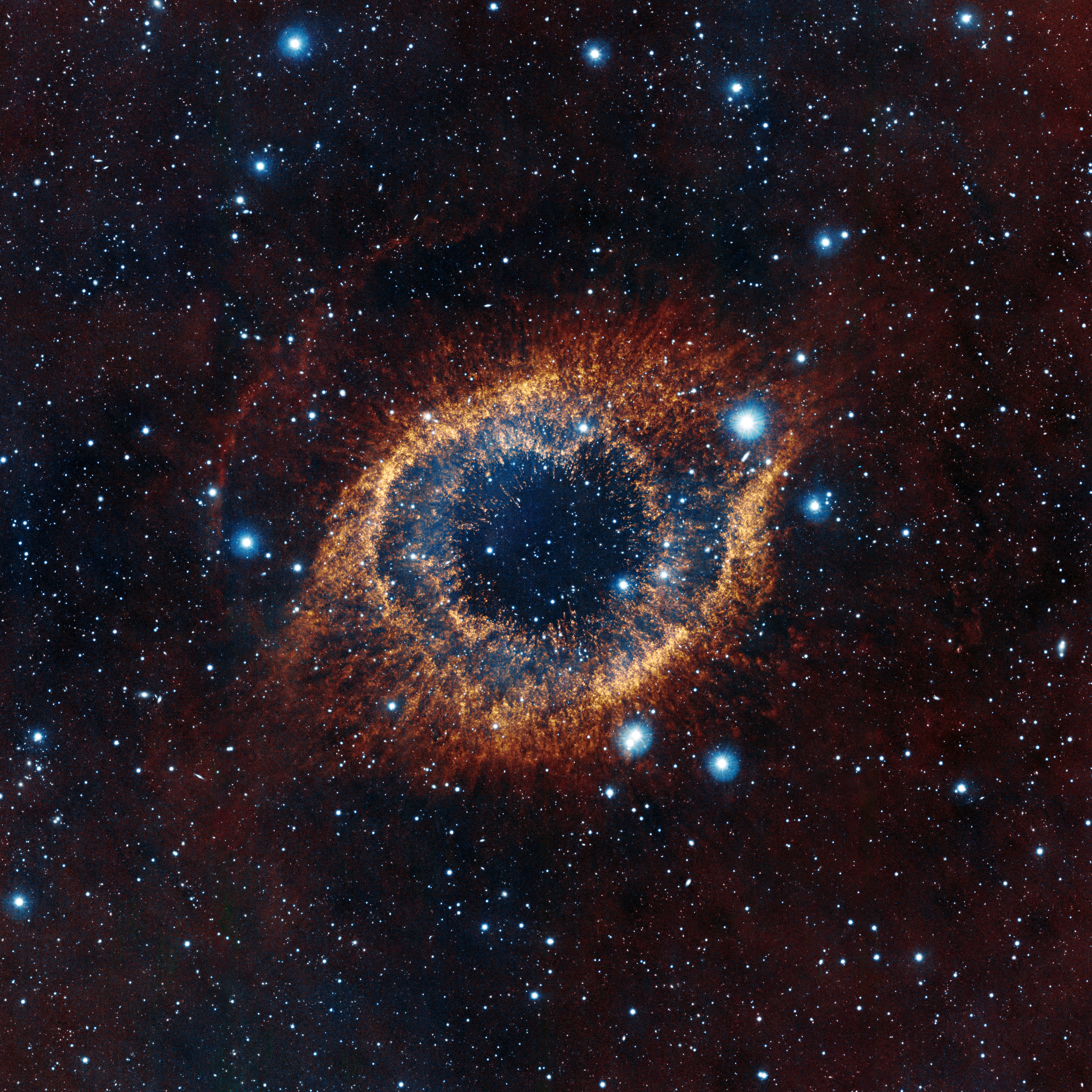
The Helix Nebula from the VISTA Telescope
Credit: ESO/VISTA/J. Emerson; Acknowledgment: Cambridge Astronomical Survey Unit  


Explanation: Will our Sun look like this one day? The Helix Nebula is one of brightest and closest examples of a planetary nebula, a gas cloud created at the end of the life of a Sun-like star. The outer gasses of the star expelled into space appear from our vantage point as if we are looking down a helix. The remnant central stellar core, destined to become a white dwarf star, glows in light so energetic it causes the previously expelled gas to fluoresce. The Helix Nebula, given a technical designation of NGC 7293, lies about 700 light-years away towards the constellation of the Water Bearer (Aquarius) and spans about 2.5 light-years. The above picture was taken three colors on infrared light by the 4.1-meter Visible and Infrared Survey Telescope for Astronomy (VISTA) at the European Southern Observatory’s Paranal Observatory in Chile. A close-up of the inner edge of the Helix Nebula shows complex gas knots of unknown origin.

Astronomy Picture of the Day for Jan. 29th

Astronomy Picture of the Day

Discover the cosmos!Each day a different image or photograph of our fascinating universe is featured, along with a brief explanation written by a professional astronomer.

2012 January 29
See Explanation.  Clicking on the picture will download the highest resolution version available.

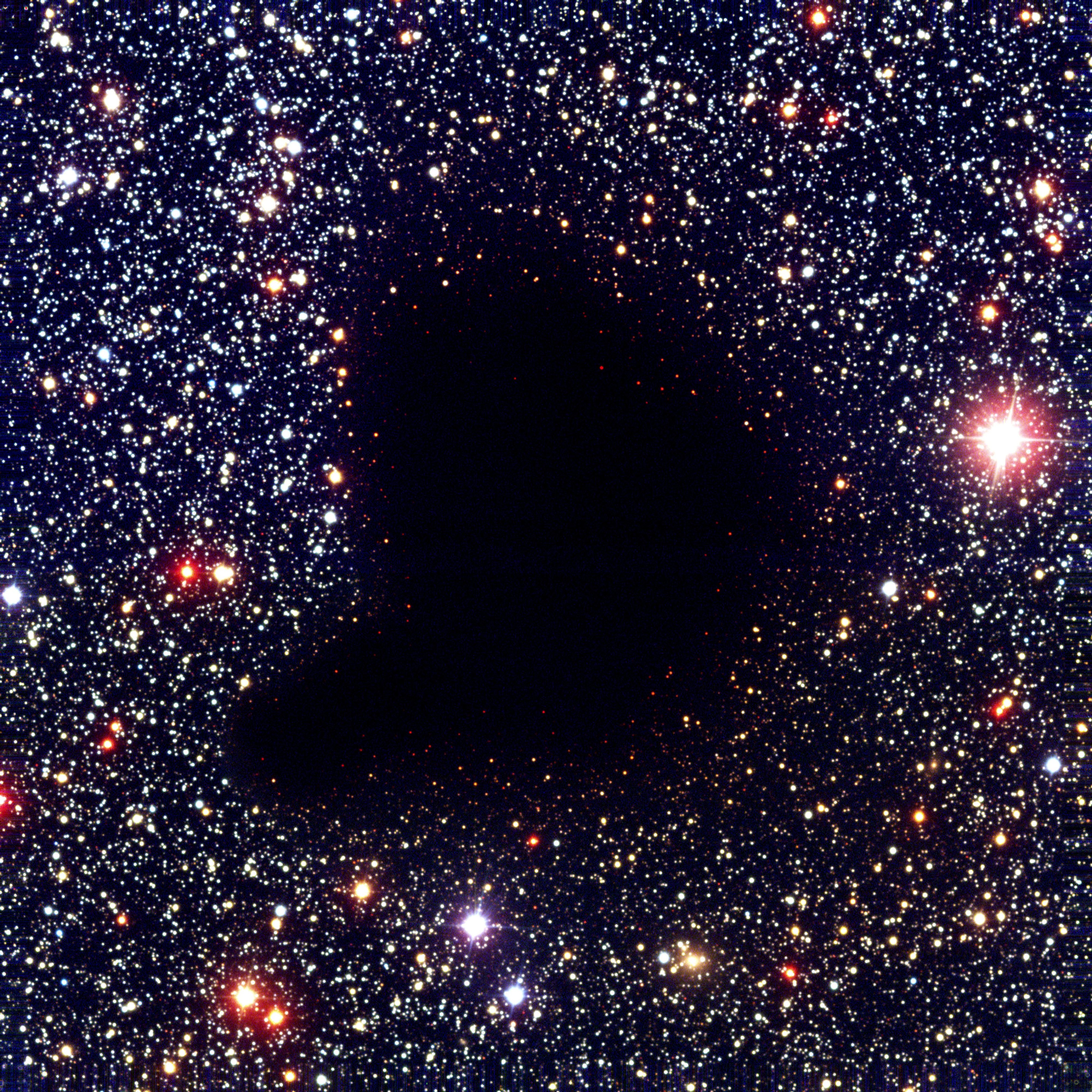
Molecular Cloud Barnard 68
Image Credit: FORS Team, 8.2-meter VLT Antu, ESO 


Explanation: Where did all the stars go? What used to be considered a hole in the sky is now known to astronomers as a dark molecular cloud. Here, a high concentration of dust and molecular gas absorb practically all the visible light emitted from background stars. The eerily dark surroundings help make the interiors of molecular clouds some of the coldest and most isolated places in the universe. One of the most notable of these dark absorption nebulae is a cloud toward the constellation Ophiuchus known as Barnard 68, pictured above. That no stars are visible in the center indicates that Barnard 68 is relatively nearby, with measurements placing it about 500 light-years away and half a light-year across. It is not known exactly how molecular clouds like Barnard 68 form, but it is known that these clouds are themselves likely places for new stars to form. In fact, Barnard 68 itself has been found likely to collapse and form a new star system. It is possible to look right through the cloud in infrared light.

Astronomy Picture of the Day for Jan. 28th

Astronomy Picture of the Day

Discover the cosmos!Each day a different image or photograph of our fascinating universe is featured, along with a brief explanation written by a professional astronomer.

2012 January 28
See Explanation.  Clicking on the picture will download the highest resolution version available.

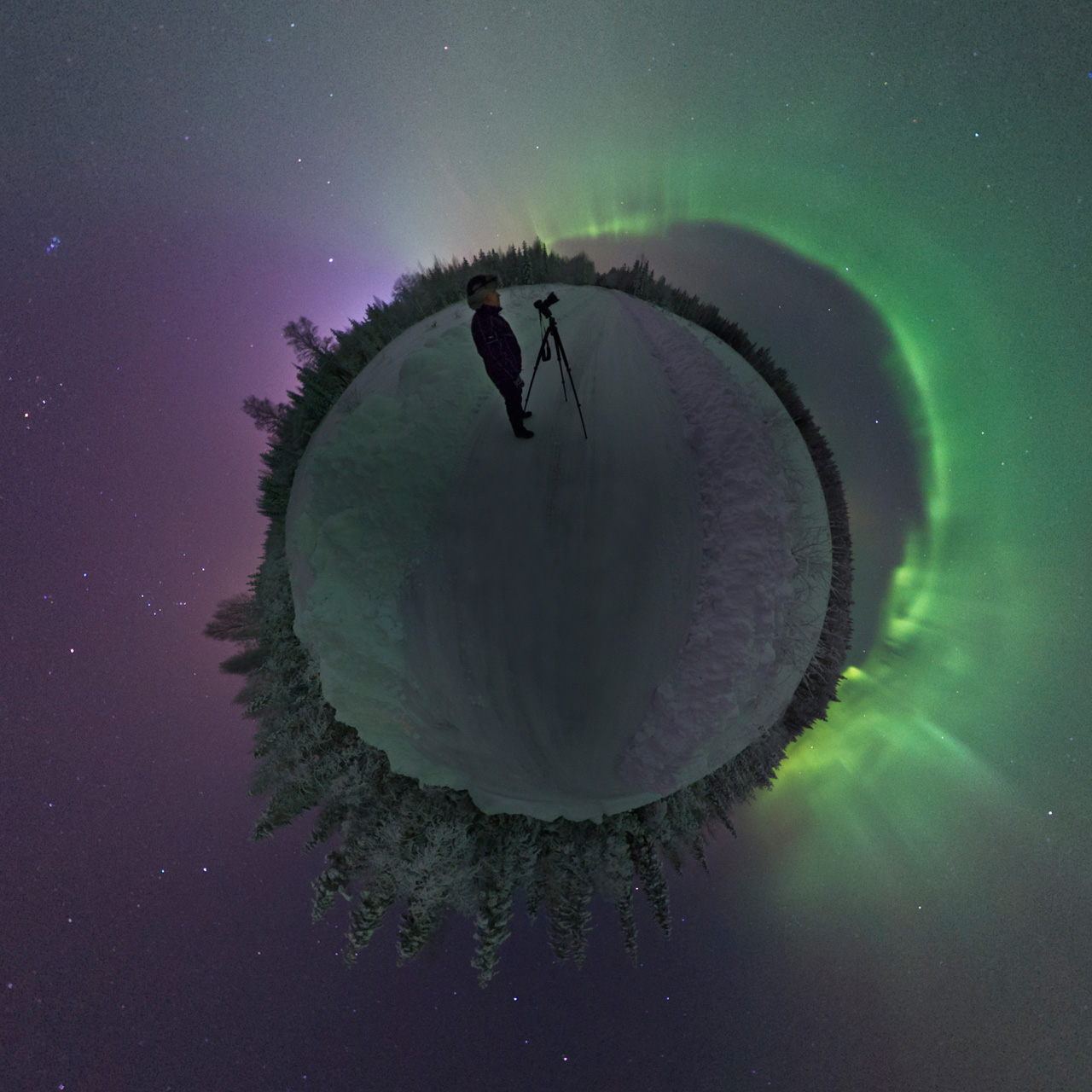
Planet Aurora Borealis
Image Credit & Copyright: Göran Strand 

Explanation: Illuminated by an eerie greenish light, this remarkable little planet is covered with ice and snow and ringed by tall pine trees. Of course, this little planet is actually planet Earth, and the surrounding stars are above the horizon near Östersund, Sweden. The pale greenish illumination is from a curtain of shimmering Aurora Borealis also known as the Northern Lights. The display was triggered when a giant solar coronal mass ejection (CME) rocked planet Earth’s magnetosphere on January 24th and produced a strong geomagnetic storm. Northern hemisphere skygazers will also recognize the familiar orientation of stars at the left, including the Pleiades and Hyades star clusters and the stars of Orion. Increasing solar activity has caused recent auroral displays to be wide spread, including Aurora Australis, the Southern Lights, at high southern latitudes.

Astronomy Picture of the Day for Jan. 27th

Astronomy Picture of the Day

Discover the cosmos!Each day a different image or photograph of our fascinating universe is featured, along with a brief explanation written by a professional astronomer.

2012 January 27
See Explanation.  Clicking on the picture will download the highest resolution version available.

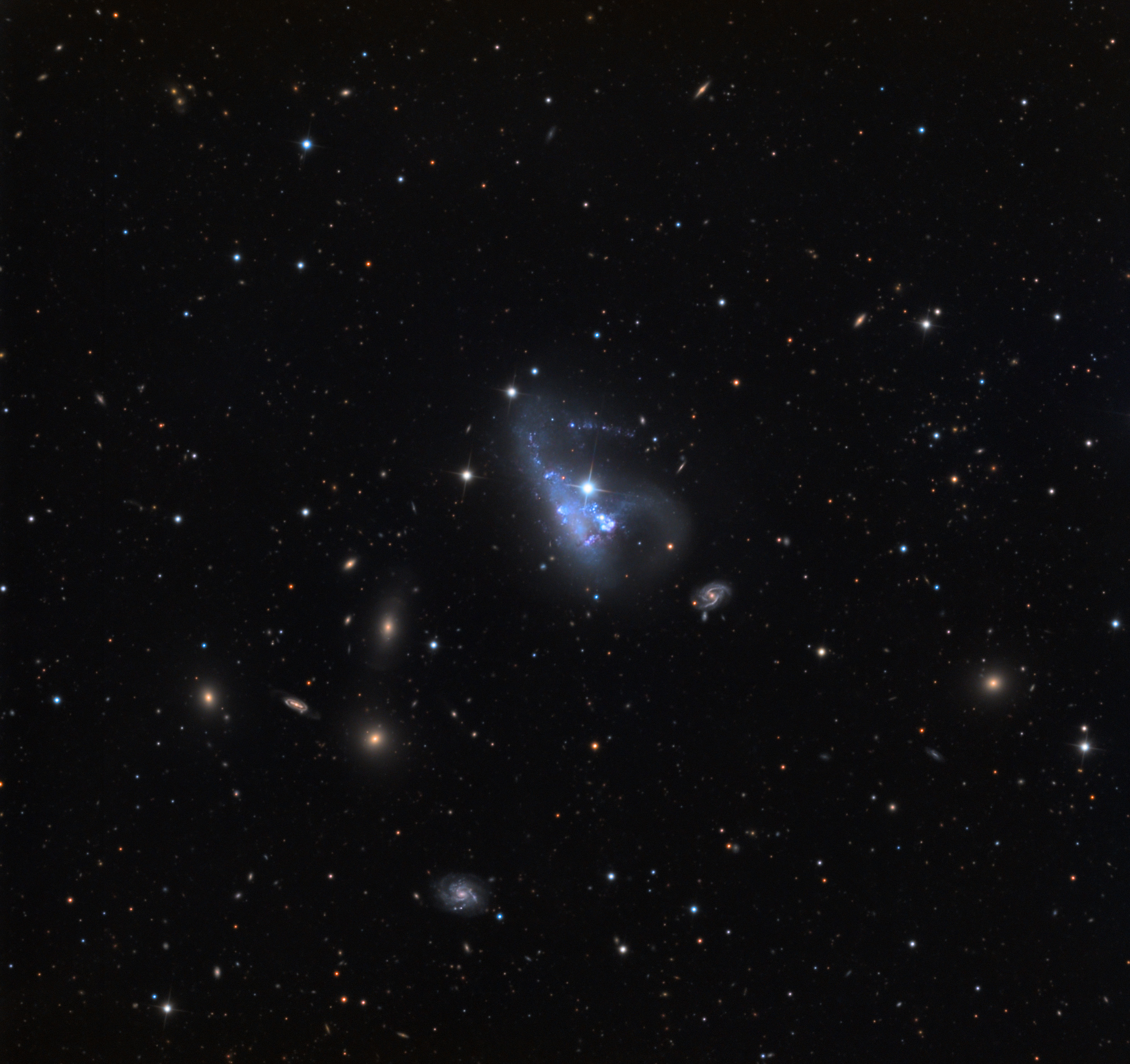
NGC 3239 and SN 2012A
Image Credit & Copyright: Adam Block, Mt. Lemmon SkyCenter, University of Arizona 


Explanation: About 40,000 light-years across, pretty, irregular galaxy NGC 3239 lies near the center of this lovely field of galaxies in the galaxy rich constellation Leo. At a distance of only 25 million light-years it dominates the frame, sporting a peculiar arrangement of structures, young blue star clusters and star forming regions, suggesting that NGC 3239 (aka Arp 263) is the result of a galaxy merger. Appearing nearly on top of the pretty galaxy is a bright, spiky, foreground star, a nearby member of our own Milky Way galaxy almost directly along our line-of-sight to NGC 3239. Still, NGC 3239 is notable for hosting this year’s first confirmed supernova, designated SN 2012A. It was discovered early this month by supernova hunters Bob Moore, Jack Newton, and Tim Puckett. Indicated in a cropped version of the wider image, SN 2012A is just below and right of the bright foreground star. Of course, based on the light-travel time to NGC 3239, the supernova explosion itself occurred 25 million years ago, triggered by the core collapse of a massive star.