Astronomy Picture of the Day

Discover the cosmos! Each day a different image or photograph of our fascinating universe is featured, along with a brief explanation written by a professional astronomer.

2021 November 25
At the Shadow’s Edge

Image Credit & Copyright: Jean-Francois Gout

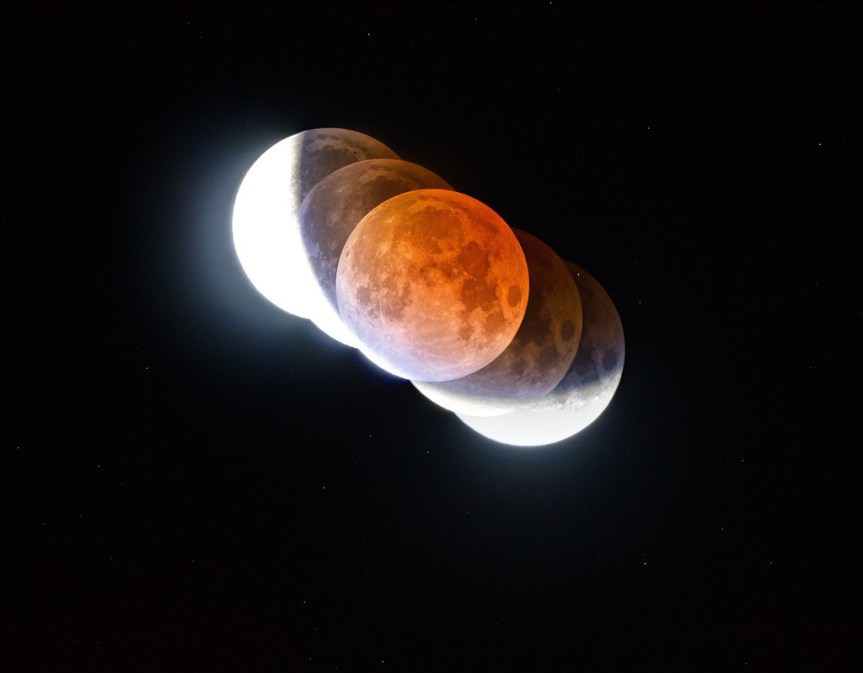
Explanation: Shaped like a cone tapering into space, the Earth’s dark central shadow or umbra has a circular cross-section. It’s wider than the Moon at the distance of the Moon’s orbit though. But during the lunar eclipse of November 18/19, part of the Moon remained just outside the umbral shadow. The successive pictures in this composite of 5 images from that almost total lunar eclipse were taken over a period of about 1.5 hours. The series is aligned to trace part of the cross-section’s circular arc, with the central image at maximum eclipse. It shows a bright, thin sliver of the lunar disk still beyond the shadow’s curved edge. Of course, even within the shadow the Moon’s surface is not completely dark, reflecting the reddish hues of filtered sunlight scattered into the shadow by Earth’s atmosphere.


Notable APOD Submissions: Lunar Eclipse of 2021 November 19
Astronomy Picture of the Day

Discover the cosmos! Each day a different image or photograph of our fascinating universe is featured, along with a brief explanation written by a professional astronomer.

2021 November 24

Pleiades: The Seven Sisters Star Cluster

Image Credit & Copyright: Damien Cannane

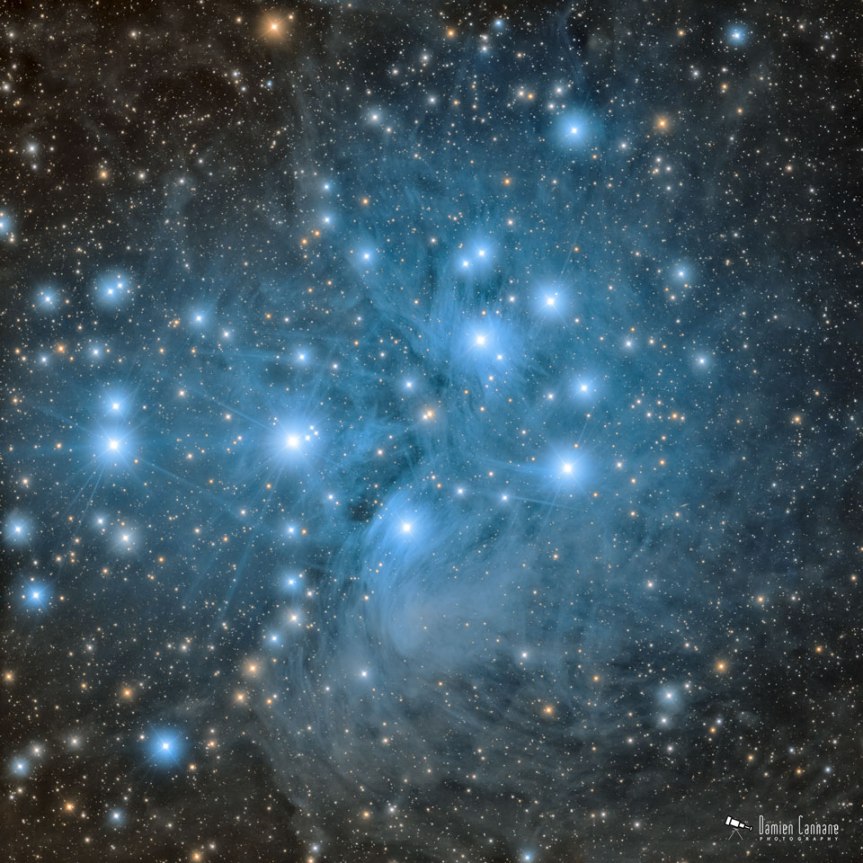
Explanation: Have you ever seen the Pleiades star cluster? Even if you have, you probably have never seen it as large and clear as this. Perhaps the most famous star cluster on the sky, the bright stars of the Pleiades can be seen without binoculars from even the depths of a light-polluted city. With a long exposure from a dark location, though, the dust cloud surrounding the Pleiades star cluster becomes very evident. The featured exposure, taken from Florida, USA, covers a sky area several times the size of the full moon. Also known as the Seven Sisters and M45the Pleiades lies about 400 light years away toward the constellation of the Bull (Taurus). A common legend with a modern twist is that one of the brighter stars faded since the cluster was named, leaving only six of the sister stars visible to the unaided eye. The actual number of Pleiades stars visible, however, may be more or less than seven, depending on the darkness of the surrounding sky and the clarity of the observer’s eyesight.


Volunteer Opportunity: Someone to Update APOD’s RSS Feed

Astronomy Picture of the Day

Discover the cosmos! Each day a different image or photograph of our fascinating universe is featured, along with a brief explanation written by a professional astronomer.

2021 November 22

Lunar Eclipse over a Skyscraper

Image Credit & Copyright: Yuri Beletsky (Carnegie Las Campanas ObservatoryTWAN)

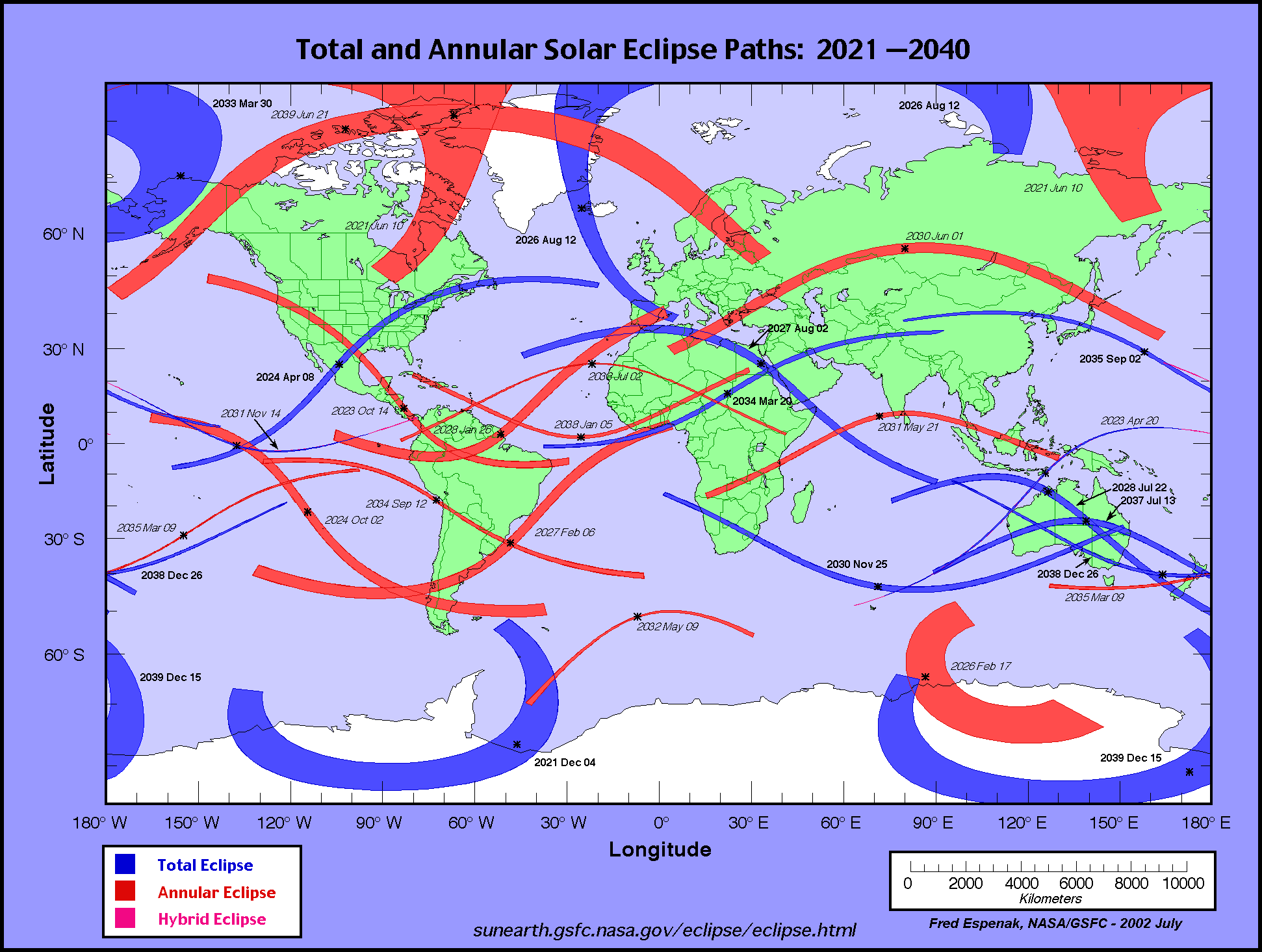
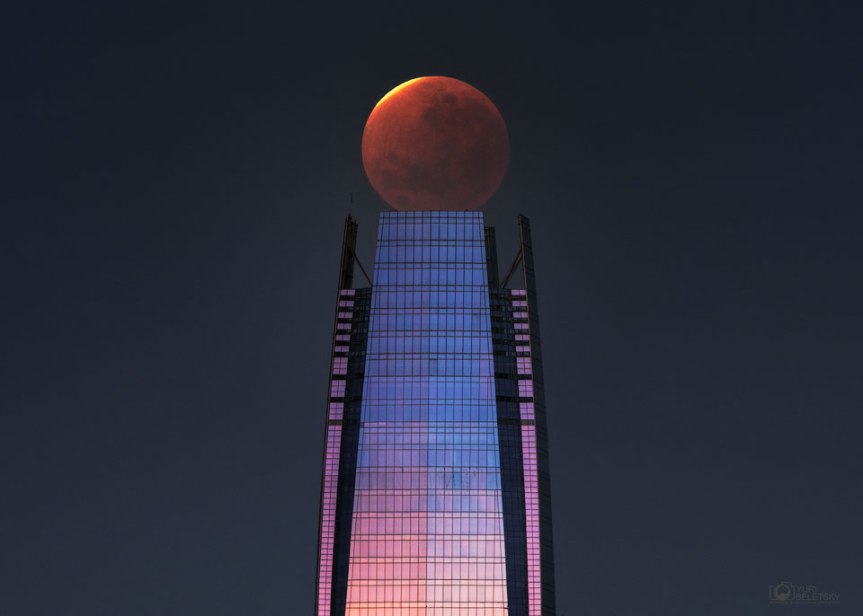
Explanation: Why is the Moon on top of this building? Planning. It took the astrophotographer careful planning — including figuring out exactly where to place the camera and exactly when to take the shot — to create this striking superposition. The single image featured was taken in the early morning hours of November 19, near the peak of the partial lunar eclipse that was occurring as the Moon passed through the Earth’s shadow. At this time, almost the entire Moon — 99.1 percent of its area — was in the darkest part of the Earth’s shadow. The building is the Gran Torre Santiago building in Chile, the tallest building in South America. Although the entire eclipse lasted an impressive six hours, this image had to be taken within just a few seconds to get the alignment right — the Earth’s rotation soon moved the building out of alignment. The next Earth-Moon eclipse will be a total eclipse of the Sun that will occur on December 4 — but only be visible from the bottom of our world.


APOD Editor (RJN) Online Monday: NASA’s Best Space Images (& Videos)
Notable APOD Submissions: Lunar Eclipse of 2021 November 19
Astronomy Picture of the Day

Discover the cosmos! Each day a different image or photograph of our fascinating universe is featured, along with a brief explanation written by a professional astronomer.

2021 November 21

Introducing Comet Leonard
Image Credit & Copyright: Dan BartlettExplanation: Here comes Comet Leonard. Comet C/2021 A1 (Leonard) was discovered as a faint smudge in January 2021 when it was out past Mars — but its orbit will take the giant shedding ice-ball into the inner Solar System, passing near both Earth and Venus in December before it swoops around the Sun in early January 2022. Although comets are notoriously hard to predict, some estimations have Comet Leonard brightening to become visible to the unaided eye in December. Comet Leonard was captured just over a week ago already sporting a green-tinged coma and an extended dust tail. The featured picture was composed from 62 images taken through a moderate-sized telescope — one set of exposures tracking the comet, while another set tracking the background stars. The exposures were taken from the dark skies above the Eastern Sierra Mountains, near June Lake in CaliforniaUSA. Soon after passing near the Earth in mid-December, the comet will shift from northern to southern skies.


APOD Editor (RJN) Online Monday: NASA’s Best Space Images (& Videos)

Astronomy Picture of the Day

Discover the cosmos! Each day a different image or photograph of our fascinating universe is featured, along with a brief explanation written by a professional astronomer.

2021 November 20

An Almost Total Lunar Eclipse

Image Credit & Copyright: Robert Fedez

Explanation: Predawn hours of November 19 found the Moon in partly cloudy skies over Cancun, Mexico. Captured in this telephoto snapshot, the lunar disk is not quite entirely immersed in Earth’s dark umbral shadow during a long partial lunar eclipse. The partial eclipse was deep though, deep enough to show the dimmed but reddened light in Earth’s shadow. That’s a sight often anticipated by fans of total lunar eclipses. Wandering through the constellation Taurus, the eclipsed Moon’s dimmer light also made it easier to spot the Pleiades star cluster. The stars of the Seven Sisters share this frame at the upper right, with the almost totally eclipsed Moon.


Notable APOD Submissions (so far): Lunar Eclipse of 2021 November 19
Astronomy Picture of the Day

Discover the cosmos! Each day a different image or photograph of our fascinating universe is featured, along with a brief explanation written by a professional astronomer.

2021 November 16

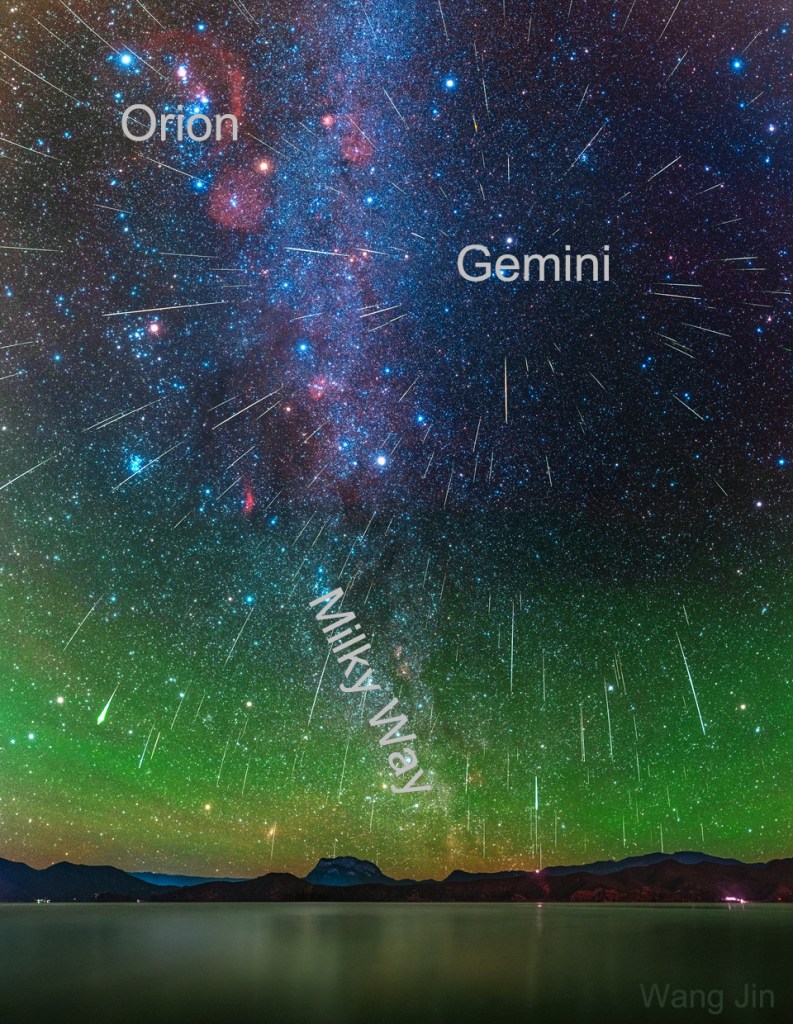
Geminids from Gemini

Image Credit & Copyright: Wang Jin

Explanation: Where are all of these meteors coming from? In terms of direction on the sky, the pointed answer is the constellation of Gemini. That is why the major meteor shower in December is known as the Geminids — because shower meteors all appear to come from a radiant toward Gemini. Three dimensionally, however, sand-sized debris expelled from the unusual asteroid 3200 Phaethon follows a well-defined orbit about our Sun, and the part of the orbit that approaches Earth is superposed in front of the constellation of Gemini. Therefore, when Earth crosses this orbit, the radiant point of falling debris appears in Gemini. Featured here, a composite of many images taken during the 2020 Geminids meteor shower shows over 200 bright meteors that streaked through the sky during the night December 14. The best meteor shower in November, the Leonids, peaks tonight and tomorrow. Unfortunately, this year, dim meteors during the early-morning peak will be hard to see against a sky lit by a bright gibbous moon. Still, a few bright Leonid meteors should be visible each hour.

Astronomy Picture of the Day

Discover the cosmos! Each day a different image or photograph of our fascinating universe is featured, along with a brief explanation w ritten by a professional astronomer.

2021 November 15

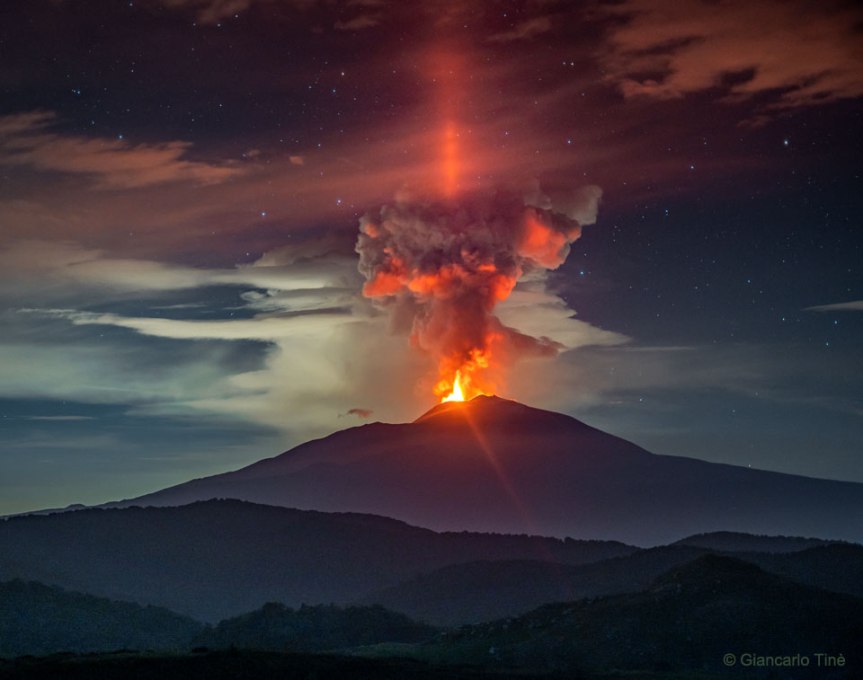
Light Pillar over Volcanic Etna

Image Credit & Copyright: Giancarlo Tinè

Explanation: What happening above that volcano? Something very unusual — a volcanic light pillar. More typically, light pillars are caused by sunlight and so appear as a bright column that extends upward above a rising or setting Sun. Alternatively, other light pillars — some quite colorful — have been recorded above street and house lights. This light pillar, though, was illuminated by the red light emitted by the glowing magma of an erupting volcano. The volcano is Italy‘s Mount Etna, and the featured image was captured with a single shot a few hours after sunset in mid-June. Freezing temperatures above the volcano’s ash cloud created ice-crystals either in cirrus clouds high above the volcano — or in condensed water vapor expelled by Mount Etna. These ice crystals — mostly flat toward the ground but fluttering — then reflected away light from the volcano’s caldera.


Explore Your Universe: Random APOD Generator

Astronomy Picture of the Day

Discover the cosmos! Each day a different image or photograph of our fascinating universe is featured, along with a brief explanation written by a professional astronomer.

2021 November 12

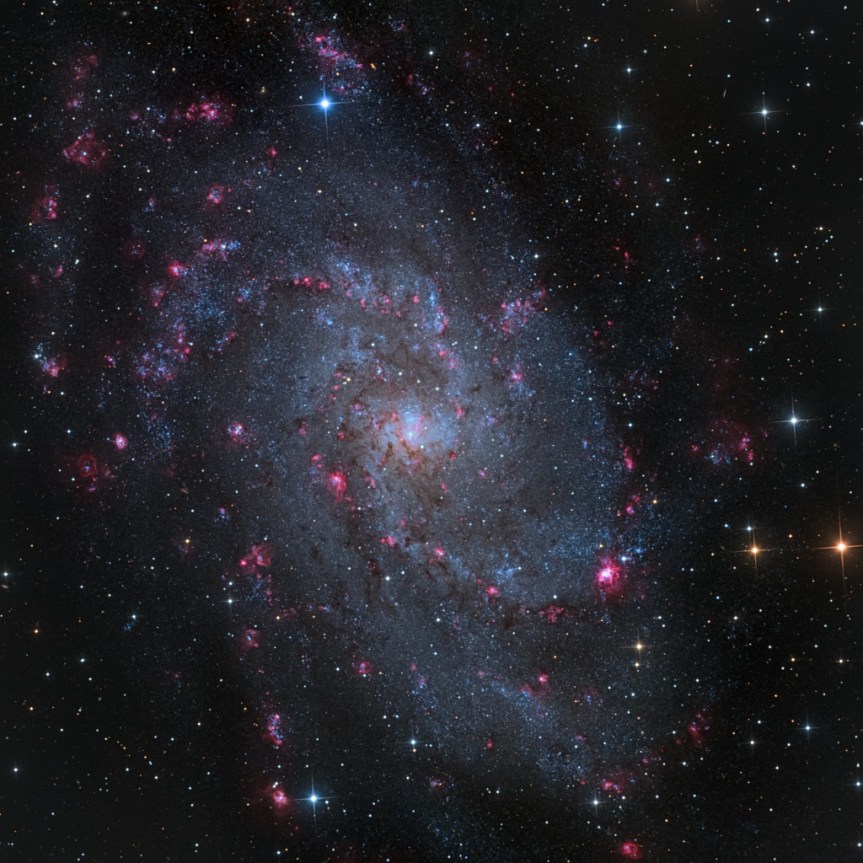
M33: The Triangulum Galaxy

Image Credit & Copyright: Bernard Miller

Explanation: The small, northern constellation Triangulum harbors this magnificent face-on spiral galaxy, M33. Its popular names include the Pinwheel Galaxy or just the Triangulum Galaxy. M33 is over 50,000 light-years in diameter, third largest in the Local Group of galaxies after the Andromeda Galaxy (M31), and our own Milky Way. About 3 million light-years from the Milky Way, M33 is itself thought to be a satellite of the Andromeda Galaxy and astronomers in these two galaxies would likely have spectacular views of each other’s grand spiral star systems. As for the view from planet Earth, this sharp image shows off M33’s blue star clusters and pinkish star forming regions along the galaxy’s loosely wound spiral arms. In fact, the cavernous NGC 604 is the brightest star forming region, seen here at about the 4 o’clock position from the galaxy center. Like M31, M33’s population of well-measured variable stars have helped make this nearby spiral a cosmic yardstick for establishing the distance scale of the Universe.

Astronomy Picture of the Day

Discover the cosmos! Each day a different image or photograph of our fascinating universe is featured, along with a brief explanation written by a professional astronomer.

2021 November 11

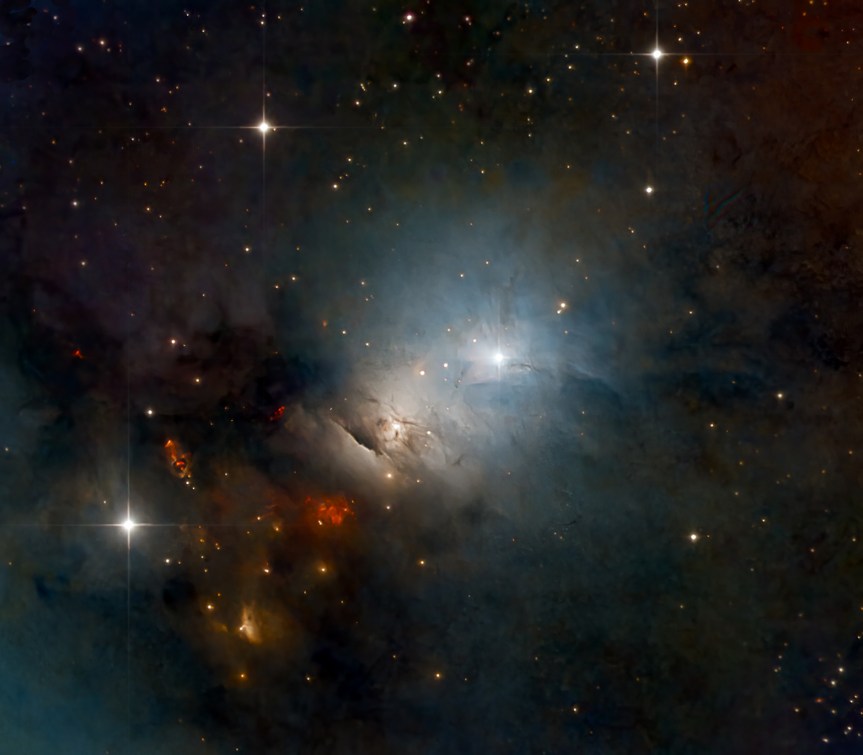
NGC 1333: Stellar Nursery in Perseus

Image Credit & Copyright: Michael Sherick

Explanation: NGC 1333 is seen in visible light as a reflection nebula, dominated by bluish hues characteristic of starlight reflected by interstellar dust. A mere 1,000 light-years distant toward the heroic constellation Perseus, it lies at the edge of a large, star-forming molecular cloud. This telescopic close-up spans about two full moons on the sky or just over 15 light-years at the estimated distance of NGC 1333. It shows details of the dusty region along with telltale hints of contrasty red emission from Herbig-Haro objects, jets and shocked glowing gas emanating from recently formed stars. In fact, NGC 1333 contains hundreds of stars less than a million years old, most still hidden from optical telescopes by the pervasive stardust. The chaotic environment may be similar to one in which our own Sun formed over 4.5 billion years ago.

Astronomy Picture of the Day

Discover the cosmos! Each day a different image or photograph of our fascinating universe is featured, along with a brief explanation written by a professional astronomer.

2021 November 8

A Filament Leaps from the Sun

Video Credit & Copyright: Stéphane PoirierExplanation: Why, sometimes, does part of the Sun’s atmosphere leap into space? The reason lies in changing magnetic fields that thread through the Sun‘s surface. Regions of strong surface magnetism, known as active regions, are usually marked by dark sunspots. Active regions can channel charged gas along arching or sweeping magnetic fields — gas that sometimes falls backsometimes escapes, and sometimes not only escapes but impacts our Earth. The featured one-hour time-lapse video — taken with a small telescope in France — captured an eruptive filament that appeared to leap off the Sun late last month. The filament is huge: for comparison, the size of the Earth is shown on the upper left. Just after the filament lifted off, the Sun emitted a powerful X-class flare while the surface rumbled with a tremendous solar tsunami. A result was a cloud of charged particles that rushed into our Solar System but mostly missed our Earth — this time. However, enough solar plasma did impact our Earth’s magnetosphere to create a few faint auroras.

Astronomy Picture of the Day

Discover the cosmos! Each day a different image or photograph of our fascinating universe is featured, along with a brief explanation written by a professional astronomer.

2021 November 6

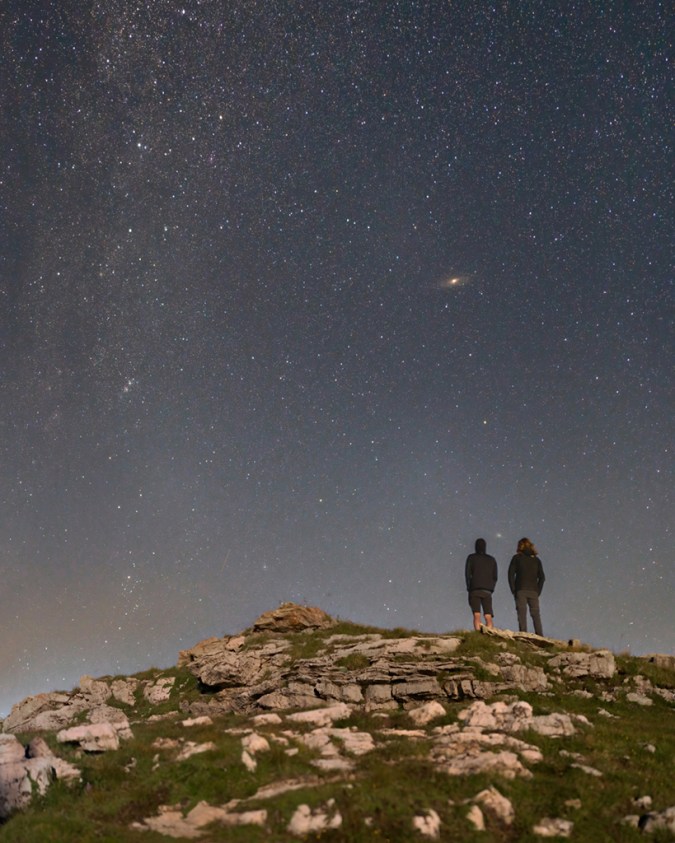
The Galaxy Between Two Friends

Image Credit & Copyright: Martin Lefranc

Explanation: On an August night two friends enjoyed this view after a day’s hike on the Plateau d’Emparis in the French Alps. At 2400 meters altitude the sky was clear. Light from a setting moon illuminates the foreground captured in the simple vertical panorama of images. Along the plane of our Milky Way galaxy stars of Cassiopeia and Perseus shine along the panorama’s left edge. But seen as a faint cloud with a brighter core, the Andromeda galaxy, stands directly above the two friends in the night. The nearest large spiral galaxy, Andromeda is about 2.5 million light-years beyond the stars of the Milky Way. Adding to the evening’s shared extragalactic perspective, the fainter fuzzy spot in the sky right between them is M33, also known as the Triangulum galaxy. Third largest in the local galaxy group, after Andromeda and Milky Way, the Triangulum galaxy is about 3 million light-years distant. On that night, the two friends stood about 3 light-nanoseconds apart.

Astronomy Picture of the Day

Discover the cosmos! Each day a different image or photograph of our fascinating universe is featured, along with a brief explanation written by a professional astronomer.

2021 November 5

The Dark Seahorse in Cepheus

Image Credit & Copyright: Valerio Avitabile

Explanation: Light-years across, this suggestive shape known as the Seahorse Nebula appears in silhouette against a rich, luminous background of stars. Seen toward the royal northern constellation of Cepheus, the dusty, obscuring clouds are part of a Milky Way molecular cloud some 1,200 light-years distant. It is also listed as Barnard 150 (B150), one of 182 dark markings of the sky cataloged in the early 20th century by astronomer E. E. Barnard. Packs of low mass stars are forming within, but their collapsing cores are only visible at long infrared wavelengths. Still, the colorful stars of Cepheus add to this pretty, galactic skyscape.

Astronomy Picture of the Day

Discover the cosmos! Each day a different image or photograph of our fascinating universe is featured, along with a brief explanation written by a professional astronomer.

2021 November 3

The Horsehead and Flame Nebulas

Image Credit & Copyright: Wissam Ayoub

Explanation: The Horsehead Nebula is one of the most famous nebulae on the sky. It is visible as the dark indentation to the orange emission nebula at the far right of the featured picture. The horse-head feature is dark because it is really an opaque dust cloud that lies in front of the bright emission nebula. Like clouds in Earth’s atmosphere, this cosmic cloud has assumed a recognizable shape by chance. After many thousands of years, the internal motions of the cloud will surely alter its appearance. The emission nebula‘s orange color is caused by electrons recombining with protons to form hydrogen atoms. Toward the lower left of the image is the Flame Nebula, an orange-tinged nebula that also contains intricate filaments of dark dust. Two prominent reflection nebulas are visible: round IC 432 on the far left, and blue NGC 2023 just to the lower left of the Horsehead nebula. Each glows primarily by reflecting the light of their central star.


Discovery + Outreach: Graduate student research position open for APOD

Astronomy Picture of the Day

Discover the cosmos! Each day a different image or photograph of our fascinating universe is featured, along with a brief explanation written by a professional astronomer.

2021 November 2

SN Requiem: A Supernova Seen Three Times So Far

Image Credit: NASAESAHubble; Data: S. A. Rodney (U. South Carolinaet al.; Image Processing: J. DePasquale (STScI)Explanation: We’ve seen this same supernova three times — when will we see it a fourth? When a distant star explodes in a supernova, we’re lucky if we see it even once. In the case of AT 2016jka (“SN Requiem”), because the exploding star happened to be lined up behind the center of a galaxy cluster (MACS J0138 in this case), a comparison of Hubble Space Telescope images demonstrate that we saw it three times. These three supernova images are highlighted in circles near the bottom of the left frame taken in 2016. On the right frame, taken in 2019, the circles are empty because all three images of the single supernova had faded. Computer modeling of the cluster lens, however, indicates that a fourth image of the same supernova should eventually appear in the upper circle on the right image. But when? The best models predict this will happen in 2037, but this date is uncertain by about two years because of ambiguities in the mass distribution of the cluster lens and the brightness history of the stellar explosion. With refined predictions and vigilant monitoring, Earthlings living 16 years from now may be able to catch this fourth image — and perhaps learn more about both galaxy clusters and supernovas at once.


Discovery + Outreach: Graduate student research position open for APOD

November 1 Astronomy Picture of the Day

Discover the cosmos! Each day a different image or photograph of our fascinating universe is featured, along with a brief explanation written by a professional astronomer. (I think this is one of the coolest pictures NASA has shared with us this year.)

2021 November 1

A Waterfall and the Milky Way

Image Credit & Copyright: Xie Jie

Explanation: The dream was to capture both the waterfall and the Milky Way together. Difficulties included finding a good camera location, artificially illuminating the waterfall and the surrounding valley effectively, capturing the entire scene with numerous foreground and background shots, worrying that fireflies would be too distracting, keeping the camera dry, and avoiding stepping on a poisonous snake. Behold the result — captured after midnight in mid-July and digitally stitched into a wide-angle panorama. The waterfall is the picturesque Zhulian waterfall in the Luoxiao Mountains in eastern Hunan ProvinceChina. The central band of our Milky Way Galaxy crosses the sky and shows numerous dark dust filaments and colorful nebulas. Bright stars dot the sky — all residing in the nearby Milky Way — including the Summer Triangle with bright Vega visible above the Milky Way’s arch. After capturing all 78 component exposures for you to enjoy, the photographer and friends enjoyed the view themselves for the rest of the night.


Discovery + Outreach: Graduate student research position open for APOD

(If someone who reads WOTC is able to get this positions please let us know. Thank you)

Astronomy Picture of the Day

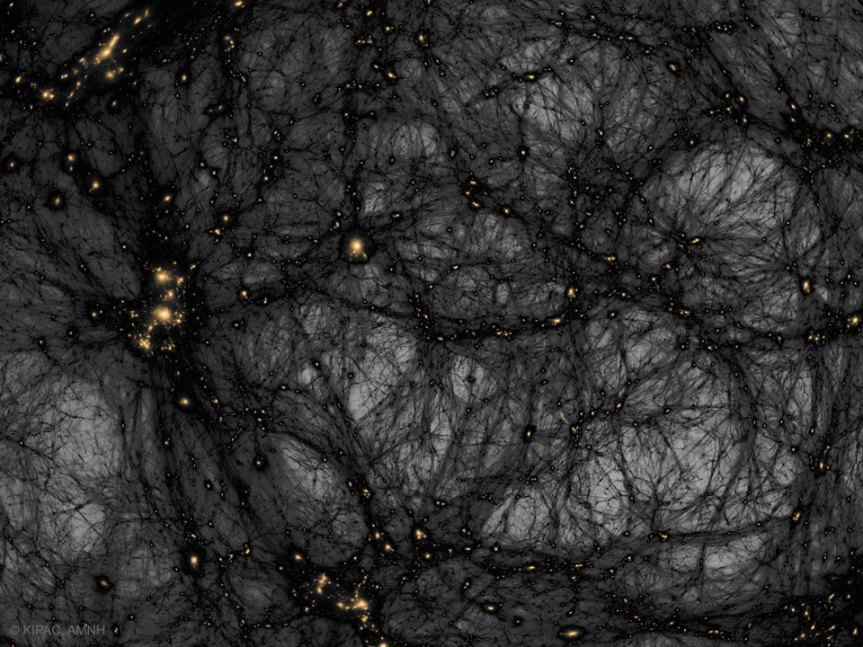
Dark Matter in a Simulated Universe

Illustration Credit & Copyright: Tom Abel & Ralf Kaehler (KIPACSLAC), AMNHExplanation: Is our universe haunted? It might look that way on this dark matter map. The gravity of unseen dark matter is the leading explanation for why galaxies rotate so fast, why galaxies orbit clusters so fast, why gravitational lenses so strongly deflect light, and why visible matter is distributed as it is both in the local universe and on the cosmic microwave background. The featured image from the American Museum of Natural History‘s Hayden Planetarium Space Show Dark Universe highlights one example of how pervasive dark matter might haunt our universe. In this frame from a detailed computer simulation, complex filaments of dark matter, shown in black, are strewn about the universe like spider webs, while the relatively rare clumps of familiar baryonic matter are colored orange. These simulations are good statistical matches to astronomical observations. In what is perhaps a scarier turn of events, dark matter — although quite strange and in an unknown form — is no longer thought to be the strangest source of gravity in the universe. That honor now falls to dark energy, a more uniform source of repulsive gravity that seems to now dominate the expansion of the entire universe.

Not only Halloween: Today is Dark Matter Day.

October 30 Astronomy Picture of the Day

A Rorschach Aurora

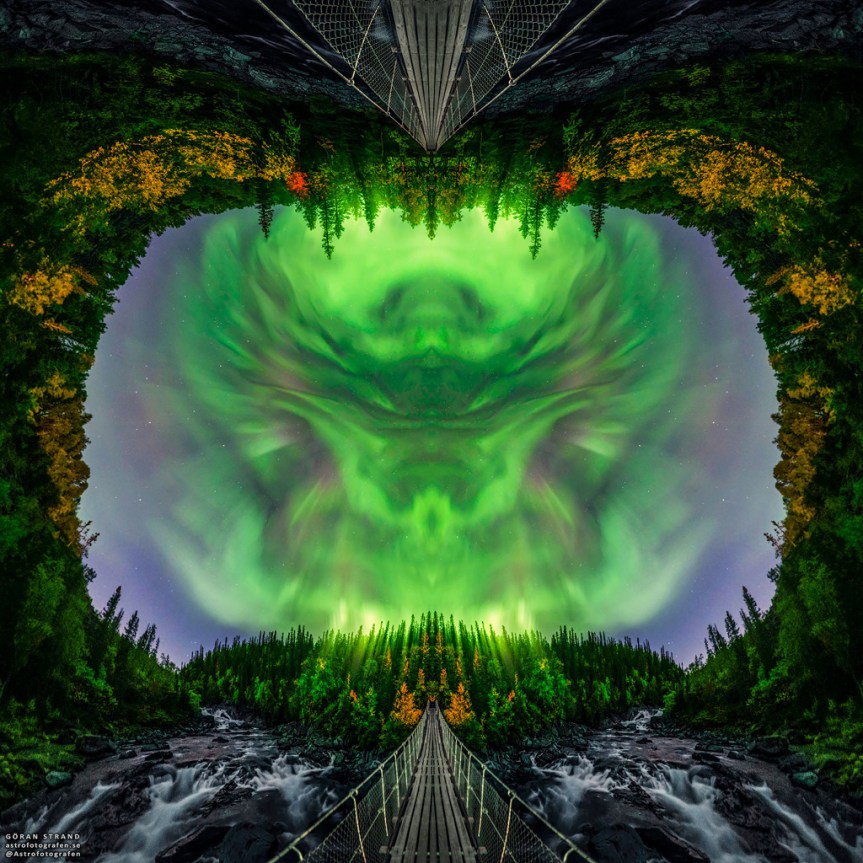
Image Credit & Copyright: Göran Strand

Explanation: If you see this as a monster’s face, don’t panic. It’s only pareidolia, often experienced as the tendency to see faces in patterns of light and shadow. In fact, the startling visual scene is actually a 180 degree panorama of Northern Lights, digitally mirrored like inkblots on a folded piece of paper. Frames used to construct it were captured on a September night from the middle of a waterfall-crossing suspension bridge in Jamtland, Sweden. With geomagnetic storms triggered by recent solar activity, auroral displays could be very active at planet Earth’s high latitudes in the coming days. But if you see a monster’s face in your own neighborhood tomorrow night, it might just be Halloween.

Astronomy Picture of the Day

Discover the cosmos! Each day a different image or photograph of our fascinating universe is featured, along with a brief explanation written by a professional astronomer.

2021 October 29

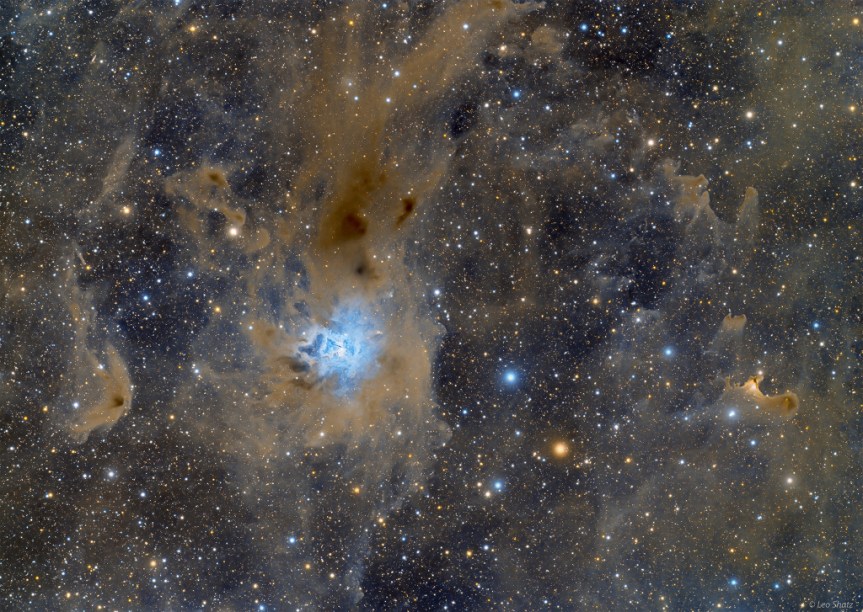
Haunting the Cepheus Flare

Image Credit & Copyright: Leo Shatz

Explanation: Spooky shapes seem to haunt this dusty expanse, drifting through the night in the royal constellation Cepheus. Of course, the shapes are cosmic dust clouds visible in dimly reflected starlight. Far from your own neighborhood, they lurk above the plane of the Milky Way at the edge of the Cepheus Flare molecular cloud complex some 1,200 light-years away. Over 2 light-years across and brighter than most of the other ghostly apparitions, vdB 141 or Sh2-136 is also known as the Ghost Nebula, seen at the right of the starry field of view. Inside the nebula are the telltale signs of dense cores collapsing in the early stages of star formation. With the eerie hue of dust reflecting bluish light from hot young stars of NGC 7023, the Iris Nebula stands out against the dark just left of center. In the broad telescopic frame, these fertile interstellar dust fields stretch almost seven full moons across the sky.

Astronomy Picture of the Day

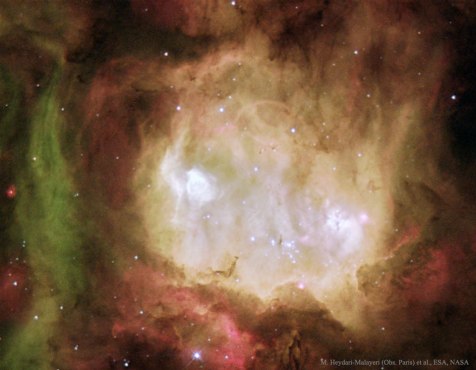
Halloween and the Ghost Head Nebula

Image Credit: Mohammad Heydari-Malayeri (Observatoire de Paris) et al., ESANASA

Explanation: Halloween’s origin is ancient and astronomical. Since the fifth century BC, Halloween has been celebrated as a cross-quarter day, a day halfway between an equinox (equal day / equal night) and a solstice (minimum day / maximum night in the northern hemisphere). With a modern calendar however, even though Halloween occurs next week, the real cross-quarter day will occur the week after. Another cross-quarter day is Groundhog Day. Halloween’s modern celebration retains historic roots in dressing to scare away the spirits of the dead. Perhaps a fitting tribute to this ancient holiday is this view of the Ghost Head Nebula taken with the Hubble Space Telescope. Similar to the icon of a fictional ghost, NGC 2080 is actually a star forming region in the Large Magellanic Cloud, a satellite galaxy of our own Milky Way Galaxy. The Ghost Head Nebula (NGC 2080) spans about 50 light-years and is shown in representative colors.

Astronomy Picture of the Day

Discover the cosmos! Each day a different image or photograph of our fascinating universe is featured, along with a brief explanation written by a professional astronomer.

Today’s Astronomy Picture is a Video. Click here to watch it.

Jupiter Rotates

Video Credit & Copyright: JL DauvergneMusic: Oro Aqua (Benoit Reeves)

Explanation: Observe the graceful twirl of our Solar System’s largest planet. Many interesting features of Jupiter’s enigmatic atmosphere, including dark belts and light zones, can be followed in detail. A careful inspection will reveal that different cloud layers rotate at slightly different speeds. The famous Great Red Spot is not visible at first — but soon rotates into view. Other smaller storm systems occasionally appear. As large as Jupiter is, it rotates in only 10 hours. Our small Earth, by comparison, takes 24 hours to complete a spin cycle. The featured high-resolution time-lapse video was captured over five nights earlier this month by a mid-sized telescope on an apartment balcony in ParisFrance. Since hydrogen and helium gas are colorless, and those elements compose most of Jupiter’s expansive atmosphere, what trace elements create the observed colors of Jupiter’s clouds remains a topic of research.


Discovery + Outreach: Graduate student research position open for APOD