Astronomy Picture of the Day

Discover the cosmos! Each day a different image or photograph of our fascinating universe is featured, along with a brief explanation written by a professional astronomer.

2021 December 23
Three Planets and a Comet

Image Credit & Copyright: Tunc Tezel (TWAN)

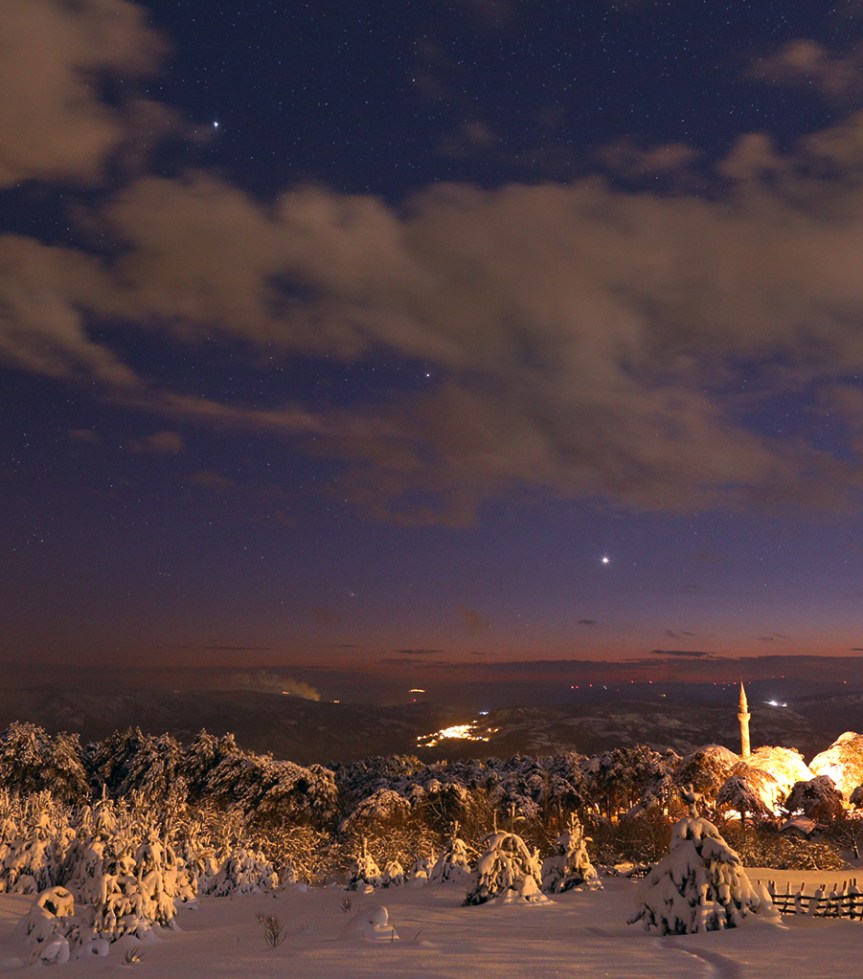
Explanation: Are you still looking for that perfect holiday gift for an astronomer? If your night sky is dark and horizon clear enough, the Solar System may have done your shopping for you. Send them outside after sunset to see three planets and a comet. In this snapshot of the December solstice evening sky from the village of Kirazli, Turkey the brightest celestial beacon is Venus, close to the southwestern horizon at the right. Look left and up to find Saturn shining between clouds. Follow that line farther left and up to bright Jupiter, the Solar System’s ruling gas giant. This year’s surprise visitor to the inner Solar System, Comet Leonard (C/2021 A1), is near the horizon too. The comet is fainter but forms a nearly equilateral triangle with planets Venus and Saturn in this view. After a dramatic brightening in recent days the comet is just visible to the unaided eye, though a nice pair of binoculars is always a good idea.

Astronomy Picture of the Day

Discover the cosmos! Each day a different image or photograph of our fascinating universe is featured, along with a brief explanation written by a professional astronomer.

2021 December 22

Launch of the IXPE Observatory

Image Credit & Copyright: Jordan Sirokie

Explanation: Birds don’t fly this high. Airplanes don’t go this fast. The Statue of Liberty weighs less. No species other than human can even comprehend what is going on, nor could any human just a millennium ago. The launch of a rocket bound for space is an event that inspires awe and challenges description. Pictured here, a SpaceX Falcon 9 rocket lifted off from Kennedy Space CenterFlorida earlier this month carrying the Imaging X-ray Polarimetry Explorer (IXPE). IXPE is scheduled to observe high-energy objects such as neutron stars, black holes, and the centers of distant galaxies to better determine the physics and geometries that create and control them. From a standing start, the 300,000+ kilogram rocket ship lifted IXPE up to circle the Earth, where the outside air is too thin to breathe. Rockets bound for space are now launched from somewhere on Earth every few days.


Launch Update: James Webb Space Telescope

Astronomy Picture of the Day

Discover the cosmos! Each day a different image or photograph of our fascinating universe is featured, along with a brief explanation written by a professional astronomer.

2021 December 21

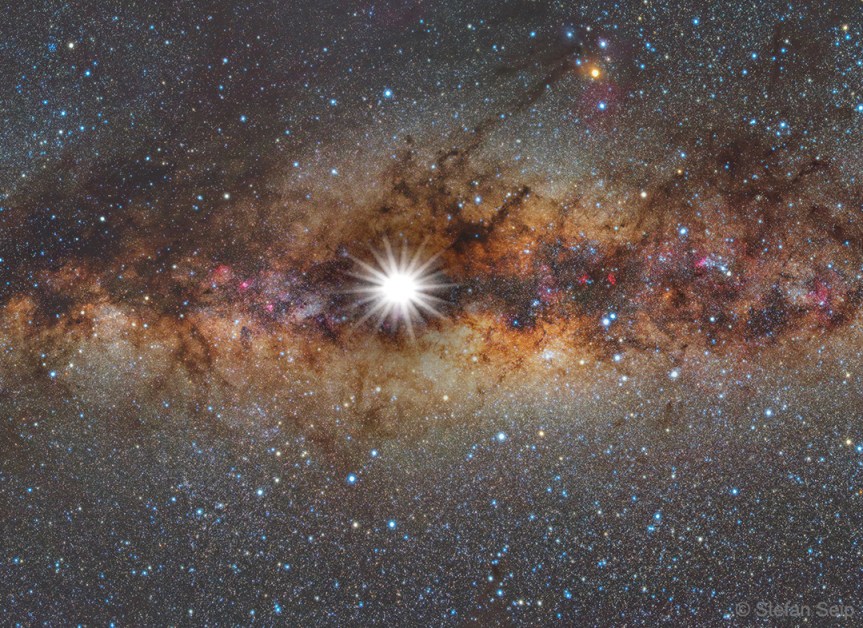
Solstice Sun and Milky Way

Composite Image Credit & CopyrightStefan Seip (TWAN)

Explanation: Welcome to December’s solstice, first day of winter in the north and summer for the southern hemisphere. Astronomical markers of the seasons, solstice and equinox dates are based on the Sun’s place in its annual journey along the ecliptic, through planet Earth’s sky. At this solstice, the Sun reaches its maximum southern declination of -23.5 degrees today at 15:59 UTC, while its right ascension coordinate on the celestial sphere is 18 hours. That puts the Sun in the constellation Sagittarius in a direction near the center of our Milky Way galaxy. In fact, if you could see today’s Solstice Sun against faint background stars and nebulae (that’s really hard to do, especially in the daytime …) your view might look something like this composited panorama. To make it, images of our fair galaxy were taken under dark Namibian night skies, then stitched together in a panoramic view. From a snapshot made on 2015 December 21, the Sun was digitally overlayed as a brilliant star at today’s northern winter solstice position, close to the center of the Milky Way.


Discovery + Outreach: Graduate student research position open for APOD

Astronomy Picture of the Day

Discover the cosmos! Each day a different image or photograph of our fascinating universe is featured, along with a brief explanation written by a professional astronomer.

2021 December 19

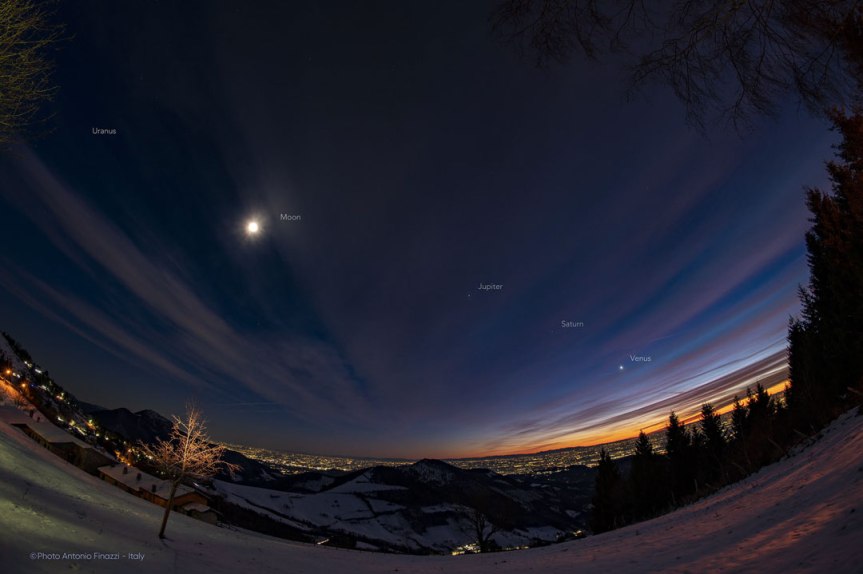
Planetary Alignment over Italy

Image Credit & Copyright: Antonio Finazzi

Explanation: It is not a coincidence that planets line up. That’s because all of the planets orbit the Sun in (nearly) a single sheet called the plane of the ecliptic. When viewed from inside that plane — as Earth dwellers are likely to do — the planets all appear confined to a single band. It is a coincidence, though, when three of the brightest planets all appear in nearly the same direction. Such a coincidence was captured earlier this month. Featured above (right to left), VenusSaturn, and Jupiter were all imaged together in a line just after sunset, from the San Fermo HillsBergamoItaly. Joining the alignment are Earth’s Moon, and the position of the more distant Uranus. Bands of clouds streak across the sky toward the setting Sun. As Comet Leonard fades, this planetary alignment — absent the Moon — should persist for the rest of the month.


Discovery + Outreach: Graduate student research position open for APOD

Astronomy Picture of the Day

Discover the cosmos! Each day a different image or photograph of our fascinating universe is featured, along with a brief explanation written by a professional astronomer.

2021 December 14

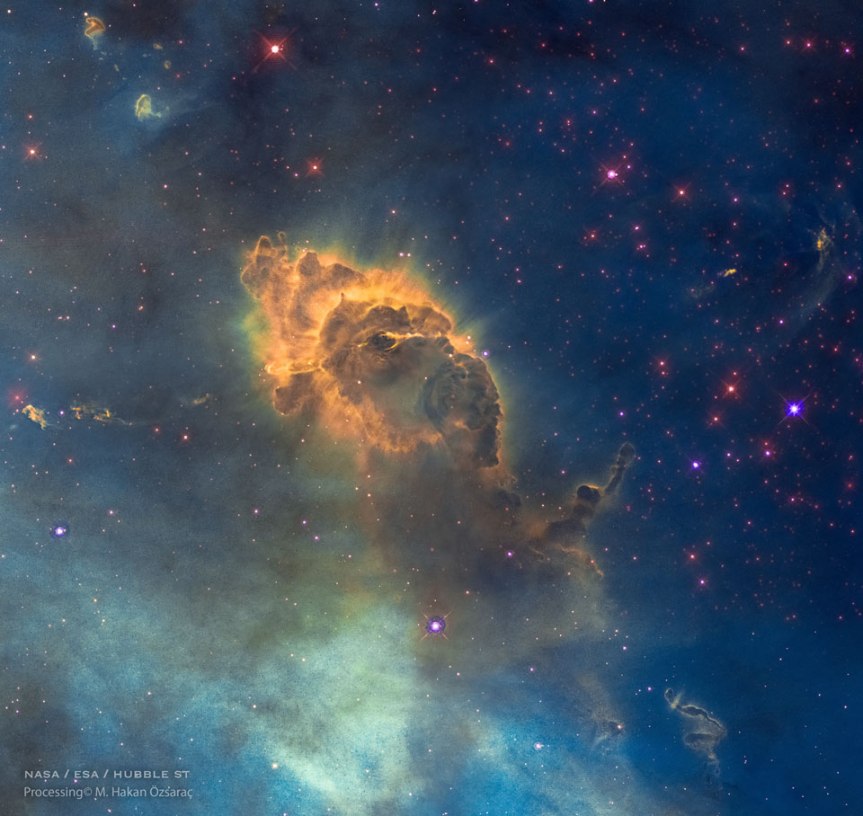
HH 666: Carina Dust Pillar with Jet

Image Credit: NASAESAHubbleProcessing & Copyright: Mehmet Hakan Özsaraç

Explanation: To some, it may look like a beehive. In reality, the featured image from the Hubble Space Telescope captures a cosmic pillar of dust, over two-light years long, inside of which is Herbig-Haro 666 — a young star emitting powerful jets. The structure lies within one of our galaxy’s largest star forming regions, the Carina Nebula, shining in southern skies at a distance of about 7,500 light-years. The pillar‘s layered outline are shaped by the winds and radiation of Carina’s young, hot, massive stars, some of which are still forming inside the nebula. A dust-penetrating view in infrared light better shows the two, narrow, energetic jets blasting outward from a still hidden infant star.


Open Science: Browse 2,600+ codes in the Astrophysics Source Code Library

Astronomy Picture of the Day

Discover the cosmos! Each day a different image or photograph of our fascinating universe is featured, along with a brief explanation written by a professional astronomer.

2021 December 13

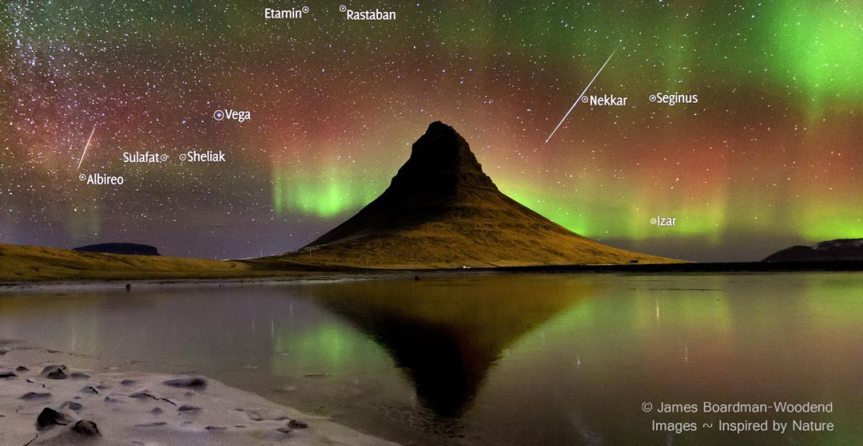
Meteors and Auroras over Iceland

Image Credit & Copyright: James Boardman-WoodendAnnotation: Judy Schmidt

Explanation: What’s going on behind that mountain? Quite a bit. First of all, the mountain itself, named Kirkjufell, is quite old and located in western Iceland near the town of Grundarfjörður. In front of the steeply-sloped structure lies a fjord that had just begun to freeze when the above image was taken — in mid-December of 2012. Although quite faint to the unaided eye, the beautiful colors of background aurorae became quite apparent on the 25-second exposure. What makes this image of particular note, though, is that it also captures streaks from the Geminids meteor shower — meteors that might not have been evident were the aurora much brighter. Far in the distance, on the left, is the band of our Milky Way Galaxy, while stars from our local part of the Milky Way appear spread across the background. Tonight the Geminids meteor shower peaks again and may well provide sky enthusiasts with their own memorable visual experiences.

Astronomy Picture of the Day

Discover the cosmos! Each day a different image or photograph of our fascinating universe is featured, along with a brief explanation written by a professional astronomer.

2021 December 12

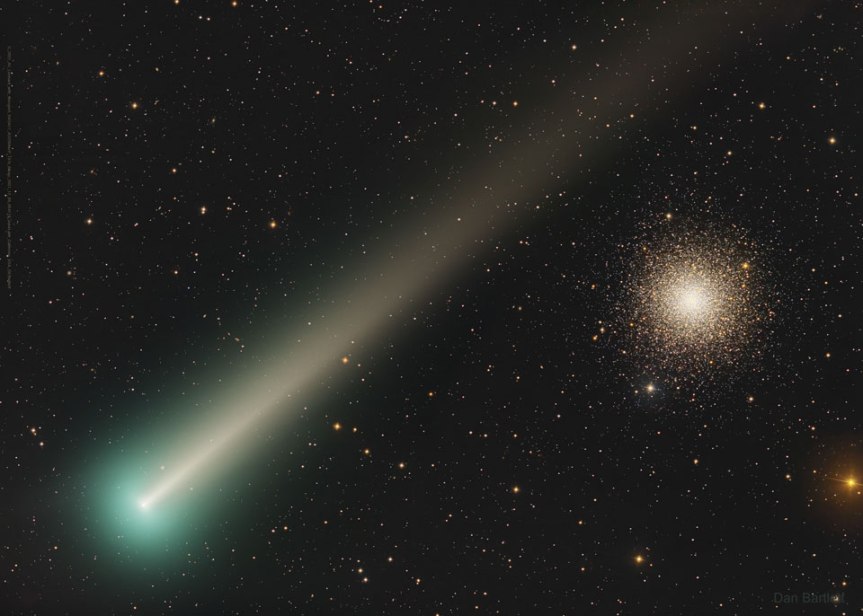
Comet Leonard Before Star Cluster M3

Image Credit & Copyright: Dan Bartlett

Explanation: Comet Leonard is now visible to the unaided eye — but just barely. Passing nearest to the Earth today, the comet is best seen this week soon after sunset, toward the west, low on the horizon. Currently best visible in the north, by late December the comet will best be seen from south of Earth’s equator. The featured image of Comet C/2021 A1 (Leonard) was taken a week ago from CaliforniaUSA. The deep exposure shows in great detail the comet’s green gas coma and developing dust tail. The comet — across our inner Solar System and only light-minutes away — was captured passing nearly in front of globular star cluster M3. In contrast, M3 is about 35,000 light-years away. In a week, Comet Leonard will pass unusually close to Venus, but will continue on and be at its closest to the Sun in early January.


Tomorrow’s picture: meteor mountain

Astronomy Picture of the Day

Discover the cosmos! Each day a different image or photograph of our fascinating universe is featured, along with a brief explanation written by a professional astronomer.

2021 December 10

Eclipse on a Polar Day

Image Credit & Copyright: Stephanie Ziyi Ye

Explanation: During polar day, in Arctic and Antarctic summer, the Sun stays above the horizon for periods of 24 hours or more. Recorded on December 4, this fisheye timelapse image tracks the Sun in multiple frames as it completes a circle in the summer sky above Union Glacier, Antarctica. Of course on that date, Union Glacier’s sky did grow dark even though the Sun was above the horizon. Captured during the brief period of totality, an eclipsed Sun is at bottom center of the composite view. Near the edge of the total eclipse path across planet Earth, the Moon’s shadow darkens the sky above.

Astronomy Picture of the Day

Discover the cosmos! Each day a different image or photograph of our fascinating universe is featured, along with a brief explanation written by a professional astronomer.

2021 December 9

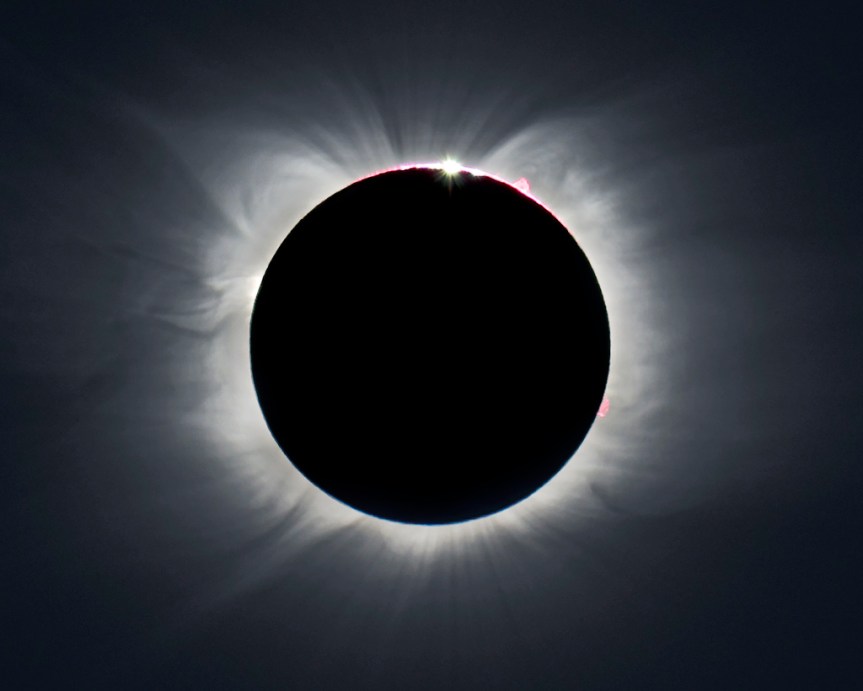
A Total Eclipse of the Sun

Image Credit & Copyright: Theo Boris, Christian A. Lockwood, David Zimmerman (JM Pasachoff Antarctic Expedition)
Compositing: Zev Hoover and Ronald Dantowitz (MARS Scientific)

Explanation: Few were able to stand in the Moon’s shadow and watch the December 4 total eclipse of the Sun. Determined by celestial mechanics and not geographical boundaries, the narrow path of totality tracked across planet Earth’s relatively inaccessible southernmost continent. Still, some enthusiastic and well-insulated eclipse chasers were rewarded with the dazzling spectacle in Antarctica’s cold but clear skies. Taken just before the brief totality began, this image from a ground-based telescope inside the edge of the shadow path at Union Glacier catches a glimmer of sunlight near the top of the silhouetted lunar disk. Look closely for the pinkish solar prominences arcing above the Sun’s limb. During totality, the magnificent solar corona, the Sun’s outer atmosphere, made its much anticipated appearance, seen in the composite view streaming far from the Sun’s edge.

Astronomy Picture of the Day

Discover the cosmos! Each day a different image or photograph of our fascinating universe is featured, along with a brief explanation written by a professional astronomer.

2021 December 8

Comet Hale-Bopp Over Val Parola Pass

Image Credit & Copyright: A. Dimai, (Col Druscie Obs.), AAC

Explanation: Comet Hale-Bopp, the Great Comet of 1997, became much brighter than any surrounding stars. It was seen even over bright city lights. Away from city lights, however, it put on quite a spectacular show. Here Comet Hale-Bopp was photographed above Val Parola Pass in the Dolomite mountains surrounding Cortina d’AmpezzoItalyComet Hale-Bopp‘s blue ion tail, consisting of ions from the comet’s nucleus, is pushed out by the solar wind. The white dust tail is composed of larger particles of dust from the nucleus driven by the pressure of sunlight, that orbit behind the comet. Comet Hale-Bopp (C/1995 O1) remained visible to the unaided eye for 18 months — longer than any other comet in recorded history. The large comet is next expected to return around the year 4385. This month, Comet Leonard is brightening and may soon become visible to the unaided eye.

Astronomy Picture of the Day

Discover the cosmos! Each day a different image or photograph of our fascinating universe is featured, along with a brief explanation written by a professional astronomer.

2021 December 7

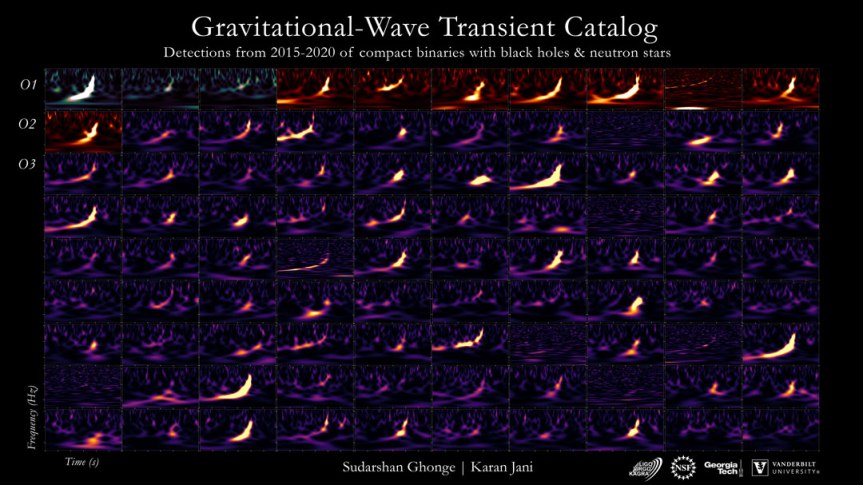
Ninety Gravitational Wave Spectrograms and Counting

Image Credit: NSFLIGOVIRGOKAGRAGeorgia TechVanderbilt U.Graphic Sudarshan Ghonge & Karan Jani

Explanation: Every time two massive black holes collide, a loud chirping sound is broadcast out into the universe in gravitational waves. Humanity has only had the technology to hear these unusual chirps for the past seven years, but since then we have heard about 90 — during the first three observing runs. Featured above are the spectrograms — plots of gravitational-wave frequency versus time — of these 90 as detected by the giant detectors of LIGO (in the USA), VIRGO (in Europe), and KAGRA (in Japan). The more energy received on Earth from a collision, the brighter it appears on the graphic. Among many science firsts, these gravitational-radiation chirps are giving humanity an unprecedented inventory of black holes and neutron stars, and a new way to measure the expansion rate of our universe. A fourth gravitational wave observing run with increased sensitivity is currently planned to begin in 2022 December.

Astronomy Picture of the Day

Discover the cosmos! Each day a different image or photograph of our fascinating universe is featured, along with a brief explanation written by a professional astronomer.

2021 December 3

Comet Leonard and the Whale Galaxy

Image Credit & Copyright: Gregg Ruppel

Explanation: Sweeping through northern predawn skies, on November 24 Comet Leonard (C/2021 A1) was caught between two galaxies in this composite telescopic image. Sporting a greenish coma the comet’s dusty tail seems to harpoon the heart of NGC 4631 (top) also known as the Whale Galaxy. Of course NGC 4631 and NGC 4656 (bottom, aka the Hockey Stick) are background galaxies some 25 million light-years away. On that date the comet was about 6 light-minutes from our fair planet. Its closest approach to Earth (and even closer approach to Venus) still to come, Comet Leonard will grow brighter in December. Already a good object for binoculars and small telescopes, this comet will likely not return to the inner Solar System. Its perihelion, or closest approach to the Sun, will be on January 3, 2022.

December 2 Astronomy Picture of the Day

Discover the cosmos! Each day a different image or photograph of our fascinating universe is featured, along with a brief explanation written by a professional astronomer.

2021 December 2

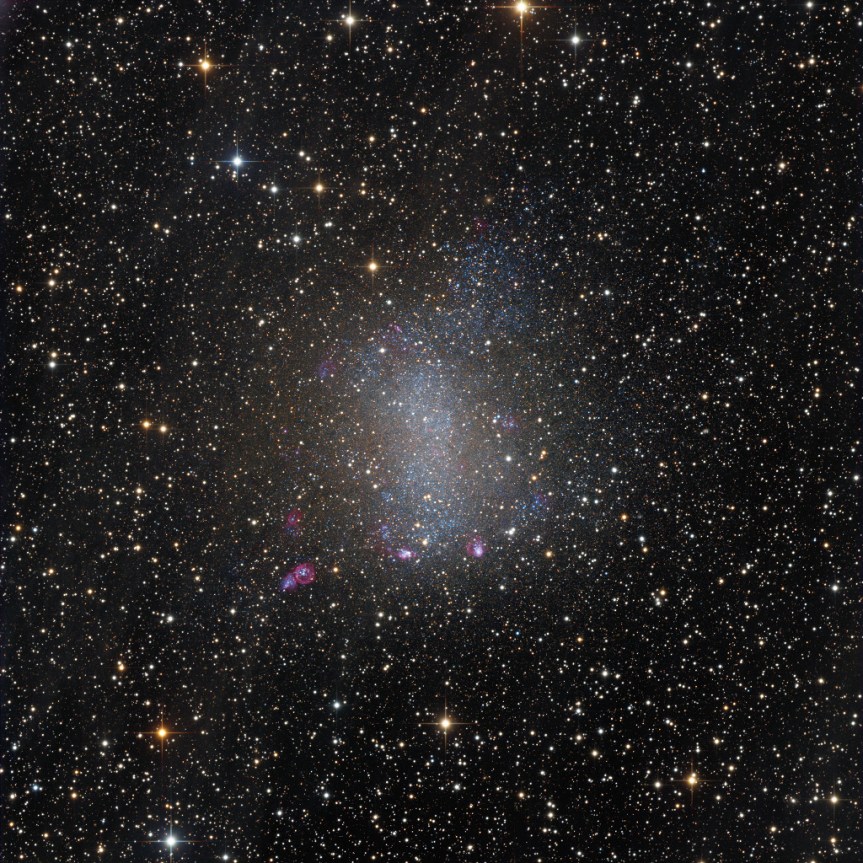
NGC 6822: Barnard’s Galaxy

Image Credit & Copyright: Dietmar HagerEric Benson

Explanation: Grand spiral galaxies often seem to get all the glory, flaunting their young, bright, blue star clusters in beautiful, symmetric spiral arms. But small galaxies form stars too, like nearby NGC 6822, also known as Barnard’s Galaxy. Beyond the rich starfields in the constellation Sagittarius, NGC 6822 is a mere 1.5 million light-years away, a member of our Local Group of galaxies. A dwarf irregular galaxy similar to the Small Magellanic Cloud, NGC 6822 is about 7,000 light-years across. Brighter foreground stars in our Milky Way have a spiky appearance. Behind them, Barnard’s Galaxy is seen to be filled with young blue stars and mottled with the telltale pinkish hydrogen glow of star forming regions in this deep color composite image.

15 Must-See Astronomy Events in the December Night Sky (2021)

From spacetourismguide.com

While December is a month of extremes – cold and dark in the northern hemisphere and opposite in the southern – it’s also one of the best months of the year for amateur astronomers and stargazers.

A series of meteor showers occur in such quick succession that you might almost grow tired of wishing on ‘shooting stars;’ there are also good opportunities to spot solar system neighbors, watch the celestial dance of our Sun and Moon, and mark the astronomical calendar with the December solstice. Whatever drives you out to enjoy the night sky this month, be sure to bundle up – even in the southern hemisphere, it gets chilly at night.

If you need a telescope to help enjoy this month’s night sky events, we have a guide to the best stargazing telescopes and binoculars. On that page you’ll find resources on how to find a good piece of astronomical equipment that fits your budget and helps unlock the wonders of the December night sky. Ready to explore? Read on for all of the December night sky events you can see in the coming month.

Table of Contents

December 2 – Peak of the Pheonicid Meteor Shower

December 4 – Total Solar Eclipse

December 6 – Peak of the φ-Cassiopeid Meteor Shower

December 7 – Conjunction of the Moon & Saturn

December 7 – Peak of the Puppid-Velid Meteor Shower

December 7 – Venus at Greatest Brightness

December 9 – Conjunction of the Moon & Jupiter

December 9 – Peak of the Monocerotid Meteor Shower

December 10 – Asteroid 44 Nysa at Opposition

December 12 – Peak of the σ-Hydrid Meteor Shower

December 14 – Peak of the Geminid Meteor Shower

December 16 – Peak of the Comae Berenicid Meteor Shower

December 19 – Peak of the December Leonis Minorid Meteor Shower

December 21 – December Solstice

December 22 – Peak of the Ursid Meteor Shower

Astronomy Picture of the Day

Discover the cosmos! Each day a different image or photograph of our fascinating universe is featured, along with a brief explanation written by a professional astronomer.

2021 December 1

A Blue-Banded Blood Moon

Image Credit: Angel Yu

Explanation: What causes a blue band to cross the Moon during a lunar eclipse? The blue band is real but usually quite hard to see. The featured HDR image of last week’s lunar eclipse, however — taken from YanchengChina — has been digitally processed to equalize the Moon’s brightness and exaggerate the colors. The gray color of the bottom right is the Moon‘s natural color, directly illuminated by sunlight. The upper left part of the Moon is not directly lit by the Sun since it is being eclipsed — it in the Earth’s shadow. It is faintly lit, though, by sunlight that has passed deep through Earth’s atmosphere. This part of the Moon is red — and called a blood Moon — for the same reason that Earth’s sunsets are red: because air scatters away more blue light than red. The unusual blue band is different — its color is created by sunlight that has passed high through Earth’s atmosphere, where red light is better absorbed by ozone than blue. A total eclipse of the Sun will occur tomorrow but, unfortunately, totality be visible only near the Earth’s South Pole.


Almost Hyperspace: Random APOD Generator

Astronomy Picture of the Day

Discover the cosmos! Each day a different image or photograph of our fascinating universe is featured, along with a brief explanation written by a professional astronomer.

2021 November 30

In Motion: Uranus and Moons

Video Credit: David Campbell (U. Hertfordshire), Bayfordbury ObservatoryExplanation: What’s that moving across the sky? A planet just a bit too faint to see with the unaided eye: Uranus. The gas giant out past Saturn was tracked earlier this month near opposition — when it was closest to Earth and at its brightest. The featured video captured by the Bayfordbury Observatory in HertfordshireUK is a four-hour time-lapse showing Uranus with its four largest moons in tow: TitaniaOberonUmbriel and Ariel. Uranus’ apparent motion past background stars is really dominated by Earth’s own orbital motion around our Sun. The cross seen centered on Uranus is called a diffraction spike and is caused by light diffracting around the four arms that hold one of the telescope‘s mirrors in place. The rotation of the diffraction spikes is not caused by the rotation of Uranus but, essentially, by the rotation of the Earth. During the next few months Uranus itself will be visible with binoculars, but, as always, to see its moons will require a telescope.

Astronomy Picture of the Day

Discover the cosmos! Each day a different image or photograph of our fascinating universe is featured, along with a brief explanation written by a professional astronomer.

2021 November 29

The Extraordinary Spiral in LL Pegasi

Image Credit: NASAESAHubbleHLAProcessing & Copyright: Jonathan LodgeDodge

Explanation: What created the strange spiral structure on the upper left? No one is sure, although it is likely related to a star in a binary star system entering the planetary nebula phase, when its outer atmosphere is ejected. The huge spiral spans about a third of a light year across and, winding four or five complete turns, has a regularity that is without precedent. Given the expansion rate of the spiral gas, a new layer must appear about every 800 years, a close match to the time it takes for the two stars to orbit each other. The star system that created it is most commonly known as LL Pegasi, but also AFGL 3068 and IRAS 23166+1655. The featured image was taken in near-infrared light by the Hubble Space Telescope. Why the spiral glows is itself a mystery, with a leading hypothesis being illumination by light reflected from nearby stars.

Astronomy Picture of the Day

Discover the cosmos! Each day a different image or photograph of our fascinating universe is featured, along with a brief explanation written by a professional astronomer.

2021 November 28

A High Cliff on Comet Churyumov-Gerasimenko

Image Credit & LicenceESARosetta spacecraft, NAVCAM; Additional Processing: Stuart Atkinson

Explanation: This high cliff occurs not on a planet, not on a moon, but on a comet. It was discovered to be part of the dark nucleus of Comet Churyumov-Gerasimenko (CG) by Rosetta, a robotic spacecraft launched by ESA that rendezvoused with the Sun-orbiting comet in 2014. The ragged cliff, as featured here, was imaged by Rosetta in 2014. Although towering about one kilometer high, the low surface gravity of Comet CG would likely make it an accessible climb — and even a jump from the cliff survivable. At the foot of the cliff is relatively smooth terrain dotted with boulders as large as 20 meters across. Data from Rosetta indicates that the ice in Comet CG has a significantly different deuterium fraction — and hence likely a different origin — than the water in Earth’s oceans. Rosetta ended its mission with a controlled impact onto Comet CG in 2016. Comet CG has just completed another close approach to Earth and remains visible through a small telescope.

Astronomy Picture of the Day

Discover the cosmos! Each day a different image or photograph of our fascinating universe is featured, along with a brief explanation written by a professional astronomer.

2021 November 27

Messier 101

Image Credit: NASAESACFHTNOAO;
Acknowledgement – K.Kuntz (GSFC), F.Bresolin (U.Hawaii), J.Trauger (JPL), J.Mould (NOAO), Y.-H.Chu (U. Illinois)

Explanation: Big, beautiful spiral galaxy M101 is one of the last entries in Charles Messier’s famous catalog, but definitely not one of the least. About 170,000 light-years across, this galaxy is enormous, almost twice the size of our own Milky Way. M101 was also one of the original spiral nebulae observed by Lord Rosse’s large 19th century telescope, the Leviathan of Parsontown. Assembled from 51 exposures recorded by the Hubble Space Telescope in the 20th and 21st centuries, with additional data from ground based telescopes, this mosaic spans about 40,000 light-years across the central region of M101 in one of the highest definition spiral galaxy portraits ever released from Hubble. The sharp image shows stunning features of the galaxy’s face-on disk of stars and dust along with background galaxies, some visible right through M101 itself. Also known as the Pinwheel Galaxy, M101 lies within the boundaries of the northern constellation Ursa Major, about 25 million light-years away.

Astronomy Picture of the Day

Discover the cosmos! Each day a different image or photograph of our fascinating universe is featured, along with a brief explanation written by a professional astronomer.

2021 November 26


Great Refractor and Lunar Eclipse
Image Credit & Copyright: Laurie Hatch
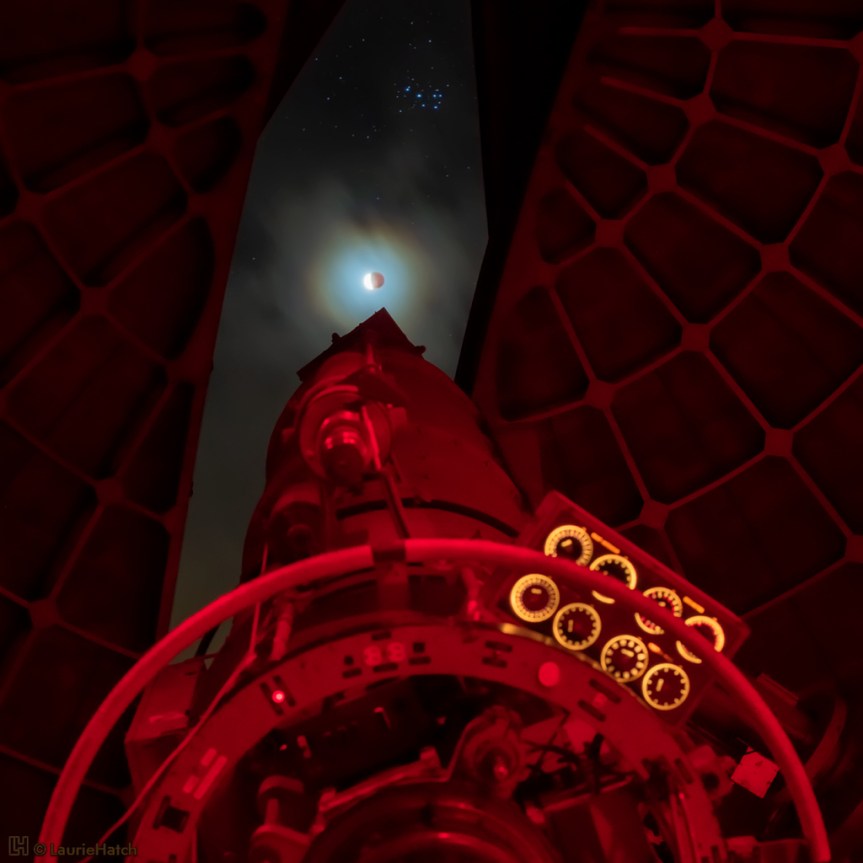
Explanation: Rain clouds passed and the dome of the Lick Observatory’s 36 inch Great Refractor opened on November 19. The historic telescope was pointed toward a partially eclipsed Moon. Illuminated by dim red lighting to preserve an astronomer’s night vision, telescope controls, coordinate dials, and the refractor’s 57 foot long barrel were captured in this high dynamic range image. Visible beyond the foreshortened barrel and dome slit, growing brighter after its almost total eclipse phase, the lunar disk created a colorful halo through lingering clouds. From the open dome, the view of the clearing sky above includes the Pleiades star cluster about 5 degrees from Moon and Earth’s shadow.
Notable APOD Submissions: Lunar Eclipse of 2021 November 19