
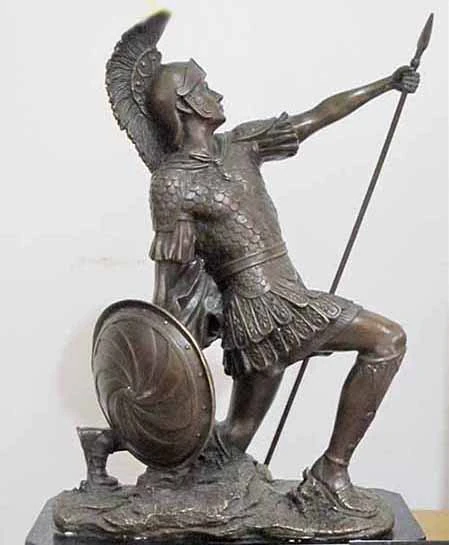
The Pagan Study of the Gods & Goddesses for March 14th – Ares

Ares

Ares

Greek God of War

Ares is the god of war, one of the Twelve OLYMPIAN GODS and the son of ZEUS and HERA. In literature Ares represents the violent and physical untamed aspect of war, which is in contrast to ATHENA who represents military strategy and generalship as the goddess of intelligence.

Although Ares embodied the physical aggression necessary for success in war, the Greeks were ambivalent toward him because he was a dangerous, overwhelming force that was insatiable in battle.

He is well known as the lover of APHRODITE, who was married to HEPHAESTUS, and though Ares plays a limited role in literature, when he does appear in myths it is typically facing humiliation. For example, one famous story of Ares and Aphrodite exposes them to ridicule by the gods when her husband Hephaestus trapped them both naked in a bed using a clever device he made.

The ROMAN COUNTERPART to Ares was MARS, who was known as a FATHER TO THE ROMAN PEOPLE. Because of this, he was a less aggressive and physical form, revealing a more calm and understanding demeanour.

Facts about Ares
Ares was most notably referred to as the God of War; he represented the unpleasant aspects of battle.
He was the son of Zeus and Hera, both of whom hated him (according to Homer).
Ares was most often characterized as a coward in spite of his connection to war; he responded to even the slightest injury with outrage.
According to some sources, Ares was described as Aphrodite’s lover and was held in contempt by her husband, Hephaestus. The affair between them was not a secret among the Olympians.
Ares was never very popular—either with men or the other immortals. As a result, his worship in Greece was not substantial or widespread.
He came from Thrace, home of a fierce people in the northeast of Greece.
His bird was the vulture.
The Amazons, warrior women, were his daughters. Their mother was a peace-loving nymph named Harmony.
Otus and Ephialtes, twin giants, imprisoned Ares for a lunar year by binding him with chains of brass; he was eventually rescued by Hermes.
Ares always took the side of Aphrodite in the Trojan War. He fought for Hector (a Trojan) until a Greek warrior pierced him with a spear that was guided by Athena. He then departed the battlefield in order to complain to Zeus about Athena’s violence.
Harmonia, Goddess of Harmony, was the daughter of Ares and Aphrodite.
Eros (more commonly known as Cupid) was also the child of Ares and Aphrodite.
Tereus, a son of Ares, was known to have inherited his father’s abhorrent qualities.
Ares was the biological father of at least three of Hercules’ enemies: Cycnus, Lycaon, and Diomedes.
Ares had a sister named Eris, who was the Goddess of Discord.
Hebe, another sister of his, was the Goddess of Youth.
Ares rarely figures into mythology stories, but when he does, he usually suffers some form of humiliation.
Ares was associated with two other war deities: Enyalius and Enyo.
Ares had many offspring, which is characteristic of nearly all of the notable Greek gods. He conceived more mortal children than divine children.
In art, Ares is generally depicted wearing a spear and a helmet.

 – Greek Gods & Goddesses, September 19, 2014

Ares

Ares was the god of war, and son of Zeus and Hera. He represented the raw violence and untamed acts that occured in wartime, in contrast to Athena, who was a symbol of tactical strategy and military planning.

What side of the Trojan War was Ares on?

He was disliked by both his parents. Whenever Ares appeared in a myth, he was depicted as a violent personality, who faced humiliation through his defeats more than once. In the Iliad, it is mentioned that Zeus hated him more than anyone else; Ares was also on the losing side of the Trojan War, favouring the Trojans.

He was the lover of his sister, Aphrodite, who was married to Hephaestus. When the latter found out about the affair, he devised a plan and managed to humiliate both of them. The union of Ares and Aphrodite resulted in the birth of eight children, including Eros, god of love.

Ares temples

There were few temples attributed to Ares in Ancient Greece. Sacrifices would usually be made to him when an army would march to war; Spartans would make sacrifices to Enyalius, another lesser god and son of Ares and Enyo. However, the name was also used as a byname for Ares.

Who were Ares companions?

When Ares went to war, he was followed by his companions, Deimos (terror) and Phobos (fear), who were the product of his union with Aphrodite. Eris, goddess of discord and sister of Deimos and Phobos, often accompanied them in war.

Reference

Greek Mythology

Ares


Ares was the Greek god of war and perhaps the most unpopular of all the Olympian gods because of his quick temper, aggressiveness, and unquenchable thirst for conflict. He famously seduced Aphrodite, unsuccessfully fought with Hercules, and enraged Poseidon by killing his son Halirrhothios. One of the more human Olympian gods, he was a popular subject in Greek art and even more so in Roman times when he took on a much more serious aspect as Mars, the Roman god of war.

FAMILY RELATIONS
Son of Zeus and Hera, Ares’ sisters were Hebe and Eileithyia. Despite being a god, the Greeks considered him from Thrace, perhaps in an attempt to associate him with what they thought of as foreign and war-loving peoples, wholly different from themselves. Ares had various children with different partners, several of whom were unfortunate enough to come up against Hercules when he performed his celebrated twelve labours. Ares’ daughter Hippolyta, the Amazon queen, lost her girdle to Hercules; his son Eurytion lost his cattle; and Diomedes had his horses stolen by the Greek hero. The courageous but warlike Amazons were also thought to be descendants of Ares.

Ares was noted for his beauty and courage, qualities which no doubt helped him win the affections of Aphrodite (even though she was married to Hephaistos) with whom he had a daughter, Harmonia, and the god of love and desire Eros. Hephaistos managed to entrap the lovers in an ingenious bed, and the tale is told in some detail in Book 8 of Homer’s Odyssey. Once caught, the punishment for Ares’ indiscretion was temporary banishment from Mount Olympus.

Described by Hesiod in his Theogony as ‘shield-piercing Ares’ and ‘city-sacking Ares,’ the god represented the more brutal and bloody side of battle, which was in contrast to Athena who represented the more strategic elements of warfare. In stories from Greek mythology, Ares was usually to be found in the company of his other children with Aphrodite, Phobos (Fear) and Deimos (Terror), with his sister Eris (Strife), and with his charioteer Ennyo.

BATTLE WITH HERCULES
The most popular myth involving Ares was his fight with Hercules. Ares’ son Kyknos was infamous for waylaying pilgrims on their way to the oracle at Delphi, and so earned the displeasure of Apollo, who sent Hercules to deal with him. Hercules killed Kyknos, and a furious Ares engaged the hero in a fight. However, Hercules was protected from harm by Athena and even managed to wound Ares. Another myth and ignominious episode for Ares was his capture by the twin Giants Ephialtes and Otus when they stormed Mount Olympus. They imprisoned the god in a bronze jar (or cauldron) for one year and he was only freed through the intervention of Hermes.

THE TROJAN WAR
In Homer’s version of the Trojan War in the Iliad, Ares supports the Trojans, sometimes even leading them in battle along with Hector. The Iliad shows Ares in a less than positive light, and he is described as ‘hateful Ares,’ ‘the man-killer,’ ‘the war-glutton,’ and the ‘curse of men.’ Homer’s picture of Ares, like the above mythological tales, often demonstrates his weakness in comparison to the other gods. Ares is roundly beaten by Athena who, supporting the Achaeans, knocks him out with a large rock. He also comes off worse against the Achaean hero Diomedes who even manages to injure the god with his spear, albeit with the help of Athena. Homer describes the scream of the wounded Ares as like the shouts of 10,000 men. Fleeing back to Olympus, Zeus ignores the complaints of Ares but instructs Paieon to heal his wound.

ATHENS & CULT
Ares again upset the harmony of Olympus when he was accused of killing Poseidon’s son Halirrhothios near a stream below the Athenian acropolis. A special court was convened – the Areopagos – on a hill near the stream, to hear the case. Ares was acquitted as it was disclosed Halirrhothios had raped Ares’ daughter Alcippe. Thereafter in Athens, the Areopagus became the place of trial for cases involving murder and impiety.

Perhaps unsurprisingly, considering the city’s strong militaristic culture, Ares was greatly esteemed in Sparta. Ares was not commonly worshipped but there were cult sites with temples dedicated to the god on Crete (he is mentioned in Linear B tablets from Knossos) and at Argos, Athens, Erythrae, Geronthrae, Megalopolis, Tegea, Therapne, and Troezon. He also had a cult in Thrace and was popular among the Colchians on the Black Sea.

REPRESENTATION IN ART
In ancient Greek Archaic and Classical art, Ares is most often depicted wearing full armour and helmet and carrying a shield and spear. In this respect, he may appear indistinguishable from any other armed warrior. Sometimes he is shown riding his chariot pulled by fire-breathing horses. The myth of Ares’ battle with Hercules was a popular subject for Attic vases in the 6th century BCE.

In later times, the Roman god Mars was given many of the attributes of Ares, although, as was typical of the Roman view of the gods, with less human qualities. In Roman mythology, Mars was also the father of Romulus and Remus (through the rape of the Vestal Virgin Rhea Silvia), the legendary founders of Rome, and, therefore, the city achieved a sacred status. Like Athena for Athens, Mars was also the patron god of the Roman capital and the month martius (March) was named after him.

ABOUT THE AUTHOR
Mark Cartwright
Mark’s special interests include ancient ceramics, architecture, and mythology. He loves visiting and reading about historic sites and transforming that experience into free articles accessible to all.

Ancient History

BALDER ODINSEN (Norse)

THE COMMENTARY GAZETTE


How Balder, the good and beautiful god, was done to death by a stroke of the mistletoe

A deity whose life might in a sense be said to be neither in heaven nor on earth but between the two, was the Norse Balder, the good and beautiful god, the son of the great god Odin, and himself the wisest, mildest, best beloved of all the immortals. The story of his death, as it is told in the younger or prose “Edda”, runs thus. Once on a time Balder dreamed heavy dreams which seemed to forebode his death.

Thereupon the gods held a council and resolved to make him secure against every danger. So the goddess Frigg took an oath from fire and water, iron and all metals, stones and earth, from trees, sicknesses and poisons, and from all four-footed beasts, birds, and creeping things, that they would not hurt Balder. When this was done Balder was deemed invulnerable; so the gods amused themselves by setting him in their midst, while some shot at him, others hewed at him, and others threw stones at him. But whatever they did, nothing could hurt him; and at this they were all glad. Only Loki, the mischief-maker, was displeased, and he went in the guise of an old woman to Frigg, who told him that the weapons of the gods could not wound Balder, since she had made them all swear not to hurt him. Then Loki asked, “Have all things sworn to spare Balder?” She answered, “East of Walhalla grows a plant called mistletoe; it seemed to me too young to swear.” So Loki went and pulled the mistletoe and took it to the assembly of the gods. There he found the blind god Hother standing at the outside of the circle. Loki asked him, “Why do you not shoot at Balder?” Hother answered, “Because I do not see where he stands; besides I have no weapon.” Then said Loki, “Do like the rest and shew Balder honour, as they all do. I will shew you where he stands, and do you shoot at him with this twig.” Hother took the mistletoe and threw it at Balder, as Loki directed him….Read More

Let’s Talk Witch – The God and Goddess

Possessed by you

Let’s Talk Witch – The God and Goddess

The Goddess and the God are everything and everywhere. They are the sun, the moon, the sky, the oceans, ants, flowers, nature, everything. You can see their splendor in a sunset, a child, a tree, in the stars; it’s everywhere, you just have to look and see it. They reveal themselves quite often in the most simplest forms. That seems quite a contradiction to what I just said about them being complex, but it’s true. Take a walk in the woods, or look at a butterfly, you’ll see it. The Goddess and The God are inherent in nature, and since they are so entwined in nature, we have to treat nature with just as much respect as we would a divine being.

The Goddess and the God as being part of the same being, just different aspects of that being. “Goddess”, refers to the female, creative aspect of that being. Both The Goddess and The God are equal, neither deserving more respect than the other. When you start focusing on just The Goddess, or just The God, things become unbalanced and unnatural. The ideal is a perfect balance of both energies. They are all of the deities that have ever existed, and the ones that will exist.

All the different gods and goddesses of all the different religions are the same being; almost but not quite the same idea as the 99 names of Allah, each name refers to a different aspect of that God. When you call the Goddess by the name of Bridget or Margawse, you are calling upon those aspects of The Goddess.

THE GODDESS

The Goddess is the universal mother. She is fertility, endless wisdom and love. She is all aspects of nature, harmful and helpful. Wiccans acknowledge both aspects of Her nature.

The Goddess has three aspects; The Maiden (Anu, Elaine, Blodeuwedd), The Mother (Badb, Arianrhod, Margawse), and The Crone (Morgan LeFey, Cerridwen, Macha). The Maiden is innocence, Springtime, renewal, youth, dawn and the continuation of all life. The Mother is the richness of life, nurturing, Summer, the day and a teacher. The Crone is darkness, night, the rest before the continuation of life, wisdom, counsel and reincarnation. Each of these aspects shows different stages of a women’s life, and each can be placed with the phases of the moon; The Maiden being the waxing moon, The Mother the full moon and The Crone the waning moon.

The Goddess of the Wicca is the Great Goddess. She is the Ground of Being, the Mother of All Living; the Creatrix, and the Destroyer, for She is ever Dual. She is the Earth Mother, the Lady of the Moon, and the Star Goddess. She is Queen of Heaven, Queen of Earth, and Queen of the Underworld. She is the Triple Goddess: the Virgin, the Bride, and the Hag, called the Three Mothers in Celtic regions.

The three aspects of the Triple Goddess are usually described as the Maiden, the Mother, and the Crone; it must be remembered that the connotations of age associated with those titles derive from the experience of humans, who are subject to age and death; the Goddess is eternal: ever-changing and ever self-renewing, She will be young or old as She pleases.

As the Virgin, She is the Creatrix, the Lady of Birth and Death, the Star Goddess, the Queen of Heaven, the Giver of Inspiration, the Initiatrix.

She is Diana, Lady of the Moon and the Wild Things, Ever Virgin unto Pan: virgin unto the All, and therefore wed to None.She is also the Virgin Mother; and Her blue and white colors, and title “Queen of Heaven”, were borrowed by the Catholic Church for the Virgin Mary. Hers are the Waxing Moon, Venus as Morning and Evening Star, and all the vast starry realm; Her sacred color is White.

As the Bride, She is the Preserver, the Lady of Growth and Fertility, the Earth Mother, the Goddess of flocks and herds, Lady of Love and Fruitfulness and the fertility of the land; as Goddess of the Land She is also the Goddess of Sovereignty, and it is only by Sacred Marriage to Her that the King holds the right to the Throne. Hers are the Full Moon, the Earth, fruits and flocks and fields; Her sacred color is Red.

As the Hag, She is the Destroyer, the Lady of Decay and Death, the Goddess of Night and the Underworld, and also the cave and the tomb. For that which is born must also age, and decay, and die; and out of that which is dead and decaying arises new fertility, for life feeds ever on life. She is the Sow who eats Her own young, the “Nightmare Fertility and Death in One”, the Great Necessity by which the food chain and the cycle of life continue. Hence She is also the Goddess of regeneration. Hers is the Waning Moon, the dark night, the silence of the shadows, the midnight crossroads, and the wailing of the widow; Her sacred color is Black.

The Goddess is the Queen of all Witcheries: She is the Enchantress, the Shape-Changer; She is Isis, the “Lady of the Words of Power”; She is Cerridwen, the Sorceress at Her Cauldron; She is Hecate, the Mistress of the Magick of the Dark Moon. She is the Great Lady. She is the Goddess.

THE GOD

The God of the Wicca is the Horned God, the ancient God of Fertility: the God of forest, flock, and field and also of the hunt. He is Lord of Life, and the Giver of Life, yet He is also Lord of Death and Resurrection. For, like the Goddess, the nature of Her Horned Consort is also dual. For the Horned God is not only the Hunter, He is also the Hunted; He is the Sun by day, but He is also the Sun at Midnight; He is the Lord of Light, but He is also the Lord of Darkness: the darkness of night, the darkness of the Shadows, the darkness of the depths of the forest, the darkness of the depths of the Underworld.

The Horned God is the group soul of the hunted animal, invoked by the primitive shaman and the tribe: and as such, He is the Sacrificial Victim, the beast who is slain that the tribe might live, a gift from that group soul, who was often revered as the tribal totem or ancestral spirit. The Celts believed they were the descendents of the God of the Underworld, who was also the God of Fertility: the Latinized form of His name was Cernunnos, which means simply, the Horned One.

The Horned God is also the spirit of vegetation, of the green and growing things, whether of the vine or of the forest or of the field. Dionysus, Adonis, and many other vegetation and harvest Gods were all often depicted as horned, wearing the horns of the bull, the goat, the ram, or the stag: of whichever of the horned beasts was held sacred in that place and time. This aspect is the Dying and Resurrecting God who dies with the harvest and is rent asunder, as the grain is gathered in the fields; who is buried, as is the seed; who then springs forth anew, fresh and green and young, in the spring, reborn from the Womb of the Great Mother.

The Horned God is Osiris, who was often depicted with the horns of a bull. Osiris was believed to be incarnate in a succession of sacred bulls, and worshipped in that form as the god Apis. This was yet another form and manifestation of Osiris as the God of Fertility and also of Death and Resurrection. And Osiris bears the marks of a lunar, rather than a solar god, for Set tears the body of Osiris into fourteen pieces, the number of days of the waning moon; and then Isis, the Great Mother, gathers those pieces together and restores Osiris to life again.

The Horned God is the Great God Pan, the Goat-foot God with a human torso and a human but goat-horned head, the God whose ecstatic worship was so hated by the Church that they used His description for their “Devil” and called Him the lord of all evil. Yet, to the ancients who worshipped Him, and to the modern Pagans and Witches that worship Him still, “Pan is greatest, Pan is least. Pan is all, and all is Pan.”

The Horned God is not “the Devil”, except to those who fear and reject Nature, and the Powers of Life and human sexuality, and the ecstasy of the human spirit. The Horned God is the God of the Wicca.

Source

Wiccan One

The Magickal Day of Wednesday

Egyptian God

The Magickal Day of Wednesday


Wednesday is named for Woden himself, although the Romans called it dies Mercurii. This is a day associated with the color purple, the planet Mercury, and the metal quicksilver – which is also called mercury. See a pattern here?


When it comes to deities… yes, Mercury! However, there are a few other gods associated with Wednesday, including Odin and Hermes, Athena, and Lugh. Gemstones like adventurine and agate come in handy as well, as do plants such as aspen trees, lilies, lavender and even ferns.


Business and job-related issues, communication, loss and debt, traveling, and journeys are all tied in to Wednesday. This is a good day to do a working to open up lines of communication – especially if your own actions are preventing you from being an effective speaker or listener. Go someplace new or return to an old favorite stomping ground, step up your game, and settle up your accounts.

Source

Patti Wigington, Paganism/Wicca Expert
Article published on ThoughtCo


Save

God of the Day for Friday, February 24th is Adonis

IsisAdonis

Greek God of beauty and desire

Adonis was the god of beauty and desire in Greek mythology. He was originally worshipped in Phoenicia (which is now the modern-day Lebanon) but he was adopted by the Greeks later.

He was the son of Theias, the king of Syria. His mother was Myrrha (who was also known by the name Smryna) and she was actually Theias’ daughter. In the myth, Myrrha fell in love with her father and tricked him into having sex with her, which is how Adonis was conceived.

When King Theias found out that his daughter had tricked him he tried to find her and kill her. Myrrha begged the gods for mercy and they transformed her into a myrrh tree.

In tree form, she gave birth to Adonis. At some point, Aphrodite came along and fell in love with him. She protected Adonis and let Persephone take care of him and raise him.

Later on, Aphrodite and Persephone would have a dispute over Adonis because both of the goddesses wanted him and Persephone refunded to give him back. In the end, Zeus had to get involved and settle the argument once and for all.

Zeus told the goddesses that a third of a year should be given to both of them and the other would be for Adonis to decide. Adonis chose to be with Aphrodite for two thirds a year.

Adonis died after being attacked by a wild boar that was sent by Artemis. Artemis was jealous of his hunting skills and wanted to punish him. Another version of that story says that Ares, the god of war, sent the boar to kill Adonis, because he was Aphrodite’s lover.

After the death of Adonis, Aphrodite then let nectar flow over his blood and the anemone flower sprouted.
Roles and Responsibilities of Adonis

From his blood sprinkled with nectar sprung the short lived flower named Anemone and the Adonis river.
He spent one third of the year with Persephone and two thirds of the year with Aphrodite to settle the dispute between the two goddesses.
He was a hunter and was said to have been envied by Artemis which led to his demise.
He was said to be a fertility god.

Appearance and Personality of Adonis

He was said to be an extremely beautiful young man and the most beautiful among men.
Not much of his personality was talked about.

Facts about Adonis

He was a product of incest. Apparently, her mother was struck by Eros instructed by Aphrodite to love his father because of her father bragging that his daughter was more beautiful than Aphrodite.
He was born in a Myrrh tree (his transformed mother).
Aphrodite fell in love at first sight and hid him away with Persephone.
Persephone also loved him as he grew up.
Artemis was said to have killed him by sending a boar.
Other sources say that he was killed by Ares who was transformed into a boar when Persephone taunted him that his beloved had a mortal lover.
He was said to come back to life.
He was also said to be a god of vegetation.
Mostly women worshipped him.
Adoniscries were women’s laments.
There was an Adonis garden adorned with potted flowers surrounding his statue.
His blood was said to have formed the Adonis river which turns to red and fades when he came back to life.


Source
Adonis: https://greekgodsandgoddesses.net – Greek Gods & Goddesses, November 24, 2016

Deities Who Have Ties to Tuesdays – Eros, Greek God of Passion and Lust

dragons
Eros, Greek God of Passion and Lust

Often described as a son of Aphrodite by her lover Ares, the god of war, Eros was a Greek god of lust and primal sexual desire. In fact, the word erotic comes from his name. He is personified in all kinds of love and lust — heterosexual and homosexual — and was worshiped at the center of a fertility cult that honored both Eros and Aphrodite together.

Eros in Mythology

There does seem to be some question about Eros’ parentage.

In later Greek myth he is indicated to be Aphrodite’s son, but Hesiod portrays him as merely her servant or attendant. Some stories say Eros is the child of Iris and Zephyrus, and early sources, such as Aristophanes, say he is the offspring of Nix and Erebus, which would make him quite an old god indeed.

During the classical Roman period, Eros evolved into Cupid, and became portrayed as the chubby cherub that still remains as a popular image today. He is typically shown blindfolded — because, after all, love is blind — and carrying a bow, with which he shot arrows at his intended targets. As Cupid, he is often invoked as a god of pure love during Valentine’s Day, but in his original form, Eros was mostly about lust and passion.

Early History and Worship

Eros was honored in a general way across much of the ancient Greek world, but there were also specific temples and cults dedicated to his worship, particularly in the southern and central cities. The Greek writer Callistratus described a statue of Eros that appeared in the temple at Thespeia, the earliest known, and most popular cult site. Callistratus’ summary is extremely poetic…and borders on the erotic.

“The Eros, the workmanship of Praxiteles, was Eros himself, a boy in the bloom of youth with wings and bow. Bronze gave expression to him, and as though giving expression to Eros as a great and dominating god, it was itself subdued by Eros; for it could not endure to be only bronze, but it became Eros just as he was. You might have seen the bronze losing its hardness and becoming marvelously delicate in the direction of plumpness and, to put the matter briefly, the material proving equal to fulfilling all the obligations that were laid upon it. It was supple but without effeminacy; and while it had the proper color of bronze, it looked bright and fresh; and though it was quite devoid of actual motion, it was ready to display motion; for though it was fixed solidly on a pedestal, it deceived one into thinking that it possessed the power to fly… As I gazed on this work of art, the belief came over me that Daidalos had indeed wrought a dancing group in motion and had bestowed sensation upon gold, while Praxiteles had all but put intelligence into his image of Eros and had so contrived that it should cleave the air with its wings.

As a god of lust and passion – and fertility as well – Eros played a major role in courtship. Offerings were made at his temples, in the form of plants and flowers, vessels filled with sacred oils and wine, beautifully crafted jewelry, and sacrifices.

Eros didn’t have too many boundaries when it came to making people fall in love, and was considered the protector of same-sex love as well as hetero relationships.

Festivals and Celebrations

In the city of Athens, Eros was honored side by side at the acropolis with Aphrodite, starting around the fifth century B.C.E. Every spring, a festival took place honoring Eros – after all, spring is the season of fertility, so what better time to celebrate a god of passion and lust? The Erotidia happened in March or April, and was an event full of sporting events, games, and art.

Interestingly, scholars seem to disagree on whether or not Eros was a god who functioned independently of others, or whether he always appeared complementary to Aphrodite. It is possible that Eros did not appear as an autonomous deity of fecundity and reproduction, but instead as the fertility aspect of Aphrodite’s worship.

Modern Worship of Eros

There are still some Hellenic polytheists who honor Eros in their worship today. Appropriate offerings to Eros include fruits like the apple or grapes, or flowers that are representative of love, such as roses. You can also include a bow and arrow, or symbols of them, on your altar. If you’re honoring Eros as a deity of fertility, rather than primarily of lust, consider fertility symbols like rabbits and eggs.

Author

Patti Wigington, Paganism/Wicca Expert
Article published on & owned by About.com

Deity Closely Associated With The Day of Lupercalia – Faunus

Wolves howl in the moonlightDeity Closely Associated With The Day of Lupercalia – Faunus

In ancient Roman religion and myth, Faunus was the horned god of the forest, plains and fields; when he made cattle fertile he was called Inuus. He came to be equated in literature with the Greek god Pan.

Faunus was one of the oldest Roman deities, known as the di indigetes. According to the epic poet Virgil, he was a legendary king of the Latins who came with his people from Arcadia. His shade was consulted as a god of prophecy under the name of Fatuus, with oracles in the sacred grove of Tibur, around the well Albunea, and on the Aventine Hill in ancient Rome itself.

Marcus Terentius Varro asserted that the oracular responses were given in Saturnian verse. Faunus revealed the future in dreams and voices that were communicated to those who came to sleep in his precincts, lying on the fleeces of sacrificed lambs. W. Warde Fowler suggested that Faunus is identical with Favonius, one of the Roman wind gods (compare the Anemoi).

In fable Faunus appears as an old king of Latium, grandson of Saturnus, son of Picus, and father of Latinus by the nymph Marica (who was also sometimes Faunus’ mother). After his death he is raised to the position of a tutelary deity of the land, for his many services to agriculture and cattle-breeding.

A goddess of like attributes, called Fauna and Fatua, was associated in his worship. She was regarded as his daughter, wife, or sister. The female deity Bona Dea was often equated with Fauna.

As Pan was accompanied by the Paniskoi, or little Pans, so the existence of many Fauni was assumed besides the chief Faunus. Fauns are place-spirits (genii) of untamed woodland. Educated, Hellenizing Romans connected their fauns with the Greek satyrs, who were wild and orgiastic drunken followers of Dionysus, with a distinct origin.

With the increasing Hellenization of literate upper-class Roman culture in the 3rd and 2nd–centuries BC, the Romans tried to equate their own deities with one of the Greeks’, applying in reverse the Greeks’ own interpretatio graeca. Faunus was naturally equated with the god Pan, who was a pastoral god of shepherds who was said to reside in Arcadia. Pan had always been depicted with horns and as such many depictions of Faunus also began to display this trait. However, the two deities were also considered separate by many, for instance, the epic poet Virgil, in his Aeneid, made mention of both Faunus and Pan independently.

The Christian writer Justin Martyr identified him as Lupercus (“he who wards off the wolf”), the protector of cattle, following Livy, who named his aspect of Inuus as the god who was originally worshiped at the Lupercalia, celebrated on the anniversary of the founding of his temple, February 15, when his priests (Luperci) wore goat-skins and hit onlookers with goat-skin belts.

Two festivals, called Faunalia, were celebrated in his honour—one on the 13th of February, in the temple of Faunus on the island in the Tiber, the other on the 5th of December, when the peasants brought him rustic offerings and amused themselves with dancing.

A euhemeristic account made Faunus a Latin king, son of Picus and Canens. He was then revered as the god Fatuus after his death, worshipped in a sacred forest outside what is now Tivoli, but had been known since Etruscan times as Tibur, the seat of the Tiburtine Sibyl. His numinous presence was recognized by wolf skins, with wreaths and goblets.

In Nonnos’ Dionysiaca, Faunus/Phaunos accompanied Dionysus when the god campaigned in India.

Faunus was worshipped across the Roman Empire for many centuries. An example of this was a set of thirty-two 4th-century spoons found near Thetford in England in 1979. They had been engraved with the name “Faunus”, and each also had a different epithet after the god’s name. The spoons also bore Christian symbols, and it has been suggested that these were initially Christian but later taken and devoted to Faunus by pagans. The 4th century was a time of large scale Christianisation, and the discovery provides us with evidence that even during the decline of traditional Roman religion, the god Faunus was still worshipped.

In Gaul, Faunus was identified with the Celtic Dusios.

Source:
Wikipedia