
2022 September 29: DART Asteroid Impact from Space
2022 September 28: A Furious Sky over Mount Shasta
2022 September 27: DART: Impact on Asteroid Dimorphos
2022 September 26: All the Water on Planet Earth
2022 September 25: The Fairy of Eagle Nebula
2022 September 24: September Sunrise Shadows
2022 September 23: Ringed Ice Giant Neptune
2022 September 22: NGC 7331 Close Up
2022 September 21: The Horsehead Nebula in Infrared from Hubble
2022 September 20: Star Forming Region NGC 3582 without Stars
2022 September 19: Star Trails and Lightning over the Pyrenees
2022 September 18: Analemma over the Callanish Stones
2022 September 17: Perseverance in Jezero Crater s Delta
2022 September 16: The Tarantula Zone
2022 September 15: Harvest Moon over Sicily
2022 September 14: Waves of the Great Lacerta Nebula
2022 September 13: A Long Snaking Filament on the Sun
Category: Daily Astronomy
Astronomy Picture of the Day
Here is the list for the astronomy pictures of the day from September 1 to September 12, 2022. I will go back to posting them on their day starting tomorrow.
2022 September 12: Red Sprite Lightning over the Czech Republic
2022 September 11: Planets of the Solar System: Tilts and Spins
2022 September 10: Galaxy by the Lake
2022 September 09: Interstellar Voyager
2022 September 08: North America and the Pelican
2022 September 07: Tarantula Stars R136 from Webb
2022 September 06: An Iridescent Pileus Cloud over China
2022 September 05: Carina Cliffs from the Webb Space Telescope
2022 September 04: Sea and Sky Glows over the Oregon Coast
2022 September 03: Sun and Moon and ISS
2022 September 02: M51: The Whirlpool Galaxy
2022 September 01: The Tulip and Cygnus X-1
August 30, 2022 Astronomy Picture of the Day
Discover the cosmos! Each day a different image or photograph of our fascinating universe is featured, along with a brief explanation written by a professional astronomer.
2022 August 30
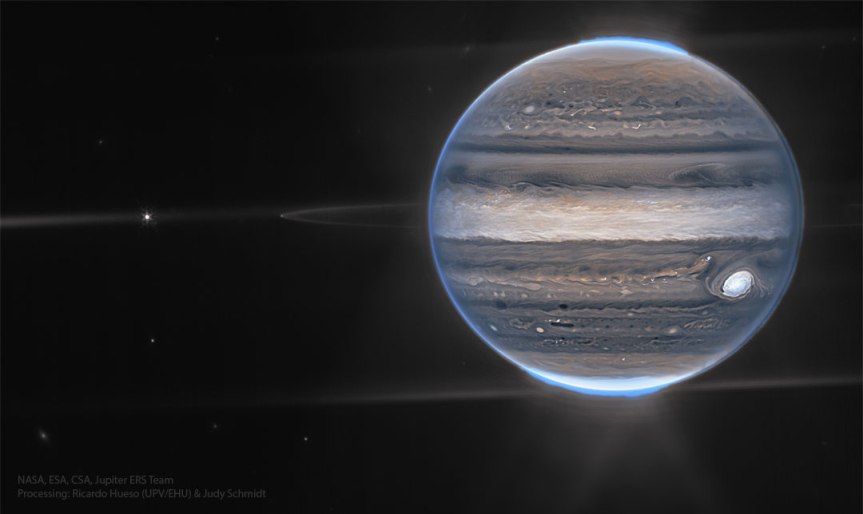
Jupiter from the Webb Space Telescope
Image Credit: NASA, ESA, CSA, Jupiter ERS Team; Processing: Ricardo Hueso (UPV/EHU) & Judy Schmidt
Explanation: This new view of Jupiter is illuminating. High-resolution infrared images of Jupiter from the new James Webb Space Telescope (Webb) reveal, for example, previously unknown differences between high-floating bright clouds — including the Great Red Spot — and low-lying dark clouds. Also clearly visible in the featured Webb image are Jupiter’s dust ring, bright auroras at the poles, and Jupiter’s moons Amalthea and Adrastea. Large volcanic moon Io‘s magnetic funneling of charged particles onto Jupiter is also visible in the southern aurora. Some objects are so bright that light noticeably diffracts around Webb’s optics creating streaks. Webb, which orbits the Sun near the Earth, has a mirror over six meters across making it the largest astronomical telescope ever launched — with over six times more light-collecting area than Hubble.
August 29 Astronomy Picture of the Day
Discover the cosmos! Each day a different image or photograph of our fascinating universe is featured, along with a brief explanation written by a professional astronomer.
2022 August 29
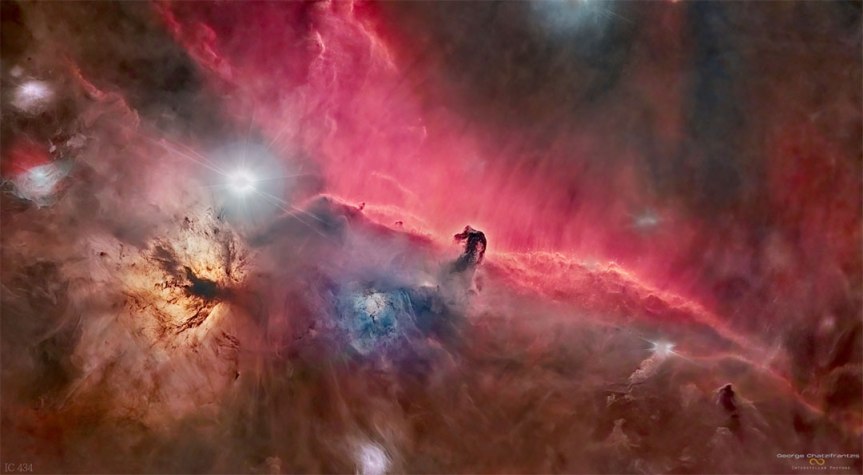
The Horsehead Nebula Region without Stars
Image Credit & Copyright: George Chatzifrantzis
Explanation: The famous Horsehead Nebula in Orion is not alone. A deep exposure shows that the dark familiar shaped indentation, visible just right of center, is part of a vast complex of absorbing dust and glowing gas. The featured spectacular picture details an intricate tapestry of gaseous wisps and dust-laden filaments that were created and sculpted over eons by stellar winds and ancient supernovas. The Flame Nebula is visible in orange just to the Horsehead’s left. To highlight the dust and gas, most of the stars have been digitally removed, although a notable exception is Alnitak, just above the Flame Nebula, which is the rightmost star in Orion’s famous belt of three aligned stars. The Horsehead Nebula lies 1,500 light years distant towards the constellation of Orion.
NASA Coverage: Artemis I Mission to the Moon
Teachers & Students: Ideas for utilizing APOD in the classroom
List of Astronomy Pictures of the Day from All of 2022 to Date
If you would like to catch up on all the Astronomy Picture of the Day from January 1 to August 28, 2022 you can click on this link From apodNASA.gov
August 2 Astronomy Picture of the Day
Discover the cosmos! Each day a different image or photograph of our fascinating universe is featured, along with a brief explanation written by a professional astronomer.
2022 August 2
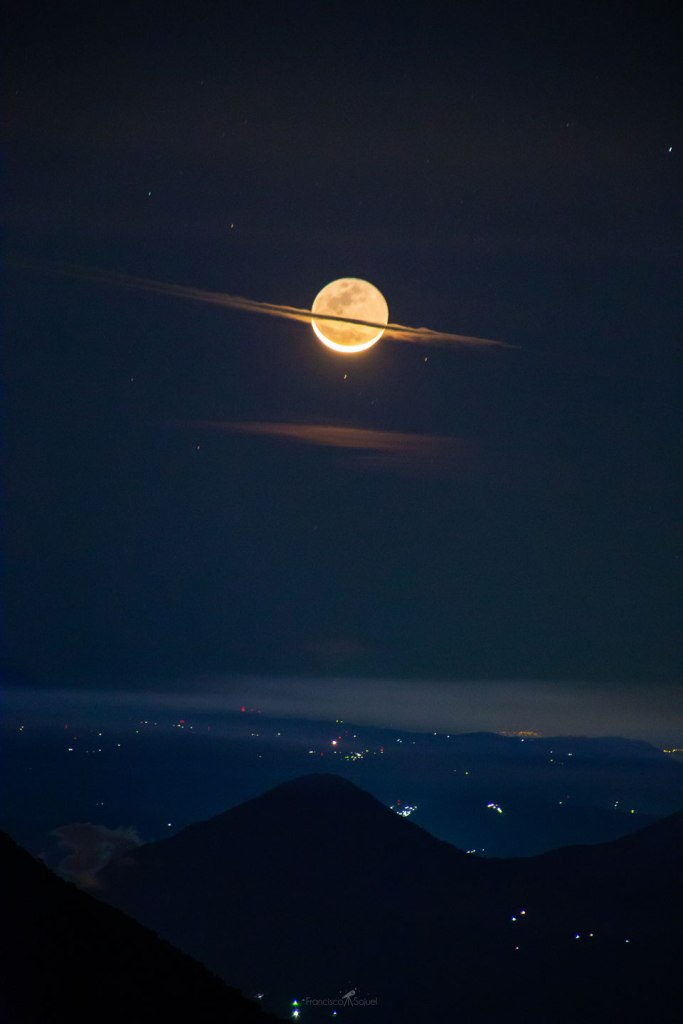
A Moon Dressed Like Saturn
Image Credit & Copyright: Francisco Sojuel
Explanation: Why does Saturn appear so big? It doesn’t — what is pictured are foreground clouds on Earth crossing in front of the Moon. The Moon shows a slight crescent phase with most of its surface visible by reflected Earthlight known as ashen glow. The Sun directly illuminates the brightly lit lunar crescent from the bottom, which means that the Sun must be below the horizon and so the image was taken before sunrise. This double take-inducing picture was captured on 2019 December 24, two days before the Moon slid in front of the Sun to create a solar eclipse. In the foreground, lights from small Guatemalan towns are visible behind the huge volcano Pacaya.
News: APOD Receives First Outreach Prize from the International Astronomical Union
July 31 Astronomy Picture of the Day
Discover the cosmos! Each day a different image or photograph of our fascinating universe is featured, along with a brief explanation written by a professional astronomer.
2022 July 31
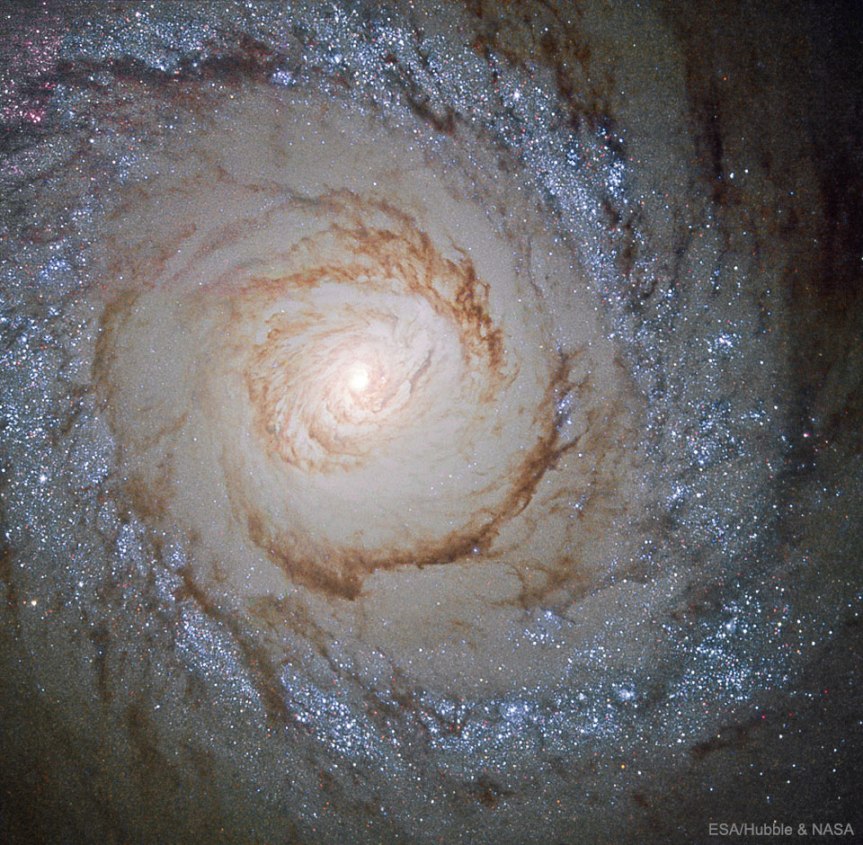
Starburst Galaxy M94 from Hubble
Image Credit: ESA/Hubble & NASA
Explanation: Why does this galaxy have a ring of bright blue stars? Beautiful island universe Messier 94 lies a mere 15 million light-years distant in the northern constellation of the Hunting Dogs (Canes Venatici). A popular target for Earth-based astronomers, the face-on spiral galaxy is about 30,000 light-years across, with spiral arms sweeping through the outskirts of its broad disk. But this Hubble Space Telescope field of view spans about 7,000 light-years across M94‘s central region. The featured close-up highlights the galaxy’s compact, bright nucleus, prominent inner dust lanes, and the remarkable bluish ring of young massive stars. The ring stars are all likely less than 10 million years old, indicating that M94 is a starburst galaxy that is experiencing an epoch of rapid star formation from inspiraling gas. The circular ripple of blue stars is likely a wave propagating outward, having been triggered by the gravity and rotation of a oval matter distributions. Because M94 is relatively nearby, astronomers can better explore details of its starburst ring.
July 30 Astronomy Picture of the Day
Discover the cosmos! Each day a different image or photograph of our fascinating universe is featured, along with a brief explanation written by a professional astronomer.
2022 July 30
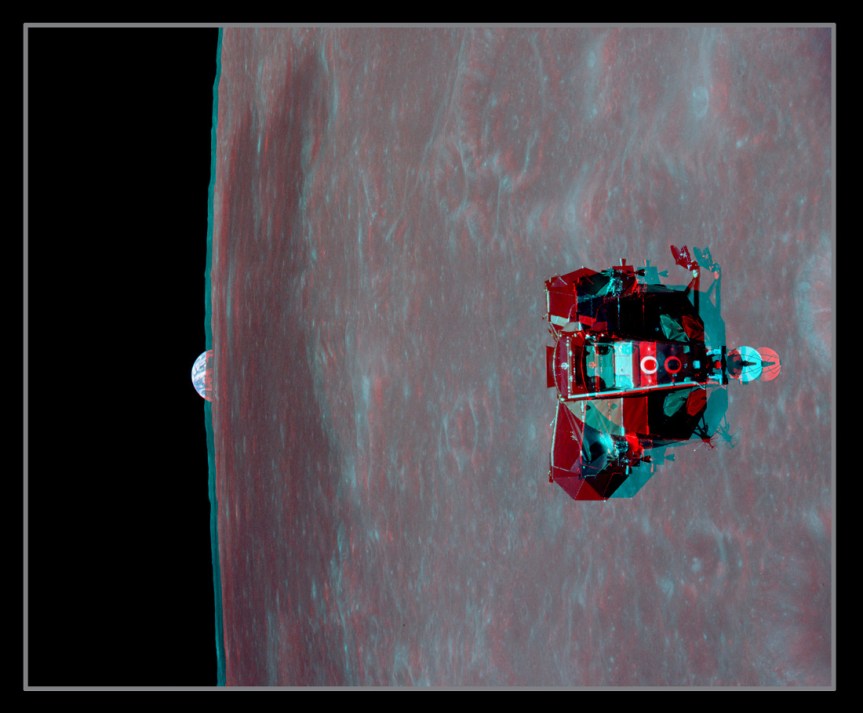
The Eagle Rises
Image Credit: Apollo 11, NASA – Stereo Image Copyright: John Kaufmann (ALSJ)
Explanation: Get out your red/blue glasses and check out this stereo view from lunar orbit. The 3D anaglyph was created from two photographs (AS11-44-6633, AS11-44-6634) taken by astronaut Michael Collins during the 1969 Apollo 11 mission. It features the lunar module ascent stage, dubbed The Eagle, rising to meet the command module in lunar orbit on July 21. Aboard the ascent stage are Neil Armstrong and Buzz Aldrin, the first to walk on the Moon. The smooth, dark area on the lunar surface is Mare Smythii located just below the equator on the extreme eastern edge of the Moon’s near side. Poised beyond the lunar horizon is our fair planet Earth.
July 29 Astronomy Picture of the Day
Discover the cosmos! Each day a different image or photograph of our fascinating universe is featured, along with a brief explanation written by a professional astronomer.
2022 July 29
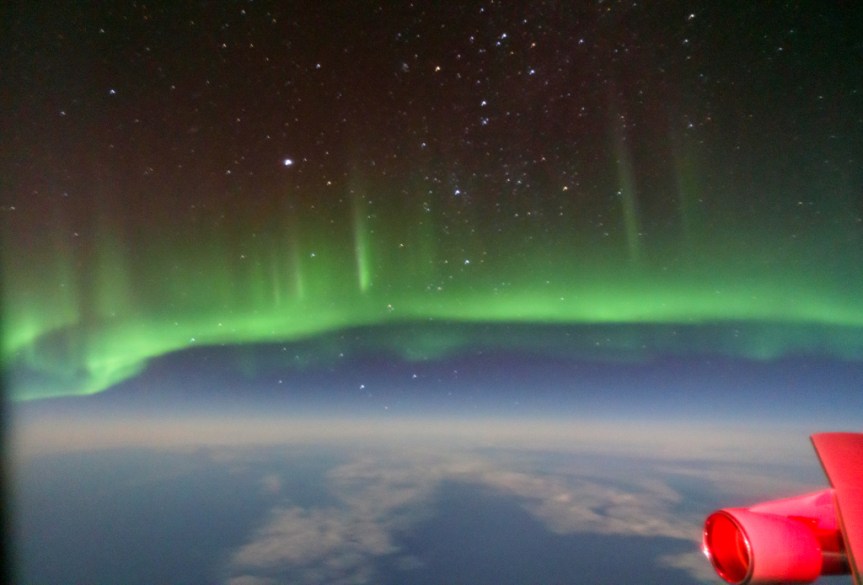
SOFIA’s Southern Lights
Image Credit & Copyright: Ian Griffin (Otago Museum)
Explanation: SOFIA, the Stratospheric Observatory for Infrared Astronomy, is a Boeing 747SP aircraft modified to carry a large reflecting telescope into the stratosphere. The ability of the airborne facility to climb above about 99 percent of Earth’s infrared-blocking atmosphere has allowed researchers to observe from almost anywhere over the planet. On a science mission flying deep into the southern auroral oval, astronomer Ian Griffin, director of New Zealand’s Otago Museum, captured this view from the observatory’s south facing starboard side on July 17. Bright star Canopus shines in the southern night above curtains of aurora australis, or southern lights. The plane was flying far south of New Zealand at the time at roughly 62 degrees southern latitude. Unfortunately, after a landing at Christchurch severe weather damaged SOFIA requiring repairs and the cancellation of the remainder of its final southern hemisphere deployment.
July 27 Astronomy Picture of the Day
Discover the cosmos! Each day a different image or photograph of our fascinating universe is featured, along with a brief explanation written by a professional astronomer.
2022 July 27
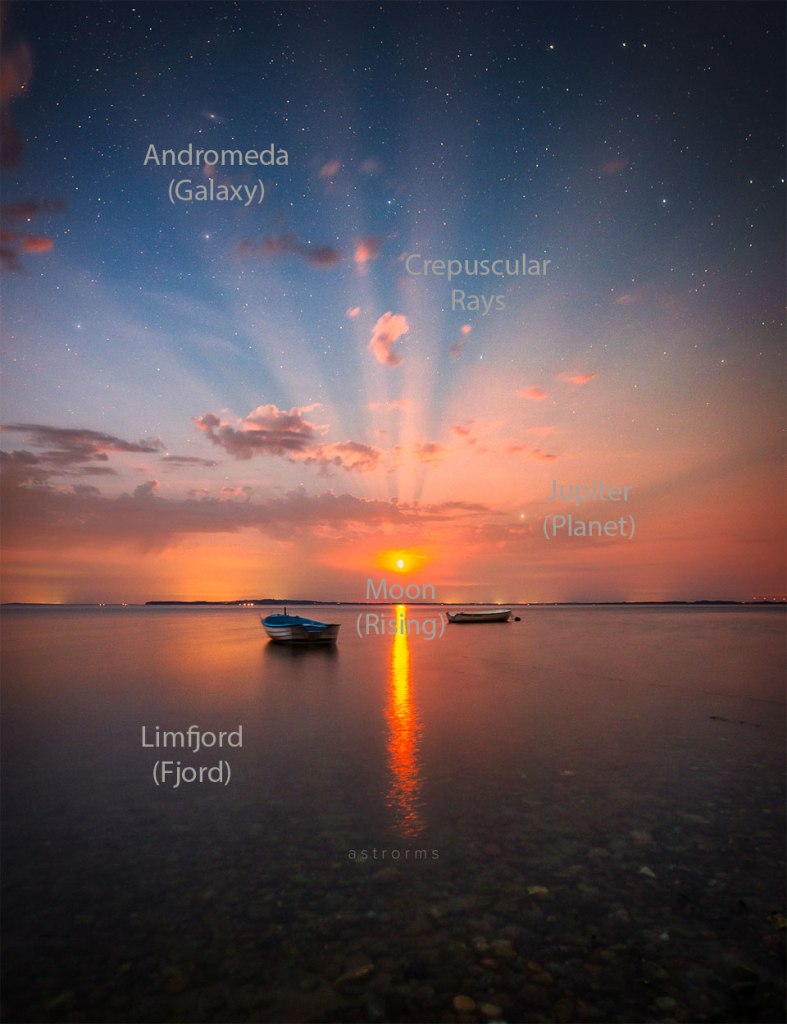
Crepuscular Moon Rays over Denmark
Image Credit & Copyright: Ruslan Merzlyakov (astrorms)
Explanation: This moon made quite an entrance. Typically, a moonrise is quiet and serene. Taking a few minutes to fully peek above the horizon, Earth’s largest orbital companion can remain relatively obscure until it rises high in the nighttime sky. About a week ago, however, and despite being only half lit by the Sun, this rising moon put on a show — at least from this location. The reason was that, as seen from Limfjord in Nykøbing Mors, Denmark, the moon rose below scattered clouds near the horizon. The result, captured here in a single exposure, was that moonlight poured through gaps in the clouds to created what are called crepuscular rays. These rays can fan out dramatically across the sky when starting near the horizon, and can even appear to converge on the other side of the sky. Well behind our Moon, stars from our Milky Way galaxy dot the background, and our galaxy’s largest orbital companion — the Andromeda galaxy — can be found on the upper left.
Almost Hyperspace: Random APOD Generator
July 26 Astronomy Picture of the Day
Discover the cosmos! Each day a different image or photograph of our fascinating universe is featured, along with a brief explanation written by a professional astronomer.
2022 July 26
Comet NEOWISE Rising over the Adriatic Sea
Comet NEOWISE Rising over the Adriatic Sea
Video Credit & Copyright: Paolo GirottiExplanation: This sight was worth getting out of bed early. Two years ago this month, Comet C/2020 F3 (NEOWISE) rose before dawn to the delight of northern sky enthusiasts awake that early. Up before sunrise on July 8th, the featured photographer was able to capture in dramatic fashion one of the few comets visible to the unaided eye this century, an inner-Solar System intruder that has become known as the Great Comet of 2020. The resulting video detailed Comet NEOWISE from Italy rising over the Adriatic Sea. The time-lapse video combines over 240 images taken over 30 minutes. The comet was seen rising through a foreground of bright and undulating noctilucent clouds, and before a background of distant stars. Comet NEOWISE remained unexpectedly bright until 2020 August, with its ion and dust tails found to emanate from a nucleus spanning about five kilometers across.
Astrophysicists: Browse 2,800+ codes in the Astrophysics Source Code Library
July 25 Astronomy Picture of the Day
Discover the cosmos! Each day a different image or photograph of our fascinating universe is featured, along with a brief explanation written by a professional astronomer.
2022 July 25
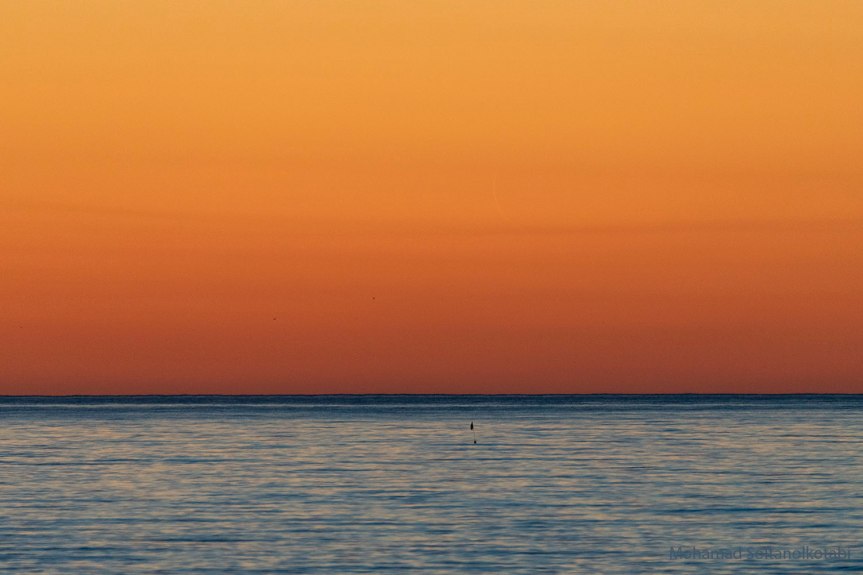
Find the New Moon
Image Credit & Copyright: Mohamad Soltanolkotabi
Explanation: Can you find the Moon? This usually simple task can be quite difficult. Even though the Moon is above your horizon half of the time, its phase can be anything from crescent to full. The featured image was taken in late May from Sant Martí d’Empúries, Spain, over the Mediterranean Sea in the early morning. One reason you can’t find this moon is because it is very near to its new phase, when very little of the half illuminated by the Sun is visible to the Earth. Another reason is because this moon is near the horizon and so seen through a long path of Earth’s atmosphere — a path which dims the already faint crescent. Any crescent moon is only visible near the direction the Sun, and so only locatable near sunrise or sunset. The Moon runs through all of its phases in a month (moon-th), and this month the thinnest sliver of a crescent — a new moon — will occur in three days.
July 24 Astronomy Picture of the Day
Discover the cosmos! Each day a different image or photograph of our fascinating universe is featured, along with a brief explanation written by a professional astronomer.
2022 July 24
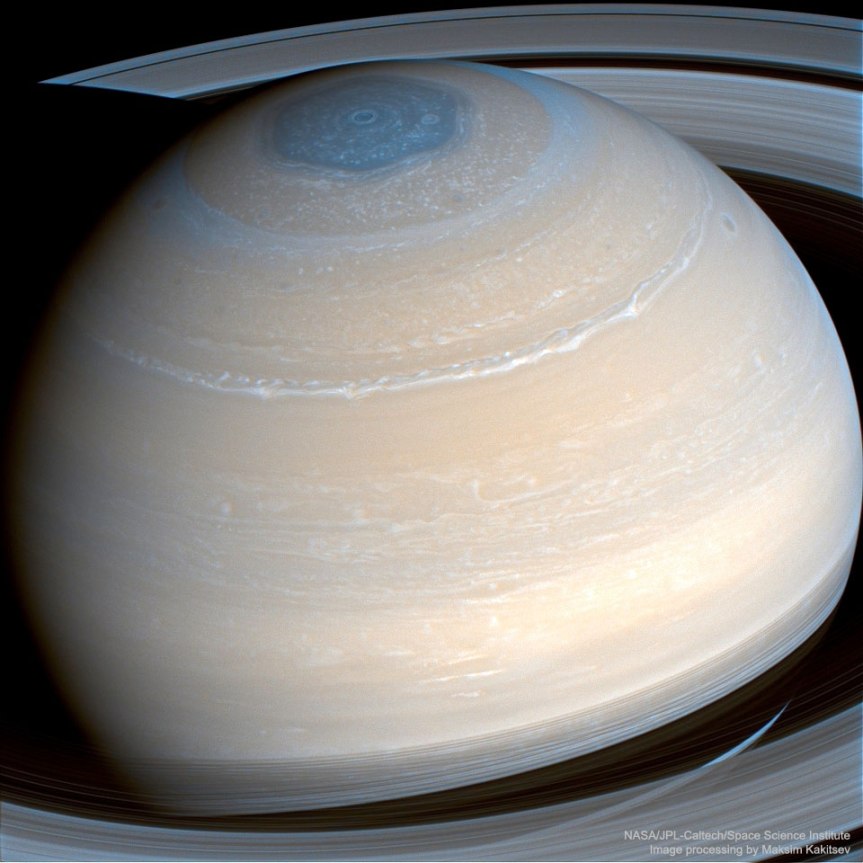
Saturn in Infrared from Cassini
Image Credit: NASA, JPL-Caltech, SSI; Processing: Maksim Kakitsev
Explanation: Many details of Saturn appear clearly in infrared light. Bands of clouds show great structure, including long stretching storms. Also quite striking in infrared is the unusual hexagonal cloud pattern surrounding Saturn‘s North Pole. Each side of the dark hexagon spans roughly the width of our Earth. The hexagon‘s existence was not predicted, and its origin and likely stability remains a topic of research. Saturn’s famous rings circle the planet and cast shadows below the equator. The featured image was taken by the robotic Cassini spacecraft in 2014 in several infrared colors. In 2017 September, the Cassini mission was brought to a dramatic conclusion when the spacecraft was directed to dive into ringed giant.
Explore Your Universe: Random APOD Generator
July 23 Astronomy Picture of the Day
Discover the cosmos! Each day a different image or photograph of our fascinating universe is featured, along with a brief explanation written by a professional astronomer.
2022 July 23
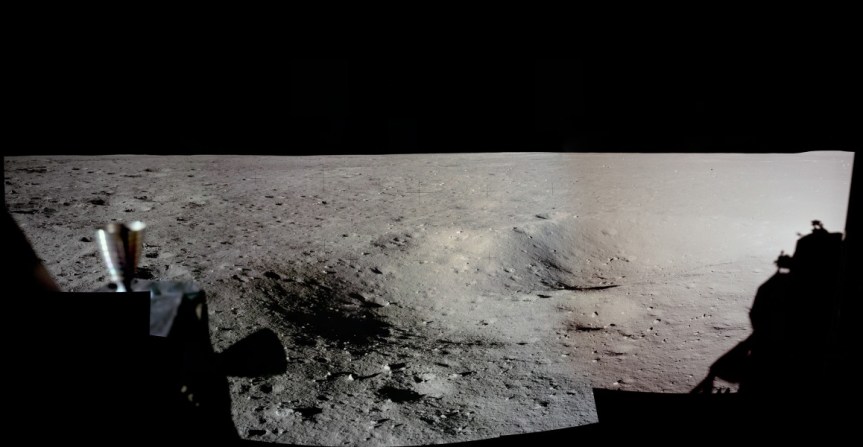
Apollo 11 Landing Panorama
Neil Armstrong, Apollo 11, NASA
Explanation: Have you seen a panorama from another world lately? Assembled from high-resolution scans of the original film frames, this one sweeps across the magnificent desolation of the Apollo 11 landing site on the Moon’s Sea of Tranquility. The images were taken by Neil Armstrong looking out his window of the Eagle Lunar Module shortly after the July 20, 1969 landing. The frame at the far left (AS11-37-5449) is the first picture taken by a person on another world. Toward the south, thruster nozzles can be seen in the foreground on the left, while at the right, the shadow of the Eagle is visible to the west. For scale, the large, shallow crater on the right has a diameter of about 12 meters. Frames taken from the Lunar Module windows about an hour and a half after landing, before walking on the lunar surface, were intended to initially document the landing site in case an early departure was necessary.
July 22 Astronomy Picture of the Day
Discover the cosmos! Each day a different image or photograph of our fascinating universe is featured, along with a brief explanation written by a professional astronomer.
2022 July 22
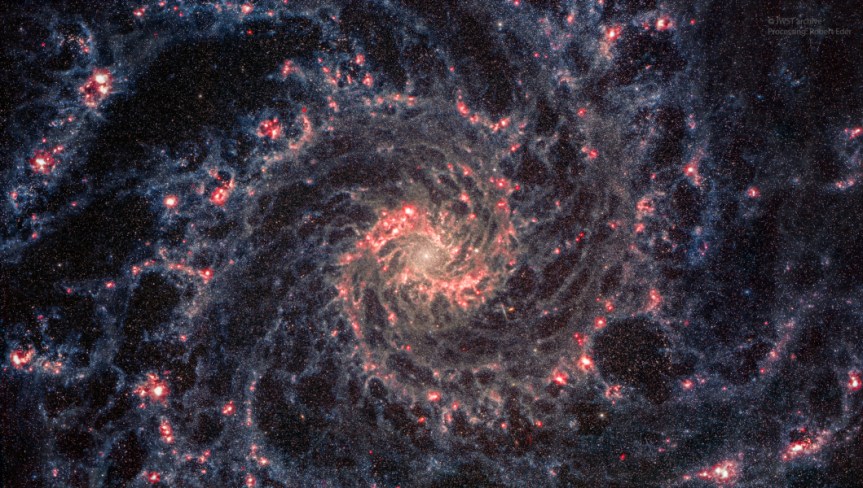
Spiral Galaxy M74: A Sharper View
Image Credit: NASA, ESA, CSA, STScI; Processing Copyright: Robert Eder
Explanation: Beautiful spiral galaxy Messier 74 (also known as NGC 628) lies some 32 million light-years away toward the constellation Pisces. An island universe of about 100 billion stars with two prominent spiral arms, M74 has long been admired by astronomers as a perfect example of a grand-design spiral galaxy. M74’s central region is brought into a stunning, sharp focus in this recently processed image using publicly available data from the James Webb Space Telescope. The colorized combination of image data sets is from two of Webb’s instruments NIRcam and MIRI, operating at near- and mid-infrared wavelengths. It reveals cooler stars and dusty structures in the grand-design spiral galaxy only hinted at in previous space-based views.
July 21 Astronomy Picture of the Day
Discover the cosmos! Each day a different image or photograph of our fascinating universe is featured, along with a brief explanation written by a professional astronomer.
2022 July 21
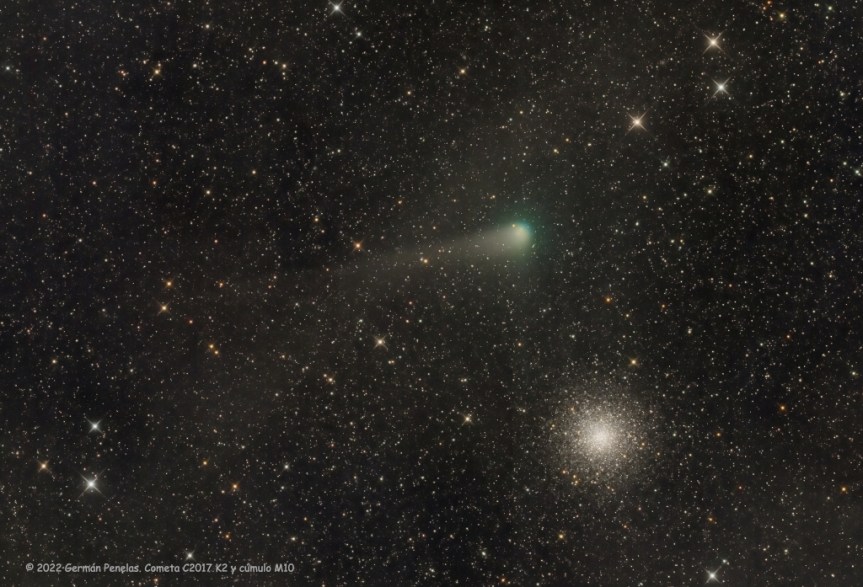
Messier 10 and Comet
Image Credit & Copyright: German Penelas Perez
Explanation: Imaged on July 15 2022, comet C/2017 K2 (PanSTARRS) had a Messier moment, sharing this wide telescopic field of view with globular star cluster Messier 10. Of course M10 was cataloged by 18th century comet hunter Charles Messier as the 10th object on his list of things that were definitely not comets. While M10 is about 14 thousand light-years distant, this comet PanSTARRS was about 15 light-minutes from our fair planet following its July 14 closest approach. Its greenish coma and dust tail entertaining 21st century comet watchers, C/2017 K2 is expected to remain a fine telescopic comet in northern summer skies. On a maiden voyage from our Solar System’s remote Oort Cloud this comet PanSTARRS was discovered in May 2017 when it was beyond the orbit of Saturn. At the time that made it the most distant active inbound comet known. Its closest approach to the Sun will be within 1.8 astronomical units on December 19, beyond the orbital distance of Mars.
July 20 Astronomy Picture of the Day
Discover the cosmos! Each day a different image or photograph of our fascinating universe is featured, along with a brief explanation written by a professional astronomer.
2022 July 20
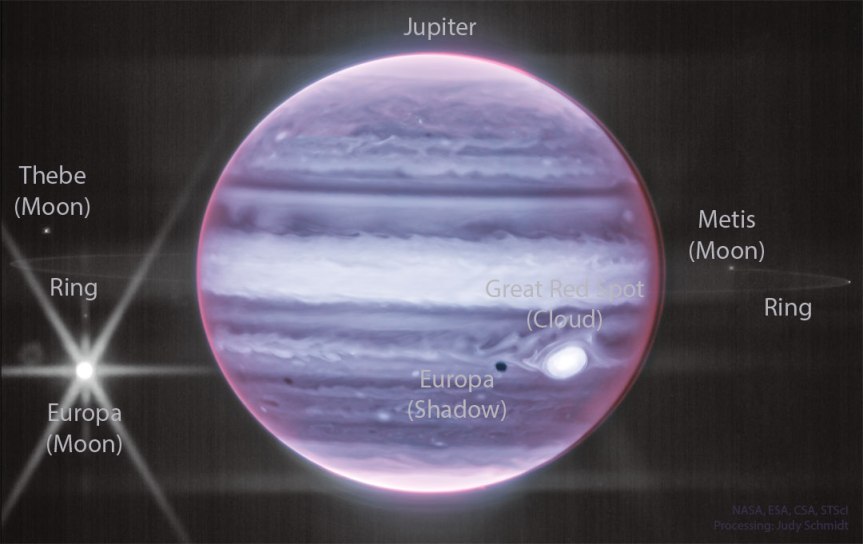
Jupiter and Ring in Infrared from Webb
Image Credit: NASA, ESA, CSA, STScI; Processing & License: Judy Schmidt
Explanation: Why does Jupiter have rings? Jupiter’s main ring was discovered in 1979 by NASA’s passing Voyager 1 spacecraft, but its origin was then a mystery. Data from NASA’s Galileo spacecraft that orbited Jupiter from 1995 to 2003, however, confirmed the hypothesis that this ring was created by meteoroid impacts on small nearby moons. As a small meteoroid strikes tiny Metis, for example, it will bore into the moon, vaporize, and explode dirt and dust off into a Jovian orbit. The featured image of Jupiter in infrared light by the James Webb Space Telescope shows not only Jupiter and its clouds, but this ring as well. Also visible is Jupiter’s Great Red Spot (GRS) — in comparatively light color on the right, Jupiter’s large moon Europa — in the center of diffraction spikes on the left, and Europa’s shadow — next to the GRS. Several features in the image are not yet well understood, including the seemingly separated cloud layer on Jupiter’s right limb.
Celestial Surprise: What picture did APOD feature on your birthday? (post 1995)
July 19 Astronomy Picture of the Day
Discover the cosmos! Each day a different image or photograph of our fascinating universe is featured, along with a brief explanation written by a professional astronomer.
2022 July 19
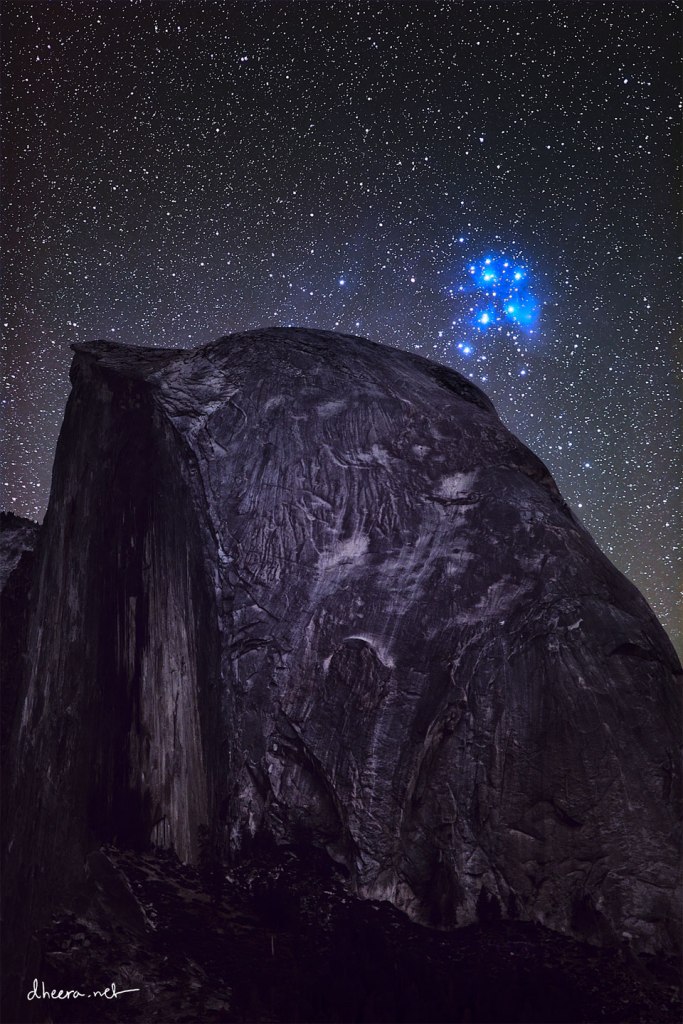
Pleiades over Half Dome
Image Credit & Copyright: Dheera Venkatraman
Explanation: Stars come in bunches. The most famous bunch of stars on the sky is the Pleiades, a bright cluster that can be easily seen with the unaided eye. The Pleiades lies only about 450 light years away, formed about 100 million years ago, and will likely last about another 250 million years. Our Sun was likely born in a star cluster, but now, being about 4.5 billion years old, its stellar birth companions have long since dispersed. The Pleiades star cluster is pictured over Half Dome, a famous rock structure in Yosemite National Park in California, USA. The featured image is a composite of 28 foreground exposures and 174 images of the stellar background, all taken from the same location and by the same camera on the same night in October 2019. After calculating the timing of a future juxtaposition of the Pleiades and Half Dome, the astrophotrographer was unexpectedly rewarded by an electrical blackout, making the background sky unusually dark.
July 18 Astronomy Picture of the Day
Discover the cosmos! Each day a different image or photograph of our fascinating universe is featured, along with a brief explanation written by a professional astronomer.
2022 July 18
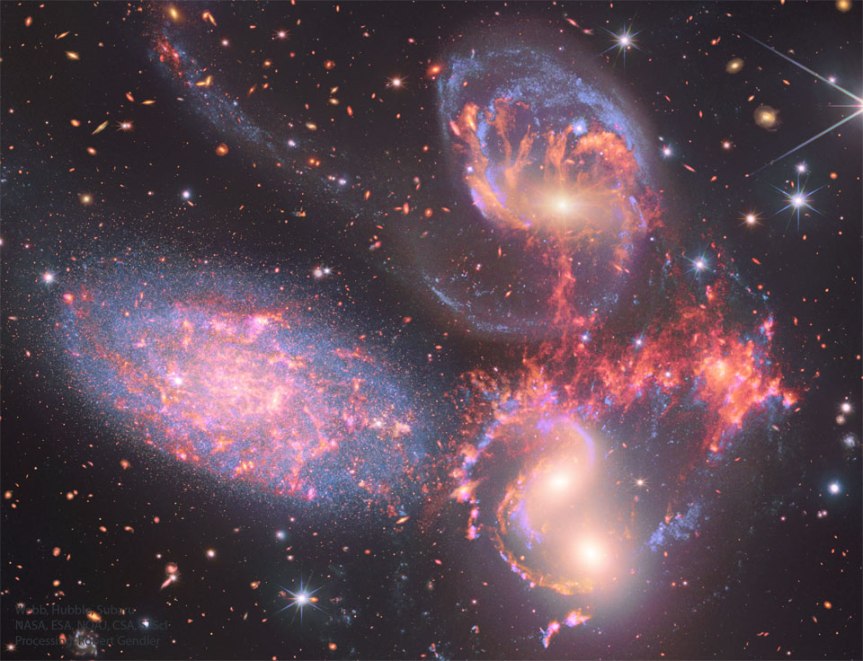
Stephan’s Quintet from Webb, Hubble, and Subaru
Image Credit: Webb, Hubble, Subaru; NASA, ESA, CSA, NOAJ, STScI; Processing & Copyright: Robert Gendler
Explanation: OK, but why can’t you combine images from Webb and Hubble? You can, and today’s featured image shows one impressive result. Although the recently launched James Webb Space Telescope (Webb) has a larger mirror than Hubble, it specializes in infrared light and can’t see blue — only up to about orange. Conversely, the Hubble Space Telescope (Hubble) has a smaller mirror than Webb and can’t see as far into the infrared as Webb, but can image not only blue light but even ultraviolet. Therefore, Webb and Hubble data can be combined to create images across a wider variety of colors. The featured image of four galaxies from Stephan’s Quintet shows Webb images as red and also includes images taken by Japan‘s ground-based Subaru telescope in Hawaii. Because image data for Webb, Hubble, and Subaru are made freely available, anyone around the world can process it themselves, and even create intriguing and scientifically useful multi-observatory montages.
July 17 Astronomy Picture of the Day
Discover the cosmos! Each day a different image or photograph of our fascinating universe is featured, along with a brief explanation written by a professional astronomer.
2022 July 17
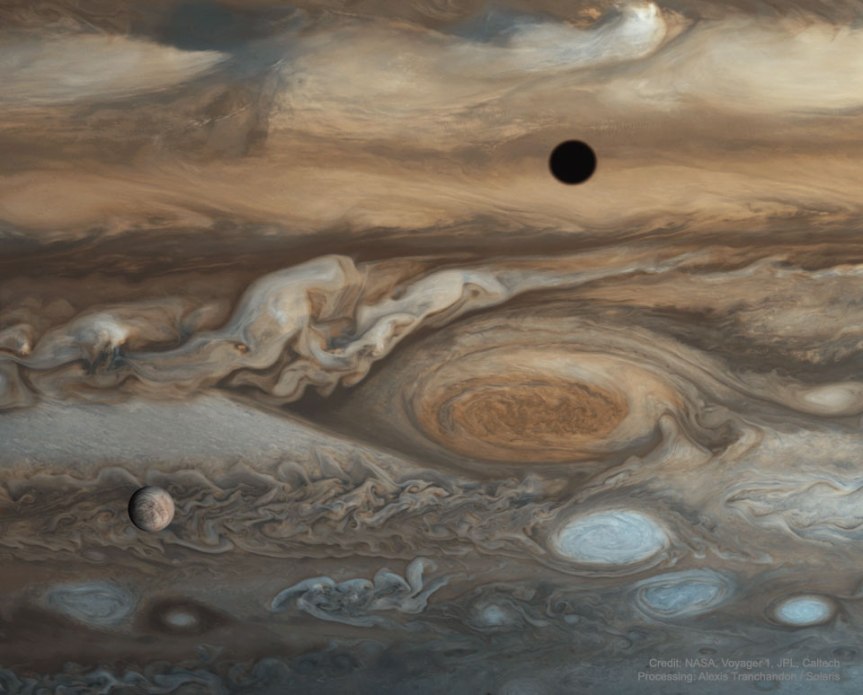
Europa and Jupiter from Voyager 1
Image Credit: NASA, Voyager 1, JPL, Caltech; Processing & License: Alexis Tranchandon / Solaris
Explanation: What are those spots on Jupiter? Largest and furthest, just right of center, is the Great Red Spot — a huge storm system that has been raging on Jupiter possibly since Giovanni Cassini‘s likely notation of it 357 years ago. It is not yet known why this Great Spot is red. The spot toward the lower left is one of Jupiter’s largest moons: Europa. Images from Voyager in 1979 bolster the modern hypothesis that Europa has an underground ocean and is therefore a good place to look for extraterrestrial life. But what about the dark spot on the upper right? That is a shadow of another of Jupiter’s large moons: Io. Voyager 1 discovered Io to be so volcanic that no impact craters could be found. Sixteen frames from Voyager 1’s flyby of Jupiter in 1979 were recently reprocessed and merged to create the featured image. Forty-five years ago this August, Voyager 1 launched from Earth and started one of the greatest explorations of the Solar System ever.
Free Download: Voyager Posters
 Witches Of The Craft®










You must be logged in to post a comment.