I Apologize to My Readers in the Southern Hemisphere

Greetings Sisters, Brothers, and Honored Guests,

I am very sorry that the ‘ Daily Correspondence Digest for the Southern Hemisphere’s Moon Phase and Planetary Positions ‘ has been missing for some days in January. As you might have read in other posts, I have been having a lot of fibromyalgia problems along with arthritis ones this winter. Our winter where I live in the Midwestern United States has been going from below 0F up to in the 40’s F which is causing me multiple fibromyalgia flares. During fibromyalgia flares I get what is referred to as brain fog and since I have had problems with short term memory from the age of 2 years old after a major car accident, I was in. I think I have done all the major posts for both hemispheres only to come back the next day and find I have once again forgot to do the major post for your hemisphere. From today forward I am making myself a check list to make sure I do not forget to do the ‘ Daily Correspondence Digest for the Southern Hemisphere’s Moon Phase and Planetary Positions ‘. I will also make sure I do not forget to do Southern Hemisphere Sabbat posts at the appropriate time.

May you all be blessed with a beautiful spring and a summer that is not too hot and that both seasons bring you adequate amounts of rain.

Astronomy Picture of the Day

Discover the cosmos! Each day a different image or photograph of our fascinating universe is featured, along with a brief explanation written by a professional astronomer.

2022 January 27

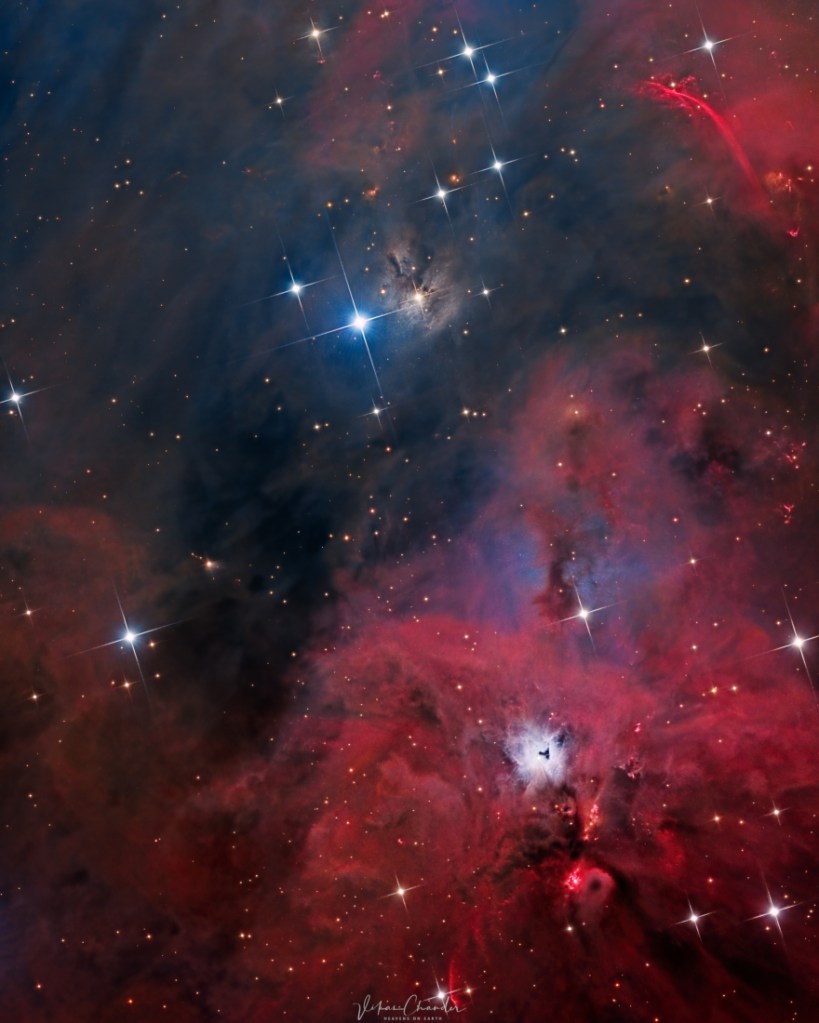
South of Orion

Image Credit & Copyright: Vikas Chander

Explanation: South of the large star-forming region known as the Orion Nebula, lies bright blue reflection nebula NGC 1999. At the edge of the Orion molecular cloud complex some 1,500 light-years distant, NGC 1999’s illumination is provided by the embedded variable star V380 Orionis. The nebula is marked with a dark sideways T-shape at center right in this telescopic vista that spans about two full moons on the sky. Its dark shape was once assumed to be an obscuring dust cloud seen in silhouette. But infrared data suggest the shape is likely a hole blown through the nebula itself by energetic young stars. In fact, this region abounds with energetic young stars producing jets and outflows with luminous shock waves. Cataloged as Herbig-Haro (HH) objects, named for astronomers George Herbig and Guillermo Haro, the shocks have intense reddish hues. HH1 and HH2 are just below and right of NGC 1999. HH222, also known as the Waterfall nebula, looks like a red gash near top right in the frame. To create the shocks stellar jets push through the surrounding material at speeds of hundreds of kilometers per second.

January 27, 2022 Daily Correspondence Digest for the Northern Hemisphere’s Moon Phase and Planetary Positions

You can use this link to go forward or backward in time for Moon phase information. If you are curious, you can even find out what phase the Moon was in when you or anyone else, you know was on the date the person was born.

From Moongiant.com

The Moon’s current phase for today and tonight is a Waning Crescent phase.  In this phase the Moon’s illumination is growing smaller each day until the New Moon. During this part of the Moon cycle, the Moon is getting closer to the Sun as viewed from Earth and the night side of the Moon is facing the Earth with only a small edge of the Moon being illuminated. This phase is best viewed an hour or 2 before the sunrise and can be quite beautiful if you’re willing to get up early. It can also be a great time to see the features of the Moon’s surface. Along the edge where the illuminated portion meets the dark side, the craters and mountains cast long shadows making them easier to observe with a telescope or binoculars.

Visit the January 2022 Moon Phases Calendar to see all the daily moon phase for this month.

Today’s Waning Crescent Phase

The Waning Crescent on January 27 has an illumination of 29%. This is the percentage of the Moon illuminated by the Sun. The illumination is constantly changing and can vary up to 10% a day. On January 27 the Moon is 24.21 days old. This refers to how many days it has been since the last New Moon. It takes 29.53 days for the Moon to orbit the Earth and go through the lunar cycle of all 8 Moon phases.

The 8 Lunar Phases

There are 8 lunar phases the Moon goes through in its 29.53 days lunar cycle. The 4 major Moon phases are Full Moon, New Moon, First Quarter and Last Quarter. Between these major phases, there are 4 minor ones: the Waxing Crescent, Waxing Gibbous, Waning Gibbous and Waning Crescent. For more info on the Moon Cycle and on each phase check out Wikipedia Lunar Phase page.

Phase Details

Phase: Waning Crescent
Illumination: 29%
Moon Age: 24.21 days
Moon Angle: 0.55
Moon Distance: 364,256.38 km
Sun Angle: 0.54
Sun Distance: 147,323,717.13 km

Useful Moon Resources

27 January 2022 Daily Correspondence Digest for the Southern Hemisphere’s Moon Phase and Planetary Positions

You can use this link to go forward or backward in time for Moon phase information. If you are curious, you can even find out what phase the Moon was in when you or anyone else, you know was on the date the person was born.

From Moongiant.com

The Moon’s current phase for today and tonight is a Waning Crescent phase.  In this phase the Moon’s illumination is growing smaller each day until the New Moon. During this part of the Moon cycle, the Moon is getting closer to the Sun as viewed from Earth and the night side of the Moon is facing the Earth with only a small edge of the Moon being illuminated. This phase is best viewed an hour or 2 before the sunrise and can be quite beautiful if you’re willing to get up early. It can also be a great time to see the features of the Moon’s surface. Along the edge where the illuminated portion meets the dark side, the craters and mountains cast long shadows making them easier to observe with a telescope or binoculars.

Visit the January 2022 Moon Phases Calendar to see all the daily moon phase for this month.

Today’s Waning Crescent Phase

The Waning Crescent on January 27 has an illumination of 29%. This is the percentage of the Moon illuminated by the Sun. The illumination is constantly changing and can vary up to 10% a day. On January 27 the Moon is 24.21 days old. This refers to how many days it has been since the last New Moon. It takes 29.53 days for the Moon to orbit the Earth and go through the lunar cycle of all 8 Moon phases.

The 8 Lunar Phases

There are 8 lunar phases the Moon goes through in its 29.53 days lunar cycle. The 4 major Moon phases are Full Moon, New Moon, First Quarter and Last Quarter. Between these major phases, there are 4 minor ones: the Waxing Crescent, Waxing Gibbous, Waning Gibbous and Waning Crescent. For more info on the Moon Cycle and on each phase check out Wikipedia Lunar Phase page.

Phase Details

Phase: Waning Crescent
Illumination: 29%
Moon Age: 24.21 days
Moon Angle: 0.55
Moon Distance: 364,256.38 km
Sun Angle: 0.54
Sun Distance: 147,323,717.13 km

Useful Moon Resources

If you need to calculate the planetary positions for a specific use and time, click on this link

Currentplanetarypositions.com

To figure out GMT (Greenwich Mean Time) to your local time use this link

 For Your Local Time and Date

Southeastern Hemisphere

The time for this Custom Planetary Positions is from the local time in Sao Paulo, Brazil, South America

27 January 2022
08:00 pm GMT 5:00 PM BRT
Zodiac: Tropical (Standard Western)

Sun:07 Aquarius 51
Moon:07 Sagittarius 25
Mercury:28 Capricorn 07 Rx
Venus:11 Capricorn 07 Rx
Mars:02 Capricorn 24
Jupiter:06 Pisces 15
Saturn:14 Aquarius 59
Uranus:10 Taurus 51
Neptune:21 Pisces 18
Pluto:26 Capricorn 49
True Lunar Node:29 Taurus 12 Rx
Mean Lunar Node:28 Taurus 07 Rx
Lilith (Black Moon):21 Gemini 26
Chiron:09 Aries 07
Ceres:28 Taurus 31
Pallas:24 Pisces 09
Juno:27 Capricorn 57
Vesta:08 Capricorn 47
Eris:23 Aries 43
Fire:3
Earth:10
Air:3
Water:3
Cardinal:8
Fixed:6
Mutable:5

Southern Hemisphere

The time for this Custom Planetary Positions is from the local time in Cape Town, South Africa

27 January 2022
03:00 pm GMT 5:00 PM SAST
Zodiac: Tropical (Standard Western)

Sun:07 Aquarius 39
Moon:04 Sagittarius 26
Mercury:28 Capricorn 19 Rx
Venus:11 Capricorn 08 Rx
Mars:02 Capricorn 15
Jupiter:06 Pisces 13
Saturn:14 Aquarius 58
Uranus:10 Taurus 51
Neptune:21 Pisces 18
Pluto:26 Capricorn 48

True Lunar Node:29 Taurus 12 Rx

Mean Lunar Node:28 Taurus 07 Rx
Lilith (Black Moon):21 Gemini 25
Chiron:09 Aries 07
Ceres:28 Taurus 30
Pallas:24 Pisces 05
Juno:27 Capricorn 52
Vesta:08 Capricorn 41
Eris:23 Aries 43

Fire:3
Earth:10
Air:3
Water:3
Cardinal:8
Fixed:6
Mutable:5

Southwestern Hemisphere

The time for this Custom Planetary Positions is from the local time in Melbourne, Victoria, Australia

27 January 2022
06:00 am GMT 5:00 PM AEDT
Zodiac: Tropical (Standard Western)

Sun:07 Aquarius 16
Moon:29 Scorpio 04
Mercury:28 Capricorn 43 Rx
Venus:11 Capricorn 10 Rx
Mars:01 Capricorn 58
Jupiter:06 Pisces 08
Saturn:14 Aquarius 55
Uranus:10 Taurus 51
Neptune:21 Pisces 17
Pluto:26 Capricorn 48
True Lunar Node:29 Taurus 13
Mean Lunar Node:28 Taurus 08 Rx
Lilith (Black Moon):21 Gemini 22
Chiron:09 Aries 06
Ceres:28 Taurus 28
Pallas:23 Pisces 57
Juno:27 Capricorn 43
Vesta:08 Capricorn 29
Eris:23 Aries 43
Fire:2
Earth:10
Air:3
Water:4
Cardinal:8
Fixed:7
Mutable:4