
| Your Charm for Today | |||
| <!– Interpretation Basics–> |
|||
 The Bulla |
|||
| Today’s Meaning: You are distracted from this aspect by other areas of your life you feel are more pressing. This aspect is suffering from this lack of attention. You must ask yourself how much more you can let it suffer before you give it due attention.General Description: From remote times the terrors of the arts of fascination have been dreaded, and by wearing this charm, which contained a written invocation to their gods, it was believed that full protection was obtained. The Bulla was popular in Rome from a very early period. It was worn on a necklace, or upon the girdle. The Gorgons head, with hair of writhing snakes, was believed to terrify and drive away the power of the bewitcher. Even today in many countries, the magic power of the evil eye is still believed in. |
|||
Tag: Rome
Your Charm for April 25 is Leo the Lion
| Your Charm for Today | |||
| <!– Interpretation Basics–> |
|||
 Leo the Lion |
|||
| Today’s Meaning: This aspect of your life will be strongly influenced by a person who is generous, warm-hearted, creative, enthusiastic, broad-minded, expansive, faithful and loving. This person is most likely a relative.General Description: Fifth sign of the Zodiac, July 23rd to Aug. 23rd. Ruled by the Sun; correct metal, Gold. Those born under the influence of Leo were believed to be enthusiastic, high spiritied, affable, generous, strong, quick tempered, artistic, inventive, generally successful and proverbially lucky. The Leo stones are the Peridot and Onyx, also Amber. The Peridot was in former times valued more than the Diamond. In Rome it was worn as a charm to drive away evil spirits, despondencey and illusions. Peridot amulets enjoyed a great reputation in the Middle Ages for inspiring wisdom and eloquence. Many medicinal properies were atrributed to Amber, and its supposed virtues are still relied on in the East. |
|||
Your Charm for April 18th
| Your Charm for Today | |||
 Capricornus the Goat |
|||
| Today’s Meaning: This aspect of your life will be strongly influenced by a person who is practical, prudent, ambitious, disciplined, patient, careful, humorous and reserved. They could be someone you know in the medical field–a nurse or doctor perhaps.General Description: Tenth sign of the Zodiac, Dec 22nd to Jan 19th. Ruling planet, Saturn; correct metal, lead. Those born under Capricornus influence were believed to be prudent, deep thinkers, prosperous in financial affairs, generous, with strong and foreible tempers. The capricorn stone is the Ruby. The Ruby was a favourite talisman in the Orient. In India it was worn to guard against attacks of enemies, foretell danger, supposed to change colour in presence of poison, and attract friends and good fortune; China and Japan health, Happiness and long life. The Romans believed that the Ruby preserved health and strength, averted danger, plauge and fevers. |
|||
Seasons of the Witch! Ancient Holidays (and some not so ancient!)

Live each Season as it passes; breathe the air, drink the drink, taste the fruit, and resign yourself to the influences of each. ~Henry David Thoreau (1817 – 1862)
Zurich: SIX RINGINGS FESTIVAL: Boog (Old Man Winter), a giant snowman stuffed with explosives, is jeered, taunted,
& then blown up. Much feasting & revelry.
Tibet: SUNNING OF THE BUDDHA. Lamas bring buddha statues out of temples of abstract tranquility to enjoy the sun.
Festival for Good Luck in Rome; the Goddess Fortuna.
Resources : GrannyMoon’s Morning Feast Archives
)0(
NOTE: Because of the large number of ancient calendars, many in simultaneous use, as well as different ways of computing holy days (marked by the annual inundation, the solar year, the lunar month, the rising of key stars, and other celestial and terrestrial events), you may find these holy days celebrated a few days earlier or later at your local temple .
Seasons of the Witch! Ancient Holidays (and some not so ancient!)
Your Charm for 4/5
| Your Charm for Today | |||
| <!– Interpretation Basics–> |
|||
Capricornus the Goat |
|||
| Today’s Meaning: This aspect of your life will be strongly influenced by a person who is practical, prudent, ambitious, disciplined, patient, careful, humorous and reserved. They could be someone you know in the medical field–a nurse or doctor perhaps.General Description: Tenth sign of the Zodiac, Dec 22nd to Jan 19th. Ruling planet, Saturn; correct metal, lead. Those born under Capricornus influence were believed to be prudent, deep thinkers, prosperous in financial affairs, generous, with strong and foreible tempers. The capricorn stone is the Ruby. The Ruby was a favourite talisman in the Orient. In India it was worn to guard against attacks of enemies, foretell danger, supposed to change colour in presence of poison, and attract friends and good fortune; China and Japan health, Happiness and long life. The Romans believed that the Ruby preserved health and strength, averted danger, plauge and fevers. |
|||
| Your Charm for Today | |||
| <!– Interpretation Basics–> |
|||
|
|||
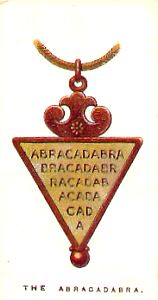 Abracadabra |
|||
| Today’s Meaning: The most powerful of all talisman indicating you or someone close to you will recover from an infection.General Description: One of the most famous of all talismans, and used as a magical formula by the Gnostics in Rome for invoking the aid of beneficient spirits against disease, misfortune and death. Sammonieus, the celebrated Gnostic physician; instructed that the letters of this magical triangle which he used for curing agues and fevers, were to be written on paper, folded into the shape of a cross, worn for nine days suspended from the neck, and, before sunrise, cast behind the patient into a stream running eastward. It was also a most popular charm in the middle ages. During the Great Plague, 1665, great numbers of these amulets were worn as supposed safeguards against infection. |
|||
The Goddess Companion
The Goddess Companion
The law of the season becomes
the law of religion. According to that law,
the day born of this night is sacred.
for on this day offerings are made
that dedicate all ships to me.
As this day dawns, the storms of winter
lose their strength. The surging waves
grow calm. The sea is a highway once again.
Go through this day with a mind not clouded
by worry over the past or fear of futures
that have not yet come to be.
~The Goddess Isis, speaking in Apuleius’ The Golden Ass
Although Isis was originally an Egyptian Goddess, her worship spread to Rome during imperial times. There she was honored as the Goddess of the sea, Stella Maris, Each year at this time, all the boats that would ply the waters during the summer were blessed in lavish festivals. The Goddess was invoked to keep the sea-farers safe and to bring the goods they sought safely back to port.
We too are sailors, navigating the oceans of our lives, often buffeted by storms and gales. We leave the safe harbour of our homes each day to travel in search of the goods we need to survive. Yet we have no seasonal festivals that bless our voyages. Taking time to ask for the kindness and protection of the Goddess as we move through the day is a small ritual, but one that can sustain us as we travel.
.
By Patricia Monaghan
Venus
Venus
The Roman Goddess of love and beauty, but originally a vegetation goddess and patroness of gardens and vineyards. Later, under Greek influence, she was equated with Aphrodite and assumed many of her aspects. Her cult originated from Ardea and Lavinium in Latium. The oldest temple known of Venus dates back to 293 BC, and was inaugurated on August 18. Later, on this date the Vinalia Rustica was observed. A second festival, that of the Veneralia, was celebrated on April 1 in honor of Venus Verticordia, who later became the protector against vice. Her temple was built in 114 BC. After the Roman defeat near Lake Trasum in 215 BC, a temple was built on the Capitol for Venus Erycina. This temple was officially opened on April 23, and a festival, the Vinalia Priora, was instituted to celebrate the occasion. Venus is the daughter of Jupiter, and some of her lovers include Mars and Vulcan, modeled on the affairs of Aphrodite. Venus’ importance rose, and that of her cult, through the influence of several Roman political leaders. The dictator Sulla made her his patroness,and both Julius Caesar and the emperor Augustus named her the ancestor of their (Julian) family: the ‘gens Julia’ was Aeneas, son of Venus and the mortal Anchises. Ceasar introduced the cult of Venus Genetrix, the goddess of motherhood and marriage, and built a temple for her in 46 BC. She was also honored in the temple of Mars Ultor. The last great temple of Venus was built by the emperor Hadrianus near the Colusseum in 135 AD. Roman statues and portraits of Venus are usually identical to the Greek representations of Aphrodite.
 Witches Of The Craft®