How Do Pagans React To Interfaith Relations?

How Do Pagans React To Interfaith Relations?

Author: Silver Faery 

How do interfaith relationships affect our lives? Is the struggle worth it in the end? How can we learn and grow from the people involved in this situation? Those are but a few of the questions that run through my mind.

My main view of an interfaith relationship is with my husband. He is a Satanist, and currently a member of the CoS; he is also in the United States Military, serving to protect our freedoms. He was Pagan when I met him, but over time decided to finally follow what felt right to him, and within the last two years took the path to get him into that area. He views himself as a “God, ” but still won’t deny that there isn’t something out there helping out and guiding. He just won’t worship them anymore. After being in Afghanistan once already, he learned that the Gods don’t really watch and – in his mind – care about humanity. Does this make him “evil” or “damned?” Well it depends on who you ask.

To me as long as he is loyal to his friends and family, truthful, and hard-working; as long as he will help those who he thinks deserves it, and is willing to fight for what he feels is right, I will support him. Though it does get comical at times:

Last year, we had taken our daughter to the park in town. On the way out I happened to notice him talking to a young teenage girl. I walked up beside him…in time to hear her ask him if he was Pagan. He stopped mid-sentence and said, “No, why do you ask?” She pointed to his Baphomet and said it was a Pentacle. He held it up for her to get a closer look. She then realized her mistake and stepped back like he would attack her! He then noticed me standing beside him, looked over and said, “But my wife is Pagan.” I wear a ring with a Pentacle on it, nothing too noticeable, but still there if you know what you are looking at. She didn’t see one around my neck. I showed her my ring. She smiled, and then looked shocked (for lack of a better word). We both get that a lot. She was Pagan; she had pulled her Pentacle out from under her shirt and was hoping to talk to him about Paganism. Obviously she had a lot to learn if she couldn’t understand why a Pagan would be married to someone like that! Then again, it seems to me a lot of people have to learn about Satanism before jumping to the wrong conclusions.

We have talked about how we are going to raise our children. My husband wants them to choose; I want to give them a “base” to compare other religions to. Both of us agree that in the end it will be the kids’ choice on what they want to be. Be it Christian, Jewish, Muslim, Pagan, or Satanist…we have the sources for all.

My group of friends is interesting as well. We are mostly Pagans, but we get Christians and have some good Christian friends that hang out with us as well as Atheists and Satanists. We are also one of the few (and I mean few) Gothic Groups in town. Which at times DOES not help our image any. We amazingly get along well: we all love similar types of music, most of us love to learn, and love to debate. We could care less about how a person was raised, what they believe in, as long as they don’t try to force it on anyone else around us. The Christians in our group are pretty opened-minded. They have no problems with us doing our rituals, just as we have no problems if they go to church. If anything, it makes for some interesting discussions. I have had them ask me questions, questions that most Christians can’t or won’t answer about Paganism. One actually asked me an interesting one. He asked if we could go to confession and get help from a Priest with us being Pagan. I told him no, we are not Catholic, so therefore we could not get help from that Christian denomination. He looked shocked that they would not help. This area is mainly conservative Catholic (which can be rather interesting at times).

I had a friend tell me that he was approached by “friends” when he first started to hang out with us…warning him that the Witches were out to take his soul and send him to Hell! He looked at them and said, “No, not really.” The guy didn’t get it. Finally our friend said, “Well I hang out with them because they are more Christian then you are and most of the people you know!” Something that we all took as an honor (especially from the friend it came from).

I had one friend tell me that his parents told him to stay away from us (after seeing one of us walking on the street). His reply was, “I am in my late 20’s and those are the friends that helped me out when I had to stop drinking! I will not stop being friends because they are Witches and on top of that Goth.” He was an alcoholic and was court-ordered to stop drinking; all of his other friends tried to slip alcohol into his drinks. We were the only ones that supported him, even though we all drink. Amazing how influence gets passed along and support gets remembered at the most interesting times.

We have to worry about people thinking we will curse them or even hex them. That’s a laugh, but there are times we use that to our advantage; it keeps them away from us. Probably not the best idea, but we get desperate at times. Do we ever do anything like that? Nope, but we aren’t going to tell them that. Because they wouldn’t believe us even if we did.

Dealing with Christians in general is interesting. If both sides are willing to listen and learn, you can learn wonderful things from each other. The problem arises when one or both sides don’t want to listen. I think the best time I have ever had in this town was when The Passion came out. For once I had people that were willing to listen and learn what Paganism was. Conversations were about different religions and what makes each one unique and how it improves your life! I just wish that it was like that always, not just because a movie came out…especially a movie that described one faith so strongly. And yes I did go and see it – on opening night actually! That was why I could understand where the people I was talking to were coming from. Just as I once in a while re-read the Bible and other Holy Books, again to keep that basic understanding. As well as why I am on Christian Forums, just as I am on Pagan. I think all religions are valid to the believers and that even though it is not for me, I should at least learn about it, just so I know where the other person is coming from. Being a true Christian is a way of life, just as being a Pagan is a way of life. It is much more than a religion or belief or path: it is what helps us decide on everything we say, do, and live. It should change as we learn and grow. Paganism is more fluid then Christianity ever will be, but if a person follows Christianity, you have to take into account that you might never get them to understand. And hopefully through your and all Pagans actions…you might one day get them to at least admit you are not a bad or evil person because of your beliefs.

Enough with Christianity! I know of some Pagans that are just as set in their ways. You know the Pagans that you run into in a chat room on-line. Those are the ones that call all other Pagans “fluffy-bunny” because they don’t agree with their views of what Wicca or Paganism is. The ones that, if you even think of correcting them, you are iggied on the spot. Those irk me to no end! Why? Because it’s Pagans like them that prove to Christians we are all idiots, just as unwilling to learn about them. It goes both ways people – you go into a room bashing Christianity or Paganism (depending on the main religion of the room) and you are going to get a fight and not find one person willing to listen to you. BUT if a person comes into a Pagan room that is Christian and asks a serious question and is willing to learn, DON’T chase them off; they might actually either help their local Pagans or become Pagan themselves. We don’t recruit, but if someone is interested, it would be in our favor to help them.

Paganism 101: Basics of Pagan Spirituality

Paganism 101: Basics of Pagan Spirituality

Author: Cu Mhorrigan

Introduction:

Paganism has received a lot of attention in recent years with the increased use of the internet, television shows like Charmed, Buffy: the Vampire Slayer, Angel and movies like The Craft, Harry Potter, as well as cartoons like Sabrina the Teen-Aged Witch.

Nowadays, it has become fashionable to announce oneself to be a Pagan, or Neo-Pagan, Wiccan or Witch – especially for teenagers, wishing to attract attention, adults trying to follow the latest fad in spirituality, or just as an excuse to justify weird or aberrant behavior.

However, calling yourself a Pagan is one thing; actually following the spiritual path is something else. It is my hope with this ‘class’ that I might explain in practical terms what it actually means to be a Pagan in our modern age and to assist those who wish to implement the following of this spiritual path.

Definition of the word “Pagan”:

The Word Pagan is derived from the Latin word ‘paganus’, which is loosely translated to mean “of the country”. It should be noted however that the usage of ‘paganus’ within the Roman Empire (Where they spoke Latin. Duh!) was always meant to be a slur meaning “hillbilly, redneck, hick, trailer trash, or white trash”. Much in the same way we would talk about guests on the Jerry Springer Show.

Later, when the Christian faith took over the Roman Empire under Charlemagne, it was used to describe those outside of the Christian faith and those in need of conversion. Not an improvement, because paganus was still pretty much of an insult.

Turning a negative into a positive:

It wasn’t until recently that the term ‘Pagan’ gained a more positive use with the resurgence of Pagan beliefs within the European and American Cultures. Those who sought spirituality closer to that of their “ancestors” adopted it. Eventually, it came to mean ‘those who follow the Old religions’ or ‘those who follow a spiritual path outside of the big three Abrahamic religions’. (What are the big Three Abrahamic religions?)

What DO Pagans Believe?:

An it harm none Do as thou wilt.

Speaking in general terms, Paganism is an earth-centered spirituality, which believes in the sacredness of all things, equality of all persons regardless of gender, sexual, and spiritual and social practices. The practices within Paganism are extremely diverse and open-ended allowing individuals to incorporate whatever rituals and belief systems they feel comfortable with.

Since there is so much diversity within our spiritual path, we stress personal liberty, and responsibility for one’s own actions. That as long as a person does not cause physical, mental, emotional, financial, and spiritual harm to others or himself, he/she is free to pursue one’s physical, mental and spiritual development as he/she sees fit.

Which brings me to my next point: Pagans, in general, do not proselytize! That means you aren’t going to get a call from us at three o’clock in the morning asking us if you are going to ritual or not. There is no High Priestess going around smacking people over the head if they haven’t worked on their Book of Shadows or if they bought the wrong candle for a personal ritual. Aint gonna happen.

Why? We are assuming that if you are here, you want to be here. We’ll give you information, let you know your options, and the rest is up to you. We aren’t going to stand on a street corner and scream at folks for not worshipping Athena nor at women/men who chose not to go around sky clad (That’s ‘nekkid’ for those of us who are really new to this).

The Law of Return (or sowing and reaping):

There are no true “sins” within our spiritual practices. There are only things that cause harm (or, as I like to call them, “Stupid Ideas”) and things that are helpful (Or as I like to call them, “Good Ideas”).

When you do good things, good things tend to happen to you (Eventually). When you do bad things, bad things tend to happen to you (Eventually). Of course, since we do not live in a static environment, and people tend to interact with one another, sometimes things get a little ‘fa-kakhed’. However, the Universe always balances Itself out in the end.

This concept is called, karma and it’s a relatively complicated matter, which I have here boiled down to its lowest common denominator. Of course, there are differing views of Karma, one of which is the Three-Fold Law What you do comes back three-fold, or three times, back at you. (If you are not sure as to whether an act will have some kind of repercussion, ask yourself, how much would I really like this done to me?)

(The self-defense caveat: Like all “Laws”, there are loopholes. If someone else is out to cause you harm in some way it would be a really STUPID (Bad Karma) idea not to protect yourself, or your family, or your friends. However, make sure you have as many facts as possible (like the guy is holding a knife and threatens to cut you up) before beating the oneness of all things back into these individuals.

Pantheons, Divinities, Spirits, Energies:

Okay this is where it gets a little tricky, but stay with me. The most common (and extremely annoying) question we as Pagans get is, “Don’t you folks worship Satan?” (Everyone roll his or her eyes here.)

The answer to that is a resounding, “NO!” For the most part, you need to keep in mind that Paganism is a separate religion from Christianity. Hence Satan (Whom I call, the Christian God of Evil and Nastiness) is not a part of our pantheon. Sorry…

For the most part (depending on the tradition you follow) the Pagan concept of Divinity falls under one of the following expressions:

Duo-Theism: (Duo=Two or Dual, Theos=Divinities):

The Worship of a Co-Equal God and Goddess, each having unlimited power, compassion, wisdom, energy or what-have-you, but maintaining different roles and functions.

The God is aggressive, powerful, sexual adventurous, skillful. He handles the Male side of fertility.

The Goddess is nurturing, passionate, creative, sensual and artistic. She oversees the power of creating life through birth and the Female side of fertility.

This belief is widely held by the Wiccans and Wicca-like factions of Paganism.

Poly Theism: (Poly=Many, Theos=Divinities) The belief in multiple Gods and Goddesses.

Many folks see these Gods as extensions of the God and Goddess (i.e. Monism) with each one taking on different aspects at the time of their encounter with the worshipper. Others (like myself) believe that They are actually separate entities with Their own personalities, quirks and motives.

Not every god or goddess is a real people person nor does every god and goddess have a laid back attitude. If you are going to get involved with a particular deity, you had better make sure you do a LOT of research as to what they like, don’t like, and if a particular god or goddess is right for you. Otherwise your life will get extremely interesting in a bad way.

The third school of though in polytheism is the idea of the gods and goddesses being archetypes within a person’s own psyche. This is sort of like a piece of our own subconscious wrapped up in a costume and a mask in order to teach our conscious minds lessons they need.

Of course, there is more than those three Schools of thought, but I’m just giving the basics here.

Pantheism:

Simply put, this is the idea that the Divine is in everything; hence all things are a part of the energy we call god. Since all things are a part of god, all things are sacred and are expressions of the divine in some way, shape or form. When I worship a tree, I am worshipping the Divine; when I give food to a hungry stray, I am feeding the Divine; when I am hurting someone, I am hurting the Divine.

Then there is the Fourth Category:

I-have-no-Friggin-Clue-ism:

For the beginner, this is the best spiritual idea I can suggest. The idea is essentially, “I have no friggin’ clue if there is a Divinity or not, therefore unless I am shown otherwise, I will not say that the Gods are this way or that. I will respect the Power behind the name, but I will not pledge myself to him/her/it unless I have an absolutely good reason to.”

This is actually one of the safest belief systems to take as a new student of the Pagan path because you are open enough to receive enlightenment, but at the same time, you do not run the risk of making a total, complete ass out of yourself. The Gods will instruct you as They see fit.

Now of course, Pagans will usually incorporate not only one, but perhaps two or three of the ideas listed above. This usually comes from personal experience and cannot be learned any other way.
Keep in mind that it’s okay to shift from one idea to another or even to incorporate two or more of these ideas…it’s all good. Just find out what works best for you.

So How the Hades do I Become a Pagan? (Or stupid questions that are commonly asked)

Well, for the most part, it’s a matter of doing a lot of reading and a lot of self-exploration. It took me at least two years of studying online and reading books and attending classes to even consider myself a Pagan. A lot of the traditions under the banner of Paganism will have different views on training and initiation (think of it as baptism), and how one becomes a member of that tradition.

The best way is to start out attending Pagan gatherings, visiting bookstores and such, and talk to other Pagans. Eventually, you will either find a religious path that works for you or you will throw your arms up in dismay and run screaming back to your religion of birth. And there is nothing wrong with that. NOT AT ALL! We realize that the Pagan spiritual path is not for everyone, and we will not be offended. Just make sure you don’t tell people we sacrificed your cat and you’ll be cool with us.

Do I Need to Buy Special Clothes and Dress in Black?

The answer is: Only if you really want to. Yes, there are special robes some folks wear, but unless your coven says otherwise, you can pretty much wear what you want.

Just some basic suggestions: Wear something comfortable and wear something you won’t mind getting dirty. Most of our rituals take place outdoors and, while you may look really good in an Armani suit and Gucci shoes, there is a good chance your clothes will get messed up and your shoes scuffed.

Loose, light clothes in summer and spring is always a good idea, and warmer clothes in the fall are really smart. Most winter rituals will be held indoors, depending on the weather. If it makes you comfortable to wear black Witch clothes and pointed hats and cloaks… Knock yourself out…You’ll be getting lots of stares and odd looks (mostly from us), but all-in-all, if it makes you comfortable, then that is all that matters.

Do I Need to Buy Special Jewelry?

Again, only if you want to and if you enjoy it. Jewelry is a personal matter to the people who wear it. And it’s usually best to find a piece that says, “HEY! I LIKE YOU. WEAR ME AROUND YOUR NECK!” Otherwise, No special jewelry is required to be a Pagan.

Do I Need to Kill Something (like a kitten) and Drink its Blood?

No, you don’t have to kill an animal to be a Pagan. For the most part, we are animal friendly and don’t believe in killing a critter in order to work our rituals. Yes, there are some Pagan groups that practice animal sacrifice and it is left alone…but fear not, the only thing usually killed has already been slaughtered and put on the feasting table in a sacred bucket marked, KFC.

Do I Need to Become a Vegetarian?

Nope, being a vegetarian is a matter of personal preference and what you feel in your heart. While many of us are vegetarians, a lot of us aren’t. It may be a good idea to eat a little healthier, but no one is going to come down on you for eating meat or using meat-based products. However, you might want to do your own research and come up with your own choices.

So, What DO I Need to Do?

Excellent question. One, as I suggested before, do a lot of research, a lot of reading and, when in doubt, do more research. A lot of Pagans keep what is called a “Book of shadows”, which is just a fancy name for a Journal. Write down everything you learn in that book and when you get a chance, read it. If you see a cool article on the net, feel free to print it (for your personal use only, please).

To create a book of shadows, I would suggest buying a loose-leaf binder and fill it half-way with paper. It’s also a good idea to invest in a three hole punch. That way, you can put articles that you printed from the net and use them for later reference. Do not worry about using blood and special things to “make it official”. It is your study guide — your book — and so, make sure you personalize it to suit your needs.

When you feel you are ready, and you have found a religious tradition you feel comfy with, take that Book of Shadows and attend any class you can afford. A lot of places have very reasonable rates for their classes. The Learning Annex is one source, but so is your local Pagan bookstore. Just make sure you talk to the person running the store to make sure he knows what he/she is talking about. If you are not entirely comfortable in studying there, consider looking for another teacher. Remember, this is about YOUR spiritual growth and enrichment and you need to be in an environment conducive to YOUR learning.

Holidays, and Rituals:

There are eight major Holy Days during the Pagan year that a lot of us agree upon. There are also rituals that are held on the New Moon and the Full moon depending on how often your coven (A group of Pagans you worship with) meets.

The Eight Major Holidays are listed in the order they fall on:
Imbolc (February)
Spring Equinox (March 21)
Beltaine (May 1)
Summer Solstice (Litha) (June 21)
Lughnassadh or Lamas (August)
Autumn Equinox (Mabon) (September 21)
Samhain or Halloween (October 31 to Nov 1)
Winter Solstice (Yule) (December 21)

Each Holy Day represents a certain mythological event in our religion, which will be discussed by the High Priest (ess) in advance.

It’s usually a good idea to find out what you would need to bring so that you can best participate in the ritual.

Now most likely you are going to have a hard time pronouncing the names of the days when you first start out, so don’t be afraid to ask stupid questions; it’s the only way you are going to learn.

Tools For Rituals:

Energy: This is the most important, and since I am assuming people know Jack about Paganism, I’m going to make this explanation brief: When we perform rituals and cast spells, we are attempting to gather energy. This energy comes from the universe and ourselves. Depending on what we are trying to do, we use certain rituals, and tools. Think of it this way: It’s like gathering up a whole bunch of snow together. We eventually gather enough to make a snowball and then we pack it in and send it off to impact your friend. It’s basically the same thing. When we perform these rites, they help our minds to focus on gathering this energy and tell it what we want done. Energy is the most important part of any ritual, and without it, we are just looking stupid.

Cauldron: This is basically a black, three-legged pot to be used for burning incense and for other things. They range from tiny to huge and can be used to burn incense, burn paper, and make potions. Now cauldrons tend to be rather expensive, so if you are a bit “Price Sensitive” like me, find yourself one of those old fashioned iron pots that Mom uses to make rice. Make sure you clean it before and after use. If you have one of these in your own home and have had it for a long time, you are pretty much used to it and it is used to you. So, you really don’t have to “charge” it with energy.

Athemae: Essentially, this is a knife or a really small sword. This is used to direct energy raised up during rituals. THESE ARE NOT USED TO CUT PEOPLE (of any species). It can be used for cutting vegetables. Most traditions prefer a double sided blade, small enough to conceal. (You would be amazed how many cops will stop you for carrying a broad sword.) If you’re unable to get an athamae, it’s totally cool to make yourself a wand or use your index finger to direct energy.

Wands/Rods: Okay, these are wooden or crystal sticks also used to direct energy as well as to draw it to yourself. Wands tend to be no longer than your arm, while rods can be longer. Best way to get a rod is to go out on little walks in the park and look for a stick. Once you find a stick you like and that screams out for you to take it, take it home, and sand it and decorate it until you are totally comfortable with it. Viola! You have a wand or rod. If you have as much mechanical aptitude as a slug, ask around your local occult bookstores. Keep in mind they are going to be slightly expensive and you will have to charge it once you get it home.

Candles: Candles are used in rituals to help get your mind into the practice of Magic (No, I am not spelling magic with a K or a J…I’m keeping this as simple as possible. If you want to use the funky spellings in your own notebooks, knock yourself out. You’re not being graded here). Candles are lit in order to help get the mind into a state where it’s easier to put the patterns in for the energy to flow. I would strongly suggest getting candles of all colors and sizes and as many as you can afford. (Usually one of each color.) You can pick them up anywhere.

Incense: Like candles, incense helps the mind get energy together to cast spells. It’s a good idea to make your own incense or to purchase them from a botanica, or occult bookstore. Incense sticks may be colored, but it’s usually a good idea to purchase them based on their smells. Pungent or spicy incense is normally used to send stuff away. (Mainly because they are offensive.) Sweet incense is used to bring stuff to you. Earthy smells help to facilitate healing and to strengthen you.

Divination tools: Things like Tarot Cards, Runes and what not. These are mainly used to help you to make decisions or to gain some kind of insight as to what is going on around you. Keep in mind, these items themselves are not magical in and of themselves, but are based on your own intuition interpreting what you are seeing.

Books, books and more books: Like I said earlier, it is suggested you read religiously. It’s best to keep a library of things you have read or are about to read. Don’t just pick books only by one author, but of different ones. Some people may know a lot about what they are talking about; others are complete and utter horse feces. However, the only way you are going to find out is if you look for yourself and keep your Book of Shadows nearby while you read. If something sounds like nonsense, or if you aren’t sure about whether or not what is true within a book, do some research. It sounds like a lot of work, but this is your spirituality we are talking about here.

It is a good idea to question everything and find out if there is an agreement between the authors you have read. Another thing to keep in mind is that some folks are completely full of fluff and bluster while others deliberately water stuff down to keep from divulging too much about their path. And some are completely straightforward about the things they are writing about.

One of the best ways to learn about an author is find out when they are going to be doing a book signing near you. Get to meet them (Most book signings are free and most will give a short lecture about their book just to whet your appetite for it.) Some of the most intense learning experiences I gained were in attending some of these lectures; it’s also a great way to actually see the person who is writing.

Use your intuition…and don’t be shy about picking their brains. That is what they are there for. In fact, I would suggest doing the same thing at the store where you get your tools and books. It helps you learn a lot faster; especially when you ask Stupid questions. Yes you will get looks. Yes, you will even get the occasional shake of the head, But if you don’t ask, you wont know. It’s worth it.

Suggested Things to do:

Check out different groups that meet in your area. You can do this by attending open (public) circles or classes. Use them as a way to meet other Pagans and eventually find a group that you feel comfortable studying with. If you are Solitary Pagan, it helps to “meet and greet” other Pagans.

Look around for Pagan shops, botanicas and other places where you can get supplies. Most botanicas are devoted to Santeria or Voudu, but you can get some really good equipment at cheap prices.

Check out the local library, as well as the bookstore for things you can read about your particular pantheon.

Ask a lot of questions. Even stupid ones. It’s one of the chief tenets of Paganism to question everything you come across. If you get an answer that sounds like horsesh*t, then verify, verify, verify.

Things Not To Do:

Don’t panic; this seems like a lot of information, but it really isn’t. This is just the primer for your own research.

Don’t sweat if you cannot find a teacher right away, Nine times out of ten, they usually show up when you are ready to learn more about a particular aspect of your tradition.

Don’t start off calling yourself a High Something of a particular tradition. Most systems within Paganism have their own methods of teaching and credentials for clergy and what not. No faking!

Don’t be afraid of getting criticized; it’s going to happen. Learn to grow a thick skin, and if someone points something out to you, listen and check out your own motives and conscience. If the shoe fits, wear it. If it doesn’t, then don’t.

Don’t take everything at face value…Learn how to question what you hear and not be a total jerk about it.

Don’t try and convert people, It rarely works just put out information let people know where you stand and end it there.

Recommended Websites:

http://www.witchvox.com “The Witches’ Voice” — It’s a great place to start since they have information about everything.

http://pantheon.org — A great place to learn about the Gods of your chosen pantheon. It doesn’t have all the information, but enough for you to get your feet wet and do some research.

Yahoo.com — They have a plethora of Pagan groups and places where you can talk to people of different walks of life. It’s also a great way to meet Pagans in your area.

Google and other search engines — Another great website with links to thousands of Pagan websites.

Recommended Books:

The Truth about Witchcraft Today: Scott Cunningham
Urban Primitive: Tannin Silverstein and Raven Kaldera
The Book of Shamanic Healing: Kristin Madden
The Celestine Prophecy: James Redfield (Yes, it’s a novel but it helps to get an idea about energy-work and how energy can be gathered and stolen.)
The Wiccan Warrior: Kerr Cucuhain
Witchcraft Theory and Practice: Ly de Angeles
When I see the Wild God: Ly de Angeles
Drawing Down the Moon: Margot Adler (of NPR)
The Spiral Dance: Starhawk
Buckland’s Complete Witches Handbook: Raymond Buckland

5 Tips for Solitary Pagans

5 Tips for Solitary Pagans

In many modern Pagan belief systems, there are far more people who practice as solitaries than there are people who have joined covens or established traditions. Why is this? It’s partly because most people who want to learn about Paganism develop the interest long before they meet a coven or trad that they’re interested in joining. It’s also because even if you decide you want to be part of a coven or group, it’s not always easy to find one.

Wiccan covens and Pagan groups don’t exactly have a listing in the Yellow Pages, so you may have five covens right up the street from you, and you’d never know it.

Certainly, practicing as a solitary can have its rewards. After all, you can make your own guidelines and follow your own set of ethics. Worship can be done at your convenience, rather than according to a schedule dictated by others. As a solitary, you’re really under no obligation to anyone but yourself and your gods. Many people spend their entire lives practicing as solitaries, and never feel a need to join a coven or group.

Occasionally, you may find some drawbacks to practicing as a solitary Pagan or Wiccan. You might sometimes feel alone, like you have no one to network with or share ideas with. You may at some point feel like you’ve stagnated — it’s hard to figure out what the next step is if you don’t have someone to compare notes. Sometimes, it’s nice to just get feedback from like-minded people — someone who can help you when you’re wondering about what to do.

If you’ve decided to practice as a solitary — either temporarily, or in the long-term — here are some tips on how to have a successful experience:

  1. Try to establish a daily routine. It’s easy to let your studies go by the wayside if you’re all by yourself, so establishing a daily routine will help you keep on task. Whether your routine includes meditation, reading, ritual work, or whatever, try to do something each day that helps you work towards achieving your spiritual studies.
  2. Write things down. Many people choose to keep a Book of Shadows, or BOS, to chronicle their magical studies. This is important for a variety of reasons. First, it allows you to document what you’ve tried and done, as well as what works and doesn’t work for you. Secondly, by writing down your rituals, prayers, or spellwork, you’re laying the foundation for your tradition. You can go back and repeat things that you find to be useful later one. Finally, it’s important to keep track of what you do magically and spiritually because as people, we evolve. The person you are now is not the same person you were ten years ago, and it’s healthy for us to be able to look back and see where we were, and how far we’ve come.
  3. Get out and meet people. Just because you’ve chosen to practice as a solitary doesn’t mean you should never come into contact with other Pagans or Wiccans. Most metropolitan areas — and a lot of smaller communities — have informal Pagan groups that get together regularly. This offers solitaries a chance to network and chat with each other, without having to form specific organized groups. Take advantage of resources like Witchvox and Meetup to see what’s in your area. If there’s nothing around you, consider starting a study group of your own for like-minded folks.
  4. Ask questions. Let’s face it, we all need to start somewhere. If your read or hear something and you want to know more about it, ask. If something isn’t clear, or contradicts something you’ve already read, ask. Don’t accept everything at face value, and remember that just because one person had a particular experience doesn’t mean that you’ll have an identical experience. Also, keep in mind that just because you read something in a book doesn’t necessarily mean it’s valid — learn to ask whether a resource is worth using or not. Don’t be afraid to be a skeptic sometimes.
  5. Don’t ever stop learning. Ask other people in the Pagan community — either online, or in real life — for recommendations about books and other resources. If you read a book that you enjoy, check the back for a bibliography and see what other books that author suggests. Remember that learning can take place by reading, but it can also develop from personal experience, and from speaking with other people involved in Paganism.


Author:

Website:

Article Found On & Owned By About.com

Covens vs. Solitary Practice

Covens vs. Solitary Practice

It’s an argument that comes up frequently in the Pagan community, particularly among those who identify as Wiccans. There’s one school of thought that says “only a witch can make a witch,” which means you must be initiated and part of a coven — typically a lineaged one — before you can claim to be Wiccan, Pagan, or any other variety thereof. There’s another camp that says anyone can be a witch or Pagan, and what matters more than initiation and coven connections is what’s in your heart and soul.

Will people ever agree on these things?

It’s pretty unlikely.

However, as you begin your studies of Wicca and other forms of Paganism, you may at some point be offered the opportunity to join a group. You may also find that you really prefer working alone. Let’s take a look at some of the pros and cons of covens vs. solitary practice, so that when the time comes for you to make a decision, you can do so with some knowledge under your belt.

Working as a Solitary


Many people begin their Pagan studies by working as a solitary. This happens for a number of reasons, but the most common one is that quite simply, most people develop an interest in Paganism long before they meet a coven they’re interested in joining. There are benefits to working alone, to be sure, but it also has its drawbacks.

Advantages

  • You can make your own rules, and follow your own set of ethics
  • You can worship at your convenience, rather than following a schedule involving several people
  • You’re free to work with anyone you like, even if they’re a member of another traditions
  • You’re not under any obligation to anyone but yourself and your deities

Disadvantages

  • You may find yourself eventually limited in the type and quantity of knowledge you obtain
  • It’s often hard for solitaries to network with other Pagans and Wiccans
  • Sometimes, it’s just nice to hang out with other people that believe as you do
  • If you’re looking to grow and learn spiritually, you may feel at some point you’d like a mentor or teacher, which you don’t have as a solitary

Working In a Group


Many Pagans and Wiccans find that they enjoy group practice. There is a certain energy that can be experienced in a group that you just don’t experience as a solitary practitioner, and there are plenty of benefits to being in a coven. On the other hand, when you work with a coven or group, there’s a whole new set of dynamics involved, which can create its own set of problems.

Advantages

  • Working in a group gives you the benefit of learning from people who may have more experience and knowledge than you
  • When you’re part of a group, you have more opportunities to network and meet others in the greater Pagan community
  • Coven work typically is more structured and formal, and rituals are usually more elaborate, which some people find beneficial to their studies
  • A coven usually has a pre-determined course of study, so rather than just randomly reading books, you’ll find yourself following specific lesson plans as you move towards various degrees of initiation

Disadvantages

  • Coven work typically has to be scheduled ahead of time, making sure everyone is available
  • If someone is on a power trip, a coven has the potential to be a miserable experience for everyone else involved
  • When you’re part of a coven, there are numerous relationships going on, so there can be issues if one person decides to cause problems
  • If you join an existing coven, chances are good that they’re already set in their ways, and may not be willing to make accommodations to meet your needs

Whether or not you decide to practice as a solitary or as part of a coven is a personal decision. Covens can be hard to find in some areas, but it is possible to do – just be aware that you may have to make some effort and put some work into the process. If you choose instead to be a solitary practitioner, there is nothing wrong with that either. Regardless, choose the path that is the right one for you.


Author:

Website:

Article Found On & Owned by About.com

The Three Centers of Paganism

The Three Centers of Paganism

Author: John Halstead

I have found a useful tool for thinking about the Pagan community. Most attempts to describe contemporary Paganism use lists of beliefs or practices. Some of these lists attempt to be comprehensive, while others do not. One problem with these lists is that they inevitably focus on those elements that the person making the list wants to emphasize. Consequently, large portions of the Pagan community are excluded.

Another common way of understanding the Pagan community is as a metaphorical umbrella. The problem with this metaphor is that the image of an umbrella suggests a single center. And what the “center” represents is a matter of perspective, usually the perspective of the person drawing the umbrella.

Instead of a single circle with a single center, I would describe the Pagan community as three overlapping circles. Each circle has a different center, a different focus that transcends the individual. The three circles of the contemporary Pagan community are: earth, Self, and deity.

Earth-centered Paganism

Earth-centered Paganism includes those Paganisms concerned primarily with religious ecology, “deep green religion”, animism, and what is sometimes euphemistically called “dirt worship”. For earth-centered Pagans, their relationship to the earth is what defines their Paganism, and connecting to the “more-than-human” natural world is what characterizes their spiritual practice. A sense of wonder or awe often characterizes the religious experience of earth-centered Pagans. Of course, there are those whose spirituality may be described in these terms, but who do not identify with the Pagan community, including some earth-centered Christians.

Self-centric Paganism

“Self-centric” is used here, not in pejorative sense of ego-centrism, and for that reason I have capitalized the word “Self”. “Self” here means that larger sense of “self” which transcends the ego and even the individual. It is sometimes called the “Big Self” or “Deep Self”. Self-centric Paganism includes many forms of Neo-Wicca, Jungian Neo-Paganism, feminist witchcraft, and more ceremonial or esoteric forms of Paganism. The goal of Self-centric Pagan practice is personal development, spiritually and/or psychologically, through connecting with the Deep Self. This may be described in terms of psychological wholeness or ecstatic union with a divine “Oneness”. Again, there are those whose spirituality may be described in these terms, but who do not identify with the Pagan community, including many New Age practitioners and ceremonial magicians.

Deity-centered Paganism

“Deity-centered” is a term which I adopted from Janet Farrar and Gavin Bone’s book, Progressive Witchcraft. Deity-centered Paganism includes many forms of polytheistic worship, some reconstructionist or revivalist forms of Paganism, including those that are closer to Heathenry, and those that borrow techniques from African-diasporic religions. Deity-centered Pagans identify primarily in terms of their dedication to one or more deities. The goal of deity-centered Pagan practice is to develop a relationship with those deities. A sense of passionate devotion is what most characterizes the religious experience of deity-centered Pagans. As with the other two categories mentioned above, there are many people whose spirituality might be called “deity-centered”, but who do not identify as Pagan. They would include some contemporary polytheists who have rejected the Pagan label, many traditional or indigenous (small-p) “pagan” religions, bhakti Hindus, and many Judeo-Christian-Islamic monotheists as well, including but not limited to evangelical Christians and Catholic devotee’s of Mary.

Drawing Boundaries

Because contemporary Paganism is so diverse, the more inclusive ways of describing Paganism tend to group individual Pagans together with others with whom they share little commonality. This is one reason why there is so much conflict over the definition of “Pagan”. Individuals respond to this by either opting-out and rejecting the Pagan label, or by attempting to define the term in a way that excludes those they are uncomfortable with.

One advantage of the “three centers” approach is that it recognizes both the similarities and the differences among contemporary Pagans. On the one hand, individual Pagans can identify with one or two of the centers, without having to identify with all three centers. On the other hand, the three centers approach also recognizes the overlap between these groups. For example, some feminist Goddess worshippers might overlap with both earth-centered and Self-centric Paganisms. Likewise, some forms of animism might overlap with both earth-centered and deity-centered Paganisms.

“Three Centers” Correspondences

The three centers described above correspond to three chapters in Graham Harvey’s book, What Pagans Believe, which describes Pagan practices in these terms: “Celebrating Nature”, “Working Magic”, and “Honoring Deities”.

In addition, the three centers correspond roughly to three different Classical “paganisms” described by 19th century classicists and philologists: (1) the local cults of the country folk (which corresponds to earth-centric Paganism) (2) the mystery cults (which correspond to Self-centric Paganism) , and (3) the poets and the city state cults (which corresponds to deity-centric Paganism) . Often contemporary Pagans will focus on one of these groups of ancient Pagans when invoking antiquity in support of their claim to the term “Pagan”.

Finally, the three centers correspond to three different reactions to Christianity. Earth-centered Pagans reject the “other-worldly” focus of Christian eschatology and the dualistic separation of matter and spirit, as well as its anthropocentrism. Self-centric Pagans, challenge the Christian condemnation of the body, sex, and the feminine, and seek to reclaim these. And deity-centered Pagans, reject monotheism and all it implies.

Community: A Fourth Center?

In contrast to Paganism, Heathenry tends to be community-centered. In recent years there has been greater interaction between the Pagan and Heathen communities, which grew up alongside each other, but held different values. As the two communities begin to blend somewhat, a fourth center of Paganism may be discerned. Community-centered Pagans define their Pagan identity by belonging to the group, which calls itself “Pagan”. Pagan authenticity is defined in terms of conformity to communal norms and participation in group rituals. For community-centered Pagans, the community is that which transcends the individual. The relationship between community-centered Pagans and the community is ideally characterized by mutual fidelity. Like earth-centered Pagans, what community-centered Pagans get out of the relationship is a sense of belonging to something greater than themselves.

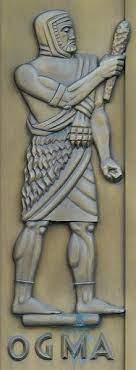
Gods – OgmaCeltic God c.2015


Ogma

Celtic God


In Irish-Celtic myth, Ogma is the god of eloquence and learning. He is the son of the goddess Danu and the god Dagda, and one of the foremost members of the Tuatha Dé Danann. He is the reputed inventor of the ancient Ogham alphabet which is used in the earliest Irish writings.

In the final battle at Mag Tuireadh he managed to take away the sword of the king of the Fomorians, but had to pay with his life for this feat. His Celtic equivalent is Ogmios.

Ogma or Oghma is a character from Irish mythology. A member of the Tuatha Dé Danann, he is often considered a deity and may be related to the Gaulish god Ogmios.

He fights in the first battle of Mag Tuired, when the Tuatha Dé take Ireland from the Fir Bolg. Under the reign of Bres, when the Tuatha Dé are reduced to servitude, Ogma is forced to carry firewood, but nonetheless is the only one of the Tuatha Dé who proves his athletic and martial prowess in contests before the king. When Bres is overthrown and Nuadu restored, Ogma is his champion. His position is threatened by the arrival of Lugh at the court, so Ogma challenges him by lifting and hurling a great flagstone, which normally required eighty oxen to move it, out of Tara, but Lugh answers the challenge by hurling it back. When Nuadu hands command of the Battle of Mag Tuired to Lugh, Ogma becomes Lugh’s champion, and promises to repel the Fomorian king, Indech, and his bodyguard, and to defeat a third of the enemy. During the battle he finds Orna, the sword of the Fomorian king Tethra, which recounts the deeds done with it when unsheathed. During the battle Ogma and Indech fall in single combat, although there is some confusion in the texts as in Cath Maige Tuired Ogma, Lugh and the Dagda pursue the Fomorians after the battle to recover the harp of Uaitne, the Dagda’s harper.

He often appears as a triad with Lugh and the Dagda, who are sometimes collectively known as the trí dée dána or three gods of skill, although that designation is elsewhere applied to other groups of characters. His father is Elatha and his mother is usually given as Ethliu, sometimes as Étaín. His sons include Delbaeth and Tuireann. He is said to have invented the Ogham alphabet, which is named after him.

Scholars of Celtic mythology have proposed that Ogma represents the vestiges of an ancient Celtic god. By virtue of his battle prowess and invention of Ogham, he is compared with Ogmios, a Gaulish deity associated with eloquence and equated with Herakles. J. A. MacCulloch compares Ogma’s epithet grianainech (sun-face) with Lucian’s description of the “smiling face” of Ogmios, and suggests Ogma’s position as champion of the Tuatha Dé Danann may derive “from the primitive custom of rousing the warriors’ emotions by eloquent speeches before a battle”, although this is hardly supported by the texts. Scholars such Rudolf Thurneysen and Anton van Hamel dispute any link between Ogma and Ogmios.

*
A Proto-Indo-European root *og-mo– ‘furrow, track, incised line’ may be the origin of the stem of the name. In addition, Proto-Celtic had a causative verbal suffix *-ej– ~ *-īj-. A hypothetical Proto-Celtic *Ogm-īj-o-sogm-. This agent noun would therefore mean ‘furrow-maker, incisor’ and may have had a metaphorical sense of ‘impresser.’ therefore looks very much like an agent noun derived from a verb formed by the addition of this causative suffix to the stem *

The Irish god of writing, eloquence and poetry. Ogma was credited of being inventor of the Celtic writing systems that the Druids used for their magic. These scripts were known as Ogham.

Ogma was the son of Dagda and the goddess Danu. Some other writers say that Ogma and Dagda were brothers; in this version they were the sons of Eithne. Ogma had also being called the son of Elatha, the king of the Fomorians.

Ogma was one the seven champions in the First Battle of Moytura (Mag Tuired), but when Bres became the king of Tuatha dé Danann, Ogma was degraded into working on humiliating manual job of gathering firewood.
When Lugh went to Nuada, asking for a place to serve the king, Ogma seemed to be Nuada’s foremost fighter. During the second battle of Moytura, Ogma had killed one of the Fomorian leaders, named Indech, the son of Domnu.

Ogma had married Etain, the daughter of Dian Cécht. Ogma had a son named Caipre. Some say that he was the father of MacCuill, MacCecht and MacGrené (MacGrene), the three Danann kings who ruled Ireland, during the Milesian invasion, though other say that Neit was their father.
To the Celtic Gauls he was called Ogmios. According to both Gallic and Irish myths Ogma was a warrior god, depicted as a wrinkled old man, wearing lion’s skin cloak, carrying a bow and club. The Romans considered Ogmios as the Celtic equivalent of Hercules (Greek Heracles). They also depicting Ogimos as holding people chained to his tongue by their ears, to indicate he was the god of eloquence and poetry.

Author: Agaliha

A Little Humor for Your Day – “You Know Someone Is New to Magick and Paganism…”

You Know Someone Is New to Magick and Paganism…


You Know Someone Is New To Magick and Paganism When They Think That…

An ATHAME is the gas you use for your grill.

A CENSOR is a drink you mix with alcohol.

ASTRAL PROJECTION is a home-made movie viewer.

A SYMPATHITIC LINK is when you feel sorry because your chain broke.

WICCA is that part of the candle that burns.

APHRODITE is a prehistoric bird.

ARCHETYPES is a kind of building structure.

BLESSED BE is the god of insects.

A BOOK OF SHADOWS contains silhouettes of friends or family members.

A BRAZIER is support wear for women.

CASTING is done with a fishing line, or on a set in Hollywood.

CHARGING is done with a credit card or battery.

The only way to get into a CIRCLE is to have the right of way.

Crystal CLEANSING is done with window cleaner.

CYCLES have to do with your washing machine and when to add fabric softener.

DEMETER is where you put your quarter when you park downtown.

A DOLMAN is a new brand of banana.

HANDFASTING is eating without utensils.

LEY LINES happen at the airport in Hawaii.

PAN is something you fry food in.

A QUARTER is 25 cents and still buys a cup of coffee. (Note: This person is not only new to magick, but they also haven’t been out in a while!)

SKYCLAD is a shade of blue clothing.

A TRAD is a type of geometrical figure.

WHEEL OF FORTUNE is the game show with Vanna White.

I’m a Witch, Not a Wiccan: A Brief Summary of Broad Pagan Designations

I’m a Witch, Not a Wiccan: A Brief Summary of Broad Pagan Designations

Author: Treasach   

I have commented before on the usefulness of designations in the neopagan community. Though we are generally self-directed with many being solitary and “eclectic”, it is darn helpful to be able to declare certain predispositions, especially if one is interested in working with others. In joining an on-line group or planning a ritual, the use of categories can help determine if a great deal of negotiation, or only a little, is required to make your collaborations most satisfying.

One question often asked is the difference between designations in the neopagan community. Of course, there are a vast variety of answers, and as a very dynamic and vibrant community, these answers may be quite altered in a decade. However, there are some trends that seem to have settled out for the moment…

Earth Religions or Earth-Centred Spirituality is currently the designation for all those traditions that are outside most of the major religions, i.e. Abrahamics, Buddhists, etc., but that also follow an Earth based path. It usually encompasses folk traditions, like European peasant beliefs and practices, as well as native aboriginal spirituality. However, not all followers of those traditions would choose to call themselves pagan, especially if they also practice some form of Abrahamic religion as well. So it’s best to not to assume, which is why Paganism is a subset of Earth Religions.

Paganism, or Neopaganism, is the modern catch-all phrase for many organized and non-organized Earth based religions and spirituality. Often seen as based on European Aboriginal practices and beliefs, it can also be used to describe traditional African, Asian, and North American spirituality, though less so, largely due to its primarily English usage. By declaring oneself “pagan”, it specifically implies resurgence in traditional Earth Based beliefs, sometimes in defiance of Abrahamics, depending on the area, and a reconstruction of traditional wisdom, knowledge, and connection with Nature as a completion of self and humanity. It can be Deity based, supernatural, or atheistic.

Witchcraft is a subset of Paganism. Because of the etymology and use of the word itself, witchcraft usually means pre-Christian folk beliefs of Western and sometimes Eastern Europe. As a modern practice, it has two main elements, either one of which may be included. It is both tribal and a religious choice. For most, it involves the preference of using magic as meditation, prayer, ritual and empowerment. For a smaller group, they are born into families that are known for the “Gift”, “Second Sight”, or the “Eye” if you are less popular… In the past in most places, children born into these families or who showed potential would often have been trained and dedicated to help their communities. A few of these families that survived the Abrahamic purgings retained the gifts and occasionally the training and traditions that went along with them, though most rejected them, usually out of real fear and concern for their safety if they weren’t outright converted.

Like many reClaimed traditions, such as native spirituality, modern witchcraft is a combination of contemporary writings and current analysis of past traditions, as well as past and extant examples of country and folk rituals, and to a much smaller extent, of witch families and their practices. Due to recent advances in cultural archaeology, it is also undergoing the greatest updates and flux. Though most are not from family traditions, modern witches can follow the folk beliefs of the aboriginal Europeans, or practice magic, or both. They can also refer to themselves as witches if they come from a witch family or have the traditional innate abilities, without practising a folk religion or spellcraft. Or any combinations of the above, including practising witchcraft in other traditions, like Abrahamics. (Jewitches. Heh.) It’s a pretty broad category, but my usual test is – anything that can get you burnt as a witch by fundies usually qualifies you to self-identify as a witch. Spellcraft, Goddess worship, foretelling, healing… But not that heretic stuff. That’s totally different.

Due to its heavy reliance on magic and its European structure, Wicca is almost entirely a subset of Witchcraft, though there are a few practitioners who could be considered outside of it, such as high magicians. Wicca is a relatively new tradition, with its origins largely in the middle part of last century, with some of the structure extending back into the Victorian era. Drawing on what was known at the time of folk history and tradition, it is a conglomeration of primarily European beliefs, but also reflects turn of the century Orientalism with elements of ancient Greek, Roman, Egyptian, and Asian references. Though slow to start, in the last few decades it has had hundreds of writers popularizing it, and has seen an explosion in individual sects. Because of its very modern feel and adaptations while retaining an aura of Romanticism, Wicca is one of the largest and best known segments of Witchcraft and neopaganism, and one of the fastest growing religions in the world.

Wiccans are almost always witches, but witches aren’t always Wiccan. Wiccan is not the ‘politically correct’ term for witch. It’s a sect of witchcraft, like Protestantism is for Christians. They have certain specific beliefs and rituals that identify them as a group. You wouldn’t call all Christians Protestants, would you? (*Hence, the Venn diagram.) I hope that clears things up, especially for the well meaning but less knowledgeable.

Heathenism is a collective category of paganism who follow the Old Religion and who will sometimes consider themselves Wiccan if they practice magic but usually don’t identify as witches at all. Primarily men, they can be of a more structured faith, like Druids, or more folk based, like Odinists. They often identify with warrior culture and value traditional knowledge, self-reliance, personal strength and honour.

This is a very brief sketch, of course, and some in the community will dispute these categories. There are lots of others as well. Wizards, or High Magic practitioners, for example, deal with the Other World and its denizens in a rigid, formalized manner, and so can be from nearly any religion, including Abrahamics. From what our current literature refers to, these are the general starting points and what most persons will intend to convey when they use these terms at the moment. As neopaganism is one of the fastest growing religions on the planet, however, I have little doubt that these terms will alter considerably in the next decade or so.


_________________________________________

Footnotes:
*Venn diagram is here:
http://gifts-of-nature.blogspot.ca/2012/10/im-witch-not-wiccan-brief-summary-of.html

Pride and Paganism in the 21st Century

Pride and Paganism in the 21st Century

Author: Melanie Marquis 

As one of the fastest growing and multi-faceted religions in America, Paganism has lately enjoyed more understanding and awareness from the mainstream community. Today, more Pagans than ever before choose to openly express their beliefs and practices. But what led to these changes?

I talked to many of today’s most notable Witches and Pagans, those who have been legends for decades, and those on the cutting edge of the modern Craft, to find out where the magical community stands today in terms of openness, expression, and public understanding, and to shed some light on how we got here.

“Hiding one’s magickal inclinations can be detrimental, ” says Raven Digitalis, Neopagan Priest, Gothic DJ, and author of Goth Craft (Llewellyn 2007) and Shadow Magick Compendium (Llewellyn Sept. 2008).

“It can be mysterious to a point, and perhaps manageable if someone only dabbles in charmery or kitchen witchery, but for someone who lives the magickal lifestyle, hiding and denying this part of one’s constitution can reinforce ideas of shame and insecurity, which builds up and can become suffocating over time. I have never hidden my beliefs, practices, or lifestyles; I simply see no need to do so unless the self-protective necessity is absolutely dire, which is the case for a handful of individuals.”

Considering that handful used to be a gigantic armload or two, we’ve come a long way.

Gwinevere Rain, college student and author of Llewellyn titles Spellcraft for Teens, Moonbeams and Shooting Stars, and Confessions of a Teenage Witch, is the founder and Editor of Copper Moon, http://www.copper-moon.com, an ezine for Wiccan and Pagan young adults. “I think that my generation and those younger than myself are more open about being Wiccan, ” she says. “I hope that ‘staying in the broom closet’ is a fading custom, but I guess, only time will tell.”

Early Pagan leaders like Circle Sanctuary’s Reverend Selena Fox, who organized one of the U.S.’s first officially recognized Wiccan churches, and spearheaded the ultimately successful effort to get the U.S. military to recognize the Pentacle as a religious symbol that can be used on military graves, have been catalysts in the evolution of modern Paganism, speaking out about their beliefs in a time when doing so entailed a lot more risk and a greater amount of boldness and bravery than it generally does today. They’ve witnessed firsthand how Paganism has transformed over the years, and they offer insight into the forces behind that change.

“Since its revival in the mid-20th century, ” says the Reverend Selena Fox, “Paganism has grown in size, scope, diversity, maturity, and visibility. The quest for equal rights for Pagans in the USA and in some other countries has had many successes through the years due to the combined efforts of those of many traditions.”

Carl “Llewellyn” Weschcke, current Chairman of Llewellyn Worldwide, the U.S.’s largest and oldest New Age/Occult/Magick publishing house, has been a major force in educating our communities about Paganism for decades, through the countless books published by his company, and also through his own willingness to be a Pagan in the public eye in the 1960’s and 1970’s, his magical and metaphysical practices and beliefs being the focus of media attention for many years. Commenting on the changes he’s seen regarding the Pagan community, Carl points out that even the word “Pagan” has much different connotations today than it did in the past:

“People may challenge our beliefs, ” he says, “but there is far more respect today for ‘alternative spirituality’ than 50 years ago, and when we use the word ‘Pagan’ today, most people know what we’re talking about. The basic change is that “Pagan” no longer means just ‘non-Christian, ’ or worse, ‘anti-Christian, ’ but is more often recognized as “alternative spirituality.” Paganism shares very little with Indian or Japanese Buddhism, for example, as non-Christian religions. On the other hand, Japanese Shinto does compare comfortably with European and American Paganism.

As a further point, ” he says, “modern Paganism is much more than Celtic spirituality and more and more is inclusive of Nordic, Germanic, Spanish, Italian, Greek, and on to Egyptian and African Spiritism, to Mayan and Afro-Caribbean, and native American traditions. “Paganism” has become a word for Earth-based spirituality – with nurturance of Nature and non-human life, visible and invisible, as key principles. Not all non-Christian religions share that with Paganism.”

“There are obviously several factors at work, ” says Ray Buckland, who is known as The Father of American Wicca due to his enormous role in introducing Witchcraft to the U.S. “Number one is probably the education that people of today have, both in general and specifically regarding paganism. They are more inclined to think for themselves and to take an interest in and express that interest regardless of what others may think or say. With the knowledge of what paganism – and especially Neo-Paganism – is, there is not the fear of being branded as a tool of Satan! There seems to be more of a thirst for knowledge these days, than in earlier generations. All of this, in turn, has led to the openness of mass media to previously occult subjects that, in turn, have led to more seeking and enquiring about what is presented.

“In the past there has always been a general fear about this whole field; that fear due to ignorance as to what was involved. It is by examining and learning all about a subject that such fear is erased. With today’s Internet access, among other things, there is the ability for anyone to research anything. In the “early days” of Neo-Paganism, Wicca, and the like, a few “pioneers” set out to straighten misconceptions and to show what was really believed and practiced. I think that started the ball rolling and today, with computer access so readily available, the ball (of enlightenment) is now traveling at very high speed!”

Brian Ewing, Membership Coordinator of the Pagan Pride Project that organizes large public gatherings, reports that their events are growing in popularity, with tens of thousands participating in activities each year around the world. Like Ray Buckland, he also credits the Internet with helping to facilitate some of that growth. The Pagan Pride Project’s website at http://www.paganpride.org serves as a source of information and a means of communication for people interested in the project.

“The Internet and email lists greatly facilitated the growth of the Project, ” he says. “Being able to connect quickly, despite living in different cities, and finding out about each other’s plans and existing events, helped us band together.

“The Internet also helps us advertise our events more widely, and for less money, than was possible in the past. In this way, we attract more people to our events. I also believe that Pagan events, including our own, are growing rapidly because our religion is now growing rapidly. We reached some kind of critical point, when there was enough practicing Pagans that they wanted to hold larger events where they could practice and worship together.

“Lastly, Pagan Pride events, and probably other events, were partly galvanized by the election of George W. Bush, and the fear that a neo-conservative administration would adversely affect our movement. I remember in 1999 George W. Bush and Congressman Bob Barr were both making some pretty negative comments about Paganism. People responded to that by writing to newspaper opinion sections and starting events such as Pagan Pride Days.”

Thriving and ready to take action, it seems that today’s Pagan community has undergone a lot of positive changes in recent years. Of course, not all the changes are seen as positive.

Flash Silvermoon, creator of The Wise Woman’s Tarot, a matriarchal Tarot deck, describes some of the negative changes she’s seen in the Pagan movement.

“One of the main differences that I see in the changes within and without this movement if you will is the fact that most of the movers and shakers in the early 70’s were powerful women, and most specifically, the Dianic branch of Wicca.

“This rising tide of Women’s Spirituality blended a Goddess centered Spirituality with Feminism, which is really humanism when you get down to it. The Womanspirit Movement swept through the country like wildfire, creating a more fluid and anarchistic style of Goddess Worship than some of the more traditional Wiccans.

“One of the problems that I have seen with the new mixed Pagan groups is that most are not at all really reverent of the Goddess or women. The talk is there but the walk is not, and most of the Pagan fests that I have attended bear the same old world sexist practices of male domination and sexual objectification of women. I realize that this can’t be totally true of all the new pagan groups but it sure seems to predominate. Even the women in some of these groups can tend to be very hierarchical.”

However, the Pagan faiths still generally enjoy a reputation of equality and respect for both sexes. Copper Moon’s Gwinevere Rain explains, “I was first attracted to Wicca because it was very empowering. It showed women being equal to men; additionally, the idea of magick was so appealing to me. The religion represented everything I wanted: to be equal, empowered, and spiritually comforted.”

So where do Wicca and the other branches of Paganism stand today? Have we really moved past a need for secrecy and concealment?

“I have had mail from guys in prisons who are openly allowed to practice their craft, ” says Ly de Angeles, outspoken environmentalist, screenwriter, and Australian author of Tarot Theory and Practice (Llewellyn 2007) and the collaborative work, Pagan Visions of a Sustainable Future (Llewellyn 2008). “I have also had a long connection with another guy who is in the US army, and I am very aware that Wicca (not Witchcraft) is a recognized religion and yet … the open expression of Paganism is still seen as fluff and twaddle by most; a bunch of very evil people by others.”

Gwinevere Rain agrees that negative and false stereotypes still exist. “I hope that the stereotypes about Wiccans and Witches are changing, ” she says. “It used to be that people’s vision of a witch was a green old hag; now that that has subsided, other images are at the forefront of people’s minds. It seems that one of the persistent false stereotypes is of real witches seeking to hurt people by casting hexes and curses.”

Because of such myths, some Pagans are deterred from expressing their beliefs openly. Christopher Penczak, teacher of magick and author of the popular Temple of Witchcraft series published by Llewellyn Worldwide, explains, “I think we are blessed to live in a time and place where more Pagans feel comfortable being out of the broom closet. While it’s important to be grateful for great strides we have taken in the recent decades, it’s also important to remember that not all Pagans and Witches have the same freedom, both across the world, and even in more conservative areas of the United States. Thankfully, most of us can live openly if we desire, and I think most pagans who can do so safely, do live an open life.”

When I asked Carl “Llewellyn” Weschcke if he feels that Pagans today are more open about expressing our beliefs, he also pointed out that where we are has a lot to do with it. “The best I can do for a short answer is to presume that today most of us are relatively comfortable in speaking about being Pagan in most selective social environments, ” he explains. “In other words, we can’t be particularly comfortable as Pagans at a Baptist convention, but we are comfortable doing so in our family and familiar social environment.”

The Pagan Pride Project’s Brian Ewing states, “The rapid growth of Pagan events, including Pagan Pride Days and many others, has allowed people to reveal their practices in public. But there are still many Pagans who practice in private, because there are occasional, but very real, instances of discrimination in the workplace or among neighbors.”

Brian reports that their events have been fairly well received by the public. He recounts only one protestor that he’s personally seen, at an event in Los Angeles. The protestor simply held a sign that read “Jesus Saves” on one side, and something about “You’re going to Hell” on the other side.

Raven Digitalis, who likes to host community worship circles in his hometown of Missoula, Missouri, reports that his gatherings have not attracted serious protest. “We are getting quite an outer circle going on! We have even performed some circles in the yard, ” he says.

“Living on a busy street, many cars have witnessed this; the reactions have been varied. Most people in this case simply drive by and look strangely, while others stop their cars to watch. It hasn’t escalated beyond that, luckily, though nearly all of our circles are now held in private places because the ‘public’ energetic exchange should only be reserved for certain times, places, and intentions.”

Tierro, lead guitarist and producer of the international Pagan tribal psychedelic rock band Kan’Nal, recalls an incident where his band encountered “polite” discrimination:

“Kan’Nal was booked to play a high end ‘Captain Planet’ fund raiser in Atlanta last year. The booking agent delicately requested that we not do anything ‘Pagan Like’ on stage in fear of offending the guests. We all laughed as if of course we would behave, but never said we would not… As far as I am concerned, the act of being born is a pagan act; it proves our equality and connection to the animals, plants, and the mysteries of the universe. To breathe is a pagan act, for we breathe together with the trees, fish, birds and bees. To experience joy, love, sorrow and loss is a pagan act, for all these emotions are reflected in the animal and plant kingdoms. So to show up and rock out a Kan’Nal set … well that alone is definitely a pagan act.”

So what is it about our religion that stirs our passions to the point that we want to speak out about it, wave our wands in the face of dissent and proclaim our magical faith to a world that, despite an increase in public awareness of what Paganism truly is, still couldn’t hardly care less? Says Christopher Penczak, “The more witches we have out and open, the more it becomes ‘normal’.”

Raven Digitalis expresses a similar sentiment. “It shatters commonly-held notions for a person to see a ‘Witch’ looking and behaving like a (relatively) ordinary person, ” says Raven. “When people learn about the validity of the modern Craft, it brings a modern and more realistic context to an antiquated stereotype. People see us operating and functioning and being progressive in our own lives, and not choosing to hide ourselves (and not having many adverse responses as a result), which can encourage others to do the same.”

Gwinevere Rain first started writing about Paganism when she was 14 years old, publishing articles in Cauldrons and Broomsticks. “I wanted to show others that young Wiccans can be as serious about religion as adults, ” says Gwinevere. “At the time there were many stereotypes about young practitioners just practicing Wicca to be ‘cool.’ I wanted to help counteract this misconception. For me, it’s worth being open or ‘out of the broom closet’ because Wicca is a part of who I am. I don’t want to hide a significant part of myself.”

Of course, not everyone wants to be open about his or her Pagan faith. Says Gwinevere, “It is important to do what is best for yourself and not succumb to any pressure within the magical community. Just remember that everyone moves at their own pace and you may not be ready to become an outspoken figure of this beautiful religion.”

Christopher Penczak stresses that the individual’s chosen path should be respected: “We should respect our sisters and brothers who wish to be secretive, as the spiritual path is a personal, and sometimes secretive, path. We cannot decide to out someone who wishes to remain private.”

Raven Digitalis emphasizes that the ways we express our beliefs to others should be appropriate for the person we are talking to. Says Raven, “There is always a balance. I believe that people should be communicated and interacted with based on their own levels of understanding. Whereas it might be appropriate to call oneself a ‘Witch’ to someone familiar with magick, it might be better to call oneself a ‘Wiccan’ or ‘Pagan’ or even ‘Earth-honoring Healer’ to someone else, who instead understands the definition of that vocabulary.”

So, what does the future hold for Paganism? How can we publicly express our beliefs in a way that ensures the well-being and growth of our community? “One of the best ways of showing Wiccan/Witch pride is to be a good person, ” says Gwinevere Rain. “Society will catch up with us if we make a collective effort to be kind, healthy, and smart people.”

Ly de Angeles also says that responsible actions are key. Ly explains, “The open expression of Paganism and magical beliefs, in my opinion, needs to be backed with very real and credible behavior, as I have seen way too much hubris and listened to way too much jargon and sheer wankery. I apologize to those who are not that way (and you are many) but the rest really need to look to what you wish to achieve for the greater community of Paganism in the future. Education and knowledge in diverse areas is the key. Acting on that is a way through. I suggest we enter the sciences, politics, the education system, as well as the Green movement.” She also shares a warning: “I am disturbed by the rising tide of radical right-wing fundamentalism, in the USA in particular, and suggest it may be very necessary for openly expressed Pagans to watch their constitutional backs in the future. This is not paranoia but prophecy, darling.”

The Wise Woman’s Tarot creator Flash Silvermoon comments that respect for women is integral. “To my thinking, ” she says, ”one earns their position through study, dedication and commitment, and if one truly loves and worships the Goddess, then women must be more empowered and respected as Her surrogate.”

Raven Digitalis is hopeful about the future of modern Paganism. Says Raven, “I think Neopaganism is becoming more and more personal and personalized every day. As more and more people are drawn to the ways of magick, self-empowerment, and mysticism, personalizing one’s own beliefs and practices will serve to allow the Pagan movement to grow and establish itself with much fuel and dedication behind it.”

The Reverend Selena Fox of Circle Sanctuary puts it in a way that resonates throughout the heart of Paganism: “It is important that Pagans of many paths and places continue to find ways to work together in our quest for freedom and in bringing more health and balance to the greater Circle of Nature of which we are all part.”

The Power of the Individual

The Power of the Individual

Author: Crick   

As I walk into the comfort of the forest a deep sigh of relief escapes my lips. I find solace amongst the towering oak trees, which provides a much-needed break from the din of what passes for a pagan community.

With so many folks coming from the Abrahamic belief systems onto a path that is diametrically opposed to their former comfort zone, the tenets of paganism are becoming ever so blurred.
Many of those who call themselves Neo Pagans banter about words like acceptance, diversity, and individualism and ponder over what constitutes a pagan community. However the intent behind these words carries less weight than the gentle breeze that is now caressing my brow as I walk along a quiet wooded ridge.

For instance, the concept of community is one that has been borrowed from the Abrahamic belief systems and has absolutely no chance of becoming a reality amongst those who walk the pagan path. There are many reasons for this summation.

One of the largest stumbling blocks to community is the neo pagans themselves. True paganism is about individualism and yet there are some neo pagan groups that see their mission in life as being regarded as the ‘Pagan standard’, though they represent no one but themselves. And as their concept of self-importance as a group becomes broader and broader, the concept of individualism gets lost in the mix. And so the one tenet that would validate them as true pagans becomes more of a façade then reality.

Such groups make ridiculous claims that paganism has died out and they are re-creating the concept of paganism. Off in the distance a crow begins to caw, as if laughing at such a foolish declaration. The Deities, which pagans ascribe to, have never left us. It is not up to the Deities to validate Themselves. Rather it is up to humans to empower themselves through the lessons that have always been proffered by Deity.

The universal energy that pagans manifest to enhance their personal workings has been in place long before humankind took its first breath and will be here long after humankind takes its last breath. For such energy is not beholden to the whim of humans, and to claim that it was ‘re-discovered’ is at best a naïve statement.

Such neo pagan groups expend more energy trying to validate their perceived position in Paganism than they do recognizing the power of the individual. It is such hypocrisy that leads to the constant posturing of personal points of view and to “my group is more pagan then your group” attitudes.

But if one embraces individualism, then who cares?

Such groups waste so much energy trying to be validated and accepted by general society and by others who see themselves as pagans that they fail to see the hypocrisy that they are engaging in.

A prime example of this is the word “community”. Such a concept as envisioned by Neo pagans is fine for those of the Abrahamic belief systems for many of these folks, with some slight variations believe in pretty much the same concepts.

But in all reality, it is an oxymoron as far as paganism goes for several reasons.

The most obvious reason is that “community” implies a central leadership of some sort. If pagans are truly individuals, then such a centralized leadership will never work beyond the coven setting. Even within the coven setting, each member is an individual who has come together with other individuals for a common purpose. Leadership is based upon actual experience and wisdom, not self-declaring oneself as a leader as is often the case in neo-pagan groups.

Another observation is that far too often are the times I have seen a respected Elder from one group or area being ripped to shreds by members of another group who are just an hour or so away. Such a realistic and yet deplorable setting will forever doom such a divergent concept as community in regards to paganism.

But not all is lost as far as paganism if only folks are willing to put forth the effort.

Instead of mimicking the Abrahamic religious concepts — which by the way are fine for those folks that such an approach works for — why not strive to create a pagan society?

The difference between ‘community’ and ‘society’ as I see it is quite clear.

Instead of a central leadership as one would expect to find in a community, under a mystical society the average mindset would have to be adjusted to accepting that there are numerous divergent pagan paths, each with its own form of leadership and representatives (Elders) .

Of course, this would knock the legs out from under the elitist groups who claim to “be the one” or who see themselves as representing all pagan paths (not a very realistic assumption really) , but then if one is going to be a pagan and mouth the words diversity, acceptance and individualism, then actually embracing such concepts should be the norm rather then the exception as it is today in modern paganism.

But it doesn’t stop there.

For a pagan society to become a reality, those who would make up the membership of such a society have a responsibility as well. Such folks, whether they are solitaire, or belong to a gathering such as a coven, teaching group, what have you, must re-learn how to be actual individuals.

With so many coming from the Abrahamic belief systems, there is a tendency to keep the same ingrained habits as before. As a member of one of the Abrahamic belief systems, one is discouraged from being an individual, which is another tenet that is diametrically opposed to the tenets of paganism and yet is one that is often over-looked by modern pagans. Within such beliefs, folks are told when to stand, when to kneel, when to sing, and when to put their funds into the collection plate.

And granted, some of the Neo pagan groups follow the same pattern in their approach to paganism, but then again, old habits are hard to break and are in fact selling themselves short as far as the experiences that the mystical path holds for them.

But again, we each choose our own cup of tea.

In order to learn how to become an individual, one must be willing to tackle the lesson of the ego, for this is a major stumbling block to the creation of a true pagan “society”. How many self-described pagans I wonder actually take the time to look deep within one‘s self?

As individuals we bring a unique source of energy and power to the table as a whole. Each person has latent abilities that are just waiting to have the eons of detritus dusted off so that one can begin to grow spiritually again. We have become a community of followers and as such, these latent abilities have become buried in the layers of disuse.

Could you just imagine how creative and thriving a mystical society would be if each of its members re-learned such abilities and talents and then united in a loose way with others of such abilities?

With the albatross of ego out of the way, there would be room for common respect and thus a natural environment for learning and true spiritual growth, as paganism was meant to be and not as it is dictated today by this group or that who by their own actions have yet to learn these lessons and thus are more of a hindrance then a help.

The last hurdle that I want to touch upon is the misguided belief that paganism died out and was re-created. There are some groups out there who emphasize that we must practice paganism as it was done by our ancestors. This is yet another myth that creates a barrier to a mystical society. Paganism is about life and how it affects ones surroundings. It is about being tuned into those changes as they occur. Paganism is an ever-changing concept that reflects the current situation in the world.

The Egyptians did not practice as the Incas did, The Romans did not practice as the Celts did. Each society was affected in different ways by their environment and style of living.

Folks today do not build pyramids or ride chariots, therefore there are separate and “individual” needs as far as paganism of today goes. This myth that one must practice as those of 3, 000 years ago did, may serve the groups that engage in such a misguided belief, but it does little if anything in advancing real paganism amongst folks.

Also, in spite of such a common misconception, there are many societies today who have never left their pagan lifestyles as such. There are the Eskimos, members of the Yoruba, Bushmen of Australia, tribes in parts of Africa and South America, Shamans of Siberia and the Native Americans and so forth who have always held on and continue to practice their traditions without all of the hoopla that some Neo pagan groups seek for themselves as far as attention and exposure.

I see such groups as trying to create an elitist persona based upon their inability to control their egos. Such attempts serve as a stepping-stone for those new to paganism but not much more as far as any real substance when it comes to the introduction of a pagan society. For the society and many wonderful teachers are already in place by the folks mentioned above.

Neo pagans just need to realize this and move past the hype put out by those who want to just sell books or stroke their egos. Once the neo pagan part of paganism finds the maturity to move past such hurdles one will find that paganism is a wonderful world of exploration indeed. But it will take the power of the individual to move such a concept forward.

Are you a pagan individual?

Living a Magical Life – Tips for Day to Day Magickal Living

Living a Magical Life

Tips for Day to Day Magical Living

By , About.com


People find themselves drawn to Paganism and Wicca for a variety of reasons. Some may be trying to escape some other religion. Others may be looking for a sense of personal empowerment. Still others may realize that the beliefs they’ve held all along are in tune with those of a Pagan path. Regardless, once you’ve found your new path, there comes a time when you may ask yourself “How can I make this spiritual system part of my daily life?”

Are you someone who thinks about the principles of your tradition all the time, or only when it’s convenient? If you honor a particular deity in your path, do you do so just on the eight Sabbats, but not bother the rest of the time? Are you constantly reading and learning, or do you figure everything you need to know is contained in the three books you already own? In other words, are you a “weekend Wiccan”?

Living a magical life is something that one does twenty-four hours a day, seven days a week. Depending on the needs of your tradition, it may involve something as complex as daily ritual, or as simple as taking a moment to thank your gods each morning when you get out of bed. It means being in tune with the spiritual world around you, and staying in balance physically, emotionally, and spiritually.

Does this mean you need to run around shouting “The Goddess loves you!” all day long? Not at all… in fact, the rest of us would appreciate it if you didn’t do that. What it does mean is there’s a difference between seeing Paganism and Wicca as something you “do” versus something you believe.

How can you bring more magic into your daily life? Try one, or more, of the following — and if something doesn’t apply to your particular flavor of Paganism, don’t sweat it. Use what you need, and set the rest aside.

  • Pay attention to the phases of the moon. Know what’s happening in the skies, and notice how (or if) it affects the way you feel.
  • Recognize that you don’t know everything there is to know. Continue learning and growing, and be willing to accept that sometimes new knowledge will come from unexpected sources. Don’t assume that you’re always right, just because you’ve always done or thought something.
  • Show respect for nature — do things on a daily basis that are good for the planet. Recycle, compost, cut back on excess energy consumption. If you believe the earth is sacred, treat it as such.
  • Get in touch with the land. Plant a garden, study the changes of the seasons. Realize how good it feels to grow your own herbs and vegetables.
  • Be empowered. Know that you have control over many of the things that happen to you. If someone or something makes you miserable, make the changes that are necessary to bring yourself happiness.
  • Understand that just as you have control over your life, you are also responsible for your actions. Take ownership of everything you do — even if that includes admitting you’re wrong sometimes.
  • Find a way to honor the Divine in your daily life, rather than just at monthly Esbats or the eight Sabbats each year. Even if you just start your day with a morning “thank you” to your gods or to the universe itself, it’s not a bad thing to acknowledge the gifts that we have in our lives.
  • Behave in a way that is honorable — if you make a promise, keep it. If someone needs help and you can provide it, offer it.
  • When you do something, think about how you can use it in a magical application. For example, when you’re baking cookies, consider what sort of magical working you can incorporate into the recipe.
  • Consider the impact that your words and actions have on not only the environment, but also on other people and on yourself.


Converting to Paganism

Converting to Paganism

Author: RuneWolf

To say that I converted to Paganism would be somewhat inaccurate. I think one must first belong to one religion before one can convert to another. As I claimed no religious affiliations when I came to Paganism, I don’t really think of myself as converting, so much as finding what was missing all along.

I’ve told a bit of my tale before on WitchVox, mainly to set the stage for some other topic. I’m not at all shy about the details of my arrival in Paganism – I came to it as a direct result of getting sober in ’93 and joining AA. I suppose it’s a bit indiscreet to mention the program in these essays, but since I’m using my “Pagan name, ” I think it still qualifies as “anonymous.” And I think one of the reasons the Gods helped me get sober was to help other Pagans in recovery, and that would be difficult if I kept the fact of my sobriety to myself.

But I digress…

The irony of the whole situation, I suppose, is that I found my way to the Goddess and the God through AA, which is founded on Christian principles, although it is – ideally – supposed to be a non-religious fellowship. The sad fact is that there are plenty of folks in AA who don’t mind you having a “God of your understanding” as long as that understanding is the same as theirs. They seem to echo the Religious Right that claims the founding fathers didn’t mean freedom of any religion, just freedom of Christian religion. Similarly, there are some who believe that the founders of AA really meant a Christian God of your understanding, not just any old Deity and certainly not – shudder – a Pagan Deity! You can even be an atheist, as long as you are a “Christian atheist, ” i.e. you choose not to believe in the Christian God.

Now how’s that for dysfunctional?

Thankfully, as vocal and obnoxious as this contingent of the fellowship can be, it does not hold sway, and many suffering alcoholics of non-Christian belief can find the help we need. Despite the attempts of some to co-opt AA for their own agendas, the fellowship remains open to all who seek it out, and anyone can get clean and sober regardless of their religious beliefs or spiritual preferences.

I was raised Methodist, in the suburbs of DC. I wouldn’t say that my parents are particularly liberal, but they are Earthy and pragmatic individuals, and as dear as the Church is to them, they don’t feel particularly constrained by it. They live their beliefs, through their relationship with life and nature, through right action and love, and don’t presume to limit the God of their understanding to a particular building on a particular day of the week. So it wasn’t really out of character when they decided to try their hand at farming in the early ’70s and bought some land on which to raise cattle. Needless to say, this took up most of their spare time and, little by little, going to Church on Sunday became less important than being at the farm. Eventually, around the time I was 13 or so, we stopped going altogether as a family. My parents didn’t insist that we children do something they weren’t, and they let us decide individually whether we would continue with the Church.

While my sister continued on, my decision was already made. For some time I had been restless and discontented with the Church. Not so much because I disagreed with the tenets of Christianity, but because I felt the Church was getting away from what we would now call “Mystical Christianity.” Our church, at least, was very much into socio-political issues such as the anti-war movement, women’s liberation, civil rights, feeding the hungry and homeless and such like. At the time, I didn’t have the life experience to realize that true spirituality can be found in just such things. Rather, I was looking for the “burning bush;” what later decades would come to call “peak experiences.” I felt I could get all of the “social studies” I needed from school or the morning paper. What I wanted from Church was to feel the breath of God blow through my soul, and I just wasn’t getting it.

So I went out to find it on my own.

My quest, as it were, started out pretty well. I began to read extensively on other religions and spiritual paths throughout history and the contemporary world, assimilating what I liked and leaving the rest. In my mid-teens, I was introduced to the martial arts – karate, initially – but within a few years had discovered aikido, and the whole concept of ki, ch’i and the Tao. Taoist thought and philosophy had a profound effect on shaping my personal spiritual philosophy, as it meshed so well with what I intuitively believed about the nature of Deity and Its relationship with us. As silly as it may sound, my self-conceived “Western Taoism” resembled nothing so much as Lucas’ concept of the Force – and this was years before Star Wars came out.

I saw Deity as the whole of existence, including all the myriad alternate universes that must exist. I saw Deity as both transcendent and immanent, existing both apart from and as a part of all Life. I saw no paradox in this, at least none that could not be resolved by a truly infinite Deity. And why then should that Deity be limited to any single gender, nationality or form? To even consider such a thing was ludicrous. An omnipotent God must, by definition, be able to assume any form, any gender, in any place or places, any time or times, simultaneously or uniquely.

Long before I new that modern Paganism or the Craft existed, I had decided that God could be Goddess and visa versa, if She/He/They wanted to.

With this general spiritual bent and direction, I probably would have found the Craft years earlier than I did, had my voyage not run aground on the shoals of alcoholism in my early 20s. But run aground it did, and I stayed a prisoner of the disease for the next 15 years.

One of the significant effects of active alcoholism is that it leads inevitably to what we call “spiritual bankruptcy, ” a loss of all connection with any concept of a Higher Power. Which isn’t surprising, since prayer and meditation don’t work very well if you are getting up every 5 minutes for a cold beer. Nor does a spiritual life mesh well with the desperation, frustration, humiliation and degradation that the alcoholic experiences with increasing frequency and force. Not only the physical addiction to the substance, but the mental obsession with it, crowd out all other considerations, and the first to go is often our faith and belief in a Power Greater Than Ourselves. For many of us, it happens as a result of the shame we feel at what we believe we have become. How could any Deity, no matter how loving, love us?

The beautiful truth is that the Gods do love us and care for us, even when we do not love or care for ourselves. For those of us who become desperate enough, They ultimately lead us to the solution.

In May of ’93, I had finally had enough, and I reached out for help. I went into treatment, where I received the bad news that, if I wanted long-term sobriety, I would have to join AA. Like so many, I thought AA was something of a cult, but I was desperate enough to try anything.

Happily, I discovered that AA was anything but a cult, and that the only thing required of me was a desire to stop drinking. I fell in with a group where not drinking one day at a time was the single most important thing in the world. No one really cared about your race, creed, color, politics, job, sexual preference or anything else. The quest for sobriety eclipsed all other considerations. It was from that group that I learned the true heart and purpose of AA. “Our primary purpose is to stay sober, and help other alcoholics to achieve sobriety.” That’s it – period. It doesn’t say anything about advancing our political, religious or economic agendas, although I have seen people try over the years. But AA remains resistant to such tampering, and for that I am grateful to the Gods.

AA’s concept of a personal relationship with a “God of our understanding” validated rather that repudiated what I had come to believe about spirituality in the early days of my quest. I found that quest renewed and nurtured in AA, and it was from the foundation of physical sobriety and spiritual awakening that I found in AA that I struck out again to find a personal spirituality that would “fill the hole in my soul.”

After less than a year sober, a friend brought to my attention a workshop on shamanism being given by a Lakota “medicine man.” Back then, I earnestly believed that everyone on Turtle Island was one big happy family, and that there was nothing intrinsically wrong with a white learning the Red Way. I’ve since come to understand that some among the Native Peoples find this distressing and exploitative, and that some Native “teachers” peddle spurious goods against the wishes of their Nations’ Elders. But I knew nothing of such things then, and I was intrigued by the advertisement for the workshop.

Whether Ghost Wolf was the real thing or not, whether he was earnestly trying to teach for the good of all mankind or was a fakir making a buck off of credulous white folk, I do not really know. Nor does it matter, in the final analysis. Because whether Ghost Wolf was a true and sincere teacher or not, he set me off in a new direction that ultimately led, not to the Red Way, but to the Way of the Witch.

I assimilated everything I could get my hands on regarding shamanism, eventually finding Michael Harner’s excellent book on the subject. In addition, I joined the online community discussing shamanism and journeying, and it wasn’t a far leap from there to the online Wiccan community. Again, my interest was sparked, and I took the “road less traveled” at the next fork. For some time, a desire had been growing in me to externalize some of the internal work I had been pursuing with such fervor, and the richness of Wiccan ritual seemed the perfect vehicle for that expression. Shamelessly, I admit that I began my career in the Craft as a “dabbler, ” trying out various rituals and techniques gleaned from books and the online community. But it wasn’t long before I was hooked.

What I found in the Craft was something that no other path had offered me – a spirituality AND a religion that expressed what I had come to deeply believe. AA often makes the distinction between spirituality and religion, and I think it is an important distinction to understand. The beauty of the Craft is that it fulfills both needs in me – the internal need for a mystical spirituality, a relationship between myself and the Divine, and the external need for ritual, liturgy and form. Not to mention community.

I am an initiated Wiccan, who now practices as a Solitaire out of equal parts circumstance and temperament. The Way of the Witch feeds my heart and soul, and I wouldn’t trade what I have found along this Way for all the green cheese in the Moon. My only regret is that I did not find this Path sooner. But then, O Sensei Morihei Ueshiba, the Founder of aikido, did not create that art until he was in his 40s. I have many years yet in which to serve the Lady and the Lord.

I left Christianity, not in anger but out of a need to find something more. I lost many years to the prison of addiction. In the end, through circumstances beyond my imagining or control, I found my way to the arms of the Goddess. Like so many of us, after years of wandering, I came home at last.

In Their Service,

RuneWolf

How Witchcraft Works – Modern Witchcraft

How Witchcraft Works

by

Modern Witchcraft

Witchcraft is a pagan religion. Pagan religions worship multiple deities rather than a single god. Paganism is one of the oldest religions and includes all religions that are not Christian, Muslim or Jewish, meaning Paganism includes the Hindu, Buddhist, Taoist, Confucian and American Indian religions as well as all other nature-oriented religions. According to the 1998 Cambridge Fact Finder, Paganism accounts for 50 percent of all religions.

The word “Pagan” actually stems from the Latin Pagini or Paganus, words meaning “hearth” or “home dweller” or, more simply, “country person” — those labeled as Pagans were considered inferior to those living in cities. It didn’t, however, mean those people were “bad.” It wasn’t until the 1450s that fear of witchcraft became more prevalent, and people began associating witchcraft and paganism with devil worship, evil hexes and spells.

Types of Witchcraft

There are many types of witchcraft, many of which overlap and all of which can be defined in different ways by different people, but here are some rough guidelines for their designations:

  • African witchcraft: There are many types of witchcraft in Africa. The Azande of central Africa believe that witchcraft causes all types of misfortune. The “gift” of witchcraft, known as mangu, is passed from parent to child. Those possessing mangu aren’t even aware of it and perform magick unconsciously while they sleep.
  • Appalachian folk magic: Those who practice witchcraft in the Appalachian mountains see good and evil as two distinct forces that are led by the Christian God and Devil, respectively. They believe there are certain conditions that their magick cannot cure. They also believe that witches are blessed with paranormal powers and can perform powerful magick that can be used for either good or evil purposes. They look to nature for omens and portents of the future.
  • Green witchcraft: A Green witch is very similar to a Kitchen/Cottage witch (see below) with the exception that the Green witch practices in the fields and forest in order to be closer to the Divine spirit. The Green witch makes his or her own tools from accessible materials from outdoors.
  • Hedge witchcraft: A Hedge witch is not part of a group or coven. This witch practices magick alone and works more with the green arts, herbal cures and spells. In the early days, Hedge witches were local wise men or women who cured illnesses and gave advice. They can be of any religion and are considered traditional witches (see below).
  • Hereditary witchcraft: Hereditary witches believe in “gifts” of the craft that are with a witch from birth, having been passed from generations before.
  • Kitchen/Cottage witchcraft: A Kitchen witch, or Cottage witch, practices magick around the hearth and home. The home is a sacred place, and the use of herbs is used often to bring protection, prosperity and healing. Kitchen witches often follow more than one path of witchcraft.
  • Pennsylvania Dutch hexcraft or “Pow-wow“: When the Germans first arrived in Pennsylvania, Native Americans were there, so the term “pow-wow” to describe this practice may come from observations of Indian gatherings. Pow-wowing includes charms and incantations dating back to the Middle Ages, as well as elements borrowed from the Jewish Kabbalah and Christian Bible. Pow-wowing focuses on healing illnesses, protecting livestock, finding love or casting or removing hexes. Pow-wowers consider themselves to be Christians endowed with supernatural powers.
  • Traditional witchcraft: Traditional witchcraft often follows science, history and the arts as its foundation. While sharing the same respect for nature as the Wiccan witch (see below), traditional witches do not worship nature nor the god or goddess of Wicca. They contact spirits that are part of an unseen spirit world during rituals. Magick is more practical than ceremonial and focuses greatly on herbs and potions. This sect of witchcraft also has no law of harming none, but does believe in responsibility and honor. Hexes and curses, therefore, can be used in self-defense or for other types of protection.
  • Wicca: Wicca is one of the modern Pagan religions that worships the Earth and nature, and it is only about 60 years old. It was created in the 1940s and ’50s by Gerald Gardner. Gardner defined witchcraft as a positive and life-affirming religion that includes divination, herblore, magic and psychic abilities. Wiccans take an oath to do no harm with their magick.


Source:

howstuffworks

The State of Paganism: A Perspective From an Old Witch

The State of Paganism: A Perspective From an Old Witch

Author:   Crick   

As Paganism slowly but surely emerges out of the grip of suppression brought on by what is now commonly referred to as organized religions. We may want to be aware of several pitfalls and realities as we once again step into the light of day.

First of all, the top three organized religions are themselves fairly new in the grand scheme of history. Prior to their appearance on the world stage, basically everyone in the world followed some type of pagan belief, which was for the most part an individual spiritual belief and not an organized religion per se. Such beliefs were influenced by ones personal environment and the immediate world around them. There was an interpersonal awareness that helped to shape one’s values and thus their corresponding beliefs. In today’s artificial world we no longer have such a mainstay or influence to guide us.

The current “accepted” beliefs being touted by the main three organized religions and the suppression of former popular beliefs did not occur as a natural effect of events in human history.

It was and continues to be a planned and concerted action, which began in one instance with the advent of the apologists and has continued on through the ages by acts of repression, fear and some very clever propaganda. These deliberate actions have been supplemented by the tactics of politicians who are overtly biased in favor of the institutions of organized religion.

After all, power begets power.

As such we should be aware that the basic tenet of these man made religious organizations is to hold onto such power at all costs. We as a community would like to think that we are accepting of all religious beliefs and spiritual paths, as we should be.

But we should not be so naïve as to think that just because we are so accepting that organized religions will welcome us back with open arms from the isolation of an exile that they themselves imposed upon those of pagan beliefs.

In all reality they (organized religions) would very much like to see paganism fade away as just another passing fad. An example of this is the gathering in Rome in the summer of 2007 of the Roman Catholic Church of which the primary topic was “how to draw folks away from Devil worship (allegedly paganism) and back into the grasp of the one true church”.

Granted there are some individuals within organized religion who are realistic and enlightened enough to accept the fact that not everyone is going to believe as they do. And thus are willing to work with members of alternate beliefs such as paganism.

However the harsh reality is that these folks generally belong to one of the very aggressive religious organizations whose leaders do not endorse such openness. And as such we are being accepted only in isolated situations and only at the very grass roots of these religious institutions.

Acceptance of the fact that the oldest religious/spiritual beliefs in the world were not obliterated and are making a re-emergence is going to take some considerable time, effort and patience.

We will re-emerge into the light of day one enlightened heart and soul at a time. To believe otherwise is in my personal opinion, both foolish and self-defeating.

Another pitfall we should be wary of is manipulation by the organized religions. They have by virtue of their position in the world today, proven to be very adept at such tactics.

And quite obviously (to some of us anyway) they are employing these tried and proven techniques to the very community that they would like to once again vanquish back into the throes of exile.

What is this manipulation you may ask?

Over the recent years, a crumb will fall off of the table of organized religion and a pagan will be ‘allowed” to sit at the same table as these folks. Each time it has been a Wiccan who is chosen to take such a seat and in each case the chosen Wiccan will proclaim themselves as representative of the whole pagan community. And then folks in the pagan community will swoon like young schoolgirls and say, “oh what a great thing this is for the community”.

In my personal opinion, such proclamations fall right into the hands of those of the organized religions who are sponsoring such meetings.

I have serious reservations about such an approach and reaction for several down to earth reasons.

First of all, realistically we as a community are dealing with folks who are well schooled in such manipulation. It is quite apparent that if you can’t outright obliterate what you object to then you find a way to control it.

For example Brighid the Goddess did not become a Christian saint by happenstance. It was an act of sage manipulation by an organized religion. Hence we have the old adage of, “keeping your friends close but your enemies even closer”.

And so with all due respect to those of the Wicca, I personally have to wonder why organized religion seems to only choose members of Wicca, which is by all accounts barely a generation old and thus but a babe in the world of paganism as the ones who are proffered a seat with these folks.

Please don’t misinterpret what I am saying here, I think that it is great that a pagan of any path gets the crumb that is offered, to a certain extent.

But then this brings me to my next concern.

One of the primary tenets of paganism is diversity. And if we are to avoid the pitfalls of hypocrisy then perhaps those Wicca who are chosen to be seated with organized religions should state responsibly, that in fact they represent but a small portion of the pagan community.

Again, with all due respect to those of the path of Wicca, not only would this be a realistic statement but it would also leave the door open to those of other pagan beliefs. And as such would be a confirmation of the pagan community’s stated belief in the tenet of diversity.

Paganism is after all an acronym or umbrella for many “diverse” beliefs. And no one path can honestly state that they alone represent the many different beliefs that align themselves under the banner of paganism.

In all reality, and yet once again with all due respect, as an Irish witch who also engages the path of shamanism, Wicca does not remotely represent my personal path. Nor does it accurately reflect the beliefs of those who are Asatru, Voudon, Santerian, Odinist, Yoruba, Shamanic, witch and so forth.

If we as a community are going to endorse diversity as one of our founding tenets then we need to surpass the temptations of ego and thus avoid the snare that is being put into place by those religious organizations that have shown such skill in manipulation.

Those who are tapped should show some responsibility and use their opportunities to ensure that organized religion is aware that we are in fact a diverse community and do not fit into one spiritual/religious shoe fits all.

By the same token, we as a community need to overcome our petty ego driven differences and be willing to proffer folks from various pagan beliefs as representatives of our community. Granted this will take a measure of maturity that has for the most part been lacking in our community.

But I personally believe that if we are true to ourselves and our community that we can indeed find the inner strength to exhibit such maturity as a community to express ourselves in such a manner.

The final concern that I would like to express in this treatise is this.
Why do we buy into the perception that organized religion has of us?

Realistically, it is “their” perception and should not be the view that we as pagans hold of ourselves.

Why do we as a community get all flustered and swoon whenever organized religion allows us a seat?

They are in all reality the newcomers to the world stage of religious/spiritual beliefs.

Paganism is in fact the oldest such beliefs in existence, period!
When one of us is invited to their table it should be with the approach that they (organized religions) should be honored to have a member of such an ancient belief seated at their table.

We need to stop playing into their blatant manipulation and express ourselves with aplomb and dignity and not as eager children grateful for a brief moment of attention.

I personally believe that this is why they (organized religions) only invite the Wicca (who are the babes of pagan society) into their midst. In this manner they can point and say “but they have only been around since 1952” and so the manipulation continues and unadulterated attempts at control continues.

In closing I would like to make it clear that I am not casting about disparaging thoughts against those of the Wicca or any other members of organized religions and/or other pagan paths.

My words are simply a reflection of the realities that we as pagans did not create but which we have to live with. How cognizant we are and how we approach such issues as a community in regards to organized religions will determine whether we remain in the daylight or whether we once again resume our existence in the darkness of religious/spiritual exile.

If you don’t want to think of these issues in regards to yourself then maybe you should consider the religious/spiritual freedoms (true freedoms) of your children and your children’s children.

For in all reality, such manipulation and control did not occur over one generation nor is it likely to ebb within just one generation. Freedom of religious/spiritual beliefs is an ongoing struggle against those who would have it otherwise.

I think the last 2000 years or so has made that quite clear…

Enhanced by Zemanta

We Who Shall Inherit Ourselves

We Who Shall Inherit Ourselves

Author:  Brannawen Ravenhart


Over the course of the past decade or two, the giant surge of information on Paganism and Wicca, and Witchcraft in general has swelled to enormous proportions. Whereas I used to have to scratch pathetically through musty bookstores, or wait patiently for a dog-eared and battered single paperback copy of “Drawing Down the Moon” by Margot Adler at the library, or, if great luck would have it, borrow a book or two from some other fortunate soul who not only owned books, but might even know someone who knew someone who might have more; now I can walk into any mall, Barnes and Noble, Borders, Waldenbooks and find many different books in a wide range of topics, depths, and styles. I can surf the Internet and find information on anything I desire. Videos, DVD’s, television documentaries, are all available to me like chocolates in a candy store. What do I want to pick today? What do I wish to learn? What path do I want to know more about? What do I want to know of our own history? The plethora of books and authors allow luxuries today that were unheard of years ago. They also allow a freedom of choice that was never dreamed of. Before, we had to be happy with what we got, and if we did manage to get our hands on something, we often followed that specific information to the people and paths where we eventually ended up. The ways to wisdom had but few trails in the wilderness, and we ended up exactly where they took us.

In a way, this was a very good thing. The hardworking, dedicated individual could find their way only through the mysterious maze of the guidance of others. This led to strength and conviction and solidarity within the covens, groves, groups or even to the Solitary Practitioner, due to the inherent nature of the learning. There are pros and cons about the ‘opening of the Book of Shadows’ to the general public, and there are many valid points to each pro and each con. However, I know what I have felt transform in my own life. I have to base my experience and knowledge on what is real to me. No longer do I have to hide. I may still be cautious, but I know that I can stand in community now, shoulder to shoulder with other battle weary survivors of the shrouded times. I am not alone. I can now say ‘We.’ To that I add “We, who live in the Information Age.”

To me, it is the transformation of having to get up and manually changing one of the three grainy channels on a TV dial to holding the remote control for 400+ stations on digital cable. It is my great luck and fortune to be living in this time, the same way my grandmother and great-grandmother lived through horse and buggy days to rocket ships to the moon. I am a witness. I will never lose sight of that blessing.

This deluge of information, of availability, has propelled Paganism into the face of the forefront of our American culture. No longer complete outcasts, or hidden away, we now have been recognized, have constitutional protections, freedom of speech and religion that is allowed to any other person in this country, as it should be. And we are growing. The information feeding tube has given birth to fantastic amounts of interest, media coverage, watchdog organizations and it is a burgeoning vein that feeds back into itself. By this very exposure we have been given tools and opportunities to defend ourselves against ignorance and segregation, against defamation and harassment (and worse) from other faiths or beliefs who once shunned and persecuted us.

In the same breath, I will also say that I fully agree that now, our own worst enemy is ourselves. Over the years, I have run into many myths about Wicca and Witchcraft, from the days when I wrote my first little book on Witches at age seven (a horrible caricature which makes me squirm due to the naivetŽ it represents — I was equally fascinated and repelled by the wicked witch myth, ) up to today where I see infighting and slander from one group to another. Here is the irony: I conquered my own reservations and cultural enslavement to the myth of ‘evil and Witchcraft, ‘ and then found my way. I conquered my fear of the unknown and of unknown people when I reached out to find others who believed the way I do, and found my way again. I conquered my fear of speaking out and letting my family and friends know about my beliefs, and found acceptance. Now I find myself trying to conquer the anxiety and confusion caused by our own infighting.

I do realize that something this new, this tremendous, this explosive, this controversial will have, by it’s own combustive nature (the birth of a new wave of faith) these types of interwoven battles. Are they of supremacy? Possibly. Jealousy? Of what, I am not sure, but yes, of jealousy too. Does this make sense? No. But I think that at this time, we are not only here to find ourselves, but to find and define each other.

Every single one of us has at this time the potential to make a mark in this path. Relatively speaking, there are so few of us. Human nature makes us want to shine out, speak out, be noticed, be recognized. I have to admit to that. The key here is; what mark is it that we truly want to leave? This is why it is so important to be careful, think hard, and speak wisely. We all have the opportunity here to be heard, if we stop pushing a little. No biting, kicking, scratching or shoving, and as for our kids, well, they just better mind their manners also! We should take the opportunity now of our few numbers, and our own voices, to promote the greater good, rather than ourselves. We can all be heard. Perhaps in another millennium, surrounded by billions of Wiccans, Druids, Shamans and Neo Pagans of all paths, when we are culturally mainstream, we would not have this chance. But now? This is the time to work with each other. To be here and now in this time is such a gift. It is sobering to realize that not everyone can see this.

We are writing our own history. This has been said many ways, many times. This is so true. This is also what upsets me sometimes, when I see someone or hear someone who doesn’t seem to understand or recognize this, or who uses subversion or duplicity to undermine one faction just to promote his or her own. On the other hand, I also feel compassion. We do have to make mistakes to ‘get’ the lesson. That is why we are here, after all. The most we can do is hold onto that thought if and when we do make those mistakes ourselves. All we have to do is notice and thank the ones who do manage to speak out clearly, and fight not only the misconceptions about us, but also the misconceptions we have about each other. We hold in our hands the pen that will leave the mark on the wall of our history. Will it be graffiti? Or poetry? Caricatures? Or great art? We are at the beginning. Our forefathers are living here among us. They could even be ourselves. This is an endowment we should never lose sight of.

Enhanced by Zemanta

The Importance of Basic Techniques

The Importance of Basic Techniques

Author:   Luna 

Since I began earnestly looking into Wicca and magickal practices, some of the most emphasized concepts were visualization and psychic hygiene. And, as I think about this now, I can’t see why anyone wouldn’t emphasize them. Much of my own successful magick has been worked with strong visualization of my goal, and I’ve had many a worthwhile meditation session with strong visualization of where I was going, whether I was dancing through a forest in the astral or finding a cave in a waterfall with a shrine to Brigit. Along with that, psychic cleansing and grounding cannot be stressed enough in magickal and ritual working. I know I’ve had many a time when I’ve tried to work some kind of magick or focus in a ritual when I managed to cleanse myself beforehand, and I found that that time I took before and after to cleanse myself of excess energies would often make all the difference in how successful I was in my work.

So where am I going with this? These are all basic techniques that all Wiccans, Pagans and other Earth-based spiritualities hopefully come to in their magickal and ritual workings. These two concepts of visualization and cleansing (along with psychic shielding, which I’ll get to later) were things I drilled into my head before I started doing my magickal workings. They’re some of the most important things a Pagan learns, depending on the tradition. These days, even before I do something as simple as yoga practice, I cleanse myself of excess energy because it’s become such a habit. And I feel it’s a good habit to get into, if only because of my experience of how cleansing and visualization helps me in my life.

However, just a couple months ago, I had an encounter that reinforced the importance of these basic techniques, and, having been granted permission from the friend I shared this experience with, I’d like to share it with you.

Towards the end of my January term at college, I invited my friend Max over to my dorm room, ostensibly to show him a fun video game I thought he might like. I met Max just last semester through our Taiko drumming group here at St. Olaf, and we hit it off immediately. Both of us were from the Twin Cities areas, both of us were involved in marching band in high school, and both of us were interested in spirituality and Mind-Body-Spirit. In fact, Max is a member of the Mind-Body-Spirit organization here at school, and he not only practices Qi Gong but is also interested in studying herbalism and Chinese medicine after graduation.

I should make one thing clear before I go any further: Max is not Pagan. Despite his considerable knowledge of new age techniques and spirituality in general, he tends to relate more to Asian religions and philosophies than to Wicca or Pagan religions. However, he understands a good deal about Paganism and Wicca and has shown great respect for them, enough that I never have any trouble talking to him about it. Despite our rather huge age gap (I’m about to graduate while he’s just finishing his freshman year) , we’ve become good friends.

So, back to the story!

After I’d shown Max the video game, we got to talking about a variety of topics, eventually coming to Max’s Qi Gong class. At this point, he mentioned an exercise they had done in class, something that he hadn’t been able to replicate outside of his class. I asked him to describe what the exercise was. As soon as he did, I remember doing the same exercise myself, and I’m sure many of you will also remember trying this exercise at some point. Max had his hands apart and was trying to project his energy into his hands to create a ball of energy and even make that ball grow. However, without his teacher’s guidance, he hadn’t been able to feel that ball of energy when he tried the exercise outside of class.

Recognizing the exercise, I asked Max if he had tried visualizing the ball of energy between his hands. This was something he hadn’t considered, so I took him through the exercise again as I knew it. Now, I didn’t try to re-explain the exercise entirely, because he already knew it. Instead, I explained to him how, when I tried it, I visualized a bluish-purple ball of light forming in my hands. While the ball wasn’t visible to my naked eye, I knew the ball was there and visualized it as strongly as I could. Max tried the same thing, and he finally understood what I was talking about. He was finally able to replicate the exercise the way he had felt it during class.

So why did Max have trouble with the exercise before he tried it with me? It’s not because of my teaching skills (I honestly doubt I’ve explained the exercise to you properly) . It was because he hadn’t tried to visualize the ball of energy there before. As spiritually and psychically capable as Max is (even more so than I am) , without that visualization, I doubt he would’ve been able to get the same result. It’s not enough the just project the energy into the space between your hands and hope it works. Visualizing the ball of energy, no matter what it looks like or feels like to the individual, is an important step to the success of that energy. I don’t mean to sound preachy or anything like that, but, just speaking from personal experience and from working with Max on this, visualization is an extremely important skill in magick and meditative work. It doesn’t matter whether you’re Pagan or not.

So after having success with that exercise in energy play, Max and I began to talk more about visualization in psychic and meditative techniques. Eventually, he mentioned how he always felt like he had so much energy. Now, Max’s energetic and enthusiastic nature is definitely one of his strong points. In my opinion, it’s made him very strong in Taiko drumming. However, there are many times when Max has too much energy or puts too much energy into his playing, so much so that he often gets asked to back off a little bit when playing so that he doesn’t go overboard. Hearing him say that he didn’t know how to get rid of the excess energy, a thought occurred to me. It reminded me of a YouTube video I’d watched when I was first getting into Wicca that was my introduction to the basics, and, after explaining to him, we decided to watch it.

The video is called Wicca First Degree course Lesson 1 Exercises and the video itself is presented and narrated by Reverend Donald Lewis-Highcorrell of the Correllian tradition of Wicca, who also authored the Witch School series of books. For those of you who haven’t seen this or any of his YouTube videos (which I believe are excerpts from the Witch School DVDs) , even if you don’t consider yourself a Wiccan, I encourage you to check them out. They’re extremely informative, and I often find they’re a valuable resource in magickal practice. If you have the time, please give them a look. Anyways, in this particular video, Reverend Donald introduces the viewer to exercises in psychic cleansing or grounding and psychic shielding. For the purposes of this story, I’m going to focus on the cleansing exercise, as this directly relates to Max’s situation with excess energy.

In the video, Reverend Donald, with the help of some beautiful animations, gives the viewer examples of how to visualize this cleansing, talking them through a visualization of a column of pure white light moving through the body and letting the excess energy flow out of the body with the white light. As an alternative to this, he also describes another visualization of a river flowing through the body and the excess energy as detritus such as twigs and leaves that flow out of the body with the river. These are the two he finds works the best, but he encourages the viewer to find a visualization that works for them. After this point in the video, Max and I having done the exercise along with the video, I paused it and asked Max how he felt. He told me he felt a lot better, not having that excess energy in his body, and we began to once again discuss the power of visualization and these basic techniques and how important they are for anyone attempting psychic or meditative work.

But why am I telling you about all of this? Why did I even bother going into all of that?

Well, that discussion and practice with Max served as a reminder, for me at least, of how important those basic techniques are. It doesn’t matter whether you are a devout Pagan or are simply interested in new age philosophy and practice. Visualization and cleansing, along with other basic techniques, play a key role in all psychic, meditative, ritual and magickal work. And I feel that sometimes we forget how important and integral these basic techniques are. Plus, I see it as an example of the power of these techniques even when used by those who don’t practice a Pagan faith. The fact that these techniques worked as well for Max as they did for me is something I find fascinating, and it’s something I wanted to share. After all, there’s something to learn from every experience, no matter how trivial or groundbreaking, whether it’s your own experience or that of someone else.

Thank you for hearing me out on this, and, for your own future workings, I wish you an enthusiastic Blessed Be! ^_^

___________________________________________

Footnotes:
“Wicca First Degree course Lesson 1 Exercises” by user MagickTV, http://www.youtube.com/watch?v=dQRyIYr3DZM

Enhanced by Zemanta

Walking The Path As A Public Witch

Walking The Path As A Public Witch

Author:   Medea  

I am a ‘public Witch’. The phrase means different things to different people but generally it means I am one who has come ‘out of the broom closet’. That has come to mean different things to me as the years have gone by.

I never was really in the ‘broom closet’. From the time I was introduced to The Craft by way of The Tarot at age eighteen, I was very open about it. Sometimes the openness was just for ‘shock value’. Sometimes it was just to be ‘different’. More often than not my openness was just a part of my personality. Like a puppy, I gleefully and playfully was just ‘me’ all over the place.

Now, at the age of forty-seven (can I really be that old?) and High Priestess in my tradition, I am still open about it, yet in very different ways. I rarely go for ‘shock value’ anymore (there are, however, those occasions when I cannot seem to help myself) . I have been a professional Nurse for twenty plus years and have learned in some instances the less said, the better. This learned, of course, the hard way. In many, many areas of my life I am much more tolerant and not so quick to take offense. I cannot attribute this to age or wisdom, as in many ways I am very immature and like it that way. It is a by-product of the path in which I have chosen to walk. One of the many, many gifts I receive.

I no longer feel the need to flash a Pentacle ring or necklace every chance I get. Most jewelry associated with the Craft and my religion are worn in private or under my clothes, close to my heart, as they should be. Yet, if I choose to wear such things in public (or forget to take them off) I make no effort to hide them, give no explanations, and make no apologies. My car is no longer adorned with bumper stickers proclaiming me ‘Witch’ or ‘Happy Heathen’. I didn’t take them off, but simply quit feeling the need to replace them each time I had to replace a vehicle. Yet I would not refrain from putting one on my bumper if it caught my fancy.

These days when I find it necessary or appropriate to speak of the Divine in general company I am as apt to say ‘God’ as ‘Goddess’ or ‘The Gods’. I have seen that getting caught up in nomenclature or schematics lessons somehow the sacredness of what one speaks of. If I am asked what Church I go to (a common question here in the South) I tell them. I don’t use flowery or holier- than -thou phrases such as ‘Nature is my Church’.

I say I am Pagan, if need be I say I am ‘Witch’, but more than that, I say I am a person of faith. And in some eyes I see the flash of recognition and in others I see distrust and incomprehension. These things no longer bother me. I am not meant to crusade. Neither am I, or my life, meant to be perfect. I can lapse in my old ways from time to time without being ‘lost’. I can make mistakes.

These days my Pentacle hangs on the lamppost in my yard. It hangs there for protection of my home and property as well as a nod to The Craft. It matters not who sees it and who does not. My home is Pagan and I call it a Temple House. It is where our rituals are mostly held. Where our classes are held. Where I sit and work on my computer on things that are important to the Temple. It is filled with altars which range from very simple to elaborate. Like all things, they change as they should, and I understand one does not need the trappings of religion to walk one’s faith. The house is lived in. It is welcoming to The Gods and Spirits I call, to my blood family and my Temple family and to visitors who come and go. It is meant to be welcoming to visitors of all faith and I believe for the most part it is. It is a work in progress, like the Temple itself. Like all things which grow and change. Like me.

I returned to the place I was born and raised after a twenty-year hiatus. It is a rural area in the Wilds of Tennessee, deep in the Bible Belt. It is a wonderful and beautiful place and the people are wonderful and beautiful too. Yet suspicions and prejudices linger along side traditions that smack of the Old Religion. I am known as a Witch and there is no mistake I am ‘the Real Thing’. At first I was humored, seen as a local girl who went ‘Out West’ and got some very strange ideas. There is often surprise when it is learned I was first introduced to the Craft in good ol’ Nashville, Tennessee. But here in the Wilds, Nashville, too, is a long way and there are many strange ideas to be found there. Maybe not as strange as ‘Out West’, but still strange.

When the realization came that this is not a passing fad for me, and that not only did I practice what I believed but ‘preached’ what I practiced the attitudes began to change. Family members and childhood friends, some I loved dearly and had missed for a long time, began to avoid me. Their attempts to ‘save my soul’ fell on deaf ears, and I took offense to being prayed for in Churches that I would ‘find my way and be saved’. They could not convert me, could not understand when I asked ‘saved from what?’ or said ‘I’m already saved’. And so I became a lost cause and to some a threat. There is no brand of persecution as scorching as that of those we know and love. My invitations to my home were unanswered by some. It became clear there were homes in which I was no longer welcome.

The Goddess does not demand sacrifice though at times it may seem so. I eventually came to understand that in order to have the things I found important in my life there were some things that by nature had to go. There is always grief, but as all things it passes and is, if not understood, accepted.

There were those who came and went. And there are those who stayed. Rituals of one became rituals of two and then three and then as many as fifteen at any given time. Others want card readings or advice or a little magick to ‘help out a situation’. Sometimes they are open about it and do not care who knows or what is thought of their association with me. Sometimes they come on the sly. I have learned to recognize those who come for a reason, such as the Goddess may have, and those who want what I can give and firmly believe me to be going to a Christian hell. There are those who do not care what becomes of me, but care about what it is I can do. Sometimes I still grow angry, usually out of hurt from the fall of one who I may have at some point respected. Mostly I do what I feel to be right and it has become very easy.

Inevitably the question will come from somewhere: ‘How did you get into that?’ that, of course, being Paganism or Witchcraft and sometimes thinly veiled ‘in league with The Devil’. I no longer feel the need to explain how Christianity never ‘felt right’ for me, implying of course I was somehow superior to that particular belief. These days I usually shrug and say ‘Like anyone of faith, I was called to it.’ This leaves little to argue about.

In my tradition today we celebrate Lenaia at the time of Imbolc, yet like so many things, the lines are blurred and the messages are the same. This Imbolc season I find myself taking stock and reflecting on many things about my life and the Path I walk. They, this life and this path, have somewhere along the line become one and the same. Perhaps it is the knowledge of having achieved this very thing, without setting out to do so or even hoping that I could, which is causing me to reflect. Perhaps it is my age, and the realization that, though I am not so old, I have most certainly lived longer in this life than I am going to live. It could be the weathering of so many changes over the last several years, some devastating enough to make me question my faith. Having come to terms with myself I have accepted many things I thought I could not. I can do this; accept these things, because at some point I began to trust that my Gods know what they are doing.

In January of 2001, I performed a solitary ritual outside in the yard at the old house my brother and I shared, divorced siblings clinging together in the changes of life. This was many years after I had picked up my first Tarot deck and felt the power of Otherworlds and the promise of mysteries revealed in them. It was cold and the Full Winter Moon rose high in a dark and starless sky. The moon was the color of ecru and its light brightened and dimmed with my incantation and my song. I had felt and witnessed the Power of the presence of the Divine before. I had seen first hand the workings of magick. Yet this was different. It was as if I were tapped on the shoulder. I had the feeling that Someone had finally gotten my attention. She had been waiting patiently for me to notice She wanted my attention. The voice I heard on the Wind, though the night was Windless, was real even though I could not make out the words. It was as if there was one voice, no, a thousand voices, and though the words were unintelligible I knew they said ‘Follow Me’.

I did not call the God and Goddess by name then, a last holdout of my Pentecost upbringing. They were to me The Lord and Lady. Yet I knew there were names, many names, and I would come to know Them. Although I became a Priestess of Hekate, it was Diana, the Huntress Mother, who called to me that night. I now know Her feel and Her smell and I recognize Her voice. When I hear Her name mentioned I see in my mind’s eye the silver disk floating in the Winter Sky. I often thank Her for calling me.

It wasn’t long after that I held my first private Imbolc ritual, as I have ever since, as I will continue to do. The day was sunny, bright, and cold. The kind of day that often depressed me. With stick incense in hand (patchouli because that is all I had) and the instructions from Scott Cunningham’s ‘Wicca’ in my head I picked my way through the thickets behind our rental house. I found a clearing and sat down, my nose running and the frozen ground pressing against my too thin pants for the weather. I meditated in silence, one thing I was only beginning to get good at. I sat there a long while, sometimes registering the sound of small animals in the thickets. Somehow understanding the sounds of the animals were gifts. I then told the Gods the things I have told them many times since:

I am Your daughter and Your lover. I give myself to You in this life and in any others to come. Set my feet upon the path You wish for me. Teach me the things I need to know. Give me the strength to learn them. I honor You and I love You. So Mote it be.

I meant those words the day I said them. And many times after, even as I wondered how hard this life has to get. I mean them now. The Gods listened and they knew I meant them and they have granted me the very things I asked for.

I love this life. It is at times messy and ugly, often chaotic, and on occasion extremely painful. It is equally interesting, comforting, and fun. And so there is balance. And so I am very, very blessed.

I love being Pagan. It is a wonderful thing to know what one’s path is and to be allowed to walk it. The Buddhist say ‘do the dishes for the sake of doing the dishes’. The clean dishes are only a result of doing the dishes correctly and wholeheartedly. Clean dishes are not the goal, doing the task well is the goal, everything else is, well, gravy. They say the same about the journey we call life. The journey is the point, the destination only the result of taking the journey well and wholeheartedly. Take the journey for the sake of taking the journey, walk the path for the sake of walking the path. Every now and then cast your eyes to the top of the mountain for a moment, but only a moment, focus on your goal, reassess your progress, make the proper adjustments, and get back to the task at hand.

In giving true love for the sake of giving true love, I have been given the truest of love. In giving friendship for the sake of giving friendship, I have received friendship. In being faithful for the sake of being faithful, I am given faithfulness. In giving mercy and kindness and justice for the sake of giving mercy and kindness and justice, I have received mercy and kindness and justice far beyond that I ever expected. In teaching the things I know for the sake of teaching the things I know I have been taught. And such fine teachers I have.

I walk the Pagan Path and the Path of the Priestess (and yes, Witch) for many reasons but mainly because it is my journey, what is put before me to do. It is an awesome task, an honor, and a door to many fleeting moments of happiness, which add up to a joyful life when all is said and done. Sometimes this path of mine is walked on nothing but faith because all else seems to elude me. Yet that which eludes me becomes mine if it is meant to be, and though I question and rail against the way, I am committed.

Along the way I catch the most peaceful sunrises, beautiful sunsets, healing breezes, and mighty storms. I am taught humility; I am reprimanded, led gently back when astray, and kicked hard when I need it. I am loved unconditionally and I know this without a doubt. I neither fear Death nor look for it, waiting for the rewards that I think might be my due. My rewards are many, and they are now. I may at times dread the act of dying and wonder if I will be granted a merciful death or if suffering at the end of this life is part of my lesson and task. Yet I trust that I will have what is needed for me and what is in the end the best. And I will not make that journey alone.

Those who have gone before will welcome me. The Gods will guide me and the Lady Hekate will walk with me as She always has. Cunningham pointed out that there is a difference in believing in something and knowing something. Many of the things I thought I believed I have come to know. To know a thing to be true is to accept it without having to understand it. There are many things I do understand and many things I will someday understand. But knowing, that is something that is not given lightly. It cannot be earned or bought; it can only come from walking the journey and walking it with an open heart and a willing soul.

I am one of many who aid this Phoenix we call Paganism to rise. My voice is among the silent ones who roar their presence into this world in this time. Our books and our Temples were burned and like so many things, though the way could have been easier, it had to be. Our Temples stand in our hearts and in our souls, in our country homes, and our suburban yards, in our small apartments in sprawling cities. This wonderful thing we call the Internet weaves us together across many, many miles. We have new books with words from Powerful hearts. We have remnants from the past which survive and which are important yet unimportant and therefore kept in perspective. We have the new and the old in which to learn and to build from. Balance. As it should be.

I am parched with thirst, and perishing,
But drink of me, the ever-flowing spring on the right (where) there is a fair cypress.
Who are you? Where are you from?
I am a child of Earth and starry Heaven, but my race is of Heaven (alone)
— Orphic Lamella from Thessaly

Enhanced by Zemanta

Learning to be a Pagan

Learning to be a Pagan

Author:   Lanterna  

I don’t call myself a Wiccan. And I don’t consider myself a Witch either, because I’ve just started walking the path of the Ancient Gods, though I have nurtured the love for magick since I was 11 or 12. It was on Samhain (I called it Halloween at the time) afternoon, and I felt like a huge, powerful, green energy filling my body and soul. I had no religion at the time, and I did not want to belong to any religious group: too many “must dos” and taboos and guilt feelings and intolerance. But an interest in spirituality grew and I got involved in a more or less spiritual movement that proved to be quite disastrous for my mental health. But I did not give up my “quest”.

I’m scared of labels. I’m scared of spiritual masters. I had a bad experience with one of them once. But, honestly, I don’t know how to become a “good” Pagan, if there are any ‘good’ or ‘wrong’ ways to be a Pagan. I just know I am honestly in love with the Earth. I like the divine breeze I can breathe in when I open my window at night, the magick of the roses and the grass in that moment, when everything is quiet, when there is none or very little human activity.

It would be presumptuous of me to say I’m a Witch. Do I serve the Gods well? Do I respect the Earth enough? Do I use my magic tools well enough? I’d like to meet guides but I’m leery of meeting people who are shallow or intolerant or manipulative. I’m tempted to learn on my own, through books (I would not believe everything that is written; I would think carefully about it first) , through Pagan forums or websites.

I think what matters most is the genuine love you feel for the Gods. Nobody can tell you what is the best way to serve Them, worship Them, or how to be an Authentic Pagan. Where there is a will, there is a way, and I’m sure Magick will show me the best path. Maybe I will make wonderful encounters here or somewhere else.

I’m sure some of you who read this article will think that I’m not an “Authentic Pagan” or that it’s just a fad or I do not truly want to get involved in Magick. It’s not true. As I said before, I am genuine. I’m just careful about spiritual movements: I don’t know everything about Paganism, and maybe there are, let’s say, dogmas, opinions, beliefs that I don’t agree with in my very core. I will have to find out.

One of the things that attracted me at first, in Paganism, is that it seems that followers are not judgmental of other faiths. “An’ Ye harm none, do what Ye wilt”. That sounds very wise to me. I try not to harm anyone, and I even try to help and / or comfort people when I can. And yet I am always doubting myself: in what way am I really a Pagan / a Witch? Do you ask yourself the same question? Do you sometimes look at yourself in the mirror and ask yourself: Do I deserve to call myself a Witch?

What does it mean to be a Witch?

This is why I have a hard time labeling myself, getting involved in a movement, belonging to a Coven or whatever. I’m a Truth seeker, and I want to be authentic. I am afraid of people telling me, “You’re doing it the wrong way” or “that’s not what a Pagan should do”. I am afraid of narrow-mindedness or people leading me on a dangerous path, as this happened once before.

Don’t get me wrong, if I spend a lot of time reading, thinking, and experimenting before calling myself a Witch and getting involved in Magick 100%. I think that’s what we should do in all religions: read, think over, experiment and then finally decide. We should also trust the signs when they are very strong: like that huge, powerful energy I felt on Halloween day 15 years ago. Or the bliss induced by a Pagan song. Where there is positive energy, bliss, ecstasy, there must be some truth. And it is likely the same thing when we sense that we have “abilities”. It is surely a sign.

I am also sure that when the Gods want something from us, they know how to get our attention. That’s why I try to be very attentive when I perform a ritual, when I pray, or simply when I feel the presence of the Divine sometime in the day.

So to sum up, I think it is not safe to call yourself a Wiccan or a Witch when you have not had a long experience of being into Paganism BUT it does not mean you’re not trying your best to be a genuine, faithful Pagan. It just means you need to take your time, to think this it over, to ask yourself if you are, or can be, a good Pagan before considering calling yourself something as solemn and serious as Witch.

But if you feel strongly attracted to Paganism, if you feel like you are “being called”, it sure means you have to dig in that way before you eventually realize you are (or are not) fit for this spiritual way of life. It’s not like getting a new haircut or getting a tattoo; it is something that will make you rethink your life and it demands involvement and honesty. You want to be sure you understand everything being a Witch implies so that you can walk the path with honor.

Enhanced by Zemanta

Practicing What We Preach

Practicing What We Preach

Author:   Kricket  

Many pagans have been ridiculing each other’s paths. Though they claim to be open and accepting of other views, they are human, and therefore opinionated. When hearing of a path that disagrees almost entirely with their own, many pagans will feel a need to explain how the other person is wrong. It is seen every day within the community in the ridicule of the openly intolerant practices of certain branches of Christianity. Although the majority of the pagan community has a higher average of open-mindedness than the rest of the world, many individuals see only their own way as the right way.

What these people lack is simply the desire to understand. No longer are they the questioning student, brimming with curiosity for the mysteries of the universe; they feel that they have advanced enough to preach these mysteries to others. Like John Travolta admits to Uma Thurman in Pulp Fiction, these pagans and people in general talk more than they listen, and they should be trying to listen a little more often.

Recently, I had an encounter in a bookstore that caught my attention more than usual. I was in the New Age aisle, looking for a specific book about Norse Magic. There was a man on my right who made me slightly uncomfortable. He felt wrong. I tried not to show my discomfort, because I prefer to not draw strong conclusions about people I do not know.

Soon enough, he began talking to me. He seemed polite enough; he was not trying to get my number or ask me out — which is a major step up from many other guys who try to start a conversation in a store — but he was more interested in the types of magick that I do not particularly like to engage in. I was not going to persecute him for being interested in Aleister Crowley’s books or for having an interest in the more macabre aspects of witchcraft. I knew that he would just be another person who was trying to teach me. It was entirely up to me if I wanted to practice in the same way that he did.

Our brief conversation consisted of he asking me what type of magick I practice and then he seemed to assume that because I focus on natural magick and working with herbs, I am naturally just beginning my path into the more metaphysical side of life… and so I would be easily drawn in by the more “adventurous and powerful” magick that he practiced.

I found the situation to be amusing. He could not have known that I have been practicing for four years now and was practicing without knowing what exactly I was doing for three years before that. I felt that I could watch and listen to him without feeling threatened. I already know what I feel comfortable with.

Unfortunately for the man, the lady who entered the aisle during our conversation also did not know that I have a good sense of self and that I am not going to suddenly go to the “dark side” just because a man says it is more “powerful.”

When the man left to find me a book on Voodoo magick, the woman began telling me what kind of trouble his type of magick would bring. She began recommending many books that were for beginners. I attempted to communicate that I already had or have read the books, but my efforts were lost on her.

When the man returned without the book, he recommended a few other books that did not fit how I practice magick. I did not tell him that I had no intention of reading them. He was not my problem, nor my master, not even my friend or acquaintance since I did not know his name.

The woman on my left began speaking to him the moment he finished talking to me. She apparently deals with spirits and has performed an exorcism or two in her life. At first she asked him if he ever saw results from the magick that he practiced. He answered that he did, and that began a recitation of The Rule of Three, which he said he already knew.

She then began railing to him about how he is opening doors that he will not be able to close. Oddly enough she then told him that for every door that he closed two more would open. Out of these doors that he could not close but every time he closed them two more would open, would come demons and evil spirits. According to the woman he was going to become possessed if he did not stop practicing the type of magick that he did and his life would be affected negatively for every time he sought power instead of balance and peace.

I would be lying if I claimed I felt that the man had a moral compass that pointed north or that his path to Spirit was going to be without its own repercussions, but even so, I felt an urge to defend him from the barrage of righteousness. The woman talked him out of the store; she followed him, preaching her beliefs the entire way to the door and then he left and she stayed to collect her children.

This incident reminded me of how even people who believe themselves to be accepting and of an open mind often disregard what is being told to them. Many of the people I meet in stores prefer to lecture rather than communicate, especially when they are speaking to someone who is younger than they are.

I know many people who have been frightened away from socializing with other pagans or joining covens because they were never allowed to talk to other pagans. They were talked to.

Most of the pagans that I know like to believe that they are more open to other people and other practices than the members of the more mainstream religions, especially Christianity. They also seem to believe that they allow people to find their own way to Spirit, no matter that person’s age. The woman and the man both proved to me that, as pagans, we are no better than any other human. We often hold strong beliefs, see the wrong in others before attempting to identify the wrongs in us, we can ignore other’s opinions, and we too can judge people based solely off appearances.

The man saw my herbs as a child’s magick, while I see them as an intimate connection to my world. The woman saw the man as a danger to himself, and thus a danger to her, but she forgot that the man has a right to choose his own path in life… just like she does. They both saw my youth as a sign of a still weak character and a paucity of my own knowledge that I could share, but neither bothered to ask me how long I had been practicing or show any interest in me of any kind other than to place their opinions on me.

Most disputes are results of a lack of understanding for the other party and a lack of personal grounding. Usually asking the simple question “Why?” will not only prevent a heated debate without any true evidence against the other side, but it may also spark an interesting conversation that will widen the horizons of both parties. From my experience, it will also give each person a sense that they are worth something and they may pass the courtesy on to the other people they meet in their lives. If people truly wish to be as nonpolluting as possible, energetically as well as physically, they should be more attentive to the light of other people, even if that means dimming their own ego for a few moments.

Not all pagans are like these two people from the store, but as a group, I have witnessed a general feeling of aloofness. Being a pagan does not elevate one above the regular human, instead it should ground us to the world that we live in. The general pagan seems to have lost the idea of practicing what they preach; in our public practices, we are saying the words without the intention, and it is about as effective as it would be in our personal practices. In order for the community as a whole to develop a positive reputation throughout the world, we must learn to be positive within the world.

Enhanced by Zemanta

Repudiating Bad Wiccan History

Repudiating Bad Wiccan History

Author:   Zan Fraser  

The problem is that we Wiccans have inherited two sets of history. One is the history shared by the persons of the world around us, recognized as an academic and intellectual discipline, and based upon consensus agreement as to demonstrable facts. The other is what I call the “Wicca Fantasy-Land” version of European history.

Wicca Fantasy-Land is without question a colorful and dramatic place, dominated as it is by a malignant and pervasive Institution of Villainy (the medieval Church) , countered by a bold and oppressed culture of Paganism, and by Pagans who band into defiant pockets reminiscent of the organizers of the Warsaw Ghetto Uprising or the French Resistance during World War II.

There are English kings who secretly keep to the Old Pagan Ways and who sympathetically guard and preserve Pagans; there are even English kings who bravely end their own lives as a Magical Sacrifice to the Old Gods to preserve the Ancient Ways. There are gallant women like Aradia and Joan of Arc who lead armed forays against the evil forces of the Inquisition to liberate captured Pagans. And there are countless devout Witches who meet in covens of thirteen, under threat of mortal danger, to worship the Horned God of Witches and to count out the seasons of the year.

It makes a really good story, with the disadvantage of not being true- or at least not really true in the manner in which it is invariably presented.

Wicca Fantasy-Land made its way into our collective history at a time well before there was even Wicca.

Margaret Murray was a respected British Egyptologist at the turn of the twentieth century, whose notes and observations upon archeological digs in Egypt are apparently still thought worthwhile. In the 19-teens, she turned her attentions to European history, producing The Witch-Cult in Western Europe in the early 1920s. Here she offered the startling (for its time) opinion that those called “Witches” during the medieval period were actually continuing the old Pagan Faith of Europe, meeting in covens of thirteen under a Master or High Priest who impersonated the God of Witches- the Horned Forest-God called Pan or Cernunnos.

The Church demonized this Deity into the Christian Devil and (according to Murray’s thinking) the rest of the Middle Ages (including the 300 years Burning Times) represented an on-going series of efforts on the part of the Church to destroy this stubborn Paganism. Murrray went on to elaborate upon her theories in two subsequent books- The God of the Witches and The Divine King in England.

Discussing Murray can be tricky, because she produced some penetrating insight into medieval history as it pertains to Witches (and therefore to the spiritual, if not actual genealogical, descendents of medieval Witches- modern Wiccans) . Her basic observation- that Paganism did not die out suddenly and completely at the Conversion of Europe, but actually continued for some time after, sometimes under threat of violence (Charlemagne proscribed death for any Saxons who continued to worship the sun, trees, and rocks) – was revelatory for its time, but is now understood as a given to researchers of the Middle Ages (especially researchers of the Pagan variety) .

Her insight that the European Devil represents a demonized version of the Horned Forest-God (known by many names, in endless local variations) was likewise a thunderbolt of perception, now also part of the bedrock of Pagan and Wiccan medieval understanding. For reasons such as these, the eminent and formidable historian Anne Llewellyn Barstow (in Witchcraze: A New History of the European Witch Hunts Pandora Publishing, 1994, p. 83) credits Murray for her detection of “ancient ‘folk religious’ practices throughout the Western witchcraft material.”

Barstow also finds in comparative studies with Russian sources support for Murray’s basic theory that Satan represents in perverse form the “lost God (s) ” of Western Europe. Likewise, in his Introduction to Ecstasies: Deciphering the Witches’ Sabbath (Pantheon Books, 1991, p. 9) the brilliant researcher Carlo Ginzburg discerns a “core of truth” and a “correct intuition” to Murray’s work.

Be this as it may- Murray is now considered discredited in the academic and scholastic world. Every serious historian on the subject throughout the twentieth century has concluded that she pushed her theories far too far- well beyond what evidence supports. Beginning with Harvard professor Kittredge in the latter 1920s, and continuing through Robbins, Briggs, Cohn, Russell, Kors and Peters, and including Barstow and Ginzburg- all have found that Murray finally reached to absurd and unsustainable lengths.

The decisive nail was struck in the early 1960s, with Elliot Rose’s A Razor for a Goat: A Discussion of Certain Problems in the History of Witchcraft and Diabolism (University of Toronto Press, 1962) , wherein he systemically blew apart Murray’s thesis bit by bit.

For the better part of the twentieth century, however, Murray was widely held almost as a sibyl breathing discernment into the murky cauldron of medieval history- so much so that it was her article on “witchcraft” that appeared in the Encyclopedia Britannica in the 1950s, when Gerald Gardner was writing Witchcraft Today.

Desiring to include an account of what many at the time thought “true” Witchcraft history in his volume, Gardner turned to Murray’s works. Therefore (at a time when they were already called into question) , Murray’s theories and highly unique recounting of European Witchcraft made their way into the founding book of the current Wiccan and Neo-Pagan movement.

Through Gardner, tales of the Divine Sacrifice of William Rufus and the Witcheries of the Countess of Salisbury (mistress to the secretly Pagan Edward III) circulated into the publishing of Doreen Valiente and Patricia Crowther, thence outside the Gardnerian line to Sybil Leek and Alex Sanders, thence to the Farrars- thence to Wicca at large.

Despite the fact that Rose devoted a special chapter in A Razor for a Goat (in the 1960s, one notes) to Gerald Gardner’s assertions of medieval “Wiccan history” as regards Murray’s interpretations, Margaret Murray’s “Wicca Fantasy-Land” version of European history continues to circulate throughout American Paganism. How else to explain the presentation offered at a well-known gathering this summer, wherein one who advertised himself by his Third-Degree Initiatory Tradition status, as well as by (it must be admitted) his forth-coming Llewellyn publication, produced a talk chock-full not only of outright mistakes (he incorrectly placed Edward III and the Burning Times in the 1200s; Edward lived in the 1300s and the Burnings do not start until the 1400s) , but of pure, unreconstructed Murrayism- the same Murrayism discredited decisively since the 1960s.

Despite treating his audience to a opening establishing the unique and special quality of Third-Degree Initiates- indeed ho-ho-ho-ing the very idea that a non-Initiated Wiccan bereft of Initiatory Training even counted as a “Wiccan” (thereby specifically invalidating self-directed, self-Initiated Wiccans such as myself) and referring at one point to himself and his “peers” with a smug self-regard that frankly rankled me- and despite much reference to his forth-coming Llewellyn volume (apparently on a subject different from that of this particular talk, giving me every confidence that it will be a far-better researched project) – I found the gentleman’s presentation to be an alarming mish-mash of outright error and wild “Wiccan Faerey-tales, ” offered without substantiation as genuine history.

The Countess of Salisbury was a Witch! Edward III founded the Order of the Garter as a secret Witches’ Coven! He charged its knights with the protection of Witches against the Inquisition! – (Despite that fact that Murray’s fanciful re-interpretation of the Order of the Garter is one of the areas specifically disproved by Rose, with no one presenting persuasive evidence to the contrary since- and despite the fact that the Inquisition was never really that powerful in England- and despite the fact that few people actually cared about punishing Witches in the 1300s, in many ways the last truly Magical era of the Middle Ages.)

The gentleman continued- the Knights Templars were closet Ceremonial Magicians, preserving the Secrets of Magic from the Inquisition! – (Never mind that the Knights broadcast themselves as a Christian order akin to monks, and were perceived as such throughout Europe) . The Masons delivered the Templars from destruction, saving the ancient wisdom of Ceremonial Magic! (This last contains all sorts of mistakes.

It ignores the historical reality that the Templars were deliberately taken unawares, leaving very few to be “saved”; that the majority of the Templars were without question killed; that the reason for their assault was without question the seizure of their properties, rather than an effort to destroy Ceremonial Magic; that the Masons as such do not come into existence until the early 1700s; and finally that there is no need for the Templars to preserve Ceremonial Magic, as Ceremonial Magic is preserved very nicely in the medieval grimoires of Bacon and Agrippa and Paracelsus.)

The part of the man’s presentation that bothered me the most was his projection of modern (Initiatory) Wicca into the medieval past. Wiccan Witch-Queens wear garters- therefore one can tell that the Countess of Salisbury was a Wiccan Witch-Queen, as she wore a garter! (Never mind that many people of the fourteenth century probably wore garters as a means of keeping their leggings straight.) Initiatory Wiccans maintain Books of Shadow- therefore medieval Witches kept Books of Shadow! – Despite the fact that few medieval Witches could probably read or write.

These Books of Shadow were in constant danger of being destroyed by the Inquisition, erasing forever the secrets of Witchery- never mind that many, many grimoires are plainly in circulation and that the “secrets of the Witches’ Craft” (far from being so closely guarded as to be in danger of vanishing) are in fact well-known enough in Elizabethan England (I assume through the avenue of oral folk-culture) that playwrights such as Shakespeare and Jonson compose plays around them.

My point finally is not to diss a bad historical presentation, but to decry the situation whereby such outmoded stuff can be peddled as a “Wiccan History-lesson.” We Wiccans are in the kind of odd position that knowledgeable observers have actually discredited much of what we assert and allege as our “Historical past”. If our movement is to receive respect in the world, we need a history that can withstand scrutiny, as well as movement-participants educated enough to separate fact from plausible supposition from outright nonsense.

Regrettably this means we must abandon a lot of what our founding elders declared to us was our past; we must locate ourselves in the genuine records of medieval Europe established by scholars such as Kittredge and Robbins and Russell (et al) .

We must insist upon elders who can deliver a reasonable review of European Witch-History and we must foreswear the colorful (but unsupportable) Murayite/ Gardnerian “Wicca Faerey-tales” that have hitherto been our history tomes.

Enhanced by Zemanta