Astronomy Picture of the Day for December 15th

Astronomy Picture of the Day

Discover the cosmos!Each day a different image or photograph of our fascinating universe is featured, along with a brief explanation written by a professional astronomer.

2011 December 15
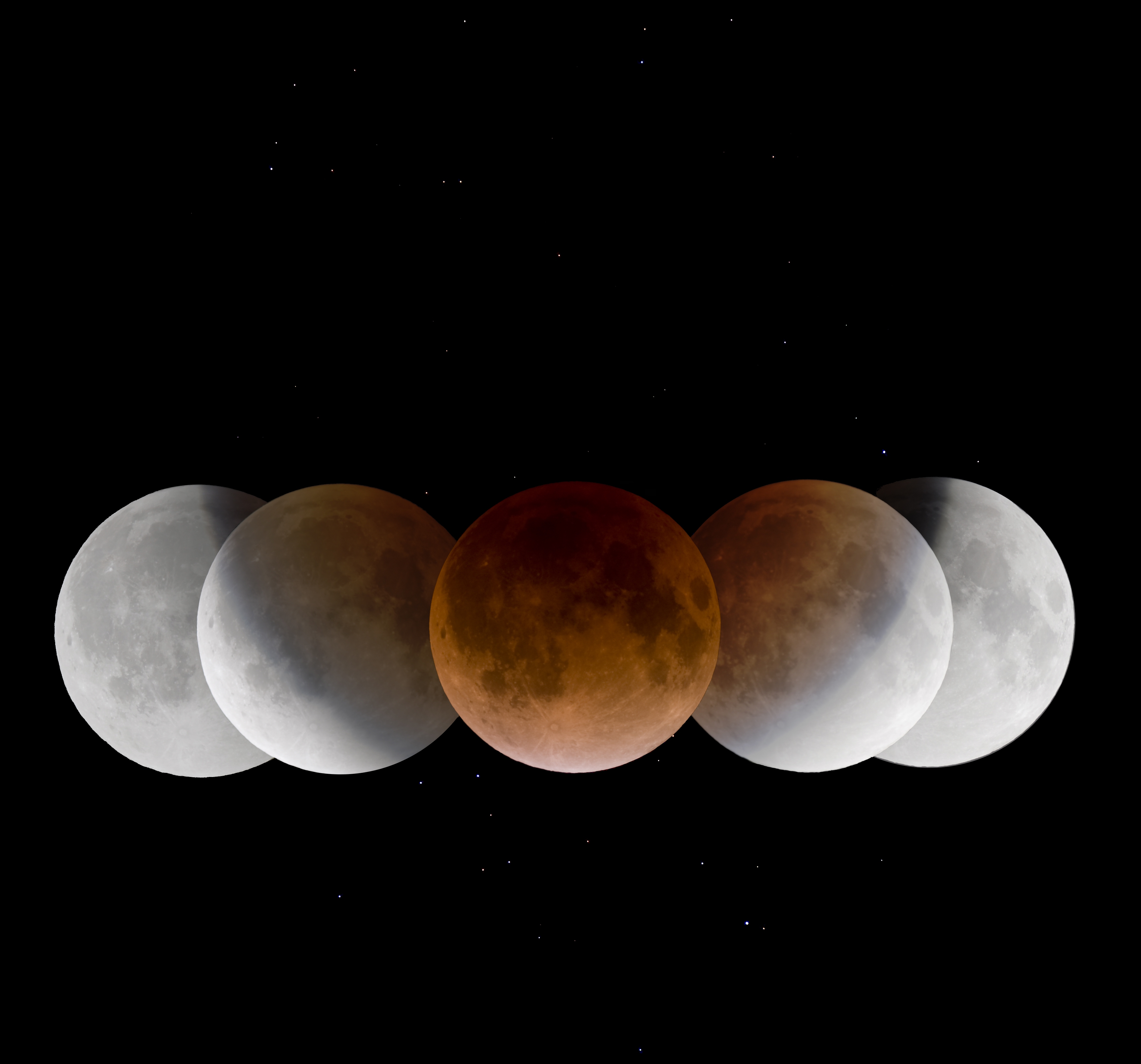
See Explanation.  Clicking on the picture will download the highest resolution version available.

The Umbra of Earth
Image Credit & Copyright: Wang, Letian  

Explanation: The dark, inner shadow of planet Earth is called the umbra. Shaped like a cone extending into space, it has a circular cross section most easily seen during a lunar eclipse. For example, last Saturday the Full Moon slid across the southern half of Earth’s umbral shadow, entertaining moonwatchers around much of the planet. In the total phase of the eclipse, the Moon was completely within the umbra for 51 minutes. Recorded from Beijing, China, this composite eclipse image uses successive pictures from totality (center) and partial phases to trace out a large part of the umbra’s curved edge. Background stars are visible in the darker eclipse phases. The result shows the relative size of the shadow’s cross section at the distance of the Moon, as well as the Moon’s path through Earth’s umbra.

Lunar Eclipses – The Science Behind These Events

Lunar Eclipses

The Science Behind These Events

By John P. Millis, Ph.D

What Is A Lunar Eclipse?

Simply put, a lunar eclipse occurs when the Earth passes directly between the Sun and the Moon. (This means that lunar eclipses, by definition, can only occur during a full Moon.) The result is that direct sunlight from the Sun does not strike the lunar surface. However, this does not mean that no light reaches the surface.

Under certain types of eclipses, light from the Sun can actually be bent by Earth’s atmosphere, casting the Moon in a red or orangish color. Other types of eclipses will simply block a percentage of the Sun’s rays, making the Moon appear darker. And of course, some eclipses are a combination of the two phenomenon (see below).

How Does This Differ From The Normal Lunar Cycle?

While the Moon does go around the Earth, it’s path is actually normally tilted with respect to the Sun. Therefore the different phases of the Moon that we observe during the normal lunar cycle are a result of only half of the Moon getting sunlight at any given time. Then depending on where you are on Earth, you see the Moon at an angle.

The Different Types of Lunar Eclipses

Boiling lunar eclipse down to the Earth’s shadow being cast over the surface of the Moon is quite an over simplification. As already stated, some of the Sun’s light can still reach the surface because of the bending of the light around the Earth. But to complicate the matter further, the Earth’s shadow is actually broken up into two distinct parts (see image).

The umbra is the portion of the Earth’s shadow that does not contain any direct radiation from the Sun. The focus of the umbra is the point at which all three celestial bodies are properly aligned. Despite this, the eclipse does not completely drape the Moon in darkness because light from the Sun can actually be refracted through the Earth’s atmosphere and find its way to the Moon.

The result of this refraction is that the Sun’s light will be separated into individual colors. The more directly aligned the Earth, Moon and Sun are the Moon’s color will transition to more of an orange hue, then red. This is actually the same phenomenon that causes the sky to appear reddish at sunset and sunrise.

When the Moon is fully contained within the umbra, the Moon is said to be in total eclipse. This event can last nearly two hours, while the Moon can be in at least partial eclipse for nearly four hours.

The penumbra is the region of space where the Earth is only partially blocking the light from the Sun. As the Moon moves from outside the shadow toward the umbra the Moon will begin to appear darker and darker. Again, the Moon never appears in complete darkness because some of the light from the Sun is always reaching the surface up until the Moon reaches the umbra.

Normally the Moon will lie only partially in the penumbra area (known as a penumbral eclipse), but occasionally, the Moon will find itself completely in the penumbra. These events, called total penumbral eclipses, are rare. And they are typically characterized by one side of the Moon appearing darker than the other due to one side approaching or receding from the umbra.

These total penumbral eclipses can immediately precede or follow a partial eclipse where the Moon is partially in each of the umbra and penumbra regions.

The Danjon Scale For Lunar Eclipse Brightness

There are obviously a variety of lunar eclipses, causing a variety of different Lunar appearances. In order to classify what kind of lunar eclipse is occurring a scale known as the Danjon scale was developed by André-Louis Danjon.

Essentially an L value is determined based solely on the appearance of the Moon. Using only the naked eye, the observer estimates which category the eclipse falls into to.

    • L=0, This represents the darkest eclipse, and is probably what most people imagine when they think of a lunar eclipse.


    • L=1, While still very dark, there is a grey or brown hue to the Moon. However, details of the Moon are still difficult to identify.


    • L=2, During this type of eclipse the Moon will appear dark red, possibly with a slight hint of orange. The Moon still appears very dark at this value.


    • L=3, The Moon is now brick-red and noticeably lighter than the previous value. Also, the edges can appear lighter, possibly with a yellowish hue.


  • L=4, The Moon now appears bright red or orange, while the edge of the Moon appears almost bluish

The problem with the Danjon scale is that it is not based on an absolute flux or color level, meaning that scientific instruments aren’t used to decide what L value the eclipse represents. Therefore, different people observing the same eclipse can arrive at different L values. So, it’s not very precise, but typically it yields a fairly good idea of what kind of eclipse you are observing.

When Is the Next Lunar Eclipse?

There are always at least two lunar eclipses per year. However, these are sometimes penumbral eclipses which can be difficult to see because the Moon simply appears slightly darker. And given atmospheric conditions, no noticeable different may be apparent.

Total and partial eclipses are far more exciting however, although these are more rare. Typically there are anywhere from zero to three total or partial eclipses each year. To determine when the next eclipse will occur, NASA has put together a handy online tool, which will tell you the date and time of the next lunar eclipse given your location on the Earth.

Lunar Eclipse

Lunar Eclipse

In the Earth’s Shadow

By Molly Hall

The Full Moon is always the alignment of the Sun and Moon in opposite Zodiac signs. The lunar eclipse happens when the Earth is smack dab in the middle, altering how the Moon reflects the solar light. Eclipses come in pairs, and usually come every six months, as that’s when the Moon’s orbit hits the ecliptic.

There’s a mysterious, underworld quality to the lunar eclipse. The Moon turns orangey or blood red, because of the shorter wavelengths being filtered through the Earth’s atmosphere. This frightened people in earlier times, as the cool lunar surface turned a malevolent red. Some cultures believed the Moon was swallowed by a three-legged toad (China) or a jaguar (Maya), and was a herald of demonic or destructive energies afoot. They shouted, clanged pots and pans, and banged drums to dispel the dark spirits lurking around.

What does it bring?

 Since full Moon’s are a time of illumination, the lunar eclipse momentarily throws up shadows of darkness. And often it’s the shadows of the “unlived life,” buried potential, being brought to the surface. It’s a bit like the rich void of the New Moon, where you’re in touch with a well of psychic material. It can be disorienting, as your feet are often leaving the ground of the known!

If you’ve been living in a fantasy world, you’re knocked back to earth. It can be destabilizing and rock the foundations. You are forced to be fully present to some event. You may get shattering news. It takes awhile to fully understand what’s happening, and to find your footing again. Sometimes the events of the eclipse are worked out over a long period, say six months.

Full Moons are times of super high energy, and surging emotion across the spectrum. The eclipse intensifies the sense of being overwhelmed, and events are experienced in vivid color. You’ll get this hit in the house in which the eclipse is taking place. It also loosens the moorings of any planet it touches. You’re in the rapid transformation chute, and clues to how it’ll manifest come from the Zodiac sign of the Sun and Moon at the time. Eclipses liberate us from the status quo, and get things moving. It’s a time to trust, though the outcome may be uncertain, that all things work toward progress in the end.

New Moon Report for December 10th – Full Moon Lunar Eclipse in Gemini

New Moon Report

By Jeff Jawer


Full Moon Lunar Eclipse in Gemini

Saturday, December 10, 6:38 am PST, 9:38 am EST

The opposition of the Moon in multi-faceted Gemini and the Sun in philosophical Sagittarius always increases mental activity and intensifies conversations. This one, though, is also a lunar eclipse meant to reduce distractions so we can focus on one task at a time. Mars in meticulous Virgo reinforces this principle with its squares to the Sun and Moon. Conflicts may arise over minor matters or system failures. Yet concentrating on the work that must be done will turn nervous energy in a productive direction and replace excessive chatter with constructive action.

Balancing Light & Dark

Balancing Light & Dark

by Janice Van Cleve


At 11 minutes after the eleventh hour of the eleventh day of August, 1999, a total eclipse of the sun began to trace its shadow across Europe, Anatolia, and India. Thousands gathered in Cornwall, England, to witness the event while others spent thousands of dollars to fly in a Concorde jet in the path of the shadow. What did it all mean?

This was the last solar eclipse of the millennium. Some predicted that it heralded the fulfillment of biblical revelations, others said it marked the beginning of Armageddon — the last battle before the end of the world. Some looked for aliens from other planets to appear or for a shift in the earth’s magnetic fields that would cause catastrophic earthquakes or floods. For myself, it was an energetic day of creative writing which I attribute more to the extra coffee than to celestial events.

Yet an eclipse is an awesome occurrence. To think that an object far out in space could throw its shadow across our earth somehow shakes loose our narrow focus on the mundane and underscores our connection to a greater universe. The immensity of this phenomenon dwarfs our puny existence and forces a humbling awe. Those who fear what they cannot control are driven to spread their fear in dire prophecies and ludicrous interpretations. Still others, seeking escape from temporal reality, see in the eclipse a sign of alternative worlds where they might fare better.

There is another aspect of eclipses: they are beautiful to behold. In a world flush with beauty which unfolds daily in the sheer joy of its own existence, the solar eclipse is one more delightfully exquisite manifestation of pure joy. The eclipse does not have to be either mechanical science or holy creation or portent for the future. It just is, for its own sake, with no purpose other than to be. Like the yellow mountain lily or the fingerling salmon in the sea, like a graceful waltz or reading to a little child, the sun’s diamond ring around the moon is a delight to the open heart.

The eclipse can also provide a symbolic reference for a deeper truth. The moon, which brings light to the darkness, now brings darkness to the light. The moon reflects the sun’s light during the night and, during a solar eclipse, it is the moon that hides that light from us. It is a symbol for the principle of universal duality. Dark cannot exist without light and light cannot exist without dark. Light and dark are coequal twins, like life and death, love and fear, joy and sorrow.

Patriarchal religions attempt to break up universal duality. They fear darkness and shun it, seeking in its place eternal light. Pagans, however, can embrace both the light and the darkness. They can appreciate each one for its own sake and for the anticipation each creates for the other. Bliss is the happy balance of both, in perfect love and perfect trust.

The happy balance of light and dark is the theme of autumn equinox when day and night are of equal length. The expressive and expansive days of spring and summer give way necessarily to the introspective days of autumn and winter. It is no accident that this is the time of Libra, the scales of balance.

Now we gather that which is of lasting value and let go that which is no longer useful. Debts are settled, produce is harvested, and we look back at summer’s accomplishments with a sigh of both satisfaction and relief. Now we begin to draw inward and to take stock and give thanks for how far we have traveled since we made those promises at Imbolc and planted those seeds at spring equinox.

An eclipse gives us a quick vision of the interchangeability of light and dark. The equinox bears out the vision in the wheel of the year. We are the children of the light and we are equally the children of the dark.

New Moon for July 1 – New Moon Solar Eclipse in Cancer

New Moon Solar Eclipse in Cancer

Friday, July 1, 1:54 am PDT, 4:54 am EDT

This New Moon in protective Cancer is a very powerful Solar Eclipse. Instead of planting seeds of security in our gardens of desire, we are challenged to break up the old soil of expectations about what will make us safe and happy. Cancer wants closeness and continuity but eclipses break patterns, especially when forming stressful 90-degree squares with volatile Uranus. Yet while Uranus sparks surprises, constraining Saturn and transformational Pluto also form tense aspects to the New Moon. Pressure is building that can affect major institutions, individuals and the environment and is best met with innovation, passion and commitment. Being a well-prepared and patient agent of change will radically improve lives while desperately holding onto the past can be futile and frustrating.

We may feel a sense of loss or disorientation with this Solar Eclipse, but it is time to burn some bridges with the past. However, we don’t need to erase all memories of what has come before. This New Moon is a clear signal that bold methods and beliefs are more likely to sustain personal growth and collective survival than returning to outmoded ideas.


New Moon Report for June 15th – Full Moon in Sagittarius

Full Moon in Sagittarius

Wednesday, June 15, 1:14 pm PDT, 4:14 pm EDT

This lunation occurs in optimist but judgmental Sagittarius where the need for absolute answers can lead to philosophical fundamentalism. It is a Total Eclipse of the Moon, signaling the need to let go of past beliefs and prejudices. Emptying ourselves of old truths can feel like stepping into the void of ignorance, but what we gain by opening our minds to let outmoded concepts fall away invites in a greater range of awareness. Being wrong might feel embarrassing yet is often the first step to acquiring more knowledge.