Discover the cosmos! Each day a different image or photograph of our fascinating universe is featured, along with a brief explanation written by a professional astronomer.
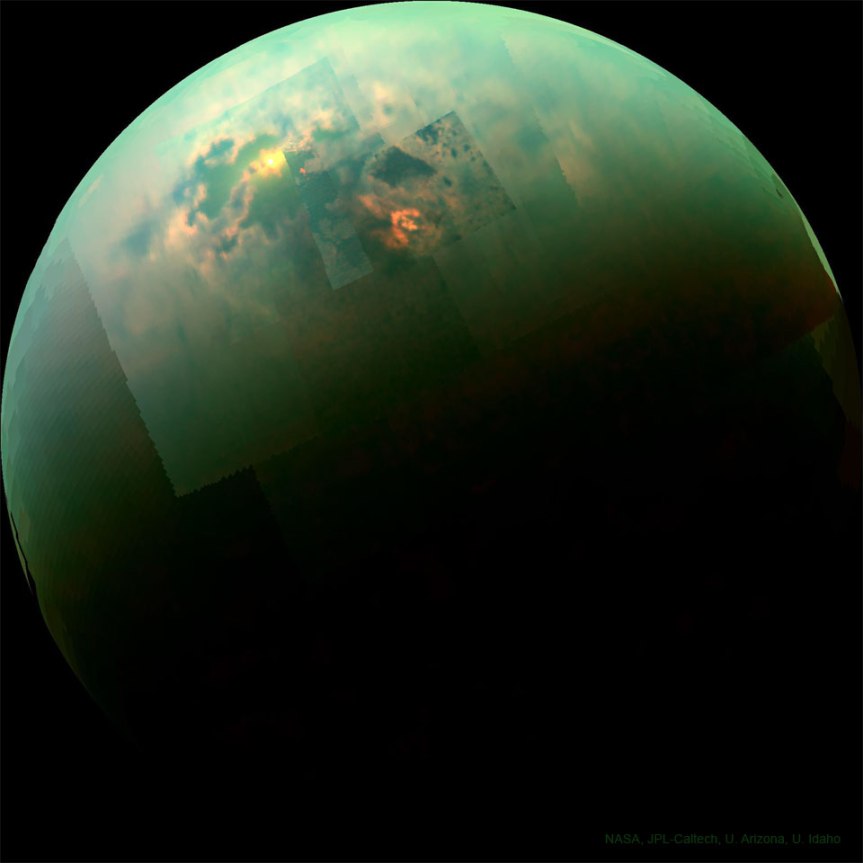
Explanation: Why would the surface of Titan light up with a blinding flash? The reason: a sunglint from liquid seas. Saturn’s moon Titan has numerous smooth lakes of methane that, when the angle is right, reflect sunlight as if they were mirrors. Pictured here in false-color, the robotic Cassini spacecraft that orbited Saturn from 2004 to 2017 imaged the cloud-covered Titan in 2014 in different bands of cloud-piercing infrared light. This specular reflection was so bright it saturated one of Cassini’s infrared cameras. Although the sunglint was annoying — it was also useful. The reflecting regions confirm that northern Titan houses a wide and complex array of seas with a geometry that indicates periods of significant evaporation. During its numerous passes of our Solar System‘s most mysterious moon, Cassini has revealed Titan to be a world with active weather — including times when it rains a liquefied version of natural gas.
Discover the cosmos! Each day a different image or photograph of our fascinating universe is featured, along with a brief explanation written by a professional astronomer.
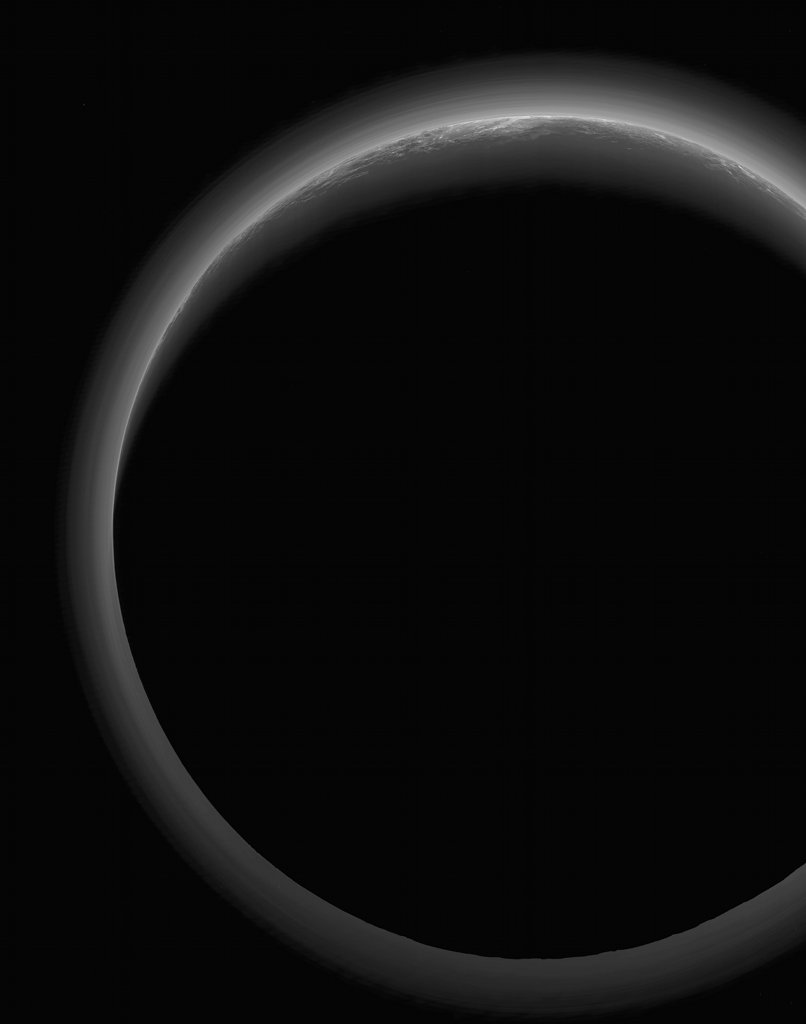
Explanation: The night side of Pluto spans this shadowy scene. In the stunning spacebased perspective the Sun is 4.9 billion kilometers (almost 4.5 light-hours) behind the dim and distant world. It was captured by far flung New Horizons in July of 2015 when the spacecraft was at a range of some 21,000 kilometers from Pluto, about 19 minutes after its closest approach. A denizen of the Kuiper Belt in dramatic silhouette, the image also reveals Pluto’s tenuous, surprisingly complex layers of hazy atmosphere. Near the top of the frame the crescent twilight landscape includes southern areas of nitrogen ice plains now formally known as Sputnik Planitia and rugged mountains of water-ice in the Norgay Montes.
Discover the cosmos! Each day a different image or photograph of our fascinating universe is featured, along with a brief explanation written by a professional astronomer.
2022 March 24
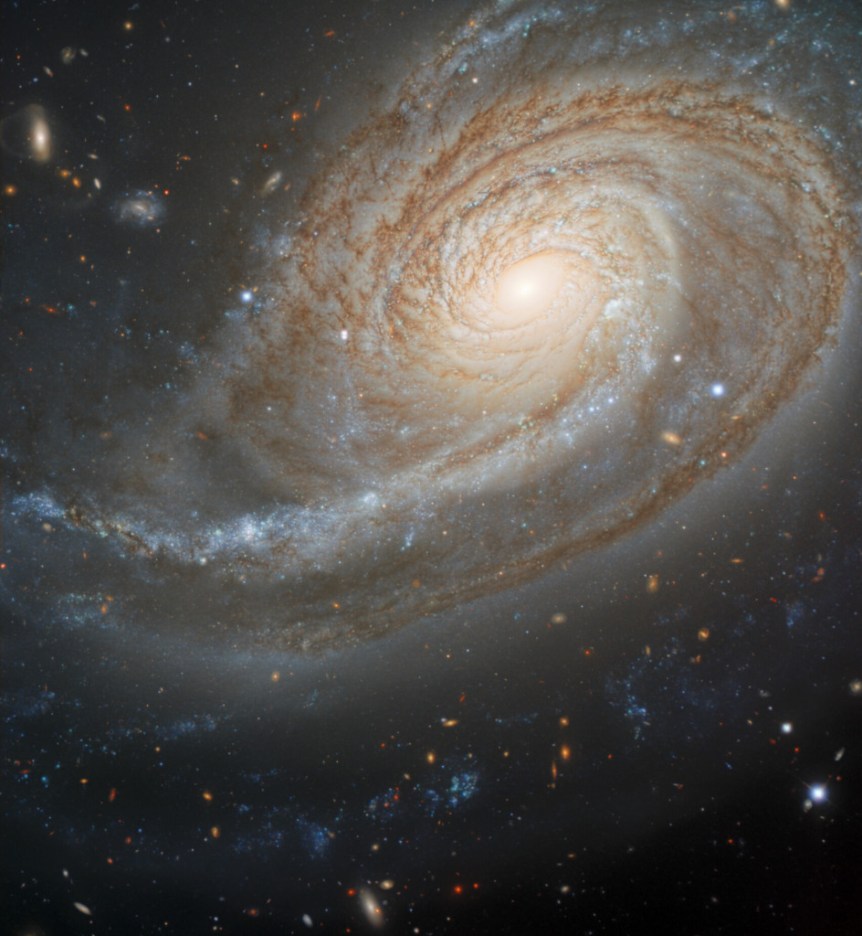
The overdeveloped spiral arm of the galaxy NGC 772, which was created by tidal interactions with an unruly neighbor, dominates this observation made by astronomers using the Gemini North telescope located near the summit of Maunakea in Hawai‘i.
Arp 78: Peculiar Galaxy in Aries
Image Credit & License: International Gemini Observatory / NOIRLab / NSF / AURA Processing: T.A. Rector (Univ. Alaska Anchorage), J. Miller (Gemini Observatory/NOIRLab), M. Zamani & D. de Martin
Explanation: Peculiar spiral galaxy Arp 78 is found within the boundaries of the head strong constellation Aries. Some 100 million light-years beyond the stars and nebulae of our Milky Way galaxy, the island universe is over 100,000 light-years across. Also known as NGC 772, it sports a prominent, outer spiral arm in this detailed cosmic portrait from the large Gemini North telescope near the summit of Maunakea, Hawaii, planet Earth. Tracking along sweeping dust lanes and lined with young blue star clusters, Arp 78’s spiral arm is likely pumped-up by galactic-scale gravitational tidal interactions The close companion galaxy responsible is NGC 770, located off the upper right of this frame. But more distant background galaxies are clearly visible in the cosmic field of view.
Discover the cosmos! Each day a different image or photograph of our fascinating universe is featured, along with a brief explanation written by a professional astronomer.
Explanation: What’s that in the sky? An aurora. A large coronal mass ejection occurred on our Sun earlier this month, throwing a cloud of fast-moving electrons, protons, and ions toward the Earth. Part of this cloud impacted our Earth’s magnetosphere and, bolstered by a sudden gap, resulted in spectacular auroras being seen at some high northern latitudes. Featured here is a particularly photogenic auroral corona captured above a forest in Sweden from a scenic perch overlooking the city of Östersund. To some, this shimmering green glow of recombining atmospheric oxygen might appear like a large whale, but feel free to share what it looks like to you. The unusually quietSun of the past few years has now passed. As our Sun now approaches a solar maximum in its 11-year solar magnetic cycle, dramatic auroras like this are sure to continue.
Discover the cosmos! Each day a different image or photograph of our fascinating universe is featured, along with a brief explanation written by a professional astronomer.
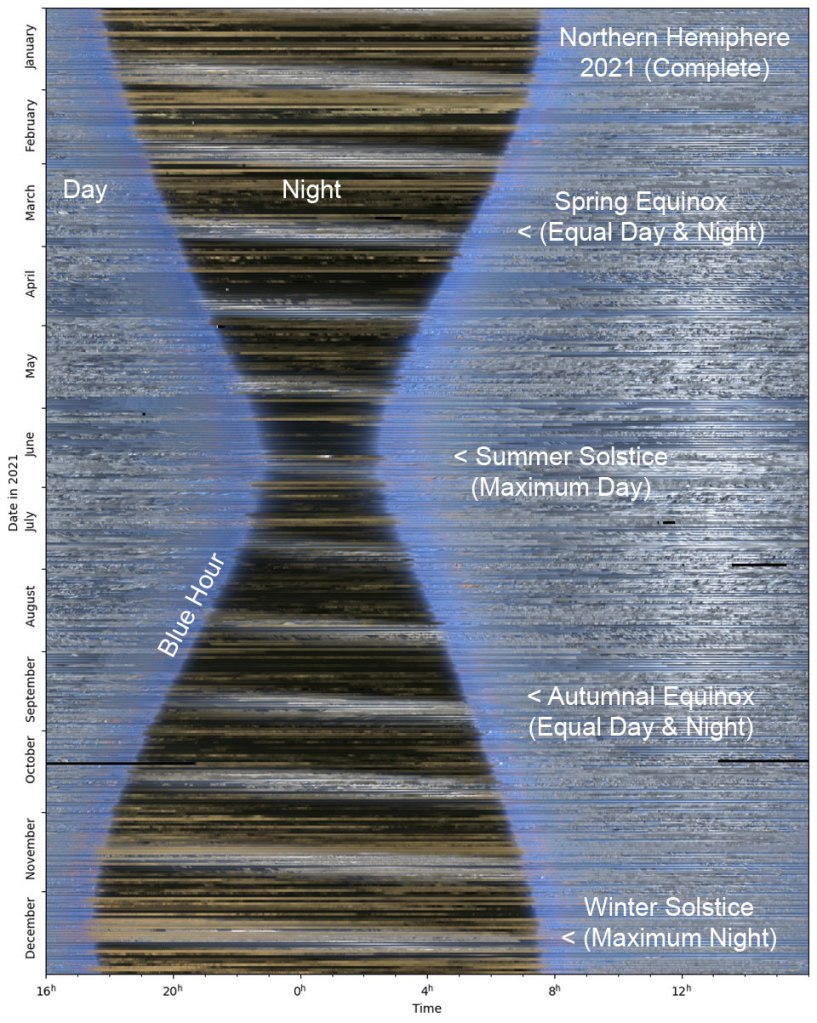
Explanation: What if you could see the entire sky — all at once — for an entire year? That, very nearly, is what is pictured here. Every 15 minutes during 2021, an all-sky camera took an image of the sky over the Netherlands. Central columns from these images were then aligned and combined to create the featured keogram, with January at the top, December at the bottom, and the middle of the night running vertically just left of center. What do we see? Most obviously, the daytime sky is mostly blue, while the nighttime sky is mostly black. The twelve light bands crossing the night sky are caused by the glow of the Moon. The thinnest part of the black hourglass shape occurs during the summer solstice when days are the longest, while the thickest part occurs at the winter solstice. Yesterday was an equinox — when night and day were equal — and the northern-spring equinox from one year ago can actually be located in the keogram — about three-quarters of the way up.
Discover the cosmos! Each day a different image or photograph of our fascinating universe is featured, along with a brief explanation written by a professional astronomer.
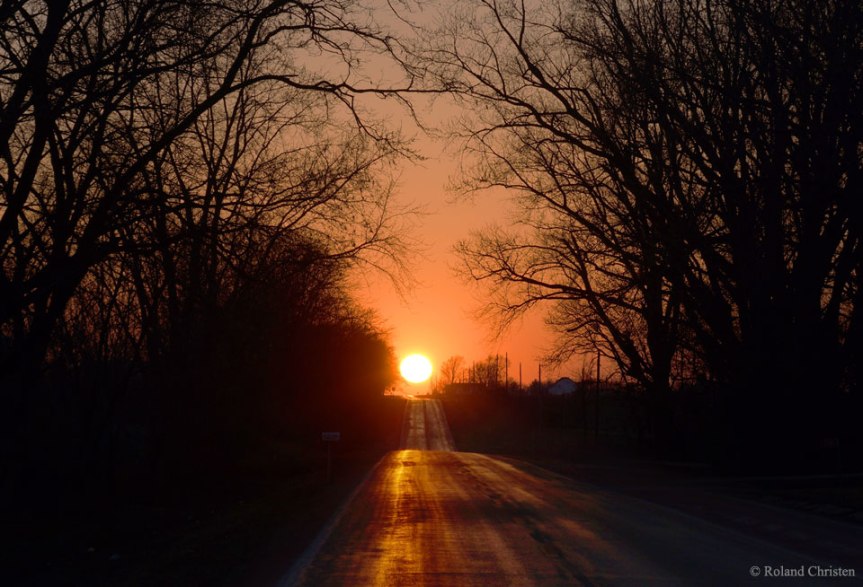
Explanation: What’s that at the end of the road? The Sun. Many towns have roads that run east – west, and on two days each year, the Sun rises and sets right down the middle. Today is one of those days: an equinox. Not only is today a day of equal night (“aequus”-“nox”) and day time, but also a day when the sun rises precisely to the east and sets due west. Featured here is a picturesque road in northwestIllinois, USA that runs approximately east -west. The image was taken during the March Equinox of 2015, and shows the Sun down the road at sunset. In many cultures, this March equinox is taken to be the first day of a season, typically spring in Earth’s northern hemisphere, and autumn in the south. Does your favorite street run east – west? Tonight, at sunset, you can find out with a quick glance.
Discover the cosmos! Each day a different image or photograph of our fascinating universe is featured, along with a brief explanation written by a professional astronomer.
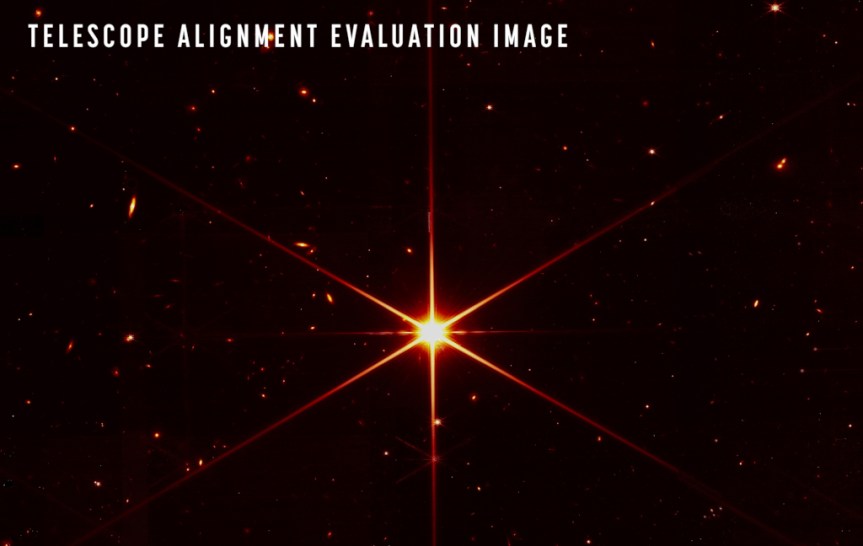
Explanation: 2MASS J17554042+6551277 doesn’t exactly roll off the tongue but that’s the name, a coordinate-based catalog designation, of the star centered in this sharp field of view. Fans of the distant universe should get used to its spiky appearance though. The diffraction pattern is created by the 18 hexagonal mirror segments of the James Webb Space Telescope. After unfolding, the segments have now been adjusted to achieve a diffraction limited alignment at infrared wavelengths while operating in concert as a single 6.5 meter diameter primary mirror. The resulting image taken by Webb’s NIRcam demonstrates their precise alignment is the best physics will allow. 2MASS J17554042+6551277 is about 2,000 light-years away and well within our own galaxy. But the galaxies scattered across the background of the Webb telescope alignment evaluation image are likely billions of light-years distant, far beyond the Milky Way.
Discover the cosmos! Each day a different image or photograph of our fascinating universe is featured, along with a brief explanation written by a professional astronomer.
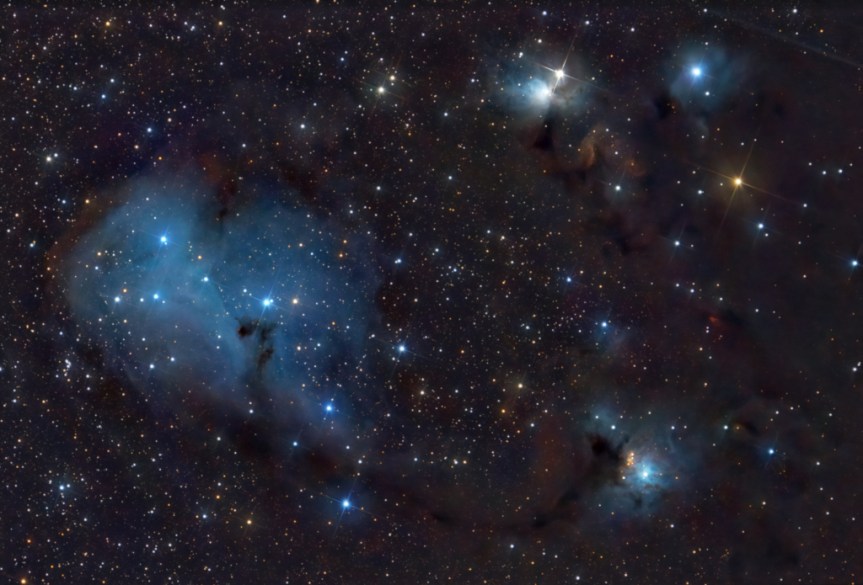
Explanation: Bluish reflection nebulae seem to fill this dusty expanse. The sharp telescopic frame spans over 1 degree on the sky toward the faint but fanciful constellation Monoceros, the Unicorn. Seen within the Monoceros R1 cloud complex some 2,500 light-years away, bluish IC 447 is on the left, joined by a long dark filament of dust to IC 446 at lower right. Embedded in IC 447 are young, massive blue stars much hotter than the Sun, whose light is reflected by the cosmic cloud of star stuff. Observations reveal that IC 446 also contains a young stellar object, a massive star still in an early stage of evolution. The dark filament of dust and molecular gas joining the two star-forming regions is over 15 light-years long.
Discover the cosmos! Each day a different image or photograph of our fascinating universe is featured, along with a brief explanation written by a professional astronomer.
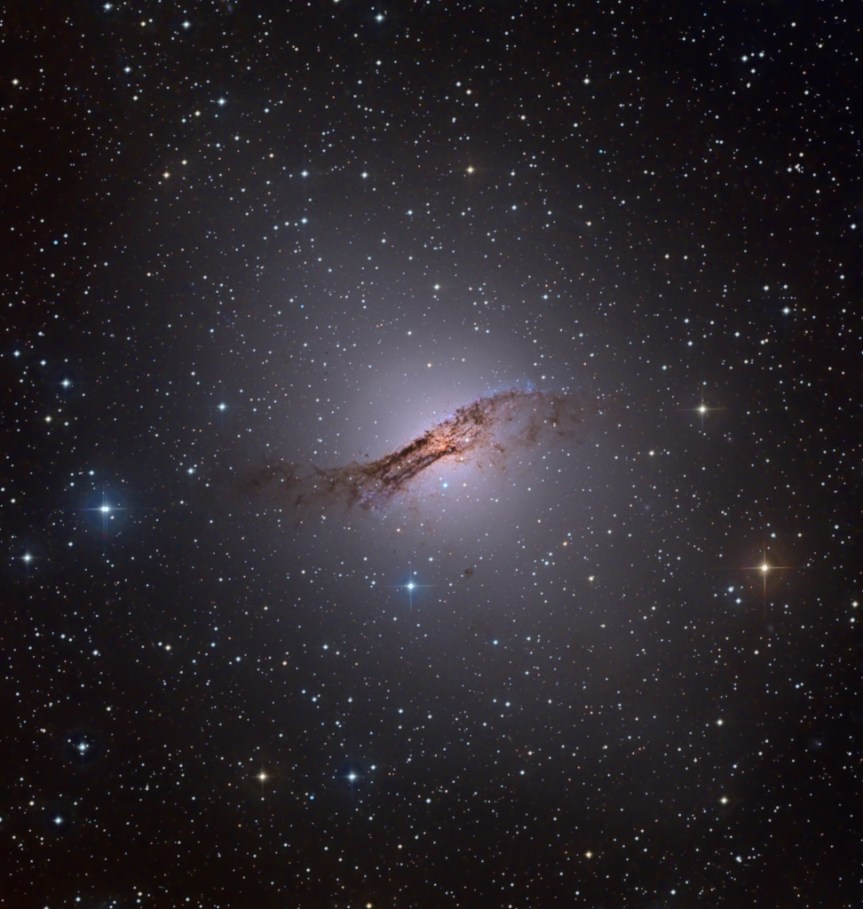
Explanation: A mere 11 million light-years away, Centaurus A is the closest active galaxy to planet Earth. Spanning over 60,000 light-years, the peculiar elliptical galaxy also known as NGC 5128, is featured in this sharp telescopic view. Centaurus A is apparently the result of a collision of two otherwise normal galaxies resulting in a fantastic jumble of star clusters and imposing dark dust lanes. Near the galaxy’s center, leftover cosmic debris is steadily being consumed by a central black hole with a billion times the mass of the Sun. As in other active galaxies, that process likely generates the enormous radio, X-ray, and gamma-ray energy radiated by Centaurus A.
Discover the cosmos! Each day a different image or photograph of our fascinating universe is featured, along with a brief explanation written by a professional astronomer.
Discover the cosmos! Each day a different image or photograph of our fascinating universe is featured, along with a brief explanation written by a professional astronomer.
A stunning night view, taken close to the 1.54m Danish Telescope and the 3.6m telescope on the road at La Silla, shows the Milky Way above the horizon, accompanied by the Magellanic Clouds. ESO’s 3.6m Telescope, seen here atop a hill at the centre of the image, is home to HARPS, an instrument dedicated to the discovery of planets outside the Solar System via the radial velocity method. This method enables the detection of a planet by measuring the wobbling motion of the central star caused by the gravitational pull of the planet itself. The towers on the left are the support structures of the BlackGEM telescopes, which had not been installed yet when this image was taken. BlackGEM is an array of telescopes that will search for the light emitted by the optical counterparts of the most powerful gravitational-wave sources, namely colliding neutron stars and black holes. On the right of the image, we see the Large and Small Magellanic Clouds, two irregular dwarf galaxies orbiting the Milky Way at a distance of approximately 160 000 and 200 000 light-years, respectively. In the Mapuche culture of south-central Chile, these neighbouring galaxies were known as lafken, labken or künchalabken (“the lagoons”) as well as rünanko (“the water wells”). [1] The red filamentary emission stretching across the sky in the horizon is called airglow, which is light naturally emitted by atoms and molecules in the atmosphere through various physical and chemical processes. Despite showing up prominently in this image, airglow is invisible to the unaided eye. [1] Source: Wenumapu. Astronomía y Cosmología Mapuche, Gabriel Pozo Menares & Margarita Canio LlanquinaoExplanation: Pictured — a very scenic road to the stars. The road approaches La Silla Observatory in Chile, with the ESO‘s 3.6-meter telescope just up ahead. To the left are some futuristic-looking support structures for the planned BlackGEM telescopes, an array of optical telescopes that will help locate optical counterparts to gravitational waves detections by LIGO and other detectors. But there is much more. Red airglow illuminates the night sky on the right, while the central band of our Milky Way Galaxy slants across the image center. Jupiter can be seen just above the band near the image center, while Saturn is visible just above the 3.6-meter telescope dome. The two largest satellite galaxies of our Milky Way Galaxy, the LMC and SMC, are seen on the far right. The featured image panorama was built up from multiple 15-second exposures that were captured on 2019 June 30. Two days later, La Silla experienced a rare total eclipse of the Sun.
Discover the cosmos! Each day a different image or photograph of our fascinating universe is featured, along with a brief explanation written by a professional astronomer.
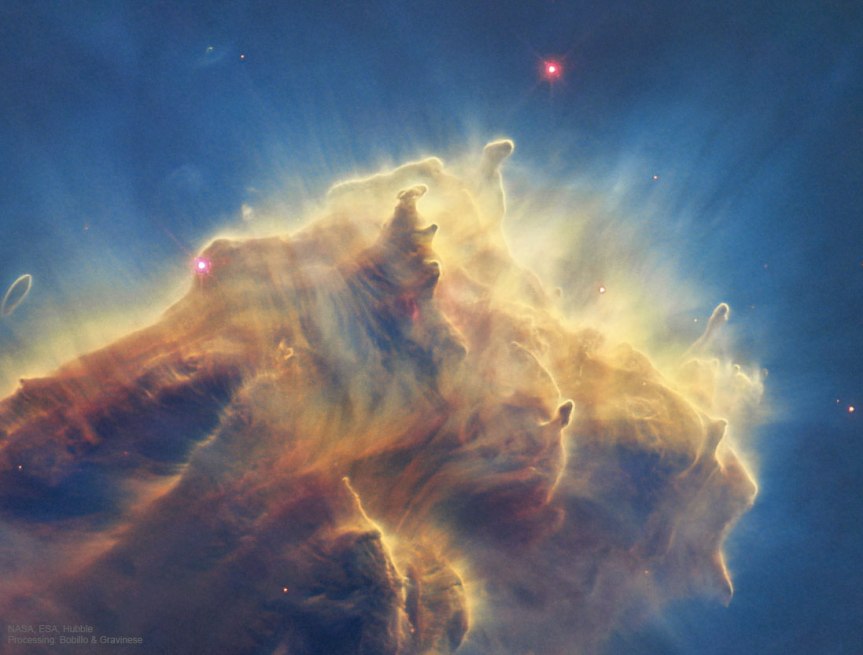
Explanation: Where do stars form? One place, star forming regions known as “EGGs”, are being uncovered at the end of this giant pillar of gas and dust in the Eagle Nebula (M16). Short for evaporating gaseous globules, EGGs are dense regions of mostly molecular hydrogen gas that fragment and gravitationally collapse to form stars. Light from the hottest and brightest of these new stars heats the end of the pillar and causes further evaporation of gas and dust — revealing yet more EGGs and more young stars. This featured picture was created from exposures spanning over 30 hours with the Earth-orbiting Hubble Space Telescope in 2014, and digitally processed with modern software by experienced volunteers in Argentina. Newborn stars will gradually destroy their birth pillars over the next 100,000 years or so — if a supernova doesn’t destroy them first.
Discover the cosmos! Each day a different image or photograph of our fascinating universe is featured, along with a brief explanation written by a professional astronomer.
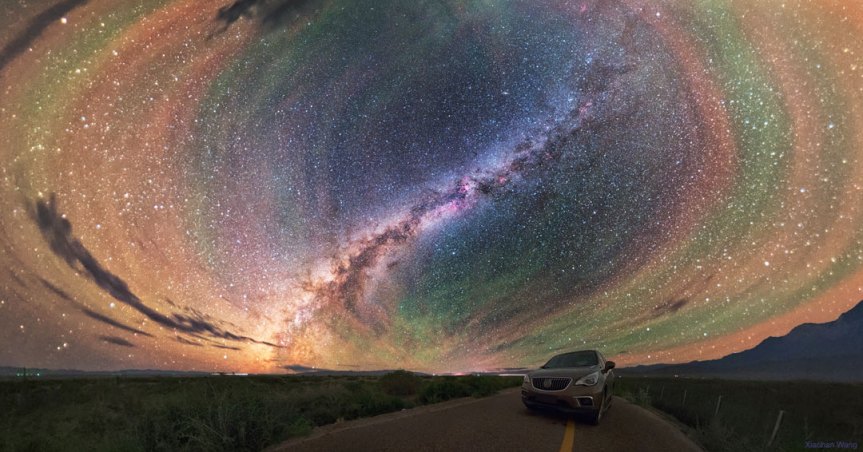
Explanation: Why would the sky glow like a giant repeating rainbow? Airglow. Now air glows all of the time, but it is usually hard to see. A disturbance however — like an approaching storm — may cause noticeable rippling in the Earth’s atmosphere. These gravity waves are oscillations in air analogous to those created when a rock is thrown in calm water. Red airglow likely originates from OH molecules about 87-kilometers high, excited by ultraviolet light from the Sun, while orange and green airglow is likely caused by sodium and oxygen atoms slightly higher up. While driving near Keluke Lake in Qinghai Provence in China a few years ago, the photographer originally noticed mainly the impressive central band of the Milky Way Galaxy. Stopping to photograph it, surprisingly, the resulting sensitive camera image showed airglow bands to be quite prominent and span the entire sky. The featured image has been digitally enhanced to make the colors more vibrant.
Discover the cosmos! Each day a different image or photograph of our fascinating universe is featured, along with a brief explanation written by a professional astronomer.
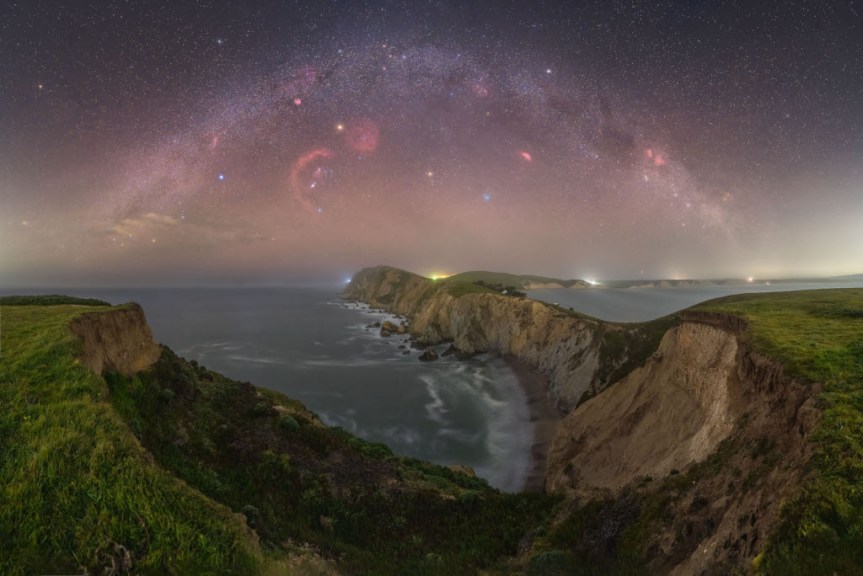
Explanation: Northern winter constellations and a long arc of the Milky Way are setting in this night skyscape looking toward the Pacific Ocean from Point Reyes on planet Earth’s California coast. Sirius, alpha star of Canis Major, is prominent below the starry arc toward the left. Orion’s yellowish Betelgeuse, Aldebaran in Taurus, and the blue tinted Pleiades star cluster also find themselves between Milky Way and northwestern horizon near the center of the scene. The nebulae visible in the series of exposures used to construct this panoramic view were captured in early March, but are just too faint to be seen with the unaided eye. On that northern night their expansive glow includes the reddish semi-circle of Barnard’s Loop in Orion and NGC 1499 above and right of the Pleiades, also known as the California Nebula.
Discover the cosmos! Each day a different image or photograph of our fascinating universe is featured, along with a brief explanation written by a professional astronomer.
Explanation: Want to see a rainbow smile? Look near the zenith (straight up) when the sun is low in the sky and you might. This example of an ice halo known as a circumzenithal arc was captured above a palm tree top from Ragusa, Sicily on February 24. The vividly colorful arcs are often called smiling rainbows because of their upside down curvature and colors. For circumzenithal arcs the zenith is at the center and red is on the outside, compared to rainbows whose arcs bend toward the horizon after a downpour. True rainbows are formed by water droplets refracting the sunlight to produce a spectrum of colors, though. Circumzenithal arcs are the product of refraction and reflection in flat hexagonal ice crystals, like the ice crystals that create sundogs, formed in high thin clouds.
Discover the cosmos! Each day a different image or photograph of our fascinating universe is featured, along with a brief explanation written by a professional astronomer.
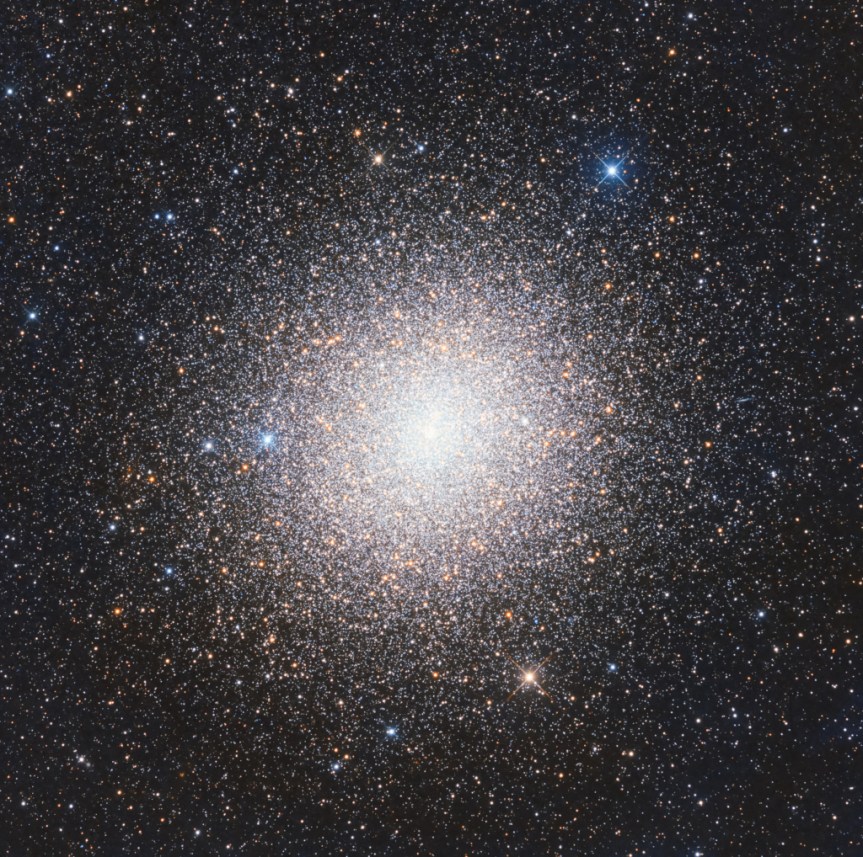
Explanation: Globular star cluster 47 Tucanae is a jewel of the southern sky. Also known as NGC 104, it roams the halo of our Milky Way Galaxy along with some 200 other globular star clusters. The second brightest globular cluster (after Omega Centauri) as seen from planet Earth, 47 Tuc lies about 13,000 light-years away. It can be spotted with the naked-eye close on the sky to the Small Magellanic Cloud in the constellation of the Toucan. The dense cluster is made up of hundreds of thousands of stars in a volume only about 120 light-years across. Red giant stars on the outskirts of the cluster are easy to pick out as yellowish stars in this sharp telescopic portrait. Tightly packed globular cluster 47 Tuc is also home to a star with the closest known orbit around a black hole.
Discover the cosmos! Each day a different image or photograph of our fascinating universe is featured, along with a brief explanation written by a professional astronomer.
Explanation: It is one of the more unusual rocks yet found on Mars. Smaller than a penny, the rock has several appendages that make it look, to some, like a flower. Although it would be a major discovery if the rock was truly a fossilized ancient Martian flower, there are less spectacular — and currently preferred — explanations for its unusual structure. One theory that has emerged is that the rock is a type of concretion created by minerals deposited by water in cracks or divisions in existing rock. These concretions can be compacted together, can be harder and denser than surrounding rock, and can remain even after the surrounding rock erodes away. The flower structure may also be caused by crystal clusters. The small rock, named Blackthorn Salt, has similarities to previouslyimagedMartianpebbles. The featured image was taken by the Curiosity rover on Mars in late February. Scientists will continue to study data and images taken of this — and similar — surprising Martian rocks.
Discover the cosmos! Each day a different image or photograph of our fascinating universe is featured, along with a brief explanation written by a professional astronomer.
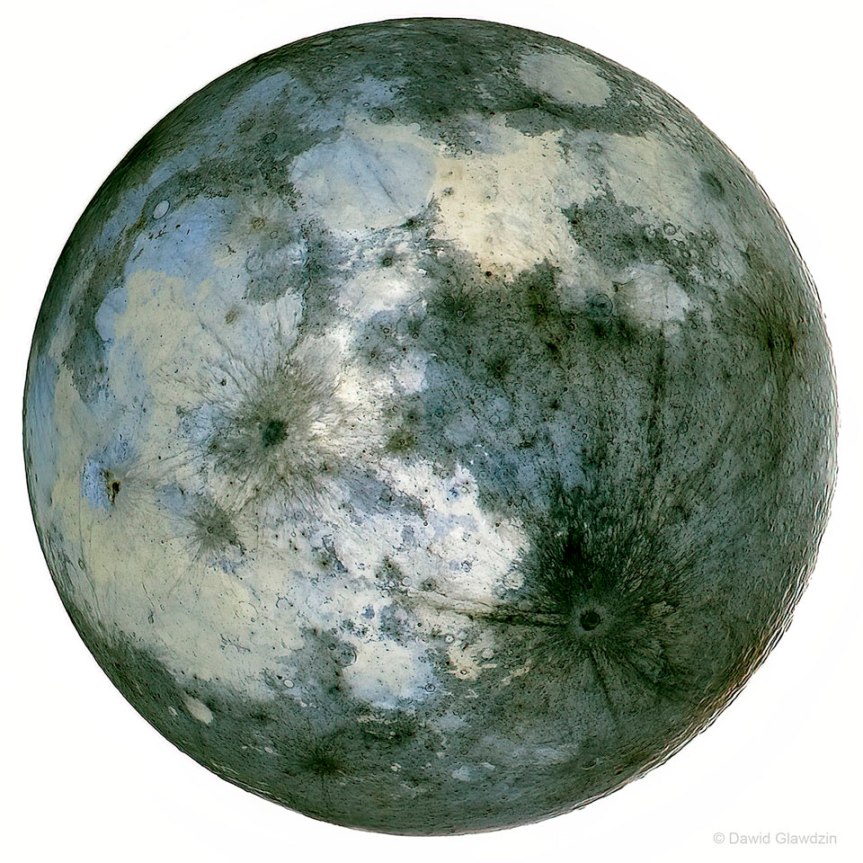
Explanation: Which moon is this? It’s Earth’s moon — but in inverted colors. Here, the pixel values corresponding to light and dark areas have been translated in reverse, or inverted, producing a false-color representation reminiscent of a black and white photographic negative. However, this is an inverted color image — where the muted colors of the moon are real but digitally exaggerated before inversion. Normally bright rays from the large crater Tycho dominate the southern (bottom) features as easily followed dark green lines emanating from the 85-kilometer diameter impact site. Normally dark lunar mare appear light and silvery. The image was acquired in Southend-on-Sea, England, UK. Historically, astronomical images recorded on photographic plates were directly examined on inverted-color negatives because it helped the eye pick out faint details.
Discover the cosmos! Each day a different image or photograph of our fascinating universe is featured, along with a brief explanation written by a professional astronomer.
Explanation: Yes, but can you see the lion? A deep exposure shows the famous dark indentation that looks like a horse’s head, visible just left and below center, and known unsurprisingly as the Horsehead Nebula. The Horsehead Nebula (Barnard 33) is part of a vast complex of dark absorbing dust and bright glowing gas. To bring out details of the Horsehead’s pasture, an astrophotographer artistically combined light accumulated for over 20 hours in hydrogen (orange), oxygen (blue), and sulfur (green). The resulting spectacular picture captured from Raachine, Lebanon, details an intricate tapestry of gaseous wisps and dust-laden filaments that were created and sculpted over eons by stellar winds and ancient supernovas. The featured composition brings up another pareidolic animal icon — that of a lion’s head — in the expansive orange colored gas above the horse’s head. The Flame Nebula is visible just to the left of the Horsehead. The Horsehead Nebula lies 1,500 light years distant towards the constellation of Orion.
Discover the cosmos! Each day a different image or photograph of our fascinating universe is featured, along with a brief explanation written by a professional astronomer.
2022 March 6
Venus and the Triply Ultraviolet Sun
Image Credit: NASA/SDO & the AIA, EVE, and HMI teams; Digital Composition: Peter L. Dove







 Witches Of The Craft®






.png)







You must be logged in to post a comment.