April 20 Astronomy Picture of the Day

Discover the cosmos! Each day a different image or photograph of our fascinating universe is featured, along with a brief explanation written by a professional astronomer.

2022 April 20

Planet Line over New York Bridge

Image Credit & CopyrightStan Honda

Explanation: There’s an interesting sky to see if you wake up before the Sun. Lined up on toward the eastern horizon are four planets in a row. The planets are so bright they can even be seen from the bright sky inside a city. In fact, the featured image was taken from New York City, USA, with the foreground highlighted by the RFK (TriboroughBridge. Pictured, the planets are, left to right, JupiterVenusMars, and Saturn. The planets all appear in a row because they all orbit the Sun in the same plane. This plane, called the ecliptic plane, was created in the early days of our Solar System and includes all planets, including Earth. The morning planet parade will continue throughout April and May, and will even be joined by Mercury in June.


APOD volunteer programming opportunity: Discord
April 19 Astronomy Picture of the Day

Discover the cosmos!

Each day a different image or photograph of our fascinating universe is featured, along with a brief explanation written by a professional astronomer.

2022 April 19

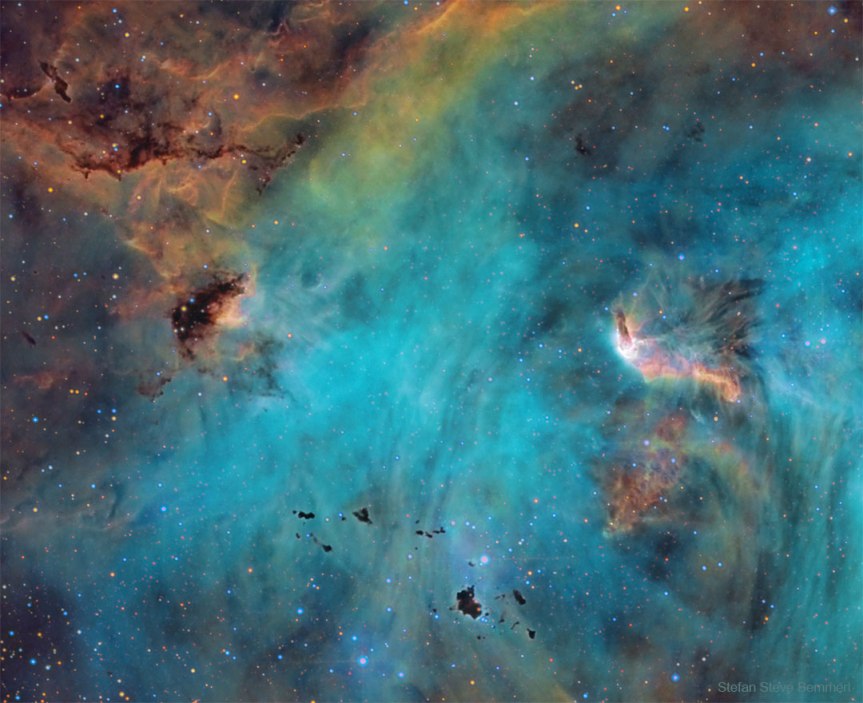
Stars and Globules in the Running Chicken Nebula

Image Credit & Copyright: Stefan Steve Bemmerl

Explanation: The eggs from this gigantic chicken may form into stars. The featured emission nebula, shown in scientifically assigned colors, is cataloged as IC 2944 but known as the Running Chicken Nebula for the shape of its greater appearance. Seen toward the bottom of the image are small, dark molecular clouds rich in obscuring cosmic dust. Called Thackeray’s Globules for their discoverer, these “eggs” are potential sites for the gravitational condensation of new stars, although their fates are uncertain as they are also being rapidly eroded away by the intense radiation from nearby young stars. Together with patchy glowing gas and complex regions of reflecting dust, these massive and energetic stars form the open cluster Collinder 249. This gorgeous skyscape spans about 60 light-years at the nebula’s estimated 6,500 light-year distance.

April 18 Astronomy Picture of the Day

Discover the cosmos! Each day a different image or photograph of our fascinating universe is featured, along with a brief explanation written by a professional astronomer.

2022 April 18

Stars and Planets over Portugal

Image Credit & Copyright: Miguel Claro (TWAN, Dark Sky Alqueva)

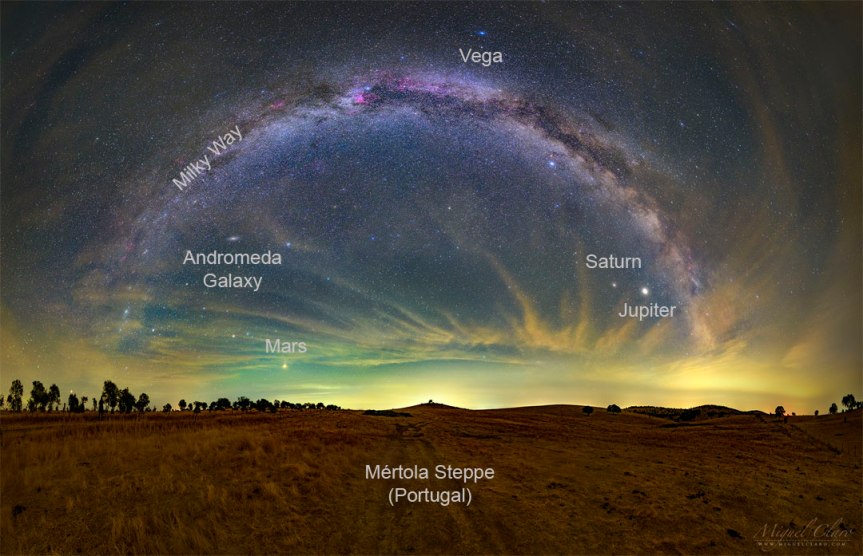
Explanation: The mission was to document night-flying birds — but it ended up also documenting a beautiful sky. The featured wide-angle mosaic was taken over the steppe golden fields in MértolaPortugal in 2020. From such a dark location, an immediately-evident breathtaking glow arched over the night sky: the central band of our Milky Way galaxy. But this sky had much more. Thin clouds crossed the sky like golden ribbons. The planet Mars appeared on the far left, while the planets Saturn and Jupiter were also simultaneously visible — but on the opposite side of the sky, here seen on the far right. Near the top of the image the bright star Vega can be found, while the far-distant and faint Andromeda Galaxy can be seen toward the left, just below Milky Way’s arch. As the current month progresses, several planets are lining up in the pre-dawn sky: JupiterVenus, Mars, and Saturn.


Did you know? Many APODs have links for adventure & humor

April 17 Astronomy Picture of the Day

Discover the cosmos! Each day a different image or photograph of our fascinating universe is featured, along with a brief explanation written by a professional astronomer.

2022 April 17

Shuttle Over Earth

Image Credit: NASAExpedition 22 Crew

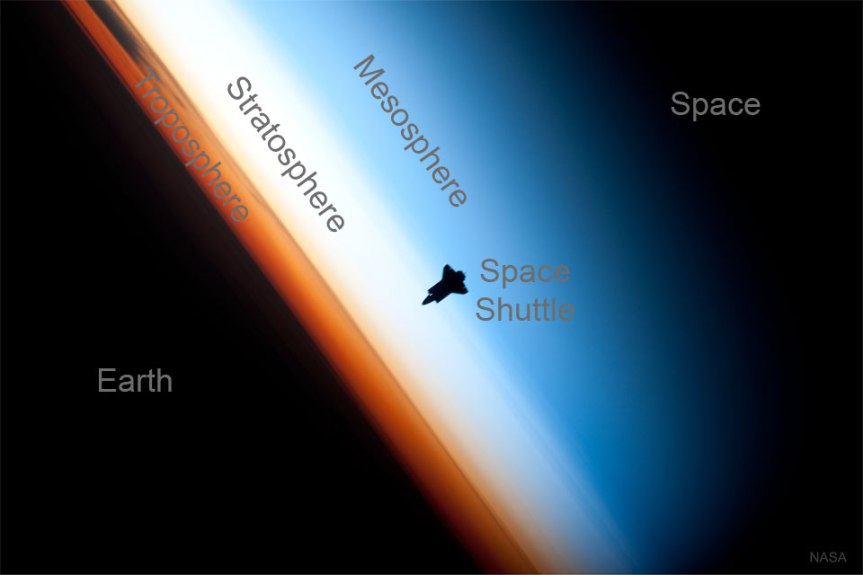
Explanation: What’s that approaching? Astronauts on board the International Space Station in 2010 first saw it far in the distance. Soon it enlarged to become a dark silhouette. As it came even closer, the silhouette appeared to be a spaceship. Finally, the object revealed itself to be the Space Shuttle Endeavour, and it soon docked as expected with the Earth-orbiting space station. Pictured here, Endeavour was imaged near Earth’s horizon as it approached, where several layers of the Earth’s atmosphere were visible. Directly behind the shuttle is the mesosphere, which appears blue. The atmospheric layer that appears white is the stratosphere, while the orange layer is Earth’s Troposphere. Together, these thin layers of air — collectively spanning less than 2 percent of Earth‘s radius — sustain us all in many ways, including providing oxygen to breath and a barrier to dangerous radiations from space.

April 16 Astronomy Picture of the Day

Discover the cosmos! Each day a different image or photograph of our fascinating universe is featured, along with a brief explanation written by a professional astronomer.

2022 April 16

{“SLSFrameType”:”Composite”,”Description”:”Made from 43 light frames. Algorithm: Min Horizon Noise”}

Orion Pines

Image Credit & CopyrightJuan Carlos Casado (Starry EarthTWAN)

Explanation: Taken with a camera fixed to a tripod, many short exposures were aligned with the stars to unveil this beautiful, dark night sky. Captured near the rural village of Albany`a at the northeastern corner of Spain, the three stars of Orion’s belt stretch across top center in the starry frame. Alnitak, the easternmost (left) of the belt stars is seen next to the more diffuse glow of the Flame Nebula and the dark notch of the famous Horsehead. Easily visible to the naked-eye The Great Nebula of Orion is below the belt stars. A mere 1,500 light-years distant, it is the closest large stellar nursery to our fair planet. Best seen in photographs, the broad and faint arc of Barnard’s Loop seems to embrace Orion’s brighter stars and nebulae though. In the northern spring the familiar northern winter constellation is setting. Near the western horizon toward lower right Orion’s apparently bright blue supergiant Rigel just touches the branches of a pine tree.

April 15 Astronomy Picture of the Day

Discover the cosmos! Each day a different image or photograph of our fascinating universe is featured, along with a brief explanation written by a professional astronomer.

2022 April 15

The Gator-back Rocks of Mars

Image Credit: NASAJPL-CaltechMSSS

Explanation: Wind-sharpened rocks known as ventifacts, cover this broad sloping plain in the foot hills of Mount Sharp, Gale crater, Mars. Dubbed gator-back rocks their rugged, scaly appearance is captured in these digitally stitched Mastcam frames from the Curiosity rover on mission sol 3,415 (March 15, 2022). Driving over gator-back rocks before has resulted in damage to the rover’s wheels, so Curiosity team members decided to turn around and take another path to continue the rover’s climb. Curiosity has been on an ascent of Gale crater’s central 5.5 kilometer high mountain since 2014. As it climbs, it’s been able to study layers shaped by water on Mars billions of years ago.

April 14 Astronomy Picture of the Day

Discover the cosmos! Each day a different image or photograph of our fascinating universe is featured, along with a brief explanation written by a professional astronomer.

2022 April 14

Messier 96

Image Credit & Copyright: Mark Hanson and Mike Selby

Explanation: Spiral arms seem to swirl around the core of Messier 96 in this colorful, detailed portrait of a beautiful island universe. Of course M96 is a spiral galaxy, and counting the faint arms extending beyond the brighter central region it spans 100 thousand light-years or so. That’s about the size of our own Milky Way. M96 is known to be 38 million light-years distant, a dominant member of the Leo I galaxy group. Background galaxies and smaller Leo I group members can be found by examining the picture. The most intriguing one is itself a spiral galaxy seen nearly edge on behind the outer spiral arm near the 1 o’clock position from center. Its bright central bulge cut by its own dark dust clouds, the edge-on background spiral appears to be about 1/5 the size of M96. If that background galaxy is similar in actual size to M96, then it would be about 5 times farther away.

April 13 Astronomy Picture of the Day

Discover the cosmos! Each day a different image or photograph of our fascinating universe is featured, along with a brief explanation written by a professional astronomer.

2022 April 13

Milky Way over Devils Tower

Image Credit & Copyright: MaryBeth Kiczenski

Explanation: What created Devils Tower? The origin of this extraordinary rock monolith in WyomingUSA is still debated, with a leading hypothesis holding that it is a hardened lava plume that never reached the surface to become a volcano. In this theory, the lighter rock that once surrounded the dense volcanic neck has now eroded away, leaving the dramatic tower. Known by Native Americans by names including Bear’s Lodge and Great Gray Horn, the dense rock includes the longest hexagonal columns known, some over 180-meters tall. High above, the central band of the Milky Way galaxy arches across the sky. Many notable sky objects are visible, including dark strands of the Pipe Nebula and the reddish Lagoon Nebula to the tower’s right. Green grass and trees line the foreground, while clouds appear near the horizon to the tower’s left. Unlike many other international landmarks, mountaineers are permitted to climb Devils Tower.


Birthday Surprise: What picture did APOD feature on your birthday? (post 1995)

April 11 Astronomy Picture of the Day

Discover the cosmos! Each day a different image or photograph of our fascinating universe is featured, along with a brief explanation written by a professional astronomer.

2022 April 11

A Space Station Crosses a Busy Sun

Image Credit & Copyright: Wang Letian (Eyes at Night)

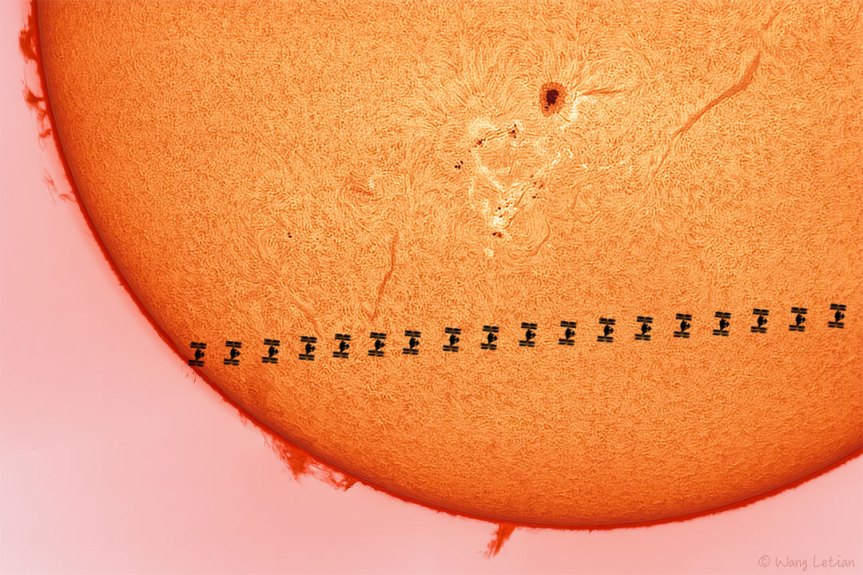
Explanation: Typically, the International Space Station is visible only at night. Slowly drifting across the night sky as it orbits the Earth, the International Space Station (ISS) can be seen as a bright spot several times a year from many locations. The ISS is then visible only just after sunset or just before sunrise because it shines by reflected sunlight — once the ISS enters the Earth’s shadow, it will drop out of sight. The only occasion when the ISS is visible during the day is when it passes right in front of the Sun. Then, it passes so quickly that only cameras taking short exposures can visually freeze the ISS’s silhouette onto the background Sun. The featured picture did exactly that — it is actually a series of images taken earlier this month from BeijingChina with perfect timing. This image series was later combined with separate images taken at nearly the same time but highlighting the texture and activity on the busy Sun. The solar activity included numerous gaseous prominences seen around the edge, highlighted in red, filaments seen against the Sun’s face, and a dark sunspot.

April 10 Astronomy Picture of the Day

Discover the cosmos! Each day a different image or photograph of our fascinating universe is featured, along with a brief explanation written by a professional astronomer.

2022 April 10

Shadows at the Moon’s South Pole

Image Credit: NASAArizona State U.Lunar Reconnaissance Orbiter

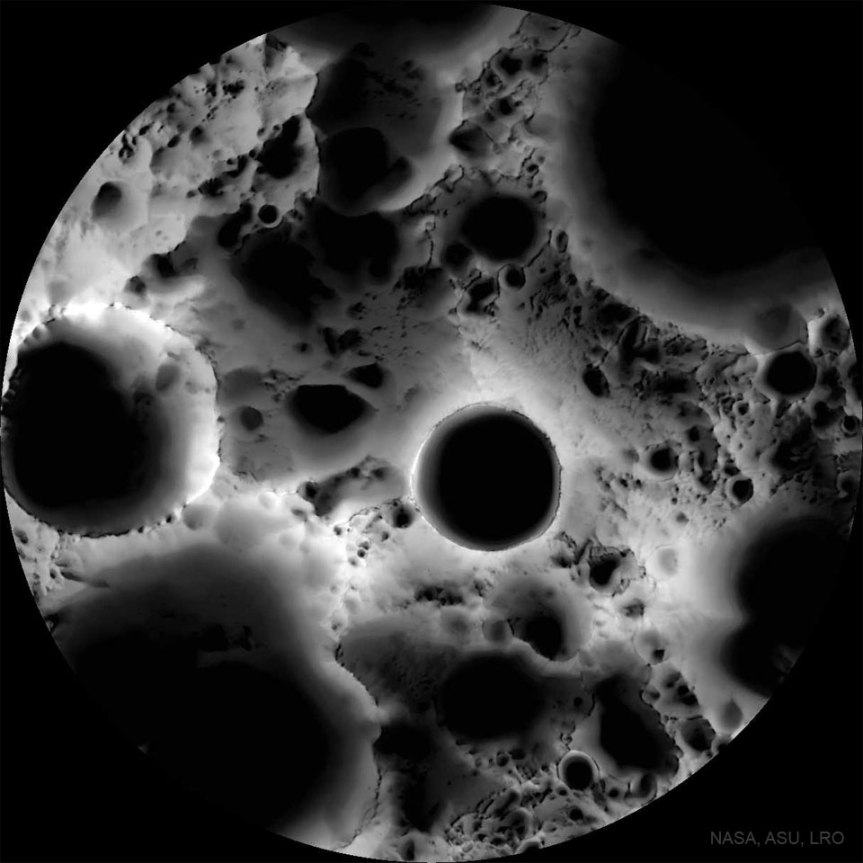
Explanation: Was this image of the Moon’s surface taken with a microscope? No — it’s a multi-temporal illumination map made with a wide-angle camera. To create it, the Lunar Reconnaissance Orbiter spacecraft collected 1,700 images over a period of 6 lunar days (6 Earth months), repeatedly covering an area centered on the Moon’s south pole from different angles. The resulting images were stacked to produce the featured map — representing the percentage of time each spot on the surface was illuminated by the Sun. Remaining convincingly in shadow, the floor of the 19-kilometer diameter Shackleton crater is seen near the map’s center. The lunar south pole itself is at about 9 o’clock on the crater’s rim. Crater floors near the lunar south and north poles can remain in permanent shadow, while mountain tops can remain in nearly continuous sunlight. Useful for future outposts, the shadowed crater floors could offer reservoirs of water-ice, while the sunlit mountain tops offer good locations to collect solar power.

April 9 Astronomy Picture of the Day

Discover the cosmos! Each day a different image or photograph of our fascinating universe is featured, along with a brief explanation written by a professional astronomer.

2022 April 9

mars_saturn

Mars-Saturn Conjunction

Image Credit & Copyright: Damian Peach

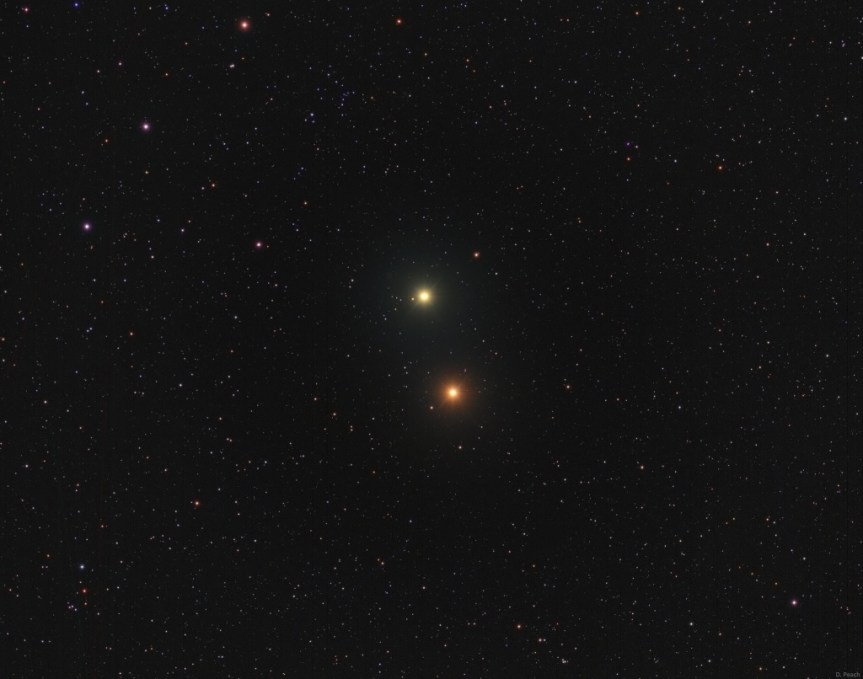
Explanation: Fainter stars in the zodiacal constellation Capricornus are scattered near the plane of the ecliptic in this field of view. The two brightest ones at center aren’t stars at all though, but the planets Mars and Saturn. Taken on the morning of April 4, the telescopic snapshot captured their tantalizing close conjunction in a predawn sky, the pair of planets separated by only about 1/3 of a degree. That’s easily less than the apparent width of a Full Moon. Can you tell which planet is which? If you guessed Mars is the redder one , you’d be right. Above Mars, slightly fainter Saturn still shines with a paler yellowish tinge in reflected sunlight. Even at the low magnification, Saturn’s largest and brightest moon Titan can be spotted hugging the planet very closely on the left.


April 8 Astronomy Picture of the Day

Discover the cosmos! Each day a different image or photograph of our fascinating universe is featured, along with a brief explanation written by a professional astronomer.

2022 April 8

Hale-Bopp: The Great Comet of 1997

Image Credit & Copyright: Stefan Seip (TWAN)

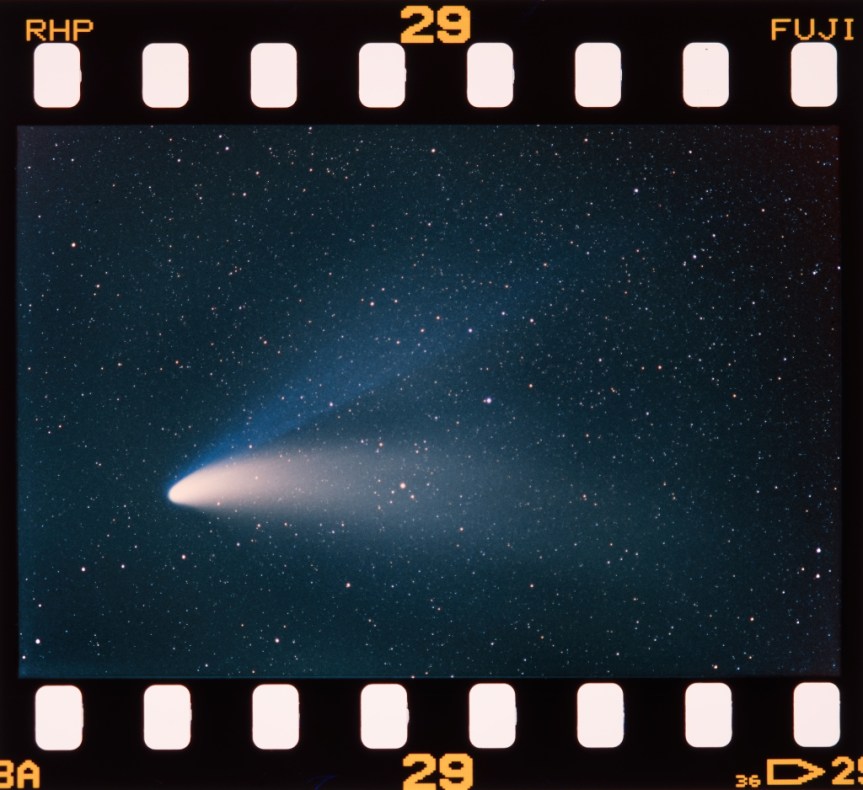
Explanation: Only twenty-five years ago, Comet Hale-Bopp rounded the Sun and offered a dazzling spectacle in planet Earth’s night skies. Digitized from the original astrophoto on 35mm color slide film, this classic image of the Great Comet of 1997 was recorded a few days after its perihelion passage on April 1, 1997. Made with a camera and telephoto lens piggy-backed on a small telescope, the 10 minute long, hand-guided exposure features the memorable tails of Hale-Bopp, a whitish dust tail and blue ion tail. Here, the ion tail extends well over ten degrees across the northern sky. In all, Hale-Bopp was reported as visible to the naked eye from late May 1996 through September 1997. Also known as C/1995 O1, Hale-Bopp is recognized as one of the most compositionally pristine comets to pass through the inner Solar System. A visitor from the distant Oort cloud, the comet’s next perihelion passage should be around the year 4380 AD. Do you remember Hale-Bopp?

April 6 Astronomy Picture of the Day

Discover the cosmos! Each day a different image or photograph of our fascinating universe is featured, along with a brief explanation written by a professional astronomer.

2022 April 6

Earendel: A Star in the Early Universe

Image Credit: NASAESAB. Welch (JHU), D. Coe (STScI); Processing: A. Pagan (STScI)

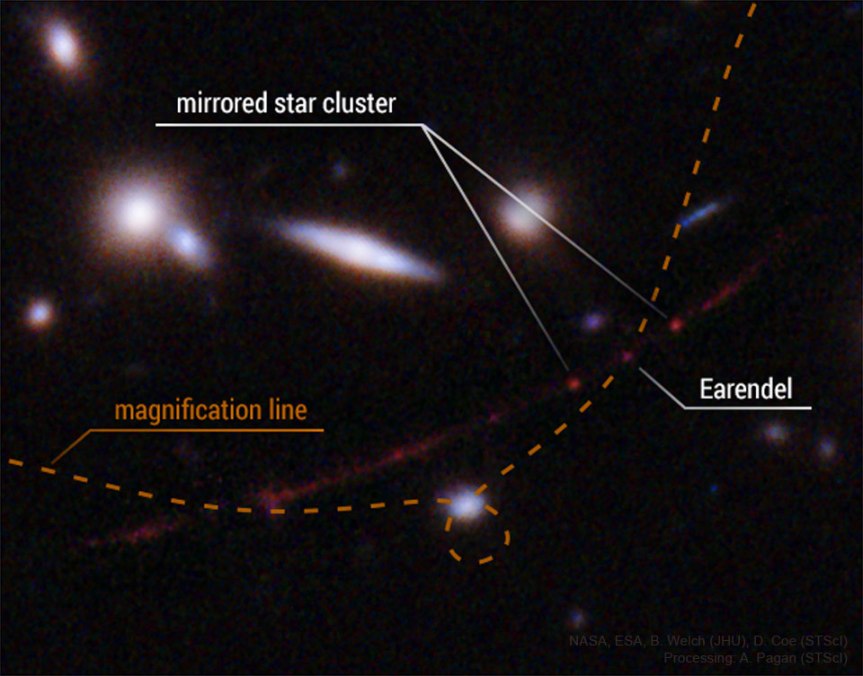
Explanation: Is Earendel the farthest star yet discovered? This scientific possibility started when the Hubble Space Telescope observed a huge cluster of galaxies. The gravitational lens effect of this cluster was seen to magnify and distort a galaxy far in the background. This distorted background galaxy — so far away it has a redshift of 6.2 — appears in the featured image as a long red string, while beads on that string are likely to be star clusters.   The galaxy cluster lens creates a line of maximum magnification line where superposed background objects may appear magnified many thousands of times. On the intersection between the galaxy line and the maximum magnification line is one “bead” which shows evidence of originating from a single bright star in the early universe — now named Earendel. Future investigations may include more imaging by Hubble to see how Earendel’s brightness varies, and, quite possibly, by the new James Webb Space Telescope when it becomes operational later this year.  Earendel’s great distance exceeds that of any known stable star — although the star that exploded creating GRB 090423 had a redshift of 8.2.

April 5 Astronomy Picture of the Day

Discover the cosmos! Each day a different image or photograph of our fascinating universe is featured, along with a brief explanation written by a professional astronomer.

2022 April 5

Seven Sisters versus California

Image Credit & Copyright: Neven Krcmarek

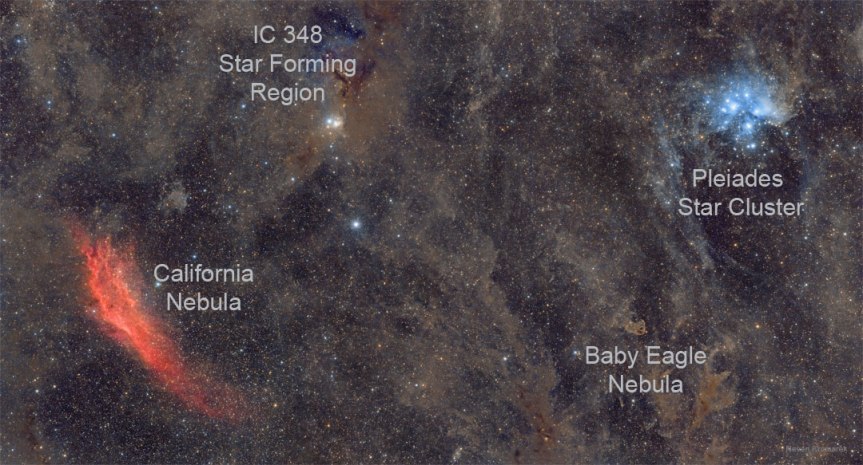
Explanation: On the upper right, dressed in blue, is the Pleiades. Also known as the Seven Sisters and M45the Pleiades is one of the brightest and most easily visible open clusters on the sky. The Pleiades contains over 3,000 stars, is about 400 light years away, and only 13 light years across. Surrounding the stars is a spectacular blue reflection nebula made of fine dustA common legend is that one of the brighter stars faded since the cluster was named. On the lower left, shining in red, is the California Nebula. Named for its shape, the California Nebula is much dimmer and hence harder to see than the Pleiades. Also known as NGC 1499, this mass of red glowing hydrogen gas is about 1,500 light years away. Although about 25 full moons could fit between them, the featured wide angle, deep field image composite has captured them both. A careful inspection of the deep image will also reveal the star forming region IC 348 and the molecular cloud LBN 777 (the Baby Eagle Nebula).

April 4 Astronomy Picture of the Day

Discover the cosmos! Each day a different image or photograph of our fascinating universe is featured, along with a brief explanation written by a professional astronomer.

2022 April 4

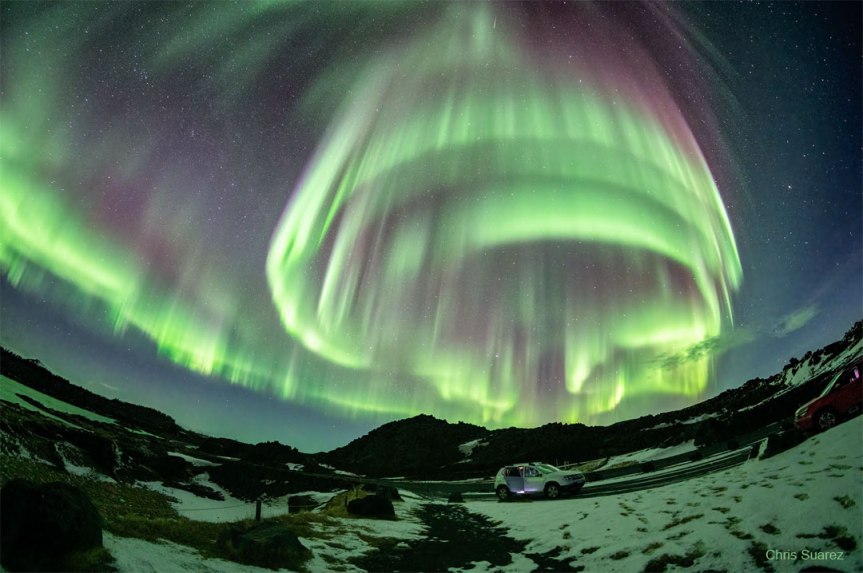
A Vortex Aurora over Iceland

Image Credit & Copyright: Christophe Suarez

Explanation: No, the car was not in danger of being vacuumed into space by the big sky vortex. For one reason, the vortex was really an aurora, and since auroras are created by particles striking the Earth from space, they do not create a vacuum. This rapidly developing auroral display was caused by a Coronal Mass Ejection from the Sun that passed by the Earth closely enough to cause a ripple in Earth’s magnetosphere. The upper red parts of the aurora occur over 250 kilometers high with its red glow created by atmospheric atomic oxygen directly energized by incoming particles. The lower green parts of the aurora occur over 100 kilometers high with its green glow created by atmospheric atomic oxygen energized indirectly by collisions with first-energized molecular nitrogen. Below 100 kilometers, there is little atomic oxygen, which is why auroras end abruptly. The concentric cylinders depict a dramatic auroral corona as seen from the side. The featured image was created from a single 3-second exposure taken in mid-March over Lake Myvatn in Iceland.


April is: Global Astronomy Month

April 3 Astronomy Picture of the Day

Discover the cosmos! Each day a different image or photograph of our fascinating universe is featured, along with a brief explanation written by a professional astronomer.

2022 April 3

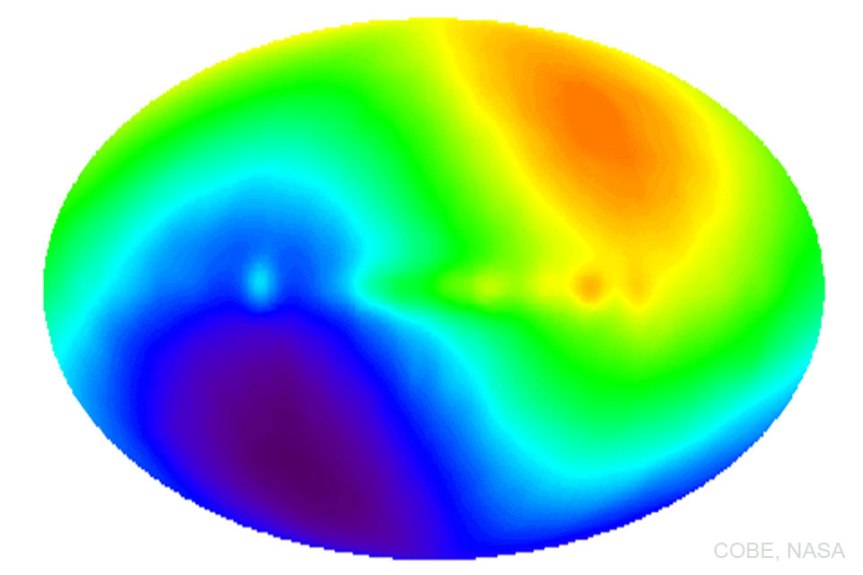
CMB Dipole: Speeding Through the Universe

Image Credit: DMRCOBENASA, Four-Year Sky Map

Explanation: Our Earth is not at rest. The Earth moves around the Sun. The Sun orbits the center of the Milky Way Galaxy. The Milky Way Galaxy orbits in the Local Group of Galaxies. The Local Group falls toward the Virgo Cluster of Galaxies. But these speeds are less than the speed that all of these objects together move relative to the cosmic microwave background radiation (CMBR). In the featured all-sky map from the COBE satellite in 1993, microwave light in the Earth’s direction of motion appears blueshifted and hence hotter, while microwave light on the opposite side of the sky is redshifted and colder. The map indicates that the Local Group moves at about 600 kilometers per second relative to this primordial radiation. This high speed was initially unexpected and its magnitude is still unexplained. Why are we moving so fastWhat is out there?

April 1 Astronomy Picture of the Day

Discover the cosmos! Each day a different image or photograph of our fascinating universe is featured, along with a brief explanation written by a professional astronomer.

2022 April 1

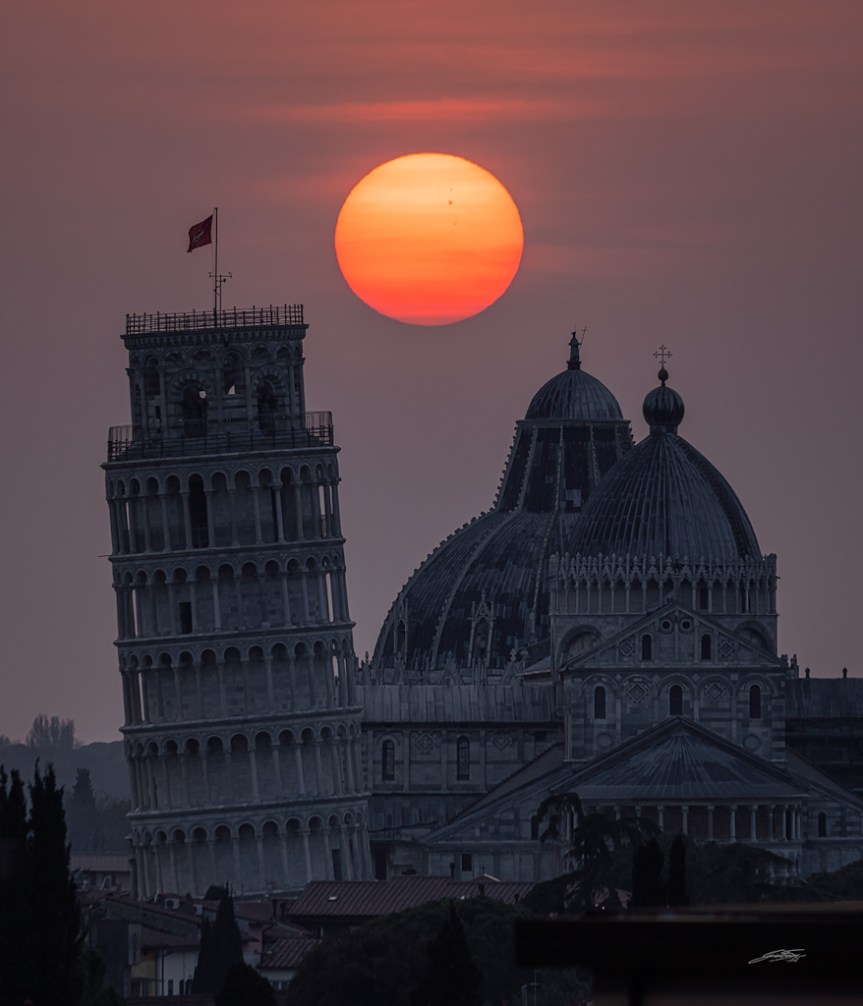
Leaning Tower, Active Sun

Image Credit & CopyrightAntonio Tartarini

Explanation: The natural filter of a hazy atmosphere offered this recognizable architecture and sunset view on March 27. Dark against the solar disk, large sunspots in solar active regions 2975 and 2976 are wedged between the Duomo of Pisa and its famous Leaning Tower. Only one day later, Sun-staring spacecraft watched active region 2975 unleash a frenzy of solar flares along with two coronal mass ejections. The largest impacted the magnetosphere on March 31 triggering a geomagnetic storm and aurorae in high-latitude night skies. On March 30, active region 2975 erupted again with a powerful X-class solar flare that caused a temporary radio blackout on planet Earth.

March 30 Astronomy Picture of the Day

Discover the cosmos! Each day a different image or photograph of our fascinating universe is featured, along with a brief explanation written by a professional astronomer.

2022 March 30

Click here to watch Animation: Odd Radio Circles

Animation: Odd Radio Circles

Credits: Illustration: Sam Moorfield; Data: CSIROHST (HUDF), ESANASA;
Image: J. English (U. Manitoba), EMUMeerKATDES (CTIO); Text: Jayanne English

Explanation: What do you call a cosmic puzzle that no one expected to see? In this case, Odd Radio Circles, aka ORCs. ORC-1 typifies the enigmatic five objects, only visible at radio frequencies, that were serendipitously discovered in 2019 using the new AustraliaSKA Pathfinder radio array. The final image in the featured video uses 2021 data from the South AfricaMeerKAT array to reveal more detail. The radio data, assigned turquoise colors, are combined with a Dark Energy Survey optical/IR map. The animated artist’s illustration explores just one idea about the ORCs’ origins. If two supermassive black holes merge in the center of a galaxy, the associated shockwaves could generate rings of radio radiation. These grow to fill the video frame. The video zooms out so the expansion the ORC can be tracked until it is about a million light-years across. Fortunately, the up-coming Square Kilometer Array can help test this and other promising scenarios.

March 29 Astronomy Picture of the Day

Discover the cosmos! Each day a different image or photograph of our fascinating universe is featured, along with a brief explanation written by a professional astronomer.

2022 March 29

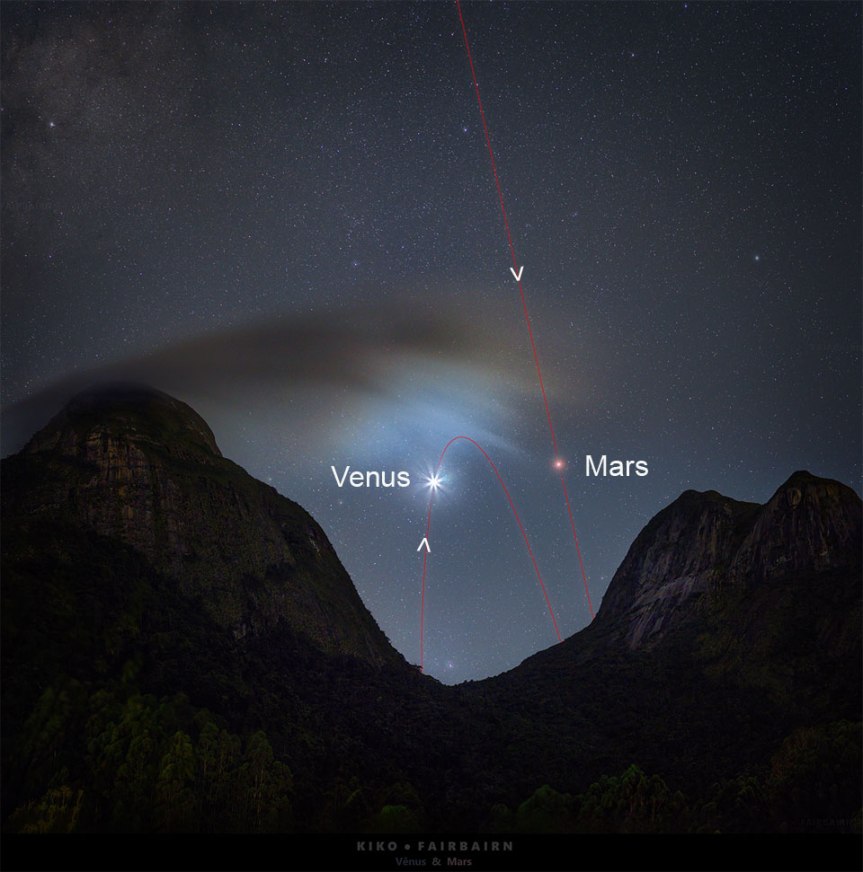
Venus and Mars: Passing in the Night

Image Credit & Copyright: Carlos Kiko Fairbairn

Explanation: When two planets pass on the night sky, they can usually be seen near each other for a week or more. In the case of this planetary conjunction, Venus and Mars passed within 4 degrees of each other earlier this month. The featured image was taken a few days prior, when Venus was slowing rising in the pre-dawn sky, night by night, while Mars was slowly setting. The image, a four-part mosaic, was captured in Brazil from the small town Teresópolis. Besides Venus and Mars, the morning sky now also includes the more distant planet Saturn. Of course, these conjunctions are only angular — Venus, Mars, and Saturn continue to orbit the Sun in very different parts of our Solar System. Next week, the angle between Saturn and Mars will drop to below a quarter of a degree.

March 28 Astronomy Picture of the Day

Discover the cosmos! Each day a different image or photograph of our fascinating universe is featured, along with a brief explanation written by a professional astronomer.

2022 March 28

Gems of a Maldivean Night

Image Credit & Copyright: Petr Horálek (ESO Photo AmbassadorInst. of Physics in Opava)

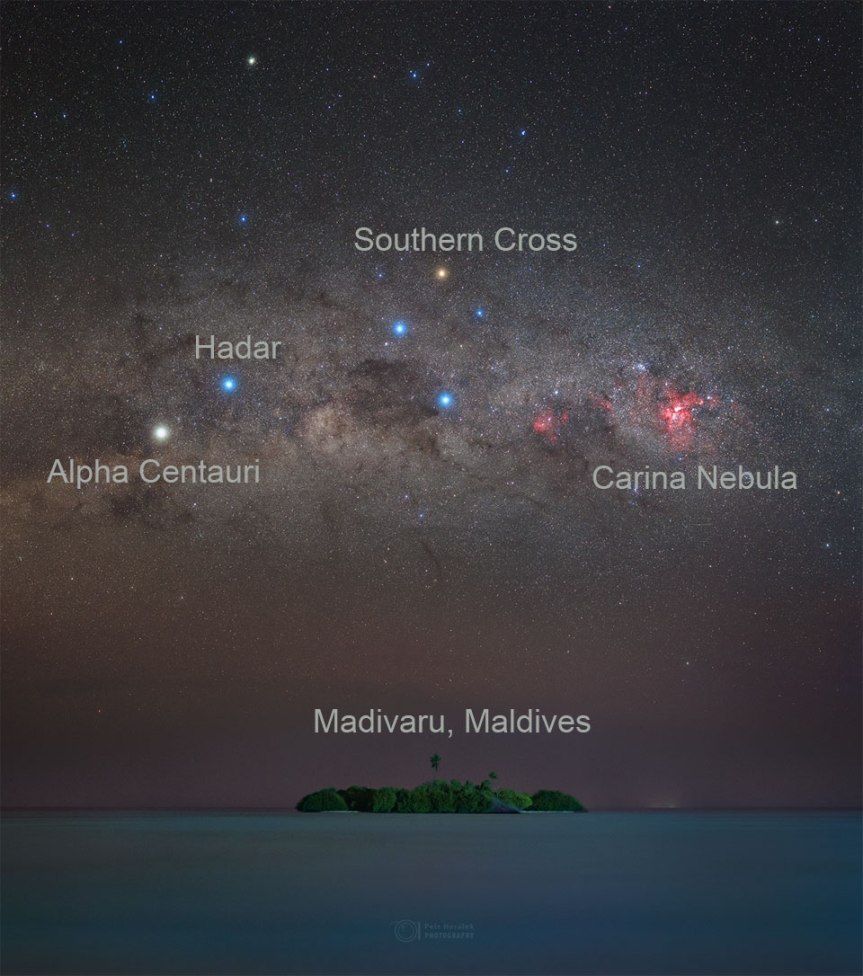
Explanation: The southernmost part of the Milky Way contains not only the stars of the Southern Cross, but the closest star system to our Sun — Alpha Centauri. The Southern Cross itself is topped by the bright, yellowish star Gamma Crucis. A line from Gamma Crucis through the blue star at the bottom of the cross, Acrux, points toward the south celestial pole, located just above the small island in the featured picture — taken in early March. That island is Madivaru of the Maldives in the Indian Ocean. Against faint Milky Way starlight, the dark Coal Sack Nebula lies just left of the cross, while farther left along the Milky Way are the bright stars Alpha Centauri (left) and Beta Centauri (Hadar). Alpha Centauri A, a Sun-like star anchoring a three-star system with exoplanets, is a mere 4.3 light-years distant. Seen from Alpha Centauri, our own Sun would be a bright yellowish star in the otherwise recognizable constellation Cassiopeia.


Almost Hyperspace: Random APOD Generator