Pagan Study of the Gods & Goddesses, Today, Adonis

Adonis

Adonis

Adonis is a seasonal life/death/rebirth God associated with Tammuz, Atunis, Baldr, Osiris, Attis and Jesus. The name means “Lord”

His feast day is the Adonia and was celebrated in what is now August. Young women mourn him on this day and plant seeds of quick blooming, short lived flowers in his honor.

Conception and Birth
King Theias (or Cinyras) of Syria (or Smyrna) had a daughter named Myrrha (or Smyrna if you prefer). She was quite lovely and he bragged that she was lovelier even than Aphrodite. Aphrodite decided that a man who was so enamored by a girl’s beauty, certainly deserved her love, and caused poor Myrrha to fall madly in love with her own father.

Of course, she was horrified at the thought that she should be feeling this way about her father and did her very best to ignore her feelings. But this only made things worse. She swooned at his smile and shuddered at his touch. She woke sweating in the night from dreams of him and then sobbed at the shame of it. She became depressed, spoke little and ate less. Her nurse, who had served her since birth could tell that something was wrong and pressed the girl until she finally revealed her horrible secret.

At first her nurse urged her to continue to suppress her feelings and tried to treat her with sleeping droughts and appetite stimulants and by diverting her attention with entertaining games, outings and stories. She even attempted to arouse her interest in other men, but to no avail. Myrrha was pining, and she was wasting away. Her nurse was certain she would die if something wasn’t done soon.

On a certain evening, when Myrrha’s mother had gone to celebrate the festival of Demeter, the nurse noticed the King was quite drunk. She led him to bed, and then led Myrrha to his side. Myrrha lay by her father in the darkness and they knew a night of passion like none known since. He was enamored, and begged to know who she was, but she would not tell him and promised to return only when it was quite dark. He agreed, and she returned night after night under cover of darkness.

One night, after they had made love she fell asleep. He lit a lamp and held it up and was horrified to see his own daughter laying naked beside him! He bellowed his rage and went for his sword, determined to kill her, but she fled outside and Aphrodite, took pity on her and turned her into a tree before he could reach her. Myrrha’s pain was so great, having lost her father’s love and her lover and having given in to shameful temptation that even as a tree, the girl wept sweet smelling resin that came to be known as Myrrh.

Sometime later, a boar came by and rubbed its tusks on the tree, causing it to split and the young Adonis emerged. Fearful that his father/grandfather would certainly kill him if he discovered him, Aphrodite scooped him up and took him to the underworld and asked its Queen, Persephone, to look after him.

Adonis grew in beauty and strength and both Goddesses fell in love with him. When Aphrodite wanted him back, Persephone refused and she kept him as her own lover in the Underworld.

Calliope, the muse of epic poetry, settled the argument, giving each Goddess his custody for one third of the year, and granting him a third of the year to himself. He chose, however, to stay with Aphrodite during that third.

Death
Aphrodite warned Adonis to stay by her side, but the boy loved to hunt and inevitably, he went out into the forest alone one day. Discovering his absence, Aphrodite rushed to his side, but too late. He lay dying having been gored in the groin by a boar. She arrived in time to catch his last breath. She sprinkled him with nectar, and red anemones sprang up where his blood stained the ground. For the first time, Aphrodite wished she wasn’t mortal, and cried out her lament to the skies that she could join Adonis in the underworld, but she knew it could not be.

Reference

Witchipedia

Adonis

Greek mythology

Adonis, in Greek mythology, a youth of remarkable beauty, the favourite of the goddess Aphrodite (identified with Venus by the Romans). Traditionally, he was the product of the incestuous love Smyrna (Myrrha) entertained for her own father, the Syrian king Theias. Charmed by his beauty, Aphrodite put the newborn infant Adonis in a box and handed him over to the care of Persephone, the queen of the underworld, who afterward refused to give him up. An appeal was made to Zeus, the king of the gods, who decided that Adonis should spend a third of the year with Persephone and a third with Aphrodite, the remaining third being at his own disposal. A better-known story, hinted at in Euripides’ Hippolytus, is that Artemis avenged her favourite, Hippolytus, by causing the death of Adonis, who, being a hunter, ventured into her domain and was killed by a wild boar. Aphrodite pleaded for his life with Zeus, who allowed Adonis to spend half of each year with her and half in the underworld.

The central idea of the myth is that of the death and resurrection of Adonis, which represent the decay of nature every winter and its revival in spring. He is thus viewed by modern scholars as having originated as an ancient spirit of vegetation. Annual festivals called Adonia were held at Byblos and elsewhere to commemorate Adonis for the purpose of promoting the growth of vegetation and the falling of rain. The name Adonis is believed to be of Phoenician origin (from ʾadōn, “lord”), Adonis himself being identified with the Babylonian god Tammuz. Shakespeare’s poem Venus and Adonis (1593) is based on Ovid’s Metamorphoses, Book X.

Written By:

The Editors of Encyclopaedia Britannica

Adonis

A tale as old as time


The myth of Adonis, a tale as old as time, is a legendary love story that combines tragedy and death on the one hand, and the joy of coming back to life on the other. The story of the impossibly handsome Adonis and his lover the goddess Aphrodite originally dates back to the ancient civilizations of the Near East. It was popular among the Canaanites, and very well-known to the people of Mesopotamia and Egypt as well, though referred to by different names in each civilization. It is the legend of the god of beauty who faced death when he was young, but came back to life for the sake of his beloved Aphrodite. The myth has been a source of great inspiration for many poets, artists and historians alike, leading to its widespread use as a major theme in literary and intellectual productions.

From The Canaanite Adon To The Greek Adonis

The god Adon was considered one of the most important Canaanite gods: he was the god of beauty, fertility and permanent renewal. The name itself, “Adon”, means “The Lord” in Canaanite. In Greek mythology and the Hellenic world generally, he was called Adonis, and became known by that name among those nations. Other adaptations of Adon in various civilizations include the Canaanite god Baal who was worshiped in Ugarit, and Tammuz or Dumuzi (meaning July) as he was known to the Babylonians. In Egypt, he was Osiris, the god of resurrection.

In addition to the god Adonis, the myth involves his everlasting mistress Astarte, the goddess of love and beauty. She was known as Aphrodite to the Greeks, and Venus to the Romans. Their stories were so intertwined that Adonis’ myth would be incomplete without mentioning Astarte and the legendary love story that brought them together.

When Aphrodite saw Adonis she was so amazed by his beauty that she decided to hide him from the rest of the goddesses.

The role that Cyprus played in transferring the myth of Adonis and Astarte from the Canaanite regions to the Greeks – and from the latter to the Romans – is a very significant one. However, perhaps due to the lack of Mesopotamian and Canaanite sources written about this legend (and often the ambiguity of such sources), the late Greek writings are the main references for this tale of eternal love. Hence, the myth is most popularly known as that of Adonis and Aphrodite, rather than Adon and Astarte.

Adonis in Greek Mythology

Based on the different Greek sources (such as Bion of Smyrna) and the other Roman references (like Ovid’s Metamorphoses) a general consensus on the story of Adonis and Aphrodite is as follows:

A great king called Cinyras (in some sources known as Theias, the king of Assyria) had a daughter named Myrrha, who was very beautiful. The king used to boast about his daughter being more beautiful than Aphrodite, the goddess of love and beauty. When Aphrodite heard of this, she became angry and decided to retaliate. She used her son Eros, the god of desire and attraction, to make Myrrha fall in love with her father, and even deceived him into committing incest. When Cinyras discovered the trick, he swore to kill Myrrha, who in turn escaped from her father after realizing she was pregnant. Myrrha was ashamed and regretful of her heinous act, and pleaded to the gods to protect her. They answered her prayers by turning her into a Myrrh tree.

Nine months later, the Myrrh tree split off, and Adonis was born; he had inherited the beauty of his mother. When Aphrodite saw the boy, she was so amazed by his beauty that she decided to hide him from the rest of the goddesses, and entrusted him to Persephone, goddess of the underworld. Persephone began looking after the boy, and when he grew older and became more and more attractive, she fell in love with him.

A conflict then rose between Aphrodite and Persephone, who refused to give Adonis back to Aphrodite. Zeus, the king of the gods, intervened and ruled that Adonis to spend four months of the year with Persephone in Hades, the Underworld, then four months with Aphrodite, and the remaining four months however he wished. Because Adonis was so taken with the charm of Aphrodite, he devoted his free four months to her as well.

Adonis was well-known for his hunting skills, and in one of the hunting journeys in the Afqa Forest (near Byblos), Adonis was attacked by a wild boar and began bleeding in the hands of Aphrodite, who poured her magical nectar on his wounds. Although Adonis died, the blood blended with the nectar and flowed onto the soil where a flower sprouted from the ground, its scent the same as Aphrodite’s nectar, and its color that of Adonis’ blood – the Anemone flower. The blood reached the river and colored the water red, and the river became known as the “Adonis River” (currently known as Nahr Ibrahim or River Abraham), which is located in the Lebanese village of Afqa.

Worship of Adonis

Byblos was one of the main places in the ancient world that used to observe the rituals of Adonis, and actually brought back the practice of these ceremonies and rites well into the early centuries of Christianity. The writings of Lucian of Samosata in the second century CE played a major role in shedding light on the rituals that were widely practiced by the people of Byblos. His book On The Syrian Goddess (De Dea Syria) recounts his visit to the village Afqa, where he explains what he encountered.

According to Lucian, the people of Byblos believed the wild boar incident that befell Adonis happened in their country. To commemorate this event, they would smite themselves each year, mourn, and celebrate religious rituals and orgies while a great mourning prevailed over the entire country. When their beating and bewailing stopped, they would celebrate the funeral of Adonis, as if he had died, and then the next day announce that he had returned to life and was sent to heaven.

Another one of the Byblos region’s marvels is the river that runs from Mount Lebanon and flows into the sea. The River Adonis is said to lose its color every year and take on a bloody red hue, pouring into the sea and dyeing a large part of the beach red – a sign to the people of Byblos to start their time of mourning. It is believed that at this time of year, Adonis was wounded in Lebanon, and his blood went to the riverbed. One of the reasons given by Lucian – as told to him by one of Byblos’ wise men – explaining why the river turns red at this time of the year is the strong wind blowing soil into the river. The soil of Lebanon (and of this region particularly) is known for its red color, which, when mixed with the river water, turns it purple.

The Immortal Myth

The popularity of the story of Adonis and his mistress Aphrodite led to a revival of its rituals in many other Phoenician cities as well. It also spread across to the ancient Greek and Roman worlds, but with minor differences in adaptation, depending on the characteristics and features of each civilization. The essence of the legend, however, remains intact across all adaptations: a god of beauty and youth and his relationship with the goddess of love, along with the young god’s death and return to life being a metaphor of nature’s annual rebirth.

The myth of Adonis is closely related to the concept of vegetation and agricultural civilizations, such as Mesopotamia or the Canaanite areas (as the story originated in the Near East). The winter was a season of gloom and sadness for the inhabitants of these areas, whereas the spring and summer brought them the joy of new life. This myth is commonly believed to be an expression of its people’s thinking, reflections, and psychological perceptions.

Remnants of Adonis worship are still present in this day and age among some nations of the Levant, Mesopotamia, and even Persia/Iran, where it is manifested as part of spring folklore celebrations, like the Feast of Nauroz.


References:

APA Style

Azar, E. N. (2016, February 21). Adonis. Ancient History Encyclopedia. Retrieved from https://www.ancient.eu/Adonis/
Chicago Style

Azar, Elias N. “Adonis.” Ancient History Encyclopedia. Last modified February 21, 2016. https://www.ancient.eu/Adonis/.
MLA Style

Azar, Elias N. “Adonis.” Ancient History Encyclopedia. Ancient History Encyclopedia, 21 Feb 2016. Web. 16 Mar 2018.
License
Written by Elias N. Azar, published on 21 February 2016 under the following license: Creative Commons: Attribution-NonCommercial-ShareAlike. This license lets others remix, tweak, and build upon this content non-commercially, as long as they credit the author and license their new creations under the identical terms.
La Fin

The Pagan Study of the Gods & Goddesses for March 14th – Ares

Ares

Ares

Greek God of War

Ares is the god of war, one of the Twelve OLYMPIAN GODS and the son of ZEUS and HERA. In literature Ares represents the violent and physical untamed aspect of war, which is in contrast to ATHENA who represents military strategy and generalship as the goddess of intelligence.

Although Ares embodied the physical aggression necessary for success in war, the Greeks were ambivalent toward him because he was a dangerous, overwhelming force that was insatiable in battle.

He is well known as the lover of APHRODITE, who was married to HEPHAESTUS, and though Ares plays a limited role in literature, when he does appear in myths it is typically facing humiliation. For example, one famous story of Ares and Aphrodite exposes them to ridicule by the gods when her husband Hephaestus trapped them both naked in a bed using a clever device he made.

The ROMAN COUNTERPART to Ares was MARS, who was known as a FATHER TO THE ROMAN PEOPLE. Because of this, he was a less aggressive and physical form, revealing a more calm and understanding demeanour.

Facts about Ares
Ares was most notably referred to as the God of War; he represented the unpleasant aspects of battle.
He was the son of Zeus and Hera, both of whom hated him (according to Homer).
Ares was most often characterized as a coward in spite of his connection to war; he responded to even the slightest injury with outrage.
According to some sources, Ares was described as Aphrodite’s lover and was held in contempt by her husband, Hephaestus. The affair between them was not a secret among the Olympians.
Ares was never very popular—either with men or the other immortals. As a result, his worship in Greece was not substantial or widespread.
He came from Thrace, home of a fierce people in the northeast of Greece.
His bird was the vulture.
The Amazons, warrior women, were his daughters. Their mother was a peace-loving nymph named Harmony.
Otus and Ephialtes, twin giants, imprisoned Ares for a lunar year by binding him with chains of brass; he was eventually rescued by Hermes.
Ares always took the side of Aphrodite in the Trojan War. He fought for Hector (a Trojan) until a Greek warrior pierced him with a spear that was guided by Athena. He then departed the battlefield in order to complain to Zeus about Athena’s violence.
Harmonia, Goddess of Harmony, was the daughter of Ares and Aphrodite.
Eros (more commonly known as Cupid) was also the child of Ares and Aphrodite.
Tereus, a son of Ares, was known to have inherited his father’s abhorrent qualities.
Ares was the biological father of at least three of Hercules’ enemies: Cycnus, Lycaon, and Diomedes.
Ares had a sister named Eris, who was the Goddess of Discord.
Hebe, another sister of his, was the Goddess of Youth.
Ares rarely figures into mythology stories, but when he does, he usually suffers some form of humiliation.
Ares was associated with two other war deities: Enyalius and Enyo.
Ares had many offspring, which is characteristic of nearly all of the notable Greek gods. He conceived more mortal children than divine children.
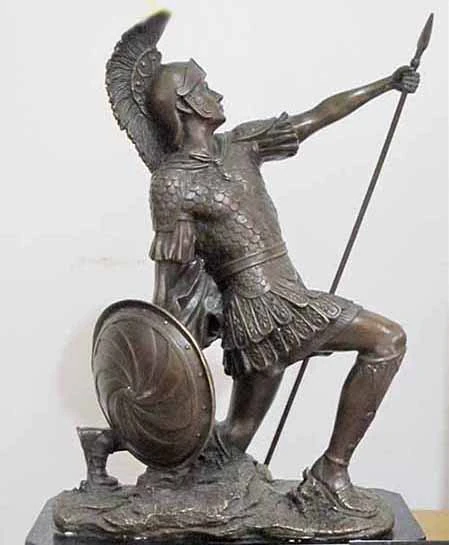
In art, Ares is generally depicted wearing a spear and a helmet.

 – Greek Gods & Goddesses, September 19, 2014

Ares

Ares was the god of war, and son of Zeus and Hera. He represented the raw violence and untamed acts that occured in wartime, in contrast to Athena, who was a symbol of tactical strategy and military planning.

What side of the Trojan War was Ares on?

He was disliked by both his parents. Whenever Ares appeared in a myth, he was depicted as a violent personality, who faced humiliation through his defeats more than once. In the Iliad, it is mentioned that Zeus hated him more than anyone else; Ares was also on the losing side of the Trojan War, favouring the Trojans.

He was the lover of his sister, Aphrodite, who was married to Hephaestus. When the latter found out about the affair, he devised a plan and managed to humiliate both of them. The union of Ares and Aphrodite resulted in the birth of eight children, including Eros, god of love.

Ares temples

There were few temples attributed to Ares in Ancient Greece. Sacrifices would usually be made to him when an army would march to war; Spartans would make sacrifices to Enyalius, another lesser god and son of Ares and Enyo. However, the name was also used as a byname for Ares.

Who were Ares companions?

When Ares went to war, he was followed by his companions, Deimos (terror) and Phobos (fear), who were the product of his union with Aphrodite. Eris, goddess of discord and sister of Deimos and Phobos, often accompanied them in war.

Reference

Greek Mythology

Ares


Ares was the Greek god of war and perhaps the most unpopular of all the Olympian gods because of his quick temper, aggressiveness, and unquenchable thirst for conflict. He famously seduced Aphrodite, unsuccessfully fought with Hercules, and enraged Poseidon by killing his son Halirrhothios. One of the more human Olympian gods, he was a popular subject in Greek art and even more so in Roman times when he took on a much more serious aspect as Mars, the Roman god of war.

FAMILY RELATIONS
Son of Zeus and Hera, Ares’ sisters were Hebe and Eileithyia. Despite being a god, the Greeks considered him from Thrace, perhaps in an attempt to associate him with what they thought of as foreign and war-loving peoples, wholly different from themselves. Ares had various children with different partners, several of whom were unfortunate enough to come up against Hercules when he performed his celebrated twelve labours. Ares’ daughter Hippolyta, the Amazon queen, lost her girdle to Hercules; his son Eurytion lost his cattle; and Diomedes had his horses stolen by the Greek hero. The courageous but warlike Amazons were also thought to be descendants of Ares.

Ares was noted for his beauty and courage, qualities which no doubt helped him win the affections of Aphrodite (even though she was married to Hephaistos) with whom he had a daughter, Harmonia, and the god of love and desire Eros. Hephaistos managed to entrap the lovers in an ingenious bed, and the tale is told in some detail in Book 8 of Homer’s Odyssey. Once caught, the punishment for Ares’ indiscretion was temporary banishment from Mount Olympus.

Described by Hesiod in his Theogony as ‘shield-piercing Ares’ and ‘city-sacking Ares,’ the god represented the more brutal and bloody side of battle, which was in contrast to Athena who represented the more strategic elements of warfare. In stories from Greek mythology, Ares was usually to be found in the company of his other children with Aphrodite, Phobos (Fear) and Deimos (Terror), with his sister Eris (Strife), and with his charioteer Ennyo.

BATTLE WITH HERCULES
The most popular myth involving Ares was his fight with Hercules. Ares’ son Kyknos was infamous for waylaying pilgrims on their way to the oracle at Delphi, and so earned the displeasure of Apollo, who sent Hercules to deal with him. Hercules killed Kyknos, and a furious Ares engaged the hero in a fight. However, Hercules was protected from harm by Athena and even managed to wound Ares. Another myth and ignominious episode for Ares was his capture by the twin Giants Ephialtes and Otus when they stormed Mount Olympus. They imprisoned the god in a bronze jar (or cauldron) for one year and he was only freed through the intervention of Hermes.

THE TROJAN WAR
In Homer’s version of the Trojan War in the Iliad, Ares supports the Trojans, sometimes even leading them in battle along with Hector. The Iliad shows Ares in a less than positive light, and he is described as ‘hateful Ares,’ ‘the man-killer,’ ‘the war-glutton,’ and the ‘curse of men.’ Homer’s picture of Ares, like the above mythological tales, often demonstrates his weakness in comparison to the other gods. Ares is roundly beaten by Athena who, supporting the Achaeans, knocks him out with a large rock. He also comes off worse against the Achaean hero Diomedes who even manages to injure the god with his spear, albeit with the help of Athena. Homer describes the scream of the wounded Ares as like the shouts of 10,000 men. Fleeing back to Olympus, Zeus ignores the complaints of Ares but instructs Paieon to heal his wound.

ATHENS & CULT
Ares again upset the harmony of Olympus when he was accused of killing Poseidon’s son Halirrhothios near a stream below the Athenian acropolis. A special court was convened – the Areopagos – on a hill near the stream, to hear the case. Ares was acquitted as it was disclosed Halirrhothios had raped Ares’ daughter Alcippe. Thereafter in Athens, the Areopagus became the place of trial for cases involving murder and impiety.

Perhaps unsurprisingly, considering the city’s strong militaristic culture, Ares was greatly esteemed in Sparta. Ares was not commonly worshipped but there were cult sites with temples dedicated to the god on Crete (he is mentioned in Linear B tablets from Knossos) and at Argos, Athens, Erythrae, Geronthrae, Megalopolis, Tegea, Therapne, and Troezon. He also had a cult in Thrace and was popular among the Colchians on the Black Sea.

REPRESENTATION IN ART
In ancient Greek Archaic and Classical art, Ares is most often depicted wearing full armour and helmet and carrying a shield and spear. In this respect, he may appear indistinguishable from any other armed warrior. Sometimes he is shown riding his chariot pulled by fire-breathing horses. The myth of Ares’ battle with Hercules was a popular subject for Attic vases in the 6th century BCE.

In later times, the Roman god Mars was given many of the attributes of Ares, although, as was typical of the Roman view of the gods, with less human qualities. In Roman mythology, Mars was also the father of Romulus and Remus (through the rape of the Vestal Virgin Rhea Silvia), the legendary founders of Rome, and, therefore, the city achieved a sacred status. Like Athena for Athens, Mars was also the patron god of the Roman capital and the month martius (March) was named after him.

ABOUT THE AUTHOR
Mark Cartwright
Mark’s special interests include ancient ceramics, architecture, and mythology. He loves visiting and reading about historic sites and transforming that experience into free articles accessible to all.

Ancient History

BALDER ODINSEN (Norse)

THE COMMENTARY GAZETTE


How Balder, the good and beautiful god, was done to death by a stroke of the mistletoe

A deity whose life might in a sense be said to be neither in heaven nor on earth but between the two, was the Norse Balder, the good and beautiful god, the son of the great god Odin, and himself the wisest, mildest, best beloved of all the immortals. The story of his death, as it is told in the younger or prose “Edda”, runs thus. Once on a time Balder dreamed heavy dreams which seemed to forebode his death.

Thereupon the gods held a council and resolved to make him secure against every danger. So the goddess Frigg took an oath from fire and water, iron and all metals, stones and earth, from trees, sicknesses and poisons, and from all four-footed beasts, birds, and creeping things, that they would not hurt Balder. When this was done Balder was deemed invulnerable; so the gods amused themselves by setting him in their midst, while some shot at him, others hewed at him, and others threw stones at him. But whatever they did, nothing could hurt him; and at this they were all glad. Only Loki, the mischief-maker, was displeased, and he went in the guise of an old woman to Frigg, who told him that the weapons of the gods could not wound Balder, since she had made them all swear not to hurt him. Then Loki asked, “Have all things sworn to spare Balder?” She answered, “East of Walhalla grows a plant called mistletoe; it seemed to me too young to swear.” So Loki went and pulled the mistletoe and took it to the assembly of the gods. There he found the blind god Hother standing at the outside of the circle. Loki asked him, “Why do you not shoot at Balder?” Hother answered, “Because I do not see where he stands; besides I have no weapon.” Then said Loki, “Do like the rest and shew Balder honour, as they all do. I will shew you where he stands, and do you shoot at him with this twig.” Hother took the mistletoe and threw it at Balder, as Loki directed him….Read More

The Study of Pagan Gods & Goddesses for Monday, March 12


Horae

In Greek mythology the Horae (/ˈhɔːr/) or Horai (/ˈhɔːr/) or Hours (Greek: ὯραιHōraipronounced [hɔ̂ːraj], “Seasons”) were the goddesses of the seasons and the natural portions of time.


They were originally the personifications of nature in its different seasonal aspects, but in later times they were regarded as goddesses of order in general and natural justice. “They bring and bestow ripeness, they come and go in accordance with the firm law of the periodicities of nature and of life”, Karl Kerenyi observed: “Hora means ‘the correct moment’.”  Traditionally, they guarded the gates of Olympus, promoted the fertility of the earth, and rallied the stars and constellations. The course of the seasons was also symbolically described as the dance of the Horae, and they were accordingly given the attributes of spring flowers, fragrance and graceful freshness. For example, in Hesiod’s Works and Days, the fair-haired Horai, together with the Charites and Peitho crown Pandora—she of “all gifts”—with garlands of flowers. Similarly Aphrodite, emerging from the sea and coming ashore at Cyprus, is dressed and adorned by the Horai, and, according to a surviving fragment of the epic Cypria,Aphrodite wore clothing made for her by the Charites and Horai, dyed with spring flowers, such as the Horai themselves wear.


The earliest written mention of Horai is in the Iliad where they appear as keepers of Zeus’s cloud gates. “Hardly any traces of that function are found in the subsequent tradition,” Karl Galinsky remarked in passing. They were daughters of Zeus and Themis, half-sisters to the Moirai.

The Horai are mentioned in two aspects in Hesiod and the Homeric Hymns:

  • in one variant emphasizing their fruitful aspect, Thallo, Auxo, and Carpo—the goddesses of the three seasons the Greeks recognized: spring, summer and autumn—were worshipped primarily amongst rural farmers throughout Greece;
  • in the other variant, emphasising the “right order” aspect of the Horai, Hesiod says that Zeus wedded “bright Themis” who bore Diké, Eunomia, and Eirene, who were law-and-order goddesses that maintained the stability of society; they were worshipped primarily in the cities of Athens, Argos and Olympia.

First triad

Of the first, more familiar, triad associated with Aphrodite and Zeus is their origins as emblems of times of life, growth (and the classical three seasons of year):

First triad

  • Thallo (Θαλλώ, literally “The one who brings blossoms”; or Flora for Romans) or Thalatte was the goddess of spring, buds and blooms, a protector of youth.
  • Auxo (Αὐξώ. “Increaser” as in plant growth) or Auxesia was worshipped (alongside Hegemone) in Athens as one of their two Charites, Auxo was the Charis of spring and Hegemone was the Charis of autumn. One of the Horae, and the goddess and personification of the season of summer; she is the protector of vegetation and plants, and growth and fertility.
  • Carpo (Καρπώ), Carpho or Xarpo was the one who brings food (though Robert Graves in The Greek Myths (1955) translates this name as “withering”) and was in charge of autumn, ripening, and harvesting, as well as guarding the way to Mount Olympus and letting back the clouds surrounding the mountain if one of the gods left. She was an attendant to Persephone, Aphrodite and Hera, and was also associated with Dionysus, Apollo and Pan.

At Athens, two Horae; Thallo (the Hora of spring) and Carpo (the Hora of autumn), also appear in rites of Attica noted by Pausanias in the 2nd century AD. Thallo, Auxo and Carpo are often accompanied by Chione, a daughter of Boreas (the god/personification of the North Wind) and Orithyia/Oreithyia (originally a mortal princess, who was later deifyied as a goddess of cold mountain winds), and the goddess/personification of snow and winter. Along with Chione, Thallo, Auxo and Carpo were a part of the entourage of the goddess of the turn of the seasons, Persephone.

Second triad

Of the second triad associated to Themis and Zeus for law and order:

  • Diké (Δίκη, “Justice”; Iustitia for Romans) was the goddess of moral justice: she ruled over human justice, as her mother Themis ruled over divine justice. The anthropomorphisation of Diké as an ever-young woman dwelling in the cities of men was so ancient and strong that in the 3rd century BCE Aratus in Phaenomena 96 asserted that she was born a mortal and that, though Zeus placed her on earth to keep mankind just, he quickly learned this was impossible and placed her next to him on Olympus, as the Greek astronomical/astrological constellation The Maiden.
  • Eunomia (Εὐνομία, “Order”, governance according to good laws) was the goddess of law and legislation. The same or a different goddess may have been a daughter of Hermes and Aphrodite.
  • Eirene or Irene (Εἰρήνη. “Peace”; the Roman equivalent was Pax), was the personification of peace and wealth, and was depicted in art as a beautiful young woman carrying a cornucopia, scepter and a torch or rhyton.

Third triad

Hyginus (Fabulae 183) identifies a third set of Horae:

  • Pherusa (Substance, farm estates),
  • Euporie or Euporia (Abundance), and
  • Orthosie or Orthosia (Prosperity).

The Four Seasons

Nonnus in his Dionysiaca mentions a distinct set of four Horae, the daughters of Helios. Quintus Smyrnaeus also attributes the Horae as the daughters of Helios and Selene, and describes them as the four handmaidens of Hera. The Greek words for the four seasons of year:

  • Eiar (Spring),
  • Theros (Summer),
  • Phthinoporon (Autumn), and
  • Cheimon (Winter).

The Hours

Finally, a quite separate suite of Horae personified the twelve hours (originally only ten), as tutelary goddesses of the times of day. The hours run from just before sunrise to just after sunset, thus winter hours are short, summer hours are long:

The nine Hours

According to Hyginus, the list is only of nine, borrowed from the three classical triads alternated:

  • Auco, or perhaps Auxo (Growth, from the 1st triad),
  • Eunomia (Order, from the 2nd triad),
  • Pherusa (Substance, from the 3rd triad),
  • Carpo (Fruit, from the 1st triad),
  • Diké (Justice, from the 2nd triad),
  • Euporie or Euporia (Abundance, from the 3rd triad),
  • Eirene or Irene (Peace, from the 2nd triad),
  • Orthosie or Orthosia (Prosperity, from the 3rd triad) and
  • Thallo (Flora, from the 1st triad).

The ten or twelve Hours

This last distinct set of ten or twelve Hours is much less known:

  • Auge, first light (initially not part of the set),
  • Anatolê or Anatolia, sunrise,
  • Mousikê or Musica, the morning hour of music and study,
  • GymnastikêGymnastica or Gymnasia, the morning hour of education, training, gymnastics/exercise,
  • Nymphê or Nympha, the morning hour of ablutions (bathing, washing),
  • Mesembria, noon,
  • Sponde, libations poured after lunch,
  • Elete, prayer, the first of the afternoon work hours,
  • AktêActe or Cypris, eating and pleasure, the second of the afternoon work hours,
  • Hesperis, end of the afternoon work hours, start of evening,
  • Dysis, sunset,
  • Arktos or Arctus, night sky, constellation (initially not part of the set).


Horae

Horae(Ὧραι), originally the personifications or goddesses of the order of nature and of the seasons, but in later times they were regarded as the goddesses of order in general and of justice. In Homer, who neither mentions their parents nor their number, they are the Olympian divinities of the weather and the ministers of Zeus; and in this capacity they guard the doors of Olympus, and promote the fertility of the earth, by the various kinds of weather they send down. As the weather, generally speaking, is regulated according to the seasons, they are further described as the goddesses of the seasons, i. e. the regular phases under which Nature manifests herself.  They are kind and benevolent, bringing to gods and men many things that are good and desirable. As, however, Zeus has the power of gathering and dispersing the clouds, they are in reality only his ministers, and sometimes also those of Hera.  Men in different circumstances regard the course of time (or the seasons) either as rapid or as slow, and both epithets are accordingly applied to the Horae. The course of the seasons (or hours) is symbolically described by the dance of the Horae; and, in conjunction with the Charites, Hebe, Harmonia, and Aphrodite, they accompany the songs of the Muses, and Apollo’s play on the lyre, with their dancing. The Homeric notions continued to be entertained for a long time afterwards, the Horae being considered as the givers of the various seasons of the year, especially of spring and autumn, i. e. of Nature in her bloom and maturity. At Athens two Horae, Thallo (the Hora of spring) and Carpo (the Hora of autumn), were worshipped from very early ties. The Hora of spring accompanies Persephone every year on her ascent from the lower world; and the expression of The chamber of the Horae opens ” is equivalent to ” The spring is coining.”  The attributes of spring-flowers, fragrance, and graceful freshness-are accordingly transferred to the Horae; thus they adorned Aphrodite as she rose from the sea, made a garland of flowers for Pandora, and even inanimate things are described as deriving peculiar charms from the Horae. Hence they bear a resemblance to and are mentioned along with the Charites, and both are frequently confounded or identified. As they were conceived to promote the prosperity of every thing that grows, they appear also as the protectresses of youth and newly-born gods ; and the Athenian youths, on being admitted along the ephebi, mentioned Thallo, among other gods, in the oath they took in the temple of Agraulos.

In this, as in many other cases of Greek mythology, a gradual transition is visible, from purely physical to ethical notions, and the influence which the Horae originally had on nature was subsequently transferred to human life in particular. The first trace of it occurs even in Hesiod, for he describes them as giving to a state good laws, justice, and peace; he calls them the daughters of Zeus and Themis, and gives them the significant names of Eunomia, Dice, and Eirene.  But the ethical and physical ideas are not always kept apart, and both are often mixed up with each other, as in Pindar. The number of the Horae is different in the different writers, though the most ancient number seems to have been two, as at Athens but afterwards their common number is three, like that of the Moerae and Charites. Hyginus (Hyg. Fab. 183) is in great confusion respecting the number and names of the Horae, as he mixes up the original names with surnames, and the designations of separate seasons or hours. In this manner he first makes out a list of ten Horae, viz. Titanis, Auxo, Eunomia, Pherusa, Carpo, Dice, Euporia, Eirene, Orthosia, and Thallo, and a second of eleven, Auge, Anatole, Musia, Gymnasia, Nymphes, Mesembria, Sponde, Telete, Acme, Cypridos, Dysis. The Horae (Thallo and Carpo) were worshipped at Athens, and their temple there also contained an altar of Dionysus Orthus; they were likewise worshipped at Argos . In works of art the H orae were represented as blooming maidens, carrying the different products of the seasons.


References

Rhyming Charge of the Goddess

RHYMING CHARGE OF THE GODDESS

I am the harmonious tune of the songbirdAnd the laughter of a gleeful child.
I am the bubbling sound of the running brook
And the scent of the flowers wild.

I am the floating leaf upon the breeze
And the dancing fire in the forest glade.
I am the sweet smell of rains upon the soil.
And the rapture of passion when love is made.

I am the germination of seed in the Spring
And the ripening of wheat in the Sun.
I am the peaceful depth of the twilight
That soothes the soul when day is done.

I am found in the twinkling of an aged eye…
And found in the birth of a newborn pup…
Yes…Birth and Growth and Death, am I
I am the gracious Earth, on whom you sup.

I am your sister, your mother, the wise one.
I wrap you gently in the warmth of my love.
That which your seek you shall find within:
Not without…not below…not above!
Remember always, my children, be reverent.
Be gentle, loving and kind to each other
And hold sacred the Earth and its creatures:
For I am the Lady: Creatrix and Mother!

-Kalioppe-

The Crone

The Crone

The Crone is a being of age-old wisdom. She is shrew and counsels well. She cares for the Maiden and the Mother as well as the off-spring thereof. She is logical and can be terrible in her vengeance. She stands at the door to the dimension of death. In human years, she is approximately 45 or older. The Crone is the Most difficult of the three to place in human age. The Crone’s traditional colors are black, gray, purple, brown or midnight blue.

Rituals using the Crone

—————————————————————————-
* Ending relationships, jobs, friendships
—————————————————————————-
* Menopause, or coming to terms with aging.
—————————————————————————-
* Divorce.
—————————————————————————-
* A regrouping of energies needed at the end of a cycle of activity or problem.
—————————————————————————-
* Rest and calmness before making new goals and plans.
—————————————————————————-
* When the garden or plants are ready for winter.
—————————————————————————-
* Harassment of any kind.
—————————————————————————-
* Retribution on rapists, murderers, abusers.
—————————————————————————-
* On the death of a person or pet; of any animal or human. Contemplation at the end of your own life cycle.
—————————————————————————-
* When moving from a dwelling or job.
—————————————————————————-
* When strong protection is needed for attacks on the physical or psychic levels, or even annoyance by spirits.
—————————————————————————-
* To understand the deepest of mysteries.
—————————————————————————-
* Developing trance or communication with the guides or other spirits.

The Mother

The Mother

The Mother stands for nurturing, caring, fertility; she is a woman in the prime of her life and at the peak of her power. She protects her own and will ensure that justice is done and done well. This woman is usually mated. In human age, she would be seen as a woman in her thirties to mid-forties. Her colors are warmer than that of the maiden, such as green, copper, red, light purple or royal blue.

Rituals using the Mother:

—————————————————————————-
* Project fruition and completion.
—————————————————————————-
* When childbirth is near
—————————————————————————-
* Strength to see matters through to the end.
—————————————————————————-
* Blessings and protection. This especially applies to females who are threatened by men.
—————————————————————————-
* Guidance in life decisions.
—————————————————————————-
* Marriages, or the contemplation of or desire for marriage.
—————————————————————————-
* Finding or choosing a mate or companion.
—————————————————————————-
* Gardening, the growing of any plant.
—————————————————————————-
* Choosing or accepting an animal. Protection of animal life.
—————————————————————————-
* Making choices of any kind.
—————————————————————————-
* Gaining or continuing peace.
—————————————————————————-
* Developing intuition and psychic gifts.
—————————————————————————-
* Spiritual direction.

The Maiden

The Maiden

The Maiden signifies youth, the excitement of the chase, and the newness of life and magick. In human age she would be between puberty and her twenties. She does not have a mate. Her colors are soft & light, such white, soft pink, or light yellow.

Rituals using the Maiden:

—————————————————————————-
* Any new beginning, or even the hopes and plans for new beginnings.
—————————————————————————-
* When taking on a new job, or planning to apply for a new job.
—————————————————————————-
* During the first steps of new ideas, whatever they are.
—————————————————————————-
* Whenever you plan or begin a complete turn around in your life.
—————————————————————————-
* Whenever you begin a new phase in your life.
—————————————————————————-
* On moving, in to a new house or apartment.
—————————————————————————-
* On entering a new school or going back to school after a delay in education.
—————————————————————————-
* Any journey that is connected with anticipated changes. This can be anything.
—————————————————————————-
* The beginning of a new relationship, love or friendship.
—————————————————————————-
* Plans for getting pregnant.
—————————————————————————-
* The birth of a child.
—————————————————————————-
* The first menstruation for girls.
—————————————————————————-
* Puberty on reaching the teens for boys.
—————————————————————————-

Being Called to a Particular Deity

BEING CALLED TO A PARTICULAR DEITY


I recall someone talking about a feeling of being called to a given deity, and how to know this was for real, and how to go about making it Signed and Official(tm) and all that . . . I thought I’d give out with few (yeah, right) words as to my own experiences this way.

I’m pretty much a believer in the notion that a person is best served by following their natural inclinations on some ways. I found my own Craft name this way — I just sort of waited until I found the “right” name. I waited until I got a handle on what I was like at that time (it may change in the future) and at that point, saw the name as the proper noun that described what I was, the word for my inner nature.

It’s not a name in any but the most basic sense — a description of what I *am*. It’s no more a “chosen” name that an apple “chooses” to be called an apple. It’s simply the name we have for the thing.

Finding a deity figure is similar, and the one that fits you is often different from time to time. Don’t look for one that you like and say, “I want to dedicate myself to that one.” Look inside yourself and see what’s there — and don’t lie or hide anything. Honesty is needed here. Know yourself, and then see if you can find a deity matchup for what you see. This is what I mean by seeing what your own natural inclinations are and then going with them. Oftentimes, the deity will just sort of fall into place with no effort, like a dewdrop rolling off a leaf. It just finds the proper time and bango — it happens. Very zen, actually. This is similar — if you relax and just know yourself, the deity will fall into place with no effort. Well, enough effort to read books and research so that you’ll be able to know him or her when you see them. But research isn’t effort — it’s fun!

My own deities are a bit odd — the moirae from the Mycenean/Greek pantheon are good, as is the Minoan god Kouros. (Never let it be said that your deity has to be the same gender!)

Anyway, the only advice I can give you is to know yourself and then when you see your deity you’ll recognize him or her as the right one. Choosing one that isn’t a good fit is a bad idea.

Deities of the Witches

Deities of the Witches


It is certain that the devils have
a profound knowledge of all things.
No theologian can interpret
the Holy Scriptures better than they can;
no lawyer has a more detailed knowledge
of testaments, contracts, and actions;
no physician or philosopher can better understand
the composition of the human body,
and the virtues of the heavens, the stars, birds and fishes,
trees and herbs, metals and stones.

A LIST OF DEITIES BELIEVED TO HAVE BEEN WORSHIPPED BY ACCUSED WITCHES DURING THE MIDDLE AGES THROUGH THE RENAISSANCE PERIOD.

Aside from worshipping the Devil, witches were purported to have abased
themselves to a bevy of other deities. Many of these goddesses, gods, devils,
and demons (the classic horned devil included) were simply familiar deities of
antiquity, sometimes given different names. Where an old god was deemed useful
by the Church, it was simply converted into a saint.

The following did not make it into the Christians’ good books:

Abonde, Abundia, Aradia, Ashtaroth, Asmodeus, Beelzebub, Belial, Cernunnos,
Diana, Fraw Fenus, Fraw Holt, Fraw Selga, Gulfora, Hecate, Herodias, Holda,
Leonard, Lilith, Mephistopheles, Minerva, Perchta, Put Satanachia, Satan, Satia,
Venus, Verdelet.

Abonde

Intrinsically linked with the classical goddess Diana, Abonde also went by the
names Abundia, Perchta, and Satia. Abonde led nocturnal hordes of witches
through homes and cellars, eating and drinking all they could find. If food and
drink were left as offerings, Abonde would bestow prosperity upon the occupants
of the home. If nothing was left out for her and her followers, she would deny
the denizens of her blessings and protection.

The Thesaurus pauperum of 1468 condemned “the idolatrous superstition of those
who left food and drink at night in open view for Abundia and Satia, or, as the
people said, Fraw Percht and her retinue, hoping thereby to gain abundance and
riches.” The same practice of offering drink, salt, and food to Perchta, “alias
domine Habundie,” on certain days had been taken note of and subsequently
condemned in 1439 by Thomas Ebendorfer von Haselbach in De decem praeceptis.

According to Roman de la Rose, written at the end of the thirteenth century,
third born children were obligated to travel with Abonde three times a week to
the homes of neighbors. Nothing could stop these people, as they became
incorporeal in the company of Abonde. Only their souls would travel as their
bodies remained behind immobile. There was a downside to this astral
projection: if the body was turned over while the soul was elsewhere, the soul
would never return.
Bibliography. (Ginzburg 40-42)

Abundia

See Abonde, Diana, or Perchta.

Aradia

A corruption of Herodias, Aradia was identified with Diana. Herodias was
directly responsible for the death of John the Baptist. According to C. G.
Leland, Aradia was worshipped by Italian witches. Aradia is still worshipped
today by some neopagans.
Bibliography. (King 25)

Ashtaroth

Also known as Astaroth, Ashtaroth was usually depicted as an ugly demon riding a
dragon and carrying a viper in his left hand. He was the Treasurer of Hell, and
was also the Grand Duke of its western regions. He encouraged sloth and
idleness.


Ashtaroth was one of two demons prayed to in the Black Masses of Catherine
Monvoisin, Madame de Montespan (mistress of Louis XIV), and a 67-year-old priest
by the name of Guibourg. (The other demon prayed to was Asmodeus.)

In 1678, Nicolas de la Reynie, Louis XIV’s Lieutenant-General of Police,
arrested these people along with 215 priests, sorcerers, and fortune tellers who
had dabbled in black magic. 110 of these people were tried and sentenced. Some
were hanged, some were exiled, and some were imprisoned for life. Of Guibourg,
La Reynie said:
A libertine who has traveled a great deal…and is at present attached to
The Church of Saint Marcel. For twenty years he has engaged continually in
The practice of poison, sacrilege and every evil business. He has cut the
throats and sacrificed uncounted numbers of children on his infernal altar.
He has a mistress…by whom he has had several children, one or two of whom
he has sacrificed…. It is no ordinary man who thinks it a natural thing
to sacrifice infants by slitting their throats and to say Mass upon the
bodies of naked women.

It seems quite likely that Madame de Montespan was one of the living altars for
Guibourg’s masses. In one such mass, “at the moment of the bread and wine a
child’s throat was cut and its blood drained into the chalice. Simultaneously,
a prayer was recited to the demons Ashtaroth and Asmodeus: ‘Prince of Love, I
beseech you to accept the sacrifice of this child…that the love of the King
may be continued…'”

Shortly before the arrest of Guibourg and his cohorts, a sorcerous attempt was
made upon the life of Louis XIV. An altered consecrated wine was prepared to be
slipped into Louis XIV’s food. In the wine was dried powdered bats, menstrual
blood, semen, and, “to give consistency,” flour.
Bibliography. (Masello 26) Bibliography. (King 110, 111)

Asmodeus

Asmodeus was one of the busiest demons. He was not only the overseer of all the
gambling houses in the court of Hell, but the general spreader of dissipation.
On top of that, Asmodeus was the demon of lust, personally responsible for
stirring up matrimonial trouble. Maybe it was because he came from the original
dysfunctional family. According to Jewish legend, his mother was a mortal woman,
Naamah, and his father was one of the fallen angels. (Or, possibly, Adam before
Eve came along.) Characterized in The Testament of Solomon, the great manual of
magic, as “furious and shouting,” Asmodeus routinely did everything he could to
keep husbands and wives from having intercourse, while encouraging them at every
turn to indulge their pent-up drives in adulterous and sinful affairs. When he
condescended to appear before a mortal, he did so riding a dragon, armed with a
spear; he had three heads–one a bull’s, one a ram’s, and one a man’s–as all
three of these were considered lecherous creatures by nature. His feet, on the
same theory, were those of a cock.

For information on a black mass held for Asmodeus, see Ashtaroth.
Bibliography. (Masello 26)

Beelzebub

Part of the Christian mythos, Beelzebub was one of the powerful seraphim first
recruited by Satan. From his new home in Hell, Beelzebub discovered how to
tempt people with pride. He became associated with flies because he had sent a
plague of the insects to Canaan. He may also have become known as the “Lord of
the Flies” because of the popular belief that decaying corpses generated flies.

Regardless, when summoned by sorcerers or witches, he would appear in the form
of a fly.
Bibliography. (Masello 25)

Belial

Much has been made of Belial, one of the Devil’s most venerable demons. As the
demon of lies, he was immortalized in Milton’s Paradise Lost (Book II):
A fairer person lost not Heaven; he seemed
For dignity composed and high exploit:
But all was false and hollow; though his tongue
Dropped manna, and could make the worse appear
The better reason, to perplex and dash
Maturest counsels: for his thoughts were low;
To vice industrious, but to noble deeds
Timorous and slothful.


Before Satan had been the established leader of the forces of evil, Belial had
been the undisputed regent of darkness. This view is reinforced in The War of
the Sons of Light and the Sons of Darkness from one of the Dead Sea Scrolls:
“But for corruption thou hast made Belial, an angel of hostility. All his
dominion is in darkness, and his purpose is to bring about wickedness and
guilt.”

Magician and necromancer Gilles de Rais attempted to summon both Belial and
Beelzebub by using the severed body parts of a murdered child.
Bibliography. (Masello 27, 28)

Cernunnos

A Celtic god whose physical attributes came to be applied to those of Satan.
Known as the Horned God and as Hu Gadarn, Cernunnos was the god of nature,
astral planes, virility, fertility, animals, sex, the underworld, reincarnation,
and shamanism.
Bibliography. (van Hattem)

Diana

The classical moon goddess, Diana, is still worshipped by neopagans today. Long
after Christianity’s triumph over classical paganism, her worship is still going
strong. St. Kilian, a Celtic missionary to the pagan Franks, was martyred when
he attempted to persuaded the peasants to abandon their worship of this goddess.
A writing on the life of St. Caesarius offhandedly mentions “a demon whom simple
folk call Diana.”

Diana was the personification of the positive aspects of lunar forces. She was
also believed to have led groups of nightriders (known as the “Wild Hunt” or the
“Furious Horde”) who flew through the air. The “Wild Hunt” was comprised of
“people taken by death before their time, children snatched away at an early
age, victims of a violent end.” The goddess would accompany her followers as
they wandered at night among the houses of the well-to-do. Whenever they would
arrive at a home that was particularly well-kept, Diana would bestow her
blessings upon it.

Many benandanti (from the Italian for “those who go well” or “good-doers”) were
followers of Diana. The benandanti were members of a fertility cult who were
basically anti-witches and practicers of white magic. Nonetheless, they were
tortured by the Inquisitors just the same as practicers of the black arts were.

Diana was intrinsically linked with several other witch deities, including
Abonde, Abundia, Aradia, Hecate, Herodias, Holda, Perchta, Satia, and Venus.
Bibliography. (Ginzburg 40-46) Bibliography. (King 24)

Fraw Fenus

See Venus.

Fraw Holt

See Holda.

Fraw Selga

Fraw Selga is yet another goddess believed to have led the “Furious Horde.” A
Germanic deity, Fraw Selga was said to be the sister of Fraw Fenus (Venus), and
like Venus and Diana, was referred to as “the mistress of the game.” The
processions following Fraw Selga “were composed of souls in purgatory, as well
as of the damned who were suffering various punishments.”

Fraw Selga could impart wisdom to her followers. She knew where buried
treasure intended for the God-fearing could be found.

During Fraw Selga’s conventicles (which took place during the Ember Days),
followers would partake in scrying. They stared into a basin “in which the
fires of hell appeared,” and they saw “likenesses of the members of the parish
who were destined to die within the year.”
Bibliography. (Ginzburg 51)

Gulfora

Gulfora, also known as the Queen of the Sabbat, was another goddess in the same
vein as Holda, Perchta, and Diana. She led the Wild Hunt, which is also known
as “the days of Jupiter.”

In 1519, Girolamo Folengo wrote Maccaronea, which says,
Not only do old hags bestride cats and goats and pigs, but many
dignitaries too, and civic officials and those who administer justice
to the people in the august senate range themselves to be governed
under Gulfora’s sway. They observe the days of Jupiter; they anoint
their limbs, hurrying to pay court to the Mistress, who is called
Gulfora.
Bibliography. (Wedeck 126)

Hecate

Perhaps the most notorious of all witch goddesses, Hecate was a dark
manifestation of Diana. Hecate is the patron goddess of witches and sorceresses
because of her skill in the arts of black magic. She is the queen of darkness,
perverse sexuality, and death. Classically, she is the goddess of “roads in
general and crossroads in particular, the latter being considered the center of
ghostly activities, particularly in the dead of night. . . . Offerings of food
(known as Hecate’s suppers) were left to placate her, for she was terrible both
in her powers and in her person–a veritable Fury, armed with a scourge and
blazing torch and accompanied by terrifying hounds.”

The followers of Hecate were rumored to have strange powers, such as that of
being able to draw down the moon in order to employ the averse aspects of lunar
forces. Followers could metamorphose into animals and birds, had insatiable
sexual appetites, and had an intrinsic understanding of aphrodisiac and
poisonous herbs. Witches in the service of Hecate had intense scatological
interests, and in one classical account, were known to have “pissed long and
vigorously” on the face of a man they captured. Indeed, one of the epithets of
Hecate was “excrement-eating.”

According to Apuleius, (a classical author who once stood trial himself on
charges of black magic), witches’ dens contained many questionable materials:
incenses, the skulls of criminals who had been thrown to wild animals, metal
discs engraved with occult signs, small vials of blood taken from the murdered
victims of the witches, the beaks and claws of birds of ill omen, and various
bits of human flesh, particularly the noses of crucifixion victims.
Bibliography. (Morford & Lenardon 182) Bibliography. (King 16,
17)

Herodias

See Aradia or Diana.


Holda

Also known as Fraw Holt, Holda became virtually synonymous with Abonde, Diana,
and Perchta. Originally, Holda had been a Germanic goddess of vegetation and
fertility, much like Perchta. Holda was also the goddess of spinning and
weaving.

She, like her other manifestations, was the leader of the “Furious Horde” or
“Wild Hunt” (Wütischend Heer, Wilde Jagd, Mesnie Sauvage)–“namely of the
ranks of those who had died prematurely and passed through village streets at
night, unrelenting and terrible, while the inhabitants barricaded their doors
for protection.”

Holda had two forms, that of a beautiful girl dressed all in white, and that of
a hideous crone with fangs, a hooked nose, and long, tangled gray hair. In the
latter form, she looked just like the stereotypical image of a witch or the evil
stepmother of fairy tales. As the White Lady, she was a fertility goddess who
granted prosperity to home, family, and field. As the Hag, she offered those
who ignored or insulted her death, illness, and misfortune. In this form, she
was responsible for fog and snow.

Many animals were sacred to Holda: birds of prey, bears, horses, goats, wolves,
pigs, and hounds. Along with her sometimes partner the Wood Man, she was the
guardian of wild animals.

Holda may be part of the origin of the Santa Clause mythos as well. She treated
children ambivalently.
If they behaved themselves during the year then at Christmas she
rewarded them with gifts and good luck. If they had been naughty they
would be severely punished. Sometimes Holda was used as a bogey
figure and mothers threatened their children that if they did not
behave then she would come and take them off to the woods and teach
them good manners. Holda allegedly kept the children in a well,
endowing the good ones with abundant luck, health and wealth, and
turning the bad ones into Faerie changelings.
Bibliography. (Ginzburg 40) Bibliography. (Hilton)


Leonard

Although he had a rather unlikely name for a demon, Leonard was a kind of
quality control expert for black magic and sorcery. He was also the master of
sabbats, presiding over them in the form of an enormous three-horned black goat
with the head of a fox.
Bibliography. (Masello 43)

Lilith

Lilith is a kabalistic demon who appealed more to magicians than to witches.
According to legend, Lilith was the first wife of Adam, and the first social
feminist. Made from filth before the creation of Eve, Lilith believed herself
to be Adam’s equal and objected to “missionary style” sex. She believed that
sexual relations should take place with the two of them lying side by side. Adam
objected to this, so Lilith left him to mate with fallen angels.

Together with the fallen angels, Lilith parented a huge family of female demons
called lilim. Lilim are identical to succubi for all intents and purposes. Both
seduce men and take away men’s strength in the night hours.
Bibliography. (King 95)

Mephistopheles

The name Mephistopheles comes from the Greek for “he who does not like light.”
Mephistopheles is perhaps most famous for being the demon summoned by Faust.
Faust had summoned Mephistopheles to teach him great knowledge and to grant him
immense power.

Mephistopheles fulfilled all of Faust’s desires. Nevertheless, at the end of
the twenty-four year contract, it was Faust’s turn to please Mephistopheles. All
that was left of Faust at the end of the contract was his torn and bloodied
corpse. The soul had been consigned to Mephistopheles in Hell.
Bibliography. (Marlowe)

Minerva

Minerva (known by the Greeks as Athena) is yet another goddess thought to have
led the Wild Hunt. Like Holda, Minerva was traditionally thought of as the
goddess of weaving, spinning, and of women’s household arts in general.

Perchta

Perchta or Percht was yet another manifestation of Diana and was synonymous with
Abonde as the leader of the host of the dead. Perchta was originally a southern
German goddess of vegetation and fertility. She had many different names (and
changed her sex) depending on the geographical region. In “southern Austria, in
Carintia, among the Slovenes, ‘Quantembermann’ (the man of the four Ember Days)
or ‘Kwaternik’; in Baden, in Swabia, in Switzerland, and with the Slovenes
again, ‘Frau Faste’ (the lady of the Ember Days) or similar names such as
‘Posterli,’ ‘Quatemberca,'” and ‘Fronfastenweiber.’
Bibliography. (Ginzburg 189, 190)

Put Satanachia

Put Satanachia was the commander-in-chief of Satan’s army of darkness. Aside
from having profound power over mothers, Put Satanichia had an immense knowledge
of the planets. He also provided witches with their animal familiars.
Bibliography. (Masello 40)


See Abonde or Diana.

Venus

Venus was originally the Roman goddess of love, but by the time of the
witchcraze she was relegated to demon status. She became synonymous with Diana
in terms of being followed at night by a retinue of women. Witches knew her as
Fraw Fenus, stating they visited her at night-time.

Venus could grant to these witches the power of astral projection. Witches
could fall into “swoons which rendered them insensible to pricks or scaldings.”
When the women revived, they said they had been to heaven and “spoke of stolen
or hidden objects.”
Bibliography. (Ginzburg 43, 44)

Verdelet

“Verdelet was something of a cross between a maitre d’ and a transportation
coordinator. He was master of ceremonies in Hell, and also shouldered the
responsibility of making sure witches on Earth got to their sabbats safely and
on time.
Bibliography. (Masello 44)

The Cycle of Transformations of February Goddesses

The Cycle of Transformations of February Goddesses

In Her Cycle of Transformations day 031, February 01 is dedicated to:

Flora, Flourishing-One.

Italy: Roman.

Maiden Goddess of spring, blooming plants, gardens & merriment; Grand Madam of
prostitutes.

——————————————————————————–
In Her Cycle of Transformations day 032, February 02 is dedicated to:

Februata, Queen-of-Love’s-Fever.

Italy: Roman Perhaps originally Sabine.

Oracular Goddess of love’s passion; She Who calls forth animals from their
winter hibernation.

——————————————————————————–
In Her Cycle of Transformations day 033, February 03 is dedicated to:

Freya, Lady.

Scandinavia: Norse.

Shape-shifting White Goddess of midsummer, beauty, love, magic, death &
divination; Fate-ruler.

——————————————————————————–
In Her Cycle of Transformations day 034, February 04 is dedicated to:

Frigg, Beloved.

Scandinavia: Norse.

Matron Goddess of earth, vegetation, compassion, healing, fertility & love;
Eponym of Friday.

——————————————————————————–
In Her Cycle of Transformations day 035, February 05 is dedicated to:

Philyra, Linden-Tree.

Greece: Hellenic.

Shape-shifting Goddess of beauty, perfume, healing, writing & divination;
Discoverer of paper.

——————————————————————————–
In Her Cycle of Transformations day 036, February 06 is dedicated to:

Fides, Faith.

Italy: Roman.

Hoary Goddess of trust, integrity & generously co-operative dealings between
human-beings.

——————————————————————————–
In Her Cycle of Transformations day 037, February 07 is dedicated to:

Phyllis, Leafy.

Greece: Hellenic.

Goddess of spring, trees, wisdom, women’s secrets & the genetic knowledge
contained in seeds.

——————————————————————————–
In Her Cycle of Transformations day 038, February 08 is dedicated to:

Ereshkigal, Queen-of-Deadland.

Mesopotamia: Sumer.

Compassionless & violent Goddess of gloom, death & the dead; She Who is full of
rage; Holy-one.

——————————————————————————–
In Her Cycle of Transformations day 039, February 09 is dedicated to:

Eriu, Noble-One.

Celtic: Ireland.

Bestower of Sovereignty; Eponym and Anthropomorph of Eriu; shapeshifting
Goddess of fate.

——————————————————————————–
In Her Cycle of Transformations day 040, February 10 is dedicated to:

Erinyes, Spirits-of-Anger-and-Revenge.

Greece: Hellenic.

Winged Triple Crone Goddess of fate, [creative anger], women’s rights & sudden
destruction.

——————————————————————————–
In Her Cycle of Transformations day 041, February 11 is dedicated to:

Eris, Strife.

Greece: Hellenic.

Goddess of deceit, discord & disputation; Provoker of rivalry, contention,
murder & wars.

——————————————————————————–
In Her Cycle of Transformations day 042, February 12 is dedicated to:

Erigone, Plentiful-Offspring.

Greece: Marathon & Attica.

Goddess of death, trees & fertility; She Who is associated with wine & a
pastoral economy.

——————————————————————————–
In Her Cycle of Transformations day 043, February 13 is dedicated to:

Djanggau, ___.

Australia: North East Arherm Land.

With Her sister Djunkgao, Dual fertility Goddess Who brought forth all life in
the beginning.

——————————————————————————–
In Her Cycle of Transformations day 044, February 14 is dedicated to:

Juno, [Shining-One].

Italy: Roman (English pronunciation).

Goddess of beauty & the lunar measurement of time; Essence of life; Protectress
of women.

——————————————————————————–
In Her Cycle of Transformations day 045, February 15 is dedicated to:

Jubchas-Guaya, Mother-of-Joy.

America, South: Columbia.

Rebellious, light-hearted, wild & lovely Goddess of the moon, love, happiness &
intoxication.

——————————————————————————–
In Her Cycle of Transformations day 046, February 16 is dedicated to:

Juturna

Italy: Roman (English pronunciation).

Goddess of springs, rivers, aqueducts & fountains; Matron of architects &
sculptors.

——————————————————————————–
In Her Cycle of Transformations day 047, February 17 is dedicated to:

Juventas, Youthfulness.

Italy: Roman (English pronunciation).

Goddess of increase & blessings; Representative of the eternal youth &
solidarity of a species.

——————————————————————————–
In Her Cycle of Transformations day 048, February 18 is dedicated to:

Jezanna, ___.

Africa: Zimbabwe.

Glowing Goddess of the golden moon, abundant crops, healthy children &
plentiful cattle.

——————————————————————————–
In Her Cycle of Transformations day 049, February 19 is dedicated to:

Druantia, Queen-of-the-Oak.

Celtic: Britain & Gaul, Druids.

Goddess of birth, wisdom, death & metempsychosis; Mother of the Irish
tree-calendar alphabet.

——————————————————————————–
In Her Cycle of Transformations day 050, February 20 is dedicated to:

Jyestha, Elder-Sister.

India: especially Dravidian.

Goddess of the cosmic energy which motivates evolution; She Who dances the
dance of life.

——————————————————————————–
In Her Cycle of Transformations day 051, February 21 is dedicated to:

Jagadhamba, World-Mother.

India: Hindu.

Goddess of the cosmic energy which motivates evolution; She Who dances the
dance of life.

——————————————————————————–
In Her Cycle of Transformations day 052, February 22 is dedicated to:

Jara, Becoming-Old.

India: Hindu.

Goddess of the household, domestic health, happiness & prosperity; Night-eater
of corpses.

——————————————————————————–
In Her Cycle of Transformations day 053, February 23 is dedicated to:

Uni, [Dove].

Italy: Etruria.

Singular Mother of the uni-verse; Goddess of the sea & sky; Ultimate Womb;
Matron of women.

——————————————————————————–
In Her Cycle of Transformations day 054, February 24 is dedicated to:

Una-Kuagsak, Great-Mother.

America, North & Siberia: Inuit.

One-eyed Queen Goddess of the Arctic Ocean; Mistress of life & death; Mother of
sea-mammals.

——————————————————————————–
In Her Cycle of Transformations day 055, February 25 is dedicated to:

Ubasti, She-of-the-City-Bast.

Egypt.

Goddess of the kindly sun, merriment, mental-health, music & dance; Guardian of
pregnant women.

——————————————————————————–
In Her Cycle of Transformations day 056, February 26 is dedicated to:

Uke-Mochi-No-Kami, She-Who-Possesses-Food.

Japan.

Goddess of fertility & nourishment; Provider, through death, of life sustaining
substances.

——————————————————————————–
In Her Cycle of Transformations day 057, February 27 is dedicated to:

Ourania, ___.

Greece: < the east.

Mountain Goddess of summer, especially mid-summer; Queen of the winds; Ruler of
the night sky.

——————————————————————————–
In Her Cycle of Transformations day 058, February 28 is dedicated to:

Urmya, ___.

India: Hindu, Vedic.

Goddess of night & the celestial order; Protectress of sleep; She Who guards
against thieves.

——————————————————————————–
In Her Cycle of Transformations day 059, February 29 is dedicated to:

Nana, Old-Queen.

Mesopotamia.

Virgin Mother Goddess of the Spirit of vegetation & fertility; beloved Consort
of kings.

On September 2, We Celebrate the Goddess Demeter

Autumn Fantasy

On September 2, We Celebrate the Goddess Demeter


Demeter

Greek Goddess of Agriculture, Fertility, Sacred Law and the Harvest


Demeter is the goddess of the harvest and presides over grains and the fertility of the earth. Although she was most often referred to as the goddess of the harvest, she was also goddess of sacred law and the cycle of life and death.


Her virgin daughter Persephone was abducted by the god of the underworld, Hades, and Demeter endlessly searched for her, preoccupied with loss and grief. The seasons halted and living things stopped growing and died. At this point, Zeus had to intervene and send his messenger Hermes to the underworld to bring Persephone back and prevent the extinction of all life on Earth.


Hades agreed to Persephone’s relief but gave her a pomegranate as she left. When she ate the pomegranate seeds, she was bound to him for one third of the year, either the dry Mediterranean summer, when plant life is threatened by drought, or the autumn and winter.


Demeter and Persephone were also the central figures to the Eleusinian Mysteries – a series of large and secretive concerts held every five years. These mysteries represented the abduction of Persephone by Hades in three phases. The “descent” (loss), the “search” and the “ascent”. The main theme is the “ascent” of Persephone and the reunion with her mother.

Facts about Demeter
Demeter was the daughter of Cronos and Rhea.

She was the goddess of harvest and fertility.

She had one daughter, Persephone; Zeus was Persephone’s father.

After Hades abducted Persephone, Demeter grieved. The earth became barren through her neglect; thus, the winter season and its manifestations were a reflection of Demeter’s emotional state during Persephone’s absence.

She revealed to man the art of growing and using corn.

Only women attended the Thesmophoria, a fertility festival held in honor of Demeter.

The fields of grain and the threshing-floor were under her protection. They were temples at which she could occupy at any moment.

Her chief festival came at the harvest time. It began as a humble feast and over time morphed into a mysterious worship. This great festival occurred only every five years.

Demeter and Dionysus were worshipped at Eleusis, a little town near Athens. Their worship was referred to as the Eleusinian Mysteries.

Demeter was older than Dionysus. They were the two great gods of the Earth.

Metaneira, a mother herself, comforted Demeter in Persephone’s absence. In fact, Demeter nursed one of Metaneira’s children. She doted on the child and anointed him with ambrosia on a daily basis. Demeter’s attachment to the child alarmed Metaneira, and the two ultimately went their separate ways.

Still angry over the abduction of Persephone, Demeter subjected the world to famine. Zeus sent the gods to Demeter one by one to try and bring her out of her despondency. Demeter and Persephone were ultimately reunited at Zeus’s decree.

Demeter was granted four months per year with Persephone; her daughter would remain with Hades for the remaining months.

Men called Demeter the “Good Goddess” despite the desolation she had brought about as a result of her grief.

She named Triptolemus her ambassador to men.

She taught Triptolemus and Celeus her sacred rites.

In ancient art, Demeter was pictured wearing a wreath made of ears of corn.

The snake and the pig were sacred to her.

The torch is often depicted in connection with Demeter because of her persistent search for Persephone.

Demeter came to Eleusis during the reign of King Erechtheus of Athens.


Demeter: https://greekgodsandgoddesses.net – Greek Gods & Goddesses, September 19, 2014

On Thursday, July 6th, We Celebrate the Goddess Haumea

Posted by Mistress of the Myst

SpellCaster

On Thursday, July 6th, We Celebrate the Goddess Haumea


HAUMEA, A POLYNESIAN GODDESS, was credited with teaching women how to give birth by pushing their babies out from between their legs. Before this, folklore claims that children were cut from their wombs, extracted by knife like a pit from ripe fruit. Thanks to Haumea, women were able to forego this dangerous life passage.

Haumea mated with the god Kane Milohai. Their numerous children included Hi’iaka, who taught the hula dance to the Hawaiians, and Pele, the tempestuous fire goddess associated with volcanoes. One myth claims that Pele was born from the goddess’s armpit, suggesting the overwhelming fertility of Haumea—life was created from all of her body, not just her womb. In some ways, Pele reflected the mirror aspect of Haumea. Just as Haumea creates life, Pele destroys with fire. Haumea was also credited with giving birth to many fantastic creatures who populated the earth.

Also a goddess of vegetation, Haumea is honored as the mother of Hawaii. It is appropriate that a goddess so closely associated with fertility would be tied to this verdant island paradise.


The Book of Goddesses: Expanded Anniversary Edition
Kris Waldherr

On Wednesday, July 5th, We Honor the Goddess Yemanja

celtic druids
On Wednesday, July 5th, We Honor the Goddess Yemanja


YEMANJA, THE SANTERIA GODDESS of the ocean, is believed to be the daughter of the earth goddess Oddudua, and the sister and wife of the god Aganju. As the mother of the fourteen gods and goddesses who make up the pantheon, Yemanja occupies an exalted position in the Santeria religion.

Santeria developed during the nineteenth century from the Yoruba religion practiced by enslaved Africans who were brought to Cuba to work on sugarcane plantations. plantations. Since the Yoruba were not allowed to practice their native beliefs, they camouflaged their rituals with the symbols of the Roman Catholicism they were forced to observe; one example of this is the affinity of the goddess Yemanja to the Virgin Mary. By this practice, the Yoruba remained loyal to their orishas, or deities, and avoided detection and punishment. The Santeria religion spread from Cuba, where it originated, through the Caribbean to North and South America. It is still widely practiced today.

At some time in their lives, each practitioner of Santeria chooses one of the gods or goddesses to be their spiritual parent. Those who are the children of Yemanja try to please the goddess in many ways. Since seven is the number sacred to Yemanja, they wear seven silver bracelets on their arms. They also burn candles as blue as the ocean Yemanja rules. Beautiful blue and crystal beads, strung into necklaces as ethereal as iridescent moonlight upon the sea, adorn their necks.


The Book of Goddesses: Expanded Anniversary Edition
Kris Waldherr


000000(2)

Today We Honor The Goddess Selene, The Moon Goddess

Book of Shadows

Selene The Moon Goddess


Areas of Influence: Selene was moon Goddess of the ancient Greeks and influenced the lunar cycles. She was traditionally worshipped on the full and new moon.

She was the Titan personification of the moon itself unlike the later moon Goddesses Hekate and Artemis.

Origins and Genealogy: She was daughter of the Titans Theia and Hyperion and had two siblings Helios (the sun God) and Eos (the goddess of the dawn). She had a number of lovers, most famously falling for the mortal Endymion. In this affair she is unable to come to terms with the fact that he would age and die.

A spell was cast on Endymion to grant him everlasting youth by placing him into a deep sleep. This did not prevent the Goddess from visiting him and having fifty of his children (This number represents the number of lunar months between each Olympiad).

This Goddess also had a daughter Pandeia after an affair with Zeus.

This serial seductress is also linked to Pan who gave her the Oxent that drove her chariot.

Strengths: The personification of the moon, passionate.

Weaknesses: Fears abandonment and is unable to be faithful to either men or Gods.


Symbolism

In art this Goddess is shown with a very white face with a crescent moon crown or cloak.

She rides a silver chariot pulled by winged white horses or oxen.

The Full moon.

Sacred Plant: Selentrope.

Roman Equivalent: Lunar.


Selene’s Archetype

The Lover

Represents passion and selfless devotion to another person. It also extends to the things that make our hearts sing, like music art or nature.

The shadow aspect is obsessive passion that completely takes over and negatively impacts on your health and self esteem.

Selene is a seductress and has numerous lovers. Her obsessive love for Endymion’s beauty leads her to place him into a deep sleep to preserve his youthfulness.

Please follow this link to the Archetypes page to discover which other Goddess Archetypes resonate with you.


How To Work With This Archetype

The Lover

You may be drawn to this stereotype if you are looking to attract a new lover or to re-ignite the fire in an existing relationship.

The Lover can also be a useful tool to discover what you are passionate about in life.

On the shadow side you need to ask, whether the amount of energy and time you are putting into relationships, or enthusiasm for projects is excessive? If this continues for too long you are likely to suffer from stress and physical ill health.


Source

Goddess-Guide.com


Let’s Talk Witch – The God and Goddess

Possessed by you

Let’s Talk Witch – The God and Goddess

The Goddess and the God are everything and everywhere. They are the sun, the moon, the sky, the oceans, ants, flowers, nature, everything. You can see their splendor in a sunset, a child, a tree, in the stars; it’s everywhere, you just have to look and see it. They reveal themselves quite often in the most simplest forms. That seems quite a contradiction to what I just said about them being complex, but it’s true. Take a walk in the woods, or look at a butterfly, you’ll see it. The Goddess and The God are inherent in nature, and since they are so entwined in nature, we have to treat nature with just as much respect as we would a divine being.

The Goddess and the God as being part of the same being, just different aspects of that being. “Goddess”, refers to the female, creative aspect of that being. Both The Goddess and The God are equal, neither deserving more respect than the other. When you start focusing on just The Goddess, or just The God, things become unbalanced and unnatural. The ideal is a perfect balance of both energies. They are all of the deities that have ever existed, and the ones that will exist.

All the different gods and goddesses of all the different religions are the same being; almost but not quite the same idea as the 99 names of Allah, each name refers to a different aspect of that God. When you call the Goddess by the name of Bridget or Margawse, you are calling upon those aspects of The Goddess.

THE GODDESS

The Goddess is the universal mother. She is fertility, endless wisdom and love. She is all aspects of nature, harmful and helpful. Wiccans acknowledge both aspects of Her nature.

The Goddess has three aspects; The Maiden (Anu, Elaine, Blodeuwedd), The Mother (Badb, Arianrhod, Margawse), and The Crone (Morgan LeFey, Cerridwen, Macha). The Maiden is innocence, Springtime, renewal, youth, dawn and the continuation of all life. The Mother is the richness of life, nurturing, Summer, the day and a teacher. The Crone is darkness, night, the rest before the continuation of life, wisdom, counsel and reincarnation. Each of these aspects shows different stages of a women’s life, and each can be placed with the phases of the moon; The Maiden being the waxing moon, The Mother the full moon and The Crone the waning moon.

The Goddess of the Wicca is the Great Goddess. She is the Ground of Being, the Mother of All Living; the Creatrix, and the Destroyer, for She is ever Dual. She is the Earth Mother, the Lady of the Moon, and the Star Goddess. She is Queen of Heaven, Queen of Earth, and Queen of the Underworld. She is the Triple Goddess: the Virgin, the Bride, and the Hag, called the Three Mothers in Celtic regions.

The three aspects of the Triple Goddess are usually described as the Maiden, the Mother, and the Crone; it must be remembered that the connotations of age associated with those titles derive from the experience of humans, who are subject to age and death; the Goddess is eternal: ever-changing and ever self-renewing, She will be young or old as She pleases.

As the Virgin, She is the Creatrix, the Lady of Birth and Death, the Star Goddess, the Queen of Heaven, the Giver of Inspiration, the Initiatrix.

She is Diana, Lady of the Moon and the Wild Things, Ever Virgin unto Pan: virgin unto the All, and therefore wed to None.She is also the Virgin Mother; and Her blue and white colors, and title “Queen of Heaven”, were borrowed by the Catholic Church for the Virgin Mary. Hers are the Waxing Moon, Venus as Morning and Evening Star, and all the vast starry realm; Her sacred color is White.

As the Bride, She is the Preserver, the Lady of Growth and Fertility, the Earth Mother, the Goddess of flocks and herds, Lady of Love and Fruitfulness and the fertility of the land; as Goddess of the Land She is also the Goddess of Sovereignty, and it is only by Sacred Marriage to Her that the King holds the right to the Throne. Hers are the Full Moon, the Earth, fruits and flocks and fields; Her sacred color is Red.

As the Hag, She is the Destroyer, the Lady of Decay and Death, the Goddess of Night and the Underworld, and also the cave and the tomb. For that which is born must also age, and decay, and die; and out of that which is dead and decaying arises new fertility, for life feeds ever on life. She is the Sow who eats Her own young, the “Nightmare Fertility and Death in One”, the Great Necessity by which the food chain and the cycle of life continue. Hence She is also the Goddess of regeneration. Hers is the Waning Moon, the dark night, the silence of the shadows, the midnight crossroads, and the wailing of the widow; Her sacred color is Black.

The Goddess is the Queen of all Witcheries: She is the Enchantress, the Shape-Changer; She is Isis, the “Lady of the Words of Power”; She is Cerridwen, the Sorceress at Her Cauldron; She is Hecate, the Mistress of the Magick of the Dark Moon. She is the Great Lady. She is the Goddess.

THE GOD

The God of the Wicca is the Horned God, the ancient God of Fertility: the God of forest, flock, and field and also of the hunt. He is Lord of Life, and the Giver of Life, yet He is also Lord of Death and Resurrection. For, like the Goddess, the nature of Her Horned Consort is also dual. For the Horned God is not only the Hunter, He is also the Hunted; He is the Sun by day, but He is also the Sun at Midnight; He is the Lord of Light, but He is also the Lord of Darkness: the darkness of night, the darkness of the Shadows, the darkness of the depths of the forest, the darkness of the depths of the Underworld.

The Horned God is the group soul of the hunted animal, invoked by the primitive shaman and the tribe: and as such, He is the Sacrificial Victim, the beast who is slain that the tribe might live, a gift from that group soul, who was often revered as the tribal totem or ancestral spirit. The Celts believed they were the descendents of the God of the Underworld, who was also the God of Fertility: the Latinized form of His name was Cernunnos, which means simply, the Horned One.

The Horned God is also the spirit of vegetation, of the green and growing things, whether of the vine or of the forest or of the field. Dionysus, Adonis, and many other vegetation and harvest Gods were all often depicted as horned, wearing the horns of the bull, the goat, the ram, or the stag: of whichever of the horned beasts was held sacred in that place and time. This aspect is the Dying and Resurrecting God who dies with the harvest and is rent asunder, as the grain is gathered in the fields; who is buried, as is the seed; who then springs forth anew, fresh and green and young, in the spring, reborn from the Womb of the Great Mother.

The Horned God is Osiris, who was often depicted with the horns of a bull. Osiris was believed to be incarnate in a succession of sacred bulls, and worshipped in that form as the god Apis. This was yet another form and manifestation of Osiris as the God of Fertility and also of Death and Resurrection. And Osiris bears the marks of a lunar, rather than a solar god, for Set tears the body of Osiris into fourteen pieces, the number of days of the waning moon; and then Isis, the Great Mother, gathers those pieces together and restores Osiris to life again.

The Horned God is the Great God Pan, the Goat-foot God with a human torso and a human but goat-horned head, the God whose ecstatic worship was so hated by the Church that they used His description for their “Devil” and called Him the lord of all evil. Yet, to the ancients who worshipped Him, and to the modern Pagans and Witches that worship Him still, “Pan is greatest, Pan is least. Pan is all, and all is Pan.”

The Horned God is not “the Devil”, except to those who fear and reject Nature, and the Powers of Life and human sexuality, and the ecstasy of the human spirit. The Horned God is the God of the Wicca.

Source

Wiccan One

May The Goddess Bless You & Yours On This Glorious Wednesday Morn’! Summer Has Arrived Early This Year, Gee!

Isis

The Ten Commandments (of the Goddess)


You shall adore (worship) my Spirit.

Your Adorations should be once a month and best when the Moon is full.

You shall gather in a secret place.

You shall worship naked before me.

You shall sing in the joy my freedom brings to thee.

You shall feast sharing the bounty of the earth I pour out unto thee.

You shall dance my dance of divine ecstacy.

Play music in Honor of She who is Queen of the Wise.

Make Love that thy Bonds with one another become sacred.

Place no sacrifice of any living creature upon my Altar for I am the Mother of All Things Living.


—H.P. Jacobus

About The Goddess of the Month – Hera

Witch
About The Goddess of the Month – Hera

HERA WAS HONORED AS the goddess of marriage in ancient Greece. As ruler of this sacred institution, she was responsible for its protection. Her anger when the bonds of matrimony were not respected is perhaps as legendary as her difficult, tempestuous relationship with her husband Zeus, the powerful ruler of the Greek gods and goddesses.

 
To win Hera as his bride, Zeus courted her for three hundred years upon the island of Samos, the goddess’s birthplace. Frustrated by his lack of success, he transformed himself into a cuckoo. Hera, charmed by the bird, allowed it into her lap, where Zeus immediately took back his natural form and seduced her. But marital happiness was not to be had: The god was as notoriously unfaithful to Hera as she was loyal to him. He had affairs with many women, including the mortal Danae and the divine Maia. Hera’s anger at Zeus’s infidelity was often expressed in the form of storms as violent as their domestic squabbling.

 
Sacred to Hera are the pomegranate and the lily—two potent symbols of feminine fertility seen in many cultures around the world—as well as oxen, trees, and mountains. Ancient rituals to Hera usually involved the use of these elements in some way or form

 
The Book of Goddesses: Expanded Anniversary Edition
Kris Waldherr

On Friday, May 5th, We Honor The Muses

defi spring dominance jaune et vertOn Friday, May 5th, We Honor……

The Muses

INVOKED BY POETS, ARTISTS, and musicians, these nine goddesses presided over the arts and sciences in ancient Greece. The Muses offered their supplicants the purest form of inspiration—infusing spirit into creative works to animate them.

The Muses were often worshiped with libations of milk, honey, or wine, which were poured upon the earth. They were especially honored in Boeotia, where the oldest city in Greece originated. Parnassus, a mountain that towered over the sacred site of Delphi, was considered the birthplace of the Muses; Apollo, the god of music and other arts, was also associated with Parnassus. Poets from Roman times believed that a sacred spring ran from Parnassus, bringing the gifts of the Muses to those fortunate to drink of it.

EXPANDING INSPIRATION

Though their parentage is uncertain, most stories hold that the Muses were the daughters of Mnemosyne, the goddess of memory, and Zeus. As such, the goddesses held a special place next to their divine father’s throne, where they often sang songs in praise of the ruling god.

Originally there was only one Muse. Over time, they grew to number nine goddesses, suggesting the expansion of their powers. Each of the nine Muses concerned herself with an area of art.

Calliope, the mother of Orpheus, was the most eloquent; she inspired epic poetry. Clio ruled over history, while Erato was usually depicted with a lyre. Other Muses included Euterpe (flute playing), Melpomene (tragedy), Polyhymnia (sacred music), Terpsichore (dance), Urania (astronomy), and Thalia (comedy).

The power of the Muses still exists today, though mainly within words in our language. When we are amused, we are reminded of the charms wielded by these graceful goddesses. Our ears are soothed by transforming music which bring harmony and peace into our lives. Museums, latter-day shrines to the Muses, offer us inspiration and education


The Book of Goddesses: Expanded Anniversary Edition
Kris Waldherr