April 6 Astronomy Picture of the Day

Discover the cosmos! Each day a different image or photograph of our fascinating universe is featured, along with a brief explanation written by a professional astronomer.

2022 April 6
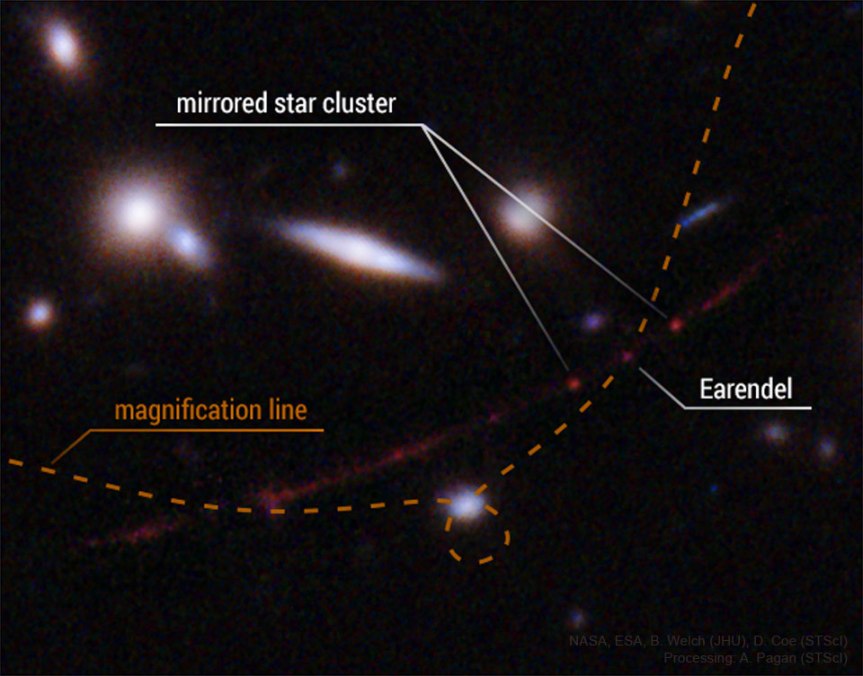
Earendel: A Star in the Early Universe

Image Credit: NASAESAB. Welch (JHU), D. Coe (STScI); Processing: A. Pagan (STScI)

Explanation: Is Earendel the farthest star yet discovered? This scientific possibility started when the Hubble Space Telescope observed a huge cluster of galaxies. The gravitational lens effect of this cluster was seen to magnify and distort a galaxy far in the background. This distorted background galaxy — so far away it has a redshift of 6.2 — appears in the featured image as a long red string, while beads on that string are likely to be star clusters.   The galaxy cluster lens creates a line of maximum magnification line where superposed background objects may appear magnified many thousands of times. On the intersection between the galaxy line and the maximum magnification line is one “bead” which shows evidence of originating from a single bright star in the early universe — now named Earendel. Future investigations may include more imaging by Hubble to see how Earendel’s brightness varies, and, quite possibly, by the new James Webb Space Telescope when it becomes operational later this year.  Earendel’s great distance exceeds that of any known stable star — although the star that exploded creating GRB 090423 had a redshift of 8.2.
April 5 Astronomy Picture of the Day

Discover the cosmos! Each day a different image or photograph of our fascinating universe is featured, along with a brief explanation written by a professional astronomer.

2022 April 5

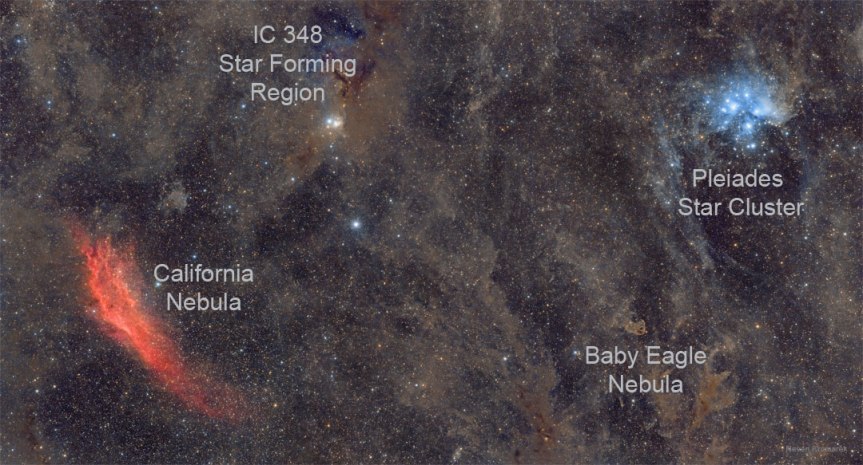
Seven Sisters versus California

Image Credit & Copyright: Neven Krcmarek

Explanation: On the upper right, dressed in blue, is the Pleiades. Also known as the Seven Sisters and M45the Pleiades is one of the brightest and most easily visible open clusters on the sky. The Pleiades contains over 3,000 stars, is about 400 light years away, and only 13 light years across. Surrounding the stars is a spectacular blue reflection nebula made of fine dustA common legend is that one of the brighter stars faded since the cluster was named. On the lower left, shining in red, is the California Nebula. Named for its shape, the California Nebula is much dimmer and hence harder to see than the Pleiades. Also known as NGC 1499, this mass of red glowing hydrogen gas is about 1,500 light years away. Although about 25 full moons could fit between them, the featured wide angle, deep field image composite has captured them both. A careful inspection of the deep image will also reveal the star forming region IC 348 and the molecular cloud LBN 777 (the Baby Eagle Nebula).

April 4 Astronomy Picture of the Day

Discover the cosmos! Each day a different image or photograph of our fascinating universe is featured, along with a brief explanation written by a professional astronomer.

2022 April 4

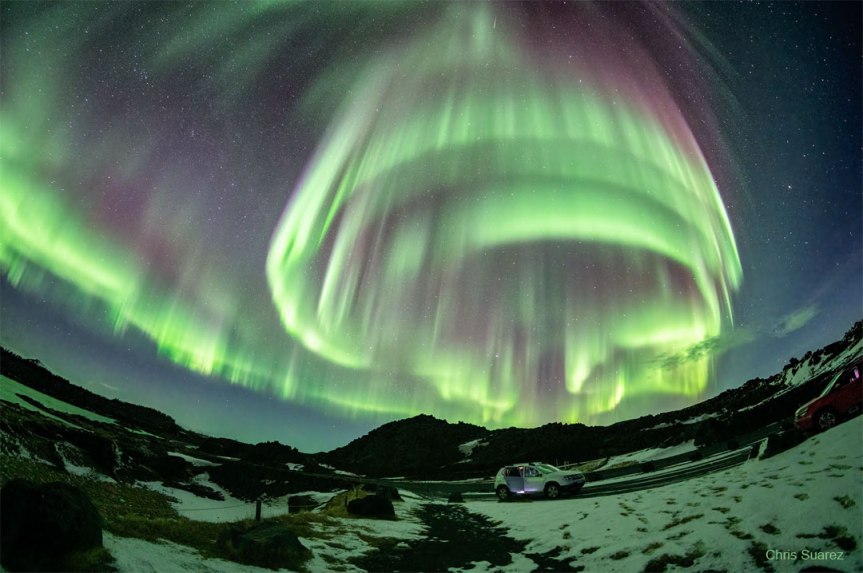
A Vortex Aurora over Iceland

Image Credit & Copyright: Christophe Suarez

Explanation: No, the car was not in danger of being vacuumed into space by the big sky vortex. For one reason, the vortex was really an aurora, and since auroras are created by particles striking the Earth from space, they do not create a vacuum. This rapidly developing auroral display was caused by a Coronal Mass Ejection from the Sun that passed by the Earth closely enough to cause a ripple in Earth’s magnetosphere. The upper red parts of the aurora occur over 250 kilometers high with its red glow created by atmospheric atomic oxygen directly energized by incoming particles. The lower green parts of the aurora occur over 100 kilometers high with its green glow created by atmospheric atomic oxygen energized indirectly by collisions with first-energized molecular nitrogen. Below 100 kilometers, there is little atomic oxygen, which is why auroras end abruptly. The concentric cylinders depict a dramatic auroral corona as seen from the side. The featured image was created from a single 3-second exposure taken in mid-March over Lake Myvatn in Iceland.


April is: Global Astronomy Month

April 3 Astronomy Picture of the Day

Discover the cosmos! Each day a different image or photograph of our fascinating universe is featured, along with a brief explanation written by a professional astronomer.

2022 April 3

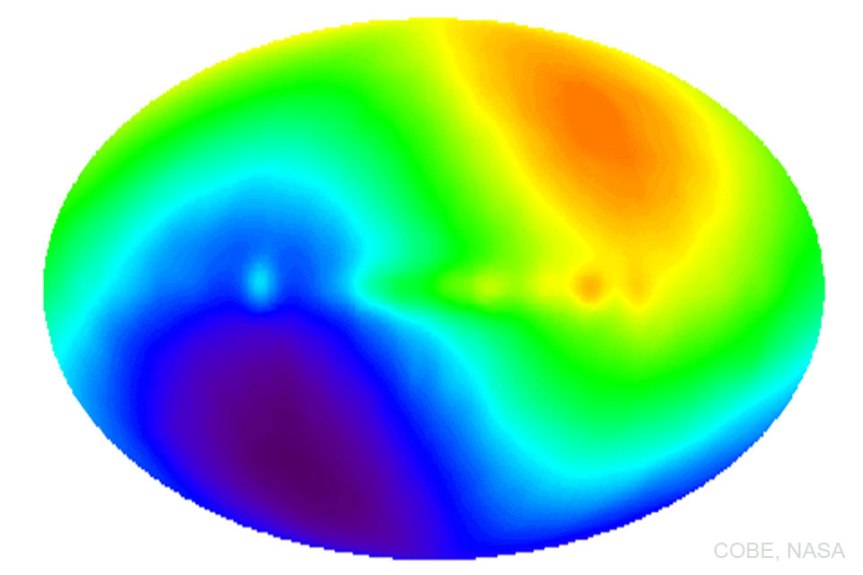
CMB Dipole: Speeding Through the Universe

Image Credit: DMRCOBENASA, Four-Year Sky Map

Explanation: Our Earth is not at rest. The Earth moves around the Sun. The Sun orbits the center of the Milky Way Galaxy. The Milky Way Galaxy orbits in the Local Group of Galaxies. The Local Group falls toward the Virgo Cluster of Galaxies. But these speeds are less than the speed that all of these objects together move relative to the cosmic microwave background radiation (CMBR). In the featured all-sky map from the COBE satellite in 1993, microwave light in the Earth’s direction of motion appears blueshifted and hence hotter, while microwave light on the opposite side of the sky is redshifted and colder. The map indicates that the Local Group moves at about 600 kilometers per second relative to this primordial radiation. This high speed was initially unexpected and its magnitude is still unexplained. Why are we moving so fastWhat is out there?

April 1 Astronomy Picture of the Day

Discover the cosmos! Each day a different image or photograph of our fascinating universe is featured, along with a brief explanation written by a professional astronomer.

2022 April 1

Leaning Tower, Active Sun

Image Credit & CopyrightAntonio Tartarini

Explanation: The natural filter of a hazy atmosphere offered this recognizable architecture and sunset view on March 27. Dark against the solar disk, large sunspots in solar active regions 2975 and 2976 are wedged between the Duomo of Pisa and its famous Leaning Tower. Only one day later, Sun-staring spacecraft watched active region 2975 unleash a frenzy of solar flares along with two coronal mass ejections. The largest impacted the magnetosphere on March 31 triggering a geomagnetic storm and aurorae in high-latitude night skies. On March 30, active region 2975 erupted again with a powerful X-class solar flare that caused a temporary radio blackout on planet Earth.

March 30 Astronomy Picture of the Day

Discover the cosmos! Each day a different image or photograph of our fascinating universe is featured, along with a brief explanation written by a professional astronomer.

2022 March 30

Click here to watch Animation: Odd Radio Circles

Animation: Odd Radio Circles

Credits: Illustration: Sam Moorfield; Data: CSIROHST (HUDF), ESANASA;
Image: J. English (U. Manitoba), EMUMeerKATDES (CTIO); Text: Jayanne English

Explanation: What do you call a cosmic puzzle that no one expected to see? In this case, Odd Radio Circles, aka ORCs. ORC-1 typifies the enigmatic five objects, only visible at radio frequencies, that were serendipitously discovered in 2019 using the new AustraliaSKA Pathfinder radio array. The final image in the featured video uses 2021 data from the South AfricaMeerKAT array to reveal more detail. The radio data, assigned turquoise colors, are combined with a Dark Energy Survey optical/IR map. The animated artist’s illustration explores just one idea about the ORCs’ origins. If two supermassive black holes merge in the center of a galaxy, the associated shockwaves could generate rings of radio radiation. These grow to fill the video frame. The video zooms out so the expansion the ORC can be tracked until it is about a million light-years across. Fortunately, the up-coming Square Kilometer Array can help test this and other promising scenarios.

March 29 Astronomy Picture of the Day

Discover the cosmos! Each day a different image or photograph of our fascinating universe is featured, along with a brief explanation written by a professional astronomer.

2022 March 29

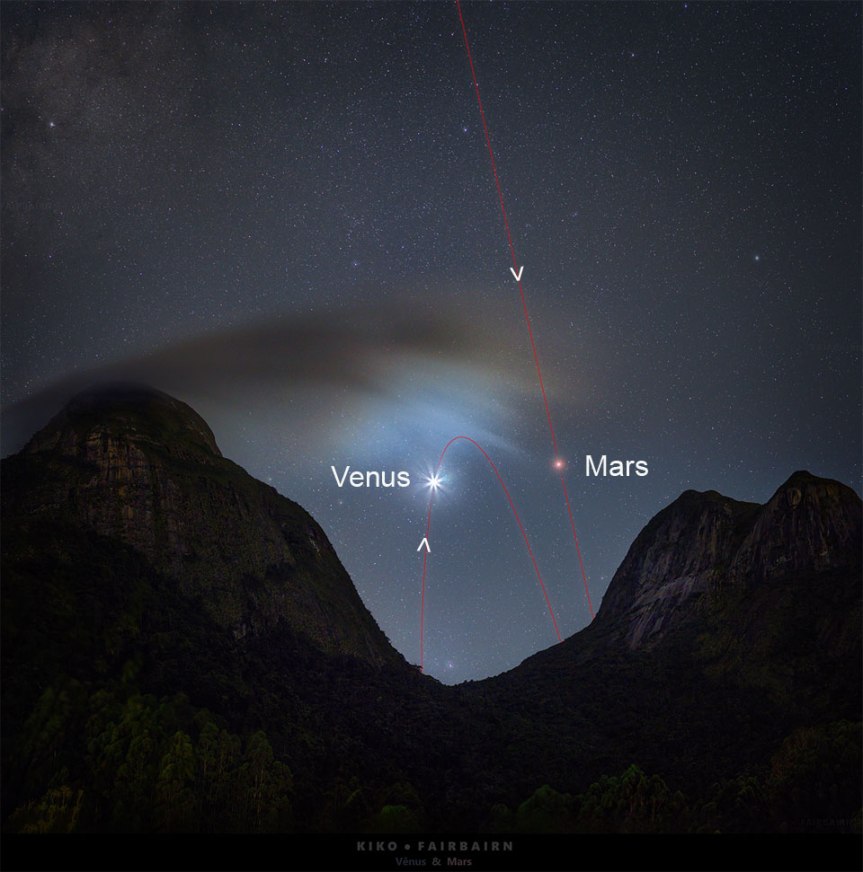
Venus and Mars: Passing in the Night

Image Credit & Copyright: Carlos Kiko Fairbairn

Explanation: When two planets pass on the night sky, they can usually be seen near each other for a week or more. In the case of this planetary conjunction, Venus and Mars passed within 4 degrees of each other earlier this month. The featured image was taken a few days prior, when Venus was slowing rising in the pre-dawn sky, night by night, while Mars was slowly setting. The image, a four-part mosaic, was captured in Brazil from the small town Teresópolis. Besides Venus and Mars, the morning sky now also includes the more distant planet Saturn. Of course, these conjunctions are only angular — Venus, Mars, and Saturn continue to orbit the Sun in very different parts of our Solar System. Next week, the angle between Saturn and Mars will drop to below a quarter of a degree.

March 28 Astronomy Picture of the Day

Discover the cosmos! Each day a different image or photograph of our fascinating universe is featured, along with a brief explanation written by a professional astronomer.

2022 March 28

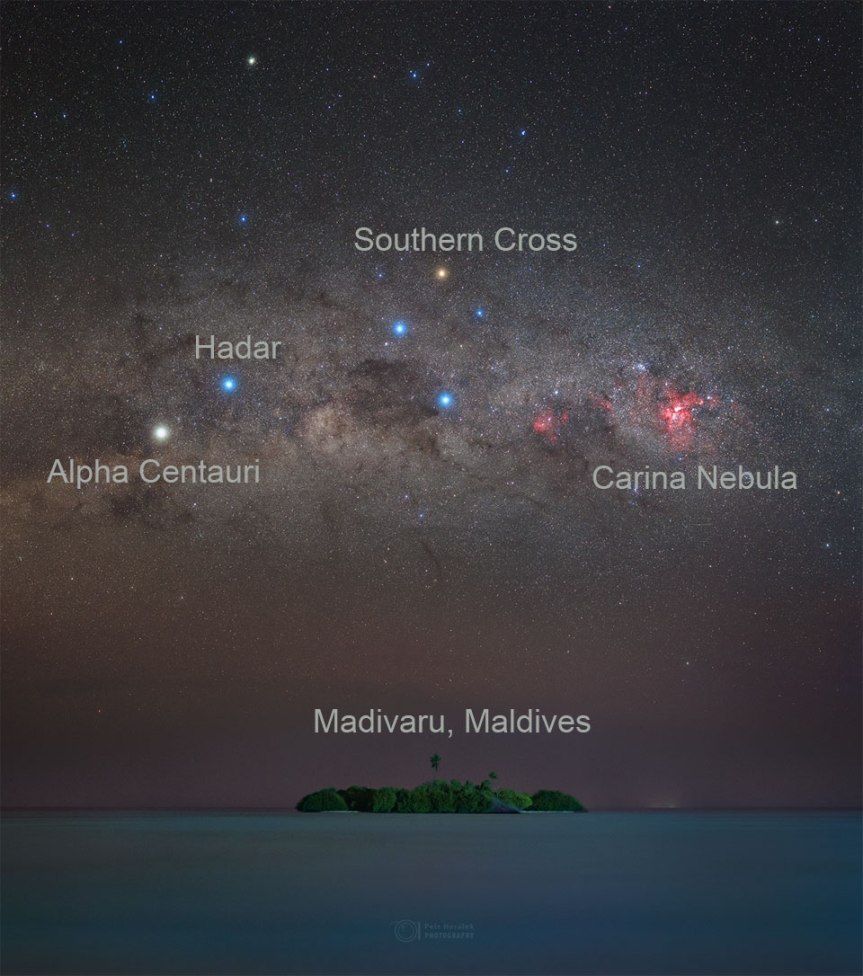
Gems of a Maldivean Night

Image Credit & Copyright: Petr Horálek (ESO Photo AmbassadorInst. of Physics in Opava)

Explanation: The southernmost part of the Milky Way contains not only the stars of the Southern Cross, but the closest star system to our Sun — Alpha Centauri. The Southern Cross itself is topped by the bright, yellowish star Gamma Crucis. A line from Gamma Crucis through the blue star at the bottom of the cross, Acrux, points toward the south celestial pole, located just above the small island in the featured picture — taken in early March. That island is Madivaru of the Maldives in the Indian Ocean. Against faint Milky Way starlight, the dark Coal Sack Nebula lies just left of the cross, while farther left along the Milky Way are the bright stars Alpha Centauri (left) and Beta Centauri (Hadar). Alpha Centauri A, a Sun-like star anchoring a three-star system with exoplanets, is a mere 4.3 light-years distant. Seen from Alpha Centauri, our own Sun would be a bright yellowish star in the otherwise recognizable constellation Cassiopeia.


Almost Hyperspace: Random APOD Generator

March 27 Astronomy Picture of the Day

Discover the cosmos! Each day a different image or photograph of our fascinating universe is featured, along with a brief explanation written by a professional astronomer.

2022 March 27

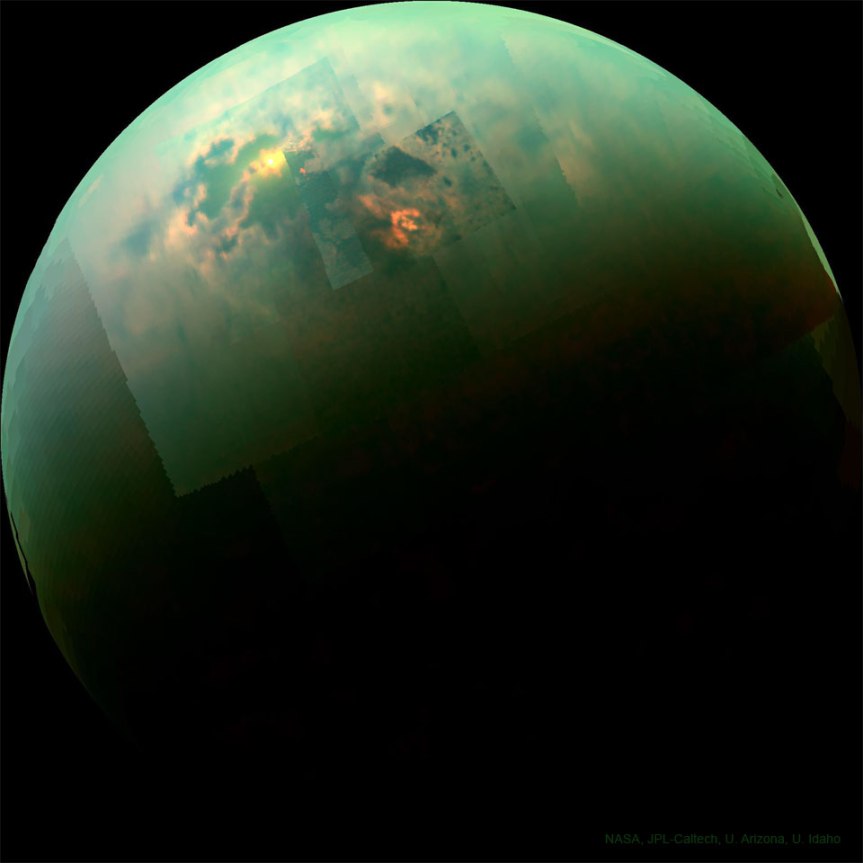
Titan Seas Reflect Sunlight

Image Credit: NASAJPL-CaltechU. ArizonaU. Idaho

Explanation: Why would the surface of Titan light up with a blinding flash? The reason: a sunglint from liquid seas. Saturn’s moon Titan has numerous smooth lakes of methane that, when the angle is right, reflect sunlight as if they were mirrors. Pictured here in false-color, the robotic Cassini spacecraft that orbited Saturn from 2004 to 2017 imaged the cloud-covered Titan in 2014 in different bands of cloud-piercing infrared light. This specular reflection was so bright it saturated one of Cassini’s infrared cameras. Although the sunglint was annoying — it was also useful. The reflecting regions confirm that northern Titan houses a wide and complex array of seas with a geometry that indicates periods of significant evaporation. During its numerous passes of our Solar System‘s most mysterious moon, Cassini has revealed Titan to be a world with active weather — including times when it rains a liquefied version of natural gas.

March 26 Astronomy Picture of the Day

Discover the cosmos! Each day a different image or photograph of our fascinating universe is featured, along with a brief explanation written by a professional astronomer.

2022 March 26

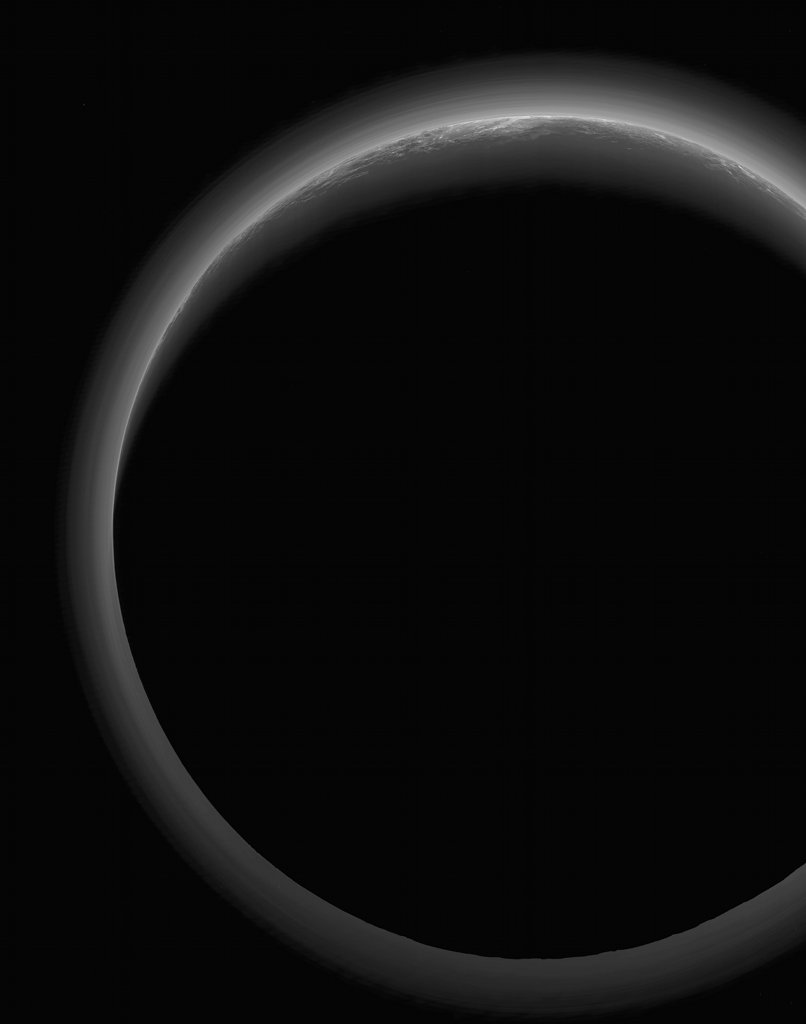
Pluto at Night

Image Credit: NASAJohns Hopkins Univ./APLSouthwest Research Institute

Explanation: The night side of Pluto spans this shadowy scene. In the stunning spacebased perspective the Sun is 4.9 billion kilometers (almost 4.5 light-hours) behind the dim and distant world. It was captured by far flung New Horizons in July of 2015 when the spacecraft was at a range of some 21,000 kilometers from Pluto, about 19 minutes after its closest approach. A denizen of the Kuiper Belt in dramatic silhouette, the image also reveals Pluto’s tenuous, surprisingly complex layers of hazy atmosphere. Near the top of the frame the crescent twilight landscape includes southern areas of nitrogen ice plains now formally known as Sputnik Planitia and rugged mountains of water-ice in the Norgay Montes.

March 25 Astronomy Picture of the Day

Discover the cosmos! Each day a different image or photograph of our fascinating universe is featured, along with a brief explanation written by a professional astronomer.

2022 March 25

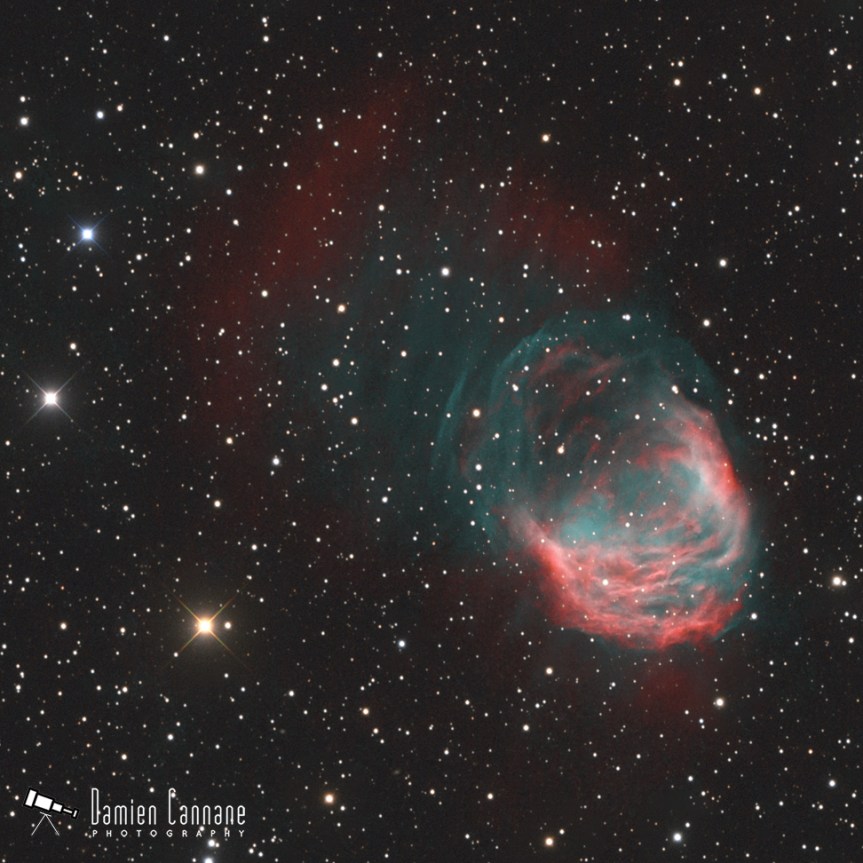
The Medusa Nebula

Image Credit & Copyright: Damien Cannane

Explanation: Braided and serpentine filaments of glowing gas suggest this nebula’s popular name, The Medusa Nebula. Also known as Abell 21, this Medusa is an old planetary nebula some 1,500 light-years away in the constellation Gemini. Like its mythological namesake, the nebula is associated with a dramatic transformation. The planetary nebula phase represents a final stage in the evolution of low mass stars like the sun as they transform themselves from red giants to hot white dwarf stars and in the process shrug off their outer layers. Ultraviolet radiation from the hot star powers the nebular glow. The Medusa’s transforming star is the faint one near the center of the overall bright crescent shape. In this deep telescopic view, fainter filaments clearly extend above and left of the bright crescent region. The Medusa Nebula is estimated to be over 4 light-years across.

March 24 Astronomy Picture of the Day

Discover the cosmos! Each day a different image or photograph of our fascinating universe is featured, along with a brief explanation written by a professional astronomer.

2022 March 24

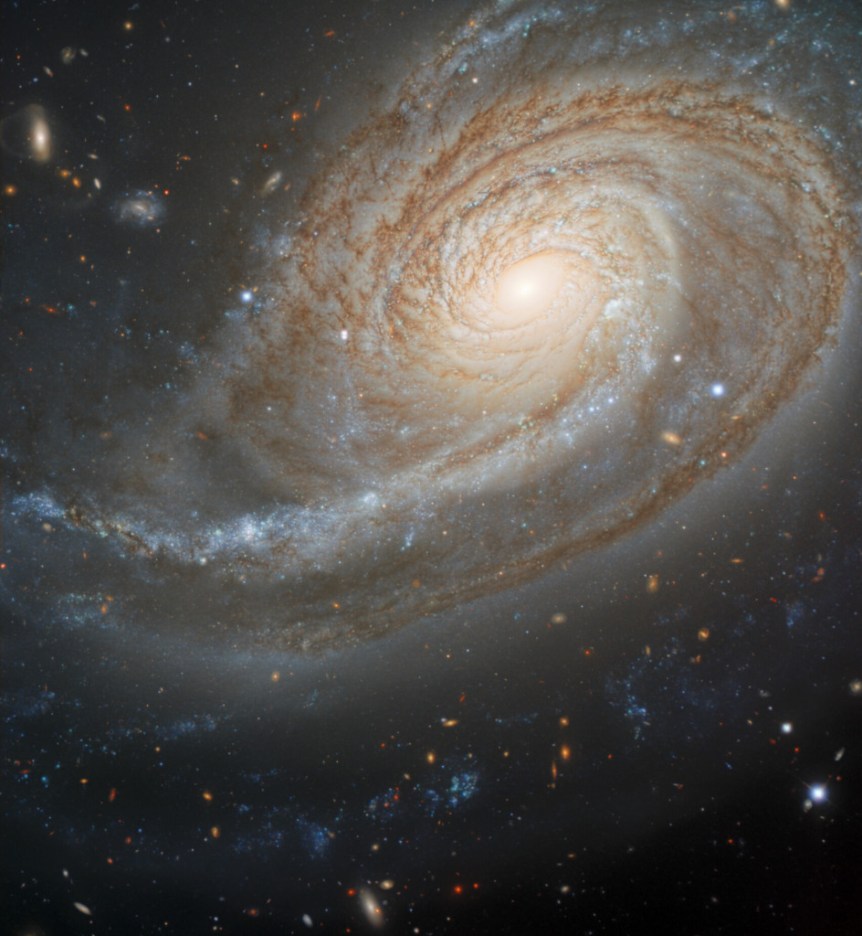
The overdeveloped spiral arm of the galaxy NGC 772, which was created by tidal interactions with an unruly neighbor, dominates this observation made by astronomers using the Gemini North telescope located near the summit of Maunakea in Hawai‘i.

Arp 78: Peculiar Galaxy in Aries

Image Credit & License: International Gemini Observatory / NOIRLab / NSF / AURA
Processing: T.A. Rector (Univ. Alaska Anchorage), J. Miller (Gemini Observatory/NOIRLab), M. Zamani & D. de Martin

Explanation: Peculiar spiral galaxy Arp 78 is found within the boundaries of the head strong constellation Aries. Some 100 million light-years beyond the stars and nebulae of our Milky Way galaxy, the island universe is over 100,000 light-years across. Also known as NGC 772, it sports a prominent, outer spiral arm in this detailed cosmic portrait from the large Gemini North telescope near the summit of Maunakea, Hawaii, planet Earth. Tracking along sweeping dust lanes and lined with young blue star clusters, Arp 78’s spiral arm is likely pumped-up by galactic-scale gravitational tidal interactions The close companion galaxy responsible is NGC 770, located off the upper right of this frame. But more distant background galaxies are clearly visible in the cosmic field of view.

March 22 Astronomy Picture of the Day

Discover the cosmos! Each day a different image or photograph of our fascinating universe is featured, along with a brief explanation written by a professional astronomer.

2022 March 22

A Whale of an Aurora over Swedish Forest

Image Credit & Copyright: Göran Strand

Explanation: What’s that in the sky? An aurora. A large coronal mass ejection occurred on our Sun earlier this month, throwing a cloud of fast-moving electrons, protons, and ions toward the Earth. Part of this cloud impacted our Earth’s magnetosphere and, bolstered by a sudden gap, resulted in spectacular auroras being seen at some high northern latitudes. Featured here is a particularly photogenic auroral corona captured above a forest in Sweden from a scenic perch overlooking the city of Östersund. To some, this shimmering green glow of recombining atmospheric oxygen might appear like a large whale, but feel free to share what it looks like to you. The unusually quiet Sun of the past few years has now passed. As our Sun now approaches a solar maximum in its 11-year solar magnetic cycle, dramatic auroras like this are sure to continue.


Open Science: Browse 2,700+ codes in the Astrophysics Source Code Library

March 21 Astronomy Picture of the Day

Discover the cosmos! Each day a different image or photograph of our fascinating universe is featured, along with a brief explanation written by a professional astronomer.

2022 March 21

The Sky in 2021

Image Credit & Copyright: Cees Bassa (Netherlands Institute for Radio Astronomy)

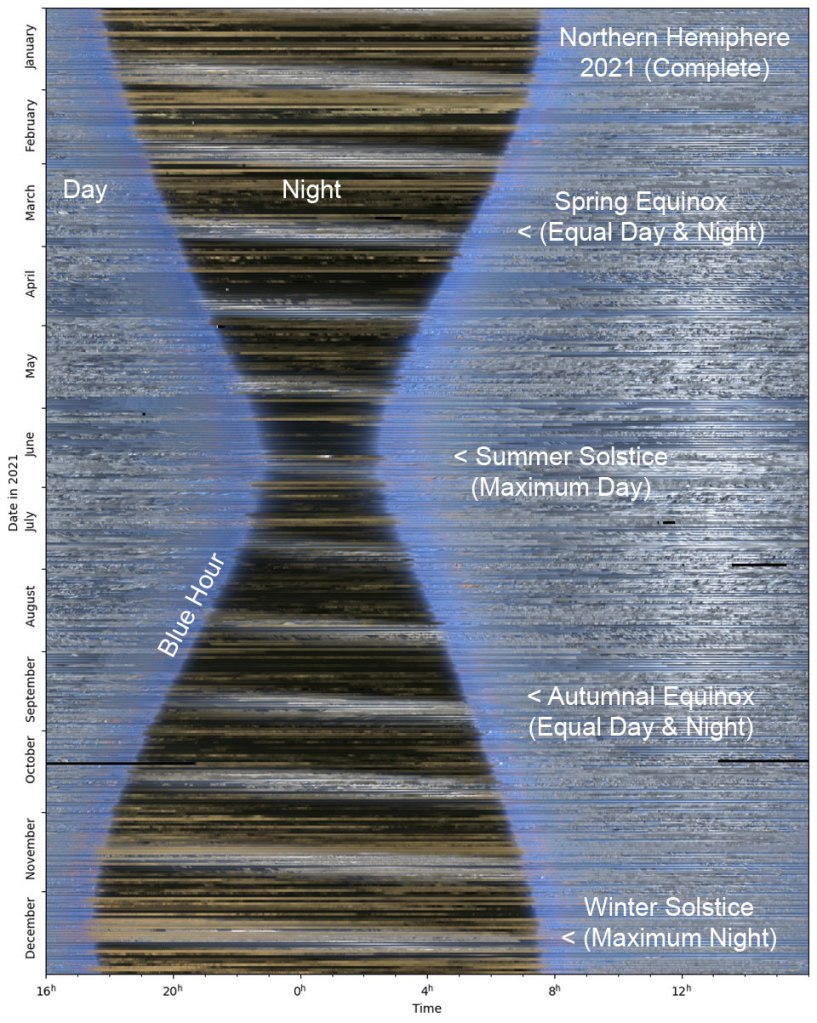
Explanation: What if you could see the entire sky — all at once — for an entire year? That, very nearly, is what is pictured here. Every 15 minutes during 2021, an all-sky camera took an image of the sky over the Netherlands. Central columns from these images were then aligned and combined to create the featured keogram, with January at the top, December at the bottom, and the middle of the night running vertically just left of center. What do we see? Most obviously, the daytime sky is mostly blue, while the nighttime sky is mostly black. The twelve light bands crossing the night sky are caused by the glow of the Moon. The thinnest part of the black hourglass shape occurs during the summer solstice when days are the longest, while the thickest part occurs at the winter solstice. Yesterday was an equinox — when night and day were equal — and the northern-spring equinox from one year ago can actually be located in the keogram — about three-quarters of the way up.


Follow APOD on Instagram in: EnglishIndonesianPersianPortuguese or Taiwanese

March 20 Astronomy Picture of the Day

Discover the cosmos! Each day a different image or photograph of our fascinating universe is featured, along with a brief explanation written by a professional astronomer.

2022 March 20

A Picturesque Equinox Sunset

Image Credit & Copyright: Roland Christen

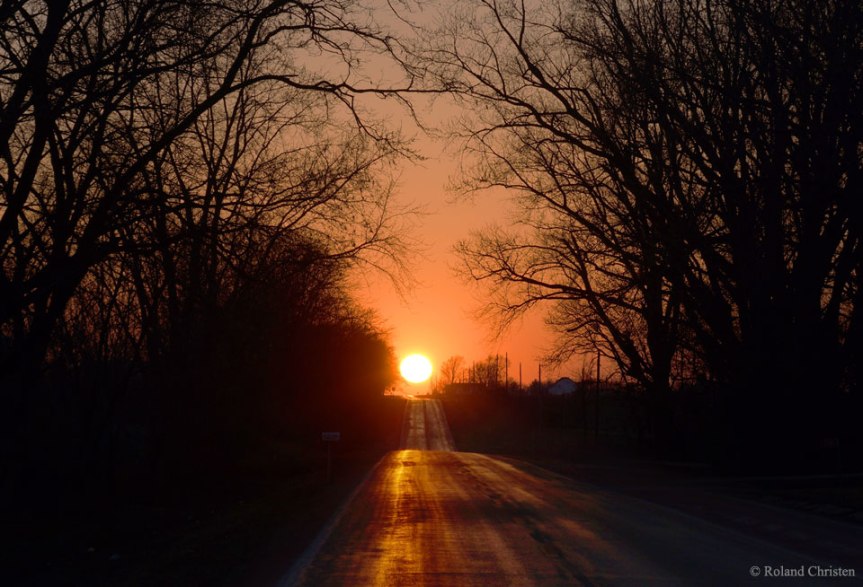
Explanation: What’s that at the end of the road? The Sun. Many towns have roads that run east – west, and on two days each year, the Sun rises and sets right down the middle. Today is one of those days: an equinox. Not only is today a day of equal night (“aequus”-“nox”) and day time, but also a day when the sun rises precisely to the east and sets due west. Featured here is a picturesque road in northwest Illinois, USA that runs approximately east -west. The image was taken during the March Equinox of 2015, and shows the Sun down the road at sunset. In many cultures, this March equinox is taken to be the first day of a season, typically spring in Earth’s northern hemisphere, and autumn in the south. Does your favorite street run east – west? Tonight, at sunset, you can find out with a quick glance.


March 19 Astronomy Picture of the Day

Discover the cosmos! Each day a different image or photograph of our fascinating universe is featured, along with a brief explanation written by a professional astronomer.

2022 March 19

2MASS J17554042+6551277

Image Credit : NASASTScIJWST

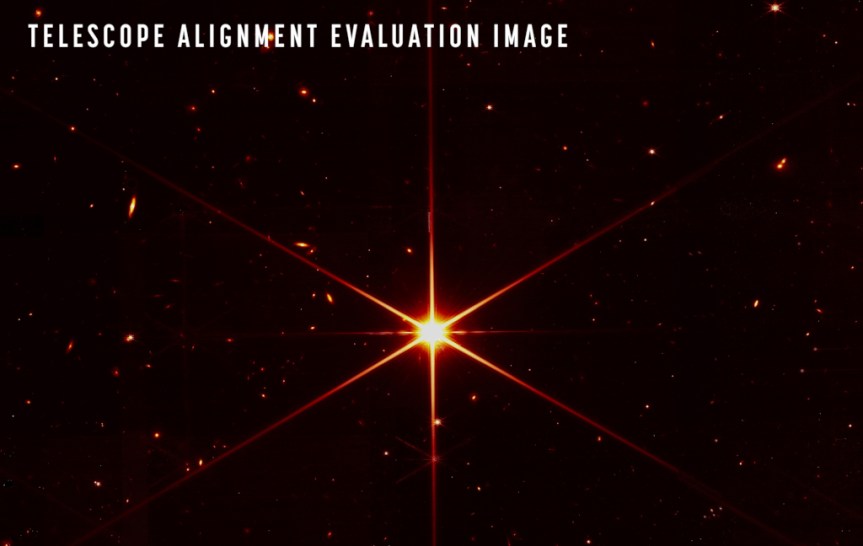
Explanation: 2MASS J17554042+6551277 doesn’t exactly roll off the tongue but that’s the name, a coordinate-based catalog designation, of the star centered in this sharp field of view. Fans of the distant universe should get used to its spiky appearance though. The diffraction pattern is created by the 18 hexagonal mirror segments of the James Webb Space Telescope. After unfolding, the segments have now been adjusted to achieve a diffraction limited alignment at infrared wavelengths while operating in concert as a single 6.5 meter diameter primary mirror. The resulting image taken by Webb’s NIRcam demonstrates their precise alignment is the best physics will allow. 2MASS J17554042+6551277 is about 2,000 light-years away and well within our own galaxy. But the galaxies scattered across the background of the Webb telescope alignment evaluation image are likely billions of light-years distant, far beyond the Milky Way.

March 18 Astronomy Picture of the Day

Discover the cosmos! Each day a different image or photograph of our fascinating universe is featured, along with a brief explanation written by a professional astronomer.

2022 March 18

A Filament in Monoceros

Image Credit & Copyright: Giorgio Ferrari

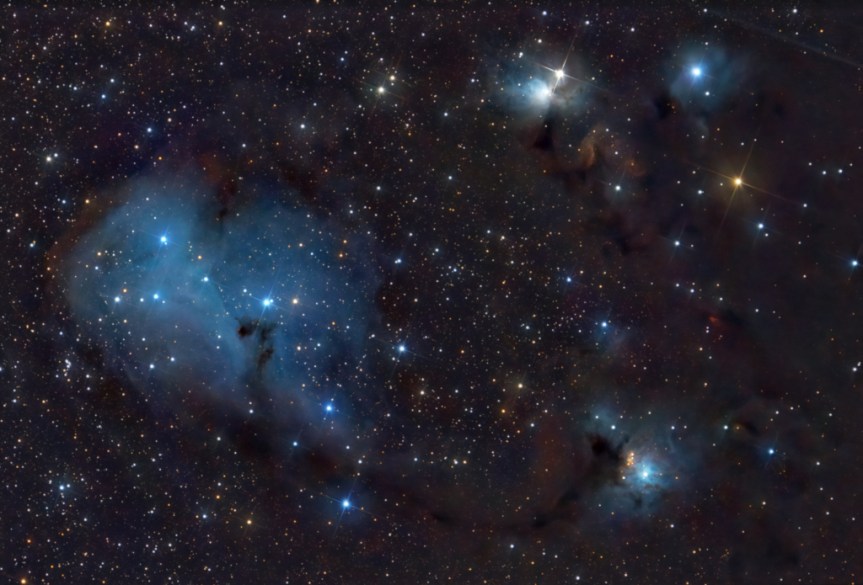
Explanation: Bluish reflection nebulae seem to fill this dusty expanse. The sharp telescopic frame spans over 1 degree on the sky toward the faint but fanciful constellation Monoceros, the Unicorn. Seen within the Monoceros R1 cloud complex some 2,500 light-years away, bluish IC 447 is on the left, joined by a long dark filament of dust to IC 446 at lower right. Embedded in IC 447 are young, massive blue stars much hotter than the Sun, whose light is reflected by the cosmic cloud of star stuff. Observations reveal that IC 446 also contains a young stellar object, a massive star still in an early stage of evolution. The dark filament of dust and molecular gas joining the two star-forming regions is over 15 light-years long.

March 17 Astronomy Picture of the Day

Discover the cosmos! Each day a different image or photograph of our fascinating universe is featured, along with a brief explanation written by a professional astronomer.

2022 March 17

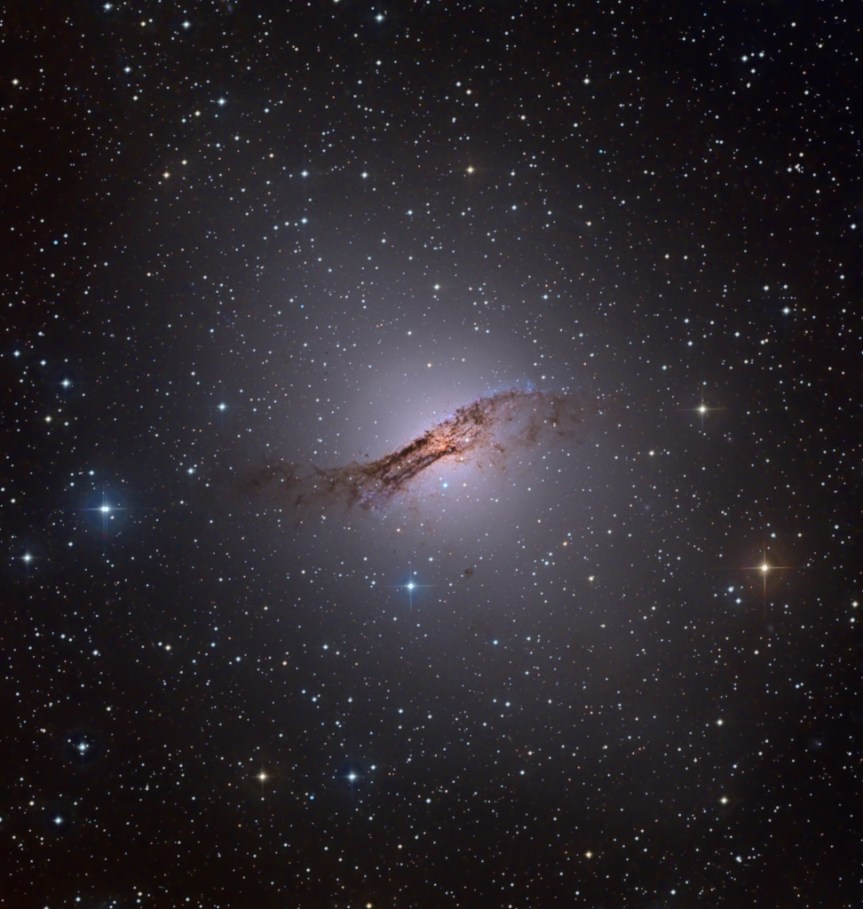
Centaurus A

Image Credit & Copyright: David Alemazkour

Explanation: A mere 11 million light-years away, Centaurus A is the closest active galaxy to planet Earth. Spanning over 60,000 light-years, the peculiar elliptical galaxy also known as NGC 5128, is featured in this sharp telescopic view. Centaurus A is apparently the result of a collision of two otherwise normal galaxies resulting in a fantastic jumble of star clusters and imposing dark dust lanes. Near the galaxy’s center, leftover cosmic debris is steadily being consumed by a central black hole with a billion times the mass of the Sun. As in other active galaxies, that process likely generates the enormous radio, X-ray, and gamma-ray energy radiated by Centaurus A.

March 16 Astronomy Picture of the Day

Discover the cosmos! Each day a different image or photograph of our fascinating universe is featured, along with a brief explanation written by a professional astronomer.

2022 March 16

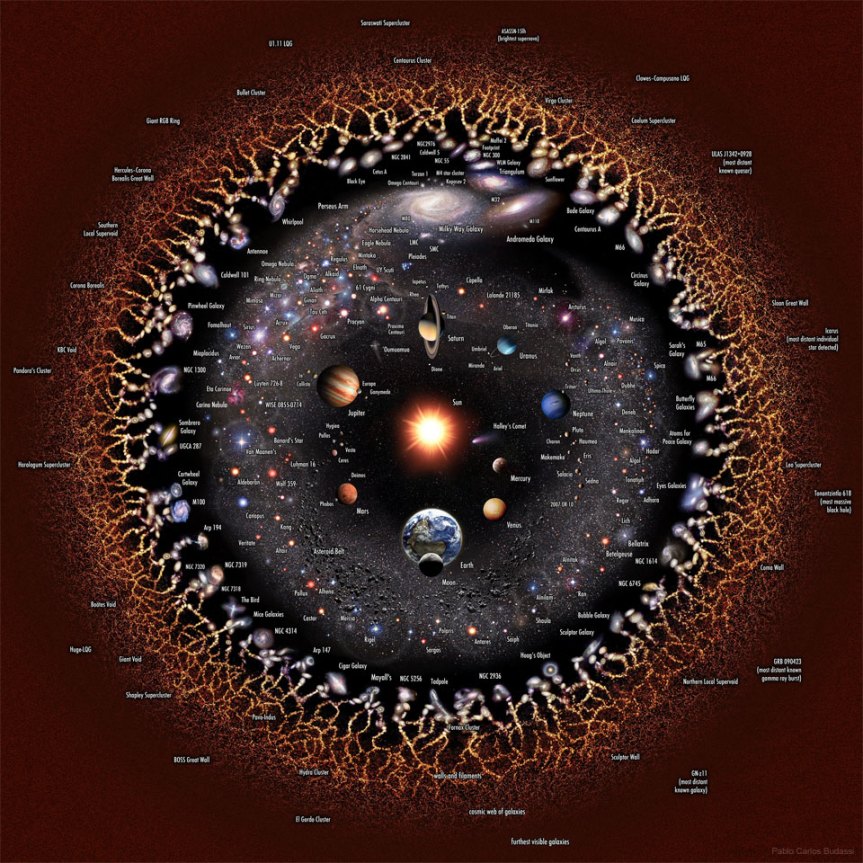
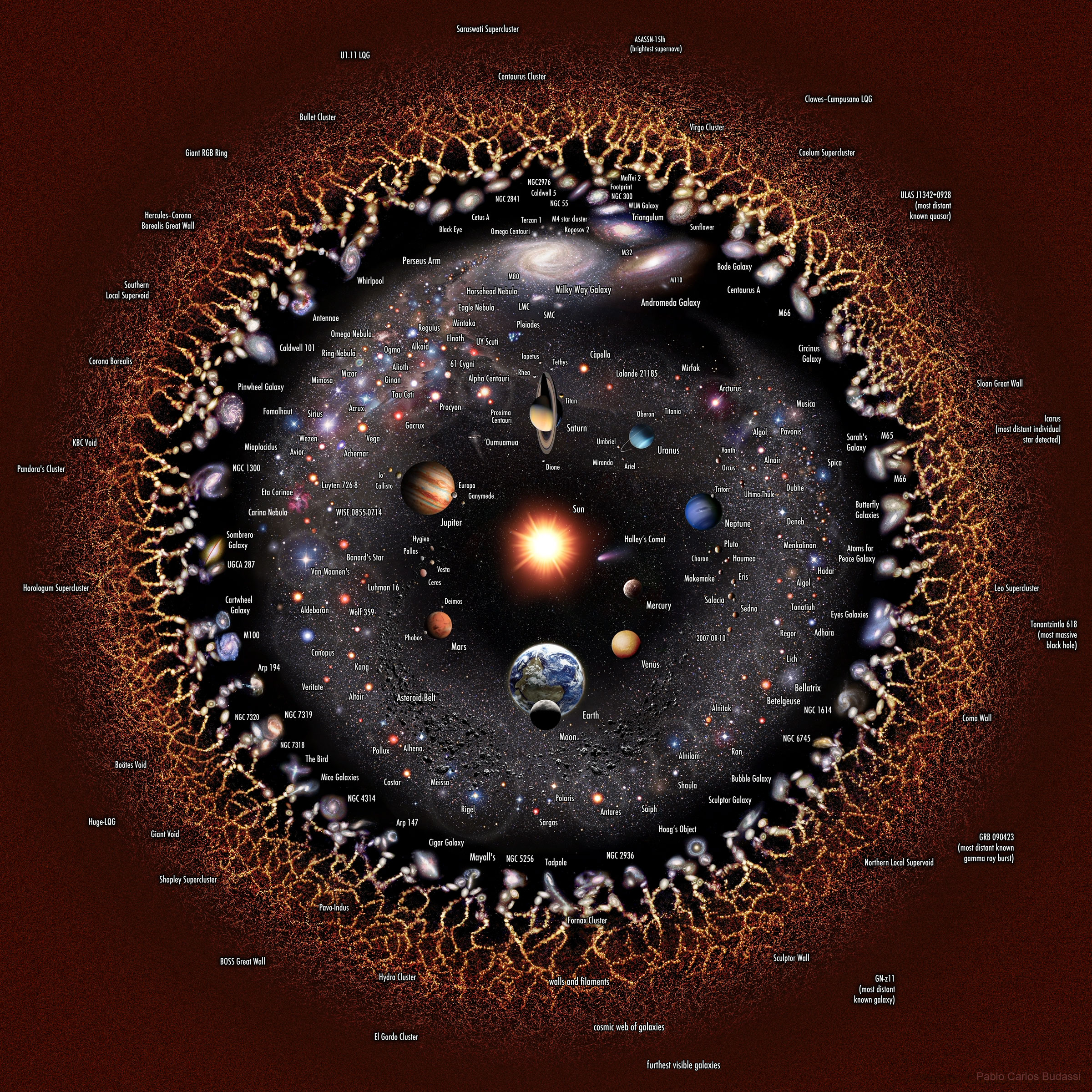
The Observable Universe

Illustration Credit & LicenceWikipediaPablo Carlos Budassi

Explanation: How far can you see? Everything you can see, and everything you could possibly see, right now, assuming your eyes could detect all types of radiations around you — is the observable universe. In light, the farthest we can see comes from the cosmic microwave background, a time 13.8 billion years ago when the universe was opaque like thick fog. Some neutrinos and gravitational waves that surround us come from even farther out, but humanity does not yet have the technology to detect them. The featured image illustrates the observable universe on an increasingly compact scale, with the Earth and Sun at the center surrounded by our Solar Systemnearby starsnearby galaxiesdistant galaxiesfilaments of early matter, and the cosmic microwave background. Cosmologists typically assume that our observable universe is just the nearby part of a greater entity known as “the universe” where the same physics applies. However, there are several lines of popular but speculative reasoning that assert that even our universe is part of a greater multiverse where either different physical constants occur, different physical laws apply, higher dimensions operate, or slightly different-by-chance versions of our standard universe exist.


Available: High res image version with readable annotations | Clickable annotation version

March 15 Astronomy Picture of the Day

Discover the cosmos! Each day a different image or photograph of our fascinating universe is featured, along with a brief explanation written by a professional astronomer.

2022 March 15

A Road to the Stars

Image Credit: ESOPetr Horálek (ESO Photo AmbassadorInst. of Physics in Opava)

A stunning night view, taken close to the 1.54m Danish Telescope and the 3.6m telescope on the road at La Silla, shows the Milky Way above the horizon, accompanied by the Magellanic Clouds. ESO’s 3.6m Telescope, seen here atop a hill at the centre of the image, is home to HARPS, an instrument dedicated to the discovery of planets outside the Solar System via the radial velocity method. This method enables the detection of a planet by measuring the wobbling motion of the central star caused by the gravitational pull of the planet itself.  The towers on the left are the support structures of the BlackGEM telescopes, which had not been installed yet when this image was taken. BlackGEM is an array of telescopes that will search for the light emitted by the optical counterparts of the most powerful gravitational-wave sources, namely colliding neutron stars and black holes.  On the right of the image, we see the Large and Small Magellanic Clouds, two irregular dwarf galaxies orbiting the Milky Way at a distance of approximately 160 000 and 200 000 light-years, respectively. In the Mapuche culture of south-central Chile, these neighbouring galaxies were known as lafken, labken or künchalabken (“the lagoons”) as well as rünanko (“the water wells”). [1] The red filamentary emission stretching across the sky in the horizon is called airglow, which is light naturally emitted by atoms and molecules in the atmosphere through various physical and chemical processes. Despite showing up prominently in this image, airglow is invisible to the unaided eye.   [1] Source: Wenumapu. Astronomía y Cosmología Mapuche, Gabriel Pozo Menares & Margarita Canio Llanquinao
Explanation: Pictured — a very scenic road to the stars. The road approaches La Silla Observatory in Chile, with the ESO‘s 3.6-meter telescope just up ahead. To the left are some futuristic-looking support structures for the planned BlackGEM telescopes, an array of optical telescopes that will help locate optical counterparts to gravitational waves detections by LIGO and other detectors. But there is much more. Red airglow illuminates the night sky on the right, while the central band of our Milky Way Galaxy slants across the image center. Jupiter can be seen just above the band near the image center, while Saturn is visible just above the 3.6-meter telescope dome. The two largest satellite galaxies of our Milky Way Galaxy, the LMC and SMC, are seen on the far right. The featured image panorama was built up from multiple 15-second exposures that were captured on 2019 June 30. Two days later, La Silla experienced a rare total eclipse of the Sun.