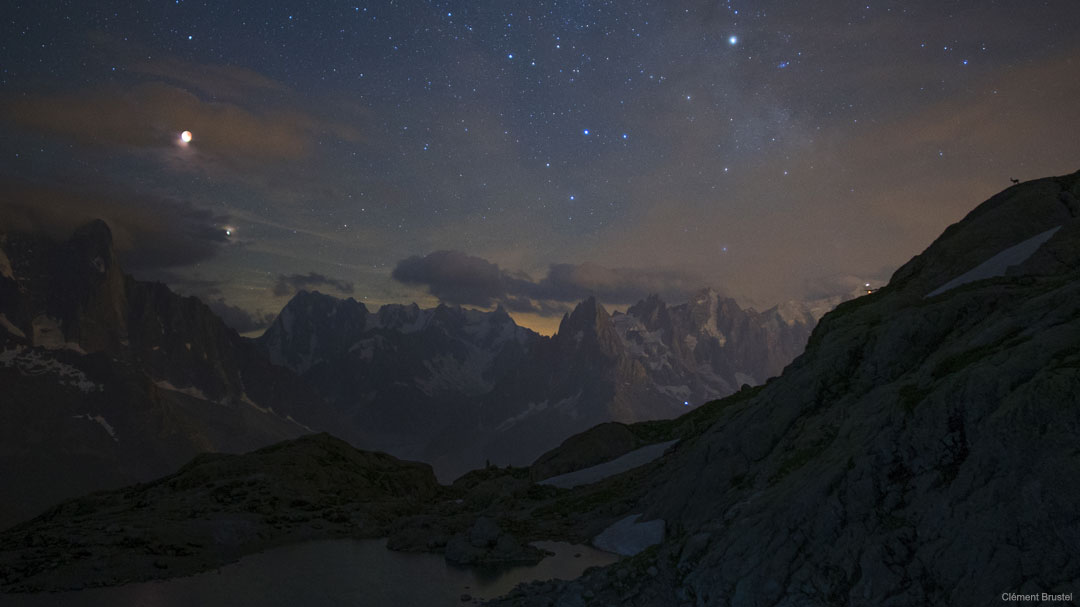
Party with the Perseids
The Perseids feature a slow (two-week) buildup to maximum (along with an equally slow decline to zero activity), and many bright meteors that leave luminous trails visible for several seconds. The trails form because Perseid meteors are fast — their speeds top 125,000 mph (200,000 km/h). Usually, Perseid meteors appear white or bluish white.
In 2018, the New Moon fortuitously occurs August 11, so our normally brilliant satellite will be absent during the shower’s peak, which falls on the night of August 12 and the morning of the 13th. If you see the Moon at all, it will be a thin crescent low in the western sky that will set an hour or so after the Sun. Perhaps the only negative about this year’s Perseids is that the peak occurs on a Sunday night into Monday morning, so work commitments may limit the number of people who actually view the shower.
Most astronomy clubs host observing sessions either on the night of the shower’s predicted maximum or on a weekend night close to it. If you’re not doing serious meteor counting, all you’ll need to bring is a lawn chair, some snacks, and your eyes.
Telescopes do a great job of magnifying objects, but they severely restrict your field of view, a negative for meteor watching. Binoculars also restrict your view, so don’t observe the shower through them. Instead, if you have binoculars nearby, you can use them to catch a close-up view of a meteor’s smoke trail after spotting it with your naked eye.
Meteors are tiny dust-size particles of rock and metal that Earth passes through as it orbits the Sun. Astronomers call these particles meteoroids when they are floating freely in space, but when they burn up in the atmosphere, they become meteors. If they survive the fiery ordeal of passage through our thick blanket of air to land on the ground, they are then known as meteorites. No meteorites come from meteor showers — the particles are too small.
Most meteor showers originate with comets. When a comet swings around the Sun, our star’s heat boils off ice and with it, trapped dusty debris. When the debris trail’s orbit crosses Earth’s orbit, we experience a meteor shower. The exception to the comet rule is the Geminid shower, which occurs in December. That event’s particles originate with dust coming from the asteroid 3200 Phaethon.
By the way, astronomers call this particular shower the Perseids because if you trace all the meteor trails backward, they meet within the boundaries of the constellation Perseus the Hero. The point of origin (the direction in space toward which Earth is heading) is called the radiant. A good visual approximation of the radiant is the famous Double Cluster in Perseus (NGC 869 and NGC 884).

August 12 isn’t the only night you can observe Perseids. This year, the shower will be active between about July 17 and August 24. Of course, you’ll see fewer meteors the further you observe from the date of the peak.
How many Perseids will you see? Meteor counters use a quantity called the zenithal hourly rate (ZHR). This is the number of meteors visible per hour for an observer under a dark sky with no scattered light and with the radiant positioned directly overhead. The ZHR for the Perseids is 110. This year, with the Moon out of the sky, you can expect to count between 80 and 90 meteors per hour from a dark site — a terrific rate!
All meteor showers are exciting events, but this summer’s Perseids rank at the top. Be comfortable, have fun, and get ready for some oohs and aahs.
Astronomy Senior Editor Michael E.


The Elder tree has often been associated with the Goddess and Mother Earth. Anyone who would cut down an Elder was risking bad fortune and ill luck. This letter of the ogham is most likely to show karma in action. Ideas that come to mind are regret, dealing with bad choices, and the inevitable. Especially if this symbol shows up in any future readings it is wise to take precautions on potential decisions.
While it also may have thorns, Gorse is known for a vibrant yellow flower that can last almost year round. For this reason this plant has become a symbol of vitality. It may be hardy and have some thorns but it protects wildlife and shines bright for everyone to see. When you draw this letter keep in mind optimism, positivity, and vigor. With Onn you will prevail as long as you keep your flower in bloom!
The beauty of heather flowers is one reason it is associated with the Irish Goddess of love, fertility, and new growth. Be happy when you draw this letter because it denotes love, companionship, and passion. Whether it will be a new love or an old love rekindled, Ura is a powerful symbol and one that may bring great luck in your love life.
Six of Coins
Gemini Reversed
Air
You must be logged in to post a comment.