Spiritualist Seance Invocation

‘There is a land where we all go,
Where never the frost or cold winds blow.
And friends remembered reunite,
where those who hate, forget their spite.
In glow, surround these gentle beings,
we call you now to bless our meetings,
Heaven’s promise, our spirits thrive,
So now for the living, let the dead come alive.
Greetings spirits, Speak now to us?’

From “The Spirit Speaks! Weekly Newspaper” 1901
~ Revised by Barbara Morris

Celtic Remembrance Ritual

Samhain Remembrance Ritual


Do not stand at my grave and weep
I am not there, I do not sleep

I am a thousand winds that blow,
I am the softly falling snow
I am the gentle showers of rain,
I am the fields of ripening grain

I am in the morning hush,
I am in the graceful rush,
Of beautiful birds in circling flight
I am in the starshine of the night

I am in the flowers that bloom
I am in a quiet room
I am in the birds that sing
I am in each lovely thing

Do not stand at my grave and cry,
I am not there, I do not die.

~ by Mary E. Frye 1932

This world is not conclusion;
A sequel stands beyond,
Invisible, as music,
But positive, as sound.
It beckons and it baffles;
Philosophies don’t know,
And through a riddle, at the last,
Sagacity must go.
To guess it puzzles scholars;
To gain it, men have shown
Contempt of generations,
And crucifixion known.

Emily Dickinson

~ Emily Dickinson

Samhain – A Very Irish Feast The Roots of Halloween in Celtic Ireland

November 1st was traditionally known assamhain, literally translated the “end of summer” and pronounced something likesow-een. This was the end of the Celtic year, the start of winter, a time for reflection. And part of a sometimes confusing tradition …

From Darkness Comes Light

One of the Celtic idiosyncrasies was the concept of beginning in darkness and working towards the light. As the year started with winter, the days started at sundown. Thus the night from October 31st to November 1st was part of samhain, known as oiche shamhna or “evening of samhain“.

Samhain was one of the four “quarter days” of the Celtic calendar, along with imbolc(February 1st, start of spring – also known asSaint Brigid’s Day), bealtaine (May 1st, start of summer) and lughnasa (August 1st, start of the harvest). We do not have any undisputed information about how these festivities were conducted in pre-Christian times. Samhain seems to have been a specifically Irish tradition and first mentioned by Christian chroniclers. Feasting seems to have taken the best part of a week, a few days either side of the actual samhain day.

Samhain – Preparing for Winter

The preparations concerned mainly cattle and other livestock – all members of the herd were caught, brought into enclosures or sheds near the homestead. And some were marked for death – those animals too weak to survive the winter were slaughtered. Not for any ritual reasons, this was down to purely practical considerations. And filled the larder for winter.

At the same time all corn, fruits and berries had to be harvested and stored. There still is a widespread belief in Ireland that after November 1st all fruit is bewitched and thus inedible. The pooka was said to roam free atsamhain – a black, ugly horse with red eyes and the ability to talk. And with a penchant for kidnappings and copious urination on berries. On the other hand a respectful contact with the pooka could show you the future …

Communal Activities – Samhain as a Day of Reckoning

Many legends concern the big meetings at samhain – this was the time to take stock and decide upon future activities. At the Hill of Tara or on lakeshores. A general armistice during this period made meetings between sworn enemies, diplomacy and social activities beyond tribal and political boundaries possible. All debts had to be settled and horse-racing as well as charioteering provided a peaceful contest.

But spiritual activities were an integral part of the feast.

Traditionally all the fires were extinguished when oiche shamhna set in, making this the darkest night of the year. The fires were then re-lit, marking the start of the new year.

Tradition has it that druids lit a huge bonfire on the Hill of Tlachtga (near Athboy, County Meath) and burning torches were then carried from there to every household during the night – alas, a physical impossibility. Though the reputed special tax levied by the king for this “service” certainly seems believable in light of the modern Irish state’s revenue ideas …

We All Have to Make Sacrifices

Other rituals involving fire were not so quaint and definitely easier to arrange – the “wicker men”. Basically a cage made from wickerwork in a rough resemblance of the human form, then stuffed with (living) sacrificial offerings. Like animals, prisoners of war or unpopular neighbors. Which were then burned to death inside the “wicker man”. Other rituals involved drowning … Happy New Celtic Year!

But these human sacrifices should not be seen as the undisputed norm. Though sacrifices were undoubtedly made, they may only have involved milk and corn spilled into the earth. And there might even have been nocturnal human activities connected to fertility rituals. It was considered a good omen if a woman became pregnant at samhain!

The Non-Human Touch at Samhain

Not everybody joining in the samhain celebrations was necessarily human … or of our world. The night from October 31st to November 1st was a time “between years” to the Celts. And during this time the borders between our world and the otherworld(s) were flexible and open.

Not only the pooka was out and about … bean sidhe (banshee) could be killed by humans during the night, fairies were visible to human eyes, the underworld palaces of the “gentry” (an Irish title for fairies) were open to come and go. Humans could drink with mighty heroes and bed their beautiful female companions … as long as you did not make any mistakes, broke any rules or violated even the most ridiculous taboo. The problem being that the chances to foul up far outweighed the chances of a good night out – so most people opted for a quiet night in. Doors securely locked.

Last but not least Uncle Brendan might come knocking, even though he has been buried the last twenty years in New York. Samhain was also a time when the dead could walk the earth, communicate with the living … and call in old debts.

“Druidic” Confusion

All this belongs to the conservative picture of samhain. Which has been thoroughly muddled by neo-pagans and esoteric authors detailing “lost knowledge”. To such a degree that even a Celtic god of death called samhain appeared – a pure invention.

Colonel Charles Valency is to blame for many inventions. In the 1770s he wrote exhaustive treatises on the origin of the “Irish race” in Armenia. Many of his writings have long been consigned to the lunatic fringe. But Lady Jane Francesca Wilde carried his torch in the 19th century and her “Irish Cures, Mystic Charms and Superstitions” – which is still being cited as an authoritative work.

Samhain meanwhile mutated into All Hallows E’en and Halloween. And samhain or Halloween is still celebrated in Ireland in various ways – complete with fortune telling andspecial meals.

Samhain Ritual

By Dorothy Morrison

This ritual was written at a time when I did not have a qualified Priest in my group. However, it may easily be adapted for those groups in which the Priestess and Priest work together. It may be just as easily adapted to solitary work.

Place an apple and pomegranate upon the altar. There should also be a “planted” pot of earth for each participant – these may be arranged on the altar as well, if there is ample space. Instruments of divination may be placed within the Circle perimeter for use during the ritual if you wish. Arrange the altar as usual and decorate with Autumn leaves, pumpkins, etc.

The Circle is cast and purified the Circle in the usual manner. Dancing around the Circle in a shuffle step (deosil), all chant three times:

The Moon is bright, the Crone is old
The body lifeless – the bones so cold
We all live and pay our dues
To die in ones and threes and twos.

Death, dance and play the harp
Piercing silence in the dark
The Woman’s old with withered limbs
Death beckons Her to dance with Him

As She accepts the Dance of Death
The Earth is cooled by ghostly breath
To lie in dormancy once more
To have Her strength and life restored

Go to the Western Quarter and draw an invoking pentagram with the athame to open the gate. Then evoke the dead by saying:

All ye spirits who walk this night –
Hearken! Hearken to my call!
I bid you in our Circle join!
Enter! Enter – one and all!

Come ye, spirits of the dead:
Be ye spirit of plant or pet
Or human being who still roams!
Into this Circle you are let!

Speak to us of things unknown!
Lend your energies to this rite!
To speed your journey, we have joined
On this sacred Samhain night!

All ye spirits who walk this night –
Hearken! Hearken to my call!
I bid you in our Circle join!
Enter! Enter – one and all!

Bestow blessings upon the dead, saying:

Oh Mighty Pan of the Summerlands:
Guardian of the beloved dead
We pour forth love on those you keep
Safely, in your peaceful stead
We bless those who have walked the path
That someday, we as well, shall rove
We offer peace unto their souls
While resting in your arms, below

Now is the time for divination (Ouija Board, pendulum, cards, etc.) and communication with those who have gone on before us. Allow plenty of time for this. [Note: I have found that it is helpful to have a tape recorder handy within the Circle for recording any communications that may be “channeled” during this time. Some people disagree with this suggestion, saying that the metal of this electronic device causes scattered energies in the Circle; however, if the recorder has been cleansed and purified as the rest of the ritual tools, the problem seems to be resolved.]

When the divinatory processes are completed, the Priestess goes to the Western Quarter and draw the banishing pentagram, saying:

Blessings be upon thee, oh wondrous Spirits of the
Summerlands. We humbly thank thee for your presence in our
Circle and honor you in celebration this sacred night. We
beseech thee, oh Pan, keeper of the sacred dead, embrace
once again those souls within your keep and hold tightly
to your breast those which have been lost and wandering.
Grant them safe passage to the Summerland, where they may
rest peacefully in your strength until they are refreshed
and reborn again in perfect love. We bid thee all a fond
farewell. So mote it be!

The gate is now closed.

The Priestess goes to the altar and hold up the pomegranate, saying:

Behold the pomegranate, fruit of Life…

The athame is plunged into the pomegranate, splitting it open to display the seeds. She says:

Whose seeds lie in the dormancy of Death!

The Priestess eats one of the seeds, saying:

I Taste the seeds of Death.

The pomegranate is then passed hand to hand through the participants of the ritual, each eating a seed and saying to the next person:

“Taste the seeds of Death.”

The Priestess then holds up the apple, saying:

Behold the apple: fruit of wisdom, fruit of Death…

She then cuts the apple crosswise, saying:

Whose symbolism rewards us with life eternal!

She holds up the apple, displaying the inner pentagram, and says:

Behold the five-fold star – the promise of rebirth!

Consecrate the fruit and wine. Each person then tastes of the apple and sips the wine, saying to the next person:

Taste the fruit of rebirth and sip from the cup of wine of Life.

After libation, the Priestess presents each member of the group with a small pot of earth, planted with three seeds [preferably rue or lavender]. She briefly explains to the group that this is the season of the seed – it is a time of dormancy, but also a time of re-generation for growth. Further, as the seed rests in the earth, they should also take time to rest and re-evaluate their lives, metaphorically planting only those values which will enrich and enhance the growth within the Divine Self. She then instructs them to name the seeds within their pots with three values they wish to incorporate into their lives, knowing that as the seeds sprout with new life, their lives will be new, as well.

After the presentation, all join hands and hold them skyward.

PRIESTESS:

Thus is the Circle of Rebirth.
All pass from this life through the great god, Pan
But through My love you are all reborn
In the cycles of nature – through the Cosmic Plan.

In living we die – in dying we live
The fruit is first seed, yet seed comes from the fruit
In the mystery of life and death and rebirth
The Circle turns ever, and I am its root.

ALL RESPOND:

The Sun conceived in Darkness, cold
In the Shadow of Death, a Life unfolds
A shred of Light begins to burn
From Death comes Life – the Circle turns.

Dismiss Quarters and Dissolve Circle.

PRIESTESS:

The rite is ended.

ALL:

Merry meet and merry part and merry meet again!

Outdoor libation to the Lord and Lady, and the spirits of the dead.

A Samhain Ritual

by Joann Keesey

Even though in Irish, sam means summer, Samhain (pronounced sah’-wen)is the festival of November eve and the beginning of the dark half of the year for the Celts. In the Coligny calendar, a series of engraved bronze plates unearthed in France in 1897, the year begins with a month marked”SAM” and a festival known as Samonios or “summer’s end.”Alwyn and Brinley Rees comment in Celtic Heritage that this arrangement harmonizes with Caesar’s testimony concerning the precedence of night over day. “The Gauls, he says called themselves sons of the god of night and defined ‘the division of every season, not by the number of days, but of nights…”

The ritual outlined below makes use of the symbolism of apples quite extensively,along with honoring the ancestors, which was a common Celtic practice at the commencement of winter. If apples are not available, nuts can be used. Keeping with a Celtic theme, hazel nuts or filberts, for the divinatory aspects would be a good choice.

This ritual was designed for public use and, as such, has a few caveats.The format is extremely simple but the preparations are fairly extensive. In our case, the person chosen to be the apple woman was from another coven. We talked quite extensively about how I envisioned the role and what she would bring to it, and she was given a small but working sickle to meditate on for a week beforehand. That sickle also formed part of her ritual attire and was worn on a cord around her waist. She had a deep basket which held about 25 apples. We had 22 participants. The apple cores were gathered up afterwards and used for garden compost. Alternatively, the seeds could be planted by someone or the apples eaten completely. For a smaller group,it could also be feasible to carve a small sigil on the apple before it’s eaten.

The second caveat has to do with the one non-Celtic element in this ritual.The second chant is a Yoruban ancestor chant from a South Carolina village that has worked extensively to recreate an African village compound in this country. It is not a chant to be used lightly. It does call the ancestors. There should be a trance medium or one who is used to working with ancestor spirits present. For those who are new to the topic or have not yet realized that you can work with ancestors other than your own, I would advise the substitution of another chant. Finally, for those who have recently lost friends or family, this chant may bring the fresh feelings of grief to the fore, and both the apple-woman and the presiding priestess as well as any other elders present should be prepared to deal with these appropriately.

The meditation, the ground of being, and the first ancestor chant are the work of Erynn Laurie from Seattle, who has a wonderful Celtic Internet list called nemeton-l. For those with Internet or e-mail access, you can subscribe by sending a message to majordomo@io.com which simply says in the body of the message “subscribe” and your e-mail address. Erynn also has a fine book out called A Circle of Stones: Journeys and Meditations for Modern Celts.

I would be happy to hear about peoples’ use of this ritual and will answer any questions. Write care of the Obsidianpost office box to Joann Keesey.

The apple is considered feminine, ruled by the planet Venus. Its element is water, and it is associated with the following deities: Venus, Dionysus, Olwen, Apollo, Hera, Athena, Diana, Zeus, Aphrodite, and Iduna. The powers of the apple are love, healing, garden magic and immortality. Folk names for the apple retain these associations; for example, Fruit of the Gods,Fruit of the Underworld, Silver Branch, and Tree of Love. Halloween apple games descended from Celtic feasts of Samhain at the end of October. If you bobbed for apples and got one, the luck of the year would accompany you. If you managed only water, then the prospects were not so bright. Iduna(1) guards her apples well,and only the worthy will emerge victorious. Throughout the Indo-European culture complex, apples represented the Goddess’s sacred heart of immortality,displaying the pentagram when cut across.

Hey ho for Hallow E’en
A’ the witches tae be seen
Some in black and some in green
Hey ho for Hallow E’en.

In the Celtic countries, this was the time when ghosts and spirits of the dead came back to their former homes looking for warmth and food. The harvest had been gathered in, the cattle bedded down in their winter stalls. Families could hardly deny the shades of relatives the welcome they gave their cattle.On Samhain Eve, a fire would be built up and a table set with food to welcome them. Sometimes there was even a dumb supper with the company of those who had gone before. Throughout Gaul and Britain, fires were kindled on the hilltops to serve as a guide to those well disposed and a warning to deter those bent on mischief. Hundreds of years after Samhain had been replaced by All Hallows’ Eve, people were still building up the fire and setting the table for a feast, then leaving the house unlocked and departing for church. The custom only died out when not only the food was gone, but also the silver and other family heirlooms. Italians and Latin Americans still make an elaborate celebration, often having picnics in the cemeteries.

Apple rust, and cinnamon rust,
And cloves like rusty nails,
Turn my head to an iron box
And my ribs to rusty rails.

Long a symbol of life and fertility, nuts were an indispensable part of the holiday feast. In some parts of the British Isles, Hallows was known as Nutcrack Night. Nuts were divinatory, especially as far as romance was concerned. For each couple, a pair of nuts would be placed near the fire or on a hot shovel. In Wales, if both “pop and fly” simultaneously,the couple will marry, but if they explode at different times, they will part. In Scotland and Northern England, the nuts should burn quietly together.If they spring apart, so will the couple, but in the South the rhyme has it:

If he loves me, pop and fly!
If he hates me, lie and die.

Samhain Ritual

Items needed:
4 quarter candles
altar decorations
stone, feather, water
large basket with apples or nuts
cakes and wine (good non-alcoholic choice here is apple cider)
container to dispose of apple cores

Cast the Circle

East, South, West, North! Let the people gather forth!
Air, Fire, Water, Earth! Sacred circle now sees birth!

Call the Quarters

EAST: (Lights Eastern candle)
Let there be a light kindled from the spirit.
Blessed be this Eastern Gate and blessed be the element of Air.

SOUTH: (Lights Southern candle)
Let there be a light increasing and illuminating the South.
Blessed be this Southern Gate and blessed be the element of Fire.

WEST: (Lights Western candle)
Let there be a light radiating in the West.
Blessed be this Western Gate and blessed be the Element of Water.

NORTH: (Lights Northern candle)
Let there be a light reflecting in the North.
Blessed be this Northern Gate and blessed be the Element of Earth.

Casters: Let these powers be as one.

All: So mote it be.

Meditation

Stand quietly and relax with your hands resting at your sides. Clear your mind and concentrate on your breathing. Breathe in and out slowly and follow along with this meditation.

Take three breaths. On the fourth, raise the hands from the sides to the heart, palm over palm.

We are at the center of the World.

Exhale, move to one knee with palms on the ground before you.

We stand firmly upon the Land.

Inhale and rise to your feet, moving the hands behind at hip height, palms up, cupping. Exhale and move the hands in an arc until they meet in front.

The sea always surrounds us.

Inhale and move hands to the sides, spread the fingers wide, palms forward.Exhale and raise the arms, bringing the hands together above the head, thumb and forefinger meeting to create a triangle.

The sky spreads itself above us.

Inhale and lower hands to heart again.

We are at the center of the Three Realms.

Exhale and lower hands to the sides.

Ground of Being

Take stone and raise it above the head, lower it to touch the ground.

May Talamh Naomh (2)support us.

Set stone back. Take water and tip some salt into it. Swirl water three times clockwise. Walk three times clockwise around group.

May Farraighe Siorai (3)surround us.

Place water back and take feather. With the feather, describe an arc from east to west over the group.

May Speir Eigriochta (4)watch over us.

Honoring of the Ancestors

After pouring the libation, the Priest/ess says:

Let us make offerings to the ancestors and land spirits. Meditate upon our debt to them, for without them we would not exist.

All chant (in one-note chant):

Here I stand on sacred land
The sky is over my head
All around me the endless sea
We honor the Mighty Dead.

Priest/ess then says:

Beginning with [name of person in circle] and continuing deosil around the circle, when you are ready go to the Apple woman and receive your offering of immortality after you have remembered those who have gone before.

All chant:

Wole wa, egun gun, wole wa (three times)
Oh, ohh… wole wa. (5)
(Continue entire chant until all have visited the Apple woman)

The fruit is eaten, and the Priest/ess then says:

As we have eaten of the fruit of life, so our ancestors live in our fruitful memories of them.

Apple cores are collected and disposed of in the manner chosen.

Cakes and Wine

Dismissal of the Ancestors

All chant:

Dobayo, egun gun, dobayo (three times)
Oh…ohh Dobayo!

Dismissal of the Quarters

NORTH: By the power of the stone at Midnight, I transform, send forth and remain at Peace.

WEST: By the power of the setting sun and rising moon at Twilight,I transform, send forth and remain at Peace.

SOUTH: By the power of the radiant Sun at Noon, I transform, send forth, and remain at Peace.

EAST: By the power of the rising sun and morning star at Dawn, I transform, send forth and remain at Peace.

Priest/ess: Let these powers be as none.

All: So mote it be.

Opening of Circle and Closing

North, West, South, and East! All have eaten of the Feast!
Earth, Water, Fire, and Air! Circle is open with joy and care!

The circle is open…

JOANN KEESEY has been a witch for ten years. She belongs to a small working coven that specializes in British and Celtic folklore.

FOOTNOTES:

1. The goddess Induna lives in Asgard and possesses magical apples which the Gods eat and, as a result, never grow old.(Return to text)

2. Pronounced “Talav Noom.” (Return to text)

3. Pronounced “Farrah Sheer.”(Return to text)

4. Pronounced “Spear Eg-greesh.” (Return to text)

Further reading:
McNeill, F. Marian, The Silver Bough, Volume Three, a Calendar of Scottish National Festivals, Hallowe’en to Yule, (Glasgow: William Maclellan,240 Hope Street, Glasgow, 1959).
Rees, Alwyn and Brinley, Celtic Heritage, Ancient Tradition in Irelandand Wales, (London: Thames and Hudson, 1961).
Spells, herbs and Aromatherapy to Help with Fevers and Colds

Keep away Fevers {Folk Magic} # 4 

Ingredients: Honeysuckle

Another way of keeping fevers at bay, is to grow Honeysuckle above your front door, and/ or around the windows around your house.

Protection from Colds {Aromatherapy & Folk Magic} # 5

Ingredients: Eucalyptus Leaves

Another method of preventing colds from infecting you is to place eucalyptus leaves under your pillow before going to sleep. These can be fresh or dried leaves.

Flowers, Dawn (2012-03-24). The Spell Book of Wiccan Shadows (Kindle Locations 902-906). Under the Moon. Kindle Edition.

Healing Chants (part 1)

Healing Chant

This spell I hereby intone

I am healthy from my skin to my bones

Gianne, Lady (2013-11-10). Magical Chants (Kindle Locations 158-160). . Kindle Edition.

Spiritual Healing Chant

Healing rays come pouring in

Pain fades away for healing to begin

Divine love flows through me Health and happiness

Health and happiness comes to me

Healing the body, mind, and spirit

And as sure as the rising sun Healthier

Personal Healing

I heal my mind, my body, and my soul

I banish illness and take control

No sickness dares to stay in me

I speak these words to make it flee

Gianne, Lady (2013-11-10). Magical Chants (Kindle Locations 161-165). . Kindle Edition.

A Final Thought About Beltane……..

Beltane Comments & Graphics
Even though it is not Beltane yet, you can feel the magick start to fill the air. It is swirling all around you, can you feel it? I believe my favorite Sabbats are Beltane and Samhain. Unusual combination isn’t it? One is the celebration of life and the other is the celebration of death. Both part of our natural cycle we call life.


I believe when the Sabbats roll around I still have something that was once said to me still haunt me to this day. I know some of you have heard it over and over again but, here goes again…..I had a dear friend I asked how was his Samhain? His reply to me was, “I guess alright, however Pagans are suppose to celebrate it.” That has been a few years back and that still haunts me. We do our best to try to provide you with the information you need to celebrate the Sabbats. Or at least I thought we did till I received my friend’s reply.


We give you the information to celebrate the Sabbats. Truthfully, the way you celebrate each turning of the Wheel is in your heart. No text book, no site, not even us can tell you how to celebrate. Look into your heart. You know the meaning of each Sabbat, celebrate them the way you want to. Do what  feels right for you? Start a new tradition for your family or yourself.


My celebration is going to be simple this year. I know most of you don’t know it because I told everyone to keep it quiet, I was in the hospital for four days. So my celebration will be rather low key. I plan on going outside around midnight when all the stars are shining brightly, looking up at the sky and giving thanks to the Universe and my Divine Mother for a very blessed year and a bountiful one to come. Then I plan on sitting quietly on the porch, with soft music playing in the background, watching the fairies play. I almost forgot the small bonfire in my grill, lol! Thanking them for their presence and the joyful gifts they bring into my life each day. After a little bit, I will get up and go in but before I do, I will say one more little prayer which will probably go like this….


Divine Mother,

Shine your love and your blessings down upon us all,

For they are needed now more than ever.

Bring peace, love and comfort back to us once again.

Continue to bless us not only tonight but for every night to come.

My Divine Mother,

I humbly ask this for not only myself but for

all my brothers & sisters of your great world.

So Mote It Be

A Beltane Prayer


Beltane Comments & Graphics

“The leaves are budding across the land
on the ash and oak and hawthorn trees.
Magic rises around us in the forest
and the hedges are filled with laughter and love.
Dear lady, we offer you a gift,
a gathering of flowers picked by our hands,
woven into the circle of endless life.
The bright colors of nature herself
blend together to honor you,
Queen of spring,
as we give you honor this day.
Spring is here and the land is fertile,
ready to offer up gifts in your name.
we pay you tribute, our lady,
daughter of the Fae,
and ask your blessing this Beltane.”

So Mote It Be

Altar Maypole Centerpiece – Make a Beltane Maypole for Your Altar

Altar Maypole Centerpiece

Make a Beltane Maypole for Your Altar


For many people, a Maypole Dance is the best way ever to celebrate the fertility holiday of Beltane… but let’s face it, you may not have the ability to do that. Not everyone can stick a 20-foot pole in their yard, or you may not even know enough other Pagans (or Pagan-friendly non-Pagans) to have a Maypole Dance in the first place. If that’s the case, there’s a much smaller alternative. You can easily make a Maypole to put on your Beltane altar.

For this simple craft project, you’ll need the following:

  • A 1″ thick dowel rod, about a foot long
  • A wooden circle, about 4″ in diameter
  • Pieces of ribbon in various colors, about 2 feet long each
  • A hot glue gun

Use the hot glue gun to attach the dowel rod to the center of the wooden circle. Once the glue has dried, you can stain or paint the wood if you choose. Attach the center of each ribbon to the top of the dowel rod, as shown in in the photo.

Use the Maypole as a centerpiece on your altar. You can braid the ribbons as a meditation tool, or include it in ritual. Optional: add a small floral crown around the bottom to represent the feminine fertility of the Sabbat.


How To Celebrate Beltane with a Maypole Dance

How To Celebrate Beltane with a Maypole Dance

The Maypole is one of the traditional symbols of Beltane, and let’s not kid ourselves about its purpose: it’s a giant phallus.

Because Beltane festivities usually kicked off the night before with a big bonfire, the Maypole celebration usually took place shortly after sunrise the next morning. This was when couples (and probably more than a few surprised triads) came staggering in from the fields, clothes in disarray and straw in their hair after a night of bonfire-inspired lustiness.

The pole was erected on the village green or common, or even a handy field — thrust into the ground either permanently or on a temporary basis — and brightly colored ribbons attached to it. Young people came and danced around the pole, each holding the end of a ribbon. As they wove in and out, men going one way and women the other, it created a sleeve of sorts — the enveloping womb of the earth — around the pole. By the time they were done, the Maypole was nearly invisible beneath a sheath of ribbons.

To set up your own Maypole dance, here’s what you’ll need:

  • Dig a hole in advance, a few feet deep. You don’t want your friends to wait while you hunt for a shovel. The hole should be at least three feet deep, to keep the pole from flopping over during the ceremony.
  • A pole anywhere from 15 to 20 feet long, preferably made of wood
  • Guests who like to have fun

Ask each participant to bring their own ribbon — it should be about 20 feet long, by two to three inches wide. Once everyone arrives, attach the ribbons to one end of the pole (if you put a metal eyelet screw in the pole beforehand, it makes it a lot easier — you can just tie each ribbon to the eyelet).

Have extra ribbons on hand, because inevitably someone will have forgotten theirs.

Once the ribbons are attached, raise the pole until it is vertical, and slide it into the hole. Be sure to make lots of bawdy jokes here. Pack dirt in around the base of the pole so it won’t shift or fall during the dance.

If you don’t have an equal number of male and female guests, don’t worry. Just have everyone count off by twos. People who are “1” will go in a clockwise direction, people who are “2” go counterclockwise. Hold your ribbons in the hand that is closest to the pole, your inside hand. As you move in the circle, pass people by on first the left, and then the right, then the left again. If you’re passing them on the outside, hold your ribbon up so they pass under it. You might want to do a practice round beforehand. Keep going until everyone runs out of ribbon, and then knot all the ribbons at the bottom.

One thing that’s always welcome at a Maypole Dance is music. There are a number of CDs available, but there are some bands whose music have a May theme to them. Look for the phrase “Morris music” or traditional pipe and drum tunes. Of course, the best thing of all is to have live music, so if you have friends who are willing to share their skill and sit out the dance, ask them to provide some musical entertainment for you.

Tips:

  • If you’re doing a kids’ Maypole, it’s probably easier just to have them all go in one direction with their ribbons. It doesn’t look quite as fancy when it’s done, but it’s still pretty.
  • You may want to have a crown of flowers attached as well — put that at the top once all the ribbons are in place, but before you raise the pole.


Source:
Author:
Article found on & owned by About.com

Call to the Lord of the Wood

Beltane Comments & Graphics

Call to the Lord of the Wood

It is You that I dream of,
My Horned One-
Lord of the Hunt
Filled with Passion
And ecstasy…
And yet, You hold back.
Standing at the edge
Of the great forest
You await My call…
Come to Me,
My Love!
For I am the Maiden,
Filled with desire for life…
I am the Mother,
Who will offer You sustenance…
I am the Crone,
And promise rebirthing
Come to Me,
My Love,
And let Me fill You
With joy everlasting
Come to Me
And find peace.

By Judith Nerbetski

Floralia: The Roman May Day Celebration

Floralia: The Roman May Day Celebration


The Romans had a celebration for just about everything. Certainly, any Roman deity worth their salt got a holiday of their own, and Flora was no exception. She was the goddess of spring flowers and vegetation, and one of many fertility goddesses. In fact, she was so well respected as a fertility deity that she was often seen as a the patron deity of Roman prostitutes.

Her holiday originated around 235 b.c.e. It was believed that a good festival ensured that Flora would protect the blooming flowers around the city. At some point the celebration was discontinued — but it clearly took its toll when wind and hail did some serious damage to the flowers of Rome. In 173 b.c.e., the Senate reinstated the holiday, and renamed it the Ludi Floralis, which included public games and theatrical performances.

Oxford professor and anthropologist E.O. James discusses the Maypole and its connection to Roman traditions in his 1962 article, The Influence of Folklore On the History of Religion. James suggests that trees were stripped of their leaves and limbs, and then decorated with garlands of ivy, vines and flowers as part of the festival of Floralia. Other theories include that the trees, or poles, were wrapped in violets as homage to Attis and Cybele.

The Floralia took place during the five days between April 28 and May 3. Citizens celebrated with drinking and dancing. Flowers were everywhere, in the temples and on the heads of revelers.

Anyone making an offering to Flora might give her a libation of milk and honey.


Source:
Author:

Article found on & owned by About.com

Beltane


Beltane Comments & Graphics

Beltane

Build the bonfire,
Raise the pole
The Great Stone Wheel
Once again rolls
Red and White
Become entwined
As ‘round the pole
The children wind
Sympathetic fertility
To nature it lends
As down the pole
The wreath descends
Flower garlands,
Wore on the head
Or given to woo
And to wed
Silver and gold
To fast the hands
And shades of green
Across the land
Becoming one
By cup and blade
The Lord and Lady
In the glade.

By Devyn Barat

Astronomy Picture of the Day – Across the Sun

Astronomy Picture of the Day

Discover the cosmos! Each day a different image or photograph of our fascinating universe is featured, along with a brief explanation written by a professional astronomer.

2015 April 30


Across the Sun
Image Credit & Copyright: Göran Strand


Explanation: A long solar filament stretches across the relatively calm surface of the Sun in this telescopic snap shot from April 27. The negative or inverted narrowband image was made in the light of ionized hydrogen atoms. Seen at the upper left, the magnificent curtain of magnetized plasma towers above surface and actually reaches beyond the Sun’s edge. How long is the solar filament? About as long as the distance from Earth to Moon, illustrated by the scale insert at the left. Tracking toward the right across the solar disk a day later the long filament erupted, lifting away from the Sun’s surface. Monitored by Sun staring satellites, a coronal mass ejection was also blasted from the site but is expected to swing wide of our fair planet.

Daily Planet Tracker: Moon in Libra, Apr 30, 2015 to May 2, 2015

Powered By


Planet Tracker

Moon in Libra

Apr 30, 2015 to May 2, 2015


You’re Ginger Rogers today. And everyone and everything you meet is Fred Astaire. During this Libra Moontime think “grace in space.” If you meet an obstacle or encounter resistance, dance like you expected it to be there. Libra’s skill is knowing just how to receive whatever shows up. The trick is recognizing its beauty, which is all there is to diplomacy and charm. Any “couple tension” on this Moon is especially instructive. With as much neutrality as you can muster, examine the feedback loop of offering and receiving. If your lower back hurts, you might be doing too much or expecting too much from others. Court the idea that all the support you need lies within, as in a yoga balancing posture. This Moon asks, “Can you keep the peace and your balance at the same time?” The atmosphere is light and neutral today. It’s okay to be indecisive. Enjoy the ability to dance (gracefully) around the possibilities.


@Tarot.com is a DailyInsightGroup Site

Your Daily Influences for April 30th

Your Daily Influences
April 30, 2015


Page of Swords Reversed
Expect the unexpected. Inane behavior may hamper you. Cunning may be called for.


Kenaz
Kenaz reversed represents a lack of needed knowledge and possible isolation. Information you may need is being withheld from you, or you may not be open to receiving it. Although others may seem distant, if you seek their friendship you may be pleasantly surprised.


Cancer the Crab
This aspect of your life will be strongly influenced by a person who is changeable, moody, overemotional, touchy, and unable to let things go. This person is annoying most of the time and when you are with them you become irritable.


Your Daily Influences represent events and challenges the current day will present for you. They may represent opportunities you should be ready to seize. Or they may forewarn you of problems you may be able to avoid or lessen. Generally it is best to use them as tips to help you manage your day and nothing more.


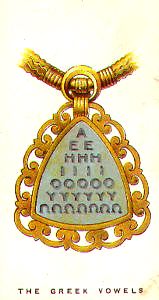
Your Charm for April 30th is The Greek Vowels

Your Charm for Today

The Greek Vowels

Today’s Meaning:
This aspect will be influenced by a sudden strong stroke of good fortune. This good fortune will be unpredictable and will last only a short time. It will bring with it good health, happiness and success.


General Description:
This talisman was a great favorite in olden times, and was composed of the Seven Vowels of the Greek Alphabet. The desired favours were supposed to be granted upon the correct utterance of the forty-nin different sounds of the Seven Vowels, each vowel having seven distinct methods of expression. Of the many benefits supposed to be conferred were – good health, happiness, wisdom, fortune, foresight, success in all undertakings, complete protection from moral, as well as physical ills, and control over the powers of darkness. The ancients thought that there was an affinity between the seven vowels and the seven planets which they believed kept this earth in existence.