
Discover the cosmos! Each day a different image or photograph of our fascinating universe is featured, along with a brief explanation written by a professional astronomer.
2022 May 3
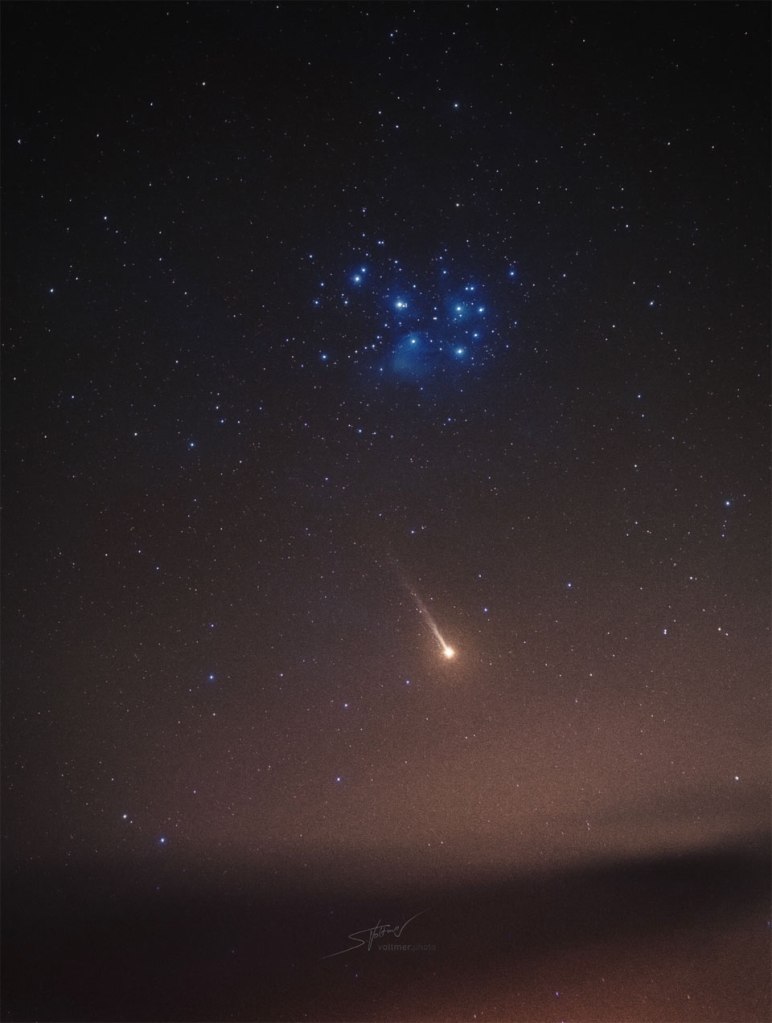
Mercury’s Sodium Tail
Image Credit & Copyright: Sebastian Voltmer
Explanation: That’s no comet. Below the Pleiades star cluster is actually a planet: Mercury. Long exposures of our Solar System’s innermost planet may reveal something unexpected: a tail. Mercury‘s thin atmosphere contains small amounts of sodium that glow when excited by light from the Sun. Sunlight also liberates these molecules from Mercury’s surface and pushes them away. The yellow glow from sodium, in particular, is relatively bright. Pictured, Mercury and its sodium tail are visible in a deep image taken last week from La Palma, Spain through a filter that primarily transmits yellow light emitted by sodium. First predicted in the 1980s, Mercury’s tail was first discovered in 2001. Many tail details were revealed in multiple observations by NASA‘s robotic MESSENGER spacecraft that orbited Mercury between 2011 and 2015. Tails, of course, are usually associated with comets.
 Witches Of The Craft®

This photo is just gorgeous! I had no idea that planets could produce a “tail” effect. I recently attended an Astronomy Class and it really piqued my interest in the movement of the planets. I wonder if there are any astrology topics related to this phenomena, I’d love more info about this
LikeLiked by 1 person
I am happy you found this picture gorgeous and informative. I will see if I can find more information about planet tails.
LikeLike