May 11 Astronomy Picture of the Day

Discover the cosmos! Each day a different image or photograph of our fascinating universe is featured, along with a brief explanation written by a professional astronomer.

2022 May 11
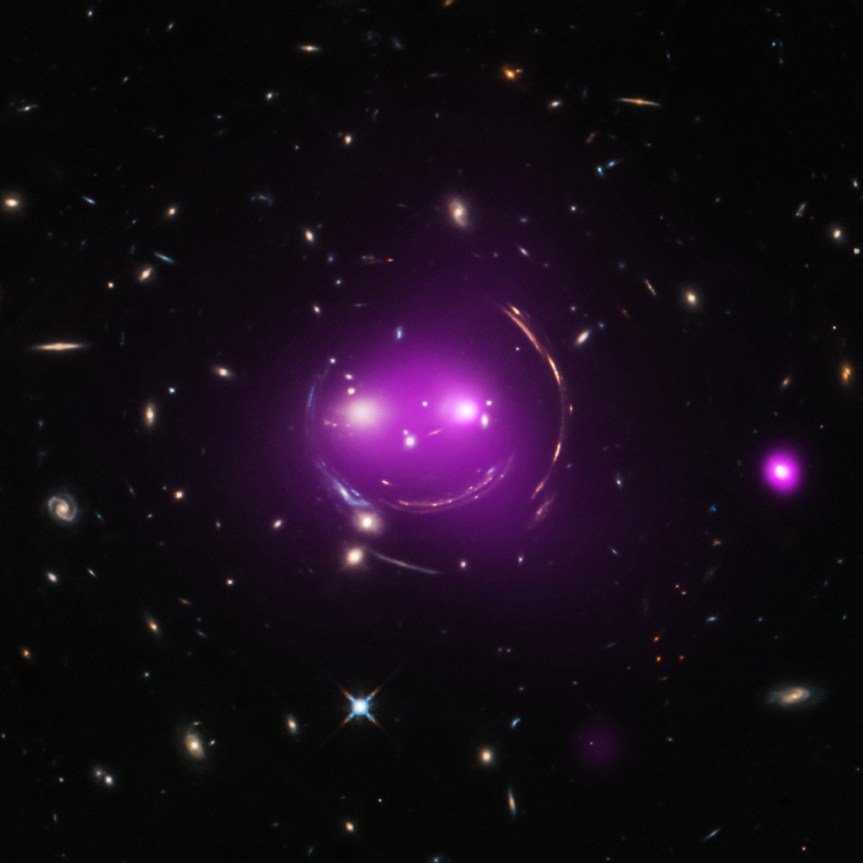
Astronomers think that in the future the “Cheshire Cat” group will become what is known as a fossil group, a gathering of galaxies that contains one giant elliptical galaxy and other much smaller, fainter ones. Today, researchers know each “eye” galaxy is the brightest member of its own group of galaxies and these two groups are racing toward one another at over 300,000 miles per hour. Data from Chandra (purple), which has been combined with optical data from Hubble, show hot gas that has been heated to millions of degrees, which is evidence that the galaxy groups are slamming into one another. Chandra’s X-ray data also reveal that the left “eye” of the Cheshire Cat group contains an actively feeding supermassive black hole at the center of the galaxy.

Gravity’s Grin

Image Credit: X-ray – NASA / CXC / J. Irwin et al. ; Optical – NASA/STScI

Explanation: Albert Einstein’s general theory of relativity, published over 100 years ago, predicted the phenomenon of gravitational lensing. And that’s what gives these distant galaxies such a whimsical appearance, seen through the looking glass of X-ray and optical image data from the Chandra and Hubble space telescopes. Nicknamed the Cheshire Cat galaxy group, the group’s two large elliptical galaxies are suggestively framed by arcs. The arcs are optical images of distant background galaxies lensed by the foreground group’s total distribution of gravitational mass. Of course, that gravitational mass is dominated by dark matter. The two large elliptical “eye” galaxies represent the brightest members of their own galaxy groups which are merging. Their relative collisional speed of nearly 1,350 kilometers/second heats gas to millions of degrees producing the X-ray glow shown in purple hues. Curiouser about galaxy group mergers? The Cheshire Cat group grins in the constellation Ursa Major, some 4.6 billion light-years away.

May 10 Astronomy Picture of the Day

Discover the cosmos! Each day a different image or photograph of our fascinating universe is featured, along with a brief explanation written by a professional astronomer.

2022 May 10

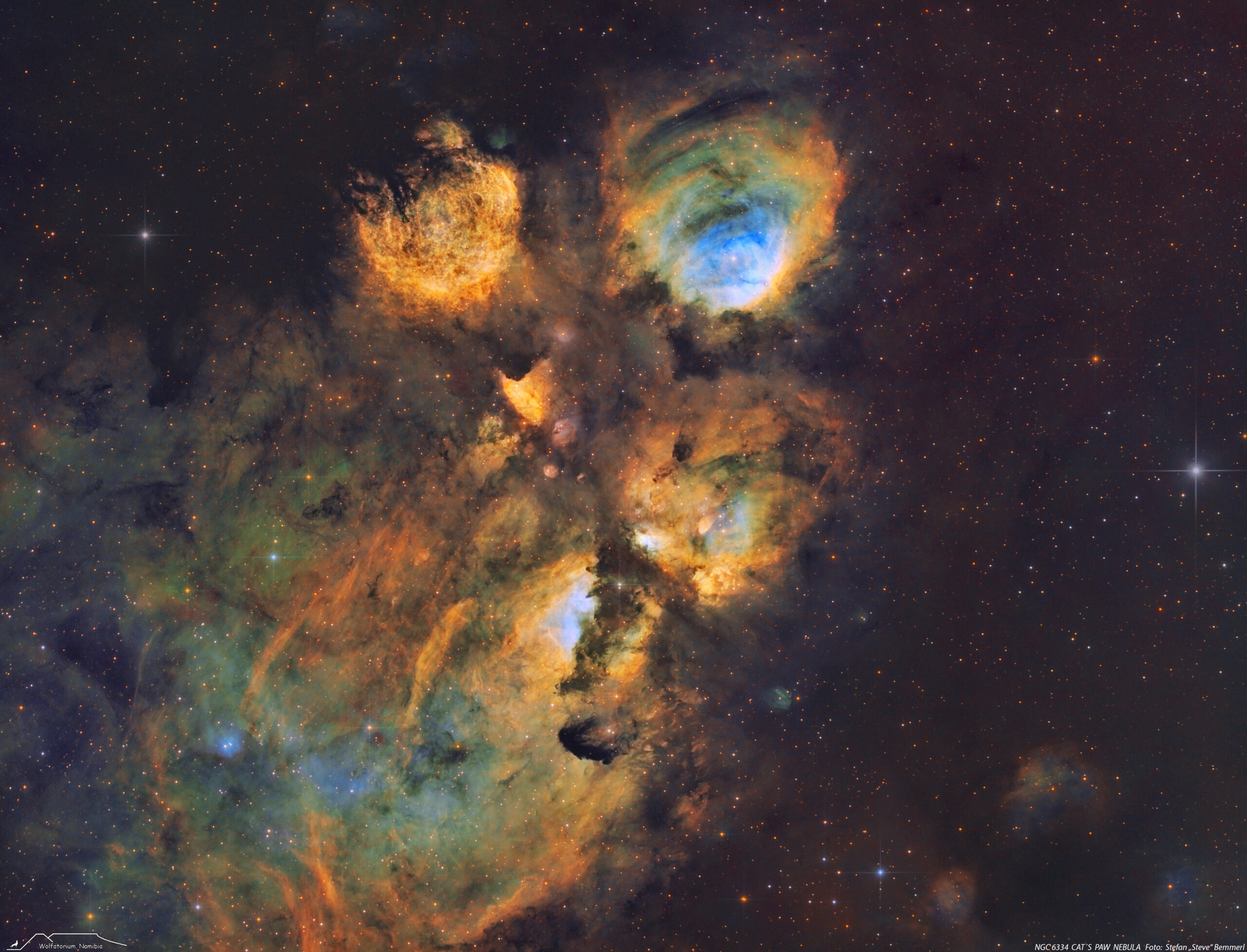
NGC 6334: The Cat’s Paw Nebula

Image Credit & Copyright: Stefan Steve Bemmerl & Team Wolfatorium (Hakos/Namibia)

Explanation: Nebulas are perhaps as famous for being identified with familiar shapes as perhaps cats are for getting into trouble. Still, no known cat could have created the vast Cat’s Paw Nebula visible toward the constellation of the Scorpion (Scorpius. At 5,500 light years distant, Cat’s Paw is an emission nebula with a red color that originates from an abundance of ionized hydrogen atoms. Alternatively known as the Bear Claw Nebula and cataloged as NGC 6334, stars nearly ten times the mass of our Sun have been born there in only the past few million years. Pictured here is a deep field image of the Cat’s Paw Nebula in light emitted by hydrogen, oxygen, and sulfur.


Explore Your Universe: Random APOD Generator

May 9 Astronomy Picture of the Day

Discover the cosmos! Each day a different image or photograph of our fascinating universe is featured, along with a brief explanation written by a professional astronomer.

2022 May 9

A Martian Eclipse: Phobos Crosses the Sun

Video Credit: NASAJPL-CaltechASU MSSSSSIExplanation: What’s that passing in front of the Sun? It looks like a moon, but it can’t be Earth’s Moon, because it isn’t round. It’s the Martian moon Phobos. The featured video was taken from the surface of Mars a month ago by the Perseverance rover. Phobos, at 11.5 kilometers across, is 150 times smaller than Luna (our moon) in diameter, but also 50 times closer to its parent planet. In fact, Phobos is so close to Mars that it is expected to break up and crash into Mars within the next 50 million years. In the near term, the low orbit of Phobos results in more rapid solar eclipses than seen from Earth. The featured video is shown in real time — the transit really took about 40 seconds,as shown. The videographer — the robotic rover Perseverance (Percy) — continues to explore Jezero Crater on Mars, searching not only for clues to the watery history of the now dry world, but evidence of ancient microbial life.


New Social Mirror: APOD now available on mastodon

May 7 Astronomy Picture of the Day

Discover the cosmos! Each day a different image or photograph of our fascinating universe is featured, along with a brief explanation written by a professional astronomer.

2022 May 7

Firefall by Moonlight

Image Credit & Copyright: Tara Mostofi

Explanation: On certain dates in February, an elusive firefall can be spotted at sunset in Yosemite National Park, when water flows, the weather cooperates and the direction to the setting Sun is just right. Often photographed from vantage points below, at the right moment the park’s seasonal Horsetail Fall is isolated in the shadows of the steep walls of El Capitan. Then, still illuminated with rays of reddened sunlight the waterfall briefly takes on a dramatic, fiery appearance. But a Horsetail firefall can be photographed by moonlight too. Even more elusive by moonlight, the firefall effect can also be seen when a bright Moon sets at the right direction along the western horizon. And skies were clear enough for this well-planned imaging of an ephemeral Horsetail firefall, lit by a bright gibbous Moon setting in the early morning hours of April 15.

May 6 Astronomy Picture of the Day

Discover the cosmos! Each day a different image or photograph of our fascinating universe is featured, along with a brief explanation written by a professional astronomer.

2022 May 6

NGC 3572 and the Southern Tadpoles

Image Credit & Copyright: Carlos Taylor

Explanation: This cosmic skyscape features glowing gas and dark dust clouds along side the young stars of NGC 3572. A beautiful emission nebula and star cluster it sails far southern skies within the nautical constellation Carina. Stars from NGC 3572 are toward top center in the telescopic frame that would measure about 100 light-years across at the cluster’s estimated distance of 9,000 light-years. The visible interstellar gas and dust is part of the star cluster’s natal molecular cloud. Dense streamers of material within the nebula, eroded by stellar winds and radiation, clearly trail away from the energetic young stars. They are likely sites of ongoing star formation with shapes reminiscent of the Tadpoles of IC 410 better known to northern skygazers. In the coming tens to hundreds of millions of years, gas and stars in the cluster will be dispersed though, by gravitational tides and by violent supernova explosions that end the short lives of the massive cluster stars.

May 5 Astronomy Picture of the Day

Discover the cosmos! Each day a different image or photograph of our fascinating universe is featured, along with a brief explanation written by a professional astronomer.

2022 May 5

NGC 3521: Galaxy in a Bubble

Image Credit & Copyright: Mark Hanson and Mike Selby

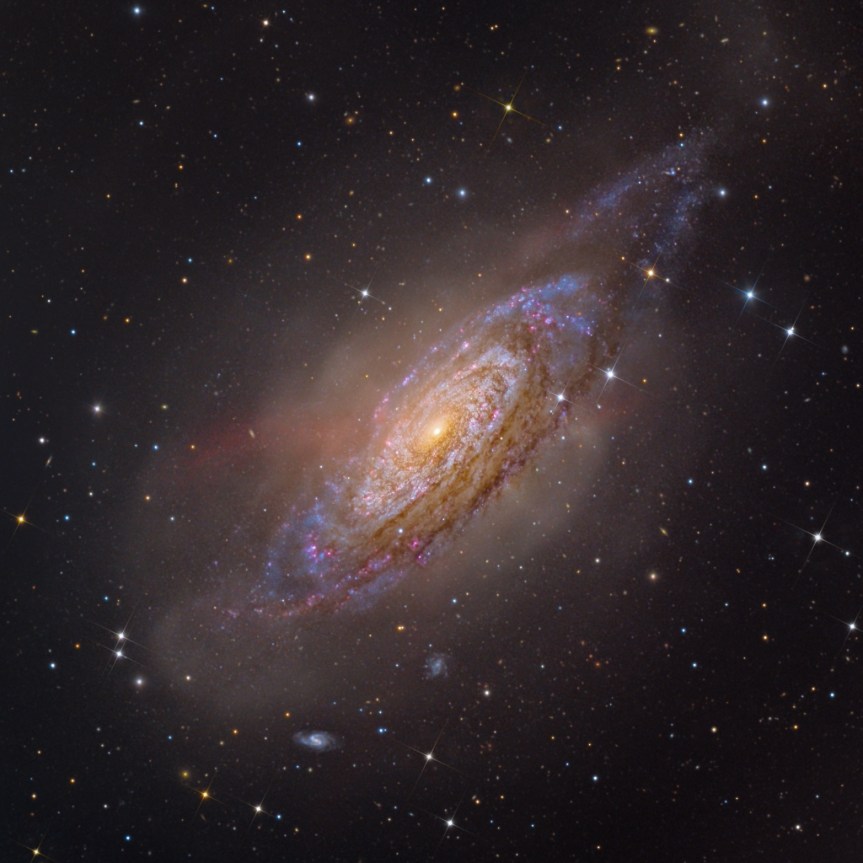
Explanation: Gorgeous spiral galaxy NGC 3521 is a mere 35 million light-years away, toward the northern springtime constellation Leo. Relatively bright in planet Earth’s sky, NGC 3521 is easily visible in small telescopes but often overlooked by amateur imagers in favor of other Leo spiral galaxies, like M66 and M65. It’s hard to overlook in this colorful cosmic portrait though. Spanning some 50,000 light-years the galaxy sports characteristic patchy, irregular spiral arms laced with dust, pink star forming regions, and clusters of young, blue stars. This deep image also finds NGC 3521 embedded in fainter, gigantic, bubble-like shells. The shells are likely tidal debris, streams of stars torn from satellite galaxies that have undergone mergers with NGC 3521 in the distant past.

May 4 Astronomy Picture of the Day

Discover the cosmos! Each day a different image or photograph of our fascinating universe is featured, along with a brief explanation written by a professional astronomer.

2022 May 4

Planets Over Egyptian Pyramid

Image Credit & Copyright: Osama Fatehi

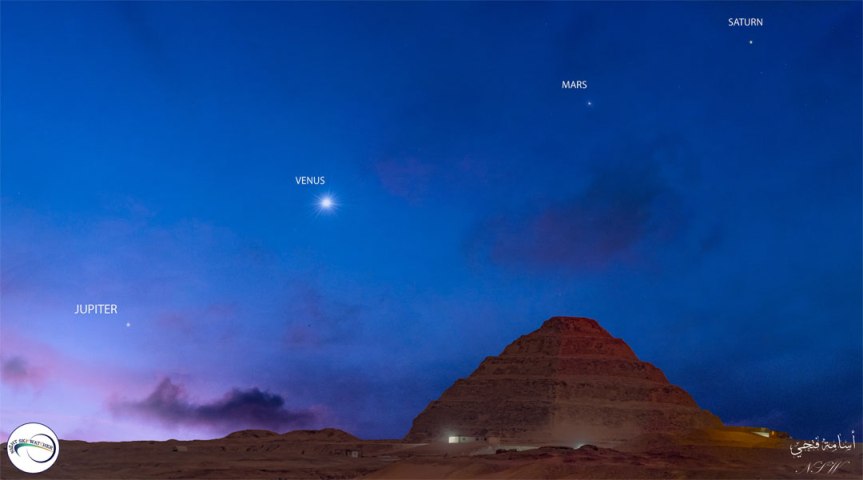
Explanation: The early morning planet parade continues. Visible the world over, the planets Jupiter, Venus, Mars and Saturn have been lining up in the pre-dawn sky since mid-April. In the featured image taken last month, these planets were captured over the Step Pyramid of Djoser, a UNESCO World Heritage Site. Located in the Saqqara necropolis of Egypt, the pyramid was constructed in the 27th century BC and is one of the oldest pyramids known. The two-image composite includes a foreground image taken during evening blue hour, and a background image captured from the same location the following morning. The morning planet line-up is slowly changing. At the end of last month, planets Jupiter and Venus switched places, while at the end of this month, Jupiter and Mars will switch after passing within one-degree of each other. Of course, this picturesque planetary angular alignment is a coincidence, as all of these worlds continue to orbit the Sun as they have for billions of years, well before even the ancient Pyramid of Djoser was built.


Notable Submissions to APOD: Morning Planet Parade 2022

May 3 Astronomy Picture of the Day

Discover the cosmos! Each day a different image or photograph of our fascinating universe is featured, along with a brief explanation written by a professional astronomer.

2022 May 3

Mercury’s Sodium Tail

Image Credit & Copyright: Sebastian Voltmer

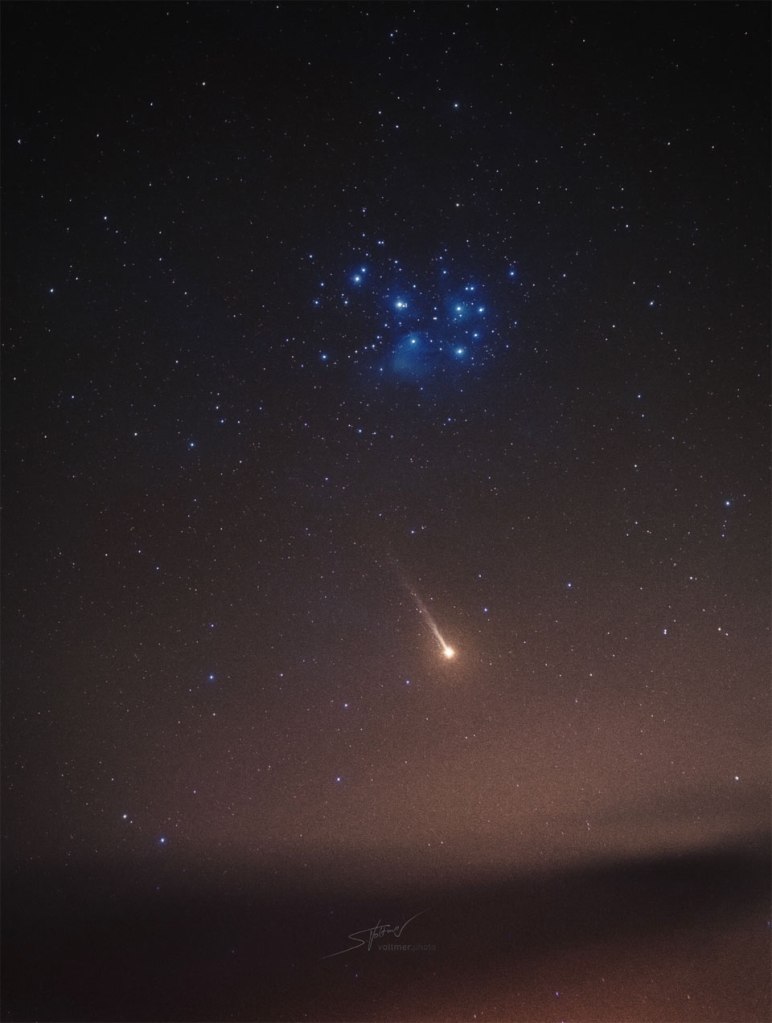
Explanation: That’s no comet. Below the Pleiades star cluster is actually a planet: Mercury. Long exposures of our Solar System’s innermost planet may reveal something unexpected: a tail. Mercury‘s thin atmosphere contains small amounts of sodium that glow when excited by light from the Sun. Sunlight also liberates these molecules from Mercury’s surface and pushes them away. The yellow glow from sodium, in particular, is relatively bright. Pictured, Mercury and its sodium tail are visible in a deep image taken last week from La PalmaSpain through a filter that primarily transmits yellow light emitted by sodium. First predicted in the 1980s, Mercury’s tail was first discovered in 2001. Many tail details were revealed in multiple observations by NASA‘s robotic MESSENGER spacecraft that orbited Mercury between 2011 and 2015. Tails, of course, are usually associated with comets.

May 2 Astronomy Picture of the Day

Discover the cosmos! Each day a different image or photograph of our fascinating universe is featured, along with a brief explanation written by a professional astronomer.

2022 May 2

Partial Solar Eclipse over Argentina

Image Credit & Copyright: Aixa Andrada

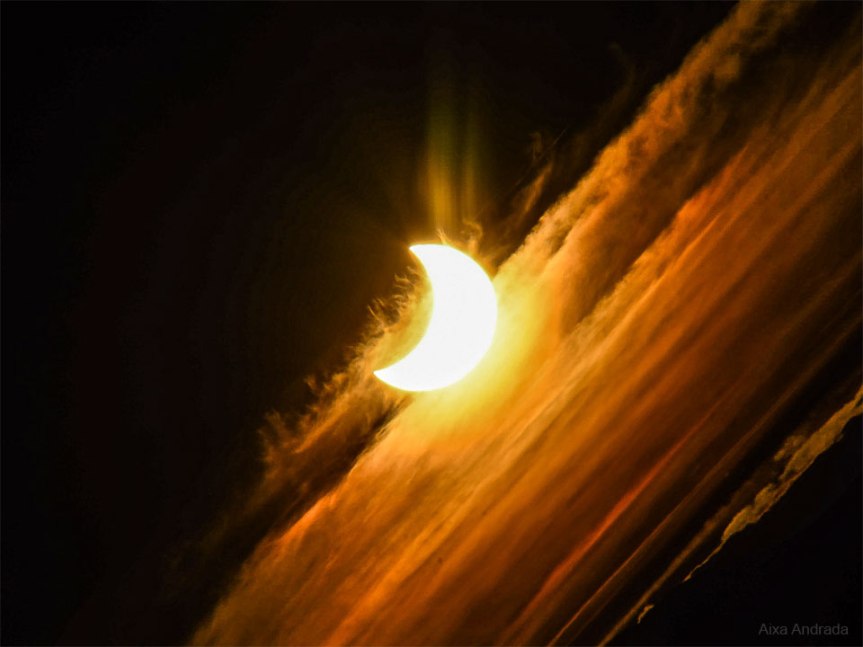
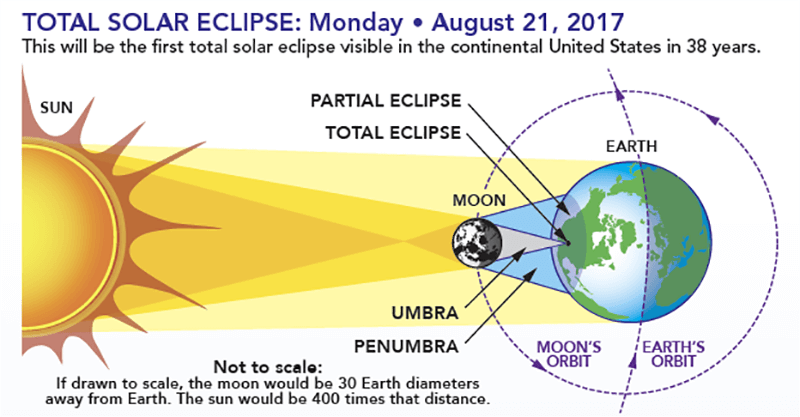
Explanation: What’s happened to the Sun? Two days ago, parts of South America were treated to a partial solar eclipse — where the Moon blocked out part of the Sun. The featured image shows an image of the partially eclipsed Sun through clouds as it was setting over PatagoniaArgentina. In the tilted image, Earth is toward the right. During the eclipse, the Moon moved partly between Earth and the Sun. Although a visually impressive sight, the slight dimming of surroundings during this partial eclipse was less noticeable than dimming created by a thick cloud. In about two weeks, all of South America and part of North America will experience a total lunar eclipse — where the Earth moves completely between the Moon and the Sun. In about two years, a total solar eclipse will cross North America.

May 1 Astronomy Picture of the Day

Discover the cosmos! Each day a different image or photograph of our fascinating universe is featured, along with a brief explanation written by a professional astronomer.

2022 May 1

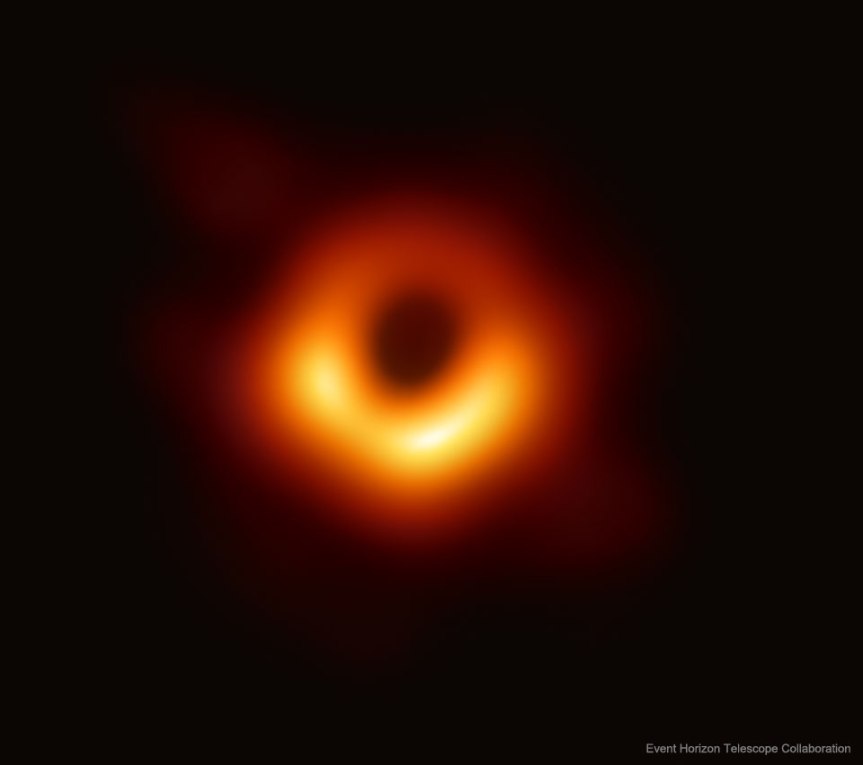
First Horizon-Scale Image of a Black Hole

Image Credit: Event Horizon Telescope Collaboration

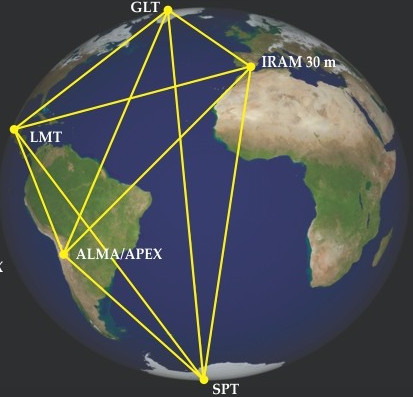
Explanation: What does a black hole look like? To find out, radio telescopes from around the Earth coordinated observations of black holes with the largest known event horizons on the sky. Alone, black holes are just black, but these monster attractors are known to be surrounded by glowing gas. This first image resolves the area around the black hole at the center of galaxy M87 on a scale below that expected for its event horizonPictured, the dark central region is not the event horizon, but rather the black hole’s shadow — the central region of emitting gas darkened by the central black hole’s gravity. The size and shape of the shadow is determined by bright gas near the event horizon, by strong gravitational lensing deflections, and by the black hole’s spin. In resolving this black hole’s shadow, the Event Horizon Telescope (EHT) bolstered evidence that Einstein’s gravity works even in extreme regions, and gave clear evidence that M87 has a central spinning black hole of about 6 billion solar masses. Since releasing this featured image in 2019, the EHT has expanded to include more telescopes, observe more black holes, track polarized light,and is working to observe the immediately vicinity of the black hole in the center of our Milky Way Galaxy.


This week is: Black Hole Week
New EHT Results to be Announced: Next Thursday

April 30 Astronomy Picture of the Day

Discover the cosmos! Each day a different image or photograph of our fascinating universe is featured, along with a brief explanation written by a professional astronomer.

2022 April 30

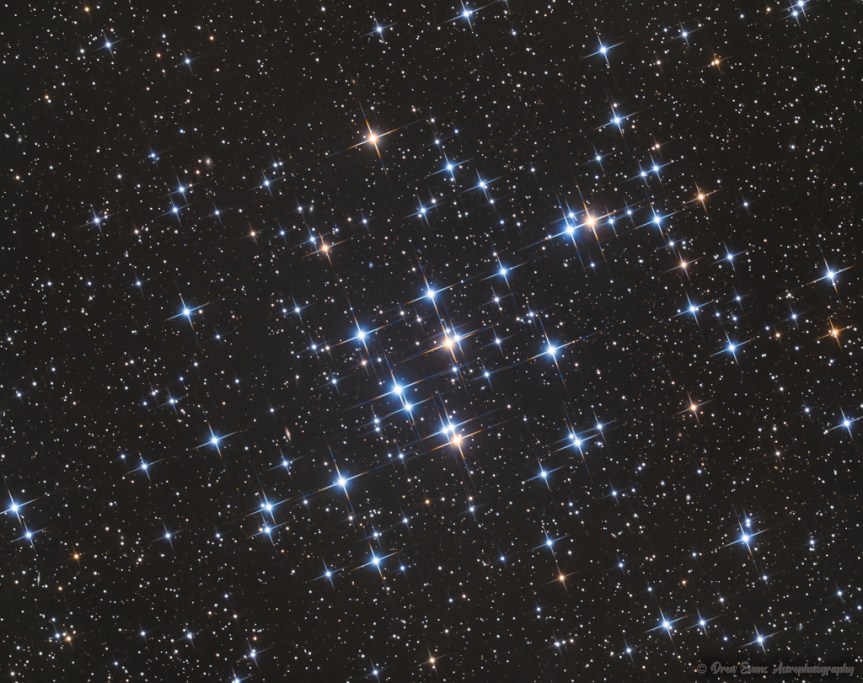
M44: The Beehive Cluster

Image Credit & Copyright: Drew Evans

Explanation: A mere 600 light-years away, M44 is one of the closest star clusters to our solar system. Also known as the Praesepe or the Beehive cluster its stars are young though, about 600 million years old compared to our Sun’s 4.5 billion years. Based on similar ages and motion through space, M44 and the even closer Hyades star cluster in Taurus are thought to have been born together in the same large molecular cloud. An open cluster spanning some 15 light-years, M44 holds 1,000 stars or so and covers about 3 full moons (1.5 degrees) on the sky in the constellation Cancer. Visible to the unaided eye, M44 has been recognized since antiquity. Described as a faint cloud or celestial mist long before being included as the 44th entry in Charles Messier’s 18th century catalog, the cluster was not resolved into its individual stars until telescopes were available. A popular target for modern, binocular-equipped sky gazers, the cluster’s few yellowish tinted, cool, red giants are scattered through the field of its brighter hot blue main sequence stars in this telescopic group snapshot. Dramatic diffraction spikes highlighting the brighter cluster members were created with string crossed in front of the telescope’s objective lens.

April 29 Astronomy Picture of the Day

Discover the cosmos! Each day a different image or photograph of our fascinating universe is featured, along with a brief explanation written by a professional astronomer.

2022 April 29

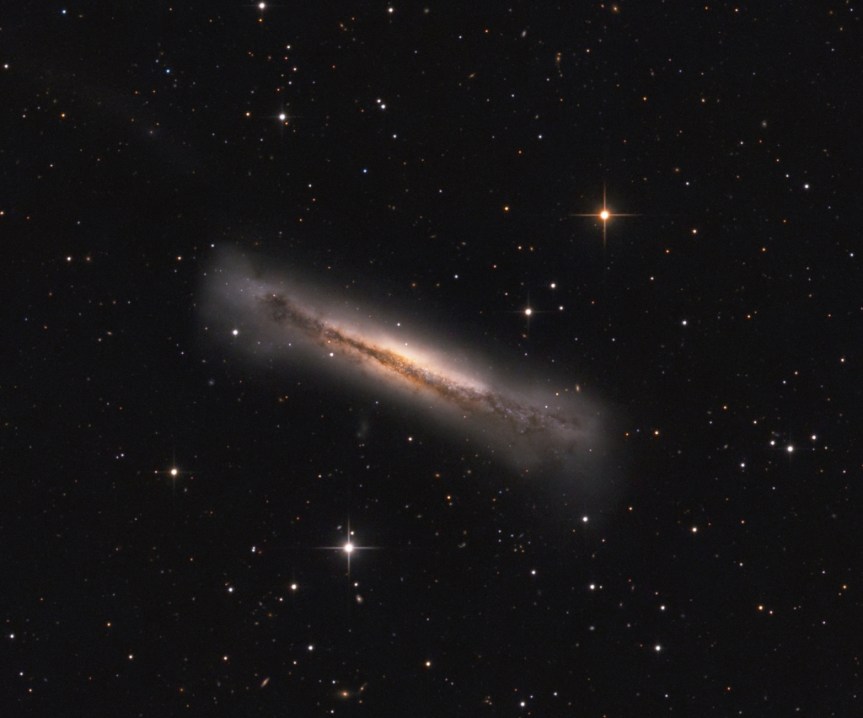
Portrait of NGC 3628

Image Credit & Copyright: Wilhelm Michael Kasakow, Olaf Guillaume

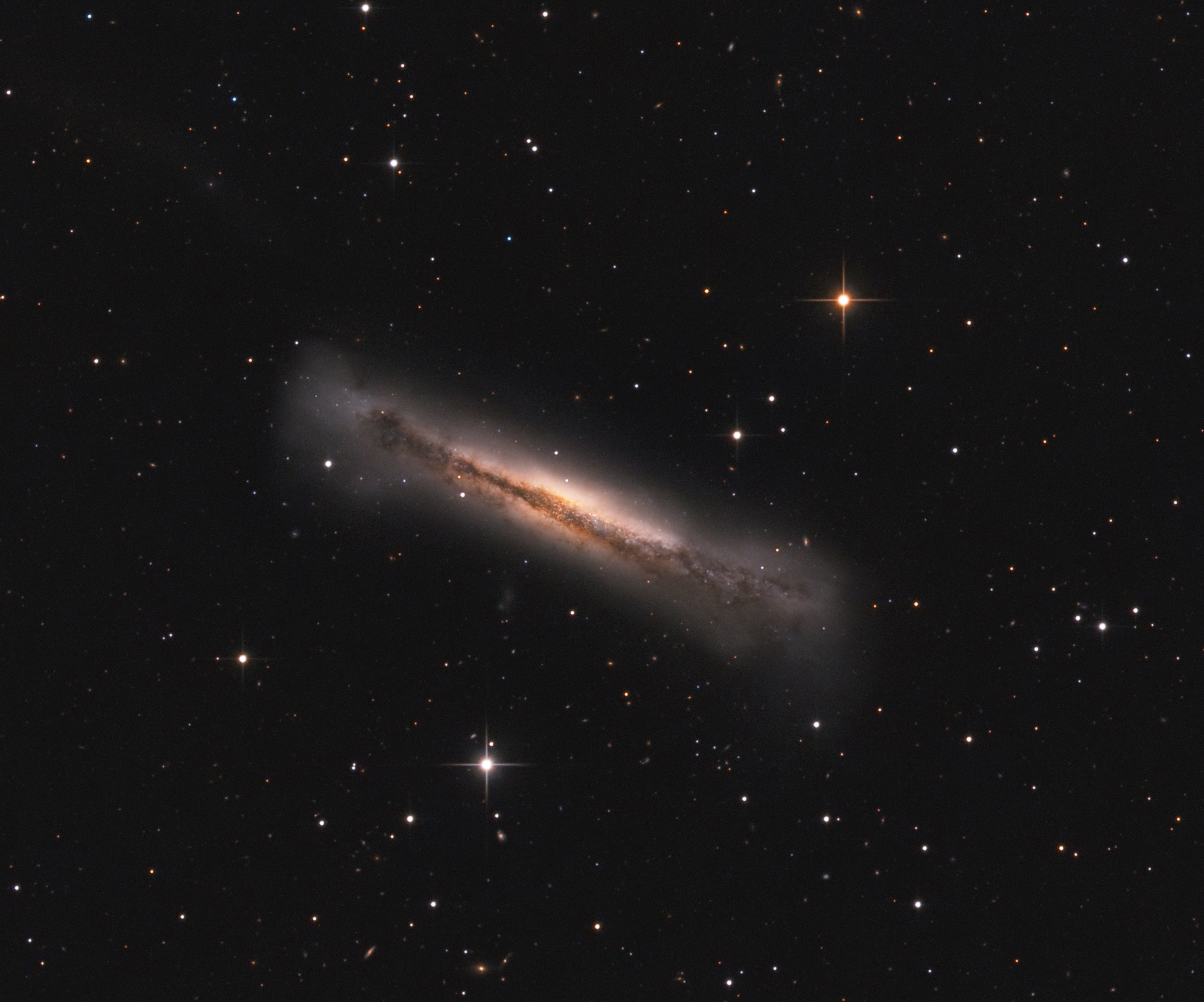
Explanation: Sharp telescopic views of NGC 3628 show a puffy galactic disk divided by dark dust lanes. Of course, this portrait of the magnificent, edge-on spiral galaxy puts some astronomers in mind of its popular moniker, the Hamburger Galaxy. It also reveals a small galaxy nearby (below), likely a satellite of NGC 3628, and a very faint but extensive tidal tail. The drawn out tail stretches for about 300,000 light-years, even beyond the upper left edge of the frame. NGC 3628 shares its neighborhood in the local universe with two other large spirals M65 and M66 in a grouping otherwise known as the Leo Triplet. Gravitational interactions with its cosmic neighbors are likely responsible for creating the tidal tail, as well as the extended flare and warp of this spiral’s disk. The tantalizing island universe itself is about 100,000 light-years across and 35 million light-years away in the northern springtime constellation Leo.

April 28 Astronomy Picture of the Day

Discover the cosmos! Each day a different image or photograph of our fascinating universe is featured, along with a brief explanation written by a professional astronomer.

2022 April 28

Lyrid of the Lake

Image Credit & Copyright: Jeff Dai (TWAN)

Explanation: In the early hours of April 24 this bright Lyrid meteor flashed along the central Milky Way. For a moment, it cast a bright reflection across Lake Nian, Yunnan province, China. The annual Lyrid meteor shower, one of the oldest known, is active in late April, as our fair planet plows through dust left along the orbit of long-period comet Thatcher. The trail of the bright fireball points back toward the shower’s radiant in the constellation Lyra high in the northern springtime sky and off the top of the frame. Just rising in that starry sky, light from a third quarter moon also cast a glow on the peaceful waters of the lake.

April 27 Astronomy Picture of the Day

Discover the cosmos! Each day a different image or photograph of our fascinating universe is featured, along with a brief explanation written by a professional astronomer.

2022 April 27

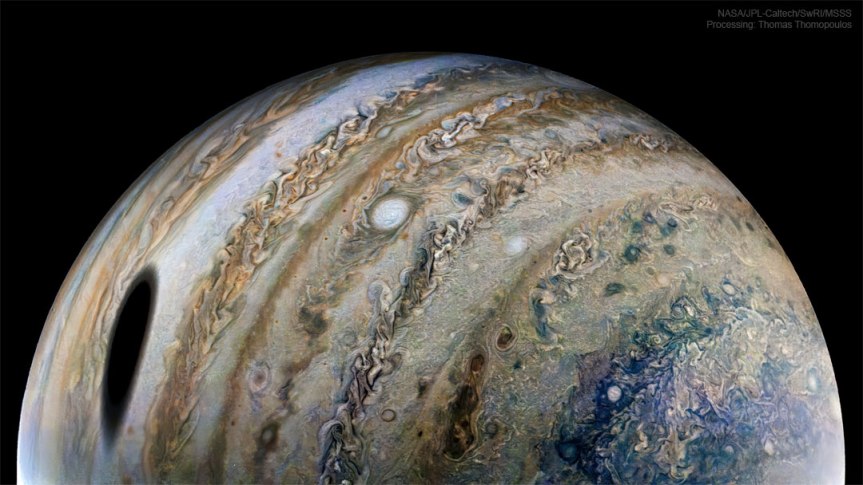
Moon Shadow on Jupiter

Image Credit: NASA/JPL-Caltech/SwRI/MSSSProcessing & LicenseThomas Thomopoulos

Explanation: What is that large dark spot on Jupiter? It’s the shadow of GanymedeJupiter‘s largest moon. When Jupiter’s moons cross between the Jovian giant and the Sun, they created shadows just like when the Earth’s moon crosses between the Earth and the Sun. Also like on Earth, if you were in a dark shadow on Jupiter, you would see a moon completely eclipse the Sun. Unlike on Earth, moon shadows occur most days on Jupiter — what’s more unusual is that a spacecraft was close enough to record one with a high-resolution image. That spacecraft, Juno, was passing so close to Jupiter in late February that nearby clouds and the dark eclipse shadow appear relatively large. Juno has made many discoveries about our Solar System‘s largest planet, including, recently, rapidly expanding circular auroras.


Explore Your Universe: Random APOD Generator

April 26 Astronomy Picture of the Day

Discover the cosmos! Each day a different image or photograph of our fascinating universe is featured, along with a brief explanation written by a professional astronomer.

2022 April 26

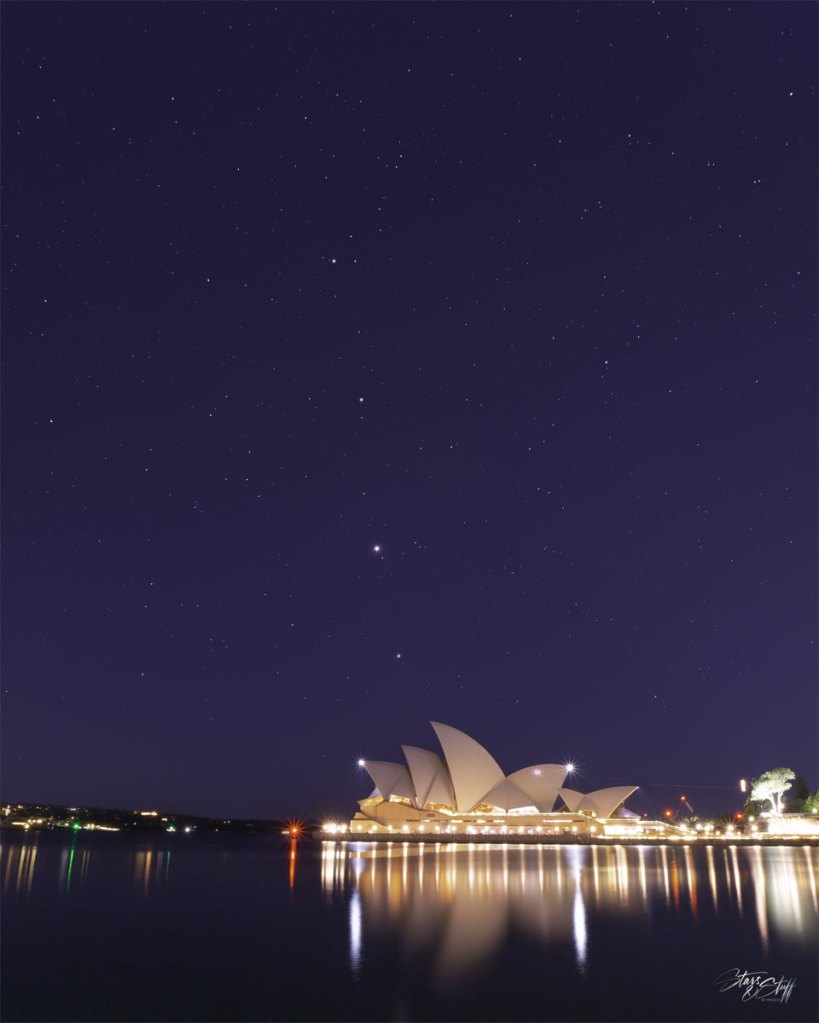
Planet Parade over Sydney Opera House

Image Credit & Copyright: Prasun Agrawal

Explanation: The world is waking up to a picturesque planet parade. Just before dawn, the eastern skies over much of planet Earth are decorated by a notable line of familiar planets. In much of Earth’s northern hemisphere, this line of planets appears most nearly horizontal, but in much of Earth’s southern hemisphere, the line appears more nearly vertical. Pictured over the Sydney Opera House in southern Australia, the planet line was captured nearly vertical about five days ago. From top to bottom, the morning planets are SaturnMarsVenus, and Jupiter. As April ends, the angular distance between Venus and Jupiter will gradually pass below a degree as they switch places. Then, as May ends, Jupiter will pass near Mars as those two planets switch places. In June, the parade will briefly expand to include Mercury.


Notable Submissions to APOD: Morning Planet Parade 2022

April 25 Astronomy Picture of the Day

Discover the cosmos! Each day a different image or photograph of our fascinating universe is featured, along with a brief explanation written by a professional astronomer.

2022 April 25

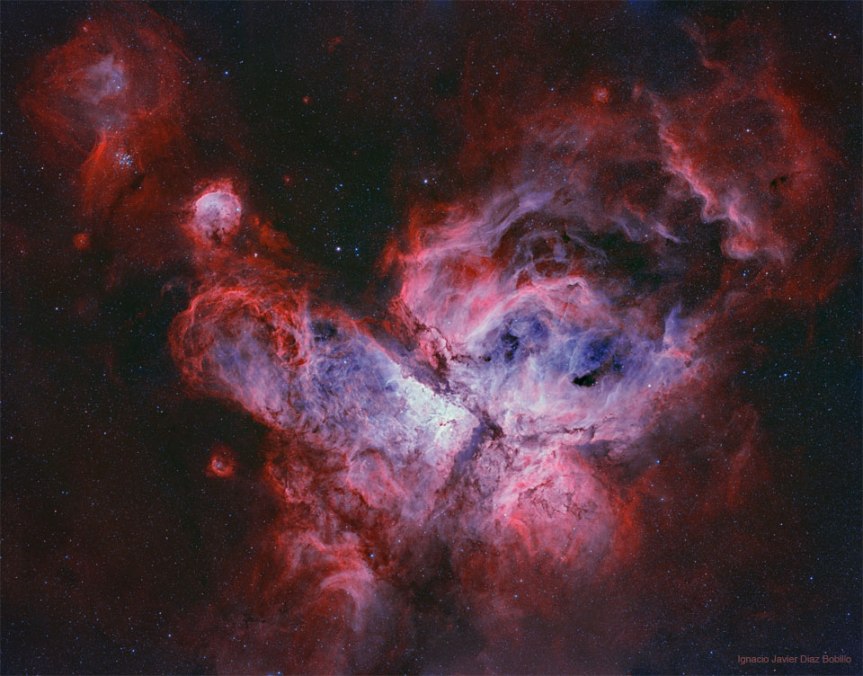
The Great Nebula in Carina

Image Credit & Copyright: Ignacio Javier Diaz Bobillo

Explanation: In one of the brightest parts of Milky Way lies a nebula where some of the oddest things occur. NGC 3372, known as the Great Nebula in Carina, is home to massive stars and changing nebulas. The Keyhole Nebula (NGC 3324), the bright structure just below the image center, houses several of these massive stars. The entire Carina Nebulacaptured here, spans over 300 light years and lies about 7,500 light-years away in the constellation of CarinaEta Carinae, the most energetic star in the nebula, was one of the brightest stars in the sky in the 1830s, but then faded dramatically. While Eta Carinae itself maybe on the verge of a supernova explosion, X-ray images indicate that much of the Great Nebula in Carina has been a veritable supernova factory.

April 24 Astronomy Picture of the Day

Discover the cosmos! Each day a different image or photograph of our fascinating universe is featured, along with a brief explanation written by a professional astronomer.

2022 April 24

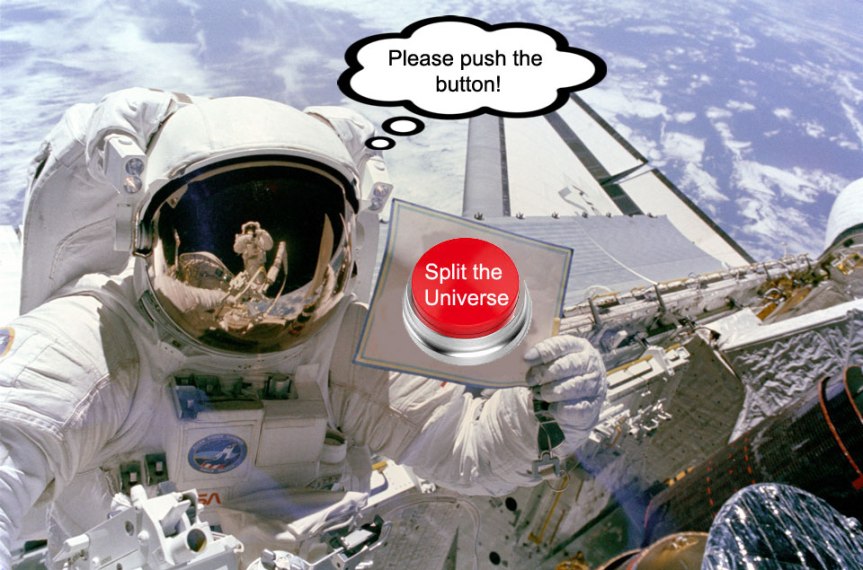
Split the Universe

Image Credit: NASA, Erwin Schrödinger’s cat

Explanation: Just now, before you hit the button, two future universes are possible. After pressing the button, though, you will live in only one. A real-web version of the famous Schrödinger’s cat experiment clicking the red button in the featured astronaut image should transform that image into a picture of the same astronaut holding one of two cats — one living, or one dead. The timing of your click, combined with the wiring of your brain and the millisecond timing of your device, will all conspire together to create a result dominated, potentially, by the randomness of quantum mechanics. Some believe that your personally-initiated quantum decision will split the universe in two, and that both the live-cat and dead-cat universes exist in separate parts of a larger multiverse. Others believe that the result of your click will collapse the two possible universes into one — in a way that could not have been predicted beforehand. Yet others believe that the universe is classically deterministic, so that by pressing the button you did not really split the universe, but just carried out an action predestined since time began. We at APOD believe that however silly you may feel clicking the red button, and regardless of the outcome, you should have a thought-provoking day. Or two.

April 23 Astronomy Picture of the Day

Discover the cosmos! Each day a different image or photograph of our fascinating universe is featured, along with a brief explanation written by a professional astronomer.

2022 April 23

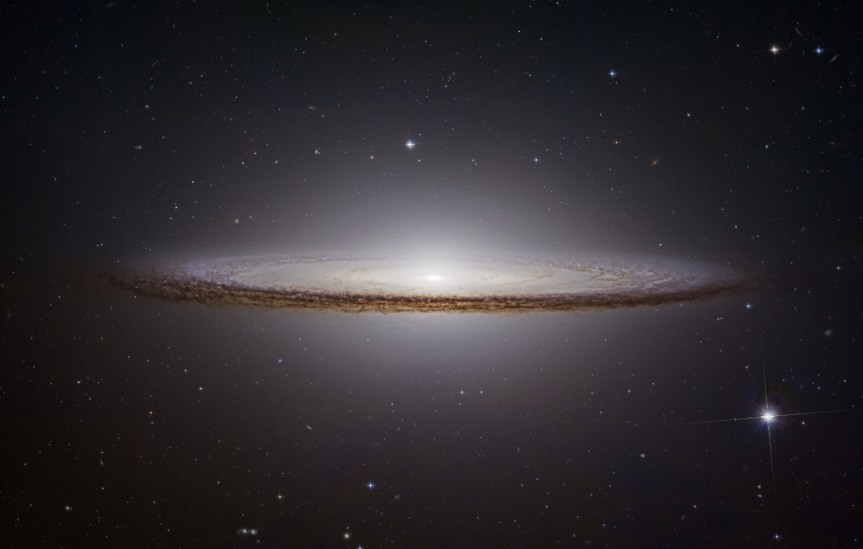
Messier 104

Image Credit: NASAESAHubble Legacy Archive;
Processing & Copyright: Ignacio Diaz Bobillo

Explanation: A gorgeous spiral galaxy, Messier 104 is famous for its nearly edge-on profile featuring a broad ring of obscuring dust lanes. Seen in silhouette against an extensive central bulge of stars, the swath of cosmic dust lends a broad brimmed hat-like appearance to the galaxy suggesting a more popular moniker, the Sombrero Galaxy. This sharp view of the well-known galaxy was made from over 10 hours of Hubble Space Telescope image data, processed to bring out faint details often lost in the overwhelming glare of M104’s bright central bulge. Also known as NGC 4594, the Sombrero galaxy can be seen across the spectrum, and is host to a central supermassive black hole. About 50,000 light-years across and 28 million light-years away, M104 is one of the largest galaxies at the southern edge of the Virgo Galaxy Cluster. Still, the spiky foreground stars in this field of view lie well within our own Milky Way.

April 22 Astronomy Picture of the Day

Discover the cosmos! Each day a different image or photograph of our fascinating universe is featured, along with a brief explanation written by a professional astronomer.

2022 April 22

Planet Earth at Twilight

Image Credit: ISS Expedition 2 CrewGateway to Astronaut Photography of EarthNASA

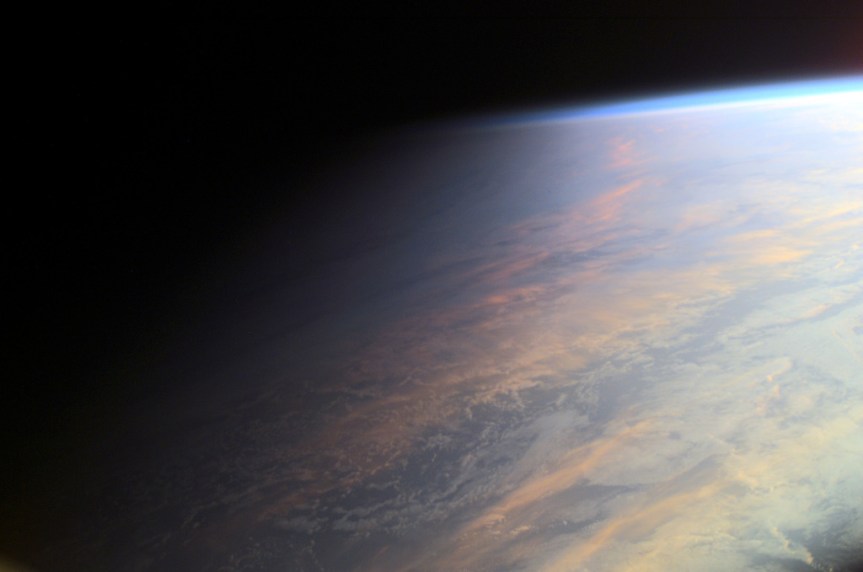
Explanation: No sudden, sharp boundary marks the passage of day into night in this gorgeous view of ocean and clouds over our fair planet Earth. Instead, the shadow line or terminator is diffuse and shows the gradual transition to darkness we experience as twilight. With the Sun illuminating the scene from the right, the cloud tops reflect gently reddened sunlight filtered through the dusty troposphere, the lowest layer of the planet’s nurturing atmosphere. A clear high altitude layer, visible along the dayside’s upper edge, scatters blue sunlight and fades into the blackness of space. This picture was taken in June of 2001 from the International Space Station orbiting at an altitude of 211 nautical miles. Of course from home, you can check out the Earth Now.


Celebrate: Today is Earth Day

April 21 Astronomy Picture of the Day

Discover the cosmos! Each day a different image or photograph of our fascinating universe is featured, along with a brief explanation written by a professional astronomer.

2022 April 21

Apollo 16 Moon Panorama

Image Credit: Apollo 16NASAPanorama Assembly: Mike Constantine

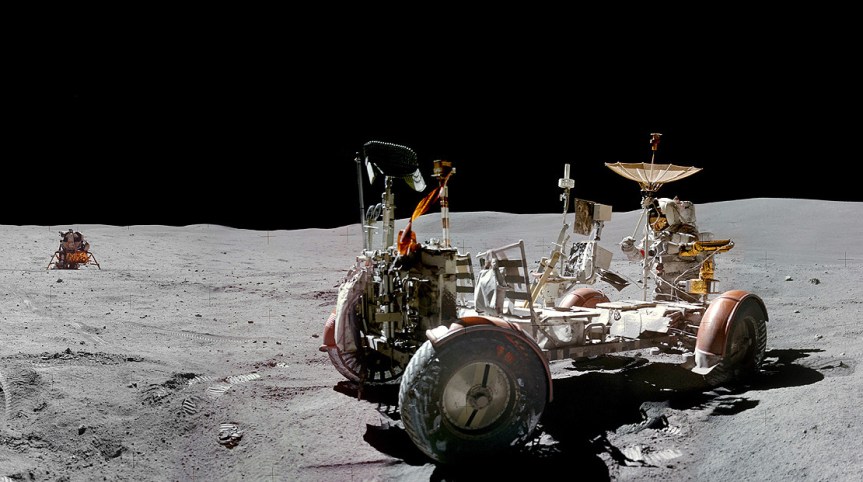
Explanation: Fifty years ago, April 20, 1972, Apollo 16’s lunar module Orion touched down on the Moon’s near side in the south-central Descartes Highlands. While astronaut Ken Mattingly orbited overhead in Casper the friendly command and service module the Orion brought John Young and Charles Duke to the lunar surface. The pair would spend nearly three days on the Moon. Constructed from images (AS16-117-18814 to AS16-117-18820) taken near the end of their third and final surface excursion this panoramic view puts the lunar module in the distance toward the left. Their electric lunar roving vehicle in the foreground, Duke is operating the camera while Young aims the high gain communications antenna skyward, toward planet Earth.


Celebrate: Earth Day