July 10 Astronomy Picture of the Day

Discover the cosmos! Each day a different image or photograph of our fascinating universe is featured, along with a brief explanation written by a professional astronomer.

2022 July 10
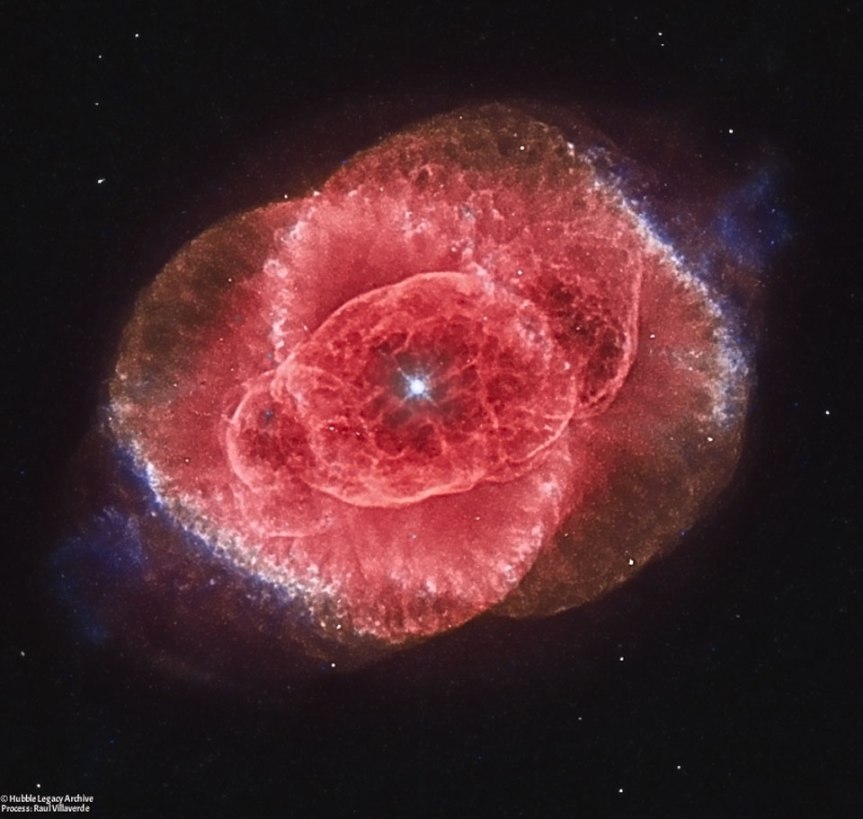
In the Center of the Cat’s Eye Nebula

Credit: NASAESAHubbleHLAReprocessing & Copyright: Raul Villaverde

Explanation: Three thousand light-years away, a dying star throws off shells of glowing gas. This image from the Hubble Space Telescope reveals the Cat’s Eye Nebula (NGC 6543), to be one of the most complex planetary nebulae known. Spanning half a light-year, the features seen in the Cat’s Eye are so complex that astronomers suspect the bright central object may actually be a binary star system. The term planetary nebula, used to describe this general class of objects, is misleading. Although these objects may appear round and planet-like in small telescopes, high resolution images with large telescopes reveal them to be stars surrounded by cocoons of gas blown off in the late stages of stellar evolutionGazing into this Cat’s Eye, astronomers may well be seeing more than detailed structure, they may be seeing the fate of our Sun, destined to enter its own planetary nebula phase of evolution … in about 5 billion years.
July 9 Astronomy Picture of the Day

Discover the cosmos! Each day a different image or photograph of our fascinating universe is featured, along with a brief explanation written by a professional astronomer.

2022 July 9

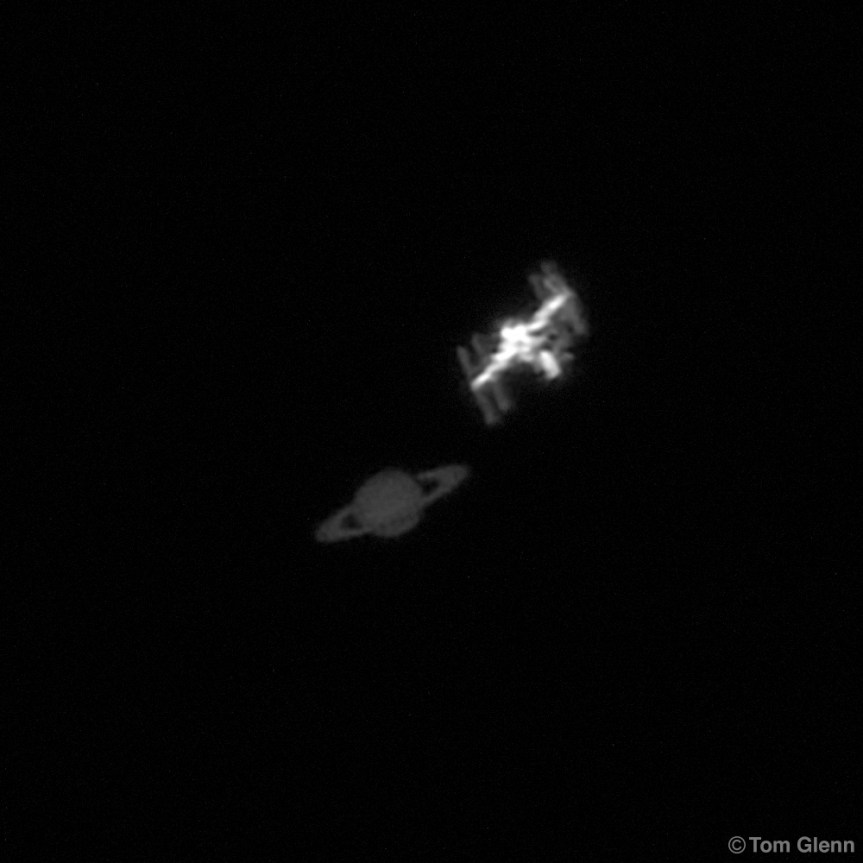
Saturn and the ISS

Image Credit & CopyrightTom Glenn

Explanation: Soaring high in skies around planet Earth, bright planet Saturn was a star of June’s morning planet parade. But very briefly on June 24 it posed with a bright object in low Earth orbit, the International Space Station. On that date from a school parking lot in Temecula, California the ringed-planet and International Space Station were both caught in this single high-speed video frame. Though Saturn was shining at +0.5 stellar magnitude the space station was an even brighter -3 on the magnitude scale. That difference in brightness is faithfully represented in the video capture frame. In the challenging image, the orbiting ISS was at a range of 602 kilometers. Saturn was about 1.4 billion kilometers from the school parking lot.

July 8 Astronomy Picture of the Day

Discover the cosmos! Each day a different image or photograph of our fascinating universe is featured, along with a brief explanation written by a professional astronomer.

2022 July 8

Roots on a Rotating Planet

Image Credit & CopyrightMarcella Giulia Pace

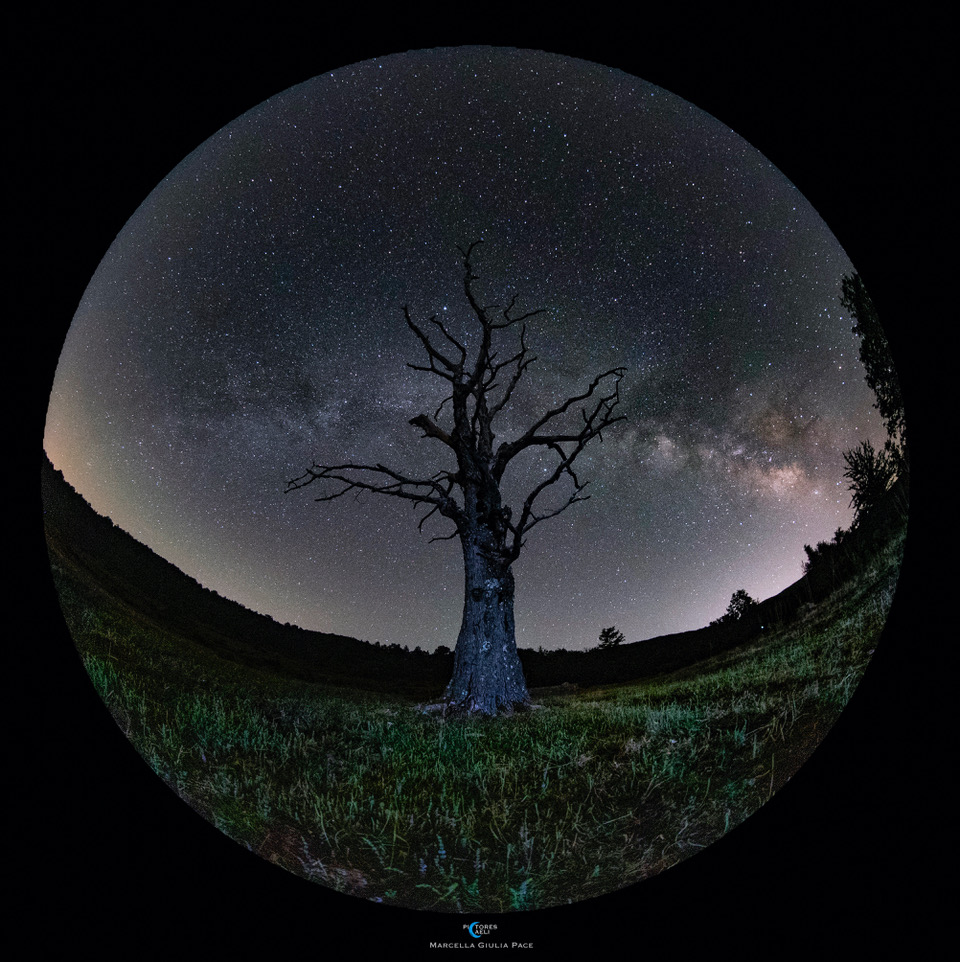
Explanation: With roots on a rotating planet, an old tree is centered in this sequence of 137 exposures each 20 seconds long, recorded one night from northern Sicily. Digital camera and fisheye lens were fixed to a tripod to capture the dramatic timelapse, so the stars trailed through the region’s dark sky. Of course that makes it easy to spot the planet’s north celestial pole. The extension of Earth’s axis of rotation into space is toward the upper left, at the center of the concentric star trail arcs. The Milky Way is there too. The plane of our galaxy stretches across the wide field of view from north to east (left to right) creating a broader luminous band of diffuse starlight.

July 7 Astronomy Picture of the Day

Discover the cosmos! Each day a different image or photograph of our fascinating universe is featured, along with a brief explanation written by a professional astronomer.

2022 July 7

The NGC 6914 Complex

Image Credit & CopyrightGiorgio Ferrari

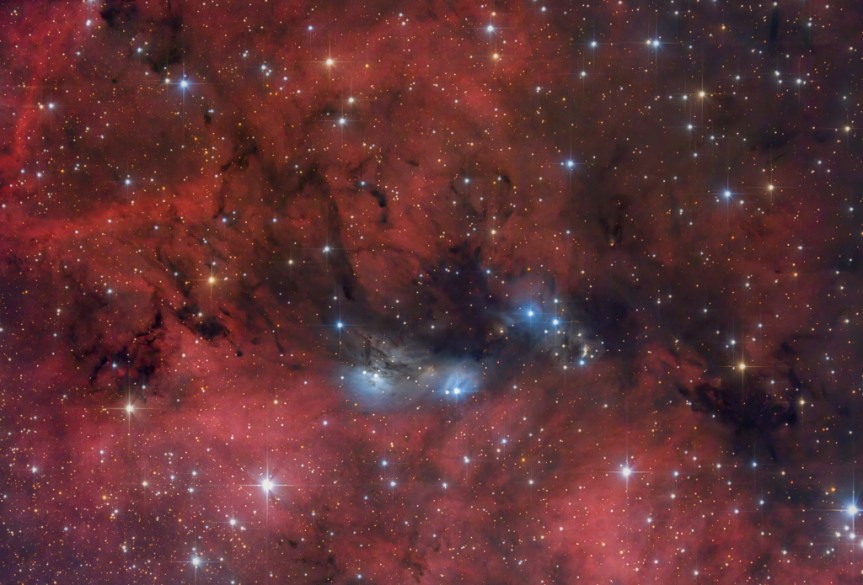
Explanation: A study in contrasts, this colorful skyscape features stars, dust, and glowing gas in the vicinity of NGC 6914. The interstellar complex of nebulae lies some 6,000 light-years away, toward the high-flying northern constellation Cygnus and the plane of our Milky Way Galaxy. Obscuring interstellar dust clouds appear in silhouette while reddish hydrogen emission nebulae, along with the dusty blue reflection nebulae, fill the cosmic canvas. Ultraviolet radiation from the massive, hot, young stars of the extensive Cygnus OB2 association ionize the region’s atomic hydrogen gas, producing the characteristic red glow as protons and electrons recombine. Embedded Cygnus OB2 stars also provide the blue starlight strongly reflected by the dust clouds. The over 1 degree wide telescopic field of view spans about 100 light-years at the estimated distance of NGC 6914.

July 6 Astronomy Picture of the Day

Discover the cosmos! Each day a different image or photograph of our fascinating universe is featured, along with a brief explanation written by a professional astronomer.

2022 July 6

Milky Way Motion in 3D from Gaia

Credit & LicenseESAGaiaDPACText: Ata Sarajedini (Florida Atlantic U.Astronomy Minute podcast)

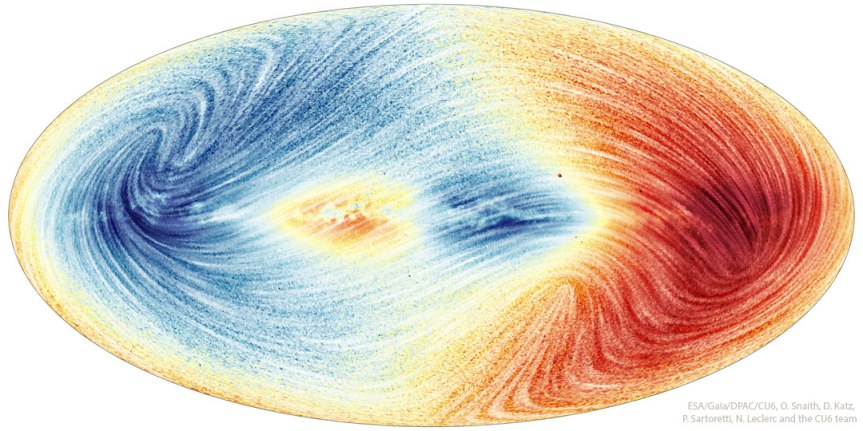
Explanation: Our sky is alive with the streams of stars. The motions of 26 million Milky Way stars are evident in the featured map constructed from recent data taken by ESA‘s Gaia satellite. Stars colored blue are moving toward us, while red indicates away. Lines depict the motion of the stars across the sky. The large blue on the left and red areas on the map’s right give the overall impression that stars in the Milky Way are rotating around the center. However, there is a region near the middle — caused by our own Sun’s motion relative to a rigidly-rotating central Galactic bar — that seems to reverse it. Understanding details about the motion of stars is helping humanity to better understand the complex history of our Milky Way galaxy and the origin of our Sun.

July 5 Astronomy Picture of the Day

Discover the cosmos! Each day a different image or photograph of our fascinating universe is featured, along with a brief explanation written by a professional astronomer.

2022 July 5

A Molten Galaxy Einstein Ring

Image Credit: ESA/Hubble & NASAS. JhaProcessing: Jonathan Lodge

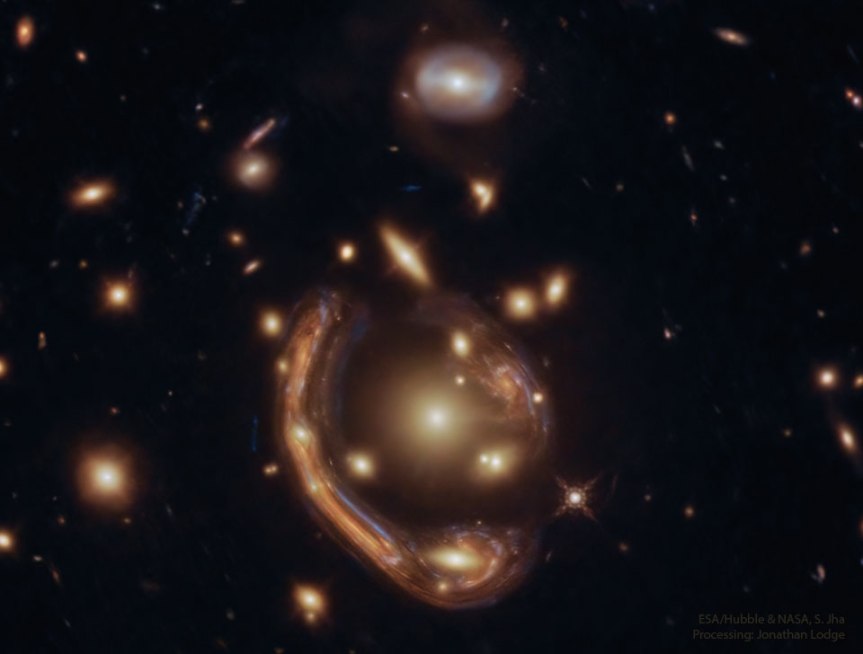
Explanation: It is difficult to hide a galaxy behind a cluster of galaxies. The closer cluster’s gravity will act like a huge lens, pulling images of the distant galaxy around the sides and greatly distorting them. This is just the case observed in the featured image recently re-processed image from the Hubble Space Telescope. The cluster GAL-CLUS-022058c is composed of many galaxies and is lensing the image of a yellow-red background galaxy into arcs seen around the image center. Dubbed a molten Einstein ring for its unusual shape, four images of the same background galaxy have been identified. Typically, a foreground galaxy cluster can only create such smooth arcs if most of its mass is smoothly distributed — and therefore not concentrated in the cluster galaxies visible. Analyzing the positions of these gravitational arcs gives astronomers a method to estimate the dark matter distribution in galaxy clusters, as well as infer when the stars in these early galaxies began to form.


New APOD Social Mirrors in Arabic: On FacebookInstagram, and Twitter

July 4 Astronomy Picture of the Day

Discover the cosmos! Each day a different image or photograph of our fascinating universe is featured, along with a brief explanation written by a professional astronomer.

2022 July 4

Strawberry Supermoon Over Devil’s Saddle

Image Credit & Copyright: Lorenzo Busilacchi

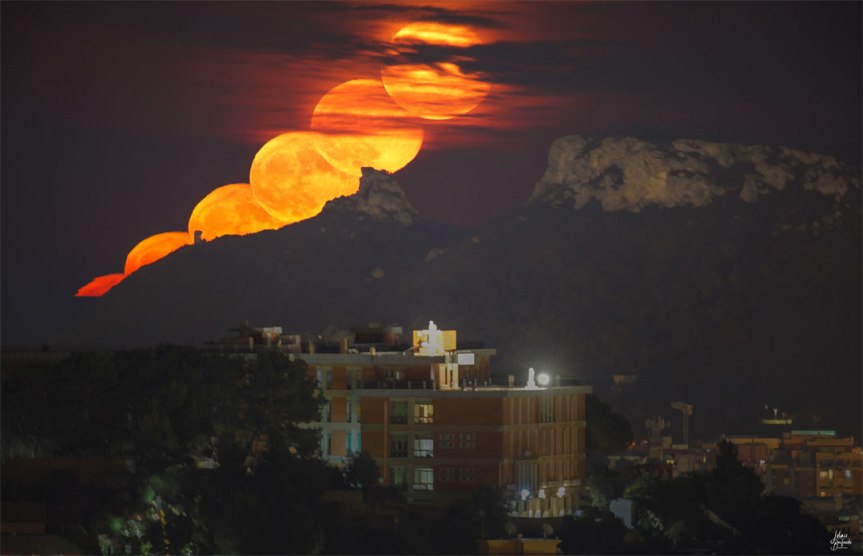
Explanation: Near the horizon the full moon often seems to loom large, swollen in appearance by the famous Moon illusion. But time-lapse image sequences demonstrate that the Moon’s angular size doesn’t really change as it rises or sets. Its color does, though. Recording a frame about every 60 seconds, this image also shows how red the Sun can look while low on the horizon. The featured montage was taken from CagliariSardiniaItaly, the day after June’s Strawberry Moon, a full moon dubbed a supermoon due to its slightly larger-than-usual angular size. This Strawberry Supermoon is seen rising behind the Devil’s Saddle, a mountain named for the unusual moon-sized dip seen just to the right of the rising moon. A shrinking line-of-sight through planet Earth’s dense and dusty atmosphere shifted the moonlight from strawberry red through honey-colored and paler yellowish hues. That change seems appropriate for a northern June Full Moon also known as the Strawberry or Honey Moon. A Thunder Supermoon — the third of four supermoons in 2022 — will occur later this month.


Today’s Adventure Link: Click on “Cagliari”

July 3 Astronomy Picture of the Day

Discover the cosmos! Each day a different image or photograph of our fascinating universe is featured, along with a brief explanation written by a professional astronomer.

2022 July 3

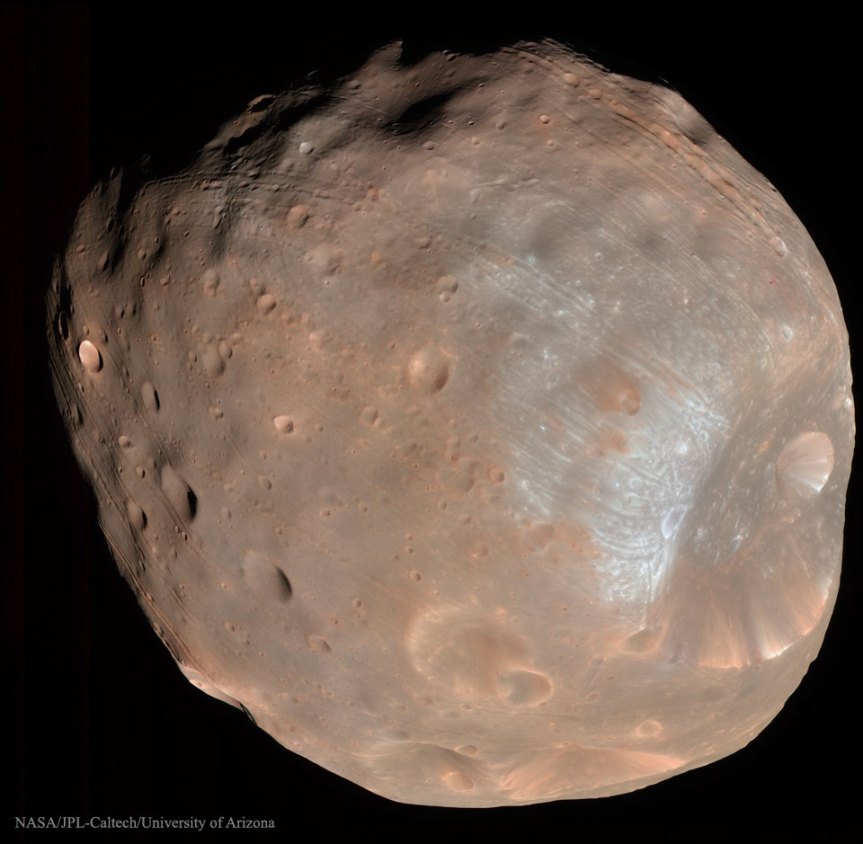
Phobos: Doomed Moon of Mars

Image Credit: HiRISEMROLPL (U. Arizona)NASA

Explanation: This moon is doomed. Mars, the red planet named for the Roman god of war, has two tiny moons, Phobos and Deimos, whose names are derived from the Greek for Fear and Panic. These martian moons may well be captured asteroids originating in the main asteroid belt between Mars and Jupiter or perhaps from even more distant reaches of our Solar System. The larger moon, Phobos, is indeed seen to be a cratered, asteroid-like object in this stunning color image from the robotic Mars Reconnaissance Orbiter, with objects as small as 10 meters visible. But Phobos orbits so close to Mars – about 5,800 kilometers above the surface compared to 400,000 kilometers for our Moon – that gravitational tidal forces are dragging it down. In perhaps 50 million years, Phobos is expected to disintegrate into a ring of debris.

July 2 Astronomy Picture of the Day

Discover the cosmos! Each day a different image or photograph of our fascinating universe is featured, along with a brief explanation written by a professional astronomer.

2022 July 2

Solargraphic Analemmas

Image Credit & CopyrightDawid Rycabel (Pinholove)

Explanation: For the northern hemisphere June 21 was the summer solstice, the Sun reaching its northernmost declination for the year. That would put it at the top of each of these three figure-8 curves, or analemmas, as it passed through the daytime sky over the village of Proboszczow, Poland. No sequence of digital exposures was used to construct the remarkable image though. Using a pinhole camera fixed to face south during the period June 26, 2021 to June 26, 2022, the image was formed directly on a single sheet of photographic paper, a technique known as solargraphy. The three analemmas are the result of briefly exposing the photo paper through the pinhole each day at 11:00, 12:00, and 13:00 CET. Groups of dashed lines on the sides show partial tracks of the Sun from daily exposures made every 15 minutes. Over the year-long solargraphic photo opportunity clouds blocking the Sun during the pinhole exposures created the dark gaps.

July 1 Astronomy Picture of the Day

Discover the cosmos! Each day a different image or photograph of our fascinating universe is featured, along with a brief explanation written by a professional astronomer.

2022 July 1

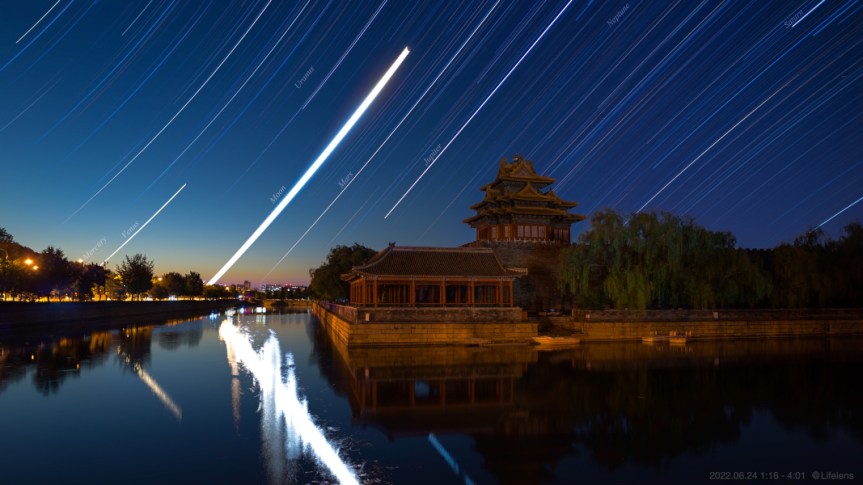
The Solar System’s Planet Trails

Image Credit & CopyrightZheng Zhi

Explanation: Stars trail through a clear morning sky in this postcard from a rotating planet. The timelapse image is constructed from consecutive exposures made over nearly three hours with a camera fixed to a tripod beside the Forbidden City in Beijing, China on June 24. Arcing above the eastern horizon after the series of exposures began, a waning crescent Moon left the brightest streak and watery reflection. On that date the planets of the Solar System were also lined up along the ecliptic and left their own trails before sunrise. Saturn was first to rise on that morning and the ringed planet’s trail starts close to the top right edge, almost out of the frame. Innermost planet Mercury rose only just before the Sun though. It left the shortest trail, visible against the twilight near the horizon at the far left. Uranus and Neptune are faint and hard to find, but mingled with the star trails the Solar System’s planet trails are all labeled in the scene.

June 30 Astronomy Picture of the Day

Discover the cosmos! Each day a different image or photograph of our fascinating universe is featured, along with a brief explanation written by a professional astronomer.

2022 June 30

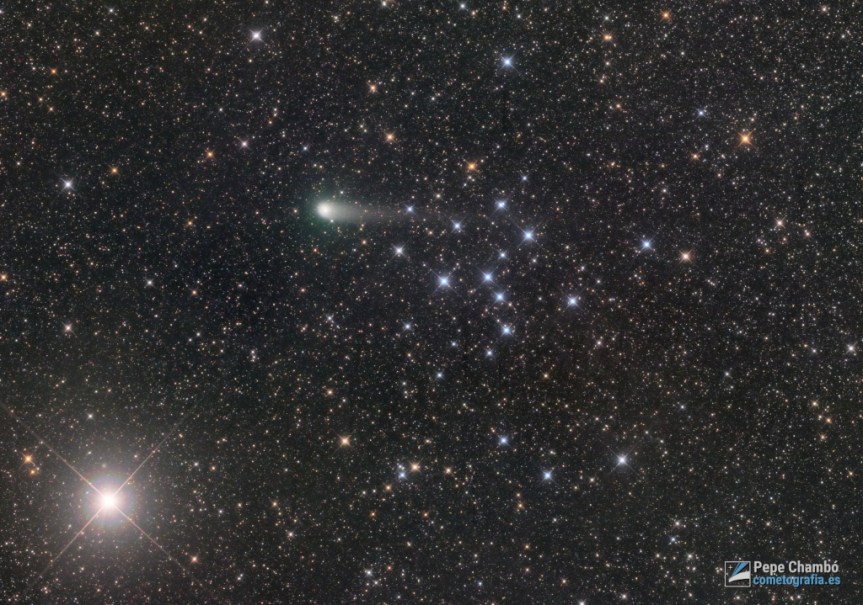
Comet C/2017 K2 (PanSTARRS)

Image Credit & CopyrightJose J. Chambo (Cometografia)

Explanation: Imaged on June 20 2022, comet C/2017 K2 (PanSTARRS) shares this wide telescopic field of view with open star cluster IC 4665 and bright star Beta Ophiuchi, near a starry edge of the Milky Way. On its maiden voyage to the inner Solar System from the dim and distant Oort cloud, this comet PanSTARRS was initially spotted over five years ago, in May 2017. Then it was the most distant active inbound comet ever found, discovered when it was some 2.4 billion kilometers from the Sun. That put it between the orbital distances of Uranus and Saturn. Hubble Space Telescope observations indicated the comet had a large nucleus less than 18 kilometers in diameter. Now visible in small telescopes C/2017 K2 will make its closest approach to planet Earth on July 14 and closest approach to the Sun this December. Its extended coma and developing tail are seen here at a distance of some 290 million kilometers, a mere 16 light-minutes away.

June 29 Astronomy Picture of the Day

Discover the cosmos! Each day a different image or photograph of our fascinating universe is featured, along with a brief explanation written by a professional astronomer.

2022 June 29

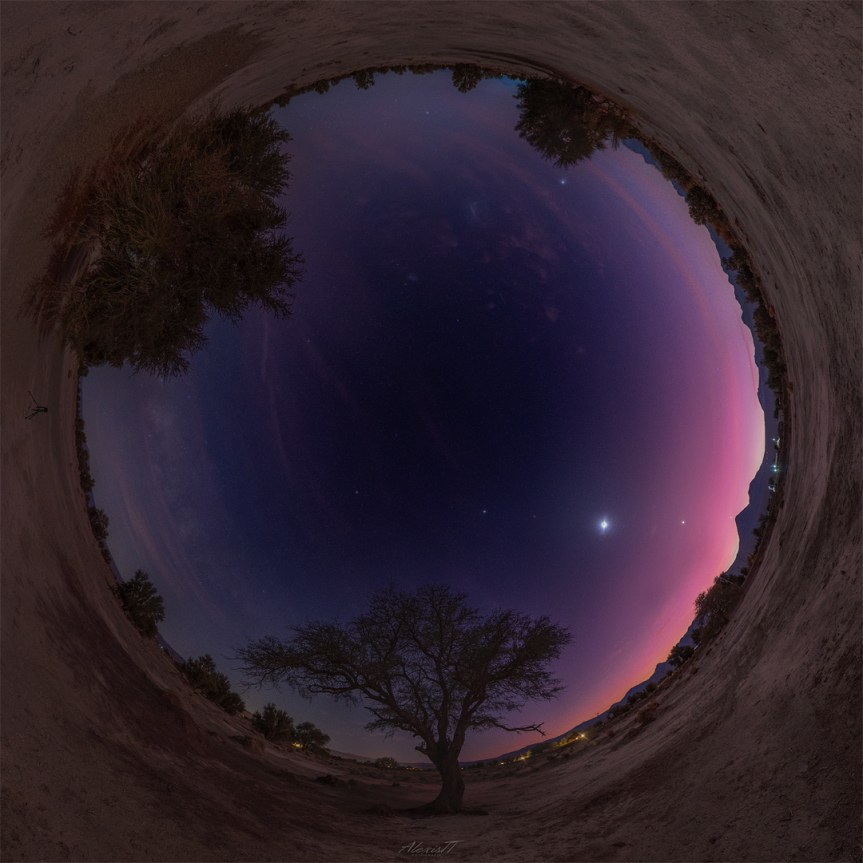
Solar System Family Portrait

Image Credit & Copyright: Alexis Trigo

Explanation: Yes, but have you ever seen all of the planets at once? A rare roll-call of planets has been occurring in the morning sky for much of June. The featured fisheye all-sky image, taken a few mornings ago near the town of San Pedro de Atacama in Chile, caught not only the entire planet parade, but the Moon between Mars and Venus. In order, left to right along the ecliptic plane, members of this Solar System family portrait are EarthSaturnNeptuneJupiterMarsUranusVenusMercury, and Earth. To emphasize their locations, Neptune and Uranus have been artificially enhanced. The volcano just below Mercury is Licancabur. In July, Mercury will move into the Sun’s glare but reappear a few days later on the evening side. Then, in August, Saturn will drift past the direction opposite the Sun and so become visible at dusk instead of dawn. The next time that all eight planets will be simultaneously visible in a morning sky will be in 2122.


Notable Submissions to APOD: Morning Planet Parade 2022 June

June 28 Astronomy Picture of the Day

Discover the cosmos! Each day a different image or photograph of our fascinating universe is featured, along with a brief explanation written by a professional astronomer.

2022 June 28

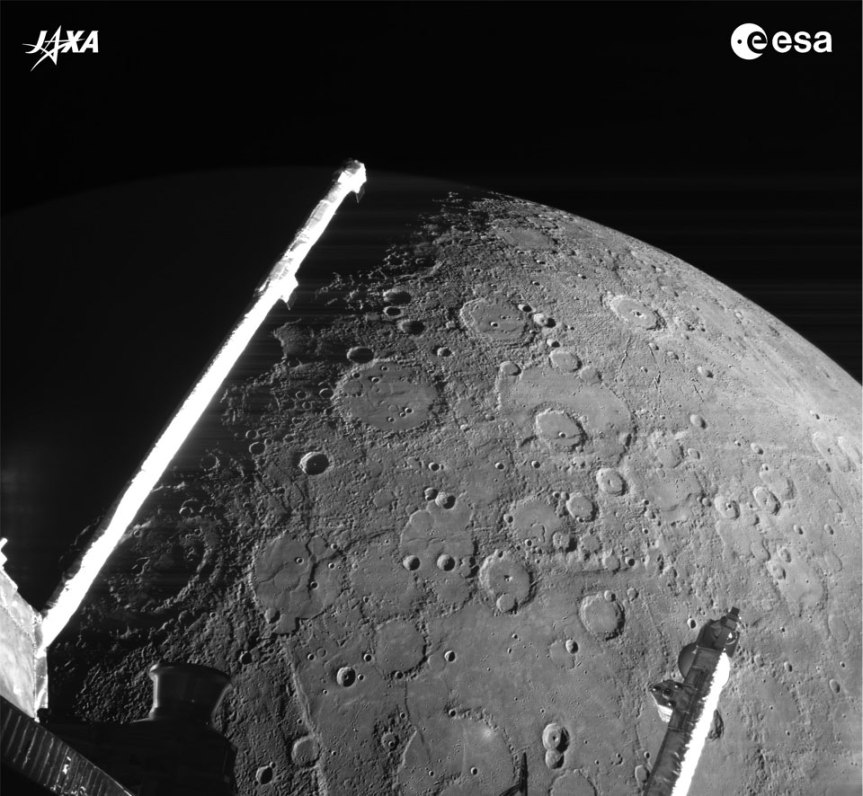
Mercury from Passing BepiColombo

Image Credit & LicenseESAJAXABepiColomboMTM

Explanation: Which part of the Moon is this? No part — because this is the planet Mercury. Mercury’s old surface is heavily cratered like that of Earth’s Moon. Mercury, while only slightly larger than Luna, is much denser and more massive than any Solar System moon because it is made mostly of iron. In fact, our Earth is the only planet more dense. Because Mercury rotates exactly three times for every two orbits around the Sun, and because Mercury’s orbit is so elliptical, visitors on Mercury could see the Sun rise, stop in the sky, go back toward the rising horizon, stop again, and then set quickly over the other horizon. From Earth, Mercury’s proximity to the Sun causes it to be visible only for a short time just after sunset or just before sunrise. The featured image was captured last week by ESA and JAXA‘s passing BepiColombo spacecraft as it sheds energy and prepares to orbit the innermost planet starting in 2025.

June 27 Astronomy Picture of the Day

Discover the cosmos! Each day a different image or photograph of our fascinating universe is featured, along with a brief explanation written by a professional astronomer.

2022 June 27

The Gum Nebula over Snowy Mountains

Image Credit & Copyright: Wang Jin

Explanation: The Gum Nebula is so large and close it is actually hard to see. This interstellar expanse of glowing hydrogen gas frequently evades notice because it spans 35 degrees — over 70 full Moons — while much of it is quite dim. This featured spectacular 90-degree wide mosaic, however, was designed to be both wide and deep enough to bring up the Gum — visible in red on the right. The image was acquired late last year with both the foreground — including Haba Snow Mountain — and the background — including the Milky Way’s central band — captured by the same camera and from the same location in Shangri-LaYunnanChina. The Gum Nebula is so close that we are only about 450 light-years from the front edge, while about 1,500 light-years from the back edge. Named for a cosmic cloud hunter, Australian astronomer Colin Stanley Gum (1924-1960), the origin of this complex nebula is still being debated. A leading theory for the origin of the Gum Nebula is that it is the remnant of a million year-old supernova explosion, while a competing theory holds that the Gum is a molecular cloud shaped over eons by multiple supernovas and the outflowing winds of several massive stars.

June 26 Astronomy Picture of the Day

Discover the cosmos! Each day a different image or photograph of our fascinating universe is featured, along with a brief explanation written by a professional astronomer.

2022 June 26

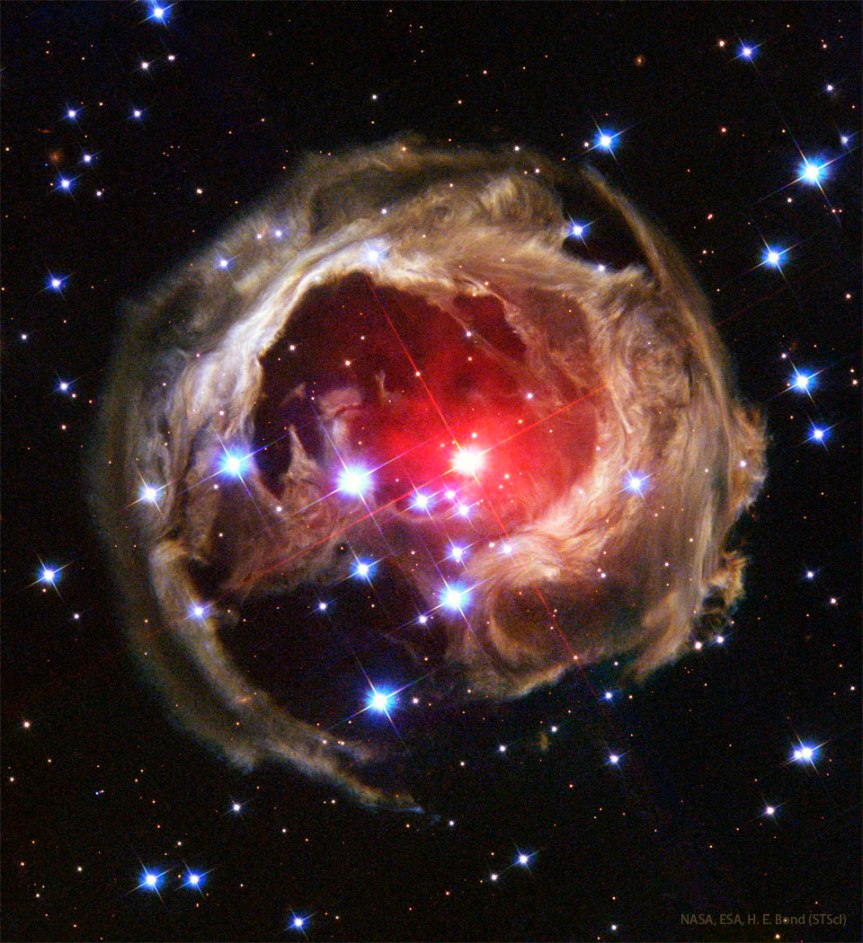
Light Echoes from V838 Mon

Image Credit: NASAESAH. E. Bond (STScI)

Explanation: What caused this outburst of V838 Mon? For reasons unknown, star V838 Mon‘s outer surface suddenly greatly expanded with the result that it became one of the brighter stars in the Milky Way Galaxy in early 2002. Then, just as suddenly, it shrunk and faded. A stellar flash like this had never been seen before — supernovas and novas expel matter out into space. Although the V838 Mon flash appears to expel material into space, what is seen in the featured image from the Hubble Space Telescope is actually an outwardly expanding light echo of the original flash. In a light echo, light from the flash is reflected by successively more distant surfaces in the complex array of ambient interstellar dust that already surrounded the star. V838 Mon lies about 20,000 light years away toward the constellation of the unicorn (Monoceros), while the light echo above spans about six light years in diameter.

June 25 Astronomy Picture of the Day

Discover the cosmos! Each day a different image or photograph of our fascinating universe is featured, along with a brief explanation written by a professional astronomer.

2022 June 25

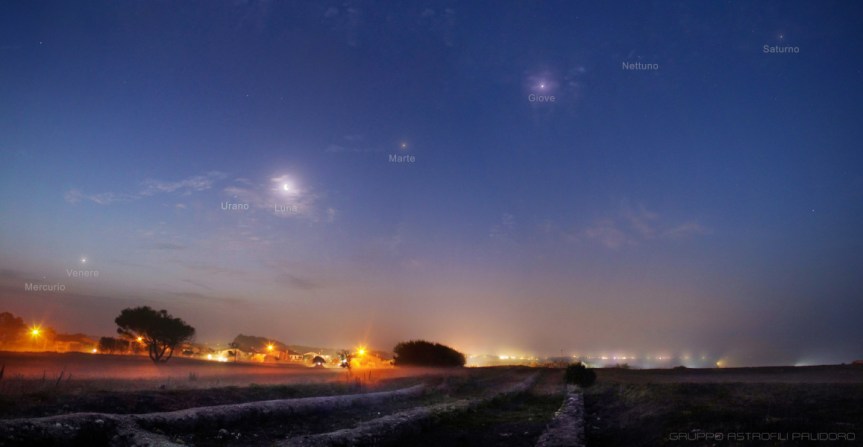
Planets of the Solar System

Image Credit & CopyrightAntonio Canaveras, Chiara Tronci, Giovanni Esposito, Giuseppe Conzo, Luciana Guariglia, (Gruppo Astrofili Palidoro)

Explanation: Simultaneous images from four cameras were combined to construct this atmospheric predawn skyscape. The cooperative astro-panorama captures all the planets of the Solar System, just before sunrise on June 24. That foggy morning found innermost planet Mercury close to the horizon but just visible against the twilight, below and left of brilliant Venus. Along with the waning crescent Moon, the other bright naked-eye planets, Mars, Jupiter, and Saturn lie near the ecliptic, arcing up and to the right across the wide field of view. Binoculars would have been required to spot the much fainter planets Uranus and Neptune, though they also were along the ecliptic in the sky. In the foreground are excavations at an ancient Roman villa near Marina di San Nicola, Italy, planet Earth.

June 23 Astronomy Picture of the Day

Discover the cosmos! Each day a different image or photograph of our fascinating universe is featured, along with a brief explanation written by a professional astronomer.

2022 June 23

Spiral Galaxy NGC 6744

Image Credit & CopyrightBasudeb Chakrabarti, Telescope Live

Explanation: Beautiful spiral galaxy NGC 6744 is nearly 175,000 light-years across, larger than our own Milky Way. It lies some 30 million light-years distant in the southern constellation Pavo but appears as only a faint, extended object in small telescopes. We see the disk of the nearby island universe tilted towards our line of sight in this remarkably detailed galaxy portrait, a telescopic view that spans an area about the angular size of a full moon. In it, the giant galaxy’s elongated yellowish core is dominated by the light from old, cool stars. Beyond the core, grand spiral arms are filled with young blue star clusters and speckled with pinkish star forming regions. An extended arm sweeps past smaller satellite galaxy NGC 6744A at the lower right. NGC 6744’s galactic companion is reminiscent of the Milky Way’s satellite galaxy the Large Magellanic Cloud.

June 24 Astronomy Picture of the Day

Discover the cosmos! Each day a different image or photograph of our fascinating universe is featured, along with a brief explanation written by a professional astronomer.

2022 June 24

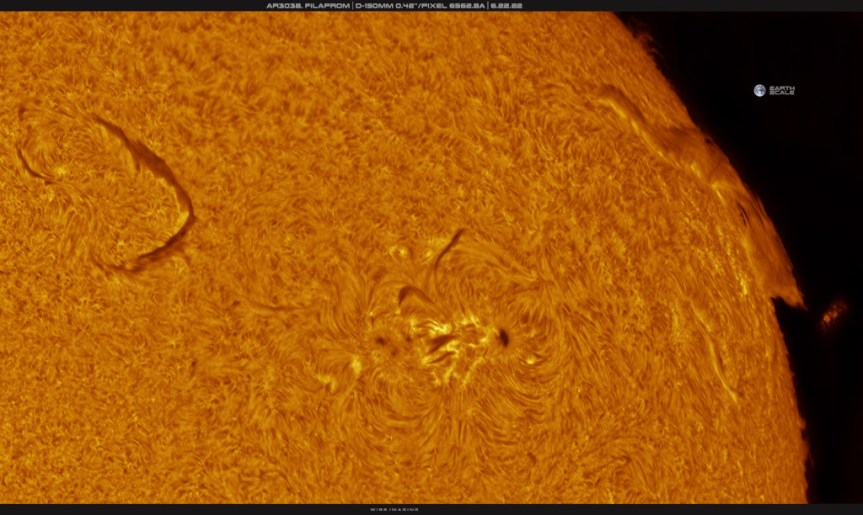
Filaprom on the Western Limb

Image Credit & CopyrightMartin Wise

Explanation: A solar filament is an enormous stream of incandescent plasma suspended above the active surface of the Sun by looping magnetic fields. Seen against the solar disk it looks dark only because it’s a little cooler, and so slightly dimmer, than the solar photosphere. Suspended above the solar limb the same structure looks bright when viewed against the blackness of space and is called a solar prominence. A filaprom would be both of course, a stream of magnetized plasma that crosses in front of the solar disk and extends beyond the Sun’s edge. In this hydrogen-alpha close-up of the Sun captured on June 22active region AR3038 is near the center of the frame. Active region AR3032 is seen at the far right, close to the Sun’s western limb. As AR3032 is carried by rotation toward the Sun’s visible edge, what was once a giant filament above it is now partly seen as a prominence, How big is AR3032’s filaprom? For scale planet Earth is shown near the top right corner.

June 22 Astronomy Picture of the Day

Discover the cosmos! Each day a different image or photograph of our fascinating universe is featured, along with a brief explanation written by a professional astronomer.

2022 June 22

Supernova Remnant: The Veil Nebula

Image Credit & Copyright: Craig Stocks (Utah Desert Remote Observatories)

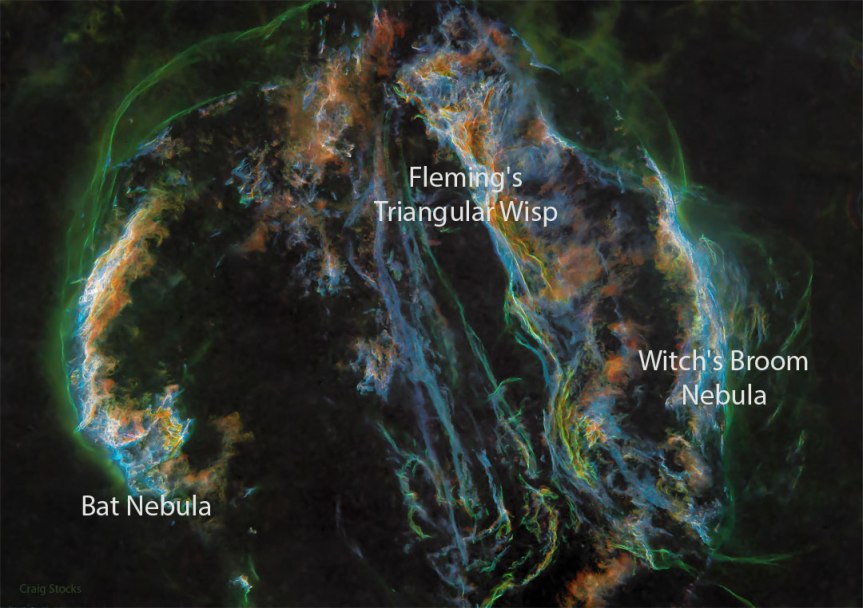
Explanation: Ten thousand years ago, before the dawn of recorded human history, a new light would have suddenly have appeared in the night sky and faded after a few weeks. Today we know this light was from a supernova, or exploding star, and record the expanding debris cloud as the Veil Nebula, a supernova remnant. Imaged with color filters featuring light emitted by sulfur (red), hydrogen (green), and oxygen (blue), this deep wide-angle view was processed to remove the stars and so better capture the impressive glowing filaments of the Veil. Also known as the Cygnus Loop, the Veil Nebula is roughly circular in shape and covers nearly 3 degrees on the sky toward the constellation of the Swan (Cygnus). Famous nebular sections include the Bat Nebula, the Witch’s Broom Nebula, and Fleming’s Triangular Wisp. The complete supernova remnant lies about 1,400 light-years away.

June 21 Astronomy Picture of the Day

Discover the cosmos! Each day a different image or photograph of our fascinating universe is featured, along with a brief explanation written by a professional astronomer.

2022 June 21

Analemma over Taipei

Image Credit & Copyright: Meiying Lee

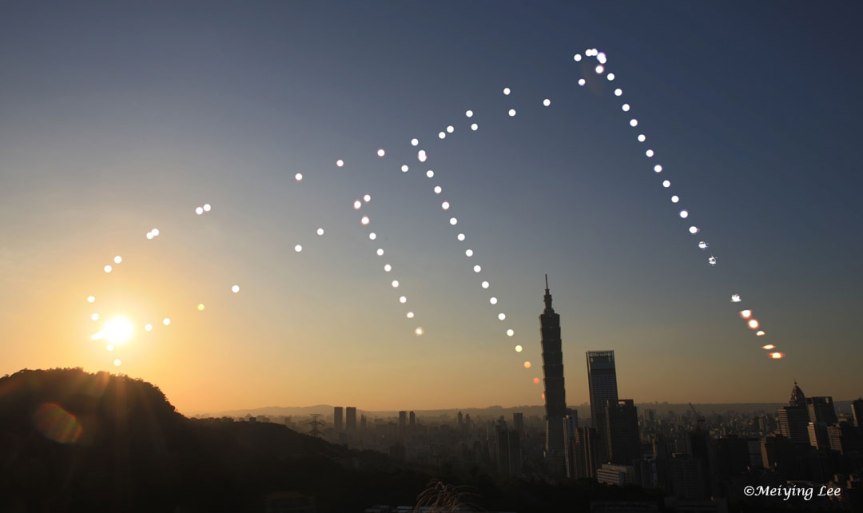
Explanation: Does the Sun return to the same spot on the sky every day? No. A better and more visual answer to that question is an analemma, a composite of images taken at the same time and from the same place over the course of a year. The featured analemma was compiled at 4:30 pm many afternoons from Taiwan during 2021, with the city skyline of Taipei in the foreground, including tall Taipei 101. The Sun‘s location in December — at the December solstice — is shown on the far left, while its location at the June solstice is captured on the far right. Also shown are the positions of the Sun throughout the rest of the day on the solstices and equinoxes. Today is the June solstice of 2022, the day in Earth‘s northern hemisphere when the Sun spends the longest time in the sky. In many countries, today marks the official beginning of a new season, for example winter in Earth’s southern hemisphere.