
Category: Uncategorized
Your Daily Rune for April 12 is Hagalaz

Psychic Tip of the Day
Psychic Tip of the Day
TARGET LOVE
You and a partner find common ground on which to build a foundation. This is as important a step as a relationship can have. Were you waiting long to reach this point?
Tarot.com is Part of the Daily Insight Group ©2018
Your Daily Erotic Tarot Card for April 12 is The Hanged Man
Daily Erotic Tarot Card
The Hanged Man
April 12, 2018
The Hanged Man
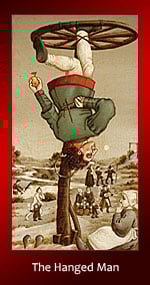
Acceptance is the keyword of the Hanged Man, and with this card showing up it means you’re out of moves, so to speak, which is kind of nice because now the games can stop and you can get down to the real nitty-gritty. Your sexual partners aren’t perfect and neither are you, but you can still have a lot of fun together. The Hanged Man may not be in the best position, but he certainly makes the best of it – and this card urges you to do the same when it comes to your sex life.
Your Daily Love Tarot Card for April 12 is The Lovers
Daily Love Tarot Card
The Lovers
April 12, 2018
The Lovers
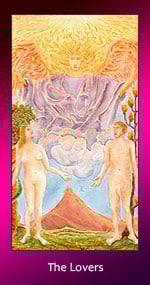
Today, The Lovers are fickle, promiscuous, or both. Because of that, they live for entanglements. Unless you are cautious, they can pull you in with them. Don’t leave someone if your relationship has encountered a rough patch. Go only if you have tried everything and the relationship still isn’t working for either of you. If you haven’t tried, now is the time to give things another chance for either openness or for closure.
Learning the Tarot: The Tower Card
Learning the Tarot
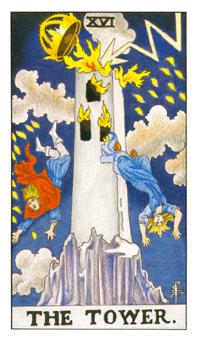
The Tower
Because of circumstances beyond your control, you have no choice.
General Meaning
In practically all renditions of the Tower card, disaster is striking or has just struck. The demons of madness and despair are released from ancient hiding places, and nature conspires with human failings to destabilize a society. The upheaval is collective and impersonal. Let us remember these images were created for the educated nobles and clergy — reminding them that they have the most to lose if the hierarchy is toppled.
Lightning is a fitting karmic payback for the guilt of those whose fortunes come from the exploitation or abuse of others. A modern subtitle might be “revolution,” indicating that through drastic social change, oppressed people can find renewed hope of better times. The Tower experience comes like a flash of lightning to topple the hierarchy of the old order, after which everyone can have a fresh start on a more equal footing.
In the Advice Position
You are the one to serve as a catalyst for change.
The card in the Advice position suggests a course of action which will harmonize what you want with what is currently possible.
With the Tower card, think of yourself as an agent of transformation. This self-sacrificing role is likely to create stressful situations. Your vision shows you that a radical change has already been unleashed by forces much larger than mere mortals, and therefore you are no longer resisting.
Now you may be at the forefront, acknowledging and accepting the bracing presence of the future bursting in on the present. Try to mediate the harsher parts of the changes as they unfold, so the most vulnerable are the most cushioned. Acknowledge yourself, as well as the others in your life, who are offering their resources to usher in a better future.
Tarot.com is Part of the Daily Insight Group ©2018
Born in April

Born on a Thursday

Morning Affirmation

The Study of Pagan Gods & Goddesses: Nephthys, Egyptian Goddess

Nephthys
Nephthys was one of the original five gods of ancient Egypt born of the union of Geb (earth) and Nut (sky) after the creation of the world. She was the fourth born after Osiris, Isis, and Set and was the older sister of Horus (usually referred to as Horus the Elder). As one of the earliest goddesses of Egypt, she was a member of the Ennead of Heliopolis, a tribunal of nine deities of immense power. Her cult centers were Heliopolis, Senu, Hebet, Per-met, Re-nefert, and Het-sekem. Contrary to some scholars’ assertions that she was never widely worshipped in Egypt, temples to Nephthys were quite common and she was considered an extremely important goddess from the Predynastic Period (c.6000-c. 3150 BCE) through the Ptolemaic Dynasty (323-30 BCE), the last dynasty to rule Egypt before it became a province of Rome.
NAME & SYMBOLS
‘Nephthys’ is the Latin version of her Egyptian name `Nebthwt’ (also given as Nebet-het and Nebt-het) which translates as “Lady of the Temple Enclosure” or “Mistress of the House” and she is routinely pictured with the heiroglyph for ‘house’ on her crown. The ‘house’ is neither an earthly home nor temple but linked to the heavens as she was related to air and ether. The ‘enclosure’ may refer to the courtyard outside a temple as she was represented by the pylons outside of temples in her role as a protective goddess; just as the pylons and wall protected the inner temple, Nephthys protected the souls of the people. She was associated with death and decay from an early period and was regularly invoked during funeral services. Professional mourners at Egyptian funerals were known as “Hawks of Nephthys” and she is one of the four goddesses (along with Isis, Selket, and Neith) whose images were found in the tomb of Tutankhamun as guardians of his canopic vessels. Historian Margaret Bunson notes:
Nephthys was associated with the mortuary cult in every era and was part of the ancient worship of Min [a god of fertility and reproduction]. The desert regions were dedicated to her and she was thought to be skilled in magic (188).
Her magical skills were similar to those of Isis and some scholars see her as Isis’ mirror image, Nephthys’ darkness balancing Isis’ light, and they are frequently pictured together as twin sisters. In the city of Heliopolis Nephthys and Isis were represented by two virgin priestesses at festivals who would recite the famous Lamentations of Isis and Nepthys at the Osiris’ festival. The Lamentations is a long narrative poem recreating the moment Isis and Nephthys worked together to revive the god Osiris and bring him back to life. Although originally spoken only at religious services, the Lamentations came to be included in the Egyptian Book of the Dead and was recited at funeral services.
Nephthys became the wife of Set and is best known for the part she played in the Osiris myth where, disguised as Isis, she seduced Osiris and provided Set with justification for the murder of his brother. She is later depicted in the myth as both betraying and then helping Isis in her efforts to restore her husband to life. She is a goddess of the dead who, like her granddaughter Qebhet, provides assistance to the souls of the deceased. She was so helpful to those in the afterlife that one of her titles was “Friend of the Dead” and she was also thought to bring news of the deceased back to their relatives on earth and comfort them in their time of mourning.
Her symbols are the hawk and the temple and the sycamore tree, one of the more popular trees depicted in inscriptions from the Egyptian Book of the Dead. She is the mother of the death god Anubis and was associated with the setting sun, twilight, and darkness. Prayers were offered to Nephthys at twilight for protection and also to aid her as she struggled with her husband Set to defend the Boat of Ra (the sun god) from the serprent Apophis as it made its journey through the realms of night.
MYTHOLOGICAL ORIGINS
According to the most popular version of the Egyptian creation myth, there was once only swirling chaotic waters and darkness in the universe until, one day, a mound (known as the ben-ben) rose from the seas with the god Atum (also known as Ra) standing upon it. Atum gazed out on the eternal nothingness and recognized he was lonely, and so mated with his own shadow to give birth to Shu (god of the air) and Tefnut (goddess of moisture). These two deities then left their father alone on the primordial mound and went off to create the world.
Atum, alone on the hill in the midst of chaos, longed for his children and worried over their safety, and so he removed his eye and sent it out in search of them. Shu and Tefnut returned with the eye, having failed to create the world, and Atum was so happy to see them, he began to cry. As his tears fell on the fertile earth of the ben-ben, men and women sprang up.
These new fragile beings had nowhere to live, however, and so Shu and Tefnut mated and gave birth to Geb (the earth) and Nut (the sky). These two quickly fell in love and became inseparable; a situation Atum found intolerable as they were brother and sister. He pushed Nut high above Geb and fastened her there so the two lovers would be able to see each other but never touch again. Nut, however, was already pregnant by Geb and soon gave birth to five children: Osiris, Isis, Set, Nephthys, and Horus. Atum gave to these five gods the task of maintaining the world and set his first born, Osiris, to rule over all the living things of the earth.
THE OSIRIS MYTH
At this point in the story the famous Osiris Myth begins when Set becomes jealous of Osiris’ power and success. Osiris married his beautiful sister Isis and the royal couple taught the humans of the world culture and art, instructed them in religion, and gave them the gifts of agriculture. To the Egyptians, their country was essentially the world and this world, under the reign of Osiris and Isis, was a paradise. Men and women were equal in all things and there was an abundance of food.
Osiris
Horus the Elder, in this story, is never mentioned but the roles of Set and Nephthys, who are, seem fairly insignificant at first until Nephthys emerges to play a pivotal role. She changed her form to take on the shape and scent of Isis and seduced Osiris, who thought he was sleeping with his wife. In some versions of the story she drugs his wine or gives him too much while, in others, he simply comes to her bed thinking she is Isis. Osiris leaves afterwards but drops a flower he wore in his hair on the floor and this is later found by Set who recognizes it as his brother’s.
Set was already resentful of his older brother but now, believing Osiris had seduced his wife, he planned to murder him. He created an ornate chest to Osiris’ exact measurements and then threw a party where he offered the box as a gift to whichever of his guests could best fit in it. Osiris, of course, fit perfectly and, when he lay down in the casket, Set slammed the cover on, fastened it, and threw it into the Nile. He then assumed the throne with Nephthys as his consort. She gave birth a short time later to a son, the god Anubis, whom she abandoned and who was raised by Isis.
Isis, meanwhile, went in search of her husband and found the casket with his body inside lodged in a tree in Byblos. The king and queen of the city had seen the tree down by the shore and were attracted by its beauty (which was the essence of Osiris permeating the tree) and its sweet scent (the aroma of Osiris) and had it cut down and brought to their court to serve as a central pillar. Isis, disguised as an older woman, was invited to the court after she befriended the queen’s handmaidens down by the shore and soon became nursemaid to the young princes. In an effort to make the youngest son immortal, she held him in a mystical fire each night to burn away his mortal part and, one night, the queen caught her and was horrified. Isis threw off her disguise, revealing herself, and the king and queen begged her for mercy, offering her anything to spare them. She asked for the pillar in the court; and they gave it to her.
All this time, the world was suffering under the rule of Set. The land was barren and the desert winds blew. Equality in the land was forgotten as people fought for each other for survival. Isis returned to the wasteland with Osiris and hid his body in the marshes of the Nile Delta and then asked Nephthys to stand guard to protect him from Set. While Isis went off to find herbs to revive her husband, Set was out searching for the body and found Nephthys. He managed to get from her where Isis had hidden Osiris and hacked the body to pieces, throwing them across the land and into the river. When Isis returned, Nephthys tearfully told her the story and offered to help in any way she could.
Isis and Nephthys found all the parts of Osiris and put him back together except for his penis, which had been eaten by a fish. Osiris revived but, because he was not whole, could not return to the land as king; he would instead descend to the underworld where he would rule over the dead as their just and merciful judge. Before he left, however, Isis transformed herself into a kite (a falcon) and flew around his body, drawing his seed into her own and becoming pregnant with a son, Horus. When Horus was born, she hid him in the marshes of the Delta as she had his father’s body and Nephthys, this time, kept her secret.
THE CONTENDINGS OF HORUS & SET
When Horus grew to manhood he challenged Set for the kingdom. The best known version of this contest is known as The Contendings of Horus and Set from a manuscript of the Twentieth Dynasty (1190-1077 BCE). The story tells of the legal battle before the Ennead of Heliopolis, a tribunal of nine gods, to decide who was the rightful king of Egypt. These gods were Atum, Shu and Tefnut, Geb and Nut, Isis and Nephthys, Set, and Osiris. Horus and Set both present their cases and then must prove themselves in a series of contests and battles which are all won by Horus.
Horus
The majority of the nine gods ruled that Horus was the rightful king but Atum, the sun god, was not convinced and the decision had to be unanimous, barring Set’s opinion. Atum believed that Horus was too young and had led too sheltered a life to effectively rule while Set had the necessary experience if not the most gentle manner. Even though Horus won every contest against his uncle, Atum would not be moved. This trial went on for over 80 years while the people of Egypt suffered under Set’s chaotic reign until Isis intervened, showed the other gods – and Set – how wickedly he had behaved, and won the ruling in favor of her son. In another, perhaps older, version of the story it is the goddess Neith who settles the dispute in favor of Horus and grants the desert lands to Set along with two foreign goddesses (Anat and Astarte) as consolation. Horus assumed the throne of his father and ruled with Isis and Nephthys as his counselors. Set was driven from the land to the arid frontier deserts and Nephthys remained as a protector of the female head of the household, Isis in this case, but later any mature married woman.
THE LAMENTATIONS OF ISIS & NEPHTHYS
This myth was important to the ancient Egyptians on many levels. It illustrated core values of harmony, order, divine intervention in human affairs, the importance of gratitude, trust, and how, in the character of Set, even the gods could succumb to temptation but, no matter what, harmony and order would be restored. The death and ressurection of Osiris provided a divine template for the passage of all human beings who were thought to be travelers on an eternal journey through life and on into the afterlife. The Cult of Osiris became extremely popular and part of his religious service included the recitation of the liturgy known as The Lamentations of Isis and Nephthys.
The most complete version of this verse comes from the Berlin Papyrus 3008 dating to the Ptolemaic Dynasty. This papyrus was part of a copy of The Book of the Dead owned by a woman named Tentruty (also given as Teret) and is written in hieratic script (the cursive, everyday, script of the Egyptians) in five columns. The poem is written as an exchange between Isis and Nephthys as they call Osiris’ soul back to his body. The two goddesses entreat the soul to return, to live again among them, and invoke Horus, Osiris’ son, as his protector in life who will provide him with “bread, beer, oxen, and fowl” and whose sons will guard his body and protect his soul. In the end, Osiris returns to life as the poem ends with the line, “Lo! He Comes!”
Following the verse, the scribe has left very careful instructions on how the Lamentations is to be presented at the festivals:
Now, when this is recited the place is to be completely secluded, not seen and not heard by anyone except the chief lector-priest and the setem-priest. One shall bring two women with beautiful bodies. They shall be made to sit on the ground at the main portal of the Hall of Appearings. On their arms shall be written the names of Isis and Nephthys. Jars of faience filled with water shall be placed in their right hands, offering loaves made in Memphis in their left hands, and their faces shall be bowed. To be done in the third hour of the day, also in the eighth hour of the day. You shall not be slack in reciting this book in the hour of the festival. It is finished.
The two virgins would recite the Lamentations to invite Osiris to participate in the festival and, once he arrived, the celebration could begin. Osiris was considered the first king of Egypt who had given the people their culture and who, through his death and resurrection, showed them the way to eternal life. In death, everyone was linked to Osiris who was the first to have died and been reborn. His festivals, therefore, were of great importance and Nephthys regularly featured as one of the most important elements of the celebration: one of the two who called the god to join the living.
She describes herself as the “beloved sister” of Osiris in the Lamentations and says, “I am with you, your bodyguard, for all eternity.” When the Lamentations became included in The Book of the Dead (c. 1550-1070 BCE), the poem was recited at funerals and Nephthys would then have been speaking to the soul of the deceased. It was in this capacity that she came to be regarded as the “Friend of the Dead” who walked with the soul and helped them in the afterlife as their “bodyguard for all eternity” and made her such an important deity to the people.
NEPHTHYS & THE BARGE OF RA
Long before the Osiris myth became popular, Nepthys was already a very significant goddess, however. In texts of the period of the Old Kingdom (c. 2613 – c. 2181 BCE) she is referenced with Set as the two gods who protect the barge of the sun god Ra (Atum) as it passes through the night sky. The evil serpent Apophis tried every night to murder the sun god but Nephthys and Set fought the creature off so the sun could rise the next morning. Set was later transformed from a protector god to the villain of the Osiris myth but Nephthys’ role remained the same: a protector and sustainer of life. Even though the focus on who was protected changed, the basic elements of her character remained the same. The scholar Geraldine Pinch has observed that, “Nephthys never enjoyed the high status of her sister, Isis” (171) and, while it may be true that worship of Nephthys never was on par with that of Isis, her status was consistently quite impressive throughout Egypt’s history.
In the Predynastic Period of Egypt, Nephthys was one of the most important deities owing to her part in this myth. If Apophis succeeded in murdering Ra, the sun would not rise and so it was vital that the barge be protected. In the Coffin Texts Set and the snake-god Mehen protect the barge; Mehen by coiling himself around Ra and Set by fending off Apophis. Mehen was later replaced by Nephthys but Apophis was considered so powerful, and the threat to Ra so dire, that other deities often appear on the barge to drive the enemy of the sun away such as Isis, Bastet, Selket, Neith, and Sekhmet who were collectively known, with Nephthys, as the Eyes of Ra in this capacity.
The myth of the nightly threat to Ra is most clearly told in a manuscript dating from the Ramessid Period (1292-1069 BCE) but archaeological evidence suggests the story is much older. By the time of the Ramessid Period the myth had evolved into a ritual known as Overthrowing Apophis in which a priest would recite a list of Apophis’ secret names (thereby gaining power over him) and the people would sing hymns celebrating his destruction. Even though the gods destroyed the great serpent every night, he returned to try to murder Ra again the next. The hymns were sung to encourage the gods in their eternal struggle. Participants in the ritual would then make serpents out of wax, spit on them, and destroy them in fire. The ritual was performed regularly after a number of cloudy days when it seemed as though Apophis was succeeding in preventing the dawn and especially during a solar eclipse.
POPULARITY & WORSHIP OF NEPHTHYS
Prior to the addition of the other goddesses, however, it was Nephthys and Set who kept the sun on course and she was duly honored for this. Temples to Nephthys were located in every region of Egypt long before she became associated with the dead and only grew more numerous afterwards. As with any Egyptian deity, her temple was attended by priests and priestesses who cared for her statue and observed her holy days and festivals. The public was barred from entering the inner sanctuary of the temple where her statue resided but were welcomed in the outer courtyards where the clergy tended to their needs and collected their donations and sacrifices.
By the time of Ramesses II (1279 – 1213 BCE) Nephthys was so popular she was given her own temple at the popular religious center of Sepermeru in the holy precinct where Set’s temple was located. Nephthys was so popular at this time that she is mentioned in texts without allusion to Isis or Set. Her temple in the town of Punodjem was apparently so popular that the head priest and vizier Pra’emhab complained of his workload and her temple at Herakleopolis, near Sepermeru, became the site of the Heb-Sed festival celebrating the rejuvenation of the king. The basalt statue of Nephthys currently housed at the Louvre in Paris comes from this temple.
Although Nephthys is frequently depicted as a mirror to her twin sister Isis, she had a life and status all her own which was just as worthy of veneration. Once she became associated with the afterlife and the care of the dead the linen which was used to mummify the deceased was known as “tresses of Nephthys” and it was thought that she, along with Selket, helped to breathe life back into the soul and help them on their eternal journey. Nephthys came to represent the promise of a helper at one’s side in the afterlife who would look after and protect the soul and who assured the living that death was nothing to be feared. The realm of the afterlife was only a new land one traveled to and old friends, like Nephthys, would be waiting to offer their protection and guidance in death as they had throughout life.
_________________
Nephthys
Nephthys was an ancient goddess, who was referenced in texts dating back to the Old Kingdom. She was a member of the Ennead of Heliopolis as the daughter of Geb and Nut and the sister of Osiris, Isis and Horus and the sister and wife of Set. When the Ennead and Ogdoad merged, Nephthys was given a place on Ra’s boat so that she could accompany him on his journey through the underworld.
Nephthys is the Greek pronunciation of her name. To the Ancient Egyptians she was Nebthwt (Nebhhwt or Nebthet) meaning “the Mistress of the House”. The word “hwt” (“house”) may refer to the sky (as in Hwt-hor, the “House of Horus” – the name of Hathor), but it also refers to either the royal family or Egypt as a whole. The latter makes a great deal of sense as she was described as the head of the household of the gods and was thought to extend her protection to the head female of every household. She was sometimes associated with Ptah-Tanen in representing Lower Egypt, while Khnum and Isis represented Upper Egypt.
It seems that she was originally conceived of as the female counterpart of Set. He represented the desert, while she represented the air. Set was infertile (like the desert that he represented) and was frequently described as either bisexual or gay and so Nephthys was often considered to be barren. As a goddess of the air, she could take the form of a bird, and because she was barren she was associated with the vulture – a bird which the Egyptians believed did not bear children. The Egyptians thought that all vultures were female (because there is very little difference in the appearance of a male vulture), and that they were spontaneously created from the air. While the care shown by a mother vulture for her child was highly respected, the Egyptians also recognised that vultures fed on carrion and associated them with death and decay. As a result, Nephthys became a goddess of death and mourning.
Nephthys
Professional mourners were known as the “Hawks of Nephthys”, in recognition of her role as a goddess of mourning. It was also believed that she protected Hapi in his role as of the Four sons of Horus (who guarded the organs stored in the four canopic jars). Hapi protected the lungs, and as a goddes of the air Nephthys was his guardian. She was also one of the four goddesses who guarded the shrine buried with the Pharaoh. She appears with Isis, Selkit (Serqet) and Neith on the gilded shrine of Tutankhamun, but was often depicted with Isis, Bast and Hathor in this role. Yet, she was also said to be the source of both rain and the Nile river (associating her with Anuket) and was thought to protect women in childbirth (with the assistance of her sister, Isis). Thus she was closely associated with both death and life.
Although she was technically infertile, later myths claimed that she was the mother of Anubis by either Osiris or Set (depending on the myth). This came about because Anubis’ position as the god of the dead was usurped by Osiris when the theologies of the Ennead and the Ogdoad merged. According to one myth Nephthys disguised herself as Isis to get the attention of her neglectful husband Set, but instead seduced Osiris (who apparently did not realise that it was Nephthys). An alternative myth made it clear that Nephthys intended to seduce Osiris from the beginning and drugged his wine to make her task easier, while a less common myth held that she did trick her husband into a brief daliance in order to concieve Anubis. It is suggested that this tale also explained the flowering of a plant in a normally barren area because Set apparently discovered the adultery when he found a flower left by his brother Osiris.
Isis and Nephthys were very close despite Nephthys’ alleged infidelity with Osiris (the husband of Isis) and her marriage to Set (the murderer of Osiris). Nephthys protected the body of Osiris and supported Isis as she tried to resurrect him. The goddesses are so similar in appearance that only their headdresses can distinguish them and they always appear together in funerary scenes. Together Isis and Nephthys could be said to represent day and night, life and death, growth and decay. In Heliopolis, Isis and Nephthys were represented by two virginal priestesses who shaved off all of their body hair and were ritually pure.
Nephthys was usually depicted as a woman with the hieroglyphs of her name (a basket on top of the glyph representing the plan of an estate) on her head. She could also be depicted as a mourning woman, and her hair was compared to the strips of cloth used in mummification. She also occasionally appears as a hawk, a kite or a winged goddess in her role as a protector of the dead. Her major centers of worships were Heliopolis (Iunu, in the 13th Nome of Lower Egypt), Senu, Hebet, (Behbit), Per-mert, Re-nefert, Het-sekhem, Het-Khas, Ta-kehset, and Diospolites.
Reference
Joshua J. Mark, Ancient History
7 Cardinal Rules for Life

All Things Connect
The Witches Astronomy Journal for Thursday, April 12th

The Witches Astronomy Journal for Thursday, April 12th

Your Daily Sun & Moon Data for Thursday, April `12th
The Sun
Sun Direction: ↑ 85.86° E
Sun Altitude: 9.21°
Sun Distance: 93.184 million mi
Next Solstice: Jun 21, 2018 5:07 am (Summer)
Sunrise Today: 6:24 am↑ 78° East
Sunset Today: 7:26 pm↑ 282° West
Length of Daylight: 13 hours, 2 minutes
The Moon
Moon Direction: ↑ 128.69° SE
Moon Altitude: 25.64°
Moon Distance: 244521 mi
Next New Moon: Apr 15, 20188:57 pm
Next Full Moon: Apr 29, 20187:58 pm
Next Moonset: Today4:07 pm
Current Moon Phase: Waning Crescent
Illumination: 13.7%
Reference
timeanddate.com
Astrology of Today – Thursday, April 12th
Mars-Uranus early today is progressive. A Last Quarter Moon occurs shortly before midday, and asks us to consider our spiritual needs.
The Moon is in Pisces all day (until Wednesday, June 10th, at 7:13 AM).
The Moon is void from 2:08 PM forward (until tomorrow at 7:13 AM).
The Moon is waning and in its Waning Gibbous phase until 11:41 AM/ Third Quarter phase from 11:41 AM forward.
The Third Quarter Moon occurs at 11:41 AM in Pisces.
Mercury is retrograde. (Mercury is retrograde from May 18 to June 11 in the sign of Gemini).

Moon in Pisces
The Moon is traveling through Pisces today. You may feel disconnected. Serve others. Listen to music. Paint a picture. Daydream.
We are not inclined to want to face reality while the Moon is in dreamy, impressionable Pisces. It can be a wistful, sensitive, intuitive, and compassionate time. We are especially imaginative, and our intuition reigns under this influence. Boundaries and walls come down, as Pisces energy merges and blends. It’s a time when details are overlooked and feelings defy description.
The Moon in Pisces generally favors the following activities: Imaginative undertakings, mystical or spiritual pursuits, inner development, music and drama, going on a retreat, activities involving water.

Daily Overview of Your Sky for Thursday, April 12th
With recent doubts and suspicions or cynicism, today’s Venus-Neptune sextile seems to come at just the right time. We are more imaginative and attuned to the world of beauty and romance today, and we tend to approach one another more gently. A “magical” time on a romantic and social level is possible now, as we are inclined to see spiritual dimensions of our relationships and to approach others with compassion. As well, the Moon is in Pisces all day, reinforcing the inclination to forgive and release.

The sky this week for April 12 to 15
Mars and Saturn chase the Moon, the Summer Triangle returns to prominence, and a brilliant Venus takes center stage, all in the sky this week.
By Michael E. Bakich
Thursday, April 12
As you stare into tonight’s starry sky, think about the two space-related anniversaries we celebrate on this date. In 1961, Soviet cosmonaut Yuri Gagarin became the first human to journey into outer space, and the first to orbit Earth. Then, in 1981, NASA launched its first space shuttle, Columbia, on a three-day mission during which it orbited Earth 36 times.
Friday, April 13
This could be your lucky night if you want to hunt down a galaxy. First, you’ll need to head to a dark observing site. Then, with binoculars in hand, scan about one field of view east-southeast of 2nd-magnitude Phecda (Gamma [γ] Ursae Majoris), the star that forms the southeastern corner of the Big Dipper’s bowl. You should see a triangle of 5th- and 6th-magnitude stars. The spiral galaxy M106 lies 1.7° south of 3 Canum Venaticorum, the triangle’s southern tip. The galaxy will appear as an oval blur of light glowing at magnitude 8.4.
Saturday, April 14
Brilliant Venus dominates the evening sky starting about half an hour after sunset. It stands 15° above the western horizon 30 minutes after the Sun goes down and doesn’t set until around 9:30 p.m. local daylight time — a full two hours after the Sun. Shining at magnitude –3.9, it lies in front of the stars of Aries the Ram and appears far brighter than any other point of light in the sky. When viewed through a telescope tonight, Venus spans only 11″ and shows a 92-percent-lit phase.
Sunday, April 15
Dwarf planet 1 Ceres is the largest object in the asteroid belt, which lies between Mars and Jupiter. Almost any telescope will reveal its 8th-magnitude glow. All this month it moves eastward in front of the stars of the constellation Cancer the Crab. You’ll find it tonight between magnitude 4.0 Iota Cancri and 57 Cancri, which glows at magnitude 5.4. It lies two-thirds of the way from the brighter to the fainter star. If you can’t pinpoint it exactly, sketch the area and come back one or two nights later. The point of light that’s moved will be Ceres.
Reference
Astronomy Magazine
Your Daily Cosmic Calendar for Thursday, April 12
The cosmos gives you a free ticket to ride thanks to the absence of any challenging alignments.
Love vibrations increase in frequency — courtesy of a supportive, 60-degree alliance between Venus in Taurus and Neptune in Pisces (9:27am) and another 60-degree tie between the moon and Venus (5:58pm).
Have a field day in the fine and graphic arts. Lend a helping hand to the truly needy. Play a favorite musical instrument or improvise with a video camera during the monthly union between the moon and Neptune in Pisces (5:10pm).
Start gearing up for Mercury’s station and shift from reverse to direct on Sunday — the same day of a new moon happening within 2 degrees of Uranus, the revolutionary planet of genius, surprises and shock-waves.
[Note to readers: All times are now calculated for Pacific Daylight Time. Be sure to adjust all times according to your own local time so the alignments noted above will be exact for your location.]
Reference
Astrology.com

The Witches Current Moon Phase for Thursday, April 12
ommorow the Moon will be in a Waning Crescent phase. In this phase the Moon’s illumination is growing smaller each day until the New Moon. During this phase the Moon is getting closer to the Sun as viewed from Earth and the night side of the Moon is facing the Earth with only a small edge of the Moon being illuminated. This phase is best viewed an hour or 2 before the sunrise and can be quite beautiful if you’re willing to get up early. It can also be a great time to see the features of the Moon’s surface. Along the edge where the illuminated portion meets the dark side, the craters and mountains cast long shadows making them easier to observe with a telescope or binoculars.
PHASE DETAILS FOR – THURSDAY, APRIL 12, 2018
Phase: Waning Crescent
Illumination: 14%
Moon Age: 25.95 days
Moon Angle: 0.50
Moon Distance: 396,671.24 km
Sun Angle: 0.53
Sun Distance: 149,989,613.22 km
Reference
MoonGiant
Waning Crescent Moon Phase
What is a waning crescent moon? The waning crescent moon, sometimes called an old moon, is defined to occur when the Moon is nearly, but not precisely, on a line with the Earth and Sun. This means that part but less than one-half of the Moon is illuminated by direct sunlight, creating a crescent moon. Because the fraction of the Moon’s disk that is illuminated is decreasing, we consider the Moon to be “waning.” Each new lunar cycle is measured beginning at each new moon and the waning crescent moon occurs when the Moon is more than three-quarters of the way around the sky (i.e., along its orbit) from new moon.
Waning Crescent Moon Dates / Next Waning Crescent Moon
When is the next waning crescent moon? A waning crescent moon is seen one day to several days before a new moon. The average calendrical month, which is 1/12 of a year, is about 30.44 days, while the Moon’s phase (synodic) cycle repeats on average every 29.53 days. Therefore the timing of the Moon’s phases shifts by an average of almost one day for each successive month. To find out the waning crescent moon dates, please see the waning crescent moon calendar below.
About the Waning Crescent Moon
The waning crescent moon, happens when the moon is between a 135 and 180 degree angle with respect to the Earth and Sun. So we are seeing less than half of the moon illuminated and more than half in shadow. The word “crescent” refers to the phases where the moon is less that half illuminated. “Waning” essentially means shrinking or decreasing in illumination. Each evening, as the moon’s orbital motion carries it away from the Earth-sun line, we see less of the moon’s day side.
Each lunar cycle begins with a new moon. As the Moon moves eastward away from the Sun in the sky, we see a bit more of the sunlit side of the Moon each night. We call this waxing. After the new moon, the sunlit portion is increasing, but less than half illuminated, so it is a waxing crescent moon. When half of the Moon’s disc is illuminated, we call it the first quarter moon. As the sunlit portion continues to increase, now more than half illuminated, it becomes waxing gibbous moon. When the Moon reaches maximum illumination, a full moon, the Moon has completed one half of the lunar month.
During the second half of the lunar month, the Moon grows thinner each night. We call this waning. The waning gibbous moon phase occurs first, followed by the last quarter moon when half of the Moon’s disc is illuminated. Next is the waning crescent moon, which wanes until the illumination is completely gone; a new moon
Reference
Full Moon Phases
Interesting Facts About The Moon
Called Luna with the Romans, Selene and Artemis with the Greeks, and many additional names in other mythologies.The Moon, of course, may be known since prehistoric times. It is the second brightest object within the sky after the Solar. As the Moon orbits round the Earth once per thirty days, the angle between the planet earth, the Moon and sunshine changes; we see this for the reason that cycle of the Moon’s periods. The time between effective new moons is twenty nine and a half days (709 hours), slightly totally different from the Moon’s orbital period (measured from the stars) since the Earth moves an important distance in its orbit round the Sun in that time period.Due to its size and composition, the Moon may also be classified as a terrestrial “planet” in addition to Mercury, Venus, Earth along with Mars.The Moon was visited by the Soviet spacecraft Luna two in 1959. It is the only extraterrestrial body to get been visited by humans. The first landing ended up being on July 20, 1969 (do you remember where you’re? ); the last is at December 1972. The Moon is additionally the only body where samples have been went back to Earth. In the summer of 1994, the Moon was very extensively mapped with the little spacecraft Clementine along with again in 1999 simply by Lunar Prospector.The gravitational forces relating to the Earth and the Moon cause some interesting results. The most obvious is the tides. The Moon’s gravitational attraction is stronger on the side of the Earth nearest to the Moon and weaker on the opposite side. Since the planet earth, and particularly the oceans, is not perfectly rigid it really is stretched out along the actual line toward the Moon. From our perspective on the Earth’s surface we notice two small bulges, one on the way to the Moon and one directly opposite. The effect is a lot stronger in the ocean water than within the solid crust so water bulges are higher. And considering that the Earth rotates much faster than the Moon moves in its orbit, the bulges maneuver around the Earth about once per day giving two high tides on a daily basis. (This is a enormously simplified model; actual tides, especially close to the coasts, are much more complicated. )But the Earth seriously isn’t completely fluid, either. The Earth’s rotation provides the Earth’s bulges slightly before point directly beneath the actual Moon. This means which the force between the Earth along with the Moon is not exactly across the line between their centers desigining a torque on the Soil and an accelerating force on the Moon. This causes a world wide web transfer of rotational energy from the Earth to the Moon, slowing down the Earth’s rotation by about 1. 5 milliseconds/century and raising the Moon in to a higher orbit by regarding 3. 8 centimeters annually. (The opposite effect occurs to satellites with unusual orbits for instance Phobos and Triton). The asymmetric nature on this gravitational interaction is also responsible for the truth that the Moon rotates synchronously, when i. e. it is locked throughout phase with its orbit so the same side is always facing toward the planet earth. Just as the Earth’s rotation is actually being slowed by the actual Moon’s influence so within the distant past the Moon’s rotation was slowed with the action of the Soil, but in that case the effect was much stronger. If your Moon’s rotation rate was slowed to match its orbital period (such which the bulge always faced toward the Earth) there is no longer an off-center torque on the Moon and a secure situation was achieved. A similar thing has happened to the vast majority of other satellites in the actual solar system. Eventually, the Earth’s rotation will likely be slowed to match the actual Moon’s period, too, as is the case with Pluto along with Charon.Actually, the Moon appears to wobble a lttle bit (due to its slightly non-circular orbit) so that a few degrees of the far side can be seen every once in awhile, but the majority of the far side (left) was completely unknown before the Soviet spacecraft Luna 3 photographed the item in 1959. (Note: there’s no “dark side” of the actual Moon; all parts of the actual Moon get sunlight half the time (except for some deep craters near the actual poles). Some uses of the term “dark side” previously may have referred to the far side as “dark” within the sense of “unknown” (eg “darkest Africa”) however even that meaning is no longer valid today! )The Moon doesn’t have atmosphere. But evidence from Clementine suggested that there could possibly be water ice in some deep craters close to the Moon’s south pole that are permanently shaded. This has been reinforced by facts from Lunar Prospector. There’s apparently ice at the north pole as well.The Moon’s crust averages 68 kilometers thick and varies by essentially 0 under Mare Crisium for you to 107 km north of the crater Korolev on the actual lunar far side. Below the crust is often a mantle and probably a tiny core (roughly 340 kilometers radius and 2% of the Moon’s mass). Unlike the planet earth, however, the Moon’s interior is no longer active. Curiously, the Moon’s center regarding mass is offset by its geometric center simply by about 2 km within the direction toward the Soil. Also, the crust is thinner on the near side.There are two primary varieties of terrain on the Moon: the heavily cratered and extremely old highlands and the actual relatively smooth and youthful maria. The maria (which comprise about 16% of the Moon’s surface) are huge impact craters which were later flooded by molten lava. A lot of the surface is covered with regolith, a mixture of great dust and rocky debris produced by meteor impacts. For many unknown reason, the maria are concentrated on the near side.Most of the craters on the in close proximity to side are named for famous figures within the history of science for instance Tycho, Copernicus, and Ptolemaeus. Features on the far side have newer references such as Apollo, Gagarin and Korolev (with any distinctly Russian bias since first images were acquired by Luna 3). Besides the familiar features on the actual near side, the Moon also offers the huge craters South Pole-Aitken on the far side which is actually 2250 km in height and 12 km deep so that it is the the largest impact basin within the solar system and Orientale on the western limb (as observed from Earth; in the biggest market of the image at left) the industry splendid example of any multi-ring crater.A total of 382 kg regarding rock samples were returned to the Earth by the Apollo along with Luna programs. These provide almost all of our detailed knowledge of the Moon. They are particularly valuable in that they may be dated. Even right now, more than 30 years as soon as the last Moon landing, people still study these cherished samples.Most rocks on the top of Moon seem to become between 4. 6 and 3 billion years. This is a fortuitous match while using the oldest terrestrial rocks that are rarely more than 3 billion years. Thus the Moon provides evidence in regards to the early history of the Solar System not available on the Earth.Prior to study of the Apollo examples, there was no consensus in regards to the origin of the Moon. There were three major theories: co-accretion which asserted which the Moon and the Earth formed concurrently from the Solar Nebula; fission which asserted which the Moon split off of the Earth; and capture which held which the Moon formed elsewhere along with was subsequently captured with the Earth. None of these work very well. But the new and detailed information from the Moon rocks led to the impact theory: that the planet earth collided with a very large object (as big because Mars or more) understanding that the Moon formed from the ejected material. There continue to be details to be exercised, but the impact theory is actually widely accepted.The Moon doesn’t have global magnetic field. But some of its surface rocks exhibit remanent magnetism indicating that there was a global magnetic field early within the Moon’s history.With no atmosphere with out magnetic field, the Moon’s surface is exposed right to the solar wind. Over its 4 million year lifetime many ions from the solar wind have become embedded within the Moon’s regolith. Thus types of regolith returned by the actual Apollo missions proved valuable in studies of the solar wind.
(And this was one long run on paragraph. Lynette)
Reference
Full Moon Phases
Good Thursday Morning To All My New Family & Friends of the WOTC!

The Witches Gather
The forest echoes with love and laughter
As the coven of witches gather.
Clearing the circle of unwanted vibes,
The maiden, onto a candle, inscribes:
“Sacred flame of fire, glow,
Asking all impurities to go.
Cleanse this space with fire and air
So our rite is fresh and fair.”
The High Priestess holds her wand above,
And casts the circle of perfect love.
Faeries flutter to and fro,
As the energy begins to grow.
The sharing of crescent cakes and ale,
Weaving spells and healing prevail.
Luna illuminates powerful light;
Blessing the coven, the earth, and the rite.
The witches hold hands as they chant:
“Oh, great Goddess, vibrant and valiant,
Blessings upon you and your earth,
Thank you for the Sun’s rebirth.”
–By The Light Of The Crystal Moon: A Book of Pagan Poetry and Short Stories
Elizabeth Gardiepy
Children Of The Earth

Children Of The Earth
We know they feared our Pagan ways,
They tried to wipe us out,
They tortured and they burned us,
If they had the slightest doubt,
They took away our festivals,
Replaced them with their own,
But we stood strong and carried on,
We’ve flourished and we’ve grown.
They said we worshiped Satan,
Stole babies and much worse,
And if by chance someone fell ill,
They said we laid a curse,
They took us in for “questioning”,
Tortured till we confessed,
But anyone would say the words,
Under such duress.
With bodies bruised and broken,
They put us on the stand,
The priests said we’d offended God,
And the devil took our hand,
The villagers believed them,
Our guilt was their desire,
Then everybody turned out to see,
The witch burned in the fire.
They never really understood,
And some to this day still,
Do not understand our craft,
We bear no one ill will,
We live a life of peace and love,
At one with Mother Earth, S
o in secrecy the Hedgewitch lives,
Gathering berries, leaves and herbs.
I sometimes think that there are those,
Who live in those dark times still,
They do not wish to understand,
And I guess they never will,
But Pagans all around the world,
Are proud to carry on,
We practice the oldest religion,
In our deeds and in our song.
Be joyful all ye Pagans,
For the road has been so long,
Remember the innocent martyrs,
That suffered in those days gone,
Give your praise to all the Gods,
And the Goddess of rebirth,
For they can never destroy our faith,
We are the children of the Earth.
—Pagan Ways
Alan Faraway
Trying out the account to make sure it works for tomorrow.
Up-date April 9th
Greetings Brothers & Sisters. I wanted to give you a quick up-date on Lady Abyss. She is currently in ICU. The doctor told us that was normal for individuals who had the surgery she had. She is doing well, still groggy, talking to you one minute and asleep the next. The doctor told us if she continue to do as well as she is doing, she will be moved out of the ICU unit tomorrow. She will be out on the floor for about two days then she will be able to come home.
I haven’t made up my mind yet whether I am going to take the boys and her back home with me or not. If she comes back here, she will only be under the same stress that caused this to happen in the first place. Lady A has always had a problem when she gets involved in anything, she jumps head first. She gives 100% of herself to the project and this time it almost killed her. I believe she has been through enough and time has come for her to have some peace and quiet. There is no way we are going to save the property and she does not need to be in the area when the property is auctioned off. More than likely, I will take them back with me.
We have discussed it and have decided the store will close on the 16th instead of the 27th. Why Lady A picked the 27th, I don’t know. We will need the extra time to pack everything up and get out. I know Jacob and Joseph both have been putting new merchandise on the site. They are holding out hope that we will be able to meet the tax bill. I am not so optimistic.
As of now, the store will close April 16th. Lady A is doing fine and I will keep you up-dated on her condition.
Thank you,
Lord of the Myst
Magickal Necessities
is now closing April 16th
Full/Blue Moon Esbat Gathering Saturday, March 31, 2018 at 3:45 PM CT
Fairy Rewards (Welsh)
THE COMMENTARY GAZETTE
Fairy treasures seen by a Man near Ogwen Lake
Another tale, similar to the preceding one, is told by my friend, Mr. Hugh Derfel Hughes, in his Hynafiaethau Llandegai a Llanllechid, pp. 35, 36. The following is a translation of Mr. Hughes’s story:-
It is said that a servant man penetrated into the recesses of the mountains in the neighbourhood of Ogwen Lake, and that he there discovered a cave within which there was a large quantity of brazen vessels of every shape and description. In the joy of his heart at his good fortune, he seized one of the vessels, with the intention of carrying it away with him, as an earnest that the rest likewise were his.
But, alas, it was too heavy for any man to move. Therefore, with the intention of returning the following morning to the cave with a friend to assist him in carrying the vessels away, he closed its month with stones, and thus he securely hid from view the entrance to the cave. When he had done this it flashed upon his mind that he had heard of people who had accidentally come across caves, just as he had, but that they, poor things, had afterwards lost all traces of them. And lest a similar misfortune should befall him, he determined to place a mark on the mouth of the cave, which would enable him to come upon it again, and also he bethought himself that it would be necessary, for further security, to indicate by some marks the way from his house to the cave. He had however nothing at hand to enable him to carry out this latter design, but his walking stick. This he began to chip with his knife, and he placed the chips at certain distances all along the way homewards. In this way he cut up his staff, and he was satisfied with what he had done, for he hoped to find the cave by means of the chips. Early the next morning he and a friend started for the mountain in the fond hope of securing the treasures, but when they arrived at the spot where the chip-marked pathway ought to begin, they failed to discover a single chip, because, as it was reported-“They had been gathered up by the Fairies.” And thus this vision was in vain….Read More
Egypt: the burial Mastabas
Egypt: the burial Mastabas
THE COMMENTARY GAZETTE
Between the Fayum and the apex of the Delta, the Lybian range expands and forms a vast and slightly undulating table-land, which runs parallel to the Nile for nearly thirty leagues. The Great Sphinx Harmakhis has mounted guard over its northern extremity ever since the time of the Followers of Horus.
Hewn out of the solid rock at the extreme margin of the mountain-plateau, he seems to raise his head in order that he may be the first to behold across the valley the rising of his father the Sun. Only the general outline of the lion can now be traced in his weather-worn body. The lower portion of the head-dress has fallen, so that the neck appears too slender to support the weight of the head. The cannon-shot of the fanatical Mamelukes has injured both the nose and beard, and the red colouring which gave animation to his features has now almost entirely disappeared. But in spite of this, even in its decay, it still bears a commanding expression of strength and dignity. The eyes look into the far-off distance with an intensity of deep thought, the lips still smile, the whole face is pervaded with calmness and power. The art that could conceive and hew this gigantic statue out of the mountain-side, was an art in its maturity, master of itself and sure of its effects. How many centuries were needed to bring it to this degree of development and perfection!….Read More
Nineveh: The Discovery
Nineveh: The Discovery
THE COMMENTARY GAZETTE
The Discovery of the Tablets at Nineveh by Layard, Rassam and Smith
In 1845-47 and again in 1849-51 Mr. (later Sir) A. H. Layard carried out a series of excavations among the ruins of the ancient city of Nineveh, “that great city, wherein are more than sixteen thousand persons that cannot discern between their right hand and their left; and also much cattle” (Jonah iv, II). Its ruins lie on the left or east bank of the Tigris, exactly opposite the town of Al-Mawsil, or Môsul, which was founded by the Sassanians and marks the site of Western Nineveh. At first Layard thought that these ruins were not those of Nineveh, which he placed at Nimrûd, about 20 miles downstream, but of one of the other cities that were built by Asshur (see Gen. x, 11, 12). Thanks, however, to Christian, Roman and Muhammadan tradition, there is no room for doubt about it, and the site of Nineveh has always been known. The fortress which the Arabs built there in the seventh century was known as “Kal’at-Nînawî, i.e., “Nineveh Castle,” for many centuries, and all the Arab geographers agree in saying that tile mounds opposite Môsul contain the ruins of the palaces and walls of Nineveh. And few of them fail to mention that close by them is “Tall Nabi Yûnis,” i.e., the Hill from which the Prophet Jonah preached repentance to the inhabitants of Nineveh, that “exceeding great city of three days’ journey” (Jonah iii, 3). Local tradition also declares that the prophet was buried in the Hill, and his supposed tomb is shown there to this day.
The Walls and Palaces of Nineveh
The situation of the ruins of the palaces of Nineveh is well shown by the accompanying reproduction of the plan of the city made by Commander Felix Jones, I.N. The remains of the older palaces built by Sargon II (B.C. 721-705), Sennacherib (B.C. 705-681), and Esarhaddon (B.C. 681-668) lie under the hill called Nabi Yûnis, and those of the palaces and other buildings of Ashur-bani-pal (B.C. 681-626) under the mound which is known locally as “Tall al-‘Armûshîyah,” i.e., “The Hill of ‘Armûsh,” and “Kuyûnjik.” The latter name is said to be derived from two Turkish words meaning “many sheep,” in allusion to the large flocks of sheep that find their pasture on and about the mound in the early spring. These two great mounds lie close to the remains of the great west wall of Nineveh, which in the time of the last Assyrian Empire was washed by the waters of the river Tigris. At some unknown period the course of the river changed, and it is now more than a mile distant from the city wall. The river Khausur, or Khoser, divides the area of Nineveh into two parts, and passing close to the southern end of Kuyûnjik empties itself into the Tigris. The ruins of the wails of Nineveh show that the east wall was 16,000 feet long, the north wall 7,000 feet long, the west wall 13,600 feet, and the south wall 3,000 feet; its circuit was about 13,200 yards or 7 1/2 miles……Read more
 Witches Of The Craft®
You must be logged in to post a comment.