On Monday, January 30th, We Celebrate…….

Fantasy Snow FairyOn Monday, January 30th, We Celebrate…….

Festival of Pax (Rome)
PAX

Themes: Peace

Symbols: White Items; Corn; Cornucopia; Olive Branch

About Pax: Pax is the Roman goddess of peace; she urges us to keep harmony among one another as a sacred commodity throughout the year. On coins, Pax appears youthful and often bears an olive branch to extend the hand of truce or a cornucopia, indicating that there is an abundance of peace for those who truly seek it.

To Do Today: Remember Pax by wearing or carrying something white today and offering to make amends with someone with whom you’ve had an argument.

Alternatively, make a funnel from a piece of white paper (like a cornucopia). Leave this somewhere predominant. Each time you have an angry or discordant thought, toss a coin into the funnel. At the end of the day donate these coins (plus a few dollars) to a charity that promotes peace.
Roman custom dictated that the images of all leaders were to be placed at Pax’s feet on this day, as if to invoke her amicable energy in their interactions. This isn’t a bad idea for modern leaders, either! Take any pictures you have of world leaders (check newspapers and magazines). If you can’t find pictures, write their names on white paper instead. Put these in a pile before a white candle. As you light the candle, say,

Pax, let peace fill their hearts.
Let all hatred depart.
Peace he between me and thee,
and all those I meet


365 Goddess: A Daily Guide To the Magic and Inspiration of the goddess
Patricia Telesco


Today Is Monday, January 30

Blue FantasyMonday, January 30

Monday is the sacred day of the moon, personified as the goddesses Selene, Luna, and Mani. The moon is ruler of flow, affecting the changeable and impressionable aspects of people. If a full moon falls on a Monday, then the powers of the moon are at their most potent.

Deity: Mani

Zodiac Sign: Cancer

Planet: Moon

Tree: Willow

Herb: Chickweed

Stone: Agate

Animal: Crab

Element: Water

Color: Green

Rune: Lagu (L)


Celtic Tree Month of Luis (Rowan) – January 21 – February 17

The Runic Half Month of Elhaz (elk) January 28 – February 11

Goddess of the Month of Bridhe – January 22 – February 19th

Source

The Pagan Book of Days
Nigel Pennick

Monday’s Conjuring

FANTASY WINTER.Monday’s Conjuring

Monday – is associated with the Moon

Candle colors – white or gray

Magickal Applications for the Day – Crossroads work to learn to read cards, dealing with family matters, Protection, Truth, Peace, Justice


—-Old Style Conjure Wisdoms, Workings and Remedies
Starr Casas


The Sky This Week for January 30 to February 5

Silver/Gold Winter 1- Pro Blingee Challenge The Sky This Week for January 30 to February 5

Visible star clusters, asteroid Vesta 4 reaches peak visibility, and other awesome things to look for in the sky this week.

By Richard Talcott


Monday, January 30

Two of the finest deep-sky objects shine prominently on January evenings. The Pleiades and Hyades star clusters appear highest in the south in early evening but remain conspicuous until after midnight. The Pleiades, also known at the Seven Sisters and M45, looks like a small dipper to naked eyes. The larger Hyades forms the V-shaped head of Taurus the Bull. Although both look nice with the naked eye, binoculars show them best.

Tuesday, January 31

The waxing crescent Moon forms a tight triangle with Venus and Mars this evening. The stunning trio lies about 30° above the southwestern horizon an hour after sunset. Venus, which shines brilliantly at magnitude –4.7, shows up easily about 5° to the Moon’s right. Although magnitude 1.1 Mars appears the dimmest of the three, it still stands out nicely 2° above the 17-percent-lit Moon. Binoculars capture them all in a single field of view. If you turn a telescope on the planets, Venus spans 31″ and appears 40 percent illuminated while Mars shows a bland disk measuring 5″ across.

Wednesday, February 1

The waxing crescent Moon appears to the upper left of Mars and Venus after sunset. The three objects form a nearly straight line, with our satellite 12° from Mars and 17° from Venus. The Sun now illuminates 26 percent of the Moon’s Earth-facing hemisphere, a noticeable difference from last night.

Saturn rises three hours before the Sun and climbs some 15° high in the southeast by the time morning twilight begins. The ringed planet shines at magnitude 0.5 among the much fainter background stars of Ophiuchus the Serpent-bearer. When viewed through a telescope, Saturn shows a 16″-diameter disk surrounded by a stunning ring system that spans 35″ and tilts 27° to our line of sight.

Thursday, February 2

Jupiter rises around 11 p.m. local time and climbs highest in the south about an hour before morning twilight commences. The giant world shines at magnitude –2.2 against the backdrop of central Virgo, some 4° north of that constellation’s brightest star, 1st-magnitude Spica. Even a small telescope reveals the planet’s 39″-diameter disk and four bright moons. But this morning, viewers get a bonus because the gas giant appears to have a “black eye.” It is actually the dark shadow of Ganymede, the solar system’s largest moon, which crosses Jupiter’s north polar region from 1:51 to 4:25 a.m. EST.

For those who believe in folklore, the fate of winter rests on the shoulders of the groundhog. If the furry rodent sticks his head out of his burrow this morning and sees his shadow, we’ll have six more weeks of winter. But if the weather is cloudy, it means spring is right around the corner. What does this have to do with astronomy? Groundhog Day celebrates one of the four so-called cross-quarter days, which mark the midpoints between the solstices and equinoxes. February 2 falls approximately midway between the winter solstice and the vernal equinox.

Friday, February 3

First Quarter Moon arrives at 11:19 p.m. EST. You can find the half-lit orb high in the south as darkness falls and then watch it sink toward the western horizon throughout the evening hours. The Moon spends the evening hugging the border between the constellations Aries the Ram and Cetus the Whale.

Saturday, February 4

Although asteroid 4 Vesta reached opposition and peak visibility in mid-January, the brightest minor planet of 2017 still shines at magnitude 6.6 and shows up quite easily through binoculars. To find the minor planet, start at magnitude 1.2 Pollux in northern Gemini and then drop 3.6° due south to magnitude 3.6 Kappa (k) Geminorum. Vesta lies 0.6° north and a touch west of Kappa this evening.

Sunday, February 5

The waxing gibbous Moon lies just east of the 1st-magnitude star Aldebaran this evening. Depending on where in North America you live, the gap appears to be between 1° and 3° in early evening and grows a bit more than 0.5° every hour thereafter. Aldebaran represents the eye of Taurus the Bull and appears to mark one tip of the V-shaped Hyades star cluster. In reality, Aldebaran lies only about half as far from Earth as the cluster does.

Source

Astronomy Magazine

Your Daily Sun & Moon Data for Monday, January 30th

Gold and Silver WinterYour Daily Sun & Moon Data for Monday, January 30th

The Sun
Sun Direction: ↑ 130.85° SE
Sun Altitude: 18.77°
Sun Distance: 91.579 million mi
Next Equinox: Mar 20, 2017 5:28 am (Vernal)
Sunrise Today: 6:58 am↑ 111° Southeast
Sunset Today: 5:17 pm↑ 249° West
Length of Daylight: 10 hours, 19 minutes


The Moon
Moon Direction: ↑ 102.64° ESE
Moon Altitude: 3.25°
Moon Distance: 236554 mi
Next Full Moon: Feb 10, 20176:32 pm
Next New Moon: Feb 26, 20178:58 am
Next Moonset: Today8:16 pm
Moon Phase for Jan. 30th: Waxing Crescent
Illumination: 7.5%


Source

timeanddate.com

What A Glorious Monday The Goddess Has Blessed Us With! May Your Day Be Filled With Peace, Blessings & Comfort!

nice Day my Friends ! :: Schönen Tag meine Freunde !IMBOLC


So the skies rumbled and the snows came,
And everywhere down through the centuries of this gray night,
Came women gathering to pray,
And to sink their hands into the dark earth.

They gathered seeds and prepared them for planting,
They meditated in the icy darkness,
And they celebrated the lambing of the first ewe,
To hasten spring.

And when through the earth they felt the stirring,
They sang songs encouraging the tiny seeds to grow.

In the dark, wet soil you can smell their work still;
They are digging along beside us. Listen!

The north wind carries their song across the snow,
This Imbolc night.

As the Earth prepares for Spring,
Wise women gather in circles to await the promise of new life,
And to sing praises for the green earth.

And so do we, here now,
This year, and every year.

Welcome Imbolc!

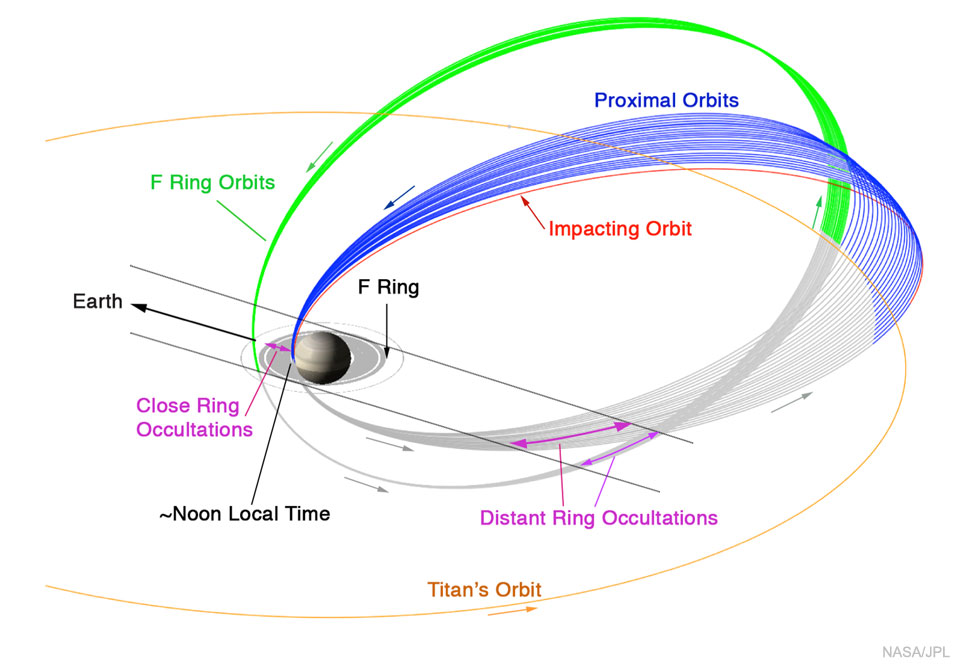
Astronomy Picture of the Day – Cassini’s Grand Finale Tour at Saturn

Astronomy Picture of the Day

Discover the cosmos! Each day a different image or photograph of our fascinating universe is featured, along with a brief explanation written by a professional astronomer.

2017 January 25

Cassini’s Grand Finale Tour at Saturn
Image Credit: NASA, JPL-Caltech


Explanation: Cassini is being prepared to dive into Saturn. The robotic spacecraft that has been orbiting and exploring Saturn for over a decade will end its mission in September with a spectacular atmospheric plunge. Pictured here is a diagram of Cassini’s remaining orbits, each taking about one week. Cassini is scheduled to complete a few months of orbits that will take it just outside Saturn’s outermost ring F. Then, in April, Titan will give Cassini a gravitational pull into Proximal orbits, the last of which, on September 15, will impact Saturn and cause the spacecraft to implode and melt. Cassini’s Grand Finale orbits are designed to record data and first-ever views from inside the rings — between the rings and planet — as well as some small moons interspersed in the rings. Cassini’s demise is designed to protect any life that may occur around Saturn or its moons from contamination by Cassini itself.

Save

Your Earth Sky News for January 25th: A winding river of stars called Eridanus

A winding river of stars called Eridanus

Here’s the real River Po as captured at sunset by EarthSky Facebook friend Marco Mereu, in February 2013. Thank you Marco!

Bottom line: Can you find the long, meandering river of stars called Eridanus in your sky? Be sure to look from a dark location.

Article published on EarthSky

Your Planet Tracker for Today: Moon in Capricorn, Jan 24, 2017 to Jan 27, 2017

Planet Tracker

Moon in Capricorn

Jan 24, 2017 to Jan 27, 2017


Maybe you noticed. Things have gotten more serious with the Moon in Capricorn. No-nonsense suits around the office. Discussions about rules, disciplines, hard work and respect. Virtues that make employees squirm and bosses feel lonely. Structure-everybody hates it until something unruly occurs. Physics says a vast and wild emptiness dances between the molecules in a chair. But we don’t fall in due to the structuring thought in wood, respecting our need for a solid place to sit. That’s Capricorn in your life, structures that support. Its energy inspires your achievements and fears (funny how both can be motivating). Face a fear today. Be the authority in something. Devise a business plan. Recognize that diligence is nothing more than keeping what you want in mind. Strategize with a wise old one. And do something especially nice this Moontime for your skin, bones or knees.


Part of the Daily Insight Group

©Tarot.com 2017. All rights reserved.