
Astronomy Pic for August 5th – Emission Nebula in Cepheus

Astronomy Picture of the Day

Discover the cosmos!Each day a different image or photograph of our fascinating universe is featured, along with a brief explanation written by a professional astronomer.

2012 August 5

IC 1396: Emission Nebula in Cepheus

Image Credit: Digitized Sky Survey, ESA/ESO/NASA FITS Liberator

Color Composite: Davide De Martin (Skyfactory)


Explanation: Stunning emission nebula IC 1396 mixes glowing cosmic gas and dark dust clouds in the high and far off constellation of Cepheus. Energized by the bright, bluish central star seen here, this star forming region sprawls across hundreds of light-years — spanning over three degrees on the sky while nearly 3,000 light-years from planet Earth. Among the intriguing dark shapes within IC 1396, the winding Elephant’s Trunk nebula lies just below center. The gorgeous color view is a composition of digitized black and white photographic plates recorded through red and blue astronomical filters. The plates were taken using the Samuel Oschin Telescope, a wide-field survey instrument at Palomar Observatory, between 1989 and 1993.
Astronomy Picture of the Day for June 1

Astronomy Picture of the Day

Discover the cosmos!Each day a different image or photograph of our fascinating universe is featured, along with a brief explanation written by a professional astronomer.

2012 June 1
See Explanation.  Clicking on the picture will download the highest resolution version available.

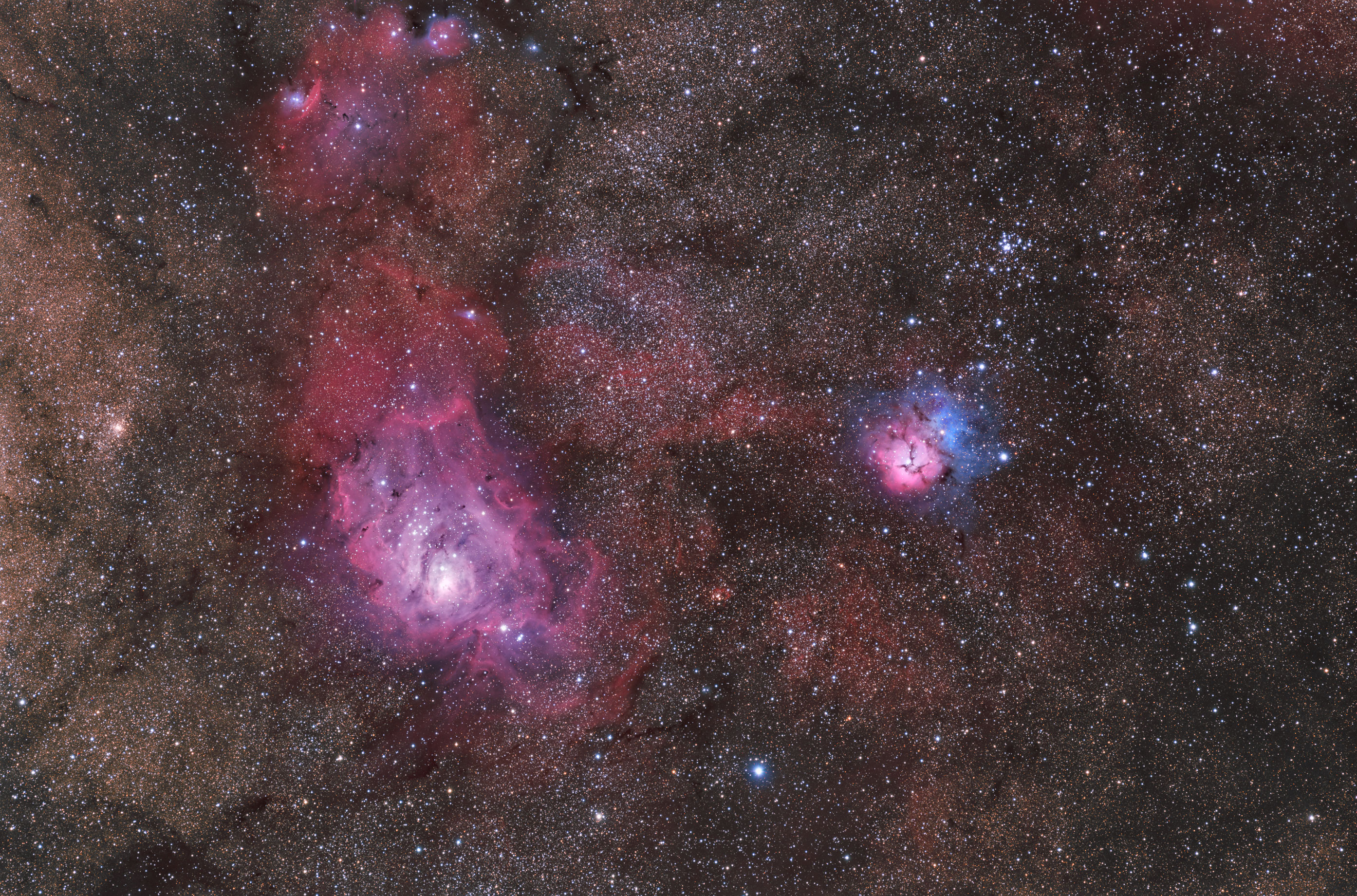
A Sagittarius Triplet
Image Credit & Copyright: Martin Pugh 

Explanation: These three bright nebulae are often featured in telescopic tours of the constellation Sagittarius and the crowded starfields of the central Milky Way. In fact, 18th century cosmic tourist Charles Messier cataloged two of them; M8, the large nebula left of center, and colorful M20 on the right. The third, NGC 6559, is above M8, separated from the larger nebula by a dark dust lane. All three are stellar nurseries about five thousand light-years or so distant. The expansive M8, over a hundred light-years across, is also known as the Lagoon Nebula. M20’s popular moniker is the Trifid. Glowing hydrogen gas creates the dominant red color of the emission nebulae, with contrasting blue hues, most striking in the Trifid, due to dust reflected starlight. This broad skyscape also includes one of Messier’s open star clusters, M21, just above and right of the Trifid.

Astronomy Picture of the Day for April 12 – A Beautiful Trifid

Astronomy Picture of the Day

Discover the cosmos!Each day a different image or photograph of our fascinating universe is featured, along with a brief explanation written by a professional astronomer.

See Explanation.  Clicking on the picture will downloadthe highest resolution version available.

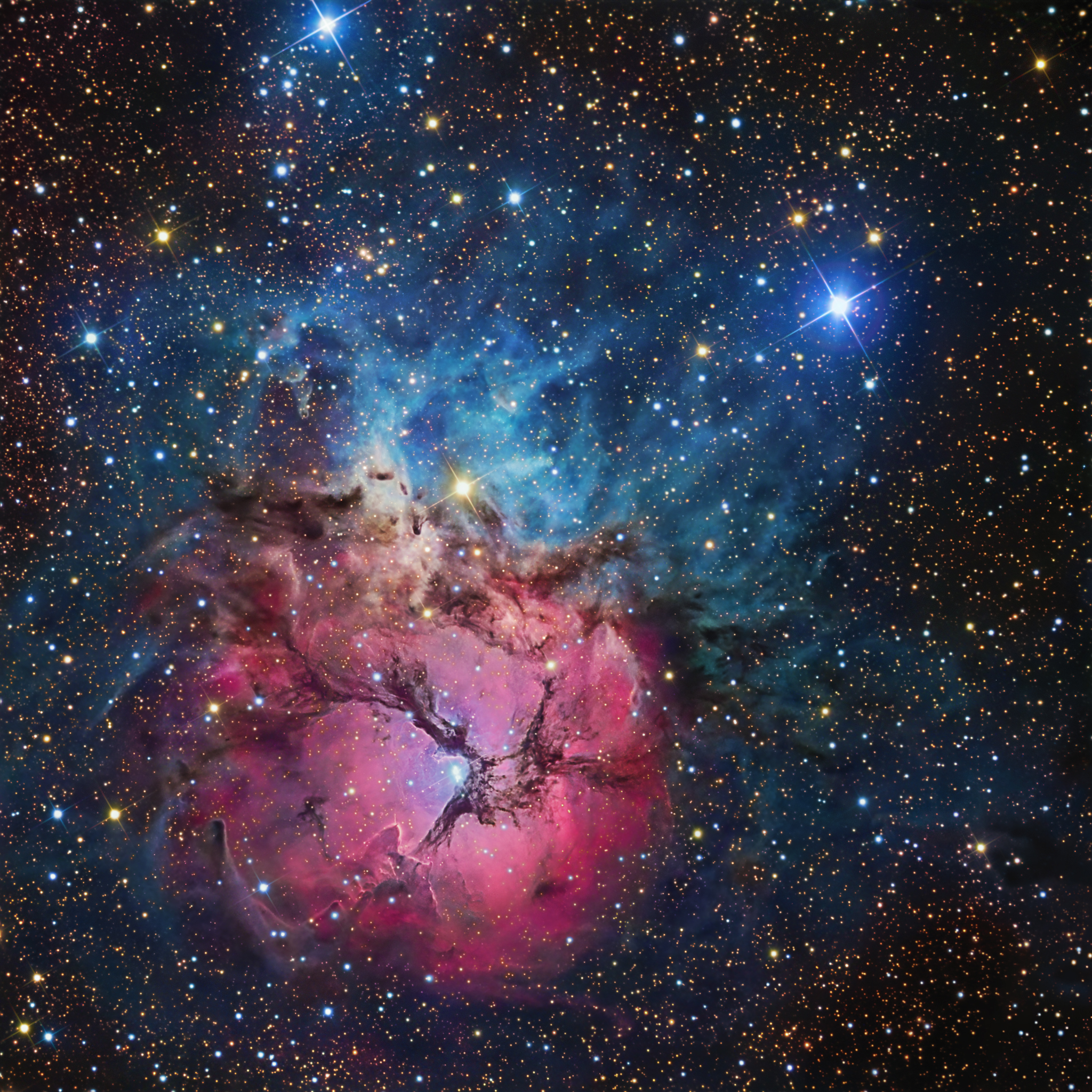
A Beautiful Trifid
Image Credit & Copyright: R Jay Gabany Explanation: The beautiful Trifid Nebula is a cosmic study in colorful contrasts. Also known as M20, it lies about 5,000 light-years away toward the nebula rich constellation Sagittarius. A star forming region in the plane of our galaxy, the Trifid illustrates three different types of astronomical nebulae; red emission nebulae dominated by light emitted by hydrogen atoms, blue reflection nebulae produced by dust reflecting starlight, and dark nebulae where dense dust clouds appear in silhouette. The bright red emission region, roughly separated into three parts by obscuring, dark dust lanes, lends the Trifid its popular name. In this well met scene, the red emission is also juxtaposed with the telltale blue haze of reflection nebulae. Pillars and jets sculpted by newborn stars, below and left of the emission nebula’s center, appear in Hubble Space Telescope close-up images of the region. The Trifid Nebula is about 40 light-years across.

Astronomy Picture of the Day

Astronomy Picture of the Day

Discover the cosmos!Each day a different image or photograph of our fascinating universe is featured, along with a brief explanation written by a professional astronomer.

2011 September 13

Great Orion Nebulae
Image Credit & Copyright: Jesús Vargas (Astrogades) & Maritxu Poyal (Maritxu) 

Explanation: The Great Nebula in Orion, also known as M42, is one of the most famous nebulas in the sky. The star forming region’s glowing gas clouds and hot young stars are on the right in this sharp and colorful image that includes the smaller nebula M43 near center and dusty, bluish reflection nebulae NGC 1977 and friends on the left. Located at the edge of an otherwise invisible giant molecular cloud complex, these eye-catching nebulae represent only a small fraction of this galactic neighborhood’s wealth of interstellar material. Within the well-studied stellar nursery, astronomers have also identified what appear to be numerous infant planetary systems. The gorgeous skyscape spans nearly two degrees or about 45 light-years at the Orion Nebula’s estimated distance of 1,500 light-years.