
Dragons In Astronomy

Dragons In Astronomy

In astronomy, the ancient constellation of Draco is in the northern heavens and curves in a winding pattern between the Big and Little Dippers. It ends in the Dragon’s Head, a trapezium of four stars. The star Draconis is a brilliant double star. The constellation has probably shifted over the millennia and may have once been the polestar to which the pyramid of Cheops was aligned.

Ancient astrologers called the north node of the Moon Caput Draconis, or head of the dragon, and the south node Cauda Draconis, or tail of the dragon.The nodes (the actual meaning is “knot” or “complication”) are not planets but points which relate the Moon’s orbit to the actual orbit of the Earth around the Sun. In astrology the north node symbolizes intake and positive aspects, the south node releases and negative aspects. These draconic nodes are still considered important to today’s astrologers.

“Dancing with Dragons”

D. J. Conway
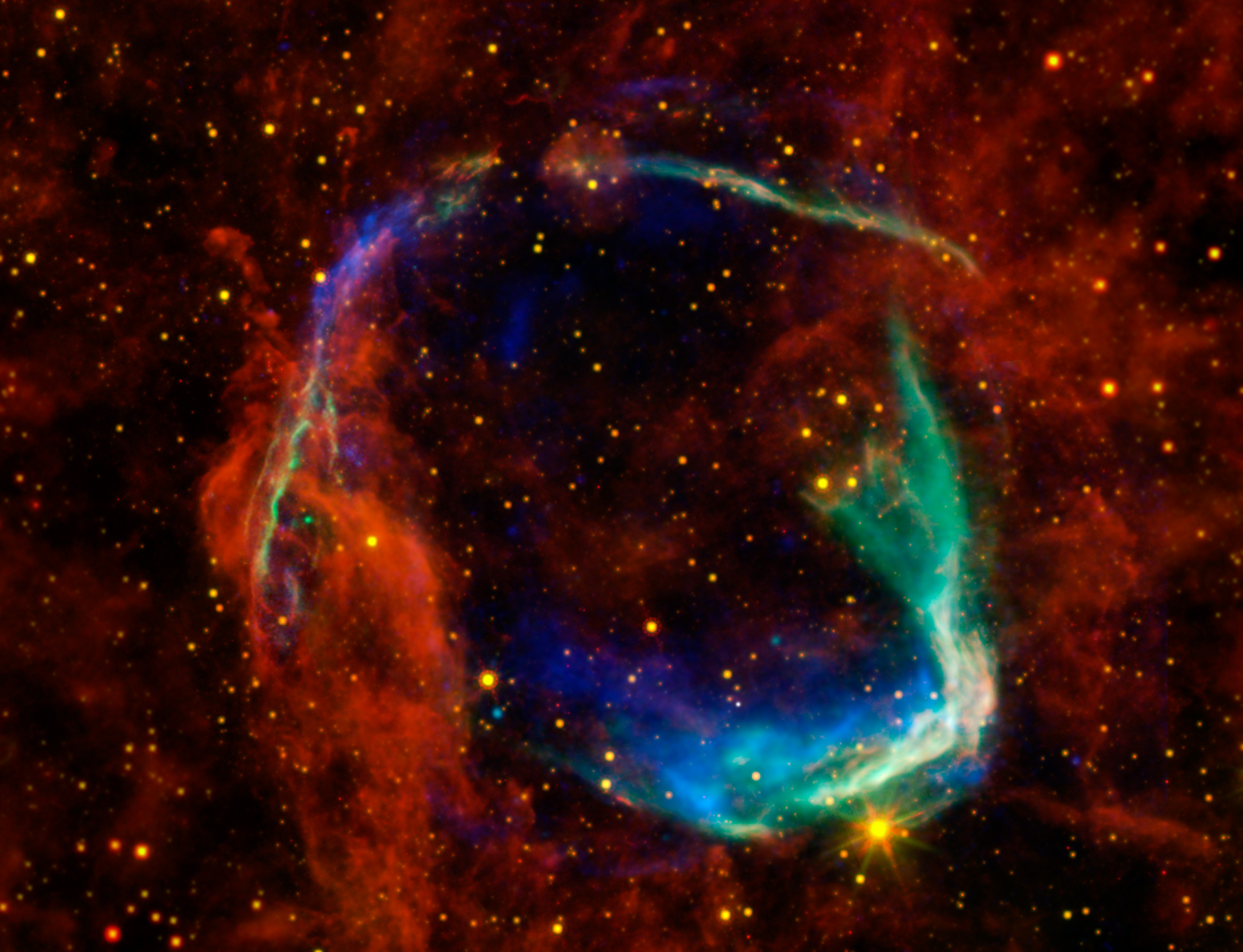
Astronomy Picture of the Day for November 10th

Astronomy Picture of the Day

Discover the cosmos!Each day a different image or photograph of our fascinating universe is featured, along with a brief explanation written by a professional astronomer.

2011 November 10
See Explanation.  Clicking on the picture will download the highest resolution version available.

RCW 86: Historical Supernova Remnant
Credit: X-ray: XMM-Newton, Chandra / IR: WISE, Spitzer 


 Explanation: In 185 AD, Chinese astronomers recorded the appearance of a new star in the Nanmen asterism – a part of the sky identified with Alpha and Beta Centauri on modern star charts. The new star was visible for months and is thought to be the earliest recorded supernova. This multiwavelength composite image from orbiting telescopes of the 21st century, XMM-Newton and Chandra in X-rays, and Spitzer and WISE in infrared, show supernova remnant RCW 86, understood to be the remnant of that stellar explosion. The false-color view shows interstellar gas heated by the expanding supernova shock wave at X-ray energies (blue and green) and interstellar dust radiating at cooler temperatures in infrared light (yellow and red). An abundance of the element iron and lack of a neutron star or pulsar in the remnant suggest that the original supernova was Type Ia. Type Ia supernovae are thermonuclear explosions that destroy a white dwarf star as it accretes material from a companion in a binary star system. Shock velocities measured in the X-ray emitting shell and infrared dust temperatures indicate that the remnant is expanding extremely rapidly into a remarkable low density bubble created before the explosion by the white dwarf system. Near the plane of our Milky Way Galaxy, RCW 86 is about 8,200 light-years away and has an estimated radius of 50 light-years.