
Astronomy Picture of the Day for November 20th

Astronomy Picture of the Day

Discover the cosmos!Each day a different image or photograph of our fascinating universe is featured, along with a brief explanation written by a professional astronomer.

2011 November 20
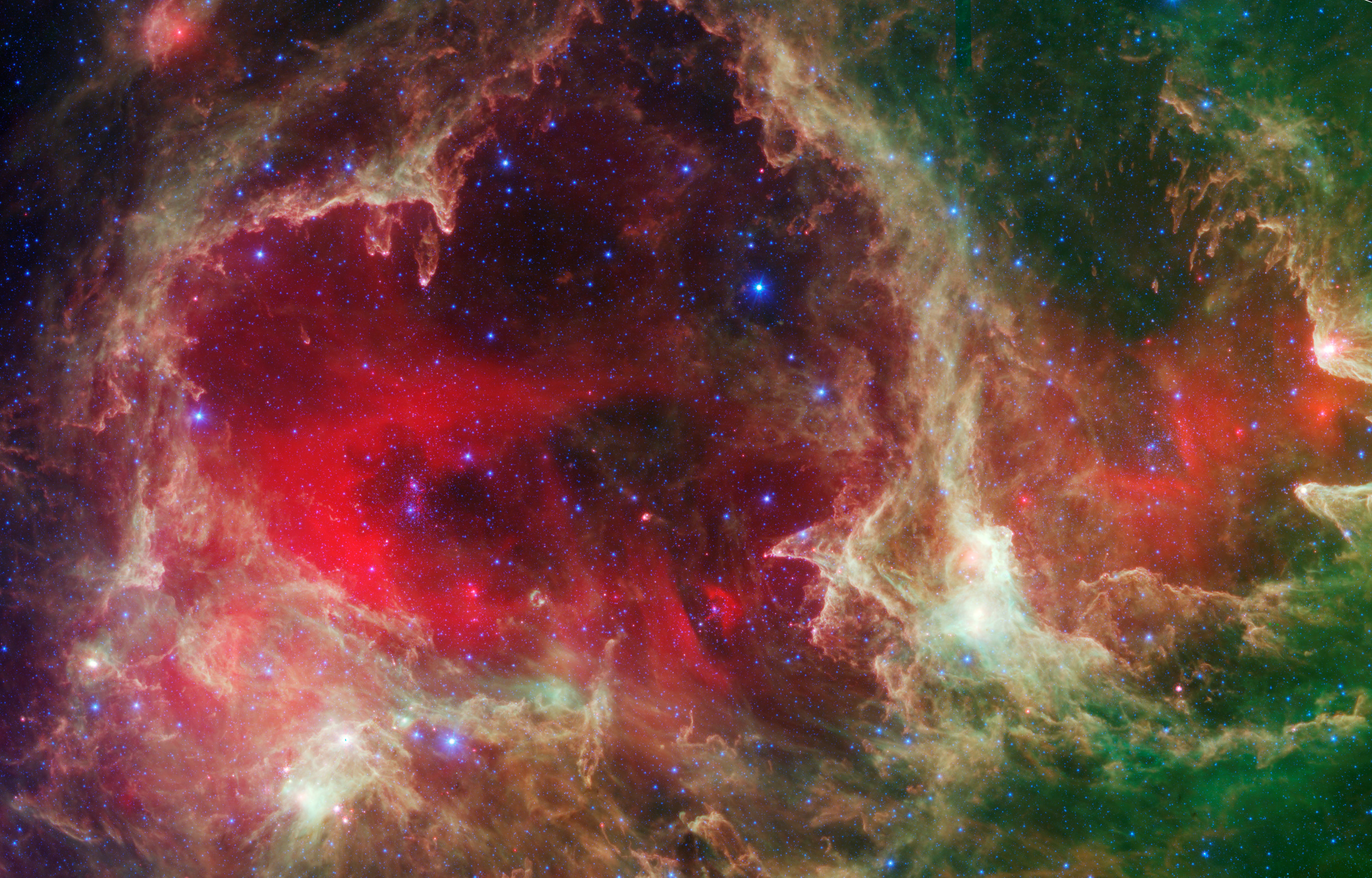
See Explanation.  Clicking on the picture will download the highest resolution version available.

W5: Pillars of Star Formation
Image Credit & Copyright: Lori Allen, Xavier Koenig (Harvard-Smithsonian CfA) et al., JPL-Caltech, NASA  


Explanation: How do stars form? A study of star forming region W5 by the sun-orbiting Spitzer Space Telescope provides clear clues by recording that massive stars near the center of empty cavities are older than stars near the edges. A likely reason for this is that the older stars in the center are actually triggering the formation of the younger edge stars. The triggered star formation occurs when hot outflowing gas compresses cooler gas into knots dense enough to gravitationally contract into stars. Spectacular pillars, left slowly evaporating from the hot outflowing gas, provide further visual clues. In the above scientifically-colored infrared image, red indicates heated dust, while white and green indicate particularly dense gas clouds. W5 is also known as IC 1848, and together with IC 1805 form a complex region of star formation popularly dubbed the Heart and Soul Nebulas. The above image highlights a part of W5 spanning about 2,000 light years that is rich in star forming pillars. W5 lies about 6,500 light years away toward the constellation of Cassiopeia.

Astronomy Picture of the Day for October 11th

Astronomy Picture of the Day

Discover the cosmos!Each day a different image or photograph of our fascinating universe is featured, along with a brief explanation written by a professional astronomer.

2011 October 11

NGC 7635: The Bubble Nebula
Image Credit & Copyright: Larry Van Vleet 


Explanation: It’s the bubble versus the cloud. NGC 7635, the Bubble Nebula, is being pushed out by the stellar wind of massive central star BD+602522. Next door, though, lives a giant molecular cloud, visible to the right. At this place in space, an irresistible force meets an immovable object in an interesting way. The cloud is able to contain the expansion of the bubble gas, but gets blasted by the hot radiation from the bubble’s central star. The radiation heats up dense regions of the molecular cloud causing it to glow. The Bubble Nebula, pictured above in scientifically mapped colors to bring up contrast, is about 10 light-years across and part of a much larger complex of stars and shells. The Bubble Nebula can be seen with a small telescope towards the constellation of the Queen of Aethiopia (Cassiopeia).

Astronomy Picture of the Day for August 25

Astronomy Picture of the Day

Discover the cosmos!Each day a different image or photograph of our fascinating universe is featured, along with a brief explanation written by a professional astronomer.

2011 August 25

Portrait of NGC 281
Image Credit & Copyright: J-P Metsävainio (Astro Anarchy)

Explanation: Look through the cosmic cloud cataloged as NGC 281 and it’s almost easy to miss stars of open cluster IC 1590. But, formed within the nebula, that cluster’s young, massive stars ultimately power the pervasive nebular glow. The eye-catching shapes looming in this portrait of NGC 281 are sculpted columns and dense dust globules seen in silhouette, eroded by intense, energetic winds and radiation from the hot cluster stars. If they survive long enough, the dusty structures could also be sites of future star formation. Playfully called the Pacman Nebula because of its overall shape, NGC 281 is about 10,000 light-years away in the constellation Cassiopeia. This composite image was made through narrow-band filters, but combines emission from the nebula’s hydrogen, sulfur, and oxygen atoms in a visible spectrum palette. It spans over 80 light-years at the estimated distance of NGC 281.