Astronomy Picture of the Day

From NASA.gov

Discover the cosmos! Each day a different image or photograph of our fascinating universe is featured, along with a brief explanation written by a professional astronomer.

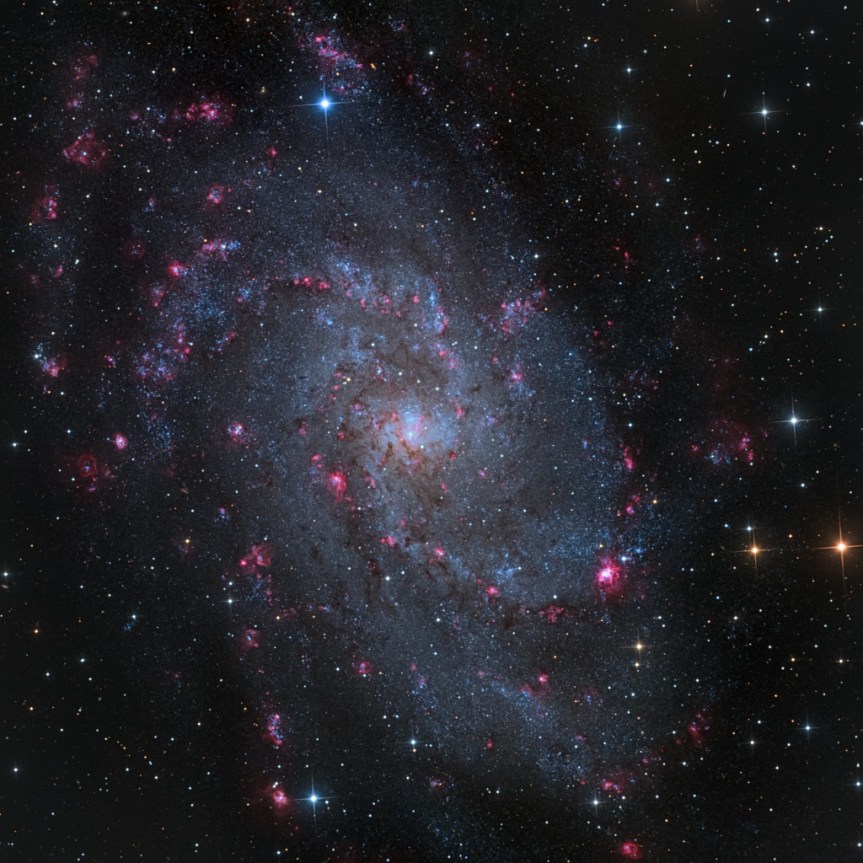
The Hydrogen Clouds of M33

Image Credit & Copyright: Luca Fornaciari

Explanation: Gorgeous spiral galaxy M33 seems to have more than its fair share of glowing hydrogen gas. A prominent member of the local group of galaxies, M33 is also known as the Triangulum Galaxy and lies a mere 3 million light-years away. Sprawling along loose spiral arms that wind toward the core, M33’s giant HII regions are some of the largest known stellar nurseries, sites of the formation of short-lived but very massive stars. Intense ultraviolet radiation from the luminous massive stars ionizes the surrounding hydrogen gas and ultimately produces the characteristic red glow. To highlight the HII regions in this telescopic image, broadband data used to produce a color view of the galaxy were combined with narrowband data recorded through a hydrogen-alpha filter, transmitting the light of the strongest hydrogen emission line. Close-ups of cataloged HII regions appear in the sidebar insets. Use the individual reference number to find their location within the Triangulum Galaxy. For example, giant HII region NGC604 is identified in an inset on the right and appears at position number 15. That’s about 4 o’clock from galaxy center in this portrait of M33.

September 29th Astronomy Picture of the Day

Gigantic Jet Lightning from Puerto Rico

Gigantic Jet Lightning from Puerto Rico
Video Credit & Copyright: Frankie LucenaExplanation: Have you ever seen a gigantic jet? They are extremely rare but tremendously powerful. Gigantic jets are a type of lightning discharge documented only this century that occur between some thunderstorms and the Earth’s ionosphere high above them. Pictured above is the middle and top of one such jet caught last week by a lightning and meteor camera from Puerto RicoUSA. The jet traversed perhaps 70 kilometers in just under one second. Gigantic jets are much different from regular cloud-to-cloud and cloud-to-ground lightning. The bottoms of gigantic jets appear similar in appearance to another type cloud-to-above strike called blue jets, while the tops appear similar to upper-atmosphere red sprites. Although the mechanism and trigger that causes gigantic jets is a topic of research, it is clear that the jets reduce charge imbalance between different parts of Earth’s atmosphere. A good way to look for gigantic jets is to watch a powerful but distant thunderstorm from a clear location.

From NASA.gov


Almost Hyperspace: Random APOD Generator
Tomorrow’s picture: open space

Astronomy Picture of the Day

Discover the cosmos! Each day a different image or photograph of our fascinating universe is featured, along with a brief explanation written by a professional astronomer.

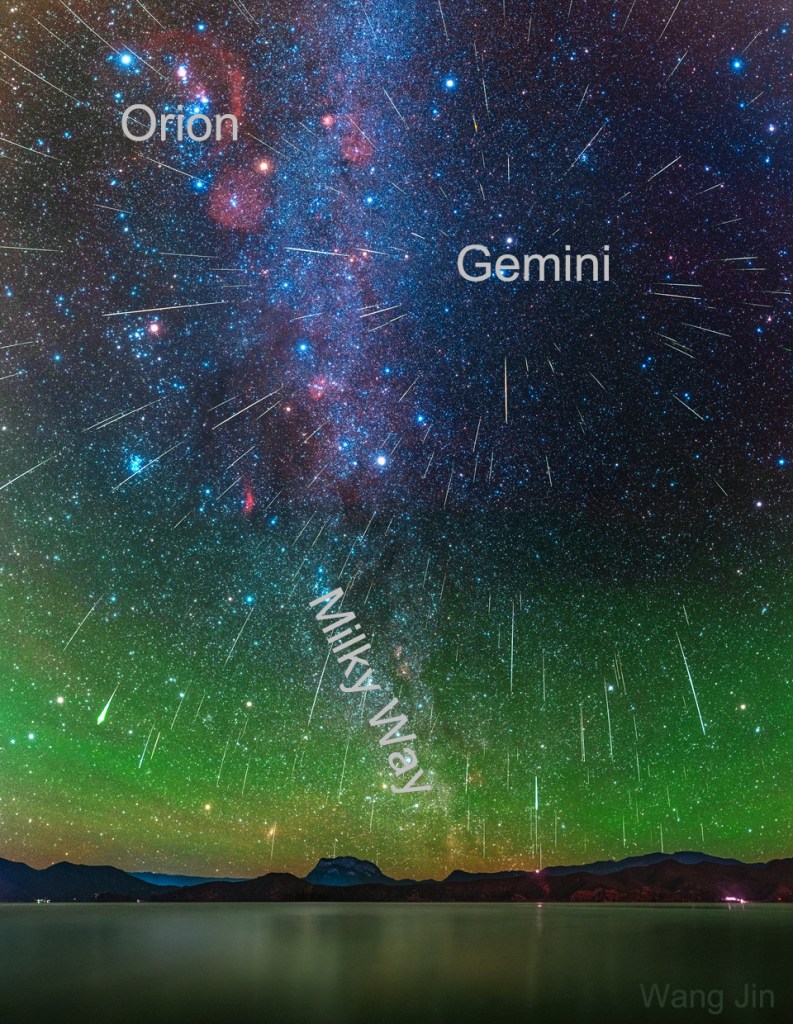
Night of the Perseids – September 28, 2021

Video Credit & Copyright: Vikas Chander & Dorje Angchuk; Music: Tea Time via PremiumBeatExplanation: Have you ever experienced a meteor shower? To help capture the wonder, a video was taken during the peak of the recent Perseid meteor shower above the Indian Astronomical Observatory in HanleIndia, high up in the Himalayan mountains. Night descends as the video begins, with the central plane of our Milky Way Galaxy approaching from the left and Earth-orbiting satellites zipping by overhead. During the night, the flash of meteors that usually takes less than a second is artificially extended. The green glow of most meteors is typically caused by vaporizing nickel. As the video continues, Orion rises and meteors flare above the 2-meter Himalayan Chandra Telescope and the seven barrels of the High Energy Gamma Ray Telescope (Hagar). The 2 minute 30 second movie ends with the Sun rising, preceded by a false dawn of zodiacal light.

September 27th Astronomy Picture of the Day

Discover the cosmos!

Unwrapped: Five Decade Old Lunar Selfie

Image Credit: NASAApollo 11Neil Armstrong; Processing: Michael Ranger

Each day a different image or photograph of our fascinating universe is featured, along with a brief explanation written by a professional astronomer.

Explanation: 

Here is one of the most famous pictures from the Moon — but digitally reversed. Apollo 11 landed on the moon in 1969 and soon thereafter many pictures were taken, including an iconic picture of Buzz Aldrin taken by Neil Armstrong. The original image captured not only the magnificent desolation of an unfamiliar world, but Armstrong himself reflected in Aldrin’s curved visor. Enter modern digital technology. In the featured image, the spherical distortion from Aldrin’s helmet has been reversed. The result is the famous picture — but now featuring Armstrong himself from Aldrin’s perspective. Even so, since Armstrong took the picture, the image is effectively a five-decade old lunar selfie. The original visor reflection is shown on the left, while Earth hangs in the lunar sky on the upper right. A foil-wrapped leg of the Eagle lander is prominently visible. Preparations to return humans to the Moon in the next few years include the Artemis program, an international collaboration led by NASA.

NASA Hubble Space Telescope snaps ‘squabbling galactic siblings’

The clashing trio earned a spot in the Atlas of Peculiar Galaxies.

The odd-looking object Arp 195 is actually three galaxies interacting.

ESA/Hubble & NASA, J. Dalcanton

Galaxies aren’t just static entities hanging out in space doing nothing. When they get close to each other, they can collide, push and pull at each other and even merge together. A newly released Hubble Space Telescope image shows what happens when three galaxies interact with each other and act like “squabbling galactic siblings.”

Hubble is a joint project of NASA and the European Space Agency. ESA said the image shows a “dramatic triplet of galaxies” engaged in a “three-way gravitational tug-of-war.” The system is known as Arp 195, getting its name from astronomer Halton Arp.

Watch “Best Night Sky Events in June”

From The Weather Channel Android App: https://weather.com/science/space/video/best-night-sky-events-in-june?pl=pl-the-latest

Take Away Pain Chant

My children grew up sbelieving that just a kiss from mom or grandma would take away their “ouchie”. When my grandchildren came along, after reaching about 2 years old, most did not believe just a mom or grandma kiss would make “boo-boo” stop hurting. So I got a little more creative witchy style by changing the lyrics to the children’s song “Rain, Rain go away…” to chant to help their pain go away

Repeat chant either 3 or 6 or 9 times depending on how long it takes you to minister 1st aid to the child. This chant is strictly for minor scrapes, cuts, and falls. It the injury requires stitches or a head injury causes any length of the child being unconscious, dizziness, double vision, etc seek professional medical care immediately.

Pain, pain go away Chant

Pain, pain go away. Don’t come back another day. Little (child’s name) wants to play.

My youngest granddaughter use this on me when I had tried outside scraping my palms and knees. She very gently wiped the spots with a soapy, dripping washcloth blowing on the abrasion when I flinched. Yes, I had a small mess in my bathroom after she was through being my “doctor” complete with wearing a surgical hat and medicine gloves, as she called them but the cleanup was worth it.

May 30 Northern Hemisphere Custom Planetary Positions

The time for the Custom Planetary Positions is from the local time in Chicago, Illinois, United States of America

May 30, 2021
01:00 pm GMT 8:00 AM CDT
Zodiac: Tropical (Standard Western)

Sun:09 Gemini 20
Moon:05 Aquarius 12
Mercury:24 Gemini 42 Rx
Venus:26 Gemini 19
Mars:22 Cancer 36
Jupiter:01 Pisces 29
Saturn:13 Aquarius 29 Rx
Uranus:12 Taurus 21
Neptune:23 Pisces 01
Pluto:26 Capricorn 34 Rx

True Lunar Node:10 Gemini 44
Mean Lunar Node:10 Gemini 56 Rx

Lilith (Black Moon):24 Taurus 35

Chiron:12 Aries 03
Ceres:08 Taurus 35
Pallas:23 Pisces 03
Juno:18 Sagittarius 03 Rx
Vesta:12 Virgo 26

Eris:24 Aries 34

Fire:3
Earth:5
Air:7
Water:4

Cardinal:4
Fixed:5
Mutable:10

If you need to calculate the planetary positions for a specific use and time, click on this link 
Currentplanetarypositions.com
 To figure out GMT (Greenwich Mean Time) to your local time use this link 
For Your Local Time and Date   

May 30 Moon Goddess’ Current Phase

Today the Moon will be in a Waning Gibbous Phase. This is the first phase after the Full Moon occurs. It lasts roughly 7 days with the Moon’s illumination growing smaller each day until the Moon becomes a Last Quarter Moon with an illumination of 50%. The average Moon rise for this phase is between 9pm and Midnight depending on the age of the phase. The moon rises later and later each night setting after sunrise in the morning. During this phase the Moon can also be seen in the early morning daylight hours on the western horizon.
Visit the May 2021 Moon Phases Calendar to see all the daily moon phase for this month.

Waning Gibbous Phase

The Waning Gibbous on May 30 has an illumination of 78%. This is the percentage of the Moon illuminated by the Sun. The illumination is constantly changing and can vary up to 10% a day. On May 30 the Moon is 19.32 days old. This refers to how many days it has been since the last New Moon. It takes 29.53 days for the Moon to orbit the Earth and go through the lunar cycle of all 8 Moon phases.

From Moongiant.com
You can use this link to go forward or backward in time for Moon phase information. If you are curious you can even find out what phase the Moon was in when you or anyone else, you know was on the date the person was born.

30 May Southern Hemisphere Custom Planetary Positions

The time for the Custom Planetary Positions is from the local time in Melbourne, Victoria, Australia  

The date in ( ) is because of us posting this from the Northern Hemisphere. So this post goes live at 8:00 AM AEDT on the date before the month. The date inside the ( ) is the date we have to use to get the timing right for you. That is also why the GMT time that shows at 10:00 PM.

30 May (29) 2021
10:00 pm GMT 8:00 AM AEST
Zodiac: Tropical (Standard Western)

Sun:08 Gemini 44
Moon:26 Capricorn 26
Mercury:24 Gemini 43
Venus:25 Gemini 33
Mars:22 Cancer 13
Jupiter:01 Pisces 26
Saturn:13 Aquarius 29 Rx
Uranus:12 Taurus 19
Neptune:23 Pisces 00
Pluto:26 Capricorn 34 Rx

True Lunar Node:10 Gemini 44
Mean Lunar Node:10 Gemini 58 Rx

Lilith (Black Moon):24 Taurus 31

Chiron:12 Aries 01
Ceres:08 Taurus 21
Pallas:22 Pisces 56
Juno:18 Sagittarius 11 Rx
Vesta:12 Virgo 16

Eris:24 Aries 34

Fire:3
Earth:6
Air:6
Water:4

Cardinal:5
Fixed:4
Mutable:10

If you need to calculate the planetary positions for a specific use and time, click on this link 
Currentplanetarypositions.com
 To figure out GMT (Greenwich Mean Time) to your local time use this link 
For Your Local Time and Date   

May 29 Northern Hemisphere Custom Planetary Positions

The time for the Custom Planetary Positions is from the local time in Chicago, Illinois, United States of America

May 29, 2021
01:00 pm GMT 8:00 AM CDT
Zodiac: Tropical (Standard Western)

Sun:08 Gemini 23
Moon:21 Capricorn 05
Mercury:24 Gemini 43
Venus:25 Gemini 06
Mars:22 Cancer 00
Jupiter:01 Pisces 25
Saturn:13 Aquarius 29 Rx
Uranus:12 Taurus 18
Neptune:23 Pisces 00
Pluto:26 Capricorn 35 Rx
True Lunar Node:10 Gemini 44
Mean Lunar Node:11 Gemini 00 Rx
Lilith (Black Moon):24 Taurus 29
Chiron:12 Aries 00
Ceres:08 Taurus 12
Pallas:22 Pisces 51
Juno:18 Sagittarius 16 Rx
Vesta:12 Virgo 10
Eris:24 Aries 34
Fire:3
Earth:6
Air:6
Water:4Cardinal:5
Fixed:4
Mutable:10

If you need to calculate the planetary positions for a specific use and time, click on this link 
Currentplanetarypositions.com
 To figure out GMT (Greenwich Mean Time) to your local time use this link 
For Your Local Time and Date   

May 29

Today the Moon will be in a Waning Gibbous Phase. This is the first phase after the Full Moon occurs. It lasts roughly 7 days with the Moon’s illumination growing smaller each day until the Moon becomes a Last Quarter Moon with an illumination of 50%. The average Moon rise for this phase is between 9pm and Midnight depending on the age of the phase. The moon rises later and later each night setting after sunrise in the morning. During this phase the Moon can also be seen in the early morning daylight hours on the western horizon.
Visit the May 2021 Moon Phases Calendar to see all the daily moon phase for this month.

Today’s Waning Gibbous Phase

The Waning Gibbous on May 29 has an illumination of 87%. This is the percentage of the Moon illuminated by the Sun. The illumination is constantly changing and can vary up to 10% a day. On May 29 the Moon is 18.24 days old. This refers to how many days it has been since the last New Moon. It takes 29.53 days for the Moon to orbit the Earth and go through the lunar cycle of all 8 Moon phases.

From Moongiant.com
You can use this link to go forward or backward in time for Moon phase information. If you are curious you can even find out what phase the Moon was in when you or anyone else, you know was on the date the person was born.

May 26 Northern Hemisphere Custom Planetary Positions

The time for the Custom Planetary Positions is from the local time in Chicago, Illinois, United States of America

May 26, 2021
01:00 pm GMT 8:00 AM CDT
Zodiac: Tropical (Standard Western)

Sun:05 Gemini 30
Moon:06 Sagittarius 33
Mercury:24 Gemini 16
Venus:21 Gemini 25
Mars:20 Cancer 09
Jupiter:01 Pisces 12
Saturn:13 Aquarius 31 Rx
Uranus:12 Taurus 08
Neptune:22 Pisces 57
Pluto:26 Capricorn 37 Rx

True Lunar Node:10 Gemini 44 Rx
Mean Lunar Node:11 Gemini 09 Rx

Lilith (Black Moon):24 Taurus 09

Chiron:11 Aries 53
Ceres:07 Taurus 03
Pallas:22 Pisces 16
Juno:18 Sagittarius 55 Rx
Vesta:11 Virgo 25

Eris:24 Aries 32

Fire:4
Earth:5
Air:6
Water:4

Cardinal:4
Fixed:4
Mutable:11

If you need to calculate the planetary positions for a specific use and time, click on this link 
Currentplanetarypositions.com
 To figure out GMT (Greenwich Mean Time) to your local time use this link 
For Your Local Time and Date   

May 26 Moon Goddess’ Current Phase

Today the Moon will be in a Full Moon phase. During a Full Moon the moon is 100% illuminated as seen from Earth and is on the opposite side of the Earth from the Sun. The Moon will be visible throughout the night sky rising at sunset in the east and setting with the sunrise the next morning. The point at which a Full Moon occurs can be measured down to a fraction of a second. The time it takes between full moons is known as a Synodic month and is 29.530587981 days long. Keep track of all the Full Moons throughout the year on the Full Moon Calendar >
Visit the May 2021 Moon Phases Calendar to see all the daily moon phase for this month.

Today’s Full Moon Phase

The Full Moon on May 26 has an illumination of 100%. This is the percentage of the Moon illuminated by the Sun. The illumination is constantly changing and can vary up to 10% a day. On May 26 the Moon is 14.8 days old. This refers to how many days it has been since the last New Moon. It takes 29.53 days for the Moon to orbit the Earth and go through the lunar cycle of all 8 Moon phases.

From Moongiant.com
You can use this link to go forward or backward in time for Moon phase information. If you are curious you can even find out what phase the Moon was in when you or anyone else, you know was on the date the person was born.

26 May Southern Hemisphere Custom Planetary Positions

The time for the Custom Planetary Positions is from the local time in Melbourne, Victoria, Australia  


The date in ( ) is because of us posting this from the Northern Hemisphere. So this post goes live at 8:00 AM AEDT on the date before the month. The date inside the ( ) is the date we have to use to get the timing right for you. That is also why the GMT time that shows at 10:00 PM.

26 May (25) 2021
10:00 pm GMT 8:00 AM AEST
Zodiac: Tropical (Standard Western)

Sun:04 Gemini 54
Moon:27 Scorpio 03
Mercury:24 Gemini 05
Venus:20 Gemini 39
Mars:19 Cancer 46
Jupiter:01 Pisces 09
Saturn:13 Aquarius 31 Rx
Uranus:12 Taurus 06
Neptune:22 Pisces 57
Pluto:26 Capricorn 38 Rx

True Lunar Node:10 Gemini 44 Rx
Mean Lunar Node:11 Gemini 11 Rx

Lilith (Black Moon):24 Taurus 05

Chiron:11 Aries 52
Ceres:06 Taurus 49
Pallas:22 Pisces 08
Juno:19 Sagittarius 03 Rx
Vesta:11 Virgo 16

Eris:24 Aries 32

Fire:3
Earth:5
Air:6
Water:5

Cardinal:4
Fixed:5
Mutable:10

If you need to calculate the planetary positions for a specific use and time, click on this link Currentplanetarypositions.com
 To figure out GMT (Greenwich Mean Time) to your local time use this link 
For Your Local Time and Date

May 21 Northern Hemisphere Custom Planetary Positions

 The time for the Custom Planetary Positions is from the local time in Chicago, Illinois, United States of America

May 21, 2021
01:00 pm GMT 8:00 AM CDT
Zodiac: Tropical (Standard Western)

Sun:00 Gemini 42
Moon:22 Virgo 38
Mercury:21 Gemini 58
Venus:15 Gemini 18
Mars:17 Cancer 06
Jupiter:00 Pisces 46
Saturn:13 Aquarius 31
Uranus:11 Taurus 52
Neptune:22 Pisces 52
Pluto:26 Capricorn 41 Rx

True Lunar Node:10 Gemini 47 Rx
Mean Lunar Node:11 Gemini 25 Rx

Lilith (Black Moon):23 Taurus 36

Chiron:11 Aries 41
Ceres:05 Taurus 08
Pallas:21 Pisces 13
Juno:19 Sagittarius 56 Rx
Vesta:10 Virgo 16

Eris:24 Aries 30

Fire:3
Earth:6
Air:6
Water:4

Cardinal:4
Fixed:4
Mutable:11

  
If you need to calculate the planetary positions for a specific use and time, click on this link 
Currentplanetarypositions.com
 To figure out GMT (Greenwich Mean Time) to your local time use this link 
For Your Local Time and Date   

May 21 Moon Goddess’ Current Phase

Today the Moon will be in a Waxing Gibbous phase. This phase is when the moon is more than 50% illuminated but not yet a Full Moon. The phase lasts about 7 days with the moon becoming more illuminated each day until the Full Moon. During a Waxing Gibbous the moon rises in the east in mid-afternoon and is high in the eastern sky at sunset. The moon is then visible through most of the night sky setting a few hours before sunrise. The word Gibbous first appeared in the 14th century and has its roots in the Latin word “gibbosus” meaning humpbacked.
Visit the May 2021 Moon Phases Calendar to see all the daily moon phase for this month.

Today’s Waxing Gibbous Phase

The Waxing Gibbous on May 21 has an illumination of 68%. This is the percentage of the Moon illuminated by the Sun. The illumination is constantly changing and can vary up to 10% a day. On May 21 the Moon is 9.13 days old. This refers to how many days it has been since the last New Moon. It takes 29.53 days for the Moon to orbit the Earth and go through the lunar cycle of all 8 Moon phases.

From Moongiant.com
You can use this link to go forward or backward in time for Moon phase information. If you are curious you can even find out what phase the Moon was in when you or anyone else, you know was on the date the person was born.

20 May Northern Hemisphere Custom Planetary Positions

The time for the Custom Planetary Positions is from the local time in Chicago, Illinois, United States of America

May 20, 2021
01:00 pm GMT 8:00 AM CDT
Zodiac: Tropical (Standard Western)

Sun:29 Taurus 44
Moon:08 Virgo 55
Mercury:21 Gemini 16
Venus:14 Gemini 04
Mars:16 Cancer 29
Jupiter:00 Pisces 41
Saturn:13 Aquarius 31
Uranus:11 Taurus 48
Neptune:22 Pisces 51
Pluto:26 Capricorn 41 Rx
True Lunar Node:10 Gemini 48 Rx
Mean Lunar Node:11 Gemini 28 Rx
Lilith (Black Moon):23 Taurus 29
Chiron:11 Aries 39
Ceres:04 Taurus 45
Pallas:21 Pisces 00
Juno:20 Sagittarius 08 Rx
Vesta:10 Virgo 04
Eris:24 Aries 29
Fire:3
Earth:7
Air:5
Water:4Cardinal:4
Fixed:5
Mutable:10


If you need to calculate the planetary positions for a specific use and time, click on this link 
Currentplanetarypositions.com
 To figure out GMT (Greenwich Mean Time) to your local time use this link 
For Your Local Time and Date   


May 20 Moon Goddess’ Current Phase

Today the Moon will be in a Waxing Gibbous phase. This phase is when the moon is more than 50% illuminated but not yet a Full Moon. The phase lasts about 7 days with the moon becoming more illuminated each day until the Full Moon. During a Waxing Gibbous the moon rises in the east in mid-afternoon and is high in the eastern sky at sunset. The moon is then visible through most of the night sky setting a few hours before sunrise. The word Gibbous first appeared in the 14th century and has its roots in the Latin word “gibbosus” meaning humpbacked.
Visit the May 2021 Moon Phases Calendar to see all the daily moon phase for this month.

Waxing Gibbous Phase

The Waxing Gibbous on May 20 has an illumination of 58%. This is the percentage of the Moon illuminated by the Sun. The illumination is constantly changing and can vary up to 10% a day. On May 20 the Moon is 8.1 days old. This refers to how many days it has been since the last New Moon. It takes 29.53 days for the Moon to orbit the Earth and go through the lunar cycle of all 8 Moon phases.

From Moongiant.com You can use this link to go forward or backward in time for Moon phase information. If you are curious you can even find out what phase the Moon was in when you or anyone else, you know was on the date the person was born.

20 May Southern Hemisphere Custom Planetary Positions 

The time for the Custom Planetary Positions is from the local time in Melbourne, Victoria, Australia


The date in ( ) is because of us posting this from the Northern Hemisphere. So this post goes live at 8:00 AM AEDT on the date before the month. The date inside the ( ) is the date we have to use to get the timing right for you. That is also why the GMT time that shows at 10:00 PM.

20 May (19) 2021
10:00 pm GMT 8:00 AM AEST
Zodiac: Tropical (Standard Western)

Sun:29 Taurus 08
Moon:00 Virgo 34
Mercury:20 Gemini 48
Venus:13 Gemini 18
Mars:16 Cancer 06
Jupiter:00 Pisces 37
Saturn:13 Aquarius 30
Uranus:11 Taurus 46
Neptune:22 Pisces 50
Pluto:26 Capricorn 42 Rx

True Lunar Node:10 Gemini 48 Rx
Mean Lunar Node:11 Gemini 30 Rx

Lilith (Black Moon):23 Taurus 25

Chiron:11 Aries 37
Ceres:04 Taurus 30
Pallas:20 Pisces 52
Juno:20 Sagittarius 15 Rx
Vesta:09 Virgo 56

Eris:24 Aries 29

Fire:3
Earth:7
Air:5
Water:4

Cardinal:4
Fixed:5
Mutable:10


If you need to calculate the planetary positions for a specific use and time, click on this link Currentplanetarypositions.com
 To figure out GMT (Greenwich Mean Time) to your local time use this link 
For Your Local Time and Date