March 5 Astronomy Picture of the Day

Discover the cosmos! Each day a different image or photograph of our fascinating universe is featured, along with a brief explanation written by a professional astronomer.

2022 March 5

Interstellar Comet 2I Borisov
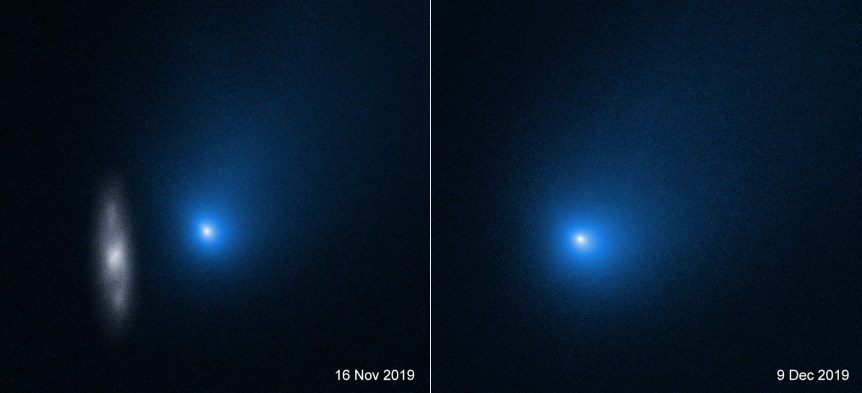
These two images, taken by NASA’s Hubble Space Telescope, capture comet 2I/Borisov streaking though our solar system and on its way back to interstellar space. It is only the second interstellar object known to have passed through the solar system.
“Hubble gives us the best upper limit of the size of comet Borisov’s nucleus, which is the really important part of the comet,” said David Jewitt, a UCLA professor of planetary science and astronomy, whose team has captured the best and sharpest look at this first confirmed interstellar comet. “Surprisingly, our Hubble images show that its nucleus is more than 15 times smaller than earlier investigations suggested it might be. Our Hubble images show that it is smaller than half-a-kilometer. Knowing the size is potentially useful for beginning to estimate how common such objects may be in the solar system and our galaxy. Borisov is the first known interstellar comet, and we would like to learn how many others there are.”
Crimean amateur astronomer Gennady Borisov discovered the comet on August 30, 2019, and reported the position measurements to the International Astronomical Union’s Minor Planet Center in Cambridge, Massachusetts. The Center for Near-Earth Object Studies at the Jet Propulsion Laboratory, working with the Minor Planet Center, computed an orbit for the comet which shows that it came from elsewhere in our Milky Way galaxy, point of origin unknown.
Nevertheless, observations by numerous telescopes show that the comet’s chemical composition is similar to the comets found inside our solar system, providing evidence that comets also form around other stars. By the middle of 2020 the comet will have already zoomed past Jupiter’s distance of 500 million miles on its way back into the frozen abyss of interstellar space.
[left] November 16, 2019 photo
The comet appears in front of a distant background spiral galaxy (2MASX J10500165-0152029). The galaxy’s bright central core is smeared in the image because Hubble was tracking the comet. Comet Borisov was approximately 203 million miles from Earth in this exposure. Its tail of ejected dust streaks off to the upper right.
[right] December 9, 2019 photo
Hubble revisited the comet shortly after its closest approach to the Sun where it received maximum heating after spending most of its life in frigid interstellar space. The comet is 185 million miles from Earth in this photo, near the inner edge of the asteroid belt but below it. The nucleus, an agglomeration of ices and dust, is still too small to be resolved. The bright central portion is a coma made up of dust leaving the surface. The comet will make its closest approach to Earth in late December at a distance of 180 million miles.
The Hubble Space Telescope is a project of international cooperation between the European Space Agency (ESA) and NASA. NASA’s Goddard Space Flight Center in Greenbelt, Maryland, manages the telescope. The Space Telescope Science Institute (STScI) in Baltimore, Maryland, conducts Hubble science operations. STScI is operated for NASA by the Association of Universities for Research in Astronomy in Washington, D.C. The Minor Planet Center and the Center for Near-Earth Orbit Studies are projects of NASA’s Near-Earth Object Observations Program of the Planetary Defense Coordination Office at NASA Headquarters.

NASAESA, and D. Jewitt (UCLA) et al.

Explanation: From somewhere else in the Milky Way galaxy, Comet 2I/Borisov was just visiting the Solar System. Discovered by amateur astronomer Gennady Borisov on August 30, 2019, the first known interstellar comet is seen in these two Hubble Space Telescope images from November and December 2019. On the left, a distant background galaxy near the line-of-sight to Borisov is blurred as Hubble tracked the speeding comet and dust tail about 327 million kilometers from Earth. At right, 2I/Borisov appears shortly after perihelion, its closest approach to Sun. European Southern Observatory observations indicate that this comet may never have passed close to any star before its 2019 perihelion passage. Borisov’s closest approach to our fair planet, a distance of about 290 million kilometers, came on December 28, 2019. Even though Hubble’s sharp images don’t resolve the comet’s nucleus, they did lead to estimates of less than 1 kilometer for its diameter.
March 4 Astronomy Picture of the Day

Discover the cosmos! Each day a different image or photograph of our fascinating universe is featured, along with a brief explanation written by a professional astronomer.

2022 March 4

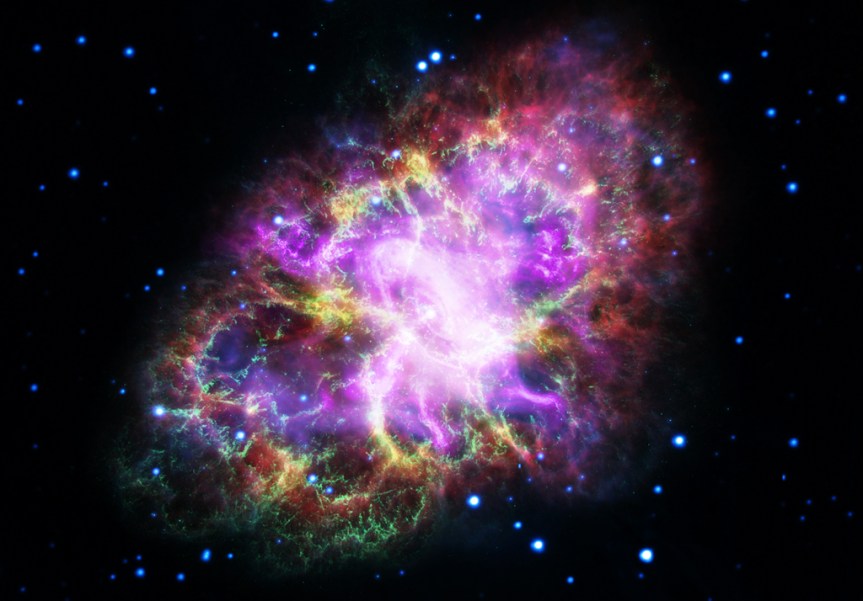
The Multiwavelength Crab

NASAESAG. Dubner (IAFE, CONICET-University of Buenos Aires) et al.;
A. Loll et al.; T. Temim et al.; F. Seward et al.; VLA/NRAO/AUI/NSF; Chandra/CXC;
Spitzer/JPL-Caltech; XMM-Newton/ESA; Hubble/STScI

Explanation: The Crab Nebula is cataloged as M1, the first object on Charles Messier’s famous list of things which are not comets. In fact, the Crab is now known to be a supernova remnant, expanding debris from massive star’s death explosion, witnessed on planet Earth in 1054 AD. This brave new image offers a 21st century view of the Crab Nebula by presenting image data from across the electromagnetic spectrum as wavelengths of visible light. From space, Chandra (X-ray) XMM-Newton (ultraviolet), Hubble (visible), and Spitzer (infrared), data are in purple, blue, green, and yellow hues. From the ground, Very Large Array radio wavelength data is shown in red. One of the most exotic objects known to modern astronomers, the Crab Pulsar, a neutron star spinning 30 times a second, is the bright spot near picture center. Like a cosmic dynamo, this collapsed remnant of the stellar core powers the Crab’s emission across the electromagnetic spectrum. Spanning about 12 light-years, the Crab Nebula is 6,500 light-years away in the constellation Taurus.

March 3 Astronomy Picture of the Day

Discover the cosmos! Each day a different image or photograph of our fascinating universe is featured, along with a brief explanation written by a professional astronomer.

2022 March 3

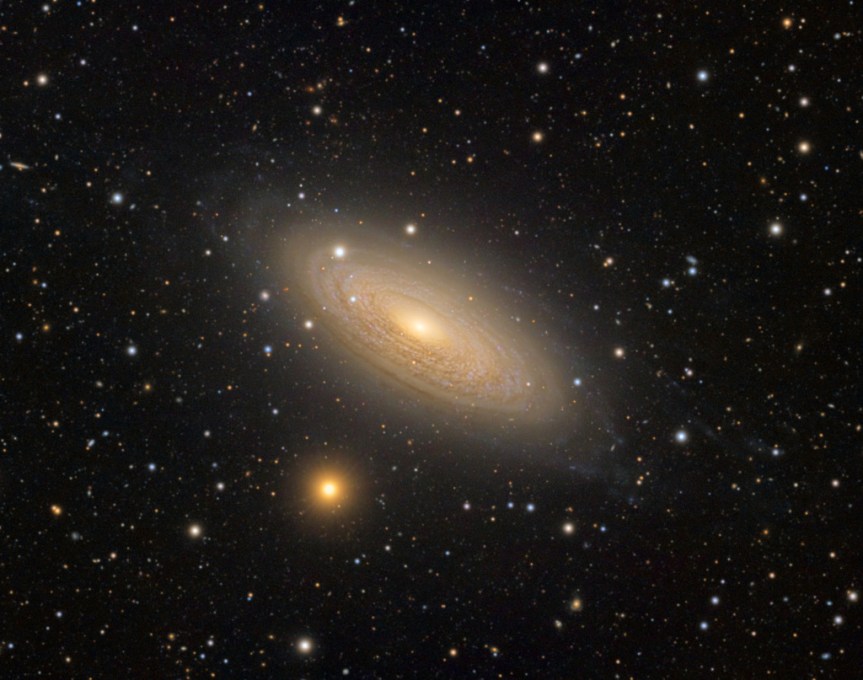
Spiral Galaxy NGC 2841

Image Credit & CopyrightVitali Pelenjow

Explanation: A mere 46 million light-years distant, spiral galaxy NGC 2841 can be found in the northern constellation of Ursa MajorThis deep view of the gorgeous island universe was captured during 32 clear nights in November, December 2021 and January 2022. It shows off a striking yellow nucleus, galactic disk, and faint outer regions. Dust lanes, small star-forming regions, and young star clusters are embedded in the patchy, tightly wound spiral arms. In contrast, many other spirals exhibit grand, sweeping arms with large star-forming regions. NGC 2841 has a diameter of over 150,000 light-years, even larger than our own Milky Way. X-ray images suggest that resulting winds and stellar explosions create plumes of hot gas extending into a halo around NGC 2841.

March 2 Astronomy Picture of the Day

Discover the cosmos! Each day a different image or photograph of our fascinating universe is featured, along with a brief explanation written by a professional astronomer.

2022 March 2

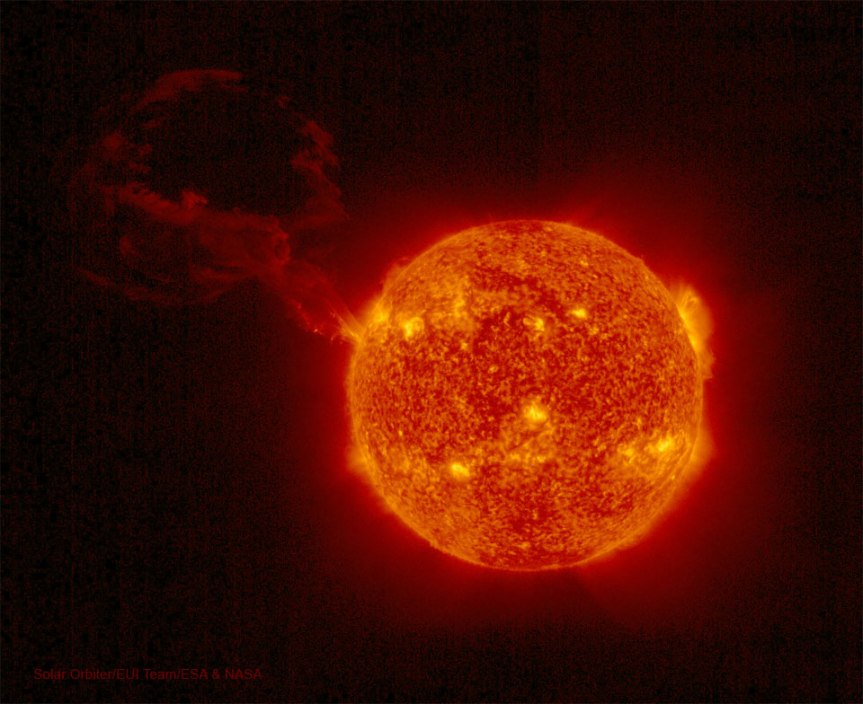
Record Prominence Imaged by Solar Orbiter

Image Credit: Solar OrbiterEUI TeamESA & NASAh/tBum-Suk Yeom

Explanation: What’s happened to our Sun? Last month, it produced the largest prominence ever imaged together with a complete solar disk. The record image, featured, was captured in ultraviolet light by the Sun-orbiting Solar Orbiter spacecraft. A quiescent solar prominence is a cloud of hot gas held above the Sun’s surface by the Sun’s magnetic field. This solar prominence was huge — spanning a length rivaling the diameter of the Sun itself. Solar prominences may erupt unpredictably and expel hot gas into the Solar System via a Coronal Mass Ejection (CME). When a CME strikes the Earth and its magnetosphere, bright auroras may occur. This prominence did produce a CME, but it was directed well away from the Earth. Although surely related to the Sun’s changing magnetic field, the energy mechanism that creates and sustains a solar prominence remains a topic of research.

March 1 Astronomy Picture of the Day

Discover the cosmos! Each day a different image or photograph of our fascinating universe is featured, along with a brief explanation written by a professional astronomer.

2022 March 1

Dueling Bands in the Night

Image Credit & Copyright: Jeff Dai (TWAN)

Explanation: What are these two bands in the sky? The more commonly seen band is the one on the right and is the central band of our Milky Way galaxy. Our Sun orbits in the disk of this spiral galaxy, so that from inside, this disk appears as a band of comparable brightness all the way around the sky. The Milky Way band can also be seen all year — if out away from city lights. The less commonly seem band, on the left, is zodiacal light — sunlight reflected from dust orbiting the Sun in our Solar System. Zodiacal light is brightest near the Sun and so is best seen just before sunrise or just after sunset. On some evenings in the north, particularly during the months of March and April, this ribbon of zodiacal light can appear quite prominent after sunset. It was determined only this century that zodiacal dust was mostly expelled by comets that have passed near Jupiter. Only on certain times of the year will the two bands be seen side by side, in parts of the sky, like this. The featured image, including the Andromeda galaxy and a meteor, was captured in late January over a frozen lake in KandingSichuanChina.

February 28 Astronomy Picture of the Day

Discover the cosmos! Each day a different image or photograph of our fascinating universe is featured, along with a brief explanation written by a professional astronomer.

2022 February 28

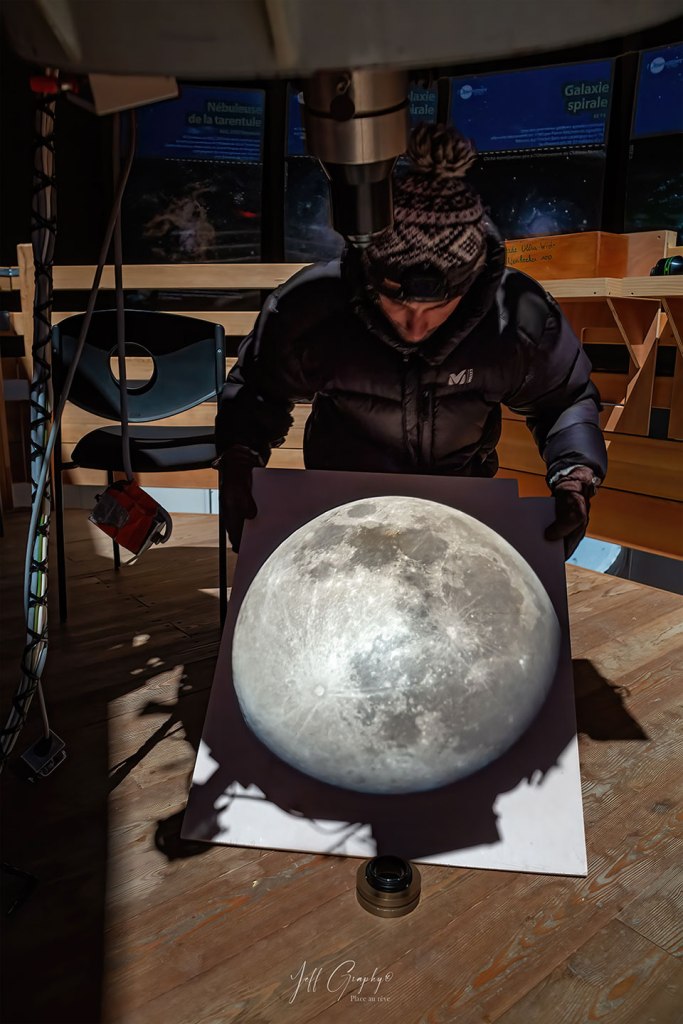
Direct Projection: The Moon in My Hands

Image Credit & Copyright: Jeff Graphy

Explanation: You don’t have to look through a telescope to know where it’s pointing. Allowing the telescope to project its image onto a large surface can be useful because it dilutes the intense brightness of very bright sources. Such dilution is useful for looking at the Sun, for example during a solar eclipse. In the featured single-exposure image, though, it is a too-bright full moon that is projected. This February full moon occurred two weeks ago and is called the Snow Moon by some northern cultures. The projecting instrument is the main 62-centimeter telescope at the Saint-Véran Observatory high in the French Alps. Seeing a full moon directly is easier because it is not too bright, although you won’t see this level of detail. Your next chance will occur on March 17.

February 25 Astronomy Picture of the Day

Discover the cosmos! Each day a different image or photograph of our fascinating universe is featured, along with a brief explanation written by a professional astronomer.

2022 February 25

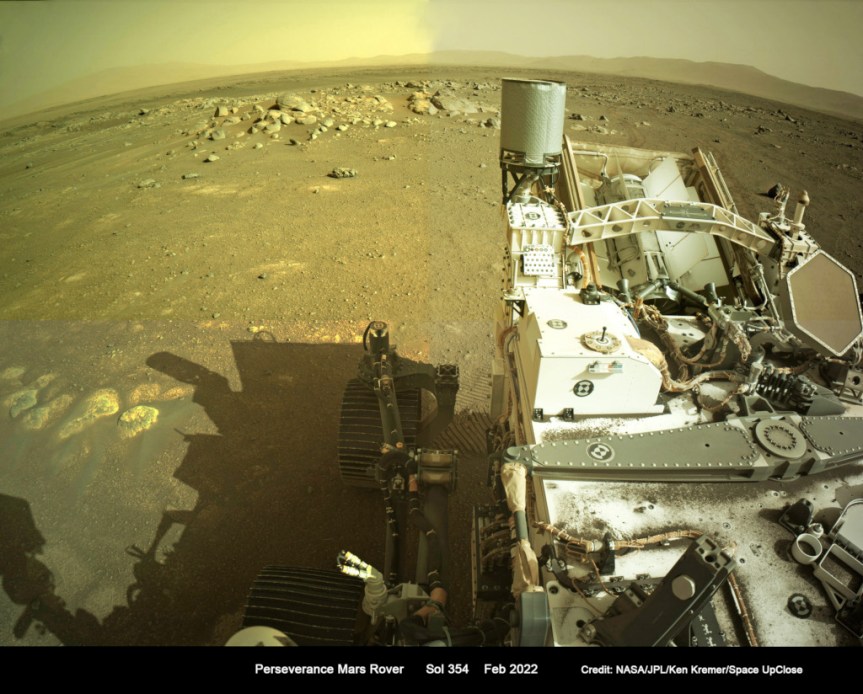
Perseverance Sol 354

Image Credit: NASAJPL-CaltechProcessingKenneth Kremer

Explanation: This Navcam mosaic from Perseverance looks out over the car-sized rover’s deck, across the floor of Jezero crater on Mars. Frames used to construct the mosaic view were captured on mission sol 354. That corresponds to Earth calendar date February 17, 2022, nearly one Earth year after the rover’s landing. With a mass of over 1,000 kilograms, six-wheeled Perseverance is the heaviest rover to touch down on Mars. During its first year of exploration the rover has collected six (so far) rock core samples for later return to planet Earth, served as the base station for Ingenuity, the first helicopter on Mars, and tested MOXIE (Mars Oxygen In-Situ Resource Utilization Experiment), converting some of the Red Planet’s thin, carbon dioxide-rich atmosphere into oxygen.

February 24 Astronomy Picture of the Day

Discover the cosmos! Each day a different image or photograph of our fascinating universe is featured, along with a brief explanation written by a professional astronomer.

2022 February 24

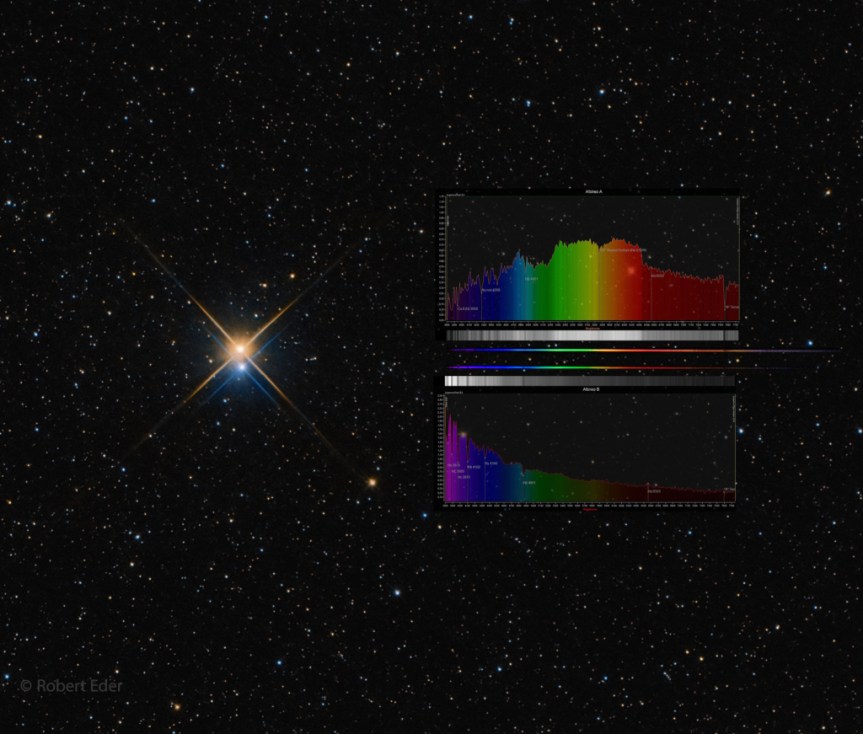
Beautiful Albireo AB

Image Credit & CopyrightRobert Eder

Explanation: Beta Cygni is a single bright star to the naked eye. About 420 light-years away it marks the foot of the Northern Cross, famous asterism in the constellation Cygnus. But a view through the eyepiece of a small telescope will transform it into a beautiful double star, a treasure of the night sky in blue and gold. Beta Cygni is also known as Albireo, designated Albireo AB to indicate its two bright component stars. Their visually striking color difference is illustrated in this telescopic snapshot, along with their associated visible spectrum of starlight shown in insets to the right. Albireo A, top inset, shows the spectrum of a K-type giant star, cooler than the Sun and emitting most of its energy at yellow and red wavelengths. Below, Albireo B has the spectrum of a main sequence star much hotter than the Sun, emitting more energy in blue and violet. Albireo A is known to be a binary star, two stars together orbiting a common center of mass, though the two stars are too close together to be seen separately with a small telescope. Well-separated Albireo A and B most likely represent an optical double star and not a physical binary system because the two components have clearly different measured motions through space.

February 23 Astronomy Picture of the Day

Discover the cosmos! Each day a different image or photograph of our fascinating universe is featured, along with a brief explanation written by a professional astronomer.

2022 February 23

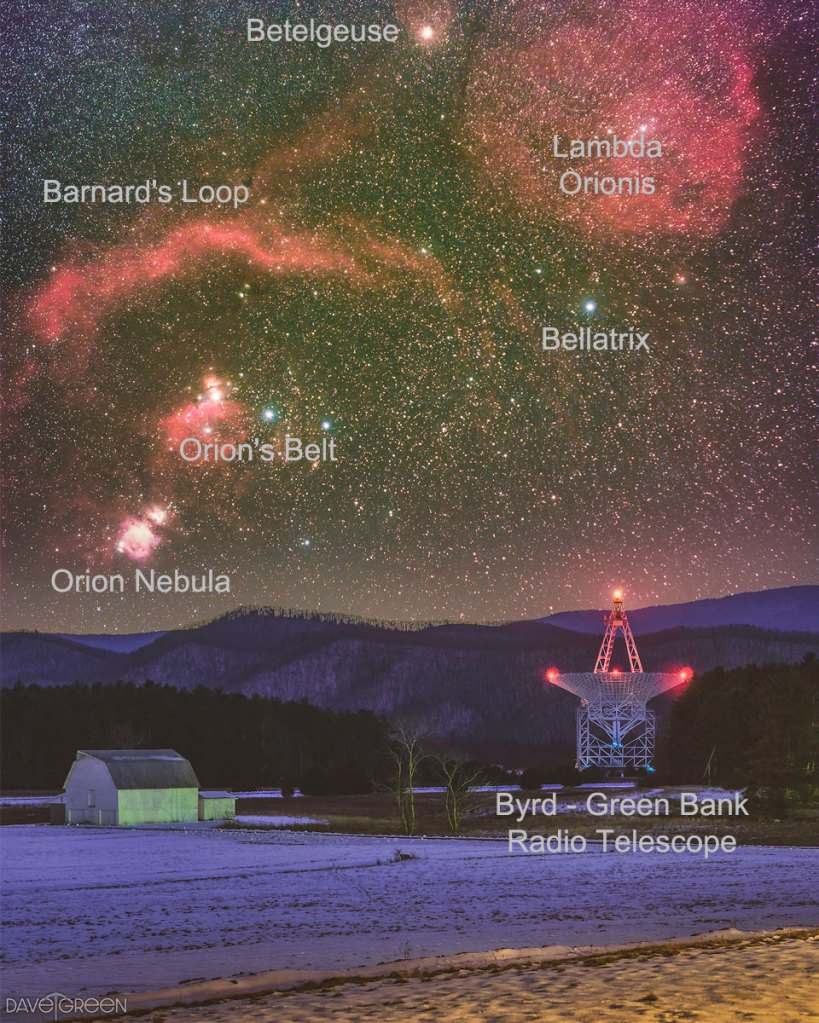
Orion over Green Bank

Image Credit & Copyright: Dave Green

Explanation: What will the huge Green Bank Telescope discover tonight? Pictured, the Robert C. Byrd Green Bank Telescope (GBT) on the lower right is the largest fully-pointable single-dish radio telescope in the world. With a central dish larger than a football field, the GBT is nestled in the hills of West VirginiaUSA in a radio quiet zone where the use of cell phones, WiFi emitters, and even microwave ovens are limited. The GBT explores our universe not only during the night — but during the day, too, since the daytime sky is typically dark in radio waves. Taken in late January, the featured image was planned for months to get the setting location of Orion just right. The image is a composite of a foreground shot taken over a kilometer away from the GBT, and a background shot built up of long exposures during the previous night. The deep background image of Orion is fitting because the GBT is famous for, among many discoveries, mapping the unusual magnetic field in the Orion Molecular Cloud Complex.

February 21 Astronomy Picture of the Day

Discover the cosmos! Each day a different image or photograph of our fascinating universe is featured, along with a brief explanation written by a professional astronomer.

2022 February 21

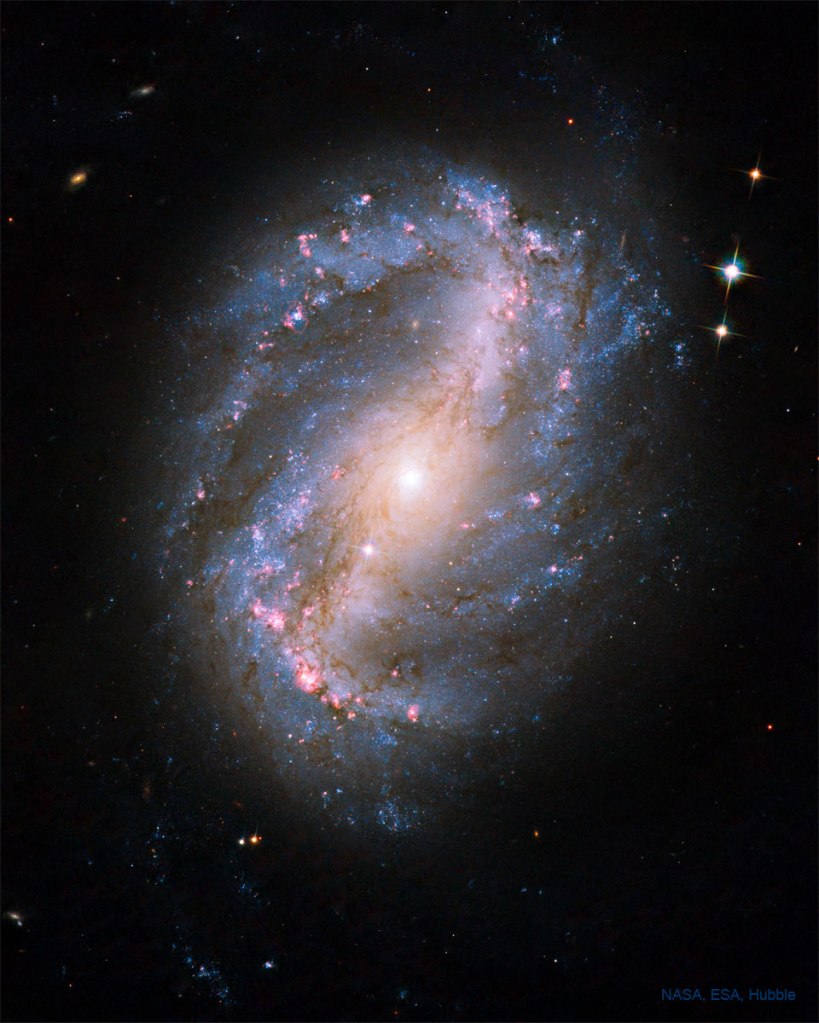
This is the first image of a celestial object taken with the newly repaired Advanced Camera for Surveys (ACS). The camera was restored to operation during the STS-125 Servicing Mission to upgrade the NASA/ESA Hubble Space Telescope. The barred spiral galaxy NGC 6217 was photographed on 13 June and 8 July 2009, as part of the initial testing and calibration of Hubble’s ACS. The galaxy lies up to 90 million light-years away in the north circumpolar constellation Ursa Major.

Barred Spiral Galaxy NGC 6217

Image Credit: NASAESA, and the Hubble SM4 ERO Team

Explanation: Many spiral galaxies have bars across their centers. Even our own Milky Way Galaxy is thought to have a modest central bar. Prominently barred spiral galaxy NGC 6217, featured here, was captured in spectacular detail in this image taken by the Advanced Camera for Surveys on the orbiting Hubble Space Telescope in 2009. Visible are dark filamentary dust lanes, young clusters of bright blue stars, red emission nebulas of glowing hydrogen gas, a long bar of stars across the center, and a bright active nucleus that likely houses a supermassive black hole. Light takes about 60 million years to reach us from NGC 6217, which spans about 30,000 light years across and can be found toward the constellation of the Little Bear (Ursa Minor).


APOD in world languages: ArabicBulgarianCatalanChinese (Beijing), Chinese (Taiwan), CroatianCzechDutchFrench,
French (Canada), GermanHebrewIndonesianJapaneseKoreanMontenegrinPolishRussianSerbianSlovenianSpanishTaiwaneseTurkishTurkish, and Ukrainian

February 20 Astronomy Picture of the Day

Discover the cosmos! Each day a different image or photograph of our fascinating universe is featured, along with a brief explanation written by a professional astronomer.

2022 February 20

Aurora Over White Dome Geyser

Image Credit & Copyright: Robert Howell

Explanation: Sometimes both heaven and Earth erupt. Colorful auroras erupted unexpectedly a few years ago, with green aurora appearing near the horizon and brilliant bands of red aurora blooming high overhead. A bright Moon lit the foreground of this picturesque scene, while familiar stars could be seen far in the distance. With planning, the careful astrophotographer shot this image mosaic in the field of White Dome Geyser in Yellowstone National Park in the western USA. Sure enough, just after midnight, White Dome erupted — spraying a stream of water and vapor many meters into the air. Geyser water is heated to steam by scalding magma several kilometers below, and rises through rock cracks to the surface. About half of all known geysers occur in Yellowstone National Park. Although the geomagnetic storm that caused the auroras subsided within a day, eruptions of White Dome Geyser continue about every 30 minutes.

February 19 Astronomy Picture of the Day

Discover the cosmos! Each day a different image or photograph of our fascinating universe is featured, along with a brief explanation written by a professional astronomer.

2022 February 19

Peculiar Galaxies of Arp 273

Image Credit & CopyrightJason Guenzel

Explanation: The spiky stars in the foreground of this backyard telescopic frame are well within our own Milky Way Galaxy. But the two eye-catching galaxies lie far beyond the Milky Way, at a distance of over 300 million light-years. Their distorted appearance is due to gravitational tides as the pair engage in close encounters. Cataloged as Arp 273 (also as UGC 1810), the galaxies do look peculiar, but interacting galaxies are now understood to be common in the universe. Nearby, the large spiral Andromeda Galaxy is known to be some 2 million light-years away and approaching the Milky Way. The peculiar galaxies of Arp 273 may offer an analog of their far future encounter. Repeated galaxy encounters on a cosmic timescale can ultimately result in a merger into a single galaxy of stars. From our perspective, the bright cores of the Arp 273 galaxies are separated by only a little over 100,000 light-years.

February 18 Astronomy Picture of the Day

Discover the cosmos! Each day a different image or photograph of our fascinating universe is featured, along with a brief explanation written by a professional astronomer.

2022 February 18

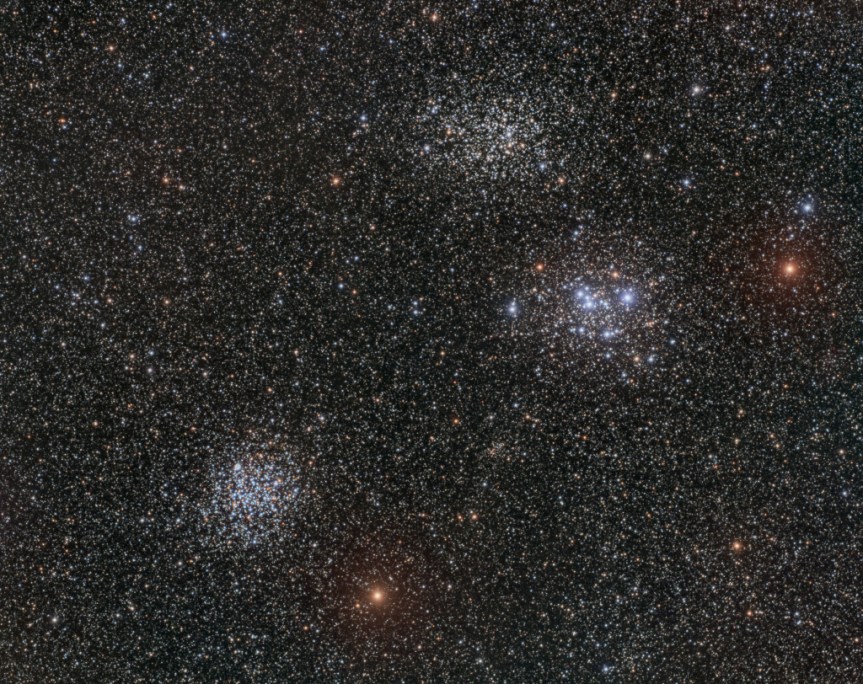
Three Clusters in Puppis

Image Credit & CopyrightDave Doctor

Explanation: Galactic or open star clusters are young. The swarms of stars are born together near the plane of the Milky Way, but their numbers steadily dwindle as cluster members are ejected by galactic tides and gravitational interactions. Caught in this telescopic frame over three degrees across are three good examples of galactic star clusters, seen toward the southern sky’s nautical constellation Puppis. Below and left, M46 is some 5,500 light-years in the distance. Right of center M47 is only 1,600 light-years away and NGC 2423 (top) is about 2500 light-years distant. Around 300 million years young M46 contains a few hundred stars in a region about 30 light-years across. Sharp eyes can spot a planetary nebula, NGC 2438, at about 11 o’clock against the M46 cluster stars. But that nebula’s central star is billions of years old, and NGC 2438 is likely a foreground object only by chance along the line of sight to youthful M46. Even younger, aged around 80 million years, M47 is a smaller and looser star cluster spanning about 10 light-years. Star cluster NGC 2423 is pushing about 750 million years in age though. NGC 2423 is known to harbor an extrasolar planet, detected orbiting one of its red giant stars.

February 17 Astronomy Picture of the Day

Discover the cosmos! Each day a different image or photograph of our fascinating universe is featured, along with a brief explanation written by a professional astronomer.

2022 February 17

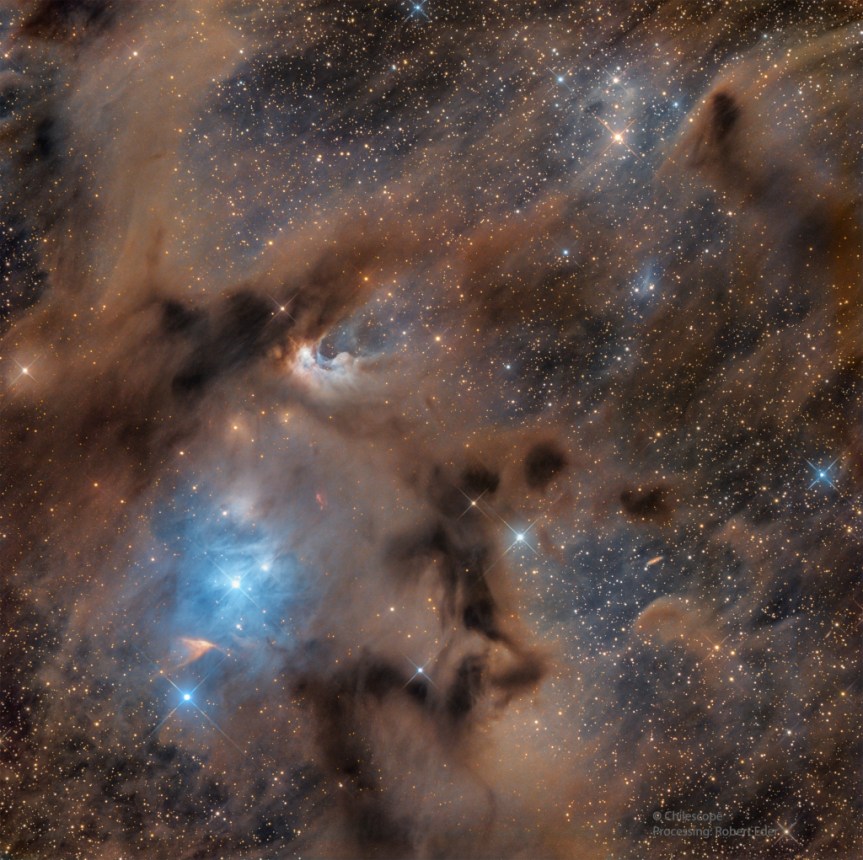
Chamaeleon I Molecular Cloud

Image Credit & CopyrightAcquisition: Stas Volskiy (Chilescope.com), Processing: Robert Eder

Explanation: Dark markings and bright nebulae in this telescopic southern sky view are telltale signs of young stars and active star formation. They lie a mere 650 light-years away, at the boundary of the local bubble and the Chamaeleon molecular cloud complex. Regions with young stars identified as dusty reflection nebulae from the 1946 Cederblad catalog include the C-shaped Ced 110 just above and left of center, and bluish Ced 111 below it. Also a standout in the frame, the orange tinted V-shape of the Chamaeleon Infrared Nebula (Cha IRN) was carved by material streaming from a newly formed low-mass star. The well-composed image spans 1.5 degrees. That’s about 17 light-years at the estimated distance of the nearby Chamaeleon I molecular cloud.

February 16 Astronomy Picture of the Day

Discover the cosmos! Each day a different image or photograph of our fascinating universe is featured, along with a brief explanation written by a professional astronomer.

2022 February 16

Eiffel Tower Prominence on the Sun

Eiffel Tower Prominence on the Sun
Video Credit & Copyright: Hawk WolinskiExplanation: What’s that on the Sun? Although it may look like a flowing version of the Eiffel Tower, it is a solar prominence that is actually much bigger — about the height of Jupiter. The huge prominence emerged about ten days ago, hovered over the Sun’s surface for about two days, and then erupted — throwing a coronal mass ejection (CME) into the Solar System. The featured video, captured from the astrophotographer’s backyard in HendersonvilleTennessee, USA, shows an hour time-lapse played both forwards and backwards. That CME did not impact the Earth, but our Sun had unleashed other recent CMEs that not only triggered Earthly auroras, but puffed out the Earth’s atmosphere enough to cause just-launched Starlink satellites to fall back. Activity on the Sun, including sunspotsprominences, CMEs and flares, continues to increase as the Sun evolves away from a deep minimum in its 11-year magnetic cycle.


Birthday Surprise: What picture did APOD feature on your birthday? (post 1995)

February 14 Astronomy Picture of the Day

Discover the cosmos! Each day a different image or photograph of our fascinating universe is featured, along with a brief explanation written by a professional astronomer.

2022 February 14

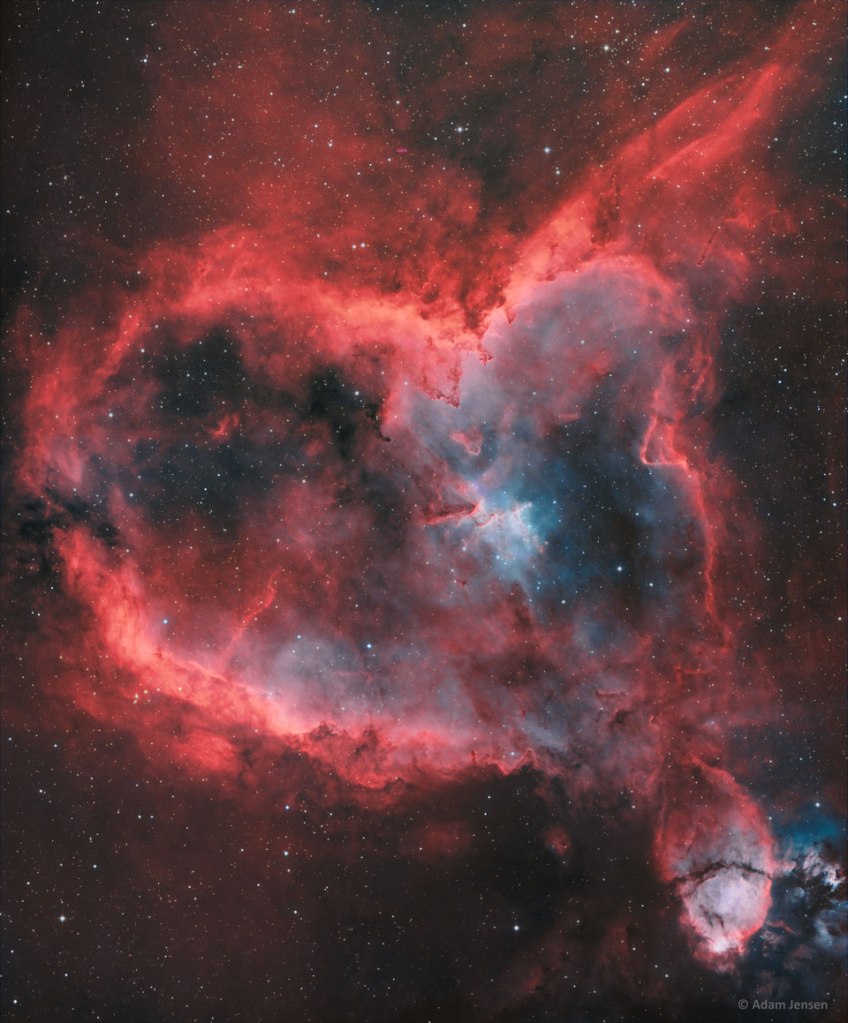
In the Heart of the Heart Nebula

Image Credit & Copyright: Adam JensenExplanation: What excites the Heart Nebula? First, the large emission nebula dubbed IC 1805 looks, in whole, like a human heart. Its shape perhaps fitting of the Valentine’s Day, this heart glows brightly in red light emitted by its most prominent element: excited hydrogen. The red glow and the larger shape are all created by a small group of stars near the nebula’s center. In the heart of the Heart Nebula are young stars from the open star cluster Melotte 15 that are eroding away several picturesque dust pillars with their energetic light and winds. The open cluster of stars contains a few bright stars nearly 50 times the mass of our Sun, many dim stars only a fraction of the mass of our Sun, and an absent microquasar that was expelled millions of years ago. The Heart Nebula is located about 7,500 light years away toward the constellation of the mythological Queen of Aethiopia (Cassiopeia).

February 13 Astronomy Picture of the Day

Discover the cosmos! Each day a different image or photograph of our fascinating universe is featured, along with a brief explanation written by a professional astronomer.

2022 February 13

Earth at Night

Image Credit: NASASuomi NPP VIIRSData: Miguel Román (NASA GSFC); Processing: Joshua Stevens

Explanation: This is what the Earth looks like at night. Can you find your favorite country or city? Surprisingly, city lights make this task quite possible. Human-made lights highlight particularly developed or populated areas of the Earth’s surface, including the seaboards of Europe, the eastern United States, and Japan. Many large cities are located near rivers or oceans so that they can exchange goods cheaply by boat. Particularly dark areas include the central parts of South AmericaAfricaAsia, and Australia. The featured image, nicknamed Black Marble, is actually a composite of hundreds of pictures remade in 2016 from data taken by the orbiting Suomi NPP satellite.

February 12 Astronomy Picture of the Day

Discover the cosmos! Each day a different image or photograph of our fascinating universe is featured, along with a brief explanation written by a professional astronomer.

2022 February 12

Aurora by Moonlight

Image Credit & CopyrightP-M Hedén (Clear SkiesTWAN)

Explanation: The ice was singing as light from a bright gibbous Moon cast shadows across this frozen lake, about 20 kilometers north of Stockholm, Sweden, planet Earth. In the alluring night skyscape captured on February 10, shimmering auroral curtains of light dance in the evening sky. On that northern night nature’s performance included the auroral displays fostered by a minor geomagnetic storm. Stormy space weather was the result of a coronal mass ejection, erupting from a solar prominence days earlier and brushing our fair planet’s magnetosphere.

February 11 Astronomy Picture of the Day

Discover the cosmos! Each day a different image or photograph of our fascinating universe is featured, along with a brief explanation written by a professional astronomer.

2022 February 11

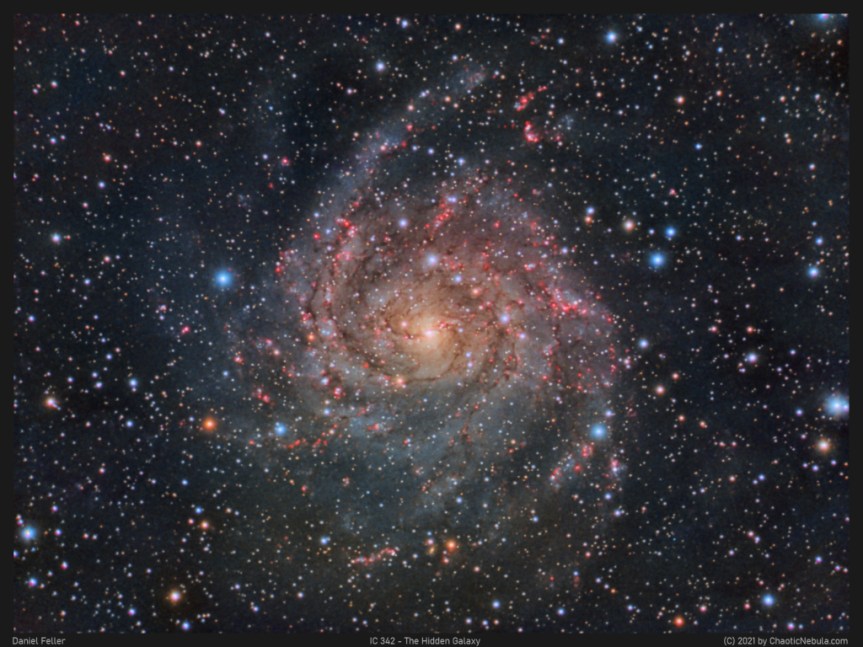
IC 342: The Hidden Galaxy in Camelopardalis

Image Credit & CopyrightDaniel Feller

Explanation: Similar in size to large, bright spiral galaxies in our neighborhood, IC 342 is a mere 10 million light-years distant in the long-necked, northern constellation Camelopardalis. A sprawling island universe, IC 342 would otherwise be a prominent galaxy in our night sky, but it is hidden from clear view and only glimpsed through the veil of stars, gas and dust clouds along the plane of our own Milky Way galaxy. Even though IC 342’s light is dimmed and reddened by intervening cosmic clouds, this sharp telescopic image traces the galaxy’s own obscuring dust, young star clusters, and glowing pink star forming regions along spiral arms that wind far from the galaxy’s core. IC 342 may have undergone a recent burst of star formation activity and is close enough to have gravitationally influenced the evolution of the local group of galaxies and the Milky Way.

February 9 Astronomy Picture of the Day

Discover the cosmos! Each day a different image or photograph of our fascinating universe is featured, along with a brief explanation written by a professional astronomer.

2022 February 9

Eta Car: 3D Model of the Most Dangerous Star Known

Video Credit: NASACXC, April Hobart; Text: Michael F. Corcoran (NASACatholic U.HEAPOW)Explanation: What’s the most dangerous star near earth? Many believe it’s Eta Carinae, a binary star system about 100 times the mass of the Sun, just 10,000 light years from earth. Eta Carinae is a ticking time bomb, set to explode as a supernova in only a few million years, when it may bathe the earth in dangerous gamma rays. The star suffered a notorious outburst in the 1840s when it became the brightest star in the southern sky, only to fade to obscurity within decades. The star was not destroyed, but lies hidden behind a thick, expanding, double-lobed structure called the Homunculus which now surrounds the binary. Studies of this ejecta provide forensic clues about the explosion. Using observations from NASA satellites we can now visualize the 3D distribution of the shrapnel, all the way from the infrared, through optical and UV, to the outermost shell of million-degree material, visible only in X-rays.