

Category: The Sabbats
Fall Bucket List

Autumn Blessings

Autumn Equinox Prayer

Mabon

Mabon – Autumn Equinox

Five Ideas for Celebrating Lughnasadh

Simple Lammas Rituals

Lammas Wishing Powder

Lammas – Spell of Courage

Lammas – The First Harvest

Lammas Wish

Lammas – August 1st

Lammas Prayer

Elements for Lammas Celebrations

Good Lammas Morning To All our Brothers & Sisters of the Craft! Wishing You & Yours A Bountiful First Harvest!

Celebrating Lammas
The year is 1100. The date is August 1. The monks in the abbey at Gloucester are celebrating the holy-day of St. Peter in Chains. One of the monks wakes from a strange dream in which God promises to strike down the wicked King who has abused the Holy Church. His superior, Abbot Serlo, on hearing of the dreams sends a warning to the King, William the Red, who has oppressed all of England with taxes and disgusted many with his licentiousness and blasphemy. Red, as he is called, receives the message the following day while preparing to indulge in one of his favorite sports, hunting, in the New Forest. Although there are no longer any people dwelling in the New Forest — they were all cleared out by Red’s father, William the Conqueror — there are rumors that it’s a hotbed of pagan activity. And August 2 is an important pagan holy-day. The Saxons call it Lammas, the Loaf-Mass. William the Red laughs at the warning from the monks and goes out hunting. A short time later, he is dead, struck in the chest by a stray arrow, and his brother, Henry, who was in the hunting party is riding hot-foot for Winchester and the crown.
Now some people say that William the Red was a Lammas sacrifice, …
Please continue reading by clicking this link: Celebrating Lammas
June Solstice: Longest and Shortest Day of the Year
The June solstice is the Summer Solstice in the Northern Hemisphere and the Winter Solstice the Southern Hemisphere.
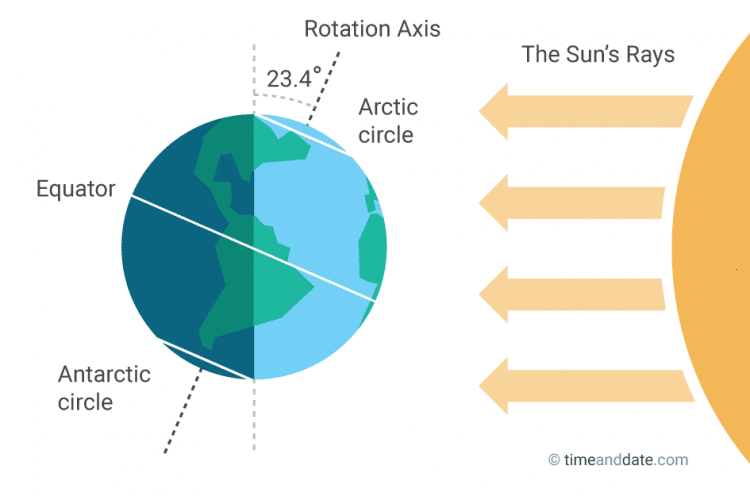
The June Solstice. (Not to scale)
The date varies between June 20 and June 22, depending on the year, and the local time zone.
June Solstice in Aurora, Illinois, USA was on
Tuesday, June 20, 2017 at 11:24 pm CDT (Change city)
June Solstice in Universal Coordinated Time was on
Wednesday, June 21, 2017 at 04:24 UTC
- Local times for June Solstice 2017 worldwide
- Sunrise, sunset and day length around June Solstice 2017
- Day and Night map for June Solstice 2017
- Equinoxes and solstices from 2000–2049
Zenith Furthest Away from the Equator
A solstice happens when the sun’s zenith is at its furthest point from the equator. On the June solstice, it reaches its northernmost point and the Earth’s North Pole tilts directly towards the sun, at about 23.4 degrees.
It’s also known as the northern solstice because it occurs when the sun is directly over the Tropic of Cancer in the Northern Hemisphere.
11 Facts About the June Solstice
Meaning of Solstice
‘Solstice’ (Latin: ‘solstitium’) means ‘sun-stopping’. The point on the horizon where the sun appears to rise and set, stops and reverses direction after this day. On the solstice, the sun does not rise precisely in the east, but rises to the north of east and sets to the north of west, meaning it’s visible in the sky for a longer period of time.
Although the June solstice marks the first day of astronomical summer, it’s more common to use meteorological definitions of seasons, making the solstice midsummer or midwinter.
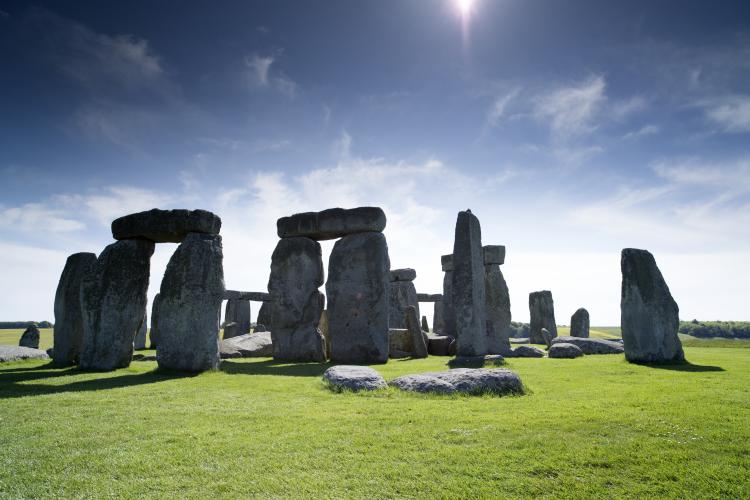
Solstices in Culture
Over the centuries, the June solstice has inspired countless festivals, midsummer celebrations and religious holidays.
One of the world’s oldest evidence of the Summer Solstice’s importance in culture is Stonehenge in England, a megalithic structure which clearly marks the moment of the June Solstice.
In the Southern Hemisphere, where the June solstice is known as the shortest day of the year, it marks the first day of astronomical winter, but the middle of winter in meteorological terms.
Midnight Sun or Polar Night?
On the June solstice, the midnight sun is visible (weather permitting) throughout the night, in all areas from just south of the Arctic Circle to the North Pole.
On the other side of the planet, south of the Antarctic Circle there’s Polar Night, meaning no Sunlight at all, on the June Solstice.
Solstice Dates Vary
Even though most people consider June 21 as the date of the June Solstice, it can happen anytime between June 20 and June 22, depending on which time zone you’re in. June 22 Solstices are rare – the last June 22 Solstice in UTC time took place in 1975 and there won’t be another one until 2203.
The varying dates of the solstice are mainly due to the calendar system – most western countries use the Gregorian calendar which has 365 days in a normal year and 366 days in a Leap Year.
A tropical year is the time it takes the Earth to orbit once around the Sun. It is around 365.242199 days long, but varies slightly from year to year because of the influence of other planets. The exact orbital and daily rotational motion of the Earth, such as the “wobble” in the Earth’s axis (precession of the equinoxes), also contributes to the changing solstice dates.
Moving to Other Seasons
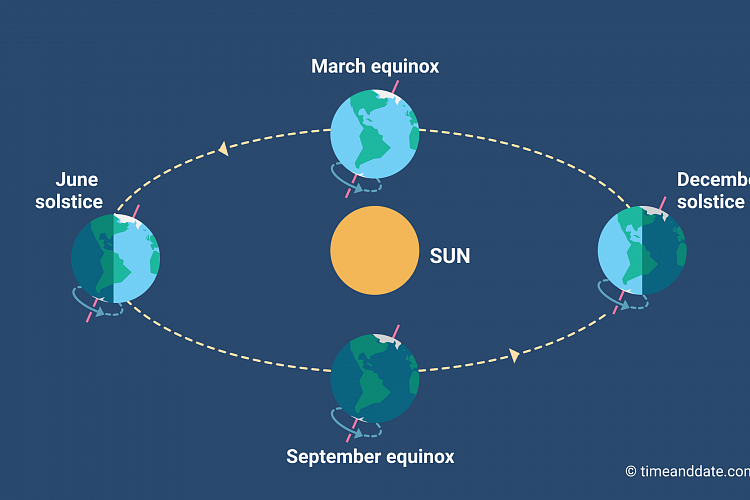
After the June solstice, the sun follows a lower and lower path through the sky each day in the Northern Hemisphere until it reaches the point where the length of daylight is about 12 hours and eight to nine minutes in areas that are about 30 degrees north or south of the equator.
Areas 60 degrees north or south of the equator have daylight for about 12 hours and 16 minutes. This is the September Equinox, the Autumnal Equinox in the Northern Hemisphere.
Earth does not move at a constant speed in its elliptical orbit. Therefore the seasons are not of equal length: the times taken for the sun to move from the March Equinox to the June Solstice, to the September equinox, to the December solstice, and back to the March equinox are roughly 92.8, 93.6, 89.8 and 89.0 days respectively.
The consolation in the Northern Hemisphere is that spring and summer last longer than autumn and winter.
Information from
Midsummer’s Eve Prayer

Summer Solstice

 Witches Of The Craft®
You must be logged in to post a comment.