

Category: Articles
Characteristics of the Bear As Your Spirit Guide

Your Animal Spirit Guide for July 3 is The Bear

Your Daily Rune for July 3rd is Thurisaz
Your Daily Rune for Today

Thurisaz
“Thor-is-as” – Literally: “Thurses” or “Giants” – Esoteric: Strong one, Resistance
Key Concepts: Unconscious forces, sociological forces, Thor, Loki as giant, chaos, destruction by natural forces, complexities of aggression, conflicts, disputes, psychological problems, lightning, breakthrough, aggressive male sexuality, battering down barriers, thorn of awakening, trouble, enthusiasm
Psi: enthusiasm, struggle against unconsciousness, male sexual prowess
Energy: enthusiasm, self-empowerment, chaos, active defensive force, breaker of resistance, destructive storms
Mundane: storms, tools, weapons, conflict
Divinations: Reactive force, directed force, vital eroticism, regenerative catalyst, constructive conflict; or danger, defenselessness, compulsion, betrayal, dullness, disease, explosive violence, annoyance, strife
Governs:
Destruction of enemies, curses binds and fetters
Awakening of the will to action
Breaking resistance of blockages in body, mind and spirit
Increased potency and prowess in romantic relationships
Understanding of the division and separation of all things
Aiming the use of psychic force
The combination of right/left brain processes for generating powerful realization
Your Psychic Tip of the Day for July 3
Psychic Tip of the Day
FLIRTING DAYS
A romantic entanglement is changing the very nature of how every one sees you and who you truly are. Could you see any of this coming during that first flirtation?
Tarot.com is Part of the Daily Insight Group ©2018
Your Erotic Tarot Card for July 3 is Strength
Your Erotic Tarot Card of the Day
Strength
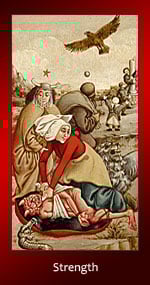
Your sex life gains some serious momentum today with the appearance of the Strength card. You have tremendous inner strength when it comes to getting what you want, and that includes sexual conquests. If you’ve been waiting for the right time to try out some new moves, the Strength card urges you to act now! There may be some obstacles in your way, but you welcome any and all challenges. Anyone playing hard to get right now is like putty in your hands.
Your Love Tarot Card for July 3 is The Devil
Your Love Tarot Card of the Day
The Devil
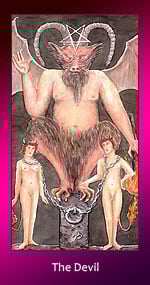
Pulling the Devil card does not mean that bad things are about to happen. What it does mean is that you have stooped to a level of thinking that is all about your ego. You have to look closely at what is driving you to be this way. You are in a wonderful relationship with an individual who adores you. You do not want to ruin the bond that is evolving between the two of you. You need to do some self-reflection in order to figure out what is going on with you under the surface.
Tarot’s Fool Is No Dummy!
Tarot’s Fool Is No Dummy!
Learn more about Tarot’s misunderstood Fool card

The Fool card often gets a bum rap. He tends to be mocked as a naive idiot without direction or purpose … but things aren’t always as they seem, right? Let’s take a closer look at The Fool and what he can teach us.
When we think of The Fool Tarot card, we are reminded to let go of expectations and trust our instincts. We think of our spiritual journey and the desire for rebirth. As the very first card in the Tarot deck’s Major Arcana, The Fool signifies a fresh start or a new beginning.
Think of The Fool not so much as naive as open-minded and optimistic. The Fool is hopeful and positive, and he’s doing his best to shine a light on new beliefs, innovative and shocking ideas and the unpredictability of life.
Motto: May innocence find wisdom
Sometimes the word “fool” has negative connotations. Think of the simpleton, the childlike state of someone who is out of touch and who might be the focus of mockery. But there’s nothing silly about The Fool.
Historically, The Fool card may have appeared as a carnival entertainer, a huckster or a jester. Symbolically, it represented a person driven by base needs and urges, one who has fallen into a state of poverty and deprivation. By the 20th century the more familiar modern image and symbolism took over, and The Fool has been widely seen as the Tarot card hearkening renewing energy and a fresh start. Quite an evolution for The Fool!
Traditional Rider-Waite metaphors and imagery have prevailed within modern Tarot decks. Nature scenes depicting beautiful mountaintops include the image of The Fool getting ready to take an adventurous step into the unknown. Getting The Fool card within a Tarot reading is a reminder to appreciate our inner growth and our journey of personal development. It is the spirit in search of experiences, and the childlike wisdom we aim to employ as we go deeper into self-realization through new challenges.
Be encouraged when you draw The Fool card in any Tarot spread, you may soon face a new opportunity or challenge!
Tarot.com is Part of the Daily Insight Group ©2018
This Week’s Tarot Card Reading: The Fool
This Week’s Tarot Card Reading: The Fool
Your weekly Tarot card advice for July 2-8, 2018
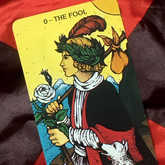

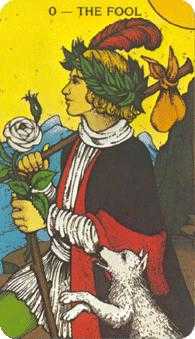 July’s theme, the Hanged Man, is about a change in point of view, and what better way to invite a fresh perspective than to begin a new journey? That’s just what The Fool card signifies this week: an attitude of openness and playfulness, of willingness to set out without an established plan and see where the road takes you. This month requires pushing past discomfort, letting go of the self-imposed restrictive attitudes that might be preventing you from living your fullest life. Loosen up your ideas of what has to be, and let life be an unfolding adventure.
Say yes to things this week before fear or rationality can talk you out of it. Be spontaneous. Go places you’ve been curious about — visit a new country, a new city, a different neighborhood, or even just the new restaurant down the street. A Fool experience doesn’t have to be hugely risky or large-scale. Cook something without a recipe. Take a walk without a destination. Try on clothes at a shop that looks interesting (without feeling pressure to buy anything!). There are so many possible manifestations of this card in daily life.
The Fool, ultimately, is an optimist, which can be a difficult attitude to maintain. But don’t worry — even the best Fool isn’t setting out without some amount of preparation. Figure out what your bare necessities are and pack them in your metaphorical traveling bag so that you can enjoy being spontaneous while still feeling safe and somewhat grounded. In many decks’ depictions of the card, including this one, the Fool is also shown with a small dog as a traveling companion. The dog is usually energetic and jumping up at the Fool’s leg to push the figure ahead in the journey. This week, figure out who or what is your little dog, the person or thing that motivates you to keep going even when you feel tired or discouraged.
Tarot.com is Part of the Daily Insight Group ©2018
Your Daily Tarot Card for July 3 is Five of Coins
Tarot Card of the Day
Five of Coins

This suit, most often named “Coins” or “Pentacles”, is a symbol for a magical talisman that represented wealth or potential. This suit represents something supportive that is available to you — whether it be health, some kind of talent, a material or financial resource.
The Five of this suit is the card of desire and gratification, expressed in classical tradition as flattery and false promises. This card represents both the seducer and the one seduced. There is undeniable excitement in the attraction of opposites; we have all had delightful moments of magnetism with a stranger. However, if promises are only spoken to achieve short-term gratification with no intent of follow-through, or the attraction appears as competition to more fulfilling relationships, the long-term result won’t be worth the thrill of the chase.
The appearance of a viable relationship does not always bear out, so don’t put anything of real value at risk over an infatuation. Since the suit here is Coins, this is as likely to be related to business as to pleasure. Try to remove the influence of glamour from your thinking.
Note: In the English decks, like the Rider-Waite, the sickly poor freezing outside a well lit church warn of the painful outcomes of bad choices, rather than focusing on the dynamic tension of the choosing itself.
Tarot.com is Part of the Daily Insight Group ©2018
If You Were Born Today, July 3…..

If You Were Born Today, July 3
You have great strength of character and have a gift for seeing the value of things. Although you do have a unique perspective on most matters, you can be very stubborn about seeing only that side to a story. You are a natural leader and often seek to have your way, but you are also quite poised and regal in manner. Learning to compromise is important to your success on a personal level. You are passionate in love. Famous people born today: Hermann Hesse, Ashley Tisdale, Jerry Hall, Lindsay Lohan, Margot Robbie.
Your Birthday Year Forecast
With the Sun and Moon in harmony in your Solar Return chart, the year ahead should be satisfying and balanced overall. You are in comfortable demand and personally popular, and you are able to achieve a decent balance between work and play; personal and professional life. For the most part, you are on top of your game this year, and positive connections with others can be made fairly easily. With the ability to handle your emotions successfully, there is less stress on both your mind and body. Your self-confidence and positive attitude will reward you!
This is an excellent year in which to advance projects revolving around communications – writing, speaking, selling, and so forth. Your reputation may be enhanced through word of mouth. Making new contacts through learning and mental pursuits figures strongly as well.
Even so, watch for impatience, especially with your communications. You may not always have follow-through when it comes to your projects as you may be experimenting with new ideas and hobbies. Ups and downs may lead to new commitments nevertheless.
You might often get frustrated if results of your actions are not instant, but it’s best to cultivate some patience when it comes to realizing your goals. As well, if you are not getting the results you crave, consider that you might be aiming too high or too wide.
There can be a stronger tendency toward, or desire for, commitment and deep involvement in your relationships during this period. You may be taking love and/or friendship more seriously. There can be a willingness to make sacrifices if it seems the best way to make improvements in relationships and with money matters. You can be quite particular in your tastes, and better than usual with money and savings.
If there are health issues this year, look for blockages or constrictions since Saturn is involved with the Node.
This can be an excellent period for opening up communications with others, as you are more sensitive than usual and more willing to listen. Getting your point across is easier — it’s not only about what specific words you choose to communicate, you intuitively express the meaning and intention behind the words. You can effectively use words to soothe, heal, and teach this year. You are also more open to new ways of looking at problems, thus it’s considerably easier to find solutions.
Idealistic and humanitarian goals or impulses surface this year. Making connections with others from different backgrounds may figure strongly. Widening your mind through unusual or different experiences can be part of the picture. You more easily make personal sacrifices for what you believe to be the greater good this year.
Saturn forms an opposition to your Sun in December/January. Saturn calls upon you to identify the weaker areas of your life and to fix or strengthen them. Take the time to sort out details, improve your work, and become more efficient this month. Taking a slow and steady approach to life is necessary during this period. Pushing too hard will likely lead to frustration and setbacks. Take it easy and work on self-improvement. Results are not immediate, but will eventually come and bring healthy rewards. Relationships may be (or seem) more challenging than usual while Saturn opposes your Sun. Fortunately, this is a quick pass transit, lasting only a month or so instead of the usual several months.
Cooperation brings rewards your way this year, although there can be some rebelliousness or assertions of independence now. With work, you’re expanding your interests in satisfying ways. Do watch for a tendency to communicate impulsively. There can be increased steadiness and reliability in your social life, however.
2018 is a Number Three year for you. Ruled by Jupiter. This is a year of sociability. It is a friendly time when you find it natural and easy to enjoy life and other people. The focus is on personal freedom, reaching out to others, making new friends, and exploration. You are more enthusiastic and ready for adventure than you are in other years. It’s likely to be a rather lighthearted year when opportunities for “play” time are greater than usual. It’s also a favorable year for expressing your creativity. Advice – reach out and connect but avoid scattering your energies.
2019 will be a Number Four year for you. Ruled by Uranus. This is a year of work and development. It’s “nose to the grindstone” time. It’s a time to pay special attention to practical matters, and it’s not a time to be lazy or especially gregarious. Sometimes, it can be a year that feels hard, monotonous and routine, and/or lonely. Positive new relationships are often not formed in a Four personal year. However, it can be a wonderful year for building, development, and laying a solid foundation for future successes. Advice – get yourself organized, work to build your resources, keep busy.
10 Ways to Attract More Love in Your Life
10 Ways to Attract More Love in Your Life
Prep your home for passion

Feng Shui practitioners believe that the best way to attract love to your life is to adjust your environment accordingly. Dingy surroundings, piles of clutter, and self-absorbed artwork can actually drive Cupid from your door.
Here are 10 simple tips for finding your perfect mate, or for increasing the passion in your long-term relationship or marriage.
Create cozy seating arrangements
Single chairs send a loud and clear message to prospective suitors and spouses: back off! If you’re looking for love, create cozy seating arrangements from love seats, sofas, and chairs. Putting chairs at comfortable angles to each other will signal that you’re ready to welcome a relationship.
Replace images of lone figures with pictures of happy couples
Artwork has a tremendous impact on the subconscious. When you surround yourself with photos, paintings, sculptures, and knickknacks of solitary figures, you’ll carry yourself accordingly. Replacing such images with representations of happy couples will make you more receptive to love.
Keep the television out of the bedroom
Nothing kills romance like the drone of late night television. If you have trouble falling asleep, try unwinding by reading love poetry or romantic novels. Your subconscious will shift accordingly, making you a virtual love magnet.
Treat yourself to sensual bedding
That old ratty pillow from college and those serviceable sheets aren’t doing your sex life any favors. Go ahead and splurge on pillows, blankets, and sheets that invite you to linger in bed.
Downsize from a king to a queen
Sleeping on a huge mattress won’t encourage intimacy. Invest in a comfortable queen-sized bed if you’d like to cultivate more love in your life. If you simply can’t make the switch, make sure to sleep on patterned sheets to add some zest to your sex life.
Make space for each other
Avoid making your partner feel crowded out by your possessions by reducing your personal clutter in shared areas of your home, closets, drawers, etc. When you demonstrate you are willing to share your physical space generously with your partner, the space in your hearts can open up, too.
Pull your bed away from the wall
Pushing your bed against the wall effectively crowds out any chance for love to expand in your life. Arrange your bed so that it has enough space to walk on either side. Before you know it, you’ll be cuddling close with your special someone, instead of hugging your pillow for comfort as if you were alone.
Make your “Gua” a shrine to love
Using the front door of your home as a reference point, the far right corner of your home represents relationships and is known as the “Relationship Gua” in Feng Shui. Therefore, you need to keep this area intimate and inviting. A love seat illuminated with adjustable lighting is ideal for this special spot.
Keep the family at bay
Your bedroom represents your romantic life. Therefore, the last images you want to see here are photos of dear old Mom and Dad. Children’s artwork and toys will also undermine your sex life. Celebrate these relationships in other areas of your household, but keep your boudoir a private retreat.
Think pink!
Warm colors like pink and red can enliven your love life considerably. Soft shades like rose, salmon, and coral can attract a gentle partner who is attentive to your needs, while bold colors like scarlet, crimson, and burgundy will draw a passionate adventurer to your side.
Tarot.com is art of the Daily Insight Group ©2018
Your Weekly Karmic Forecast: July 1 – 7, 2018
Weekly Forecast: July 1 – 7, 2018

The Karmic Tools Weekly Forecast covers the current planetary transits which affect people in different ways and to various degrees of intensity. Take notice when it is a Personal planet (Sun / Moon / Mercury / Venus / Mars) interacting with a Social (Jupiter/Saturn) or Collective planet (Uranus / Neptune/Pluto). And pay extremely close attention when it is a Social planet interacting with a Collective planet because that means something *big* is brewing that will move large groups of people along their evolutionary paths. Tuning in to the energy and rhythm of the planets can serve as a useful *guide* as you move along your Individual Path. It also helps to understand your place within the context of the larger Social & Collective Story. Below, you will find out how these energies tend to manifest, as well as guidance and direction.
*NOTE* There are some days when there are NO CONTACTS (besides the Moon), please note that there are no missing entries, we just list the actual Activations of each week + the day they happen.
Weekly Forecast: July 1 – 7, 2018
7/4 ~ Chiron Rx 2* ARIES:
This is the last dip into Pisces for 50-years so for those of you born 1960-1968, you are completing a very deep healing process, while those born 1968-1977 are being initiated. This retrograde is useful to both groups. We can all consciously honor the healing of our boundary & sensitivity issues, while opening up to the new directive of self-healing, self-assembling & self-mastery going forward. Chiron is best known as the Wounded Healer, the aspect of Self that came in with a wound to address this lifetime and in your chart, it represents your *Healing & Education Path* – it is all you learn on the journey to wholeness & integration and the healing that results from that journey. This 5-month period is going to reveal where you’re at in your own process. This time is deeply supported for a personal inventory or inner review. You have to be willing to face the fears & hurts, accept the losses & defeats, and then get up, dust yourself off & try again. Chiron can help guide this process. It’s time to brave & pioneering (clearly the old ways no longer work), it’s time to follow our instincts (though first we may have to connect to them properly), it’s time to face challenges head-on, and remember that though we have to do for Self (be self-sufficient & self-contained), we do not have to do it alone. So this time is really going to support the evolution of the individual within the context of the community or their relationships. It is all connected, if one evolves (Self), the other (Relationship) has to evolve too (or go away/dissolve).
7/5 ~ Sun (source & essential Self) ~trine~ Jupiter (expansion):
This is a blessing of Source energy fueling your biggest dreams & visions for your life, this lifetime. You are encouraged to take advantage of the good *vibe* available when these two get together to expand your life’s direction in a big way. This activation is often blessings from previous dedication. You’ve been moving in a certain direction, and it’s like the Path is wider & deeper now, allowing you to connect some huge pieces of your personal Story *together* in a new way. It’s great for learning & exploring anything that will support your forward movement. Some may use the good vibe to veg-out and relax, which for some, may be best. However, if you are stepping up to new levels of your own consciousness, this energy totally supports you as you integrate it all. It is an enthusiastic, optimistic energy that will open doors for you, depending on your attitude. It will allow you to see the big picture and the next necessary step toward your goals at this time.
7/5 ~ Mercury (thoughts, communication & expression) ~oppose~ Mars Rx (desires, action & aggression):
This energy is a mixed blessing. It is a time to consider thoughtful action, not impulsive reaction. Any opposition requires we find the balance, in this case, between our thoughts & actions. You may swing between extremes of keeping your thoughts or feelings all bottled up inside, until they explode or spewing every thought that comes into your mind before truly considering why or to whom you are speaking. If you are already imbalanced and experiencing any kind of personal blockage or famine, you may feel a deep need to be heard which (under pressure) makes you want to tell people what you really think, without any filter. The problem is, whether you actually say anything to anyone or not, you still may be giving off angry vibrations which will likely bring more challenges & contrary people into your realm and you could end up in an argument either way. So the only way to really control or avoid this type of combative nature (within or without) is to recognize that only the ego needs to be “heard” in this way, Spirit always only seeks peace, and in this case, balance. How has your ego been leading lately? If you are NOT already imbalanced, but in a strong place, feeling productive and moving forward in your life, then this is a great time to ask those you trust, and who can be objective, to give you some constructive criticism to help you improve your Self or your position at this time. No matter what, it is a good time to pause before speaking or acting and ask your Self what exactly it is that you’d like to express or acquire at this time. Any impulsive, reactive thoughts, words or deeds are likely to bring more problems than solutions.
Moon in Pisces
Moon in Pisces
The Moon is traveling through Pisces today. You may feel disconnected. Serve others. Listen to music. Paint a picture. Daydream.
We are not inclined to want to face reality while the Moon is in dreamy, impressionable Pisces. It can be a wistful, sensitive, intuitive, and compassionate time. We are especially imaginative, and our intuition reigns under this influence. Boundaries and walls come down, as Pisces energy merges and blends. It’s a time when details are overlooked and feelings defy description.
The Moon in Pisces generally favors the following activities: Imaginative undertakings, mystical or spiritual pursuits, inner development, music and drama, going on a retreat, activities involving water.
The Witches Current Moon Phase for July 3rd

The Witches Current Moon Phase for July 3rd
Waning Gibbous
Illumination: 77%
Rhe Moon today is in a Waning Gibbous Phase. This is the first phase after the Full Moon occurs. It lasts roughly 7 days with the Moon’s illumination growing smaller each day until the Moon becomes a Last Quarter Moon with a illumination of 50%. The average Moon rise for this phase is between 9am and Midnight depending on the age of the phase. The moon rises later and later each night setting after sunrise in the morning. During this phase the Moon can also be seen in the early morning daylight hours on the western horizon.
PHASE DETAILS FOR – TUESDAY, JULY 3, 2018
Phase: Waning Gibbous
Illumination: 77%
Moon Age: 19.51 days
Moon Angle: 0.50
Moon Distance: 399,454.65 km
Sun Angle: 0.52
Sun Distance: 152,099,020.56 km
Illumination: 77%
Moon Age: 19.51 days
Moon Angle: 0.50
Moon Distance: 399,454.65 km
Sun Angle: 0.52
Sun Distance: 152,099,020.56 km
Source
Wolfsbane………….Magickal Tips & Hints

Celebrating Legends, Folklore & Spirituality 365 Days A Year for July 3rd: Festival of Cerridwen

July 3rd
Festival of Cerridwen
In the rural villages of Wales, the festival of Cerridwen celebrates the fertility of the land and is a reward for the labors of Summer. As a Goddess of grain, the moon and abundance, Cerridwen represents ingenuity and fortuity. Her major contribution to Celtic mythology rests with her cauldron, around which numerous legends were developed. The cauldron, called Amen, contained a sacred beverage that bestowed creativity and knowledge on all who partook of its contents. Symbolic of the womb, the cauldron still holds a special place with the Wiccan and Witchcraft religions as it repreents the Mysteries—the inner teachings of creation, transformation, and regneration.
Magickal Activity for July 3rd, The Festival of Cerridwen
Cauldron Magick
This spell is designed to make a wish come true by reinforcing the desire on a daily basis. Affix a white tape candle to the bottom of a cauldron. Light the candle as you say:
Within this cauldron burns the fire,
That will now manifest my desire.
Concentrate on the flame of the candle, and visualize what it is you desire. Allow the candle to burn for one hour, and then extinguish it. Each day, at the same time, light the candle and repeat the chant as you focus on your desire. Allow the candle to burn for one hour. Repeat until your wish comes true.
Robin………..Magickal Tips & Hints

Strawberries………Magickal Tips & Hints

Should Add Footnote for Those New To The WOTC
Real quick, I mean it, real quick, lol! I know we have picked up lots of new members in the past month. I know the older members know this but perhaps the newer ones don’t. The daily information that we put out is for our members to use on their sites if they would like to do so. We started out as a resource site for other Pagan groups and we eventually had individuals joining us. Which was great! Then they got to asking why we put out so much information a day. I told them that we had been a resource for other sites but since the other sites were fading fast we were now open to all Pagan, Witches, Wiccans, and anyone else who cared to join.
Our information is free for you to reblog on your site or copy and paste it on site. Like today, we are doing the “Magickal Hints & Tips”,” if you see one you like grab it and take it back to your site. There is one special section that I do called “The Witch Said What” and that section really gets the reblogs.
I just wanted to let the new members know that our information is free to use. See something you like grab. You are the reason we do this every day and we want to provide you with helpful and informative information.
Lady A


You must be logged in to post a comment.