

Category: Articles
Good Sunday Morning To All Our Southern Brothers & Sisters of The Craft!

Litha Prayer to the Sun
The sun is high above us
shining down upon the land and sea,
making things grow and bloom.
Great and powerful sun,
we honor you this day
and thank you for your gifts.
Ra, Helios, Sol Invictus, Aten, Svarog,
you are known by many names.
You are the light over the crops,
the heat that warms the earth,
the hope that springs eternal,
the bringer of life.
We welcome you, and we honor you this day,
celebrating your light,
as we begin our journey once more
into the darkness
–Patti Wigington
Published on ThoughtCo
Wishing All Our Brothers & Sisters In The North, A Very Blessed & Relaxed Saturday Morn’!

DANCING IN A WICCAN WONDERLAND
Pagans sing, are you listening’
Alters set, candles glisten,
Its a magical night, we’re having tonight
Dancing in a Wiccan Wonderland
Blades held high, censor smoking,
God and Goddess, we’re invoking,
Through Elements Five, we celebrate life,
Dancing in a Wiccan Wonderland,
Queen of Heaven, is in her place,
Triple Goddess, now the Crone face
Above and below, She’s the Goddess we know,
Dancing in a Wiccan wonderland.
Now the God, is the provider
Supplying game for our fire,
Above and below, He’s the Horned one we know,
Dancing in a Wiccan Wonderland
In a circle we can burn a Yule fire,
And await the rising of the Sun,
It’s the great wheel turning for the new year,
loaded with abundance and great fun
Later on, by the fire,
Cone of Power, getting’ higher
Its a Magical Night, we’re having tonight,
Dancing in a Wiccan Wonderland!
–Author Unknown
Final Thought of the Day

A Little Humor for Everybody’s Day: Fashion No-Nos
Fashion No-Nos
| As we all get older in the Pagan Community, it is easy to get confused about how we should present ourselves. We’re unsure as we try to be nice and harmonize with the fashions that younger members of our community have adopted.
So I’ve made a sincere study of the situation and here are the results. Despite what you may have seen on the streets or at Pagan gatherings, the following combinations do not go together and thus should be avoided:
Please keep these basic guidelines foremost in your mind when you shop.
|
Ran Across This on The Old Farmer’s Almanac, Did you know we have a comet coming the 16th?

2018’S BRIGHTEST COMET COMES CLOSEST TO EARTH DECEMBER 16
COMET 46P/WIRTANEN VISITS DECEMBER 15-16
Comet 46P/Wirtanen is 2018’s brightest comet and comes closest to Earth on December 15–16, 2018—this weekend! As awesome as they can be, you can’t trust comets. We can always predict where they’ll be, but not how they will react with the Sun’s energy. So, the question is: Will it be an amazing sight or another bust?
For a short background, Comet 46P/Wirtanen is indeed the brightest comet in the night sky, though it’s been too faint to see with the naked eye thus far. From dark sky sites, however, it could just become naked-eye visible soon as it comes closest to Earth on its 5.4-year-long looping orbit.
PAST COMET SIGHTINGS
- We’ve had a goodly number of busts, such as comet Ison a few years ago that was touted as “The comet of the Century” but never got bright at all.
- On the other hand, we’ve had two spectacular comets since the mid-70s—the pre-dawn mind-blower Comet West in March of 1976, and then Hale Bopp, which remained brilliant for almost an entire year, mostly in 1997.
- We’ve also had a bunch of visible-but-not-brilliant comets in the form of Comet Kohoutek in 1973, Comet Iras-Iraki-Alcock in 1983, Halley in the autumn of 1985, and Hyakutake in 1996. The new one is comet Wirtanen.
HOW TO SEE COMET 46P/WIRTANEN
This is a good news / bad news kind of deal.
- The bad is that it’s an unusually tiny comet whose nucleus is just ½ mile wide.
- The good news is that on December 15 and 16 it will pay Earth its closest-ever visit. It’ll pass just seven million miles from us. I’ve been watching it through binoculars the past few nights, and think it will brighten to be visible to the naked eye for those in rural regions. It’s doubtful whether it will become bright enough to appear in the glowing skies over cities, although you never know. It should be large and blobby looking, appearing as a fuzzy glob the size of the full moon.
COMET VIEWING TIPS
My suggestion is to look halfway up the southern sky starting around 10 p.m. beginning tonight or the next clear night.
If you can recognize the famous Seven Sisters star cluster, also known as the Pleiades—to the upper right of Orion—look far below it and sweep binoculars there, looking for a big blob. The comet will be brightest on the nights of Saturday, December 15 and Sunday, December16, when it will be located just left of the Pleiades.
If you don’t already know the Pleiades, this is a good time to make their acquaintance. At 10 p.m. any night, look south and you’ll easily see a small, tightly packed group of stars. That’s it. Sweep binoculars over them and you’ll be thrilled, since the six naked-eye stars in the cluster will gloriously multiply to dozens, and their blue-white diamond color will be obvious too. It’s the very best celestial target for binoculars. And once you’ve located this marvelous sight, you’ll know where to look for the comet on December 15 and 16.
ABOUT THIS BLOG

Welcome to “This Week’s Amazing Sky,” the Almanac’s blog on stargazing and astronomy. Bob Berman, longtime and famous astronomer for The Old Farmer’s Almanac, will help bring alive the wonders of our universe. From the beautiful stars and planets to magical auroras and eclipses, he covers everything under the Sun (and Moon)! Bob, the world’s mostly widely read astronomer, also has a new weekly podcast, Astounding Universe!
Your Earth Sky News for December 14: Time to look for Mercury and Jupiter below Venus
Time to look for Mercury and Jupiter below Venus
Now – mid-December 2018 – it’s time to get outside in the early morning and try to spot our sun’s innermost planet, Mercury. Look east, the sunrise direction. You can’t miss super-bright Venus. Mercury is below it, near the sunrise point. If you look extra hard with the unaided eye or binoculars, you might spot bright Jupiter near the horizon, too, on a line with Venus and Mercury.
Mercury shines more brightly than a 1st-magnitude star now; in other words, it’s as bright as the brightest stars in our sky (but not nearly as brilliant as Venus). Bring along binoculars, if you have them, though. With daylight coming up fast, you could easily lose Mercury in the morning twilight.
You’ll need an unobstructed horizon in the direction of sunrise. Depending on where you live worldwide, Mercury might – or might not – be above the horizon some 90 minutes before sunrise. If you don’t see it at first below dazzling Venus, wait a bit. As Earth spins under the sky, as dawn’s light is filling the sky, Mercury will be ascending higher in the east.
Jupiter is climbing upward now, too – day by day – toward Mercury, in the December 2018 morning sky. In mid-December, the bright morning twilight might render Jupiter invisible or nearly so. Fortunately, Jupiter should become easier to see by the time this brilliant world pairs up with Mercury on December 21.
This morning apparition of Mercury favors the Northern Hemisphere. The farther north you live, the more time that Mercury rises before sunrise; the farther south you live, the closer that Mercury rises to sunrise. Assuming a level eastern horizon, we give the approximate amount of time that Mercury rises before the sun at 45 degrees North latitude, the equator (0 degrees latitude) and 45 south latitude:
45 degrees north latitude: Mercury rises approximately 100 minutes before sunrise
Equator (0 degrees latitude): Mercury rises approximately 80 minutes before sunrise
45 degrees south latitude: Mercury rises approximately 60 minutes before sunrise
Click here for a recommended almanac that’ll give you Mercury’s precise rising time in your sky.
Although the sky charts above and below are designed for mid-northern latitudes, you can easily apply them to any part of the world with a few simple considerations:
At latitudes significantly north of the equator: Mercury is found to Venus’ lower left
At latitudes at or near the equator: Mercury is found pretty much directly below Venus
At latitudes significantly south of the equator: Mercury is found to Venus’ lower right
Bottom line: In mid-December 2018, for Mercury – and possibly Jupiter – below Venus in the east at dawn.
Your Earth Sky News for December 13: Geminid meteors peak this week
Geminid meteors peak this week
These next several nights are probably the best nights for watching for meteors in the annual Geminid shower. The peak morning is likely to be December 14, 2018, but the morning of December 13 might offer a good display, too, and meteor watchers have been catching Geminids for some nights now.
Just know that – although this is one shower you can successfully watch in the (late) evening – the best viewing hours are typically around 2 a.m., no matter where you are on Earth.
In 2018, the waxing crescent moon won’t be a hindrance because it’ll set in the evening. That means a dark sky from late evening until dawn for the 2018 Gemini meteor shower. Yay!
So the absolute best time of night to watch for Geminid meteors is around 2 a.m., when the the shower’s radiant point– near the bright star Castor in the constellation Gemini – is high in the sky.
If you’re not one to stay up late, you can watch for meteors during the evening hours. Although the meteors will be few and far between at early-to-mid evening, you might, if you’re lucky, catch an earthgrazer – a slow-moving and long-lasting meteor that travels horizontally across the sky.
Can you watch the meteor shower online? Yes. It won’t be the same experience as being out under a dark country sky. But, especially if you’re clouded out and can’t get out of the city, watching online can be a good way to join the fun. So far, we’ve heard from only one organization planning to broadcast the Geminids live. It’s sky-live.tv, which will cover the live event with 3 cameras in Teide Observatory (Canary Islands), Olivenza (Extremadura) and High Energy Observatory HESS (Namibia).
The narration will be in Spanish. Find the live broadcast here: https://www.youtube.com/embed/LHuT5yDtDu0.
English speakers might like sky-live.tv’s Sky Cam for the Geminids, which has no narration: https://www.youtube.com/embed/mFUBpGEjY54.
Can you watch from the Southern Hemisphere? Sure! At temperate latitudes in the Southern Hemisphere, the meteors tend to be fewer. The Geminids do favor the Northern Hemisphere, where the radiant appears higher in the sky. However, this shower is also visible from the tropical and subtropical parts of the Southern Hemisphere.
How many meteors will you see? The Geminids are a consistent and prolific shower, but the numbers of meteors you see also strongly depends on your sky conditions and on how far you are from city lights. Often, in the hours after midnight and under a dark sky, you can see 50 or more meteors per hour. Rates of 120 per hour have been reported at the peak, under optimum sky conditions.
In 2018, the absence of moonlight will provide dark skies from late night until dawn. How many will you see? We don’t know! Just watch, and let us know.
Remember … meteors in annual showers typically come in spurts and lulls, so give yourself at least an hour of observing time. Simply sprawl out on a reclining lawn chair, look upward and enjoy the show.
Where do the meteors come from? Although meteors are sometimes called “shooting stars,” they have nothing to do with stars. Instead, they are strictly a solar system phenomenon. Around this time every year, our planet Earth crosses the orbital path of a mysterious object called 3200 Phaethon, which might be an asteroid or a burnt-out comet orbiting our sun.
Debris from this object burns up in the Earth’s upper atmosphere to give us the annual Geminid meteor shower.
Bottom line: With the moon setting relatively early in the evening, 2018 could be an excellent year for the Geminid shower. Peak morning is probably December 14, but watch December 13, too. And you might catch some Geminids before those dates!
Read more: 10 tips for watching the Geminids
Read more: Find the Geminid meteors’ radiant point
Read more: All you need to know about the Geminid meteor shower
The Words of Confucius

I will not be concerned at other men’s not knowing me;I will be concerned at my own want of ability.
Crack the Cookie

Well That Reading Was Good, Let’s Check Out the Domino for January 2019
Your Domino Reading for the Month of January 2019

One/Four
Your spiritual and physical self may be out-of-balance at this time. While the journey may be arduous at times, the opportunity for you to bring these two important aspects of your being into a harmonious state is before you.
Your Mahjong Tile for the Month of January 2019 (Ok, I’m Jumping the Gun, I know)
Your MahJong Tile for the Month of January

Red Dragon
Symbol: Center
The Red Dragon tile is indicative of success and the fulfillment of your goals.
Your Animal Spirit Guide for December 13 & December 14
Your Animal Spirit Guide for December 13


Your Animal Spirit Guide for December 14

Your Daily Karmic Number for December 13 & December 14
Your Karmic Number for December 13
Your hands may be tingling and feeling hot because you are a natural healer right now, says 7. A course in energy healing, massage, or reflexology may help your personal growth or even lead you toward a new career. Even just researching these online can be greatly beneficial and fun. Go into this as an adventure in self-exploration and kindness toward others. You will find new people who will be supportive of you regardless of how you decide to move forward with this gift. They could become friends for life – maybe even more!
Your Karmic Number for December 14

Something in your life is coming to an end. And 9 suggests that this is a happy ending. You don’t need the experience in question anymore because it has served its purpose. If you aren’t sure what it is, stop and inventory what has been taking up less of your time. Let it go. Be open to a new beginning. There is a chance that the old situation will present itself again, but you have a choice to let it pass you by when it does. This will test your determination to not repeat old habits. You will be grateful for this shift in your life.
Your Ogham Reading for December 13 & December 14
Your Ogham Reading for December 13
 Saille-Willow
The willow tree is often found growing along rivers and in areas of high water concentration. In nature it can protect riverbanks, but in human populated areas it can be a destructive force to drainage systems and walkways. This is why the letter Saille, the willow, is often associated with emotions, dreams, and the subconscious. It is a tree that longs to break up our outer protective world to get into the deep recesses to find more water and nourishment. Drawing this letter is a cause for serious soul searching.
Fortune – When you see this Ogham it is time to take a long look into your subconscious and innermost thoughts! Your soul knows the answer you seek!
Your Ogham Reading for December 14
 Ruis-Elder
The Elder tree has often been associated with the Goddess and Mother Earth. Anyone who would cut down an Elder was risking bad fortune and ill luck. This letter of the ogham is most likely to show karma in action. Ideas that come to mind are regret, dealing with bad choices, and the inevitable. Especially if this symbol shows up in any future readings it is wise to take precautions on potential decisions.
Fortune – Take the Ruis seriously to avoid any bad luck! This Ogham is a sign of Karma in the works! Stay positive and mindful of potential pitfalls!
Your Daily Witches Rune for December 13 & December 14
Your Daily Witches Rune for December 13

The Blank Rune
Meaning: This is a rune of difficulty and negative influences will rule your life for a time, but as all difficulties are a learning experience it will lead to improved personal perspective and progress on your life’s path. Always consult the surrounding runes with this stone. If it lies with a positive stone, it indicates that the pain of this experience will lead to a beneficial change in circumstances.
Your Daily Witches Rune for December 14

The Wave
Meaning: This rune symbolizes your friends and family and their influence upon you. Its meaning is usually derived from the other stones closest to it. This rune is also associated with travel. A journey abroad is indicated especially if the Sun rune is nearby, but a journey for someone close to you if the Moon stone is closest. If it is near to the Rings it foretells a holiday or long distance relationship.
Your Daily Rune For December 13 & December 14
Your Daily Rune For December 13

Perthro
“Per-throw” – Literally: unknown – Esoteric: The Norns, Fate, Lot-Cup
Rune of fate and the unmanifest. Rune of probability and the role of luck in the evolutionary process of the all things. Universe at play.
Psi: co-incidence, living with the unknown, the art and magic of guessing, pattern recognition, prophecy
Energy: evolutionary force, luck, nothingness, the unborn, the unmanifest
Mundane: gambling, random occurrences, guessing
Divinations: Good omen, knowledge of örlög, fellowship and joy, evolutionary change; or doom*, psychological or emotional addictions, stagnation, loneliness, delusion, fantasy, unknowability.
*Doom is the way in which the uncontrolled aspects of our self conspire in our destiny. It does not necessarily mean death.
Governs:
Perception of the layers of örlög and wyrd
Manipulation of cause and effect
Placing runic forces in the stream of Nornic law
Alteration of probability and dependence on luck
The creation of favorable circumstances
Chance, gambling, divination and the art of guessing
Your Daily Rune For December 14

Raido
“The journey is the destination.”
Raidho – “Ride-ho” – Literally: “Ride” or “Wagon” – Esoteric: Journey
Key Concepts: the journey of Life, stories, heroism, means of transportation, right action, movement, motion, taking charge, being in control, initiative, adventure, decision-making, direction, counsel, the right path, the inner compass, leadership, kingship, nobility held by merit, moral responsibility, integrity, respect for the rights of others, innate knowledge of right and wrong, celestial procession, rituals
Psi: the story ‘form’ in the psyche, freedom from imprisonment, self-mastery
Energy: cosmic cyclical law, rhythm, presence (active)
Mundane: street-smarts, common sense, travel, movement, taking action
Divinations: Rationality, sound advice, action, justice, ordered growth, journey; or crisis, rigidity, stasis, injustice, irrationality, control freak, hypocrisy, wrongful imprisonment, restlessness.
Governs:
Living in the present
Access to “inner advice” and our inner compass, following the heart
Movement within one’s natural limits
Blending with personal and world rhythms, consciousness of right and natural processes
Mastery of circumstance and control of situations, taking the lead
Establishment of creative rhythm in activities
Protection while traveling
Decision-making followed by immediate action
Your Daily Erotic Tarot Card for December 13 & December 14
Your Daily Erotic Tarot Card for December 13
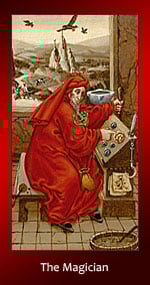
The Magician
The appearance of The Magician card is great news, because even if your sex life has been a disappearing act lately, he says that you can use your considerable sexual skill and sense of erotic adventure to compel it to come back to you starting today. There’s a creative component here, too, so don’t forget to use your steamy imagination to really get things sizzling. Once you use all of your powers of seduction to their greatest potential, there’s no limit to the carnal magic you can conjure up.
Your Daily Erotic Tarot Card for December 14
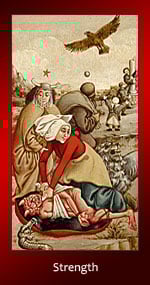 Strength
The Strength card shows that something you’ve been trying hard to obtain keeps slipping out of your grasp. Romantic partners are generally attracted to you because of your strong sense of self-confidence and sheer determination, but if that isn’t working right now you could understandably become exasperated. Crossing the line into aggression may only result in frustration, so resist the urge to keep going even after your admirably bold attempt at seduction gets rejected.
Your Daily Tarot Love Card for December 13 & December 14
Daily Tarot Love Card for December 13

Justice
Justice is a love card. Justice selected you today because you need to know that you can advance dreams when you balance your needs with another’s. Both people need to feel loved, because feeling loved is what it is all about. Today, promise to be there for each other and deliver on that promise. If single, do you need to return a favor with a favor? Does someone owe you an apology, or you owe one?
Daily Tarot Love Card for December 14
 The Wheel of Fortune
No, this is not the Wheel of Misfortune, but it reminds you that even good happens in a difficult situation. Loss is not a bad thing. It can be an opportunity to find out, for example, why you chose the person you did. In addition, it brings home messages about whether we do too much mistaking of dysfunctional relationships for love. Thank the Wheel for today’s advice.
Your Daily Tarot Card for December 13 & December 14
Your Daily Tarot Card for Thursday, December 13
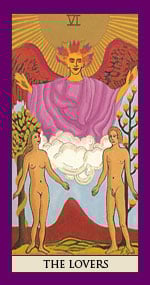 The Lovers
Keywords: choice, decision, love, communication, inspiration (ideas from above)!
Astrological Correspondence: Gemini
The Lovers card is representative not only of crucial life choices, but also of lovers, couples, and other partnerships, like business partners, siblings, and friends. The angel between a woman and a man, depicted on this card, symbolizes the struggle of deciding to follow one’s heart versus one’s temptation or obligation. The Lovers card symbolizes the choices that must be made to progress toward higher self-awareness; choices also reflect emotional values, indecisiveness, hesitation, and our fears about making wrong choices. This applies not only to love relationships – it is applicable to any relationship in which people are drawn together, even a casual one. It’s the card of uncertainty!
Your Daily Tarot Card for Friday, December 14
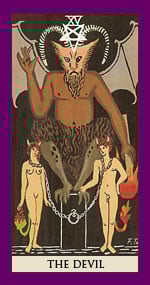 The Devil
Keywords: materialism (sex and money), lies, grounding, slavery, bondage!
Astrological Correspondence: Capricorn
The card of the Devil represents the darker side of humankind, all that is shameful, base, and that we avoid to confront. Its imagery connects to sexuality, irrationality, obsession, and addiction. Being enslaved by our fears and desires, we find it hard to let go of unhealthy relationships, addictive behavior, excessive attachment to material things, and obsession with power. Accepting the shadow side in us can help channel the energetic powers that this card also represents. Understand that confronting our dark side can indeed lift the chains that tie us down, and by not letting self-hatred and shame take over we are empowered to be free. Qualities of this card in a negative situation include excessive ambition, rigidity, and abuse of power in the emotional as well as the material realm.


You must be logged in to post a comment.