

Author: ladyoftheabyss
Egg Shells………..Magickal Hints & Tips

When You Have Guests Over…….Magickal Tips & Hints

We Have Been Here……..The Witch Said What?

Throw me to the Wolves…….The Witch Said What?

I Go Into The Forest……..The Witch Said What?

Unplug from the Drama……The Witch Said What?

Wings & Roots…….The Witch Said What?

The Most Spiritual Thing You Could Do……The Witch Said What?

A Little Thought from Me to You……..

Astronomy Picture of the Day – The Multiwavelength Crab
Astronomy Picture of the Day
Discover the cosmos! Each day a different image or photograph of our fascinating universe is featured, along with a brief explanation written by a professional astronomer.
2017 May 11
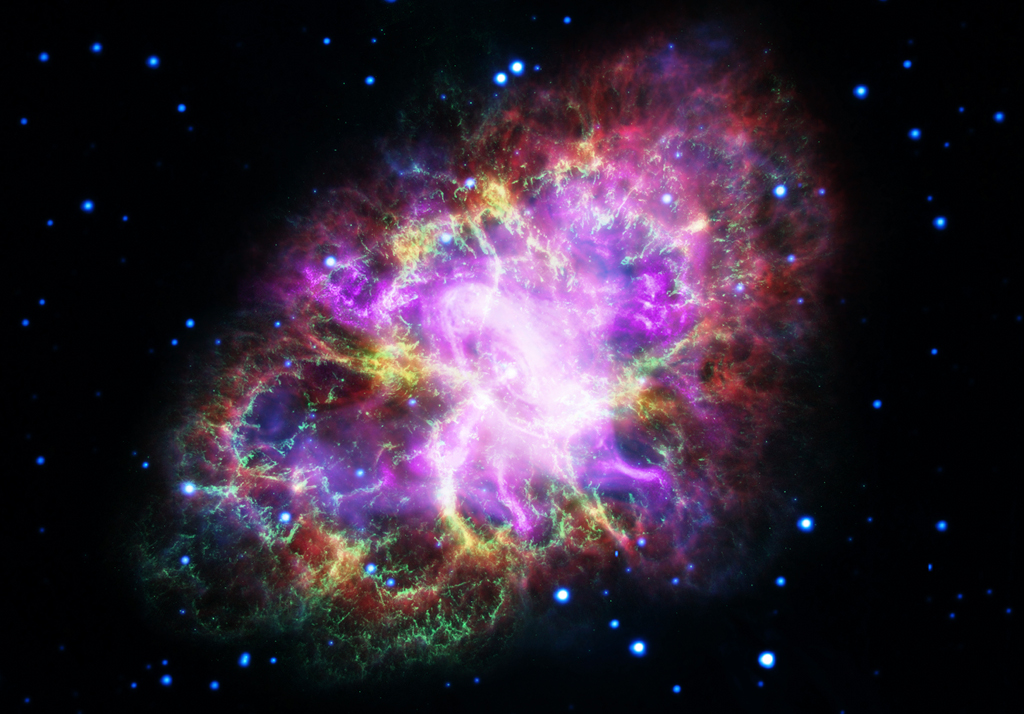
The Multiwavelength Crab
Image Credit: NASA, ESA, G. Dubner (IAFE, CONICET-University of Buenos Aires) et al.;
A. Loll et al.; T. Temim et al.; F. Seward et al.; VLA/NRAO/AUI/NSF; Chandra/CXC;
Spitzer/JPL-Caltech; XMM-Newton/ESA; Hubble/STScI
Explanation: The Crab Nebula is cataloged as M1, the first object on Charles Messier’s famous list of things which are not comets. In fact, the Crab is now known to be a supernova remnant, expanding debris from massive star’s death explosion, witnessed on planet Earth in 1054 AD. This brave new image offers a 21st century view of the Crab Nebula by presenting image data from across the electromagnetic spectrum as wavelengths of visible light. From space, Chandra (X-ray) XMM-Newton (ultraviolet), Hubble (visible), and Spitzer (infrared), data are in purple, blue, green, and yellow hues. From the ground, Very Large Array radio wavelength data is in shown in red. One of the most exotic objects known to modern astronomers, the Crab Pulsar, a neutron star spinning 30 times a second, is the bright spot near picture center. Like a cosmic dynamo, this collapsed remnant of the stellar core powers the Crab’s emission across the electromagnetic spectrum. Spanning about 12 light-years, the Crab Nebula is 6,500 light-years away in the constellation Taurus.
Earth Sky News for May 11: Moon near Antares and Saturn May 11-13
Moon near Antares and Saturn May 11-13

Tonight – May 11, 2017 – and for the next few evenings, watch for the waning gibbous moon, the star Antares and the planet Saturn to rise above your southeast horizon by mid-to-late evening. If they’re not up before your bedtime, you can also look for this celestial threesome – the moon, Antares and Saturn – in the western half of the sky before morning dawn.
Click here for recommended almanacs; they can help you find the rising times of the moon, Antares and Saturn into your sky.
Saturn is nearly at its best and will be closer to the moon on the night of May 12. Read more about Saturn at tomorrow’s night sky post.
Or check out this article on Saturn: Got 5 minutes? Learn to see Saturn

Tonight, focus on ruddy Antares, the brightest star in the constellation Scorpius the Scorpion. It’s a red supergiant star, whose immense size makes our sun appear puny. Although Antares’s size isn’t known with absolute precision, it’s thought that its radius is better than three times the Earth’s distance from the sun, a distance commonly called the Astronomical Unit (AU).
In other words, if Antares replaced the sun in our solar system, its circumference would extend well beyond the orbit of Mars and roughly 60% the way to Jupiter. Yes, our sun is huge, with the diameter of 109 Earths and the volume of about 1.3 million Earths. Yet Antares’ diameter spans about 650 sun diameters and its volume is somewhere around 275 million suns. Talk about gargantuan!
The name Antares means “like Mars” because of the similarity in color (and sometimes brightness) of Antares and the red planet Mars. In February 2018, Mars and Antares will be in conjunction and at virtually the same brightness, giving you an opportunity to try to distinguish the ruddy star from the red planet in the morning sky.

Bottom line: On the nights of May 11, 12 and 13, 2017, watch for the bright waning gibbous moon to shine near the red star Antares and golden planet Saturn.
The Words of Confucius
The Words of Confucius

Never contract friendship with a man that is not better than thyself.
Your Daily Domino for May 11 is Blank/Six
Your Daily Domino
May 11, 2017

Blank/Six
You now have the opportunity to gain materially. New ventures will come your way. To do well you will have to decide which of these new ventures best suits your ambitions for the future.
Your Daily MahJong Tile for May 11 is Fall, Symbol: The Farmer
Your Daily Tile
May 11, 2017

Fall
Symbol: The Farmer
The Farmer represents rewards gained through hard work and faith in oneself. He harvests riches from the planting and nurturing of his crops
One for the Animal Lover In All of Us…..

“Just Strolling Along”
Spell to Enlist Crow’s Help To Banish Your Troubles (Printable Spell Pages)

Crow Symbolism

Crow Medicine

Your Animal Spirit Guide for May 11 is The Crow


You must be logged in to post a comment.