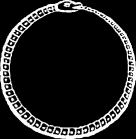
The “circular” serpent biting its own tail represents eternity and the cycles or “circle of life.” Medieval alchemists linked it to the cyclical processes in nature.

The “circular” serpent biting its own tail represents eternity and the cycles or “circle of life.” Medieval alchemists linked it to the cyclical processes in nature.

To many New Agers, it means power, purification, healing, wisdom, self-knowledge, renewal and eternal life. Origin: In the 4th century BC, Greek historian Ctesias told about a wild animal with healing powers and a spiral horn on its forehead. Medieval myths suggested it could only be caught with help from a virgin who would befriend it.

Associated with the number three. Pointing upwards, it symbolizes fire, male power and God. To Christians, it often represents the Trinity. Pointing down, it symbolizes water, female sexuality, goddess religions, and homosexuality.

Linked to flame, fire, fertility, sexual power and spiritual power. In nations around the world, images of deities or masks with protruding tongues have indicated active and occupying spiritual forces, often a union of masculine and feminine spirits. Such images were vital to pagan rituals invoking spirits. The sexual/spiritual forces represented by gargoyles with protruding tongues which adorned Gothic cathedrals were believed to protect the buildings from other spiritual powers.

A universal symbol found on ancient slabs in Nordic countries, in pre-Columbian America and in Mediterranean countries. The sun wheel represents power and supremacy. It serves as a logo for the Swedish national socialist party, Nordiska Rikspartiets, and for the French Jeune Nation.
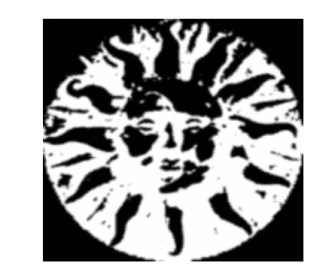
A universal pagan expression of the merging of opposites. Like the “Yin Yang,” the marriage of the male sun and the female moon represents unity in diversity, compromise instead of conflict, and conformity to a new consciousness where all is one.
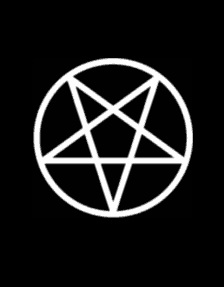
Used in occult rituals to direct forces or energies. Often represents Satanism, the horned god, or various expressions of contemporary occultism, especially when a goat-head is superimposed on the inverted pentagram.

A standard symbol for witches, Freemasons, and many other pagan or occult groups. To witches, it represent the four basic elements (wind, water, earth and fire) plus a pantheistic spiritual being such as Gaia or Mother Earth. The pentagram is also used for protection. to banish evil energy or to draw positive energy, depending on how it’s drawn.”

A broken, upside-down cross. To Roman emperor Nero, who hated and persecuted the early Christians, it meant destruction of Christianity. Revived in the sixties as a sign for peace, it now symbolizes a utopian hope for a new age of global peace and earth-centered unity.
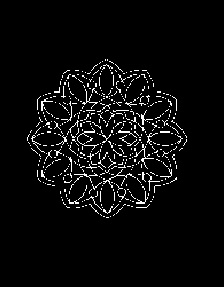
The Hindu term for “circle”. In Hindu and Buddhist meditations, it is used to raise consciousness. In meditation, the person fixes his or her mind on the center of the “sacred circle.” Geometric designs are common. The center of some mandalas show a triangle with a bindu (dot) inside a circle. It represents the merging of male and female forces.
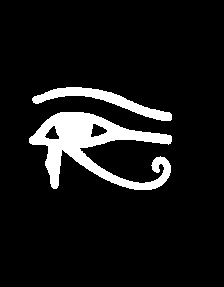
It represents the eye of Egyptian sun-god Horus who lost an eye battling Set. Pagans use it as a charm to ward off evil.

A mythical monster made up of many animals: serpent, lizard, bird, lion… It may have many heads and breath fire. To mediaeval Europe, it was dangerous and evil, but people in Eastern Asia believe it has power to help them against more hostile spiritual forces.
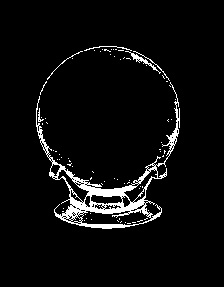
Used for divination (fortunetelling, scrying, clairvoyance…). When the heavy crystal balls were too expensive, witches often used glass-ball fishing floats, colored glass balls, or magic mirrors.
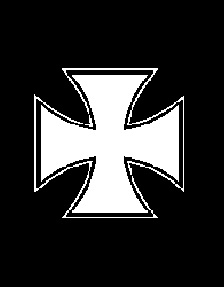
Also called Mantuan or Maltese cross. First linked to an ancient goddess temple on Malta, it was adopted as the Iron Cross in Prussia. During the First World War, it appeared on German fighter planes and tanks. Later, it became a fascist symbol in France, Portugal and other nations.

Christians believe that Jesus accepted crucifixion on a cross for the benefit of us all. This has not always been the case however. Christians didn’t use the cross as their religious symbol for many generations after Christ was crucified. Rather than being a Christian symbol it had associations with executioners.
Initially, Christians adopted the fish symbol to identify their religion. Then, early in the fourth century, when execution by crucifixion was abolished by Emperor Constantine and Christianity became the state religion of Rome, the cross became the emblem for Christians.
The cross is used extensively in black magic and in many religions.
The Cross has been used to torture, to threaten whole civilizations, yet used as jewelry and sometimes worshipped. It has associations with an illegal psychedelic 1960s drug, SARS, BSE and bird flu, hatred and despair, love, valour and heroism, World War I, World War II, the Crusades, mythology, Satan, and salvation.

A symbol of the aging goddess (crone) to contemporary witches and victory over death to many Muslims. In Islamic lands, crescent can be seen enclosing a lone pentagram.

It symbolized the sky goddess Hathor to Egyptians, enlightenment to Buddhists, one of the highest and holiest stages of transmigration (reincarnation) to Hindus.

The sacred circle filled with a cross, four equal lines pointing from the center to the spirits of the north, east, south, and west—or to the basic element: earth, water, air (or wind), and fire. In Native American traditions, it forms the basic pattern of the MEDICINE WHEEL and plays a vital part in major spiritual rituals. Many contemporary pagans consider it their main symbol for transmitting the energy of the goddess. Christian churches have used variations of the same popular shape, usually calling it the Celtic Cross.

In the complex symbolic system of Hinduism and Buddhism, the bindu (dot) represents the male force. Together, the circle and the bindu symbolize the merging of male and female forces.

An ancient and universal symbol of unity, wholeness, infinity, the goddess, and female power. To earth-centered religions throughout history, as well as to many contemporary pagans, it represents the feminine spirit or force, the cosmos or a spiritualized Mother Earth, and a sacred space. Gnostic traditions linked the unbroken circle to the “world serpent” forming a circle as it eats its own tail.
 Witches Of The Craft®
You must be logged in to post a comment.