

Category: Articles
Your Ogham Reading for the Weekend of Feb. 22
Your Ogham Reading for the Weekend of Feb. 22
Nuin-Ash

The “World Tree” in Norse mythology was an ash tree; many cultures have looked to the ash tree as a source of power and order. Ash is a hardwood known for its use for weapons, sports, and musical instruments. This hardiness of ash denotes its symbolism for order, harmony, balance, and the status quo. Drawing the Nuin symbol can take on a variety of meanings, however it is most often associated with a life of peace and symmetry.
Fortune -When you find this Ogham, a great fate is at work. Take action now and let destiny carry you to the finish line!
Ngetal-Broom
 Brooms tolerate poor soil and growing conditions, they are known for wasteland reclamation, a way of cleaning up hazardous sites. It is no surprise that this plant is also where the term broom arose as a cleaning tool. Over the centuries the Ngetal, or broom, as been associated with healing, cleaning, and restoring what once was. Drawing this letter shows some aspect in life has been cleaned and healed or is in great need of it.
Fortune – It is time to cleanup in life! This Ogham is a sign that you need to find the mess that has been made in your life or someone close to you and sweep it up!
Coll-Hazel

The Celts believed that hazelnuts gave inspiration and wisdom, even in many other cultures the hazel tree and it’s branches and nuts are used for protection. In Celtic mythology one of the greatest leaders named Fionn Mac Cumhail magically gained wisdom after eating salmon that sustained themselves upon hazelnuts. The ogham letter coll denotes wisdom, divination, and inspiration. Drawing this letter will give you a deeper look into you questions and concerns.
Fortune – Look inward to your own wisdom to gain the answer you seek. Be creative, be perceptive, this Ogham shows you already have the answer!
Shuffling the Cards, Your Daily Influences for the Weekend of Feb. 22nd
Your Influences for the Weekend of Feb. 22nd
Tarot Influence
 Page of Swords Reversed
Expect the unexpected. Inane behavior may hamper you. Cunning may be called for.
Astrological Influence
 Cancer Reversed
Cancer reversed denotes a lack of creative energy and disregard for home-life.
Element Influence
 Air
Air
Air denotes freedom and the ability to transcent the mundane. You may be, or may soon experience a spiritual or secular liberation.
THIS TAROT CARD URGES YOU TO LOOK WITHIN
THIS TAROT CARD URGES YOU TO LOOK WITHIN

In this series, Jamie Richardson of Ember + Aura Tarot explains how to embrace the message of each major arcana card.
The High Priestess is the gatekeeper between our inner and outer realms. She is the guardian of our deepest wisdom and intuition. When the High Priestess shows up, it’s time to slow down and turn within. Her language is symbolic; her methods mysterious; her pathways shadowy. She often emerges after we have lost the girlishness and naivety of our youth when we’ve tired of social interactions and are beginning to explore our own depths.
The High Priestess loves nothing more than when we set aside our own agendas and rulebooks and simply listen to the silence of our evolving hearts—when we feel our way in the dark with no idea where we are going. She teaches us to develop and trust our second sight, the sacred gift of the Divine Feminine. Traditionally seated between two pillars representing interior and exterior worlds, the High Priestess patiently waits to offer her guidance to those who approach her.
Our intuition starts out strong in life. As children, we naturally follow our bliss and are able to blend aspects of work and play. Children rarely overanalyze and are able to easily listen to their hearts, and their subconscious and conscious minds are seamless and easy to bridge. In our society, however, it isn’t too long before children begin to realize that they are expected to succeed, compete, and achieve. The dark, mysterious, self-knowing aspects of the subconscious are cast aside and replaced with what we can see and judge in the full light of day. We begin to compare ourselves to others, trust only what gives us proven results, and work towards goals that bring us a sense of accomplishment. We stop climbing trees, trying to hear the thoughts of animals, chasing our imaginary friends, and finger-painting scenes that only we understand. We begin playing organized sports, earning gold stars, posting selfies, and planning out our futures.
When we abandon our trust of the unknown, when we stop turning within, our High Priestess goes deep underground.
Often, the High Priestess resurfaces when one has endured a particular tragedy or suffered a great loss. At these times, when the solid ground of our egos has crumbled, we are in a perfect position to take on deeper learning. We are ready to put our trust into that which we cannot see or measure. We are looking for a connection to our own Source and innate knowledge. Survivors of tragedy have profound potential for higher spiritual evolvement. The High Priestess, although dark and mysterious, has compassion for her followers and shows them only what they are ready to experience.
So what is the Tarot card trying to tell you? The truth is, this is an invitation. The High Priestess is confirming that you hold all of the answers to life’s questions in the hidden spaces of your own heart. Furthermore, the capacity to which you can open your heart and suspend your own need for visible signs is the degree to which you will experience a transformation of the mind. You will know you are on track when you begin to notice synchronicities between your inner exploration and your reality: a book suddenly appears about the mysteries of the Divine Feminine, an acquaintance invites you to a local full moon circle, or you receive an email about becoming attuned in Reiki. Your dreams may become more vivid and characters may appear, offering insight and clues about your existence. These are all strong examples of the language of the High Priestess.
When the High Priestess calls, it’s time to pay attention. Accept her invitation to walk between the seen and unseen worlds. Don’t be afraid to jump down the rabbit hole and explore what this vast inner-dimension holds for you, with its delicious darkness and ancient mysteries. Her greatest gift to you will be the unveiling of what you had all along: the ability to face the dark and bring your own truth into the light.
Find Jamie Richardson on Instagram @emberandauratarot or at www.emberandaura.com
Published on Astrology.com
Your Daily Tarot Cards for Friday, February 22
Your Daily Tarot Cards for Today

Your Daily Tarot Card for Today
The Moon

Keywords: imagination, dreams, emotion, competition (the dogs), illusion!
Astrological Correspondence: Pisces
The Moon in all its phases represents the world of dreams, illusions, and the subconscious. Traditionally the symbol of the feminine, the card’s meaning encompasses the maternal, the Great Mother, womanhood, and cycles. The Moon is an ambivalent card, and its imagery signifies the difficulty to see things clearly: simultaneously inspiring and lacking courage, enchanting and bewildering, deceptive and receptive – all sides of the same coin. Signaling fluctuating moods and uncertainty we must pay attention to our dreams, confront our subconscious and deal with the issues that come to the surface in order to progress to a higher level of awareness. Being able to put our imagination and creative talents to good use is an added bonus. Negative qualities such as ambiguity, confusion, hidden fears, and deception can be causes for failure.
Your Daily Love Tarot Card for Today
The High Priestess

The High Priestess card has selected you because you need to open your eyes to the process of ‘Creative Visualization.’ If you envision the right person for you, the right person will enter your life. If you are with someone and feel deep friendship, you have discovered one of the true foundations of love. You are in the process of fulfilling your hopes and wishes.
Your Daily Egyptian Tarot Card for Today
The Hermit

The Hermit refers to health issues or having the ability to heal today. Sometimes these two issues go hand in hand. You may have become interested in healing when you develop a health issue or just over-focused on all the little details of what makes you sick. Fear of infection from disease can force you into becoming a Hermit, but don’t indulge it. A Hermit serves others by bringing light out of the darkness, not losing it in the dark.
Your Daily Egyptian Love Tarot Card for Today
Death
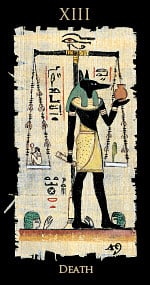
This card is a symbol of deep change and transition. If you have wanted to let go of old ways of being in relationship and want to create a new template of behavior, this is your opportunity to do so. The Death card assists in stripping away whatever is unnecessary and no longer useful to free up energy for the new and untried. Make use of this energy by letting go of the past and stepping into the future.
Get A Jump on Tomorrow, Your Daily Horoscopes for Saturday, February 23
Get A Jump on Tomorrow……
Your Daily Horoscopes for Saturday, February 23
Moon Alert
Avoid shopping or important decisions for one hour today from 10 AM to 11 AM EST (7 AM to 8 AM PST). After that the Moon moves from Libra into Scorpio.
Aries (March 21-April 19)
Expect some surprises and upsets in the early morning. Later in the day, your ability to research something is fantastic! On the other hand, if you have to keep secret – you will! “Wild horses couldn’t drag it from me. I’ll take it to the grave!”
Taurus (April 20-May 20)
Surprises related to your job, your health or a pet are likely early this morning. Later in the day, you will be very persuasive when talking to others. You might enlist the help of someone to get to the bottom of something because you want to know the real cause.
Gemini (May 21-June 20)
Be careful not to be too pushy talking to bosses, parents and VIPs today, which you might do if you think you are right and you know what you’re talking about. If you are confident, then nothing will hold you back! You’re going to tell it like it is.
Cancer (June 21-July 22)
You will love to explore new ideas, especially related to esoteric concepts like metaphysics and ancient lore. Academic secrets will appeal today. Don’t leave home without your Indiana Jones hat. “I believe this is yours, Dr. Walton?”
Leo (July 23-Aug. 22)
Be careful to avoid accidents in the early morning today. Later, you will be like a sleuth going through red-tape details about shared property, inheritances, wills and insurance disputes. You want to get to the bottom of something and you intend to do it.
Virgo (Aug. 23-Sept. 22)
Keep an eye on your money and possessions in the early morning to avoid losing something. Later in the day, expect an intense discussion with a partner or close friend. It could be prompted by jealousy or finding out a secret. Or perhaps you want to convince someone to agree with you?
Libra (Sept. 23-Oct. 22)
A partner or close friend might surprise you in the early morning. (You might have a disagreement.) Later in the day, you will be successful doing investigative work if you have to seek out hidden solutions to problems. You might also come up with medical answers.
Scorpio (Oct. 23-Nov. 21)
Something surprising might catch you off guard early this morning. Later, romantic discussion will be intense. But for the most part, you want to play games today, especially mentally challenging puzzles and mysteries, especially with children.
Sagittarius (Nov. 22-Dec. 21)
A friend might have surprising news early this morning. Family discussions will be intense today. This is an excellent day to tackle home repairs, especially repairs related to bathrooms, recycling, garbage areas and laundry. You want to get to the root of a problem.
Capricorn (Dec. 22-Jan. 19)
Avoid arguments with parents and female relatives early this morning. Later in the day, you will enjoy investigating something. Your mind will probe problems for solutions. You will also enjoy reading mysteries and whodunit’s today. (They always set up the butler.)
Aquarius (Jan. 20-Feb. 18)
Be careful early morning to avoid accidents verbal and physical. Later today, you will have strong opinions about financial matters. For example, if you are shopping, you will be intent on buying something. Nothing will dissuade you. “My mind is made up; don’t confuse me with the facts.”
Pisces (Feb. 19-March 20)
You will be very powerful talking to others today if there’s something that matters to you. If not, you will be playful and teasing. But if you do care about something – you will be unshakable, focused and full of intent.
If Your Birthday Is Today
Actress Emily Blunt (1983) shares your birthday today. You are motivated by your goals and will work hard to attain them. Partnerships are important to you. This year you begin a new cycle of exciting changes and beginnings, which is why it’s time to clarify your goals. Remember: What you begin now will unfold in the future. Get ready to take the initiative. Fortunately, your physical strength will increase this year!
If You Were Born on February 22nd, Happy Birthday Pisces!

Happy Birthday Pisces!
IF YOU ARE BORN ON FEBRUARY 22, your zodiac sign is Pisces. You are complicated, but behind all of that, there is a mild-mannered, loveable Pisces. You can be in tune with your emotions and more often than not, show sympathy to others. You are emotionally strong.
Those with a February 22 birthday, have strong shoulders. Friends and family lean on you in times of need. You are the go-to person, the person who comes up with a solution to people’s problems. Pisceans are realists, so you like to get down to the root of the matter.
If you are looking for someone who is not afraid to openly display his or her feelings, those born on this day fit that description. It awards the human element to Pisces, the Fish. Most 22 birthday Pisceans have this idea of what their romantic life should be.
It is more like a fairy tale, so perhaps we should stick to the real thing. I am afraid that if you continue to think this way, you are subject yourself to heartbreak. You make willing sacrifices for someone you love, and they appreciate it.
As a friend, Pisces, you are committed to the friendship. The February 22 birthday personality shows you are charming and patient. You attract those that are underprivileged. Everyone has his/her story, so you never judge a book by its cover.
Pisces, you believe you can learn something from everyone. We all have history and can provide important clues about the present and future.
According to the birthday meaning for February 22, you have a yearning to live life but to live it in a way that you find desirable. Pisceans hate city life. It’s way to busy for you. You like to take your time and evaluate things. You never do anything in a hurry.
Your flaw, Pisces, is that you would live in the city if you thought it would make someone else happy. Those born on this day would be silently miserable forecasts your birthday horoscope.
It is so polluted in the city. When speaking regarding your health, Pisces, you will do well to cleanse your body of toxins not to mention the preservatives. Eating on the go has its disadvantages.
You cannot fly if you are weighed down. After your cleansing, you should see an increase in stamina. Did you know this would lower your chances of depression as well?
When we talk about your imperfections, among other things, we mean that you can be forgetful. Pisces birthdays of February 22, you forget the dry cleaning, the toilet paper and you are forever looking for your keys! This can be disruptive and irritating to others.
This could have an emotional impact on your friends and family as you can be sensitive when it comes to their comments. You tend to take things out of context, and your feelings are hurt when you should be laughing at yourself. It was funny, you know.
We all look for the obvious and cannot see it such as searching for the reading glasses when they were right there on the nose the whole time. We all do it. Relax, Pisces.
Your birthday astrology predictions for today warn that because you are super sensitive, you tend to look for professions in which you can work alone. You would do well in matters that are bizarre or unconventional.
Those born on this date are people that like music. Perhaps pursuing a liberal arts degree would give you some pleasure. It will provide you with an outlet for your creative and spiritual nature.
In conclusion, February 22 Pisces birthday people are sympathetic and have big shoulders to lean on. You are charming and patient. Pisces zodiac sign born individuals tend to have a talent for music or something artistry.
You make faithful lovers but need to relax and laugh at yourself more. Above all, remember you are Pisces, and you are awesome!
Famous People And Celebrities Born On February 22
Drew Barrymore, Julius “Dr. J” Erving, James Hong, Steve Irwin, Ted Kennedy, Vijay Singh, Robert Young
This Day That Year – February 22 In History
1288 – Pope Nicolas IV was chosen by ballot
1512 – Amerigo Vespucci, an Italian explorer, is dead at age 60
1797 – The Last Invasion by the French begins
1828 – Russia and Persia sign Peace of Turkmantsjai
February 22 Meen Rashi (Vedic Moon Sign)
February 22 Chinese Zodiac RABBIT
February 22 Birthday Planet
Your ruling planet is Neptune & Saturn. Neptune represents intuition, spiritual consciousness, sentiments, and evasiveness. Saturn stands for hard work, caution, reliability, and restriction.
February 22 Birthday Symbols
The Water Bearer Is The Symbol Of The Aquarius Zodiac Sign
The Two Fishes Are The Symbol Of The Pisces Star Sign
February 22 Birthday Tarot Card
Your Birthday Tarot Card is The Fool. This card stands for freedom, impulsiveness and starting something new. The Minor Arcana cards are Eight of Cups and King of Cups.
February 22 Birthday Compatibility
You are most compatible with people born under Zodiac Sign Scorpio: This relationship is extremely well matched.
You are not compatible with people born under Zodiac Sign Sagittarius: This relationship will only work with lot of understanding.
February 22 Lucky Numbers
Number 4 – This number stands for hard work, reliable, meticulous and loyal.
Number 6 – This is a nurturing number that symbolizes caring, kindness, responsibility and supportive.
Lucky Colors For February 22 Birthday
Sea Green: This is a color that helps control your emotions and remain calm.
Purple: This color is a psychic color that symbolizes intuition, mysticism, and spirituality.
Lucky Days For February 22 Birthday
Thursday – This day ruled by Jupiter stands for cheerfulness, support, philosophy, and optimism.
Sunday – This day ruled by Sun stands for the universe, creation, authority, and dynamism.
February 22 Birthstones
Amethyst is a stone of healing and protection and helps you get over addictions.
Aquamarine stands for meditation, peace, spirituality, and wisdom.
Ideal Zodiac Birthday Gifts For People Born On February 22
An aquarium for the man and a handmade basket of biscuits for the Pisces woman. The February 22 birthday horoscope foretells that you love home-made gifts.
Your Daily Horoscopes for Friday, February 22nd
Your Daily Horoscopes for Friday, February 22nd
Moon Alert
We have the “all clear” today to shop and do business. The Moon is in Libra.
Aries (March 21-April 19)
This is a feel-good day because you are upbeat and optimistic about your world! You will enjoy talking to others and sharing ideas; however be aware of one thing: Be careful about exaggerating something in your own mind. Enjoy having your head in the clouds but keep your feet on the ground.
Taurus (April 20-May 20)
People are pumped and enthusiastic today, especially in group situations. This is a great day for team sports or any kind of competition. Discussions with others, especially younger people, will be upbeat and positive. (Don’t overlook details.)
Gemini (May 21-June 20)
Bosses, parents and VIPs will be impressed with how confident you are today because you believe in yourself and your ideas. You speak with enthusiasm, which is why others are willing to listen to you. Be careful about overlooking details. Stick to your script.
Cancer (June 21-July 22)
Travel plans look exciting today! In fact, plans related to publishing and the media or something to do with the law, medicine or higher education are also encouraging to you. As you explore these areas, be careful not to overlook important details.
Leo (July 23-Aug. 22)
You might be enthusiastic today about your fair share of something or how much money you think you can borrow or inherit. Things are looking swell! Nevertheless, something might look better than it actually is so double check details.
Virgo (Aug. 23-Sept. 22)
A conversation with a partner or close friend will be enjoyable today because you are enthusiastic and so are they. You see the broad strokes of things and everything looks good. Nevertheless, be sensible. After all, you don’t want to give away the farm. Be fair but don’t be foolish.
Libra (Sept. 23-Oct. 22)
Your plans at work look great today. You see the big picture and you’re excited about it. Furthermore, meetings and group activities about whatever you are involved with will be upbeat and positive. Just make sure you don’t overlook details because it’s easy to do this today.
Scorpio (Oct. 23-Nov. 21)
Today you are enthusiastic and excited about social plans or something to do with sports or fun activities with children. This is an upbeat day and people are happy! However, by focusing on the big picture, it’s easy to overlook details. Be aware of this.
Sagittarius (Nov. 22-Dec. 21)
Your plans for real estate or something to do with home and family are exciting and visionary. This is why you feel enthusiastic. The key is to make sure that everything is doable. Nevertheless, your optimism and enthusiasm will carry the day – as it always does.
Capricorn (Dec. 22-Jan. 19)
You’re thinking big in all your ideas today, which no doubt impresses others. You have a great ability to see the whole picture in terms of large structures and future direction. However, do not overlook elements that don’t fit in to your grand vision. Stay realistic.
Aquarius (Jan. 20-Feb. 18)
When it comes to financial matters today, you’re confident! You’re thinking big and adding zeros to everything. This certainly has its advantage, especially when you have to make an important pitch about a big project. Nevertheless, it has to be doable. Make sure you have all bases covered.
Pisces (Feb. 19-March 20)
Today Mercury is in your sign dancing with Jupiter, which makes you very optimistic. You have big plans and big hopes, and well you should. Remember the advice about sweeping the floor? “Always sweep the corners because the middle will take care of itself.” Think about this because this is wise advice.
If Your Birthday Is Today
Actor Zach Roerig (1985) shares your birthday today. You are concerned with the well-being of others and will often let people steal the limelight from you. This year you are moving away from heavy burdens to something new and lighter! It is a time of completions and taking inventory because you’re wrapping up a nine-year cycle. This is why you will say goodbye to some aspects of your life.
Your Love Horoscopes for Friday, Feb. 22nd & Saturday, Feb. 23rd
Pisces Daily Love Horoscope
Friday 22nd of February 2019
Whether or not you’re pursuing your most cherished ambition in life, it’s important to accept that a loved one or potential partner has grand ambitions and you might wonder how much you feature in these. This person might say much of what you want to hear and might not be able to look too far into the future to put your mind at rest. It’s important you don’t jump to conclusions or probe for information they might not be able to provide. Keep this conversation as one you and they return to periodically. Making clear that you’re on board and supportive might be all they need to know at this stage.
Pisces tomorrow love horoscope:
Saturday 23rd of February 2019
The communication between your head and heart could have been skewed recently but don’t let this cause you to put up a defensive barrier. You can reduce any feelings of insecurity or uncertainty by revealing your open self to a lover rather than feel you’re at risk of creating complications by doing so. Be honest with yourself about what you want and deserve to experience with affairs of the heart because unfounded or outdated doubts could be the biggest obstacle to achieving it now.
Capricorn Daily Love Horoscope
Friday 22nd of February 2019
Something emerging or unfolding in your emotional world could give you plenty to look forward to, but it’s important to set realistic expectations. That doesn’t mean a firehose should be taken to any flames of enthusiasm or passion but expecting too much, or too much too soon could result in disappointment that could have been avoided. Connect with your reserves of patience and discipline to go with the flow and be receptive to what comes your way without being the instigator.
Capricorn tomorrow love horoscope:
Saturday 23rd of February 2019
Changing romantic or relationship conditions or circumstances can bring a new level of security and stability to your emotional world or one special connection. However, you could be uninterested in upsetting a status quo, especially if you feel it offers enough security and stability you need presently. This attitude is understandable but could also be what’s preventing your love life from evolving. You don’t need to make immediate decisions as the most positive changes presenting themselves now will be more beneficial if they’re gradual. However, you should consider if you’re being too quick to dismiss what – or who – you ought to be embracing.
Sagittarius Daily Love Horoscope
Friday 22nd of February 2019
A plan you had no reason to believe might be thwarted could go off on a tangent unexpectedly at this time, especially if it involves responsibility outside the sphere of your emotional world that you must attend to. You could struggle to give attention and effort in more than one way, and this puts pressure on you to prioritize your time. If you must postpone a romantic or relationship plan briefly, then it might be that bit more magical when you can give it your undivided attention.
Sagittarius tomorrow love horoscope:
Saturday 23rd of February 2019
Your keenness to reach a new level of agreement with someone special probably has little to do with boredom or a desire to shake a love life scenario for the heck of it. You might want to strengthen the bond of trust between you and someone special at this time and are willing to play your part in strengthening security in any way you can. Whether this involves money or choosing to ‘be there’ for a lover in ways you might not have been able to do recently, you can be integral to bringing an improvement where one’s needed now.
Scorpio Daily Love Horoscope
Friday 22nd of February 2019
Your stubbornness or determination can be sexy and take your love life into wonderful territory sometimes, but you might need to dial both back at this time. Adopting a more open mind and showing a willingness to listen to a loved one will be integral to making progress where it’s needed now. Being seen to want to maintain harmony or compromise is the first step to achieving both.
Scorpio tomorrow love horoscope:
Saturday 23rd of February 2019
It might have taken time to get to where you are in your emotional world, but if you needed proof that your love life exists on sturdier foundations, then proof is coming. You might see plenty of effort needed to strengthen something between you and someone further, but resentment or fear are gradually being replaced with a justified sense of optimism – and you have your patience and efforts to thank for that!
Libra Daily Love Horoscope
Friday 22nd of February 2019
Ok, if you’ve made a mistake or glaringly obvious error of judgment in your emotional world or involving a certain person, it happens and isn’t the end of the world. Your first reaction might be one of defensiveness, and that isn’t necessary and only perpetuates tension. Whether it’s a lover or close friend who offers criticism, it’s important you accept it as constructive and helpful rather than negative or condescending.
Libra tomorrow love horoscope:
Saturday 23rd of February 2019
Expressing what’s on your mind or in your heart will require imagination, and it’s by pushing aside any fears you’ve been nurturing that you can allow a wave of creative inspiration to find you. There’s magic in spontaneity now, so don’t focus too intently on creating rigid plans or rehearsing anything you intend to say. Allow emotions to emerge straight from your heart and don’t apply them to any mental filter. The bigger and bolder your expressions of love are now; the more heartwarming the result can be.
Virgo Daily Love Horoscope
Friday 22nd of February 2019
You could be aware of comments about your emotional world or a love partnership coming your way from others but have a choice about whether you absorb or ignore their opinions. What matters is whether or not you’re happy with things as they are, and you aren’t obliged to allow anyone to dictate what is or isn’t right – or fair – in your love life. Sure, some comments or observations are well-intended, but even in response to them, you can still smile and carry on.
Virgo tomorrow love horoscope:
Saturday 23rd of February 2019
There could be something enormously satisfying and reassuring to see how your efforts and patience are bringing results and are likely to continue doing so. If you’re a single Virgo, then you can see how being your honest self is what’s needed to form or strengthen a connection. If you’re spoken for, then there could be something thrilling about a new way of collaborating with a loved one. Either way, you’ll likely feel more inclined to keep doing whatever’s working in the name of love – and rightly so!
Leo Daily Love Horoscope
Friday 22nd of February 2019
Whether it’s because you feel you got ‘your way’ with a lover or have found a way to experience a bit more freedom in a love connection, it’s still important to play the humility card. You could take your newfound freedom to an extreme, and this could rub up a partner – or, if appropriate, an ex-partner – the wrong way. Being more careful, thoughtful and sensitive might be necessary.
Leo tomorrow love horoscope:
Saturday 23rd of February 2019
An unjustified sense of caution could cause hamper something special developing between you and your paramour. It might feel sensible to ignore or dismiss an opportunity begging for attention, and it could also be easy to blame circumstances outside your relationship sphere for this. Let go of your belief that something should be more perfect than it is before you’ll embrace it. The more you allow positivity to permeate your emotional world, the sooner it will work some magic.
Cancer Daily Love Horoscope
Friday 22nd of February 2019
There might be something intriguing or even thrilling about a surge of excitement permeating your emotional world, but you could be keener to stick with what’s consistent or predictable. If you’re attached, then playing it safe shouldn’t mean downsizing romantic or relationship expectations. You could find something sexy, and fun can be enjoyed by enjoying what’s known or familiar. Whether single or attached, if this means eating ice cream on the sofa under a duvet watching a film together, then that could be sublime!
Cancer tomorrow love horoscope:
Saturday 23rd of February 2019
You could be aware of how something has improved between you and someone special. If you’ve struggled to speak openly to a lover previously or had difficulty with instigating calm, rational discussions or exchanges, then you’ll likely see proof that such obstacles are becoming less problematic now. If you encourage more openness, then it will be reciprocated. This could be the first sign of relationship progress you’ve long wanted to see or experience.
Gemini Daily Love Horoscope
Friday 22nd of February 2019
As clear as the path to romantic or relationship fun, frivolity or fulfillment might appear, you could find that obstacles stand in the way. Fortunately, you have a choice regarding how you react to this minor matter, and it’s by coming up with unusual solution that helps you circumnavigate love life hurdles. If you can’t pursue Plan A, then have Plan B ready – and the wackier, or far removed from you’d normally pursue, the better!
Gemini tomorrow love horoscope:
Saturday 23rd of February 2019
Any feeling of romantic or relationship restlessness will likely be brief, especially if you and someone close put your heads to together to do something differently or bring a new level of spontaneity to your connection. If you’re in a long-term partnership, then fresh ideas can give it the jumpstart it needs. If you’re single and seeing someone you want to be closer to, then explore options that remove you from any kind of rut or predictability that might already be showing signs of affecting your budding connection. Either way, it’s possible to shake what has become or is at risk of becoming stale or stagnant.
Taurus Daily Love Horoscope
Friday 22nd of February 2019
A development outside of your emotional world could boost your confidence wonderfully, and whether you’re single or attached, your usual sexy vibe could make you extra magnetic and alluring. You could also feel more confident about what you can offer a loved one or potential partner – but could be inclined to do so on your terms. You want to get something in place properly with affairs of the heart and although any list of demands you make are unlikely to be unrealistic or unreasonable, make sure someone knows exactly what you expect from them.
Taurus tomorrow love horoscope:
Saturday 23rd of February 2019
You’re becoming braver regarding your romantic or relationship needs, and only a small amount of confidence might be required to ask for what you want or need from someone special. Once you encourage openness on both sides, you could hit upon something that holds the key to a deeper level of fulfillment. However, it’s also important to be aware of how much you can manage emotionally. It could be easy to try to run when walking is a far better option.ten.
Aries Daily Love Horoscope
Friday 22nd of February 2019
If you and a loved one can put your heads together to bring more money into your world, then you could be surprised at or inspired by where a discussion leads. If this involves a purchase or investment that offers long-term stability or security, then it could strengthen your bond and demonstrate the solidity of your commitment. If a large purchase isn’t an option or necessary, then something small that you take shared ownership of could bring you closer.
Aries tomorrow love horoscope:
Saturday 23rd of February 2019
You could apply new levels of focus to romantic or relationship aspirations and dreams at this time – and mustn’t convince yourself that one or two are idealistic or far-fetched, either. What might have felt intangible or unrealistic could feature more prominently in your mind and sharing your inspired visions with your paramour can help you to formulate a strategy together to get one underway. Love out loud and don’t hold back.
Aquarius Daily Love Horoscope
Friday 22nd of February 2019
A seemingly random or humdrum conversation or exchange could turn romantic once you sense you and someone else are on the same page in some way. You could want to take this meeting of minds into deeper territory and are able to do so if you keep things calm and collected. Whether single or attached, you could have your mind or imagination fired up in a way that turns you on immensely, and that’s a development or opportunity that mustn’t go ignored or slip through your fingers.
Aquarius tomorrow love horoscope:
Saturday 23rd of February 2019
You have a delightful vibe of harmony heading straight toward your emotional world, and the boost to your confidence this brings can revitalize passionate energy between you and a certain person. This could also push you in a necessary way to drop an emotional or intimate barrier and allow your wonderful, experimental side to kick in to bring spontaneity where it’s needed. Simply go with whatever flow is occurring now because you’ll like where it takes you.

Your Daily Cosmic Calendar for Friday, February 22nd
COSMIC CALENDAR
You can’t always get what you want. Reflect on that old saying and strive for serenity as the moon in usually affable Libra makes tension-producing squares with Saturn (10:21 a.m.), Venus (6:48 p.m.), and Pluto (6:53 p.m.) in Capricorn.
It doesn’t necessarily help your state of mind that Mercury in Pisces squares Jupiter in Sagittarius (12:41 p.m.) while Venus makes its annual conjunction with underworld-ruler Pluto at 23 degrees of Capricorn (7:54 p.m.). One way to escape the clutches of stagnation-generating fears and repressed childhood phobias is to conduct research projects and in-depth studies with enthusiasm. Tread carefully in affairs of the heart.
[Note to readers: All times are calculated as Pacific Standard Time. Be sure to adjust all times according to your own local time so the alignments noted above will be exact for your location.]
Copyright 2018 Mark Lerner & Great Bear Enterprises, Ltd.
Daily Inspiration Roundup 18th – 22nd February 2019
Daily Inspiration Roundup 18th – 22nd February 2019

A summary of Kate Spreckley’s ‘Daily Inspiration’ series from the week starting 18th February.
18th February: Culmination
The Eclipses in January certainly stirred things up. Turmoil and confusion have dominated the last few weeks as an adjustment in the balance of all things on the planet is occuring. The new Earth energetic patterns are rising to form a new matrix through which our new reality is manifesting. To ensure our survival we are required to energetically match this matrix by healing emotionally, physical, mentally and spiritually.
To change the outer manifestation of your life a profound inner transformation must occur. To support this process the incoming energy has been drawing to the surface old, toxic emotions, thoughts and feelings readying them for release. With tomorrow’s Super Full Moon you will see the culmination of this process as the incoming energies move into the depths of your soul to activate your pure potential and expand your perceptions.
The Full Moon energy is felt for three days. Use these three days to become conscious of the thoughts, emotions and feelings you have been carrying for far too long. Are you ready to finally let them go?
19th February: Super Full Moon
Super Moons occur when the Moon is closest to Earth, and todays Full Moon will be at its closest point all year. As a result, the light of this Full Moon is at its strongest and the pull of its energy is intense. Its power is exposing the fears and untruths which have driven our past choices and decisions. As this fear rises to be cleared and released we are released from old repetitive patterns and programming.
You are being propelled forward by the evolutionary flow of life, which is dissolving the fragmented aspects of this world and your personal perception of reality. All obstacles to expanded consciousness are being removed. Consequently, you will find that old fear based emotional and mental patterns and programs are emerging. Allow them to surface and dissolve. Be receptive and yet deliberate in this process. Do not go into the drama of these old emotions or feelings. Listen to the messages they bring but focus on letting them go. Everything you are currently experiencing is liberating your innate divinity, your authenticity, so that you may hear your true, intuitive voice.
20th February: Delicate Balance
The energy being directed towards the planet is flooding the new Earth’s energetic matrix emphasising the need to for healing, transformation and release. This Full Moon has rapidly accelerated this process as any unhealed or imbalanced aspects have been highlighted and brought to our conscious awareness. Now we have a choice. Do we continue to follow the old or do we embrace the unknown and move into the new.
Destiny is taking its course prodding you along. Allow yourself to flow between the old and the new but keep your focus on the power of your inner wisdom and truth. Do not allow yourself to be drawn into judging what is wrong with you or the world. Look at yourself and the world from a greater perspective and intuitively move towards what is right for you now. As the moon begins to wane the energy will shift and bring relief. Find the delicate balance between your head and your heart and trust that your inner wisdom is guiding you.
21st February: Claim Your Place
The new Earth’s energetic matrix requires us to be in balance with the natural forces of the planet. The agricultural and industrial revolutions created a split between humanity and the Earth. This alienated humanity from nature splitting the soul, which allow the ego its reign of fear, control and domination. As a result, the Earth was forced to withdraw her energy. Now a new sacred awareness is emerging from the luminous core of the Earth to accelerate evolution and survival upon this beautiful planet.
The incoming energies are speeding up your progress by connecting you to the pure, clear consciousness you hold within your soul. The internal and external patterning created by the ego is unravelling forcing the ego to withdraw and find its rightful place as a servant to divinity. It is time to claim your place in the centre of your divine purpose. To detach from the chaos of the world and focus on freeing yourself from anything which keeps you in a state of survival. Become aware of the larger purpose of your life and allow the ancient truth of your soul to guide you in making real and practical changes. Allow nothing to get in your way.
22nd February: Integration
Every layer, every level and every aspect of our existence is being purified, cleansed and released to enable the full realisation of our pure, divine essence. The powerful burst of new energy that has been coursing across the planet since the Full Moon on the 19th, shifted our inner landscape and brought us into greater alignment with our soul.
You may well be feeling exhausted and drained at this time as you process and integrate the inner changes which have occurred this week. All is well. The light is being restored and the end of this particular storm is near. Do not give up hope. Make time for yourself, your feelings and your essential needs. Listen to your body. Take time to rest, restore and replenish yourself. And remember to be kind, gentle and compassionate with yourself.
Much love
Kate
This article may be republished as is, with no changes made and all links active © 2019 Kate Ann Spreckley http://www.spiritpathways.co.za
Thoughts from your Hostess of Light – February 2019
Thoughts from your Hostess of Light – February 2019
a message from Gillian MacBeth-Louthan
I don’t know about you all but it has been a whirlwind of Energy’s and events, since 2019 was birthed, pushing us forward like a triathlon, never allowing us to stop and take a breath. One energy after another rewrites our life scripts we have memorized. Whether on Mother Earth or in the heavens and skies everything has stirred in a big Cosmic pot, since the beginning of 2019.
Finally we all begin to feel a little better inside like a daffodil pushing through the frozen ground seeking some kind of light, and pow to the moon as more and more unusual weather comes our way saturating our very worlds. We are so programmed to reach for more light in these dreary days. The elements have become expandable and trade places with each other like snow in Hawaii and Florida. We are on edge like a cat in the winter woods jumping at every moon shadow, always waiting for something unexpected. Our adrenals are on high 24 hrs. a day without pause.
The moons are becoming Bigger and Bluer and the night sky changes its pigmentations and pixels. Planets and stars have asteroid eclipses showing off their true underbelly to all that have the eyes to see. Each new realization on Earth, each new find of ancient eras, activates cellular records of remembrance. Everyday our ancient knowing’s are birthed over and over again as what we believe is finally proven and given full credit. At that point we come to a miraculous realization that holding anything in a place of light will eventually give it proof of life.
We are all pursuing a cosmic carrot, something juicy to hang in front of us, to give us hope, to give us a reason for all of this craziness, and to give us renewal. We can feel the dimensional fluidity and variance, we can hear the dimensions stretching, we can sense it and smell it as our earthiness kicks in. We are not in the same space and time, as we were only a few months ago. There is a perceivable difference to this place, and Like a Stranger in a Strange Land we venture out into the unknown on our Quest. Our Quest For Truth For Love for peace and a smile. Our quest to know that justice will triumph, that light will always see victory and that love lives in all of the universe
We all feel the need to follow ‘A New Path’ one that is lit by the future and not the past. One that excites our curiosity, increases our heartbeat, and allows a smile to enter our eyes. We are all on a journey of time known and unknown, in a space that was given to us as a gift.
We are Pathfinders that seek illumination. The soul becomes itchy as does the feet as we move forward into spring. We are tired of being afraid of our future, ourselves, our world and we choose to wear the armor of one that is fearless in their quest. We Are ‘The Champions and the Cause’ has lived in our hearts and souls since time immortal. This next shift integrates slowly like a chameleon compelling a color change. However within the slow motion of Earth’s magnetic revolutions and time striations, a quickening is birthed.
Gillian MacBeth-Louthan – PO box 217 – Dandridge, Tennessee 37725-0217 – www.thequantumawakening.com thequantumawakening@hughes.net
Calendar of the Moon for Friday, February 22
Calendar of the Moon
Ash Tree Month
Color: Pale Blue
Elements: Water and air
Altar: On a cloth of pale blue set a great bowl of salt water in which are set many shells and stones, a shell full of salt, incense, and the figures of sea-birds and fishes.
Offerings: Wash something clean, or air it out.
Daily Meal: Either fish or seafood, or poultry.
Nion/Anthesterion Invocation
Call: Now is the time of wind and water.
Response: Now is the time of sea and sky.
Call: Now is the time of the Gods of weather.
Response: Now is the time of the great waves.
Call: Now is the time of terrible flooding.
Response: Now is the time of needed rain.
Call: Now is the time of battering gales.
Response: Now is the time of winds of change.
Call: Now is the time of fear of change.
Response: Now, and always, change will win.
Call: The wild winds disturb our dreams.
Response: The wild winds awake our minds.
Call: The heavy rains flood our hearts.
Response: The heavy rains water our future.
Call: The sea will sweep us away.
Response: The sea will bear us up.
Call: The sea is cold and unending.
Response: The sea is the source of life.
Call: We are ships on the lost expanse of the ocean.
Response: We are winds that call to one another.
Call: We will brave the wind and water.
Response: We will bring together mind and heart.
Call: We will come home safely after wandering.
Response: We will anchor safely after our journeys.
Call: We will come through wind and water!
Response: We will come through wind and water!
(Repeat last two lines twice more.)
Chant:
We will come through wind and water
We will come through sea and sky
Calendar of the Sun for Friday, February 22nd
Calendar of the Sun
Carista – Day of Peace in the Family
Color: Lavender
Element: Water
Altar: Upon a lavender cloth set a tray of cakes shaped like clasping hands, and many cups full of hot tea.
Offerings: Promise to attempt to be more considerate of those you live with.
Daily Meal: Any food, but it must be served from one great plate for every table, and it should not be in separate portions.
Carista Invocation
May there be Peace in this house.
(Response: “May there be peace in this house!”)
Peace can be a hard mistress.
The daily round of the ordinary,
The simple turn of day and night and day
The presence of the same souls
Can come to be like a shadow on the sun,
And yet Peace still demands
That we find a way to move past
That ordinariness
And all the thousand thorns and briars
And bring Peace into the house.
(Response: “May there be peace in this house!”)
Take the hand of your sister, your brother,
The one who shares your roof, your table,
The ground you walk on,
Whose feet know the boards as well as your own,
And swear to find a way
To bring peace into the space between you.
(Response: “May there be peace in this house!”)
Chant:
My brother, my heart, my sister, my soul;
My family, my life, come in from the cold;
My sister, my heart, my brother, my soul;
My family, my life, that makes this life whole.
(Instead of a ritual, this period of time should be used to mediate and address problems between members of the community, with emphasis on peacemaking and compromise and useful solutions. At the end of the meeting, all share cakes and tea.)
Moon Phase Calendar for Friday – 22nd February 2019

Moon Phase Calendar
Friday – 22nd February 2019
Moon is currently in the sign of Libra
Moon in Libra:
You might have a strong need for balance and harmony now. You probably desire to keep things “nice” rather than venturing into fundamental questions in order not to disturb the peace. You must learn to share your good and bad feelings. Do not be afraid to be who you really are, despite what is expected of you.
Organs influenced by Libra:
Organs: Kidney, ureter, urinary bladder, veins, skin as an organ of touch, pancreas, insulin, glucagon.
These organs are now more sensitive so provide them with extra care.
Surgical operations:
Surgical operations are recommended during the Waning Moon.
However, avoid surgeries of organs under the influence of the Moon Sign.
The Witches Current Moon Phase for February 22nd
The Witches Current Moon Phase for February 22nd
Waning Gibbous
Illumination: 88%
The Moon today is in a Waning Gibbous Phase. This is the first phase after the Full Moon occurs. It lasts roughly 7 days with the Moon’s illumination growing smaller each day until the Moon becomes a Last Quarter Moon with a illumination of 50%. The average Moon rise for this phase is between 9am and Midnight depending on the age of the phase. The moon rises later and later each night setting after sunrise in the morning. During this phase the Moon can also be seen in the early morning daylight hours on the western horizon.
PHASE DETAILS FOR – FRIDAY, FEBRUARY 22, 2019
Phase: Waning Gibbous
Illumination: 88%
Moon Age: 18.03 days
Moon Angle: 0.54
Moon Distance: 370,163.60 km
Sun Angle: 0.54
Sun Distance: 147,999,337.61 km
Let’s Talk Witch – The Meaning of the Ancient Myths
The Meaning of the Ancient Myths
It is perhaps difficult for us to realize that the wonderful gods and goddesses of whom we have been reading were once very real to the people who invented them, but the fact that they are commemorated for all time in the names of our months and days shows how real they were. Some of the stories may seem childish to us, and the ideas which they contain are certainly very different from the ideas of God we have to-day, But it must always be remembered that very nearly all that we know about the marvellous world in which we live has been discovered since the days of the Romans and Northmen. They did not have the opportunity of learning what we have learnt, and if their belief seems childish to us, it is because in some ways the people were childish, when we compare them with ourselves. Grown-up people, however, do not make fun of the wonderful stories which children invent, and many of the myths, as these stories of the gods are called, are very clever and very beautiful.
The earth and the sea, the sun and the moon and the stars, the seasons, the rain and the snow, the trees and the flowers were all difficult to understand, and those early peoples explained them as best they could. Most of these explanations seem fanciful to us now, but, after all, they were very natural explanations. We shall see this better if we compare the gods and goddesses of the Greeks and Romans with those of the Northmen. They are very similar in many ways, and many of the stories are similar too.
Jupiter, before he became the ruler of the gods, had to overthrow the Titans, and in the same way Odin had to conquer the frost-giants. The Roman gods had their home on Mount Olympus, from which Jupiter could look down over the earth, while Odin from his palace in Asgard could also see all heaven and earth. Hel, the Goddess of the Underworld, reigned over a dark kingdom, to which came those who died, in the same way as Pluto ruled the underground kingdom of Hades. The Underworlds, too, were very similar; the good among the dead were divided off from the evil, who suffered terrible punishments for their crimes; the entrance in each case was guarded by a fierce dog, Garm in the kingdom of Hel, and the three-headed Cerberus in Hades.
We have already noticed the way in which the Romans and the Northmen explained summer and winter, and the likeness between the punishments of Prometheus and Loki.
In the sun-myths there is much confusion, for although the Greeks and the Romans had a sun-god, Apollo, and the Northmen a god of light, Balder the Beautiful, we find in some stories that the sun is represented by other gods, and even mortals. Frey is really the sun, for it is he who makes the crops grow in the fields, and light like the sun’s rays flashes from his sword and from his golden-bristled boar. Juno is the light of heaven, and in the story of Argus, the Hundred-eyed, gives Io, who represents the moon, into the keeping of Argus, the starry sky, but the light of the stars is slowly put out by Mercury, the God of Wind and Rain. The burning of the earth by Phaeton means a drought which is brought to an end by a thunder-storm, the thunderbolt hurled at Phaeton by Jupiter.
In the story of Diana and Endymion, Endymion is a symbol of the setting sun which Diana watches as she mounts the sky. Hercules, too, probably represents the sun. His conquest of the many-headed serpent is the victory of the sun over the darkness, as is Apollo’s slaying of Python. The twelve labours of Hercules may represent the twelve constellations in the zodiac, or possibly twelve hours of daylight. Hercules’ funeral pyre, which reddens the whole sky like the setting sun, is seen again in the burning of Balder and his ship Ringhorn.
Thor is like Hercules, through his great strength, and just as he put on a woman’s dress in order to recover his hammer from the giants, so Hercules on one occasion was forced to dress like a woman. Thor’s wife, Sif, represents the earth, while her golden hair is the vegetation. When Loki steals the hair, he brings the same misfortune on the earth as Pluto causes by seizing Persephone. Loki has to visit the dwarfs underground in order to obtain the golden hair, and Mercury seeks Persephone in Hades. Persephone’s eating of the pomegranate seeds, which keeps her in the Underworld, is like the refusal of the giantess to weep for Balder.
Another sun-myth is the story of Jason, who obtains the Golden Fleece (the rays of the sun) by killing the dragon, which represents either darkness or drought. Phryxus and Helle represent clouds, as probably do the Argo and the magic ship of Frey. Bellerophon, too, is the sun, who, mounted on Pegasus, the clouds, slays the dragon of drought, and at last, when struck by Jupiter’s thunderbolt, falls from the sky into darkness.
We see then that all these myths were attempts to explain or describe what we call Nature–the earth and the sky, the sun, the moon, and so on. As Christianity spread, belief in the myths passed away, but many interesting and curious stories have been left behind which cannot be forgotten as long as we keep the names of our months and days. These names will always remind us of gods and heroes, of stirring deeds and bold adventures, all of which have been preserved too in the writings of the great poets of all times and lands.
About Caristia
About Caristia
In ancient Rome, the Caristia,[1] also known as the Cara Cognatio, was an official but privately observed holiday on February 22, that celebrated love of family with banqueting and gifts. Families gathered to dine together and offer food and incense to the Lares as their household gods.[2] It was a day of reconciliation when disagreements were to be set aside, but the poet Ovid observes satirically that this could be achieved only by excluding family members who caused trouble.[3]
Activities and context
The Caristia was one of several days in February that honored family or ancestors. It followed the Parentalia, nine days of remembrance which began on February 13 and concluded with the Feralia on February 21, or in the view of some, the Caristia on the next day. For the Parentalia, families visited the tombs of their ancestors and shared cake and wine both in the form of offerings and as a meal among themselves. The Feralia was a more somber occasion, a public festival of sacrifices and offerings to the Manes, the spirits of the dead who required propitiation.[4] The Caristia was a recognition of the family line as it continued into the present and among the living.[5]
There were distributions of bread, wine, and sportulae (bonuses, tips, tokens of appreciation).[6] The poet Martial has a pair of poems on gift-giving for the holiday; in one, he offers a sort of “non-apology apology” to his relatives Stella and Flaccus, explaining that he’s sent them nothing because he didn’t want to offend others who ought to receive a gift from him and wouldn’t.[7]
On the calendar
Unlike public festivals, the Caristia and other privately observed holidays were allowed to fall on even-numbered days of the Roman calendar.[8] The Cara Cognatio remained on the calendar long after the Roman Empire had come under Christian rule. It appeared in the Chronography of 354, and the calendar of Polemius Silvius (449 AD) juxtaposed the old holiday with a feast day commemorating the burial of St. Peter and St. Paul.[9] As a “love feast,” the Caristia was not incompatible with Christian attitudes;[10] some scholars have detected an influence of the Parentalia and Caristia on the Christian agape feast, with the consumption of bread and wine at the ancestral tomb replaced by the Eucharist.[11] In the 5th century, some Christian priests even encouraged participation in funerary meals.[12]
In the first half of the 6th century, some Gallo-Romans still observed a form of the holiday with food offerings to the dead and a ritual meal.[13] By then, however, the practice had come under suspicion as a “pagan” ritual, and the Council of Tours in 567 explicitly censured those who “defiled” the feast day of St. Peter. The observances were condemned by Caesarius of Arles as an excuse for drunkenness, dancing, singing, and other demonic behaviors. The suppression of traditional commemorations of the dead were part of increasing efforts by the Church to control and monopolize religious behaviors in Merovingian Gaul.[14]
References
The 1988 Teubner edition of the Ovid’s Fasti (2.616) gives Karistia.
Michele Renee Salzman, “Religious Koine and Religious Dissent in the Fourth Century,” A Companion to Roman Religion (Blackwell, 2007), p. 115; Ittai Gradel, Emperor Worship and Roman Religion (Oxford University Press, 2002), p. 208.
Ovid, Fasti 2.623–626, 631–632; William Warde Fowler, The Roman Festivals of the Period of the Republic (London, 1908), p. 418.
Salzman, “Religious Koine,” p. 115.
Fowler, Religious Experience p. 418.
John F. Donahue, “Towards a Typology of Roman Public Feasting,” in Roman Dining: A Special Issue of American Journal of Philology (Johns Hopkins University Press, 2005), p. 105.
Martial, Epigrams 9.54 and 55; Ruurd R. Nauta, Poetry for Patrons: Literary Communication in the Age of Domitian (Brill, 2002), p. 79.
Michael Lipka, Roman Gods: A Conceptual Approach (Brill, 2009), p. 46.
Robert Turcan, The Gods of Ancient Rome (Routledge, 1998, 2001), p. 164.
Fowler, Religious Experience p. 457.
Bonnie Effros, Creating Community with Food and Drink in Merovingian Gaul (Palgrave Macmillan, 2002), p. 74.
Effros, Creating Community, p. 76.
Bernadotte Filotas, Pagan Survivals, Superstitions and Popular Cultures in Early Medieval Pastoral Literature (Pontifical Institute of Mediaeval Studies, 2005), pp. 172–173, citing Concilium Turonense (567) 23, CCSL 148A: 191–192.
Effros, Creating Community, pp. 74–78, especially pp. 75–76.
Published on Wikipedia
The Witches Almanac for Friday, February 22
The Witches Almanac for Friday, February 22
Caristia (Roman)
Waning Moon
Moon phase: Third Quarter
Moon Sign: Libra
Incense: Thyme
Color: Pink
–Llewellyn’s 2019 Magical Almanac
Charlie Rainbow Wolf
The Witches Guide to Friday
The Witches Guide to Friday
Ruler: Freya, Venus
Colors: Emerald green or pink
Power Hours: Sunrise and the 8th, 16th, and 24th hours following.
Key Words: Love, money, health
It is easy to spot the ruler of this day by its name. In the word Friday, we see the roots of the name of the Norse goddess Freya, a goddess of love and fertility, and the most beautiful and propitious of the goddesses thus the verse “Friday’s child is loving and giving.”
In Spanish this day of the week is called Viernes and is derived from the goddess Venus. Matters of love, human interaction, the fluidity of communication, sewing and the creation of artistic garments, household improvement, shopping, and party planning all fall under the aspects of Friday and its ruling planet, Venus.
Friday’s angels are Ariel/Uriel, Rachiel, and Sachiel. Rachiel also concerns himself with human sexuality and is a presiding spirit of the planet Venus.
On Fridays, the hour of sunrise and every eight hours after that are also ruled by Venus, and that makes these times of the day doubly blessed. These four hours are the strongest four hours for conducting ritual.
Check the local newspaper, astrological calendar, or almanac to determine your local sunrise.
 Witches Of The Craft®
You must be logged in to post a comment.