March 14 Astronomy Picture of the Day

Discover the cosmos! Each day a different image or photograph of our fascinating universe is featured, along with a brief explanation written by a professional astronomer.

2022 March 14
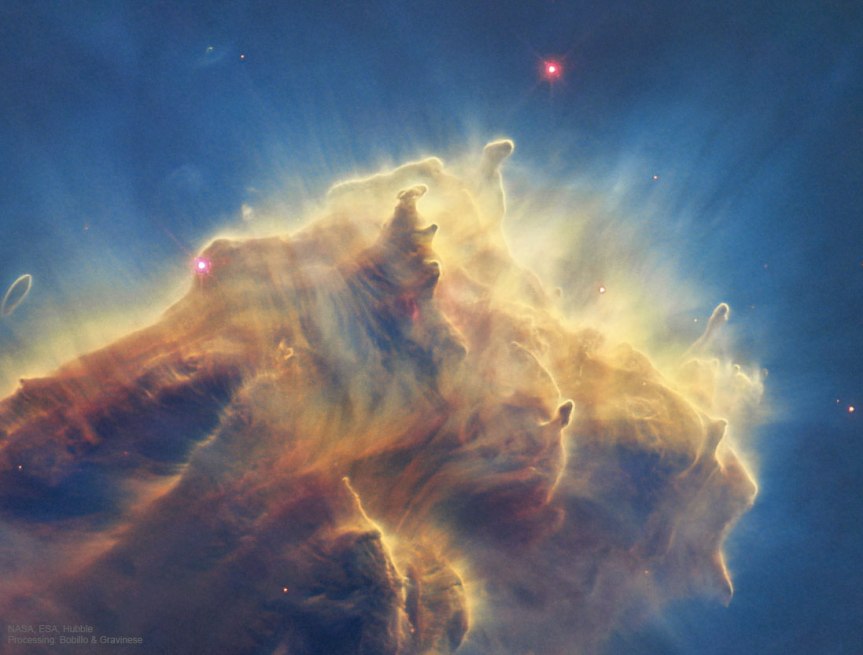
Star Formation in the Eagle Nebula

Image Credit: NASAESAHubbleProcessing & Copyright: Ignacio Diaz Bobillo & Diego Gravinese

Explanation: Where do stars form? One place, star forming regions known as “EGGs”, are being uncovered at the end of this giant pillar of gas and dust in the Eagle Nebula (M16). Short for evaporating gaseous globules, EGGs are dense regions of mostly molecular hydrogen gas that fragment and gravitationally collapse to form stars. Light from the hottest and brightest of these new stars heats the end of the pillar and causes further evaporation of gas and dust — revealing yet more EGGs and more young stars. This featured picture was created from exposures spanning over 30 hours with the Earth-orbiting Hubble Space Telescope in 2014, and digitally processed with modern software by experienced volunteers in Argentina. Newborn stars will gradually destroy their birth pillars over the next 100,000 years or so — if a supernova doesn’t destroy them first.
March 14 Astronomy Picture of the Day

Discover the cosmos! Each day a different image or photograph of our fascinating universe is featured, along with a brief explanation written by a professional astronomer.

2022 March 13

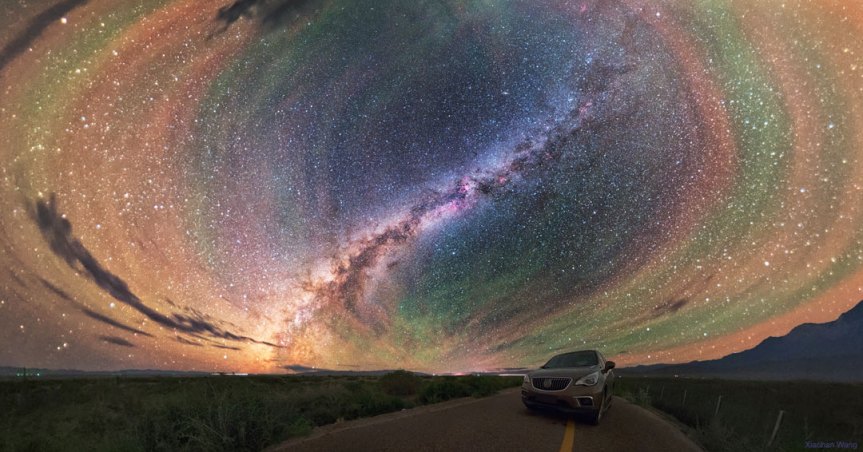
Colorful Airglow Bands Surround Milky Way

Image Credit & Copyright: Xiaohan Wang

Explanation: Why would the sky glow like a giant repeating rainbow? Airglow. Now air glows all of the time, but it is usually hard to see. A disturbance however — like an approaching storm — may cause noticeable rippling in the Earth’s atmosphere. These gravity waves are oscillations in air analogous to those created when a rock is thrown in calm water. Red airglow likely originates from OH molecules about 87-kilometers high, excited by ultraviolet light from the Sun, while orange and green airglow is likely caused by sodium and oxygen atoms slightly higher up. While driving near Keluke Lake in Qinghai Provence in China a few years ago, the photographer originally noticed mainly the impressive central band of the Milky Way Galaxy. Stopping to photograph it, surprisingly, the resulting sensitive camera image showed airglow bands to be quite prominent and span the entire sky. The featured image has been digitally enhanced to make the colors more vibrant.

March 12 Astronomy Picture of the Day

Discover the cosmos! Each day a different image or photograph of our fascinating universe is featured, along with a brief explanation written by a professional astronomer.

2022 March 12

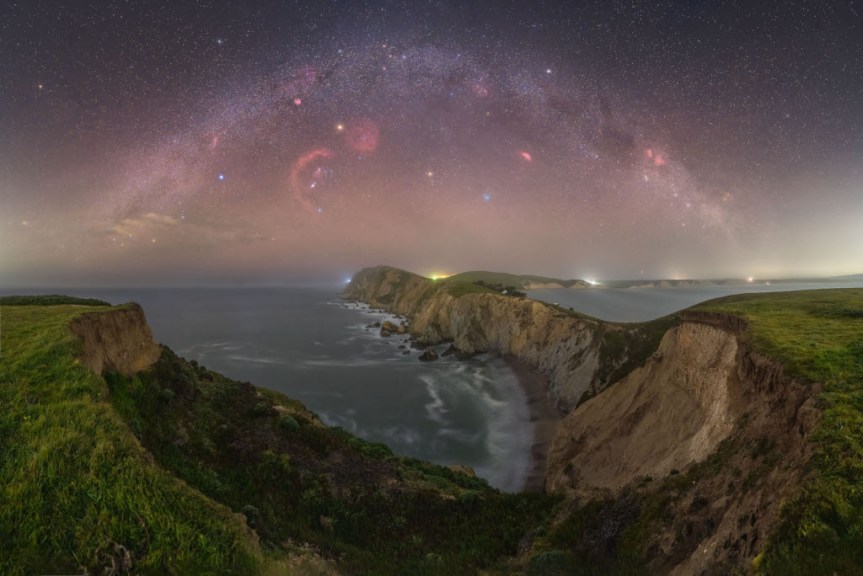
Point Reyes Milky Way

Image Credit & Copyright: Dan Zafra

Explanation: Northern winter constellations and a long arc of the Milky Way are setting in this night skyscape looking toward the Pacific Ocean from Point Reyes on planet Earth’s California coast. Sirius, alpha star of Canis Major, is prominent below the starry arc toward the left. Orion’s yellowish Betelgeuse, Aldebaran in Taurus, and the blue tinted Pleiades star cluster also find themselves between Milky Way and northwestern horizon near the center of the scene. The nebulae visible in the series of exposures used to construct this panoramic view were captured in early March, but are just too faint to be seen with the unaided eye. On that northern night their expansive glow includes the reddish semi-circle of Barnard’s Loop in Orion and NGC 1499 above and right of the Pleiades, also known as the California Nebula.

March 11 Astronomy Picture of the Day

Discover the cosmos! Each day a different image or photograph of our fascinating universe is featured, along with a brief explanation written by a professional astronomer.

2022 March 11

When Rainbows Smile

Image Credit & Copyright: Marcella Giulia Pace

Explanation: Want to see a rainbow smile? Look near the zenith (straight up) when the sun is low in the sky and you might. This example of an ice halo known as a circumzenithal arc was captured above a palm tree top from Ragusa, Sicily on February 24. The vividly colorful arcs are often called smiling rainbows because of their upside down curvature and colors. For circumzenithal arcs the zenith is at the center and red is on the outside, compared to rainbows whose arcs bend toward the horizon after a downpour. True rainbows are formed by water droplets refracting the sunlight to produce a spectrum of colors, though. Circumzenithal arcs are the product of refraction and reflection in flat hexagonal ice crystals, like the ice crystals that create sundogs, formed in high thin clouds.

March 10 Astronomy Picture of the Day

Discover the cosmos! Each day a different image or photograph of our fascinating universe is featured, along with a brief explanation written by a professional astronomer.

2022 March 10

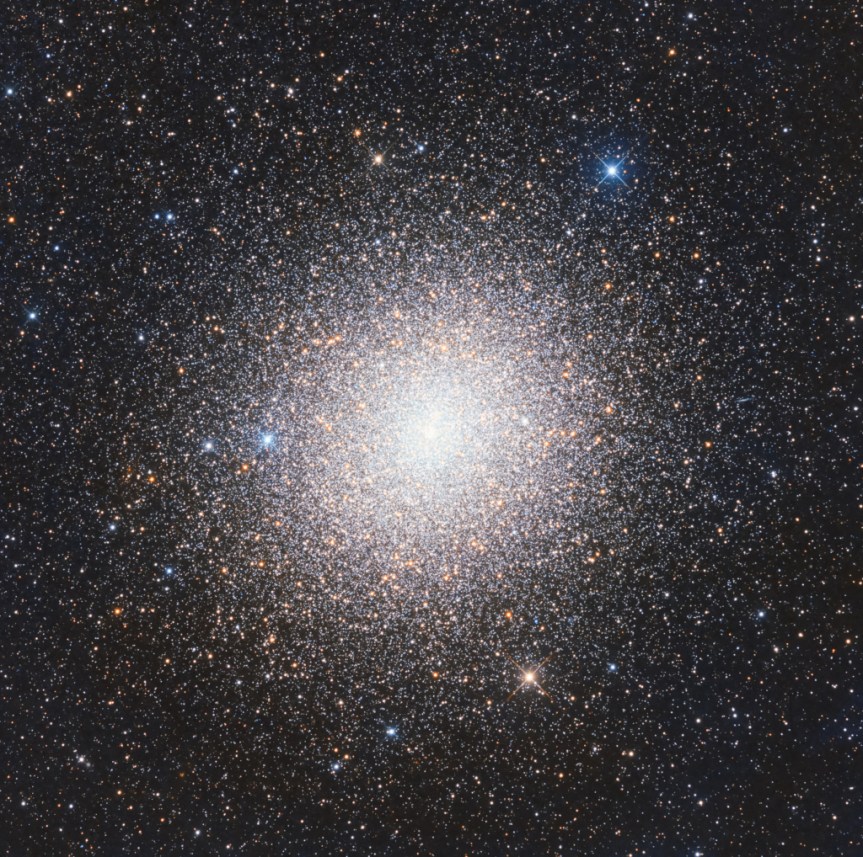
Globular Star Cluster 47 Tuc

Image Credit & Copyright: Bernard Miller

Explanation: Globular star cluster 47 Tucanae is a jewel of the southern sky. Also known as NGC 104, it roams the halo of our Milky Way Galaxy along with some 200 other globular star clusters. The second brightest globular cluster (after Omega Centauri) as seen from planet Earth, 47 Tuc lies about 13,000 light-years away. It can be spotted with the naked-eye close on the sky to the Small Magellanic Cloud in the constellation of the Toucan. The dense cluster is made up of hundreds of thousands of stars in a volume only about 120 light-years across. Red giant stars on the outskirts of the cluster are easy to pick out as yellowish stars in this sharp telescopic portrait. Tightly packed globular cluster 47 Tuc is also home to a star with the closest known orbit around a black hole.

March 9 Astronomy Picture of the Day

Discover the cosmos! Each day a different image or photograph of our fascinating universe is featured, along with a brief explanation written by a professional astronomer.

2022 March 9

A Flower-Shaped Rock on Mars

Image Credit: NASAJPL-CaltechMSSS

Explanation: It is one of the more unusual rocks yet found on Mars. Smaller than a penny, the rock has several appendages that make it look, to some, like a flower. Although it would be a major discovery if the rock was truly a fossilized ancient Martian flower, there are less spectacular — and currently preferred — explanations for its unusual structure. One theory that has emerged is that the rock is a type of concretion created by minerals deposited by water in cracks or divisions in existing rock. These concretions can be compacted together, can be harder and denser than surrounding rock, and can remain even after the surrounding rock erodes away. The flower structure may also be caused by crystal clusters. The small rock, named Blackthorn Salt, has similarities to previously imaged Martian pebbles. The featured image was taken by the Curiosity rover on Mars in late February. Scientists will continue to study data and images taken of this — and similar — surprising Martian rocks.


Review: Last Year in Space Pictures

March 8 Astronomy Picture of the Day

Discover the cosmos! Each day a different image or photograph of our fascinating universe is featured, along with a brief explanation written by a professional astronomer.

2022 March 8

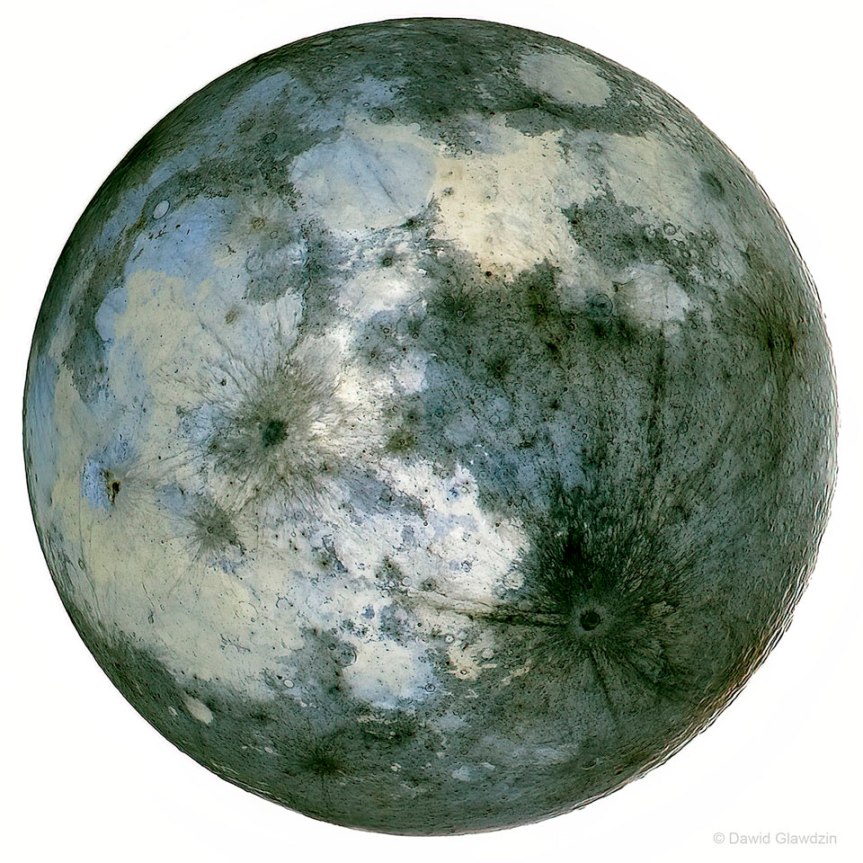
Moon in Inverted Colors

Image Credit & Copyright: Dawid Glawdzin

Explanation: Which moon is this? It’s Earth’s moon — but in inverted colors. Here, the pixel values corresponding to light and dark areas have been translated in reverse, or inverted, producing a false-color representation reminiscent of a black and white photographic negative. However, this is an inverted color image — where the muted colors of the moon are real but digitally exaggerated before inversion. Normally bright rays from the large crater Tycho dominate the southern (bottom) features as easily followed dark green lines emanating from the 85-kilometer diameter impact site. Normally dark lunar mare appear light and silvery. The image was acquired in Southend-on-SeaEnglandUK. Historically, astronomical images recorded on photographic plates were directly examined on inverted-color negatives because it helped the eye pick out faint details.

March 7 Astronomy Picture of the Day

Discover the cosmos! Each day a different image or photograph of our fascinating universe is featured, along with a brief explanation written by a professional astronomer.

2022 March 7

A Lion in Orion

Image Credit & Copyright: Maroun Mahfoud

Explanation: Yes, but can you see the lion? A deep exposure shows the famous dark indentation that looks like a horse’s head, visible just left and below center, and known unsurprisingly as the Horsehead Nebula. The Horsehead Nebula (Barnard 33) is part of a vast complex of dark absorbing dust and bright glowing gas. To bring out details of the Horsehead’s pasture, an astrophotographer artistically combined light accumulated for over 20 hours in hydrogen (orange), oxygen (blue), and sulfur (green). The resulting spectacular picture captured from RaachineLebanon, details an intricate tapestry of gaseous wisps and dust-laden filaments that were created and sculpted over eons by stellar winds and ancient supernovas. The featured composition brings up another pareidolic animal icon — that of a lion’s head — in the expansive orange colored gas above the horse’s head. The Flame Nebula is visible just to the left of the Horsehead. The Horsehead Nebula lies 1,500 light years distant towards the constellation of Orion.

March 6 Astronomy Picture of the Day

Discover the cosmos! Each day a different image or photograph of our fascinating universe is featured, along with a brief explanation written by a professional astronomer.

2022 March 6

Venus and the Triply Ultraviolet Sun

Image Credit: NASA/SDO & the AIA, EVE, and HMI teams; Digital Composition: Peter L. Dove

Explanation: This was a very unusual type of solar eclipse. Typically, it is the Earth’s Moon that eclipses the Sun. In 2012, though, the planet Venus took a turn. Like a solar eclipse by the Moon, the phase of Venus became a continually thinner crescent as Venus became increasingly better aligned with the Sun. Eventually the alignment became perfect and the phase of Venus dropped to zero. The dark spot of Venus crossed our parent star. The situation could technically be labeled a Venusian annular eclipse with an extraordinarily large ring of firePictured here during the occultation, the Sun was imaged in three colors of ultraviolet light by the Earth-orbiting Solar Dynamics Observatory, with the dark region toward the right corresponding to a coronal hole. Hours later, as Venus continued in its orbit, a slight crescent phase appeared again. The next Venusian transit across the Sun will occur in 2117.

March 5 Astronomy Picture of the Day

Discover the cosmos! Each day a different image or photograph of our fascinating universe is featured, along with a brief explanation written by a professional astronomer.

2022 March 5

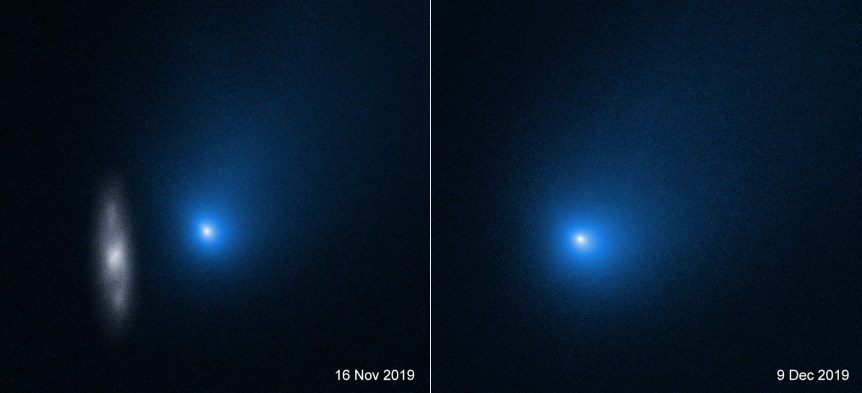
Interstellar Comet 2I Borisov

These two images, taken by NASA’s Hubble Space Telescope, capture comet 2I/Borisov streaking though our solar system and on its way back to interstellar space. It is only the second interstellar object known to have passed through the solar system.
“Hubble gives us the best upper limit of the size of comet Borisov’s nucleus, which is the really important part of the comet,” said David Jewitt, a UCLA professor of planetary science and astronomy, whose team has captured the best and sharpest look at this first confirmed interstellar comet. “Surprisingly, our Hubble images show that its nucleus is more than 15 times smaller than earlier investigations suggested it might be. Our Hubble images show that it is smaller than half-a-kilometer. Knowing the size is potentially useful for beginning to estimate how common such objects may be in the solar system and our galaxy. Borisov is the first known interstellar comet, and we would like to learn how many others there are.”
Crimean amateur astronomer Gennady Borisov discovered the comet on August 30, 2019, and reported the position measurements to the International Astronomical Union’s Minor Planet Center in Cambridge, Massachusetts. The Center for Near-Earth Object Studies at the Jet Propulsion Laboratory, working with the Minor Planet Center, computed an orbit for the comet which shows that it came from elsewhere in our Milky Way galaxy, point of origin unknown.
Nevertheless, observations by numerous telescopes show that the comet’s chemical composition is similar to the comets found inside our solar system, providing evidence that comets also form around other stars. By the middle of 2020 the comet will have already zoomed past Jupiter’s distance of 500 million miles on its way back into the frozen abyss of interstellar space.
[left] November 16, 2019 photo
The comet appears in front of a distant background spiral galaxy (2MASX J10500165-0152029). The galaxy’s bright central core is smeared in the image because Hubble was tracking the comet. Comet Borisov was approximately 203 million miles from Earth in this exposure. Its tail of ejected dust streaks off to the upper right.
[right] December 9, 2019 photo
Hubble revisited the comet shortly after its closest approach to the Sun where it received maximum heating after spending most of its life in frigid interstellar space. The comet is 185 million miles from Earth in this photo, near the inner edge of the asteroid belt but below it. The nucleus, an agglomeration of ices and dust, is still too small to be resolved. The bright central portion is a coma made up of dust leaving the surface. The comet will make its closest approach to Earth in late December at a distance of 180 million miles.
The Hubble Space Telescope is a project of international cooperation between the European Space Agency (ESA) and NASA. NASA’s Goddard Space Flight Center in Greenbelt, Maryland, manages the telescope. The Space Telescope Science Institute (STScI) in Baltimore, Maryland, conducts Hubble science operations. STScI is operated for NASA by the Association of Universities for Research in Astronomy in Washington, D.C. The Minor Planet Center and the Center for Near-Earth Orbit Studies are projects of NASA’s Near-Earth Object Observations Program of the Planetary Defense Coordination Office at NASA Headquarters.

NASAESA, and D. Jewitt (UCLA) et al.

Explanation: From somewhere else in the Milky Way galaxy, Comet 2I/Borisov was just visiting the Solar System. Discovered by amateur astronomer Gennady Borisov on August 30, 2019, the first known interstellar comet is seen in these two Hubble Space Telescope images from November and December 2019. On the left, a distant background galaxy near the line-of-sight to Borisov is blurred as Hubble tracked the speeding comet and dust tail about 327 million kilometers from Earth. At right, 2I/Borisov appears shortly after perihelion, its closest approach to Sun. European Southern Observatory observations indicate that this comet may never have passed close to any star before its 2019 perihelion passage. Borisov’s closest approach to our fair planet, a distance of about 290 million kilometers, came on December 28, 2019. Even though Hubble’s sharp images don’t resolve the comet’s nucleus, they did lead to estimates of less than 1 kilometer for its diameter.

March 4 Astronomy Picture of the Day

Discover the cosmos! Each day a different image or photograph of our fascinating universe is featured, along with a brief explanation written by a professional astronomer.

2022 March 4

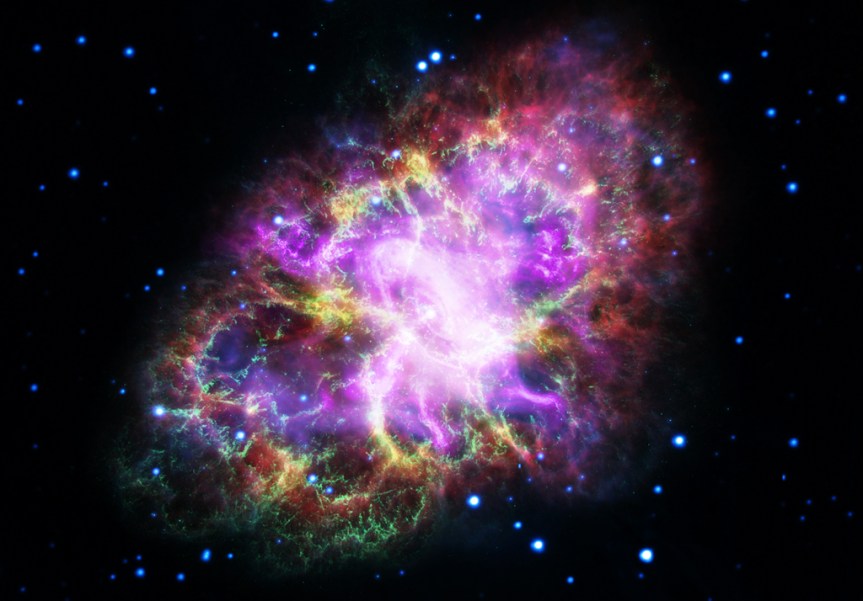
The Multiwavelength Crab

NASAESAG. Dubner (IAFE, CONICET-University of Buenos Aires) et al.;
A. Loll et al.; T. Temim et al.; F. Seward et al.; VLA/NRAO/AUI/NSF; Chandra/CXC;
Spitzer/JPL-Caltech; XMM-Newton/ESA; Hubble/STScI

Explanation: The Crab Nebula is cataloged as M1, the first object on Charles Messier’s famous list of things which are not comets. In fact, the Crab is now known to be a supernova remnant, expanding debris from massive star’s death explosion, witnessed on planet Earth in 1054 AD. This brave new image offers a 21st century view of the Crab Nebula by presenting image data from across the electromagnetic spectrum as wavelengths of visible light. From space, Chandra (X-ray) XMM-Newton (ultraviolet), Hubble (visible), and Spitzer (infrared), data are in purple, blue, green, and yellow hues. From the ground, Very Large Array radio wavelength data is shown in red. One of the most exotic objects known to modern astronomers, the Crab Pulsar, a neutron star spinning 30 times a second, is the bright spot near picture center. Like a cosmic dynamo, this collapsed remnant of the stellar core powers the Crab’s emission across the electromagnetic spectrum. Spanning about 12 light-years, the Crab Nebula is 6,500 light-years away in the constellation Taurus.

March 3 Astronomy Picture of the Day

Discover the cosmos! Each day a different image or photograph of our fascinating universe is featured, along with a brief explanation written by a professional astronomer.

2022 March 3

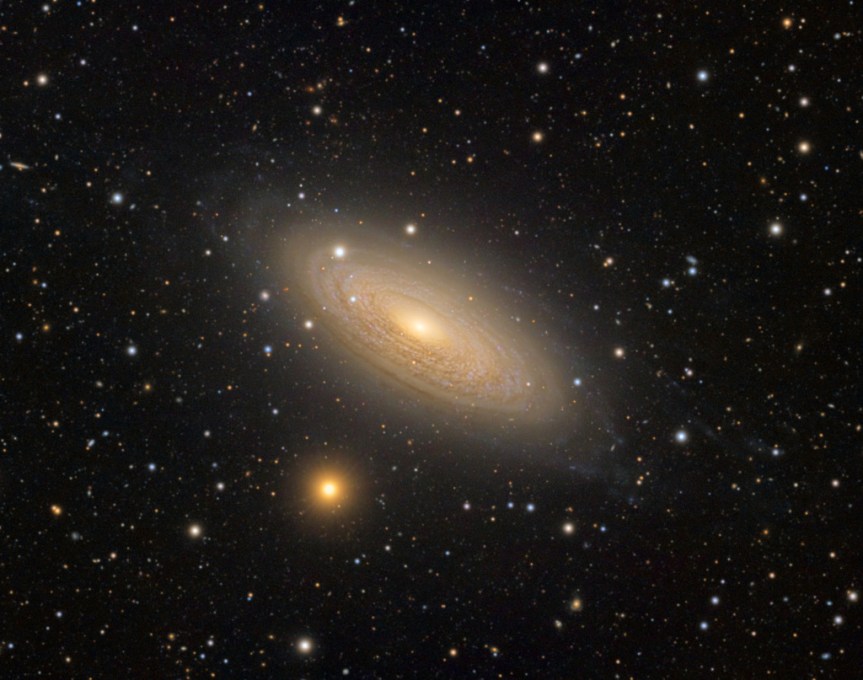
Spiral Galaxy NGC 2841

Image Credit & CopyrightVitali Pelenjow

Explanation: A mere 46 million light-years distant, spiral galaxy NGC 2841 can be found in the northern constellation of Ursa MajorThis deep view of the gorgeous island universe was captured during 32 clear nights in November, December 2021 and January 2022. It shows off a striking yellow nucleus, galactic disk, and faint outer regions. Dust lanes, small star-forming regions, and young star clusters are embedded in the patchy, tightly wound spiral arms. In contrast, many other spirals exhibit grand, sweeping arms with large star-forming regions. NGC 2841 has a diameter of over 150,000 light-years, even larger than our own Milky Way. X-ray images suggest that resulting winds and stellar explosions create plumes of hot gas extending into a halo around NGC 2841.

March 2 Astronomy Picture of the Day

Discover the cosmos! Each day a different image or photograph of our fascinating universe is featured, along with a brief explanation written by a professional astronomer.

2022 March 2

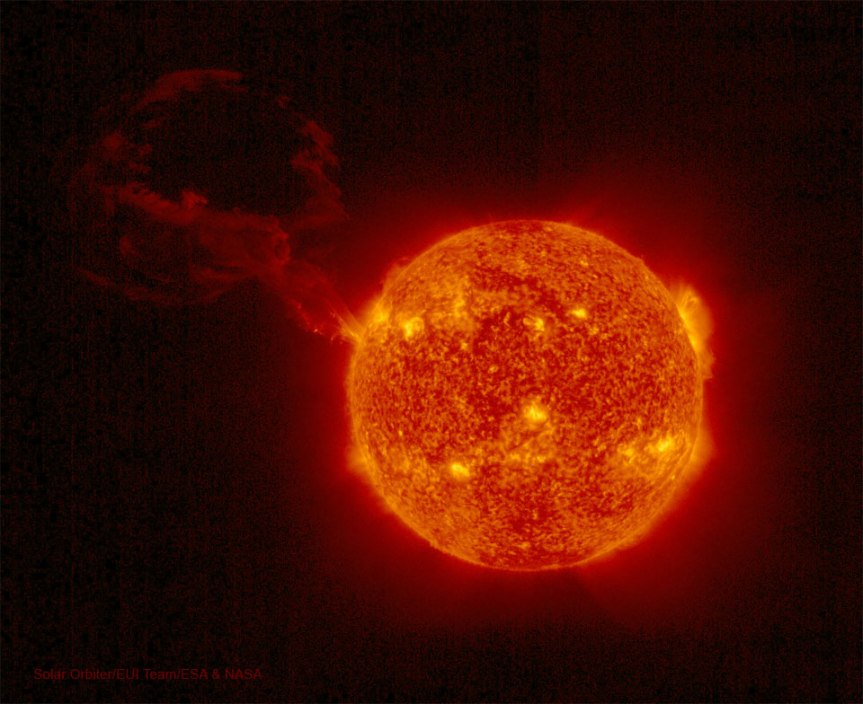
Record Prominence Imaged by Solar Orbiter

Image Credit: Solar OrbiterEUI TeamESA & NASAh/tBum-Suk Yeom

Explanation: What’s happened to our Sun? Last month, it produced the largest prominence ever imaged together with a complete solar disk. The record image, featured, was captured in ultraviolet light by the Sun-orbiting Solar Orbiter spacecraft. A quiescent solar prominence is a cloud of hot gas held above the Sun’s surface by the Sun’s magnetic field. This solar prominence was huge — spanning a length rivaling the diameter of the Sun itself. Solar prominences may erupt unpredictably and expel hot gas into the Solar System via a Coronal Mass Ejection (CME). When a CME strikes the Earth and its magnetosphere, bright auroras may occur. This prominence did produce a CME, but it was directed well away from the Earth. Although surely related to the Sun’s changing magnetic field, the energy mechanism that creates and sustains a solar prominence remains a topic of research.

March 1 Astronomy Picture of the Day

Discover the cosmos! Each day a different image or photograph of our fascinating universe is featured, along with a brief explanation written by a professional astronomer.

2022 March 1

Dueling Bands in the Night

Image Credit & Copyright: Jeff Dai (TWAN)

Explanation: What are these two bands in the sky? The more commonly seen band is the one on the right and is the central band of our Milky Way galaxy. Our Sun orbits in the disk of this spiral galaxy, so that from inside, this disk appears as a band of comparable brightness all the way around the sky. The Milky Way band can also be seen all year — if out away from city lights. The less commonly seem band, on the left, is zodiacal light — sunlight reflected from dust orbiting the Sun in our Solar System. Zodiacal light is brightest near the Sun and so is best seen just before sunrise or just after sunset. On some evenings in the north, particularly during the months of March and April, this ribbon of zodiacal light can appear quite prominent after sunset. It was determined only this century that zodiacal dust was mostly expelled by comets that have passed near Jupiter. Only on certain times of the year will the two bands be seen side by side, in parts of the sky, like this. The featured image, including the Andromeda galaxy and a meteor, was captured in late January over a frozen lake in KandingSichuanChina.

February 28 Astronomy Picture of the Day

Discover the cosmos! Each day a different image or photograph of our fascinating universe is featured, along with a brief explanation written by a professional astronomer.

2022 February 28

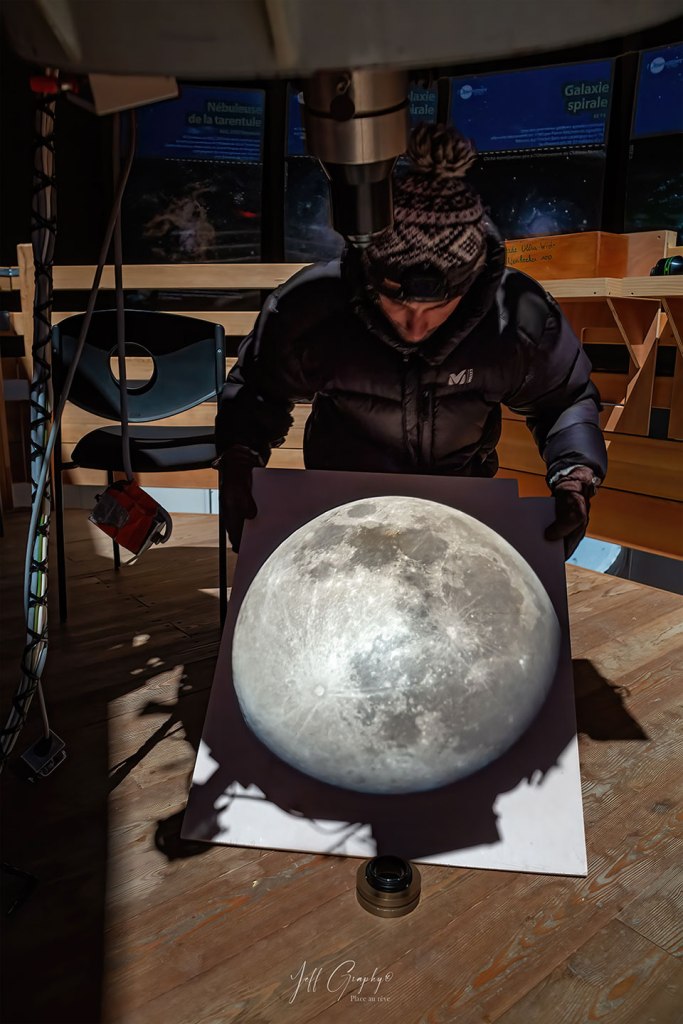
Direct Projection: The Moon in My Hands

Image Credit & Copyright: Jeff Graphy

Explanation: You don’t have to look through a telescope to know where it’s pointing. Allowing the telescope to project its image onto a large surface can be useful because it dilutes the intense brightness of very bright sources. Such dilution is useful for looking at the Sun, for example during a solar eclipse. In the featured single-exposure image, though, it is a too-bright full moon that is projected. This February full moon occurred two weeks ago and is called the Snow Moon by some northern cultures. The projecting instrument is the main 62-centimeter telescope at the Saint-Véran Observatory high in the French Alps. Seeing a full moon directly is easier because it is not too bright, although you won’t see this level of detail. Your next chance will occur on March 17.

February 25 Astronomy Picture of the Day

Discover the cosmos! Each day a different image or photograph of our fascinating universe is featured, along with a brief explanation written by a professional astronomer.

2022 February 25

Perseverance Sol 354

Image Credit: NASAJPL-CaltechProcessingKenneth Kremer

Explanation: This Navcam mosaic from Perseverance looks out over the car-sized rover’s deck, across the floor of Jezero crater on Mars. Frames used to construct the mosaic view were captured on mission sol 354. That corresponds to Earth calendar date February 17, 2022, nearly one Earth year after the rover’s landing. With a mass of over 1,000 kilograms, six-wheeled Perseverance is the heaviest rover to touch down on Mars. During its first year of exploration the rover has collected six (so far) rock core samples for later return to planet Earth, served as the base station for Ingenuity, the first helicopter on Mars, and tested MOXIE (Mars Oxygen In-Situ Resource Utilization Experiment), converting some of the Red Planet’s thin, carbon dioxide-rich atmosphere into oxygen.

February 24 Astronomy Picture of the Day

Discover the cosmos! Each day a different image or photograph of our fascinating universe is featured, along with a brief explanation written by a professional astronomer.

2022 February 24

Beautiful Albireo AB

Image Credit & CopyrightRobert Eder

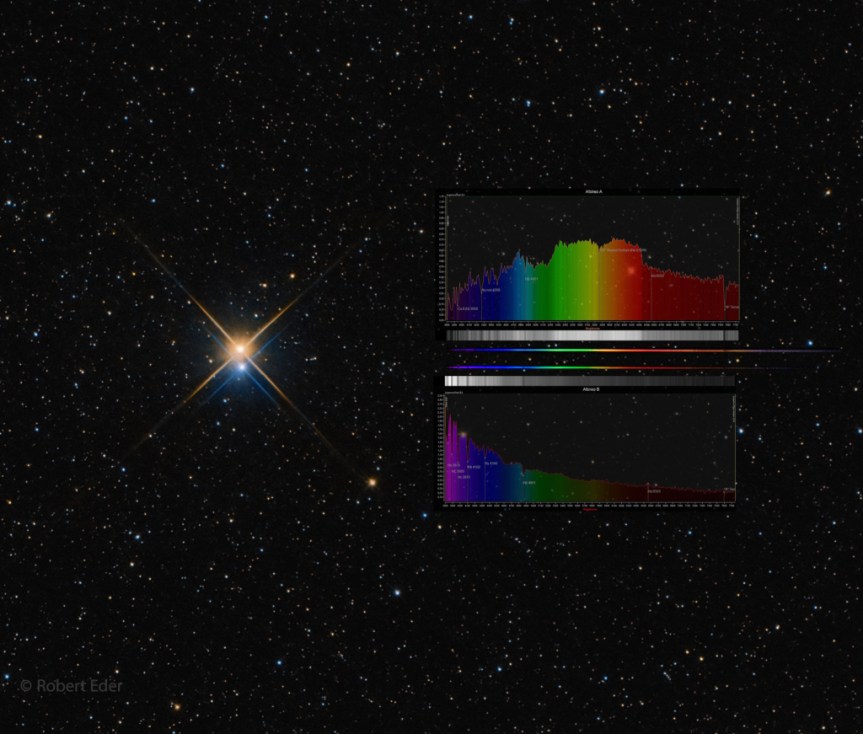
Explanation: Beta Cygni is a single bright star to the naked eye. About 420 light-years away it marks the foot of the Northern Cross, famous asterism in the constellation Cygnus. But a view through the eyepiece of a small telescope will transform it into a beautiful double star, a treasure of the night sky in blue and gold. Beta Cygni is also known as Albireo, designated Albireo AB to indicate its two bright component stars. Their visually striking color difference is illustrated in this telescopic snapshot, along with their associated visible spectrum of starlight shown in insets to the right. Albireo A, top inset, shows the spectrum of a K-type giant star, cooler than the Sun and emitting most of its energy at yellow and red wavelengths. Below, Albireo B has the spectrum of a main sequence star much hotter than the Sun, emitting more energy in blue and violet. Albireo A is known to be a binary star, two stars together orbiting a common center of mass, though the two stars are too close together to be seen separately with a small telescope. Well-separated Albireo A and B most likely represent an optical double star and not a physical binary system because the two components have clearly different measured motions through space.

February 23 Astronomy Picture of the Day

Discover the cosmos! Each day a different image or photograph of our fascinating universe is featured, along with a brief explanation written by a professional astronomer.

2022 February 23

Orion over Green Bank

Image Credit & Copyright: Dave Green

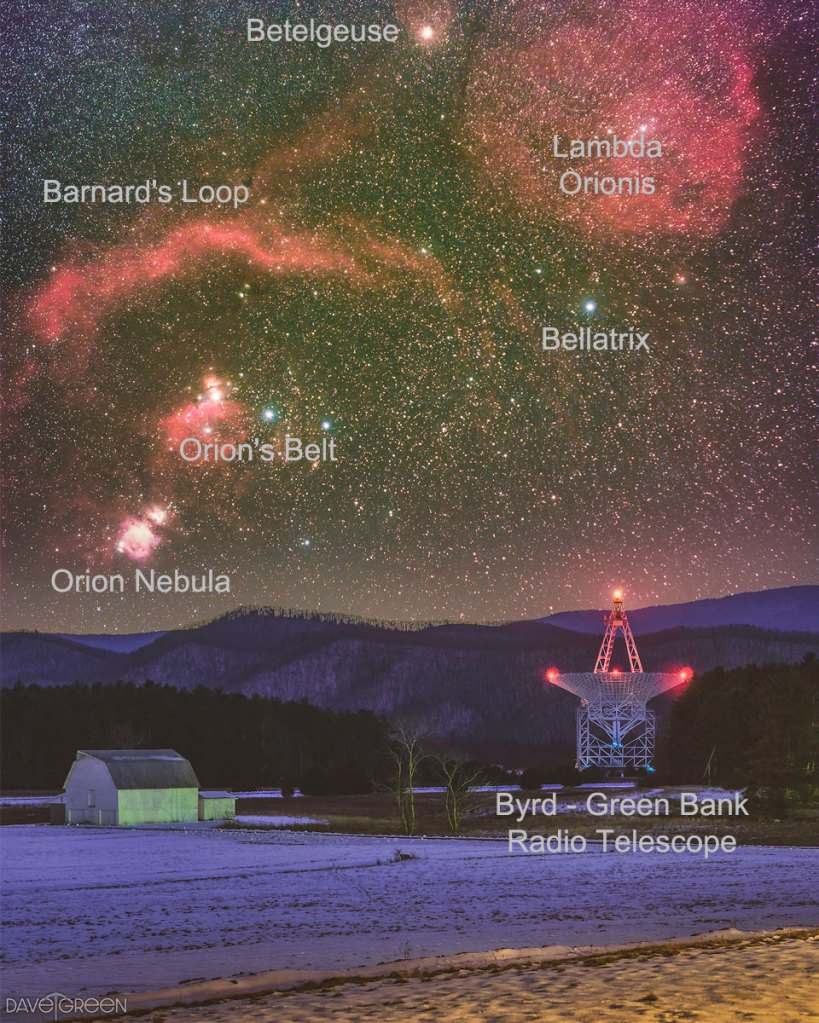
Explanation: What will the huge Green Bank Telescope discover tonight? Pictured, the Robert C. Byrd Green Bank Telescope (GBT) on the lower right is the largest fully-pointable single-dish radio telescope in the world. With a central dish larger than a football field, the GBT is nestled in the hills of West VirginiaUSA in a radio quiet zone where the use of cell phones, WiFi emitters, and even microwave ovens are limited. The GBT explores our universe not only during the night — but during the day, too, since the daytime sky is typically dark in radio waves. Taken in late January, the featured image was planned for months to get the setting location of Orion just right. The image is a composite of a foreground shot taken over a kilometer away from the GBT, and a background shot built up of long exposures during the previous night. The deep background image of Orion is fitting because the GBT is famous for, among many discoveries, mapping the unusual magnetic field in the Orion Molecular Cloud Complex.

February 20 Astronomy Picture of the Day

Discover the cosmos! Each day a different image or photograph of our fascinating universe is featured, along with a brief explanation written by a professional astronomer.

2022 February 20

Aurora Over White Dome Geyser

Image Credit & Copyright: Robert Howell

Explanation: Sometimes both heaven and Earth erupt. Colorful auroras erupted unexpectedly a few years ago, with green aurora appearing near the horizon and brilliant bands of red aurora blooming high overhead. A bright Moon lit the foreground of this picturesque scene, while familiar stars could be seen far in the distance. With planning, the careful astrophotographer shot this image mosaic in the field of White Dome Geyser in Yellowstone National Park in the western USA. Sure enough, just after midnight, White Dome erupted — spraying a stream of water and vapor many meters into the air. Geyser water is heated to steam by scalding magma several kilometers below, and rises through rock cracks to the surface. About half of all known geysers occur in Yellowstone National Park. Although the geomagnetic storm that caused the auroras subsided within a day, eruptions of White Dome Geyser continue about every 30 minutes.

February 19 Astronomy Picture of the Day

Discover the cosmos! Each day a different image or photograph of our fascinating universe is featured, along with a brief explanation written by a professional astronomer.

2022 February 19

Peculiar Galaxies of Arp 273

Image Credit & CopyrightJason Guenzel

Explanation: The spiky stars in the foreground of this backyard telescopic frame are well within our own Milky Way Galaxy. But the two eye-catching galaxies lie far beyond the Milky Way, at a distance of over 300 million light-years. Their distorted appearance is due to gravitational tides as the pair engage in close encounters. Cataloged as Arp 273 (also as UGC 1810), the galaxies do look peculiar, but interacting galaxies are now understood to be common in the universe. Nearby, the large spiral Andromeda Galaxy is known to be some 2 million light-years away and approaching the Milky Way. The peculiar galaxies of Arp 273 may offer an analog of their far future encounter. Repeated galaxy encounters on a cosmic timescale can ultimately result in a merger into a single galaxy of stars. From our perspective, the bright cores of the Arp 273 galaxies are separated by only a little over 100,000 light-years.