
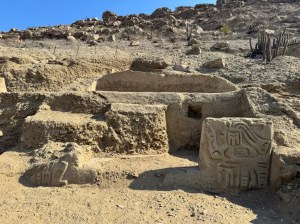
Archaeologists in Peru have unearthed the remains of what they believe are a 4,000-year-old temple and theater, shining a new light on the origins of complex religions in the region.
The team began studying the new archaeological site of La Otra Banda, Cerro Las Animas, in June. Last year, the local government alerted them to looting that had been taking place near the northern Peruvian town of Zaña, according to a press release from the Field Museum in Chicago, Illinois, Wednesday.
They excavated a plot roughly 33 feet long and 33 feet wide, finding signs of ancient walls made of mud and clay at just six feet deep.
“It was so surprising that these very ancient structures were so close to the modern surface,” Luis Muro Ynoñán, a research scientist at the Field Museum who led the team, said in the release.
After digging deeper, archaeologists found “one section” of a large temple, Muro Ynoñán said, adding that “one of the most exciting” finds was a small theater “with a backstage area and a staircase that led to a stage-like platform.”
“This could have been used to perform ritual performances in front of a selected audience,” he added
One of the theater’s staircases was flanked by mud panels with an elaborate carved design of a mythological bird-like creature, according to the release. The figure resembled other images of mythological creatures dating to the Initial Period, around 2,000 to 900 BC, giving clues to when the temple was built.
“The Initial Period is important because it’s when we first start to see evidence of an institutionalized religion in Peru,” Muro Ynoñan said, adding that Please click here to read the rest of this article
 Witches Of The Craft®
You must be logged in to post a comment.